
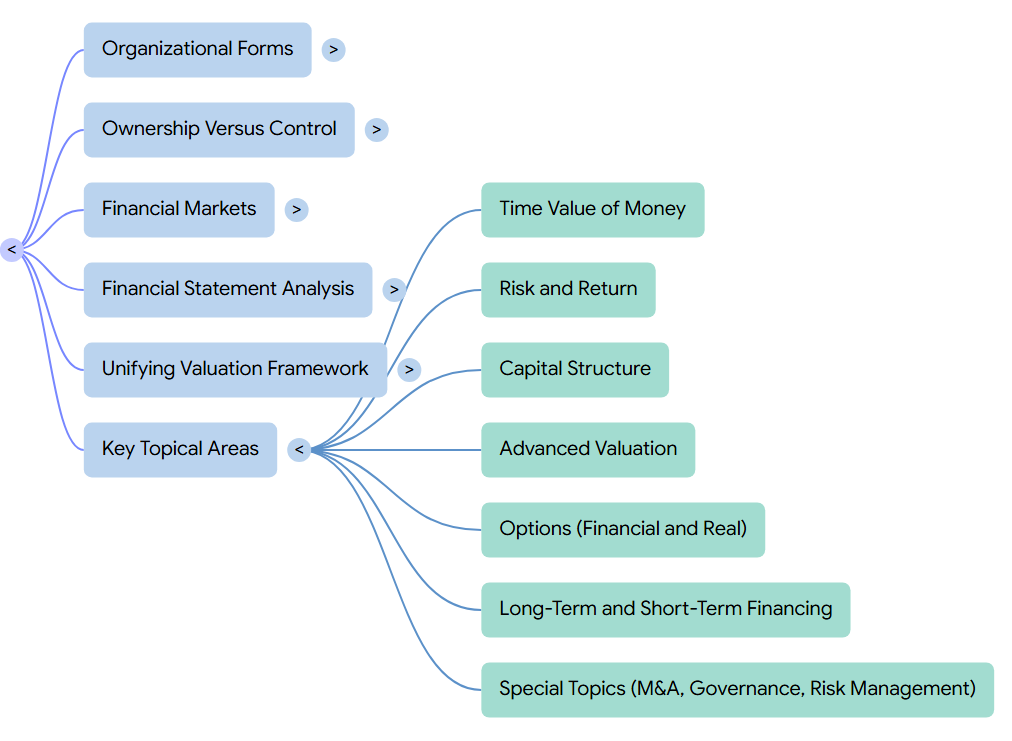
In corporate finance, the key topical areas are organized into ten comprehensive parts designed to transition from theoretical foundations to practical financial management.
Foundations and Valuation Principles
- Introduction and Framework: Part 1 introduces the corporate organizational form and establishes the Law of One Price and the absence of arbitrage as the unifying valuation framework that serves as the “backbone” of the entire text.
- Time, Money, and Interest Rates: Part 2 develops the fundamental mechanics of the time value of money, explores the determinants of interest rates, and applies these principles to the valuation of bonds.
- Valuing Projects and Firms: Part 3 focuses on identifying value-adding investments through the Net Present Value (NPV) rule and the essentials of capital budgeting and stock valuation.
Risk, Capital Structure, and Payout Policy
- Risk and Return: Part 4 quantifies the relationship between risk and return, introducing the Capital Asset Pricing Model (CAPM) and methods for estimating a firm’s cost of capital.
- Capital Structure: Part 5 analyzes how a firm should choose its mix of debt and equity financing, examining the impact of taxes, financial distress costs, and managerial incentives on firm value.
- Payout Policy: Also within Part 5, the text considers how and how much cash a firm should return to its shareholders through dividends or share repurchases.
Advanced Valuation and Specialized Tools
- Advanced Valuation: Part 6 provides an in-depth exploration of the three main methods for capital budgeting with leverage: the Weighted Average Cost of Capital (WACC), Adjusted Present Value (APV), and Flow-to-Equity (FTE) methods.
- Options: Part 7 introduces financial options and real options, demonstrating how they can be used to manage risk and value flexible investment opportunities.
Financing and Strategic Management
- Long-Term Financing: Part 8 details the mechanics of raising equity capital (IPOs and SEOs), debt financing (public and private), and leasing as an alternative form of levered financing.
- Short-Term Financing: Part 9 addresses the day-to-day management of a firm’s cash flows, focusing on working capital management and short-term financial planning.
- Special Topics: Part 10 concludes the study by covering specialized areas such as mergers and acquisitions, corporate governance, enterprise risk management, and the complexities of international corporate finance.
Time Value of Money
In corporate finance, the time value of money (TVM) is a foundational concept defined as the difference in value between money today and money in the future. This concept is built upon the fundamental premise that a dollar today is worth more than a dollar tomorrow because money available now can be invested to earn interest. In the larger context of corporate finance, TVM serves as a central pillar of the “Unifying Valuation Framework,” linking various topical areas through the application of the Law of One Price.
Mechanics and Rules of Time Travel
The practical application of the time value of money is governed by three specific “rules of time travel”:
- Rule 1: Only values at the same point in time can be compared or combined.
- Rule 2: To move a cash flow forward in time, it must be compounded by multiplying it by an interest rate factor .
- Rule 3: To move a cash flow backward in time, it must be discounted by dividing it by an interest rate factor, a process known as finding its present value.
These mechanics allow financial managers to use timelines to organize cash flows and convert them into common units—typically present-day dollars—to make valid comparisons.
Valuation of Projects and Firms
TVM is the “workhorse concept” that enables the valuation of diverse assets and investments across several key topical areas:
- Net Present Value (NPV): The “golden rule” of financial decision-making uses TVM to assess a project’s benefits and costs by summing their present values.
- Bond Valuation: Bond prices are determined by calculating the present value of promised future interest payments (coupons) and the final principal repayment.
- Stock Valuation: The value of a share of stock is modeled as the present value of all expected future dividends, recognizing that while stocks may have no maturity date, the value of distant cash flows diminishes over time.
- Capital Budgeting: TVM is essential for distinguishing between accounting earnings and actual cash flows, ensuring that investment decisions are based on the timing and magnitude of cash generated.
Interest Rates, Inflation, and Risk
Within the study of interest rates, corporate finance explains that interest acts as an “exchange rate across time,” indicating the market price today for money in the future. This rate is influenced by several factors:
- Determinants: Interest rates are shaped by government policy, market supply and demand, and inflation expectations.
- Nominal vs. Real Rates: Nominal rates indicate the growth of money, while real interest rates represent the growth in actual purchasing power after adjusting for inflation.
- Risk Premium: When cash flows are uncertain, TVM principles require the use of a discount rate that includes a risk premium to compensate investors for the level of risk they are bearing.
Ultimately, the time value of money provides the consistent methodology that allows corporate finance to bridge the gap between theoretical valuation principles and practical financial management.
Risk and Return
In corporate finance, the relationship between risk and return is identified as a critical topical area that transitions from the fundamental mechanics of the time value of money to the determination of a project’s cost of capital. Organized primarily in Part 4 of the text, this area establishes the theoretical and empirical foundations for understanding how investors perceive and are compensated for risk in financial markets.
Measuring Risk and Return
The performance of an investment is expressed through its return, which represents the percentage increase in value per dollar initially invested. When an investment is risky, practitioners utilize a probability distribution to summarize possible outcomes and their likelihood.
- Expected Return: This is the mean or “balancing point” of the return distribution, representing what an investor earns on average.
- Variance and Standard Deviation: These metrics quantify the variability or “spread” of the returns. In corporate finance, the standard deviation of a return is referred to as its volatility.
Historical Evidence: 96 Years of Investor History
Historical data spanning from 1926 to 2021 provides compelling evidence of the tradeoff between risk and return. While stocks have historically outperformed bonds and Treasury bills, they have also endured periods of significant losses and higher variability. For instance, small stocks achieved the highest long-term returns but also exhibited the most variable performance. This history demonstrates that risk-averse investors demand a “risk premium”—an excess return over the risk-free rate—to bear the uncertainty associated with risky assets.
The Role of Diversification
A central insight in corporate finance is that not all risk is rewarded with a risk premium. The total risk of a security is composed of two distinct parts:
- Firm-Specific (Diversifiable) Risk: Also called idiosyncratic risk, this stems from news unique to a specific company. By holding a large portfolio of many different investments, investors can eliminate this risk through diversification—the “free lunch” of finance.
- Systematic (Undiversifiable) Risk: Also known as market risk, this arises from market-wide news that affects all stocks simultaneously. This risk cannot be eliminated through diversification.
Because firm-specific risk can be removed for free, corporate finance emphasizes that investors only demand compensation for bearing systematic risk.
The Capital Asset Pricing Model (CAPM)
The topical area of risk and return culminates in the Capital Asset Pricing Model (CAPM), which quantifies the relationship between systematic risk and the required return.
- The Market Portfolio: Under the CAPM, the “efficient portfolio” is assumed to be the market portfolio, containing all stocks and securities in the market.
- Beta (): Systematic risk is measured by beta, which represents the sensitivity of a security’s return to the fluctuations of the overall market. A 1% change in the market’s return is expected to lead to a percent change in the individual security’s return.
- The CAPM Equation: The required return for an investment is calculated as the risk-free interest rate plus a risk premium proportional to the investment’s beta: .
- Security Market Line (SML): This line graphs the linear relationship predicted by the CAPM, through which all individual securities should lie when plotted by their expected return and beta.
Ultimately, this topical area provides managers with the tools to estimate the cost of capital, ensuring that investment decisions are commensurate with the level of market risk being undertaken.
Capital Structure
In corporate finance, capital structure is defined as the relative proportions of debt, equity, and other securities that a firm has outstanding. Within the ten comprehensive parts of the text, capital structure occupies Part 5, serving as the critical bridge between the theoretical foundations of risk and return and the practical application of advanced valuation techniques.
The Theoretical Benchmark: Perfect Capital Markets
The study of capital structure begins with the Modigliani-Miller (MM) Propositions, which operate in a setting of perfect capital markets where there are no taxes, transaction costs, or information differences.
- MM Proposition I (Value Irrelevance): Grounded in the Law of One Price, this proposition states that the total value of a firm is determined by the cash flows generated by its underlying assets and is independent of its choice of capital structure.
- MM Proposition II (Cost of Equity): While leverage does not change firm value in a perfect market, it does increase the risk and required return of the firm’s equity. The benefit of “cheap” debt is exactly offset by the higher premium equity holders demand for bearing increased financial risk.
- Conservation of Value: Ultimately, these results imply a “conservation of value” principle where financial transactions in perfect markets represent a repackaging of risk and return rather than the creation of new wealth.
Real-World Imperfections: Taxes and Distress
Once the perfect market assumptions are relaxed, capital structure becomes a primary driver of firm value through various market frictions.
- The Interest Tax Shield: Because interest payments are tax-deductible, debt financing provides a corporate tax benefit known as the interest tax shield, which increases the total income available to all investors.
- Weighted Average Cost of Capital (WACC): In the presence of taxes, a firm’s after-tax WACC declines as leverage increases because of the tax-deductibility of interest.
- Financial Distress Costs: High levels of debt increase the probability of default and bankruptcy, which impose both direct costs (legal and administrative fees) and indirect costs (loss of customers, suppliers, and key employees).
Agency Conflicts and Information
Corporate finance identifies further nuances in capital structure through the lens of human behavior and information gaps.
- Tradeoff Theory: This theory suggests that managers choose an optimal debt level by balancing the tax benefits of leverage against the present value of financial distress costs.
- Agency Costs and Benefits: Leverage can create conflicts where shareholders are tempted to “gamble” with debt holders’ money (asset substitution) or forgo positive-NPV projects (debt overhang). Conversely, debt can provide discipline by forcing managers to disgorge “free cash flow” rather than wasting it on corporate perks or inefficient investments.
- Pecking Order Hypothesis: Due to asymmetric information, managers prefer to fund investments first with internal cash, then with debt, and only as a last resort with equity, which investors often interpret as a signal of overvaluation.
Integration with Other Topical Areas
Capital structure is intrinsically linked to other major areas in the Sixth Edition of Corporate Finance:
- Valuation: The “market value balance sheet” is used to show how leverage alters the division of firm value across different securities.
- Options: Equity is modeled as a call option on the firm’s assets, providing a quantitative framework for understanding agency conflicts and the pricing of risky debt.
- Payout Policy: The choice to return cash to shareholders through dividends or repurchases is evaluated alongside capital structure to determine the most efficient distribution strategy.
- Leasing: Leasing is analyzed as an alternative form of levered financing, where its benefits are derived from tax differentials or other market imperfections.
Advanced Valuation
In corporate finance, the topical area of Advanced Valuation, organized in Part 6, serves as the culmination of the principles developed in the first five parts of the text, integrating risk, return, and capital structure into a comprehensive capital budgeting framework. While earlier sections focus on all-equity financed projects, Advanced Valuation addresses how financing decisions and market imperfections—most notably the interest tax shield—affect the cost of capital and the cash flows that must be discounted.
The Three Main Valuation Methods
The framework for Advanced Valuation is built around three primary methodologies used to value levered investments:
- Weighted Average Cost of Capital (WACC) Method: This is the most common method used in practice. It incorporates the tax benefit of debt implicitly by using the firm’s effective after-tax cost of debt to compute a downward-adjusted discount rate for unlevered free cash flows.
- Adjusted Present Value (APV) Method: This “divide and conquer” approach first calculates the project’s value as a separate, all-equity-financed venture (base-case NPV) and then separately adds the present value of financing side effects, such as interest tax shields and issuance costs.
- Flow-to-Equity (FTE) Method: This method explicitly calculates the free cash flow available to equity holders (FCFE) after all payments to and from debt holders are accounted for, discounting these cash flows at the project’s equity cost of capital.
The Role of the Unifying Framework
Advanced Valuation is grounded in the Law of One Price, which ensures that in a normal market, all three valuation methods will ultimately yield the same assessment of value. Because they are mathematically equivalent under consistent assumptions, the choice of method is primarily a matter of simplicity and convenience based on the firm’s financing policy.
Strategic Application and Context
The sources highlight that these methods are essential for complex financial decisions, such as valuing a business for acquisition or managing a multidivisional firm. In corporate finance, the application of these tools depends heavily on the firm’s leverage policy:
- Target Debt-to-Value Ratio: When a firm rebalances its debt to maintain a constant leverage ratio, the WACC and FTE methods are typically the easiest to implement because the discount rates remain constant over time.
- Fixed Debt Schedule: When debt is set according to a predetermined schedule (such as in a leveraged buyout), the APV method is preferred because it can easily handle changing leverage ratios and provides an explicit valuation of the tax shield.
Incorporating Market Imperfections
Beyond corporate taxes, Advanced Valuation adjusts for other real-world frictions that impact firm value. This includes the negative impact of issuance costs and security mispricing, as well as the potential for financial distress and agency costs to limit the benefits of leverage. By accounting for these factors, managers can determine a more accurate net contribution of a project to the overall value of the firm.
Options (Financial and Real)
In corporate finance, Options represent a critical topical area, organized into Part 7, that transitions the study from current investment decisions to settings involving future flexibility. This area is divided into financial options—contracts traded on assets like stocks—and real options, which involve the right to make future business decisions based on new information.
Financial Options and Their Mechanics
Financial options are derivatives whose value depends on the price of an underlying asset.
- Core Types: A call option gives the owner the right to buy an asset at a strike price, while a put option gives the right to sell. American options can be exercised any time before expiration, whereas European options are restricted to the expiration date itself.
- Investment Strategies: Options can be combined into complex structures like straddles (buying both a call and put with the same strike) to bet on volatility, or butterfly spreads to bet on price stability. Portfolio insurance is achieved through protective puts, allowing investors to keep the upside of a stock while insuring against a decline.
- Put-Call Parity: This fundamental relationship states that the value of a call plus the present value of the exercise price must equal the value of an otherwise identical put plus the current share price.
Option Valuation Models
The valuation of options is grounded in the Law of One Price and the construction of a replicating portfolio consisting of the underlying stock and risk-free bonds.
- Binomial Option Pricing Model: This model assumes the stock price can move to only two possible values next period, allowing the option to be valued by its replicating portfolio or through risk-neutral probabilities.
- Black-Scholes Option Pricing Model: This continuous-time model calculates the price of European options using five inputs: stock price, strike price, time to expiration, risk-free rate, and volatility.
- Unique Risk Profile: Unlike most financial assets, an option’s value increases with volatility because the holder benefits from the upside while the downside is limited to the option expiring worthless.
- Option Delta (): Representing the sensitivity of the option price to the stock price, delta dictates how many shares are needed in a replicating portfolio to hedge the option.
Real Options in Capital Budgeting
Real options apply option theory to physical investment projects, recognizing that managers can actively respond to new information rather than holding projects passively.
- Option to Delay (Wait): Managers may defer a positive NPV project to wait for uncertainty to resolve, which is most valuable when uncertainty is high and the cost of delay (lost intermediate cash flows) is low.
- Growth Options: These are call options to make follow-on investments, such as R&D projects that may lead to profitable future products.
- Abandonment Options: These act as put options, allowing a firm to shut down a poorly performing project and recover the value of its assets.
- Flexibility Options: These include the ability to vary production methods or switch between different raw materials and outputs based on market conditions.
Contextual Significance in Corporate Finance
The option framework provides a “unifying” perspective on several other key topical areas in corporate finance:
- Capital Structure: A firm’s capitalization can be viewed as options on its assets; equity is essentially a call option on the firm’s assets with a strike price equal to the debt obligation. Conversely, risky debt can be viewed as the firm’s assets minus the equity call option.
- Agency Conflicts: The option lens explains the asset substitution problem (where equity holders prefer riskier projects because the value of their “call option” increases with volatility) and the debt overhang problem (where equity holders underinvest because some benefits of new projects accrue to debt holders).
- Risk Management: Large corporations utilize currency, commodity, and interest rate options to manage business exposure, effectively “passing” risk to those better prepared to bear it.
Long-Term and Short-Term Financing
In corporate finance, long-term and short-term financing represent the eighth and ninth parts of the overarching ten-part framework, transitioning from the theoretical valuation of assets and capital structure to the practical mechanics of funding a firm’s operations and managing its liquidity. While long-term financing focuses on the strategic choice and execution of raising permanent capital, short-term financing addresses the tactical day-to-day management of cash flows and working capital.
Long-Term Financing (Part 8)
This topical area details how a firm raises the capital required for long-lived assets and permanent investments. It is divided into three primary categories:
- Raising Equity Capital: The sources of equity are tied to a firm’s lifecycle, moving from early-stage angel investors and venture capital to initial public offerings (IPOs) and seasoned equity offerings (SEOs) for mature corporations. Corporate finance emphasizes that equity represents a residual claim on the firm’s assets and cash flows, granting owners full control rights as long as the firm avoids default.
- Debt Financing: Corporations utilize a vast range of debt instruments, from publicly traded bonds with varying levels of seniority and security to private debt like syndicated bank loans and revolving lines of credit. The choice of debt maturity typically reflects the life of the assets being financed.
- Leasing: Presented as a “debt in disguise,” leasing serves as a critical alternative to long-term debt. Grounded in the Law of One Price, the framework asserts that in perfect markets, leasing is equivalent to borrowing; thus, its real-world benefits must derive from market imperfections such as tax differentials or reduced bankruptcy costs.
Short-Term Financing (Part 9)
In contrast to long-term decisions, which involve relatively permanent commitments, short-term financial management deals with short-lived assets and liabilities that are easily reversed.
- Working Capital Management: This area focuses on managing the cash cycle—the duration between paying for raw materials and collecting cash from sales. Efficient management of inventories, accounts receivable, and accounts payable is essential to maximizing free cash flow and increasing firm value.
- Short-Term Financial Planning: Managers use forecasting and cash budgeting to identify temporary cash surpluses or deficits. Short-term needs are typically met through bank loans, commercial paper, or secured financing, which are often cheaper than long-term alternatives but expose the firm to funding risk.
The Integration: The Matching Principle
The larger context of corporate finance links these two areas through the matching principle, which dictates that a firm’s financing maturity should match the life of the assets being funded.
- Application: Long-lived assets like factories should be funded with long-term debt and equity, while seasonal or temporary spikes in working capital should be funded with short-term debt.
- Policy Choices: Firms may depart from this principle through an aggressive financing policy (using short-term debt for permanent needs) or a conservative financing policy (holding a permanent cash surplus), depending on their tolerance for interest rate risk and the costs of potential financial distress.
Ultimately, while the Law of One Price suggests that financing choices are irrelevant in perfect markets, corporate finance highlights that in reality, market frictions like taxes, transaction costs, and asymmetric information make both long-term and short-term financing decisions critical to a firm’s success.
Special Topics (M&A, Governance, Risk Management)
In corporate finance, the “Special Topics” section (Part 10) represents the final, integrative stage of the curriculum, transitioning from the foundational valuation of individual assets and capital structure to the strategic management of the entire enterprise. These areas—Mergers and Acquisitions (M&A), Corporate Governance, and Risk Management—apply the Law of One Price and the Net Present Value (NPV) rule to complex, real-world interactions between firms, managers, and global markets.
Mergers and Acquisitions (M&A)
M&A activities are identified as the largest and most transformative investment decisions a financial manager can undertake.
- Categories and Synergies: Mergers are classified as horizontal (same industry), vertical (supply chain integration), or conglomerate (unrelated businesses). A merger is economically justified only if it creates synergies—meaning the combined firm is worth more than the sum of its parts through economies of scale, vertical integration, or improved management control.
- Valuation Mechanics: The NPV of a merger is the total economic gain minus the acquisition premium (cost) paid to the target’s shareholders.
- Dubious Motives and Hubris: Corporate finance cautions against “the bootstrap game,” where a firm buys low-P/E companies to artificially inflate earnings per share without creating real value. Other questionable motives include diversification (which shareholders can do more efficiently themselves) and managerial hubris, where overconfident CEOs pay excessive premiums.
Corporate Governance
Corporate governance is the system of rules and practices designed to manage agency problems—the conflicts of interest that arise when managers prioritize their own benefits over shareholder wealth.
- Monitoring and Oversight: Effective governance relies on a board of directors that is independent and appropriately sized, as well as stewardship from shareholders through voting and engagement. External monitors include auditors, lenders, and the threat of hostile takeovers, which create a “market for corporate control”.
- Incentive Alignment: Compensation policies, including stock and option grants, are used to align managerial interests with long-term firm value, though they must be carefully designed to avoid encouraging excessive risk-taking or “short-termism”.
- International Regimes: Governance differs globally, from the market-based systems of the U.S. and U.K. to the bank-based systems found in the Japanese keiretsu or German codetermination.
Risk Management
Risk management focuses on the use of financial contracts—insurance, futures, options, and swaps—to transfer business risks to parties better prepared to bear them.
- The Rationale for Hedging: Although hedging is a “zero-sum game” in perfect markets, corporate finance explains that it adds value in practice by reducing the probability of financial distress, protecting a firm’s ability to fund investments, and mitigating agency costs by allowing for more accurate performance monitoring.
- Tactical Tools: Large corporations utilize specialized derivatives to manage exposure to commodity prices, interest rate volatility, and currency fluctuations.
- Strategic Precaution: Managers are advised to “place bets” only where they have a comparative advantage and to ensure that senior management regularly monitors the firm’s total derivatives position to avoid being taken by surprise.
Integration into the Key Topical Areas
These topics serve as the “backbone” that connects theory to practice. They demonstrate that the core principles of finance—the time value of money, the relationship between risk and return (CAPM), and the conservation of value in capital structure—must be applied within a framework that accounts for market frictions, information asymmetries, and organizational incentives. Ultimately, mastering these special topics allows managers to navigate the complexities of international finance and strategic competition while adhering to the unifying goal of maximizing firm value.
— Linden Lake
This series:
→ Topic Review (1 of 6): Corporate Finance – Organizational Forms
→ Topic Review (2 of 6): Corporate Finance – Ownership Versus Control
→ Topic Review (3 of 6): Corporate Finance – Financial Markets
→ Topic Review (4 of 6): Corporate Finance – Financial Statement Analysis
→ Topic Review (5 of 6): Corporate Finance – Unifying Valuation Framework
→ Topic Review (6 of 6): Corporate Finance – Key Topical Areas
Leave a Reply