
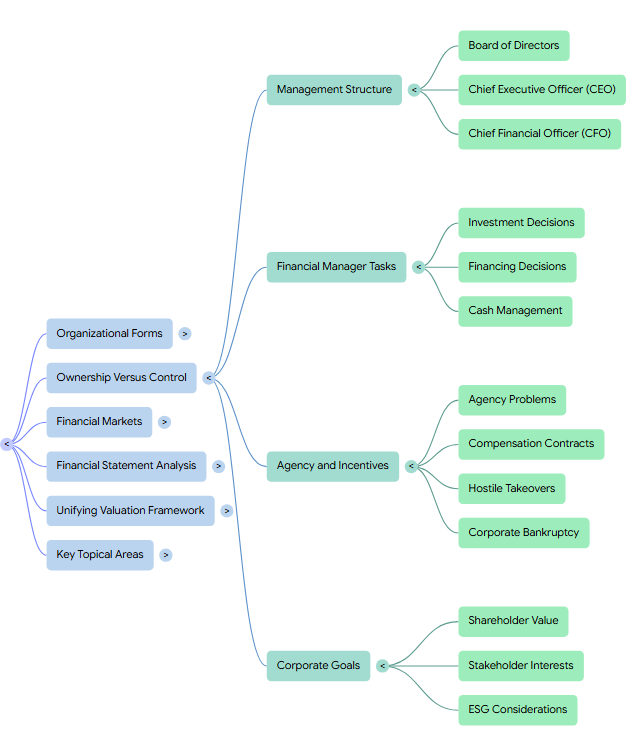
In corporate finance, the separation of ownership and control is a defining characteristic of the modern corporation, distinguishing it from other organizational forms like sole proprietorships or partnerships. While ownership is spread among many shareholders, the actual control of the firm is delegated to professional managers.
The Mechanics of Separation
Because large corporations often have thousands or even millions of shareholders who can freely trade their stock, it is unfeasible for them to participate directly in daily management. This necessitated a tiered structure:
- Shareholders: The owners of the firm, whose ownership is divided into shares of stock (equity). They exercise control indirectly through their voting rights.
- Board of Directors: A group elected by shareholders that possesses ultimate decision-making authority. The board sets policy, monitors performance, and determines executive compensation.
- Management Team: The board delegates the day-to-day running of the firm to management, led by the Chief Executive Officer (CEO). The Chief Financial Officer (CFO), who oversees financial operations, typically reports directly to the CEO.
The Agency Problem
The primary consequence of separating ownership from control is the agency problem. This occurs when managers, acting as agents, prioritize their own interests—such as personal perks, “empire building” (expanding the firm’s size for prestige rather than profit), or avoiding necessary but difficult risks—over the interests of the shareholders (the principals).
Corporate finance identifies several ways these conflicts are addressed:
- Performance-Based Compensation: Tying executive pay to the corporation’s profits or stock price to align the CEO’s incentives with shareholder wealth.
- Monitoring: Direct oversight by the board of directors and outside auditors.
- Market for Corporate Control: If a stock performs poorly due to entrenchment or mismanagement, the low price creates a profit opportunity for a “corporate raider” to initiate a hostile takeover, replace the board, and install new management.
- Stock Price as Feedback: The share price acts as a continuous barometer, giving managers feedback on how investors view their decisions.
The Broader Context in the Sixth Edition
The Sixth Edition of Corporate Finance places this separation within a modern framework that includes:
- Legal Entity Status: The corporation is a “legally defined, artificial being” separate from its owners, which provides the limited liability that makes broad, anonymous ownership possible.
- Stakeholder and ESG Concerns: The text explores the tension between shareholder value maximization and the concerns of other stakeholders (employees, customers, and the environment). It argues that to maximize shareholder value in the long run, managers must consider the firm’s impact on all stakeholders.
- Regulation: Discussion of the Dodd-Frank Act and the Sarbanes-Oxley Act is integrated to show how public policy attempts to improve accountability and transparency in corporate governance.
In contrast, organizational forms like sole proprietorships do not face this separation; the owner and the manager are the same person, ensuring their goals are perfectly aligned but limiting the firm’s ability to raise large-scale capital.
Management Structure
In corporate finance, the management structure is the operational bridge that facilitates the separation of ownership and control, wherein shareholders own the firm but delegate the responsibility of running it to professional managers. The foundation of this structure is the board of directors, a group elected by the shareholders that possesses ultimate decision-making authority, sets company policy, and monitors management performance.
The board delegates the majority of day-to-day operational decisions to a management team led by the Chief Executive Officer (CEO), who is charged with executing the rules and policies established by the board. Reporting directly to the CEO is the Chief Financial Officer (CFO), the most senior financial manager responsible for investment and financing decisions, cash flow management, and serving as a trusted advisor to the board regarding risk and capital allocation. Within a typical corporate organizational chart, the CFO oversees two primary functional areas: the controller, who manages tax and accounting functions, and the treasurer, who oversees capital budgeting, risk management, and credit activities.
Management structures vary globally; for example, German corporations utilize a two-tier system consisting of a supervisory board (Aufsichtsrat), which includes both shareholder and employee representatives, and a management board (Vorstand) that handles the actual operation of the company. The effectiveness of any management structure in protecting shareholder interests is often tied to board independence, as a majority of independent outside directors increases the likelihood that a CEO will be replaced following poor performance.
The inherent separation of ownership from control in these structures leads to agency problems, where managers may prioritize personal benefits, such as corporate perks or an easier “quiet life,” over the goal of maximizing shareholder wealth. To counter these risks, modern management structures incorporate specialized monitoring bodies, such as the audit committee, which must consist entirely of independent directors to ensure the accuracy and reliability of financial reporting. Additionally, the compensation committee is responsible for designing incentive packages, often including stock and option grants, to align the management team’s personal financial interests with those of the stockholders.
Board of Directors
In the management structure described in corporate finance, the board of directors serves as the ultimate decision-making authority, representing the interests of the shareholders who elect them. The board occupies a central position between the owners (principals) and the professional managers (agents), tasked with setting company policy, monitoring performance, and determining executive compensation.
Roles and Responsibilities
- Delegation of Authority: The board delegates the majority of day-to-day operational decisions to a management team led by the Chief Executive Officer (CEO).
- Monitoring and Oversight: A primary function of the board is to scrutinize management’s actions and intervene when they veer off course, which includes the power to fire the CEO if performance is systematically poor.
- Specialized Committees: Boards often utilize specialized monitoring bodies, such as the audit committee, which is responsible for hiring external accountants and ensuring the reliability of financial reporting. Additionally, a compensation committee—typically composed entirely of independent directors—is responsible for designing incentive packages to align management’s interests with those of the shareholders.
Board Structure and Composition
- Single-Tier vs. Two-Tier Systems: In the United States and United Kingdom, corporations typically utilize a single board of directors comprising both inside executive directors and outside nonexecutive directors. In contrast, German corporations utilize a two-tier system consisting of a supervisory board (Aufsichtsrat), which oversees strategy and elects management, and a management board (Vorstand) that handles actual operations.
- Codetermination: A unique feature of the German management structure is codetermination, where employees elect between one-third and one-half of the supervisory board members.
- Board Independence: The effectiveness of a board is often tied to its independence; a majority of independent directors—those without a business relationship with the firm—increases the likelihood that a CEO will be held accountable for poor results.
- Size and “Overboarding”: While smaller boards are generally associated with higher valuations and more effective monitoring, complex or diversified firms may require larger boards to understand different business lines. Management structure can be weakened by overboarding, where directors serve on too many boards to devote sufficient time to each.
Board Governance and the Agency Problem
The separation of ownership and control inherent in the corporate form necessitates a board that can mitigate the agency problem, where managers might prioritize personal perks or “empire building” over shareholder wealth. However, corporate finance notes that boards themselves can suffer from these problems if members are too “chummy” with the CEO or lack the will to challenge management.
To counter this, many firms have adopted annual elections for the entire board, as staggered (or classified) boards—where only a third of directors are reelected each year—can lead to management entrenchment by making it more difficult for dissatisfied shareholders to gain a majority. Ultimately, if a board becomes derelict in its duties, shareholders can attempt to replace them through a proxy fight or rely on the market for corporate control, where a hostile takeover might result in a new board and management team.
Chief Executive Officer (CEO)
In the management structure described in corporate finance, the Chief Executive Officer (CEO) is the highest-ranking manager, charged with the day-to-day operations of the firm and the execution of policies established by the board of directors. Within the broader context of management structure, the CEO serves as the primary link between the governing board and the rest of the management team, including the Chief Financial Officer (CFO) and Chief Operating Officer (COO), who typically report directly to the CEO.
Role and Reporting Hierarchy
The CEO is hired by the board of directors to run the corporation. While the board retains ultimate decision-making authority, it delegates most operational decisions to the management team led by the CEO. In many corporations, the separation of powers between these two entities is blurred, as it is not uncommon for the CEO to also serve as the chairman of the board. This dual role can sometimes complicate the board’s ability to provide independent oversight of management performance.
CEO Accountability and Agency Conflicts
The CEO occupies a central position in the “separation of ownership and control” that characterizes modern corporations. This structure creates an agency problem, wherein the CEO (acting as an agent) may be tempted to prioritize personal interests—such as job security, prestige, or “empire building” through unprofitable acquisitions—over the interests of the shareholders (the principals).
To ensure the CEO remains focused on maximizing shareholder value, several management and governance mechanisms are employed:
- Board Oversight: The board monitors the CEO’s performance and possesses the power to fire the CEO if the firm’s results are systematically poor.
- Performance BAROMETERS: For public companies, the stock price serves as a continuous feedback loop, reflecting the market’s opinion of the CEO’s decisions.
- Regulatory Responsibility: Under legislation like the Sarbanes-Oxley Act, the CEO and CFO must personally attest to the accuracy of the firm’s financial statements, facing significant legal penalties for misrepresentation.
Compensation and Incentives
Compensation is a critical tool used to align the CEO’s incentives with shareholder wealth. According to corporate finance, the majority of CEO compensation in large U.S. firms comes from stock grants, options, and other performance-linked incentives rather than base salary. This structure is intended to make the CEO an “equity holder,” ensuring they benefit directly from share price appreciation. Furthermore, some researchers argue that high CEO pay is a result of the “scalability” of talent; because a CEO’s decisions are rolled out firm-wide, a slightly more talented CEO can have a massive impact on the value of a large corporation.
International Management Contexts
The role and power of the CEO vary significantly across different global management regimes:
- Two-Tier Systems: In Germany, the CEO leads a management board (Vorstand) that handles operations but is overseen by a separate supervisory board (Aufsichtsrat).
- Japan: In the Japanese main bank system, the CEO traditionally has tremendous influence as long as the firm is financially sound, with outside shareholders exercising very little influence compared to their U.S. counterparts.
- Venture Capital: In young, start-up management structures, CEOs often agree to modest salaries and only “cash in” through the long-term appreciation of their stock, providing high-powered incentives to ensure the firm’s success.
Chief Financial Officer (CFO)
In the management structure described in corporate finance, the Chief Financial Officer (CFO) is the firm’s most senior financial manager and typically reports directly to the Chief Executive Officer (CEO). The CFO serves as a critical link between a company’s internal operations and the external financial markets. Within the corporate hierarchy, the CFO oversees two primary functional areas: the controller, who manages tax and accounting functions, and the treasurer, who is responsible for capital budgeting, risk management, and credit management activities.
Core Responsibilities
According to corporate finance, the CFO’s role is centered on three fundamental tasks:
- Investment Decisions: This is considered the most important job, requiring the CFO to weigh the costs and benefits of various projects to determine which will add the most value for the owners.
- Financing Decisions: The CFO determines the firm’s capital structure by deciding whether to raise funds through equity (selling shares) or debt (borrowing).
- Cash Management: Also known as managing working capital, the CFO must ensure the firm has sufficient liquidity to meet day-to-day obligations, a task vital for young or rapidly growing companies.
Evolution of the Role
The role of the CFO has evolved significantly in the wake of global financial crises. Beyond traditional accounting and reporting, the CFO is now viewed as the senior global manager for guardianship and risk management. This expanded role involves identifying vulnerabilities, conducting stress tests, and serving as a trusted advisor to the board and business leaders on matters of capital allocation and sensitivity analysis. During periods of disruption, such as the 2008 financial crisis, the CFO’s management of liquidity becomes paramount, often described as the “oxygen” for a financial system.
Governance and Accountability
In the broader context of corporate governance, the CFO holds significant legal and ethical responsibilities. Under the Sarbanes-Oxley Act (SOX), the CFO—alongside the CEO—is required to personally attest to the accuracy of the firm’s financial statements. They face stiff criminal penalties, including large fines and imprisonment, for providing false information to shareholders. Furthermore, if financial reports are found to be misstated, the CFO may be required to return bonuses or profits earned from stock sales. This accountability is designed to mitigate agency problems and ensure that management’s actions are aligned with the interests of the shareholders.
Financial Manager Tasks
In the study of corporate finance, the tasks of the financial manager are fundamentally defined by the separation of ownership and control. Because corporations often have many owners who cannot participate directly in daily operations, control is delegated to professional managers. Within this structure, the financial manager acts as a critical intermediary between the firm’s real operations and the external financial markets where the owners trade their shares.
According to corporate finance, the responsibilities of the financial manager are centered on three primary tasks:
1. Investment Decisions
This is considered the financial manager’s most important job. The manager must identify and weigh the costs and benefits of various projects to determine which will add the most value for the shareholders. This process, known as capital budgeting, involves forecasting future cash flows and ensuring that investments earn a return higher than the opportunity cost of capital—the rate investors could earn elsewhere on investments of similar risk. In an efficient market, taking projects with a positive Net Present Value (NPV) is the most reliable way to increase the firm’s share price.
2. Financing Decisions
Once investment opportunities are identified, the financial manager must decide how to pay for them. This is often referred to as the capital structure decision. The manager chooses between:
- Equity Financing: Raising money from owners by selling shares of stock.
- Debt Financing: Borrowing money from lenders, such as banks or bondholders.
In a perfect capital market, the Law of One Price suggests that the choice between debt and equity does not affect the total value of the firm; however, in the real world, the financial manager must consider factors like taxes, bankruptcy costs, and asymmetric information.
3. Cash Management (Working Capital Management)
The financial manager must ensure the firm has enough liquidity to meet its day-to-day obligations, such as paying employees and suppliers. This task involves managing net working capital, which is the difference between current assets (like cash and inventory) and current liabilities (like accounts payable). Efficient cash management is vital for young or rapidly growing companies, where a failure to access “liquid oxygen” can lead to business failure regardless of the quality of their products.
Context of Ownership and Control
The separation of ownership and control necessitates that these tasks be performed with a singular focus on maximizing shareholder wealth. This framework allows shareholders with diverse personal consumption needs and risk tolerances to delegate decisions to a manager whose simple instruction is to maximize the current market value of their investment.
However, this separation also creates agency problems, where managers may be tempted to prioritize their own prestige, perks, or job security over the interests of the owners. To mitigate this, modern corporate structures utilize boards of directors to monitor management and employ incentive-based compensation—often in the form of stock or options—to align the financial manager’s personal interests with the goal of value maximization. Furthermore, under legislation like the Sarbanes-Oxley Act, senior financial managers like the CFO now bear personal legal accountability for the accuracy of the financial reports they produce.
Investment Decisions
In the study of corporate finance, the tasks of the financial manager are categorized into three primary areas: making investment decisions, making financing decisions, and managing the firm’s cash flows (working capital management). Of these, the investment decision is considered the manager’s most important job.
The Nature of Investment Decisions
Investment decisions, often referred to as capital budgeting or capital expenditure (CAPEX) decisions, involve the purchase of real assets. These assets can be tangible, such as machinery or factories, or intangible, such as research and development (R&D), patents, and brand reputation. The core objective is to identify and undertake projects where the benefits—expressed in terms of cash today—exceed the costs.
The Unifying Framework: Net Present Value (NPV)
In corporate finance, the Law of One Price and the Valuation Principle serve as the unifying framework for these decisions. This framework establishes that the value of an investment is determined by its competitive market price today.
- The NPV Decision Rule: The “golden rule” of financial decision-making is to accept all projects with a positive Net Present Value (NPV). Choosing a positive-NPV project is equivalent to receiving that amount in cash today, thereby maximizing shareholder wealth.
- The Opportunity Cost of Capital: To calculate NPV, future cash flows must be discounted by the opportunity cost of capital (or hurdle rate). This rate is determined by the expected return investors could earn elsewhere on investments with comparable risk and maturity.
Practical Implementation: Cash Flows vs. Profits
A critical distinction in corporate finance is that investment analysis must focus on incremental free cash flows rather than accounting profits.
- Discount Cash Flows: Managers must ignore non-cash items like depreciation, though they must account for the depreciation tax shield (the tax savings resulting from the ability to deduct depreciation).
- Incremental Forecasting: Only the additional cash flows that result from accepting a project are relevant. This includes considering indirect effects like cannibalization (where a new product reduces sales of an existing one) and opportunity costs (the value of a resource if put to its best alternative use).
- Excluded Items: Managers must ignore sunk costs—unrecoverable past expenditures—and interest expenses, as the latter is a financing concern that is already reflected in the discount rate.
Alternative Decision Rules and Their Pitfalls
While NPV is the superior rule, corporate finance notes that firms often use supplementary metrics, which can sometimes lead to erroneous decisions:
- Internal Rate of Return (IRR): This is the discount rate that sets the project’s NPV to zero. While widely used, it has pitfalls, including failing to account for the scale of an investment or providing multiple solutions for projects with unconventional cash flow patterns.
- Payback Rule: This rule accepts projects if they recover the initial investment within a specified time. It is simple but flawed because it ignores the time value of money and any cash flows occurring after the cutoff date.
- Profitability Index: This tool is used when a firm faces resource constraints (capital rationing). It measures the “bang for your buck” by calculating the NPV per unit of resource consumed.
Advanced Analysis: Risk and Flexibility
Sophisticated investment analysis involves assessing uncertainty and the value of flexibility:
- Sensitivity and Scenario Analysis: Managers use these tools to identify which variables (e.g., units sold, production costs) have the greatest impact on a project’s NPV.
- Real Options: Many projects include embedded options, such as the option to delay until more information is learned, the option to expand if a product is successful, or the option to abandon if it fails. These real options add substantial value to an investment opportunity.
Financing Decisions
In the framework of corporate finance, the financial manager is responsible for three primary tasks: making investment decisions, making financing decisions, and managing the firm’s cash flows. Financing decisions specifically involve determining how to raise the necessary funds to pay for the projects and assets the company has decided to undertake. This process, often referred to as the capital structure decision, focuses on the relative proportions of debt, equity, and other securities that a firm has outstanding.
Core Principles and the Capital Structure Decision
In a perfect capital market, the Law of One Price and the Modigliani-Miller propositions suggest that the choice of financing is irrelevant to the total value of the firm. However, in the real-world context of corporate finance, financial managers must weigh various market imperfections when making these choices, most notably corporate taxes. Debt financing offers a significant advantage because interest payments are typically tax-deductible expenses, creating an “interest tax shield” that can enhance firm value.
Conversely, managers must balance these tax benefits against the costs of financial distress. Excessive leverage increases the probability of default and bankruptcy, which carry direct legal costs and substantial indirect costs, such as the loss of customers, suppliers, and key employees.
The Impact of Incentives and Information
Financing decisions are also heavily influenced by agency costs and asymmetric information:
- Agency Problems: Conflicts of interest between stockholders and bondholders (or managers and shareholders) can lead to suboptimal decisions, such as taking on excessive risk or under-investing in positive-NPV projects.
- The Pecking Order: Because managers typically have superior information compared to outside investors, the announcement of a security issue can signal management’s view of the firm’s value. This often leads firms to follow a “pecking order” of financing: preferring internal funds (reinvested earnings) first, then debt, and finally new equity as a last resort.
Execution and Payout Policy
To implement financing decisions, financial managers utilize a wide array of instruments, ranging from public bonds and bank loans to commercial paper and specialized leasing arrangements. Furthermore, the financing task includes the payout decision, which determines how much cash should be returned to shareholders and whether that distribution should occur through dividends or share repurchases. Ultimately, the goal of the financial manager in financing is to maximize shareholder wealth by navigating these trade-offs to lower the firm’s overall weighted average cost of capital (WACC).
Cash Management
In corporate finance, the tasks of a financial manager are broadly categorized into three areas: making investment decisions, making financing decisions, and managing the firm’s cash flows. Within this framework, cash management—often referred to as working capital management—is the task of ensuring the firm has sufficient liquidity to meet its day-to-day obligations.
The Strategic Role of Cash Management
While investment decisions shape the long-term direction of the firm, cash management is critical for its immediate survival. In corporate finance, liquidity is often described as the “oxygen” of a financial system. Even companies with successful products can fail if they lack access to the cash required to develop those products and bring them to market. For young or rapidly growing firms, the financial manager’s ability to manage cash flow can mean the difference between success and failure.
Motivations for Holding Cash
Financial managers must balance the need for liquidity against the costs of holding idle cash, which earns no interest and is subject to double taxation. According to the sources, there are three primary motivations for maintaining a cash balance:
- Transactions Balance: This is the amount needed to pay regular bills, such as wages and supplier invoices. The required amount depends on the firm’s cash cycle—the time between paying for inventory and receiving cash from sales.
- Precautionary Balance: Managers hold this as a buffer against unexpected cash flow shocks or uncertainty. This demand for savings naturally increases during times of economic stress, such as the COVID-19 pandemic.
- Compensating Balance: Banks may require firms to maintain a minimum level of non-interest-bearing deposits as compensation for services rendered.
Components of Working Capital Management
Efficient cash management involves overseeing several short-term asset and liability accounts:
- Accounts Receivable: Managers must establish credit standards and collection policies to ensure sales are converted into cash in a timely manner.
- Inventory: Financial managers coordinate with operations to balance the costs of holding inventory against the risk of stock-outs, which result in lost sales.
- Accounts Payable: A key task is managing the timing of payments to suppliers. Managers often seek to keep money working for the firm as long as possible without damaging relationships with creditors.
Investing Surplus Cash
When a firm generates more cash than is needed for operations or immediate investment, the financial manager is responsible for “parking” these funds in the money market. Common short-term, low-risk investment options include Treasury bills, certificates of deposit (CDs), and commercial paper. The goal is to earn a return on excess liquidity while maintaining the ability to access the funds on short notice.
International and Centralized Management
In large multinational corporations, cash management becomes more complex, involving different currencies and legal structures. Financial managers often utilize centralized systems, such as concentration accounts, where surplus funds from various regions are swept into a single account to be redeployed or invested more efficiently. They may also use netting systems to reduce the number of cross-border transactions and their associated costs.
Agency and Incentives
In the study of corporate finance, agency and incentives are fundamental concepts that arise from the separation of ownership and control. While shareholders own the firm, they delegate the daily operations to professional managers, creating a principal-agent relationship. This structure inevitably leads to agency problems, where managers may prioritize their own self-interests over the maximization of shareholder wealth.
The Nature of Agency Conflicts
Managers, acting as agents, face various temptations that can divert them from value-maximizing decisions. These conflicts manifest in several specific ways:
- Reduced Effort and the “Quiet Life”: Managers may avoid the hard work or high pressure of launching new projects, preferring to coast with the status quo.
- Perquisites (Perks): Executives may spend corporate funds on private benefits, such as lavish offices, luxury resorts, or redundant corporate jets.
- Empire Building: Because higher pay and prestige are often linked to firm size, managers may undertake negative-NPV acquisitions or expansions simply to increase the scale of the company.
- Risk-Taking Discrepancies: To protect their job security, managers might turn down risky but positive-NPV projects that a diversified shareholder would prefer. Conversely, a manager of a distressed firm may “gamble for resurrection,” taking excessive risks because they have little to lose if the firm fails.
- Short-Termism: Managers may focus on hitting immediate earnings targets at the expense of long-term value, such as by cutting research and development (R&D) or maintenance.
The Role of Incentives
To mitigate these problems, corporations use incentive-based compensation to align the financial interests of managers with those of stockholders.
- Performance-Linked Pay: The majority of CEO compensation in large firms consists of bonuses, stock grants, and stock options.
- Equity Ownership: When managers hold a large personal stake in the firm, they become “equity holders” who benefit directly from share price appreciation, encouraging them to work harder.
- Scalability of Talent: High pay is sometimes justified by the idea that a CEO’s decisions are rollable firm-wide; thus, even small improvements in talent can have a massive impact on the value of a large corporation.
- Restricted Stock: To combat short-termism, many firms use restricted stock that must be held for several years, often extending past the CEO’s retirement to ensure they plan for the firm’s long-term health.
Monitoring and Governance Mechanisms
Because incentives are imperfect and can sometimes encourage manipulation, they must be supported by various monitoring bodies.
- Board of Directors: The board is the first line of defense, responsible for scrutinizing management, setting policy, and firing the CEO if performance is poor. Board independence is critical; boards with a majority of outside directors are more likely to hold management accountable.
- Auditors and Lenders: Independent auditors ensure that financial statements fairly represent the company’s condition. Lenders also monitor the firm to protect their loans, often imposing covenants that restrict management’s ability to take excessive risks.
- Shareholder Stewardship: Large shareholders (blockholders) have the incentive to engage with management or use their voting rights to influence corporate policy. If dissatisfied, they may perform the “Wall Street Walk” by selling their shares, which drives down the stock price and pressures management.
External Disciplining: The Market for Corporate Control
When internal governance fails and a firm is poorly managed, the resulting low stock price creates a profit opportunity for a hostile takeover. The mere threat of being removed by a “corporate raider” acts as a powerful disciplining mechanism, encouraging entrenched managers to act in the interest of their shareholders. Despite management’s attempt to use “shark-repellent” defenses like poison pills, this market for corporate control remains a vital check on agency costs in corporate finance.
Agency Problems
In the study of corporate finance, agency problems are defined as conflicts of interest that arise when one party (the principal) hires another (the agent) to perform a service and grants them decision-making authority. In a corporation, shareholders act as the principals, and professional managers act as their agents. Because managers typically own only a small fraction of the firm’s shares, their personal interests often diverge from the goal of maximizing shareholder wealth.
Core Agency Problems in Management
The sources categorize several distinct behaviors where managers may prioritize their own self-interest over firm value:
- Reduced Effort and the “Quiet Life”: Launching and managing new projects is high-pressure work. Managers may choose to “coast,” managing existing assets rather than seeking new, high-effort, positive-NPV opportunities. This is considered an error of omission that can be even more damaging than taking a bad action.
- Perquisites (Perks): Managers may use corporate funds for private benefits, such as redundant corporate jets, lavish office renovations, or luxury retreats. These “perks” are often a signal of broader lack of accountability within a firm.
- Empire Building (Overinvestment): Because executive pay and prestige are often tied to firm size, managers may undertake negative-NPV acquisitions or expansions simply to increase the scale of the company.
- Risk-Taking Discrepancies: To protect their own job security, managers may turn down risky but positive-NPV projects that a diversified shareholder would prefer. Conversely, when a firm is near bankruptcy, a manager might “gamble for resurrection,” taking excessive risks because they have little to lose if the project fails.
- Short-Termism: Managers may focus on meeting immediate earnings targets—often to boost the short-term stock price or hit a bonus threshold—at the expense of long-term investments like R&D or maintenance.
Agency Costs of Debt
Corporate finance identifies specific agency problems that occur between equity holders and debt holders, particularly when a firm is in financial distress:
- Asset Substitution: Shareholders may have an incentive to swap low-risk assets for high-risk ones, effectively “gambling” with the bondholders’ money.
- Debt Overhang (Under-investment): Shareholders may refuse to fund safe, positive-NPV projects because the majority of the benefits would accrue to the firm’s creditors rather than the owners.
- Cashing Out: Shareholders may be tempted to liquidate assets at fire-sale prices to pay themselves a dividend before the firm defaults.
The Role of Incentives and Monitoring
To mitigate these problems, firms utilize agency and incentives frameworks to better align manager and shareholder goals:
- Performance-Linked Compensation: The majority of CEO pay in large firms comes from stock grants and options. This turns the manager into an equity holder who benefits directly from long-term share price appreciation.
- Board Monitoring: The board of directors is the primary monitor, with the authority to scrutinize decisions and fire the CEO if results are poor. Independence is key; boards dominated by outside directors are more effective at holding management accountable.
- Regulatory Oversight: Laws such as the Sarbanes-Oxley Act (SOX) and the Dodd-Frank Act impose strict standards for financial disclosure and executive accountability.
- The Market for Corporate Control: If internal governance fails, a low stock price may attract a “corporate raider” to initiate a hostile takeover, replace the management team, and unlock the firm’s hidden value.
- External Disciplining: Lenders often include debt covenants in loan agreements to restrict managers from taking actions that would unfairly harm creditors, such as paying excessive dividends or taking on more debt.
Compensation Contracts
In the context of corporate finance, compensation contracts are essential tools for managing the agency problems that arise from the separation of ownership and control. Because managers typically own only a small fraction of the firm’s shares, their personal interests often diverge from the goal of maximizing shareholder wealth, necessitating carefully structured pay agreements to align their incentives.
The Role of Governance and Shareholder Oversight
The sources state that the responsibility for designing these contracts rests with the compensation committee (or remuneration committee) of the board of directors. To ensure objectivity, modern regulations such as the Dodd-Frank Act and NYSE/SEC rules mandate that this committee consist entirely of independent outside directors.
Shareholders exercise indirect control over compensation through “Say-on-Pay” votes. While these votes are often non-binding advisory measures in the United States, boards that ignore significant shareholder opposition frequently face backlashes or are eventually forced to adjust their pay structures. In the United Kingdom and EU, companies are often required to hold binding votes on their future remuneration policies.
Mechanisms for Incentive Alignment
To motivate managers to act as “equity holders,” corporate finance identifies performance-linked pay as the dominant component of executive compensation.
- Stocks and Options: Tying a manager’s personal wealth to the company’s stock price provides a direct incentive to increase firm value. For example, Oracle CEO Larry Ellison has received a base salary of only $1, but his enormous holdings of stock and options create a massive personal stake in the firm’s success.
- Scalability of Talent: The sources argue that high compensation for top executives is partially justified by the “scalability” of their talent; because a CEO’s decisions affect the entire firm, even a slightly more talented leader can impact the value of a large corporation by hundreds of millions of dollars.
- Performance Shares and LTIPs: Many firms use Long-Term Incentive Plans (LTIPs) that link pay to specific financial targets, such as earnings per share (EPS) growth, or non-financial goals like workplace safety and environmental targets.
Trade-offs, Risks, and Limitations
While designed to solve agency problems, compensation contracts involve significant trade-offs:
- Risk-Aversion: Tying pay too closely to stock performance can make managers overly risk-averse, as they may turn down risky but positive-NPV projects to protect their personal wealth.
- Pay-for-Luck: Stock-based pay can reward or punish managers for factors beyond their control, such as general market booms or industry-wide commodity price changes.
- Short-Termism and Manipulation: Specific performance targets in LTIPs can encourage managers to manipulate results—such as cutting R&D or maintenance—to hit short-term goals at the expense of long-term value.
- Restricted Stock: To combat short-termism, the sources advocate for restricted stock that must be held for several years, often extending beyond the CEO’s retirement to ensure they remain focused on the firm’s enduring health.
Regulatory Accountability
Legislative reforms have introduced stricter penalties for misaligned incentives. Under the Sarbanes-Oxley Act (SOX) and the Dodd-Frank Act, CEOs and CFOs may be subject to “clawback” provisions, requiring them to return bonuses or profits from stock sales if the firm’s financial statements are later found to be misstated due to error or fraud.
Hostile Takeovers
In corporate finance, a hostile takeover is an external governance mechanism that arises when an individual or organization, often called a corporate raider, purchases a significant fraction of a firm’s stock to acquire enough voting power to replace the board of directors and the CEO. This process is a central component of the market for corporate control, which serves to align managerial actions with shareholder interests.
The Market for Corporate Control
According to corporate finance, the market for corporate control acts as a powerful disciplining force for managers who might otherwise succumb to agency problems.
- External Discipline: When internal governance mechanisms—such as monitoring by the board of directors—fail to prevent mismanagement, the resulting poor performance typically leads to a decline in the firm’s stock price.
- Profit Opportunity: Low stock prices create a profit opportunity for raiders, who believe they can increase the firm’s value by installing a superior management team.
- Threat as Incentive: The mere threat of being removed through a hostile takeover is often sufficient to motivate boards and managers to make difficult value-maximizing decisions they might otherwise avoid.
Addressing Agency Problems
Hostile takeovers are specifically positioned as a remedy for several core agency problems where managers prioritize their own self-interest over shareholder wealth:
- Management Entrenchment: In some corporations, senior executives become entrenched because the board of directors lacks the will or objectivity to replace them, often due to close personal ties with the CEO. Takeovers provide a way for shareholders to bypass an ineffective board.
- The “Quiet Life”: Managers may avoid the hard work or high pressure of new projects, preferring to coast with the status quo. The pressure of a potential takeover forces managers to stay competitive and efficient.
- Empire Building: Managers may undertake unprofitable acquisitions or expansions simply to increase firm size for prestige or higher pay. A hostile bidder may target such firms to break them up or eliminate wasteful spending.
Takeover Defenses and Agency Costs
The sources note that the use of takeover defenses is often a manifestation of agency conflict.
- Defensive Tactics: Managers may implement “shark-repellent” amendments, such as poison pills or staggered boards, to make the company unappetizing or difficult to acquire.
- Entrenchment Costs: While proponents argue these defenses allow managers to focus on long-term goals, corporate finance highlights evidence that managers protected by such defenses often enjoy higher remuneration while generating less wealth for their shareholders.
- Golden Parachutes: To encourage managers to step aside during a beneficial acquisition, firms may use “golden parachutes”—large bonus payments to ousted executives—which can help mitigate the conflict between a manager’s job security and the shareholders’ desire for a premium.
Ultimately, while internal incentives like stock-based compensation and board monitoring are the first lines of defense against agency costs, the hostile takeover remains a vital “last resort” for matching firms with owners and managers who can most efficiently utilize the company’s resources.
Corporate Bankruptcy
In the study of corporate finance, corporate bankruptcy is fundamentally defined as a change in ownership and control of the firm, where legal authority passes from equity holders to debt holders. While bankruptcy is often viewed as a business failure, it is frequently a legal mechanism used to reorganize a firm’s capital structure while maintaining its operations as a going concern. In the larger context of agency and incentives, bankruptcy and the threat thereof serve as both a source of severe conflict between stakeholders and a powerful tool for disciplining management.
Agency Conflicts in Financial Distress
As a firm approaches bankruptcy, the interests of shareholders (the principals) and debt holders diverge sharply, leading to specific agency costs of leverage. Shareholders, knowing their equity is nearly worthless, have an incentive to play “games” at the expense of creditors:
- Asset Substitution (Risk Shifting): Shareholders may favor highly risky projects with negative Net Present Values (NPV) because they capture the upside if the “gamble” succeeds, while debt holders bear the losses if it fails.
- Debt Overhang (Under-investment): A firm in distress may pass up safe, positive-NPV projects because the benefits of the investment would primarily accrue to creditors rather than shareholders.
- Cashing Out: Shareholders have an incentive to liquidate assets at fire-sale prices to pay themselves immediate dividends before the firm defaults.
Corporate finance emphasizes that because creditors anticipate these behaviors, they pay less for the firm’s debt initially, meaning the original shareholders ultimately bear the present value of these agency and bankruptcy costs.
Bankruptcy as an Incentive for Management
Conversely, the threat of bankruptcy provides agency benefits by motivating managers to run the firm more efficiently.
- Discipline of Debt: High leverage commits the firm to future interest payments, reducing the “free cash flow” available for managers to waste on unproductive “empire building” or personal perks.
- Commitment Device: The risk of job loss associated with bankruptcy can “tie the hands” of managers, forcing them to pursue difficult strategies—such as extracting wage concessions from unions—with a vigor they might lack in a financially healthy firm.
- Monitoring: When a firm is highly levered, creditors and the “market for corporate control” provide an additional layer of oversight, reducing management entrenchment.
Incentives within the Bankruptcy Process
The bankruptcy process itself, particularly under Chapter 11 reorganization, involves complex incentive alignments. Existing management is typically given the first opportunity to propose a reorganization plan, which can lead to conflicts if they use the delay to continue negative-NPV activities to preserve their own jobs. To counter this, modern bankruptcy practices often include “key-employee retention plans,” which provide managers with bonuses to incentivize a speedy and efficient reorganization.
Ultimately, corporate finance notes that the efficiency of bankruptcy depends on balancing these competing incentives. While a debtor-friendly system like that of the United States seeks to preserve businesses and employment, it can sometimes allow inefficient firms to survive at the expense of senior creditors. Conversely, creditor-friendly systems may lead to the premature liquidation of healthy businesses.
Corporate Goals
In the study of corporate finance, the primary goal of the firm is defined as maximizing the current market value of shareholders’ investment. This objective is considered sensible because every investor, regardless of their personal risk tolerance or investment horizon, is better off if management makes decisions that increase the value of their shares.
The separation of ownership and control
In large corporations, direct control and ownership are typically separate because it is unfeasible for thousands or millions of shareholders to manage day-to-day operations. Shareholders (the owners) delegate authority to professional managers. This separation gives corporations permanence, as the firm continues to exist even if managers or owners leave or die. However, it also necessitates a system of corporate governance to ensure that management stays focused on the firm’s goals.
Agency problems and conflicting goals
The principal-agent relationship created by this separation leads to agency problems, where managers (agents) may prioritize their own self-interest—such as personal perks, “empire building,” or pursuing a “quiet life”—over the interests of the shareholders (principals). These conflicts result in agency costs, which are the reductions in firm value that occur when managers do not maximize shareholder wealth or when shareholders must spend resources to monitor them.
According to corporate finance, several mechanisms are used to align managerial actions with corporate goals:
- Incentive Compensation: Tying management pay to profits or stock price performance.
- Board Monitoring: Scrutinizing management’s actions and retaining the power to replace the CEO if results are poor.
- Market for Corporate Control: The threat of a hostile takeover if the stock price drops due to mismanagement acts as a powerful disciplining force.
Shareholder versus stakeholder capitalism
The sources distinguish between different frameworks for defining corporate objectives:
- Shareholder Capitalism: Assumes the paramount duty of management is to the owners. It provides a clear decision rule—the NPV rule—and a concrete criterion for judging performance via the long-term stock price.
- Stakeholder Capitalism: Argues that a firm should maximize the size of the total “pie” of value created for all affected parties, including employees, customers, and the environment.
- Enlightened Shareholder Value (ESV): A hybrid model where managers consider stakeholder interests as a means to achieve the ultimate end of maximizing shareholder wealth.
- Responsible Business: A newer approach where the goal is to create value for society, viewing shareholder profits as a by-product of fulfilling a social mission or “purpose”.
Despite these different philosophies, the sources note that in practice, a focus on enriching shareholders often requires a company to treat stakeholders well to remain profitable and competitive. For instance, a firm that neglects its workforce will likely suffer from declining productivity and a falling stock price.
Shareholder Value
In corporate finance, the primary goal of the firm is defined as maximizing the current market value of the shareholders’ investment. This objective is considered sensible because shareholders—who can have vastly different wealth levels, risk tolerances, and investment horizons—all agree that they are better off if management makes decisions that increase the value of their shares. Maximizing market value provides a clear decision rule: managers should accept all investment projects that offer a higher rate of return than shareholders could earn by investing in financial markets on their own, a standard known as the opportunity cost of capital.
The Rationale for Shareholder Primacy
The focus on shareholder value is supported by the “Fisher separation theorem,” which establishes that a financial manager’s investment decisions can be separated from individual shareholder preferences. Because well-functioning financial markets allow investors to manage the timing and risk of their own consumption, the manager’s sole task is to increase the owners’ current wealth. This unifying goal allows thousands of diverse shareholders to participate in the same enterprise and delegate its operations to professional managers with one simple instruction: “Maximize net present value” (NPV).
Enlightened Shareholder Value versus Stakeholder Capitalism
While corporate finance and other sources acknowledge the rise of “stakeholder capitalism”—which argues that a firm should maximize value for all parties, including employees, customers, and the environment—they emphasize that shareholder value maximization remains the most effective framework.
- Enlightened Shareholder Value (ESV): This model argues that to maximize long-term shareholder value, a company must invest in its stakeholders. Profitable firms are those with satisfied customers and loyal employees; neglecting these groups leads to declining productivity, legal costs, and a falling stock price.
- Decision-Making Clarity: Unlike stakeholder capitalism, which may lead to arbitrary decision-making because it lacks a clear rule for weighting conflicting interests, the shareholder value framework provides the NPV rule as a concrete criterion for evaluating trade-offs.
- Performance Metrics: The long-term stock price serves as an effective “barometer” for judging management, as it captures the market’s collective view of how current decisions will impact all future cash flows.
Addressing Challenges and Criticisms
The sources address two major criticisms of the shareholder value goal:
- Short-Termism: Critics argue that focusing on “current” market value leads to a focus on short-term profits at the expense of long-term investment. However, in an efficient market, the current share price should take into account all future expected cash flows, meaning that cutting value-creating long-term projects like R&D would actually hurt the current stock price.
- Externalities: Problems arise when a firm’s actions impose costs on society (such as pollution) that do not directly affect its own profits. In such cases, the sources suggest that public policy and government regulation are required to align corporate interests with societal interests.
The Responsible Business Model
A modern synthesis presented in the sources is the concept of a “responsible business,” which seeks to create value for shareholders through creating value for society. This approach views shareholder profits as a by-product of achieving a social mission or purpose, such as developing innovative medicines or enhancing quality of life. To ensure accountability, responsible businesses use principles of materiality and comparative advantage to prioritize social investments that are most relevant to their core business and likely to support long-term firm value.
Stakeholder Interests
In corporate finance, the traditional primary goal of the firm is defined as maximizing the current market value of the shareholders’ investment. While this focus is sometimes criticized as being narrowly fixated on profits, the sources emphasize that a firm’s stakeholders—including employees, customers, suppliers, local communities, and the environment—are integral to achieving that objective.
Stakeholder Interests and Shareholder Value
The sources suggest that there is often a strong alignment between shareholder wealth and stakeholder interests, a concept known as “enlightened shareholder value”.
- Instrumental Value: Managers acting in the interest of shareholders must consider stakeholders because profitable firms require satisfied customers, loyal suppliers, and a motivated, productive workforce.
- Long-Term Orientation: Focusing on the current stock price does not imply short-termism, as a forward-looking market incorporates the value of future cash flows and the long-term reputational effects of how a firm treats its stakeholders.
- Evidence of Alignment: Research indicates that companies with high levels of employee satisfaction and customer loyalty often deliver superior long-term returns to their shareholders.
The Challenge of Externalities
A central tension in corporate finance occurs when a firm’s actions create “externalities”—social costs or benefits, such as pollution or community development, that do not directly feed back into the firm’s profits.
- Role of Regulation: Under the “Friedman doctrine,” the responsibility of a business is to maximize profits while the government uses laws and taxes to address these social externalities.
- Limits of Profit Maximization: If a firm ignores the harm it imposes on society, it may benefit shareholders in the short run but ultimately damage the broader economy and prompt restrictive public policy.
Alternative Frameworks for Corporate Goals
The sources discuss shifting paradigms regarding the ultimate purpose of the corporation:
- Stakeholder Capitalism: This model argues that a firm should maximize the size of the total “pie” of value created for all affected parties, rather than prioritizing the shareholders’ slice.
- Responsible Business: In this framework, the primary goal is to fulfill a social mission or purpose, such as improving global health or enhancing quality of life, viewing shareholder profits as a necessary by-product of that mission.
- Decision-Making Principles: To prevent arbitrary decision-making under multiple objectives, responsible businesses are guided by the principles of multiplication (the social benefit must exceed the private cost), comparative advantage (the firm must be able to deliver more value than others could), and materiality (focusing on stakeholders most relevant to the core business).
Legal and Practical Context
The ability of managers to prioritize stakeholder interests varies by jurisdiction. In the United States and United Kingdom, directors generally have a fiduciary duty to act in the interests of shareholders, though they have wide discretion to invest in stakeholders if it promotes long-term firm value. In contrast, countries like Germany and Japan utilize management structures, such as two-tier boards with employee representation, that more formally integrate stakeholder interests into the governing process. Companies seeking to legally commit to broader goals can reorganize as “benefit corporations,” which explicitly include social and environmental benefits in their articles of incorporation.
ESG Considerations
In the study of corporate finance, ESG (Environmental, Social, and Governance) considerations are positioned as essential elements for achieving the long-term goal of the firm. While the primary objective remains maximizing current shareholder value, modern financial theory emphasizes that this goal cannot be successfully pursued in a vacuum without considering the firm’s impact on society and the environment.
ESG as a Tool for Shareholder Value
Rather than viewing ESG as a distraction from profits, corporate finance highlights “Enlightened Shareholder Value” (ESV), where ESG investments are seen as a means to achieve superior financial returns.
- Alignment of Interests: Profitable firms create value for customers by aligning products with their environmental and social preferences.
- Productivity and Retention: Investing in social factors, such as employee satisfaction and job security, allows firms to attract better talent and benefit from increased productivity.
- Empirical Evidence: Research indicates that companies with high levels of employee satisfaction and strong “eco-efficiency” ratings (generating less waste relative to goods produced) have historically delivered superior long-term stock returns compared to their peers.
The Financial Manager’s Role in ESG
The role of the financial manager in the context of ESG is to quantify the trade-offs between financial performance and social consequences.
- Trade-off Evaluation: Managers must provide the CEO and the board with data-driven insights into how an ESG initiative affects firm value, allowing for informed decision-making.
- Profit as a Prerequisite: Corporate finance notes that sound financial health is a prerequisite for ESG initiatives; failing companies do not have the luxury of allocating resources to stakeholder welfare or environmental improvements.
The Responsible Business Framework
A newer synthesis of these concepts is the “responsible business” model, which seeks to create value for shareholders through the creation of value for society. This approach views shareholder profits as a natural by-product of achieving a social purpose, such as improving global health or enhancing quality of life. To ensure these goals remain disciplined, three principles are applied:
- Multiplication: The social benefit of an investment must exceed its private cost.
- Comparative Advantage: The firm should only undertake social activities where it can deliver more value than other entities could with the same resources (e.g., a perfume company using its expertise to make hand sanitizer during a pandemic).
- Materiality: The firm should prioritize ESG factors that are most relevant to its specific core business operations.
ESG Reporting and Measurement
To provide transparency to investors and stakeholders, firms utilize several non-financial reporting frameworks.
- Standardization Efforts: Organizations like the Global Reporting Initiative (GRI) and the Sustainability Accounting Standards Board (SASB) provide industry-specific standards for measuring ESG performance, such as greenhouse gas emissions or data security protocols.
- ESG Ratings: Investors often rely on ESG ratings from third-party providers like MSCI or Sustainalytics. However, unlike credit ratings, ESG ratings frequently disagree across providers due to the inherent subjectivity in assessing intangible social and environmental performance.
— Linden Lake
This series:
→ Topic Review (1 of 6): Corporate Finance – Organizational Forms
→ Topic Review (2 of 6): Corporate Finance – Ownership Versus Control
→ Topic Review (3 of 6): Corporate Finance – Financial Markets
→ Topic Review (4 of 6): Corporate Finance – Financial Statement Analysis
→ Topic Review (5 of 6): Corporate Finance – Unifying Valuation Framework
→ Topic Review (6 of 6): Corporate Finance – Key Topical Areas
Leave a Reply