
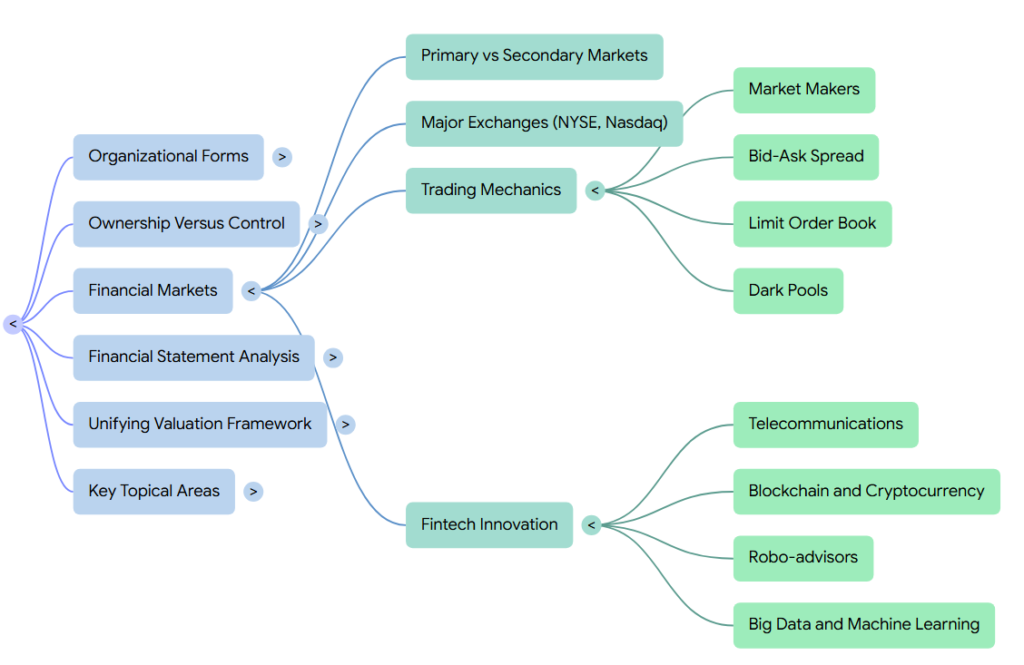
In corporate finance, financial markets are defined as organized venues where investment opportunities, known as financial securities, are issued and traded. They serve as the essential link between a corporation’s internal operations and external investors, facilitating the flow of capital and providing a mechanism for the separation of ownership and control.
Market Structure and Evolution
Financial markets are broadly categorized into two types based on when securities are traded:
- Primary Markets: These are the venues where corporations issue new shares or bonds and sell them directly to investors to raise capital.
- Secondary Markets: Once issued, securities continue to trade among investors in secondary markets, such as the New York Stock Exchange (NYSE) or Nasdaq, without the further involvement of the corporation.
corporate finance highlights that these trading venues have undergone significant structural changes, evolving from traditional floor-based auction markets to fully electronic exchanges and alternative systems like “dark pools”. This evolution is part of the broader Fintech revolution, where advanced technology and machine learning are increasingly used to automate banking services and provide security.
The Informational Role of Prices
One of the most vital functions of financial markets is providing information.
- Performance Barometer: The share price acts as a continuous feedback loop for corporate leaders, reflecting the market’s collective assessment of their management decisions and the firm’s future prospects.
- Efficient Market Hypothesis: This theory asserts that in competitive markets, prices reflect all available information. It comes in three forms: weak-form (reflecting past prices), semistrong-form (reflecting all public information), and strong-form (reflecting all public and private information).
- The Law of One Price: This serves as the unifying “compass” for valuation in corporate finance. It states that in a normal, competitive market, equivalent investment opportunities must trade simultaneously at the same price, eliminating the possibility of arbitrage—the ability to make a risk-free profit without investment.
Context in Financial Management
In the larger context of corporate finance, financial markets enable the firm and its owners to operate independently:
- Consumption Smoothing: Markets provide a “time machine,” allowing shareholders to transport their wealth across time by borrowing against future income or lending surplus cash.
- Determining the Hurdle Rate: The opportunity cost of capital for a firm’s projects is set by external factors—specifically the returns investors could earn elsewhere in financial markets on investments with comparable risk.
- Market-Based vs. Bank-Based Systems: Globally, financial systems vary. The United States and United Kingdom utilize “market-based” systems with large stock and bond markets, whereas countries like Germany and Japan rely on “bank-based” systems where long-standing relationships with financial institutions and internal capital markets within conglomerates are more prevalent.
Ultimately, while corporate finance focuses on making optimal internal decisions, these decisions are always grounded in the benchmarks and liquidity provided by the external financial markets.
Primary vs Secondary Markets
In corporate finance, financial markets are broadly categorized into primary and secondary markets based on whether securities are being issued for the first time or traded among existing investors. These markets serve as the essential conduit between a corporation’s internal operations and external investors, facilitating the flow of capital and supporting the separation of ownership and control.
Primary Markets: Raising New Capital
Primary markets are the venues where corporations obtain “new money” by issuing and selling new securities directly to investors.
- Equity Issuance: When a firm sells stock to the public for the first time, it is known as an Initial Public Offering (IPO). For established firms, subsequent share sales are called seasoned equity offerings (SEOs).
- Debt Issuance: Primary markets are also used to issue new debt, such as corporate bonds or bank loans, to finance real investments like new factories or research and development.
- Role of Intermediaries: Investment banks often act as intermediaries in these markets by underwriting offerings—purchasing the new shares from the issuing company and reselling them to the public.
Secondary Markets: Liquidity and Trading
Once securities have been issued in the primary market, they continue to trade between investors in secondary markets, such as the New York Stock Exchange (NYSE) or Nasdaq, without the further involvement of the issuing corporation.
- Mechanism of Transfer: These transactions transfer partial ownership (equity) or creditor claims (debt) from one investor to another. Crucially, no new money flows to the corporation during these “second-hand” trades.
- Providing Liquidity: The primary social function of secondary markets is to provide liquidity, giving investors the flexibility to sell their holdings and transport their wealth across time.
- Informational Role: Secondary markets aggregate the views of millions of investors, resulting in market prices that provide constant feedback to managers regarding the market’s assessment of their decisions.
Context and Interaction in Financial Markets
In the broader framework of corporate finance, the existence of robust secondary markets is a prerequisite for a functional primary market. Investors are only willing to provide new capital in the primary market if they are confident they can later sell those securities at a fair price in a liquid secondary market.
Furthermore, the corporate finance sources emphasize that financial markets are highly competitive. In an efficient market, where secondary prices accurately reflect all available information, it is difficult for a firm to find “positive-NPV” financing opportunities in the primary market because all securities are already fairly priced. Consequently, corporate finance suggests that managers should focus on making value-creating investment decisions rather than trying to time or “fine-tune” their financing in the primary markets.
Major Exchanges (NYSE, Nasdaq)
In corporate finance, the New York Stock Exchange (NYSE) and Nasdaq are identified as the two most significant stock exchanges in the United States. These venues serve as the primary conduits for secondary market trading, where the vast majority of stock transactions occur between investors without the direct involvement of the issuing corporation.
Structural Models and Evolution
The sources highlight fundamental historical differences between these two exchanges, though both have evolved significantly due to technological advances:
- NYSE (New York Stock Exchange): Historically, the NYSE operated as a floor-based auction market in lower Manhattan. It utilized a “specialist” system where a single market maker was assigned to each stock to match buyers and sellers. In recent years, the exchange has transformed into a public corporation (owned by Intercontinental Exchange Inc.) and has largely shifted toward computerized trading.
- Nasdaq: Founded more than 50 years ago as the first fully digital marketplace, Nasdaq never utilized a physical trading floor. Instead of a single specialist, Nasdaq relies on a network of multiple competing market makers for each stock who post bid and ask prices electronically. Nasdaq remains the marketplace of choice for approximately 70% of publicly traded U.S. technology companies.
Role in Price Discovery and Liquidity
Within the broader framework of financial markets, these exchanges perform several critical social and economic functions:
- Liquidity Provision: By ensuring there is always a counterparty available to trade, exchanges provide investors with the flexibility to buy or sell shares at a fair price.
- Real-Time Price Discovery: The competitive bidding process on these exchanges allows buyers and sellers to arrive instantly at an agreed-upon price, aggregating the collective views of millions of investors.
- Information Barometer: For corporate managers, the share prices established on these exchanges act as a continuous feedback loop. A rising stock price generally reflects market approval of management decisions, while a falling price serves as a warning of dissatisfaction or mismanagement.
The Competitive Landscape and Fintech
Corporate finance notes that the dominance of traditional exchanges has been challenged by the “Fintech” revolution and structural changes in the 21st century:
- Electronic Communication Networks (ECNs): These automated systems connect traders directly and have gained significant market share.
- Dark Pools: These are alternative trading systems that do not make their limit order books visible to the public. They account for nearly 40% of all trades as of 2015, appealing to traders who wish to execute large orders without immediately revealing their demand to the entire market.
- High-Frequency Traders (HFTs): This class of traders uses sophisticated algorithms to update and execute trades many times per second, profiting by providing liquidity or exploiting small, short-lived price discrepancies.
Ultimately, while the NYSE and Nasdaq remain the high-profile faces of the U.S. equity markets, they now operate within a highly fragmented and competitive global ecosystem of approximately 50 different trading venues in the U.S. alone.
Trading Mechanics
In the study of corporate finance, trading mechanics encompass the specific processes and protocols that enable the exchange of securities between investors, thereby providing liquidity and establishing market prices. These mechanics serve as the operational core of financial markets, particularly the secondary market where existing shares are traded without the direct involvement of the issuing corporation.
Core Transaction Mechanics
- Bid-Ask Spread: This is the primary transaction cost investors pay to trade. The “bid price” is the highest price a buyer is willing to pay, while the “ask price” (or offer price) is the lowest price at which a seller is willing to sell.
- Limit vs. Market Orders: A limit order is an instruction to buy or sell a specific quantity of a security at a fixed price; these orders populate the limit order book and provide liquidity to the market. In contrast, a market order is an instruction to trade immediately at the best currently available price in the limit order book, effectively “taking” liquidity.
- Market Makers: Historically, exchanges like the NYSE relied on specialists—official market makers who matched buyers and sellers and honored posted bid and ask prices. In digital markets like Nasdaq, a network of multiple competing dealers performs this function.
Trading Venues and Systems
- Auction vs. Dealer Markets: The NYSE historically operated as a floor-based auction market in lower Manhattan, though it has largely transitioned to computerized systems. Nasdaq was founded as a digital dealer market where all trades occur between investors and professional dealers.
- Electronic Communication Networks (ECNs) and Dark Pools: Modern trading often bypasses traditional exchanges through ECNs, which are automated systems that connect traders directly. Corporate finance also notes the rise of dark pools, alternative trading systems that do not display their limit order books to the public, allowing institutional traders to execute large orders without revealing their demand to the broader market.
- High-Frequency Trading (HFT): A specialized class of traders uses sophisticated algorithms and high-speed telecommunications to execute, update, or cancel trades many times per second. These participants profit by providing liquidity and exploiting small, temporary price discrepancies across different venues.
Mechanics for Specific Securities and Strategies
- Marking to Market: In futures markets, the clearinghouse calculates profits and losses daily; participants must pay any losses and receive any profits into their margin accounts. This process effectively resets the contract price each day and eliminates counterparty risk.
- Short Selling: This mechanic involves borrowing a security from another investor to sell it immediately, with the obligation to repurchase and return the security later. Short sellers profit if the security’s price falls and are often viewed as essential for market efficiency by weighing against overvaluation.
- Fintech Integration: The “Fintech” revolution has further automated these mechanics through the use of big data, machine learning, and blockchain technology to verify transactions and predict short-term price movements.
Market Makers
In the trading mechanics described in corporate finance, market makers are essential intermediaries who provide liquidity by ensuring that investors always have a counterparty with whom they can trade. Historically, their role was formalized through official positions on major exchanges, but modern trading has transitioned toward decentralized and automated systems.
Historical and Structural Models
The sources distinguish between two primary models of market-making that characterized the U.S. stock markets for decades:
- The Specialist System (NYSE): Historically, each stock on the New York Stock Exchange was assigned a single market maker known as a specialist. Operating on the physical trading floor in lower Manhattan, the specialist matched buyers and sellers and was obligated to honor their posted prices.
- Competing Dealers (Nasdaq): In contrast, Nasdaq never utilized a physical floor and instead relied on a network of multiple professional dealers for each stock. These dealers competed with one another by electronically posting their buy and sell prices to the Nasdaq network.
The Bid-Ask Spread
The primary mechanic through which market makers operate—and profit—is the bid-ask spread.
- Bid Price: The price at which the market maker is willing to buy a security.
- Ask Price: The higher price at which the market maker is willing to sell a security.
- Transaction Costs: Corporate finance defines the bid-ask spread as a transaction cost paid by investors. For the market maker, this spread represents the compensation for the risk and service of providing a liquid market.
Evolution to the Limit Order Book
With the rise of fully electronic exchanges, the role of the “official” market maker has largely disappeared. Trading mechanics now often center on the limit order book, a publicly visible collection of all outstanding limit orders to buy or sell at fixed prices.
- Liquidity Providers: Anyone can now “make a market” by posting a limit order. Those who post these orders are termed liquidity providers and earn the bid-ask spread.
- Liquidity Takers: Traders who place market orders—instructions to trade immediately at the best available price—are considered “takers” of liquidity.
- High-Frequency Traders (HFTs): This specialized class of traders uses algorithms to update and execute trades many times per second. They have largely replaced traditional human market makers, profiting by providing liquidity and exploiting stale limit orders.
Dealer Markets Beyond Equities
While the role of market makers has evolved in stock trading, professional dealers remain central to other financial venues:
- Bond Markets: Unlike stocks, most government and corporate bonds do not trade on organized exchanges; instead, they are traded in over-the-counter (OTC) markets by a network of dealers.
- Foreign Exchange: Trading in foreign currencies also occurs OTC, where banks and dealers quote prices for immediate (spot) or future (forward) delivery.
Bid-Ask Spread
In the study of corporate finance, the bid-ask spread is a fundamental element of trading mechanics, representing the primary transaction cost investors encounter in the secondary market. It is defined as the difference between the ask price (the lowest price at which a seller is willing to sell) and the bid price (the highest price at which a buyer is willing to buy).
The Mechanics of Liquidity Provision
The bid-ask spread serves as the essential compensation for market participants who provide liquidity—the ability to trade a security immediately at a fair price.
- Market Makers and Dealers: Historically, on exchanges like the NYSE, a single “specialist” was assigned to match buyers and sellers for each stock, earning the spread as profit for standing ready to trade at any time. In contrast, the Nasdaq system utilized a network of multiple competing dealers for each stock.
- The Limit Order Book: In modern electronic markets, the role of the official market maker has largely been replaced by the limit order book. The spread is now determined by the outstanding limit orders: the lowest limit sell order becomes the ask price, and the highest limit buy order becomes the bid price. Anyone who posts a limit order acts as a “provider” of liquidity and potentially earns the spread.
- High-Frequency Trading (HFT): This class of traders uses algorithms to update, cancel, and execute trades many times per second, profiting by providing liquidity and earning the bid-ask spread while managing the risk of their orders becoming “stale” due to new information.
Transaction Costs and Investor Behavior
The bid-ask spread is a direct cost to the “takers” of liquidity—those who place market orders to trade immediately.
- Direct Cost: For example, if Intel is quoted with a bid of $55.10 and an ask of $55.14, the spread is $0.04; an investor buying at the ask and selling at the bid immediately would lose this amount.
- Market Efficiency: Because investors who trade more frequently incur these costs more often, excessive trading can significantly erode investment returns. Studies show that the performance of individual investors typically declines as their portfolio turnover increases due to these accumulated costs.
- Tick Size: On exchanges like the NYSE and Nasdaq, the minimum price increment (tick) for the spread is generally $0.01. Consequently, the spread is often proportionally larger for low-priced stocks than for high-priced ones.
Impact on Valuation and Arbitrage
The bid-ask spread complicates the application of the Law of One Price, which states that equivalent investment opportunities should trade for the same price.
- Arbitrage Bounds: In practice, arbitrageurs only act when price discrepancies between markets exceed total transaction costs, including the bid-ask spread. Therefore, the Law of One Price holds only “up to transaction costs”.
- No-Arbitrage Price Range: Instead of a single exact price, the presence of the spread implies a narrow range of possible no-arbitrage prices for a security. For instance, if different dealers provide varying bid and ask quotes, an arbitrage opportunity only exists if the highest bid price is higher than the lowest ask price.
- Valuation Models: When using the Black-Scholes formula or other models to value securities like options, practitioners often “back out” implied volatility from the midpoint of the bid and ask prices to find a single representative market value.
Limit Order Book
In corporate finance, the limit order book is defined as the publicly visible collection of all outstanding limit orders—instructions to buy or sell a specific amount of a security at a fixed price,. Within the framework of modern trading mechanics, this digital book has largely replaced the historical role of official market makers, as electronic exchanges now utilize these books to match buyers and sellers automatically.
The mechanics of the book are central to price discovery: the lowest-priced limit sell order represents the ask price, while the highest-priced limit buy order represents the bid price,. The difference between these two prices determines the bid-ask spread, which serves as a transaction cost for those seeking immediate execution and a source of profit for those willing to provide liquidity,.
Traders interact with the book in two primary ways:
- Liquidity Providers: These are participants who post limit orders to the book. While they can potentially earn the bid-ask spread, they face the risk that their orders may become “stale” if new information arrives and they are unable to cancel or update their prices fast enough to avoid being exploited by better-informed traders.
- Liquidity Takers: These are participants who place market orders, which are instructions to trade immediately at the best currently available price within the limit order book.
The evolution of these mechanics has led to the rise of high-frequency traders (HFTs), a specialized class of participants who use sophisticated computer algorithms to place, update, and cancel orders many times per second. HFTs profit by providing liquidity to the book and by rapidly responding to new information to take advantage of stale limit orders.
While transparency is a hallmark of traditional exchanges, which make their books public so investors can see current demand, corporate finance highlights the existence of dark pools,. These are alternative trading systems that do not make their limit order books visible to the public, allowing institutional investors to execute large trades at potentially better prices without immediately revealing their demand to the entire market. To attract volume, exchanges compete with one another to ensure their limit order books are “deep,” meaning they contain a high volume of orders, often experimenting with different compensation schemes to reward liquidity providers.
Dark Pools
In corporate finance, dark pools are defined as alternative trading systems that do not make their limit order books visible to the public. This lack of transparency distinguishes them from traditional exchanges, such as the NYSE and Nasdaq, which make their books public so investors or their brokers can see current demand and the best bid and ask prices.
Mechanics and Advantages
Within the broader framework of trading mechanics, dark pools offer a specific set of trade-offs:
- Price Improvement: Dark pools often allow investors to trade at a better price than what is available on a public exchange. For example, they may execute trades at the average of the current bid and ask prices, which allows the investor to save the cost of the bid-ask spread.
- Execution of Large Orders: These venues are particularly attractive to institutional traders who need to execute large orders without immediately revealing their demand to the entire market. On a public exchange, a large visible order can move the price against the trader before the order is fully executed; dark pools mitigate this risk by keeping the order hidden.
Trade-offs and Risks
The primary drawback of dark pools is the sacrifice of guaranteed immediacy. While a traditional exchange guarantees that an investor can trade immediately at the current posted bid or ask price, a dark pool order might not be filled if the venue receives an excess of either buy or sell orders.
Market Competition and Context
Dark pools are part of the significant structural evolution in financial markets described in corporate finance.
- Declining Exchange Dominance: In 2005, the NYSE and Nasdaq accounted for over 75% of all U.S. stock trades. By 2012, competition from new electronic entrants and alternative systems handled more than 50% of trades.
- Market Fragmentation: By 2015, dark pools and internal dealer platforms accounted for nearly 40% of all trading volume. Researchers estimate there are now as many as 50 different venues in the United States—including dark pools—competing with each other for order volume and liquidity.
- Fintech Integration: The rise of these alternative venues is a key component of the Fintech revolution, where automated systems and high-speed telecommunications are used to create efficiencies for issuers and more diverse opportunities for investors.
Fintech Innovation
In corporate finance, fintech innovation is described as the intersection of financial and technical innovation, fundamentally automating the traditional roles of financial markets and intermediaries. While the term is modern, corporate finance notes that the financial industry has historically been an early adopter of advanced technology, ranging from the telegraph in the 1840s to modern microwave transmissions used to reduce order execution time by milliseconds.
Structural Evolution of Financial Markets
The sources highlight how technology has shifted the landscape of financial markets from physical trading floors to decentralized electronic networks.
- From Floors to Computers: Historically, exchanges like the NYSE relied on physical floors and human specialists; today, markets are largely digital, with computers automatically matching buy and sell orders.
- Market Fragmentation: The rise of electronic communication networks (ECNs) and alternative trading systems has diluted the dominance of traditional exchanges. Researchers estimate there are now as many as 50 different trading venues in the U.S. alone.
- Dark Pools and High-Frequency Trading (HFT): Fintech has enabled the creation of dark pools, which are alternative systems that do not display their limit order books to the public, allowing institutional traders to execute large orders without revealing their demand. Additionally, HFTs use sophisticated algorithms to execute trades many times per second, profiting from providing liquidity and exploiting short-lived price discrepancies.
Disruption of Intermediation and Raising Capital
Fintech innovation allows firms and individuals to bypass traditional financial institutions, creating more competitive and accessible markets.
- Crowdfunding: New platforms allow start-up ventures to raise capital directly from a large number of individuals over the internet, a process facilitated in the U.S. by the JOBS Act.
- Person-to-Person (P2P) Lending: Platforms like Lending Club connect borrowers and lenders directly, bypassing the traditional banking system by using predetermined algorithms to set interest rates.
- Initial Coin Offerings (ICOs): Companies developing blockchain-based products can raise funds by selling digital tokens in exchange for cash or other cryptocurrencies, though these often carry high risks or regulatory scrutiny.
Security, Verification, and New Asset Classes
The sources emphasize that fintech is redefining how transactions are recorded and what constitutes a “financial asset.”
- Blockchain and Distributed Ledgers: Based on advances in cryptography, blockchain technology allows transactions to be recorded in a publicly verifiable way without the need for a trusted third-party intermediary, such as a central bank or clearinghouse.
- Cryptocurrencies: These digital assets, such as Bitcoin, utilize blockchain technology for creation and ownership. While they offer benefits like instantaneous cross-border transfers and “smart contracts,” they are also associated with high volatility and potential for illicit activity.
Data-Driven Decision Making
The availability of “Big Data” and advances in Artificial Intelligence/Machine Learning (AI/ML) have transformed market analysis and operations.
- Algorithmic Prediction: Firms like Renaissance Technologies use sophisticated pattern recognition software to predict very short-term price movements, resulting in a technological “arms race” among traders.
- Credit Scoring and Lending: Lenders now use machine learning and “soft data” (such as social media and payment app history) to make improved credit decisions, potentially granting access to the millions of people who are otherwise “unbanked” or have thin credit files.
- Robo-Advisors: These computer programs provide customized investment recommendations, intended to replace the traditional work of financial advisors.
Competitive Landscape
Finally, corporate finance observes that fintech has opened the door for non-finance organizations—such as Apple, Google, and Amazon—to provide services like payments and business loans, further intensifying competition and driving further innovation in the financial sector.
Telecommunications
Fintech innovation is characterized by the intersection of technical and financial developments that automate the roles of markets and intermediaries. Within this context, corporate finance identifies telecommunications as a primary driver of change, noting that finance professionals have historically been early adopters of such technology. The introduction of the telegraph in the 1840s allowed for the linking of distant markets, which caused the prices of securities trading in different locations to converge significantly. The telegraph also enabled the first digital electronic communication system: the stock ticker, which continuously transmitted price information until it was replaced by digital and internet-based systems in the 1970s.
Further innovation in the 1860s included the pantelegraph, an early fax machine used by banks to transmit signatures and verify transactions across distances. Modern fintech continues to rely on advanced telecommunications to achieve extreme speeds in financial markets. Traders now utilize dedicated fiber optic lines and microwave transmissions to reduce order execution and communication times between exchanges by mere milliseconds. This technological “arms race” allows participants to exploit short-lived arbitrage opportunities before they disappear.
On a consumer level, telecommunications have revolutionized payment systems through the use of smartphone applications. Services such as PayPal’s Venmo, Tencent’s WeChat, and Block’s Cash App permit individuals to transfer funds and pay for goods nearly instantly. In the developing world, cellular phone technology provides a full range of automated banking services to millions of people who were previously excluded from the modern financial system. An example highlighted in the sources is Kenya’s M-PESA system, which allows users to store value and transfer money using basic mobile phones, helping to lift a significant portion of the population out of poverty.
Blockchain and Cryptocurrency
In corporate finance, the intersection of financial and technical innovation is termed Fintech, a field characterized by the automation of traditional roles for financial markets and intermediaries. Within this broader context, blockchain and cryptocurrency represent significant shifts in how transactions are verified and how assets are defined and exchanged.
Blockchain: Distributed Ledger Technology
Blockchain is a specific form of distributed ledger technology (DLT), which acts as a database distributed across many computers or “nodes”.
- Verification Without Intermediaries: Blockchain allows transactions to be recorded in a publicly verifiable way without needing a trusted third party, such as a central bank, to certify authenticity.
- Immutability and Transparency: Nodes can add new data, but they cannot alter or delete existing records, creating an immutable historical ledger that offers faster transfers of ownership and improved record accuracy.
- Financial Impact: Given that millions of financial transactions require verification every hour, this technology has the potential to fundamentally reform standard financial practices.
Cryptocurrency: Nature and Utility
Cryptocurrency is a digital asset whose creation and ownership are determined via a public blockchain.
- Departure from Fiat Currency: Unlike traditional bank accounts, which represent an “IOU” or contract with a bank, owning a cryptocurrency token is defined entirely by the entry on the ledger. Transactions are instantaneous, irrevocable, and can be executed at lower fees than traditional channels.
- Bitcoin and Market Scope: Bitcoin, introduced in 2008, was the first cryptocurrency. While it has seen massive price appreciation—reaching over $63,000 in April 2021—it remains volatile and is still viewed by some as an impractical means of daily transacting.
- Smart Contracts: Digital assets on a blockchain can be manipulated by software through “smart contracts”. These act as virtual escrows or “locked boxes” that automatically distribute funds based on specific real-world conditions, reducing the costs of high-value transactions to nearly zero.
Valuation and Usage
In corporate finance, valuing cryptocurrencies is unique because they do not pay dividends or interest. Their value is derived from several factors:
- Transactional Value: They facilitate cross-border fund transfers and remittances. For example, if Bitcoin captured a portion of the global remittance market, it could save users billions in transaction costs.
- Hedging Potential: Like gold, cryptocurrencies may serve as a hedge against future economic crises or excessive inflation.
- Speculation and Bubbles: Current values are heavily driven by investor beliefs regarding future adoption and speculative demand. Extreme price fluctuations in “meme” stocks and crypto during the COVID-19 pandemic are often cited as potential price bubbles.
Financing Innovation: ICOs
Fintech has also introduced Initial Coin Offerings (ICOs), where companies raise capital by selling digital tokens in exchange for cash or established cryptocurrencies.
- Direct Funding: Startups use ICOs to bypass traditional investment banks, offering tokens that can later be used for software services or resold on exchanges.
- Risk and Regulation: ICOs carry high risks; many have been identified as scams or failed shortly after launch. Because they are often not registered as securities, they may lack the traditional protections of a prospectus.
Challenges and Concerns
Despite the potential for growth, corporate finance identifies several negative impacts associated with these innovations:
- Environmental Impact: Many networks require massive amounts of energy for the “proof of work” verification process.
- Lack of Consumer Protection: Because transactions are irreversible, consumers who lose their authentication keys or mistype an address have no legal recourse.
- Illicit Activity: The anonymity and ease of borderless transfers make cryptocurrencies an asset of choice for money laundering, ransomware, and other criminal activities.
Robo-advisors
In corporate finance, fintech innovation is defined as the intersection of financial and technical advancements that automate the traditional roles of financial markets and intermediaries. Within this broader landscape, robo-advisors are identified as a disruptive force in the field of investment advising.
Definition and Function
Robo-advisors are computer programs specifically designed to provide detailed and customized investment recommendations. Their primary goal is to automate the functions traditionally performed by human financial advisors, utilizing algorithms to guide individual investment strategies.
Context within Fintech and Banking
The rise of robo-advisors is part of a larger trend toward the automation of banking and financial services:
- Customer Service Automation: Robo-advisors follow in the footsteps of earlier innovations like the automated teller machine (ATM), which introduced automated customer service to the banking industry in 1967.
- Digital Integration: Just as smartphone applications like PayPal’s Venmo or Block’s Cash App have automated payment systems, robo-advisors seek to digitize and streamline personal wealth management.
- Data-Driven Decisions: The effectiveness of these tools is linked to the wider fintech focus on “Big Data” and machine learning, which allow firms to extract valuable insights from massive datasets to inform financial choices.
Adoption and Uncertainty
Despite their potential for efficiency, the sources highlight that the long-term success of robo-advisors depends on consumer behavior. Corporate finance notes that it remains an “open question” whether investors will ultimately embrace robo-advisors with the same level of enthusiasm that led to the universal acceptance of ATMs.
Ultimately, robo-advisors represent the fintech goal of using technology to create efficiencies for issuers and provide greater opportunity and accessibility for investors by removing the friction often associated with traditional human intermediation.
Big Data and Machine Learning
Fintech innovation is characterized by the intersection of technical and financial advancements that automate traditional financial roles, a process increasingly driven by the availability of large volumes of data and advances in artificial intelligence and machine learning (AI/ML). In corporate finance, “big data” is rooted in the long-standing financial practice of price reporting, which evolved from newspapers to digital databases like Bloomberg and finally to the trade-by-trade data made available in the 1990s. Today, investors and policymakers have access to an unprecedented array of low-cost data that allows for more informed decision-making.
One primary application of these technologies is predicting short-term price changes in financial markets. Firms such as Renaissance Technologies and D.E. Shaw utilize sophisticated pattern recognition software to identify repeatable patterns, often exploiting the behavior of informed traders who break up large trades to hide their informational advantage. However, as these computer algorithms compete, a “technological arms race” has ensued, making future price moves progressively harder to forecast as traders adjust their strategies to remain unpredictable.
In the lending sector, machine learning enables firms to go beyond traditional credit scores to make more nuanced decisions. Platforms such as LendingClub, SoFi, and Upstart, along with established lenders like Capital One, use AI to analyze “soft data”—including online shopping history, social media activity, and mobile phone accounts—to assess creditworthiness. This data-driven approach can expand access to the modern financial system for millions of “unbanked” individuals who lack traditional credit files.
Big data also allows insurance providers to more precisely structure their contracts and offerings. Furthermore, the availability of this information has lowered barriers to entry for non-finance organizations; companies like Amazon and Square now provide business loans by exploiting the vast data they collect on the vendors they already service. Despite these efficiencies, corporate finance identifies potential concerns, noting that machine learning algorithms may cause customers identified as high risk to pay significantly more for services or be denied access entirely.
— Linden Lake
This series:
→ Topic Review (1 of 6): Corporate Finance – Organizational Forms
→ Topic Review (2 of 6): Corporate Finance – Ownership Versus Control
→ Topic Review (3 of 6): Corporate Finance – Financial Markets
→ Topic Review (4 of 6): Corporate Finance – Financial Statement Analysis
→ Topic Review (5 of 6): Corporate Finance – Unifying Valuation Framework
→ Topic Review (6 of 6): Corporate Finance – Key Topical Areas
Leave a Reply