
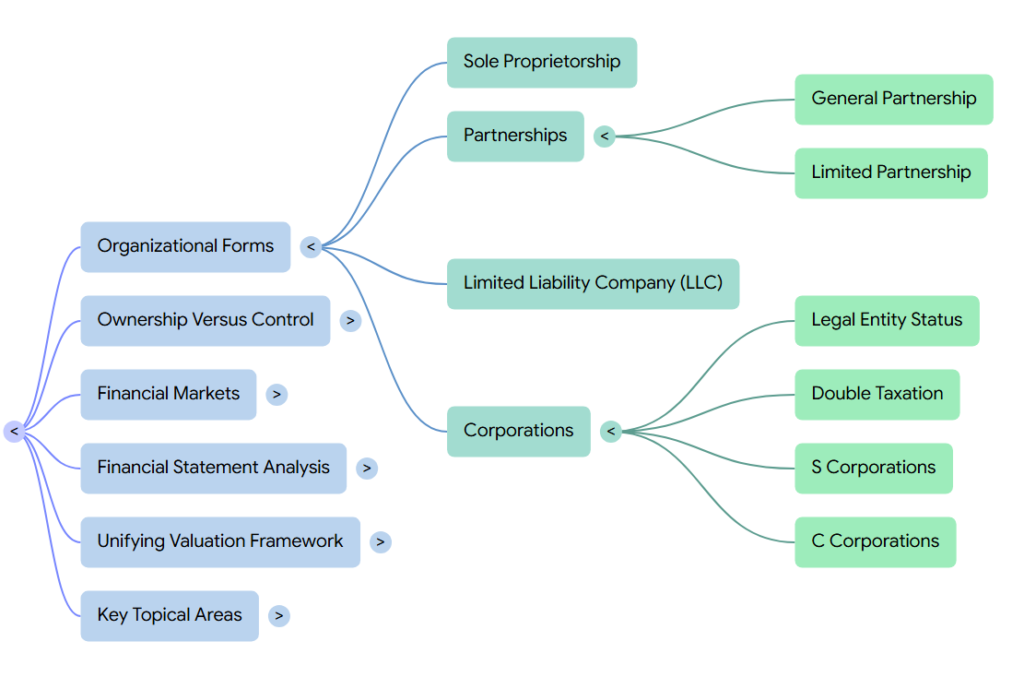
In the context of corporate finance, businesses are categorized into four primary organizational forms: sole proprietorships, partnerships, limited liability companies (LLCs), and corporations. While sole proprietorships are the most numerous, the corporation is the dominant form in terms of revenue and impact on the global economy.
1. Sole Proprietorships
A sole proprietorship is a business owned and operated by a single individual.
- Characteristics: These firms are straightforward to set up, making them popular for new businesses.
- Limitations: There is no legal separation between the owner and the business, meaning the owner has unlimited personal liability for any of the firm’s debts.
- Life and Ownership: The life of the firm is limited to the life of the owner, and transferring ownership is difficult.
- Economic Scale: In the United States, nearly 72% of businesses are sole proprietorships, yet they generate only 4% of total revenue.
2. Partnerships
Partnerships are similar to sole proprietorships but involve more than one owner.
- General Partnerships: All partners are personally liable for the firm’s entire debt. The partnership typically ends upon the death or withdrawal of any single partner.
- Limited Partnerships: This form includes both general partners, who manage the business and have unlimited liability, and limited partners, who have limited liability but no management authority. Limited partners’ interests are transferable and their withdrawal does not dissolve the partnership.
3. Limited Liability Companies (LLCs)
An LLC is a hybrid form that functions like a limited partnership but without a general partner.
- Liability: All owners have limited liability, protecting their personal assets from the firm’s creditors.
- Management: Unlike limited partners in a partnership, all owners of an LLC can actively participate in running the business.
- History: The LLC is a relatively recent development in the U.S., with the first statute passed in Wyoming in 1977.
4. Corporations
The corporation is a legally defined, artificial being (a legal entity) that is entirely separate from its owners.
- Legal Identity: It has the power to enter contracts, own assets, and borrow money. It is solely responsible for its own obligations, providing owners with limited liability.
- Ownership: Ownership is divided into shares of stock, collectively known as equity. There is no limit to the number of owners, and shares can be traded freely, which allows corporations to raise massive amounts of capital.
- Economic Impact: Corporations make up less than 18% of U.S. firms but are responsible for approximately 82% of U.S. revenue.
- Legal Foundation: The modern U.S. corporation was significantly shaped by the 1819 Supreme Court case Dartmouth College v. Woodward, which established that a corporation’s property is private and protected by the Constitution.
5. Ownership Versus Control
A defining feature of large corporations discussed in corporate finance is the separation of ownership and control.
- Governance: Shareholders exercise control indirectly by electing a board of directors, which sets policy and monitors performance. The board delegates day-to-day operations to management, led by the Chief Executive Officer (CEO).
- Agency Problems: This separation can lead to agency problems, where managers may prioritize their own interests (such as “empire building” or personal perks) over the maximization of shareholder value.
6. Tax Implications
Organizational forms differ significantly in their tax treatment under U.S. law:
- C Corporations: Most large corporations are subject to double taxation. The firm first pays corporate income tax on its profits, and then shareholders pay personal income tax on any dividends received.
- S Corporations: Smaller firms (fewer than 100 shareholders who are U.S. citizens/residents) can elect S-status to be exempt from corporate income tax. Profits and losses are instead allocated directly to shareholders’ individual tax returns.
Sole Proprietorship
In the study of corporate finance, the sole proprietorship is identified as one of the four primary types of business firms, standing alongside partnerships, limited liability companies (LLCs), and corporations. While it is the most common form of business in the world by sheer number, it represents a relatively small fraction of total economic revenue.
Definition and Characteristics
A sole proprietorship is a business owned and operated by a single individual. These businesses are typically small and may have few or no employees. They are characterized by several distinct features:
- Ease of Setup: They are straightforward to establish, making them a popular choice for many new businesses.
- Lack of Legal Separation: There is no legal distinction between the owner and the business entity. The firm can have only one owner, and other investors cannot hold an ownership stake in this form.
- Unlimited Personal Liability: This is considered the principal limitation of the form. The owner is personally responsible for all the firm’s debts; if the business defaults, creditors can seize the owner’s personal assets to satisfy the debt.
- Limited Life and Transferability: The life of the business is tied to the life of the owner. Furthermore, transferring ownership of a sole proprietorship is difficult compared to other organizational forms.
Economic Impact and Transition
Despite their prevalence, sole proprietorships generate significantly less revenue than corporations. In the United States, nearly 72% of all businesses are sole proprietorships, yet they account for only approximately 4% of total business revenue. In contrast, corporations make up less than 18% of firms but are responsible for 82% of U.S. revenue.
Because of the disadvantages—specifically unlimited liability and limited access to capital—most successful businesses eventually transition away from this form. As soon as a firm grows to a point where it needs to borrow without the owner being personally liable or requires outside equity for growth, owners typically convert the business into a corporation or a limited liability form.
Taxation and Comparison to Other Forms
In the broader context of organizational forms, sole proprietorships share certain similarities and differences with other structures:
- Tax Advantage: Unlike “C” corporations, which are subject to double taxation (once at the corporate level and again when dividends are distributed), sole proprietorships are not subject to corporate income tax. Instead, the owner simply pays personal income taxes on the business profits.
- Comparison to Partnerships: A partnership is effectively identical to a sole proprietorship in its lack of legal separation and its tax treatment, except that it has more than one owner.
- Contrast with Corporations: The defining feature of a corporation in corporate finance is that it is a “legally defined, artificial being” separate from its owners, providing shareholders with the limited liability that sole proprietors lack.
Partnerships
In the study of corporate finance, a partnership is defined as a business entity owned by more than one individual. While it shares many legal characteristics with a sole proprietorship, it allows for the pooling of capital and expertise among multiple associates. Despite their importance in professional services and investment sectors, partnerships and limited liability companies combined represent a relatively small portion of the total number of U.S. firms and revenue compared to corporations.
General Partnerships
A general partnership is essentially a sole proprietorship with multiple owners. Its primary characteristics include:
- Unlimited Personal Liability: This is the most significant drawback, as each partner is personally responsible for the firm’s entire debt. If the business fails, a lender can require any partner to repay all outstanding obligations from their personal assets.
- Limited Life: Generally, the partnership dissolves upon the death or withdrawal of any single partner. However, partners can often avoid liquidation through agreements that provide for the buyout of a deceased or withdrawn member.
- Reputation and Professionalism: This form is frequently used by law firms, medical groups, and accounting firms where personal reputation is critical. In these professions, the partners’ personal liability can increase client confidence that the partners will strive to maintain their professional standing.
Limited Partnerships and Specialized Forms
To mitigate some of the risks of the general partnership, corporate finance identifies several hybrid organizational forms:
- Limited Partnerships: These consist of two types of owners: general partners, who manage the business and have unlimited liability, and limited partners, who have liability limited to their investment and no management authority. This structure is the dominant form in industries like private equity and venture capital.
- Limited Liability Partnerships (LLPs) and LLCs: Many states allow LLPs or Limited Liability Companies (LLCs), which provide all partners with limited liability.
- Master Limited Partnerships (MLPs): Some large entities, like energy pipeline companies, are organized as master limited partnerships, which are traded on public exchanges like corporations but retain the tax benefits of a partnership.
Tax Implications
One of the primary advantages of the partnership form is its tax treatment. Unlike “C” corporations, which face double taxation, partnerships do not pay corporate income tax. Instead, all profits and losses are passed directly through to the partners, who report them on their individual tax returns.
Economic Context and Growth
While the partnership structure is useful for many businesses, it often proves inadequate as a firm grows. Historical examples in corporate finance include major investment banks like Goldman Sachs and Morgan Stanley, which originated as partnerships but eventually reorganized as corporations because their financing requirements and number of owners became too large for the partnership form to manage effectively.
Statistically, partnerships (excluding LLCs) account for approximately 3.4% of U.S. businesses and generate about 5.1% of total business revenue. In contrast, corporations make up 17.5% of firms but command over 82% of the total revenue.
General Partnership
In the study of corporate finance, a general partnership is defined as a business owned and operated by more than one person where there is no legal separation between the owners and the entity. It is essentially a sole proprietorship that has been expanded to include multiple owners who share in decision-making and profit-splitting.
Core Characteristics
The defining feature of a general partnership is unlimited personal liability. Every partner is personally responsible for the entirety of the firm’s debts; if the business defaults on a loan, a lender can require any partner to repay the obligation using their personal assets. Additionally, the life of a general partnership is typically limited to the lifespan of its owners. The partnership generally dissolves upon the death or withdrawal of any single partner, although many firms avoid liquidation through specific buyout agreements.
Professional and Economic Context
General partnerships are frequently utilized in professional service sectors where personal reputation is critical, such as law, medicine, and accounting. In these fields, the partners’ personal liability serves as a signal to clients that the professionals will strive to maintain high standards and protect their reputations.
From an economic perspective, partnerships (including general and limited forms) represent a small segment of the market compared to corporations. In the United States, they account for approximately 3.4% of businesses and generate roughly 5.1% of total business revenue. Many major investment banks, including Goldman Sachs and Morgan Stanley, originated as partnerships but eventually reorganized into corporations because their financing needs and number of owners grew too large for the partnership structure to manage effectively.
Taxation and Hybrid Forms
A primary advantage of this organizational form is its tax treatment. Unlike “C” corporations, which face double taxation, general partnerships do not pay corporate income tax. Instead, all profits and losses are passed directly through to the partners, who report them on their individual tax returns.
In the broader context of partnerships, the general partnership serves as the baseline form. It is often contrasted with specialized hybrid forms:
- Limited Partnerships: These include at least one general partner with unlimited liability and management authority, alongside limited partners who have no management authority and whose liability is limited to their initial investment.
- Limited Liability Partnerships (LLPs): These allow all partners to enjoy limited liability, protecting their personal assets from the firm’s creditors.
- Master Limited Partnerships (MLPs): These are large partnerships that are publicly traded on stock exchanges while retaining the tax benefits of a partnership.
Limited Partnership
In the study of corporate finance, a limited partnership is a specialized business structure that differentiates between two distinct classes of owners: general partners and limited partners. This form is often used when a business requires a combination of expert management and significant outside capital.
Roles and Liability of Partners
The primary distinction between the two types of partners lies in their legal liability and their authority to manage the business:
- General Partners: These partners function similarly to owners in a standard partnership. They possess full management authority and are responsible for all investment and operational decisions. Crucially, they have unlimited personal liability for the firm’s debt obligations, meaning their private property can be seized by creditors if the firm defaults.
- Limited Partners: These owners are primarily investors and have limited liability, which is restricted to the amount of their initial investment. Unlike general partners, they have no management authority and are legally barred from participating in the firm’s day-to-day decision-making. Their role is typically limited to monitoring the performance of their investments.
Transferability and Continuity
Limited partnerships offer greater flexibility regarding ownership changes than general partnerships. According to corporate finance, the death or withdrawal of a limited partner does not dissolve the partnership, and their ownership interest is generally transferable to others. In contrast, a general partnership typically ends upon the death or withdrawal of any single partner unless prior buyout agreements are in place.
Industry Applications
This organizational form is the dominant structure in specific high-stakes investment sectors:
- Venture Capital and Private Equity: These industries rely heavily on limited partnerships. In these cases, a few general partners contribute a portion of the capital and manage the funds, while large institutional investors (like pension funds or endowments) act as limited partners, providing the bulk of the financing.
- Master Limited Partnerships (MLPs): Some large entities, such as energy pipeline companies, are organized as master limited partnerships. These allow “units” of ownership to be traded on public stock exchanges, providing limited partners with liquidity similar to that of corporate shareholders while maintaining partnership tax status.
Tax and Legal Context
Like other partnerships, limited partnerships are “pass-through” entities for tax purposes. They do not pay corporate income tax; instead, all profits and losses are allocated directly to the partners, who report them on their individual tax returns.
In the broader context of organizational forms, the limited partnership serves as a bridge between the simple partnership and the corporation. While it allows for larger-scale capital raising from limited partners who seek to avoid personal liability, it still requires at least one general partner to bear unlimited liability. To mitigate this risk, corporate finance notes that general partners can themselves be corporations, effectively placing a shield of limited liability between the partnership’s debts and the individuals who own the general partner [785n].
Limited Liability Company (LLC)
In the study of corporate finance, a Limited Liability Company (LLC) is defined as a hybrid organizational form that functions like a limited partnership but without the requirement of a general partner. It is one of the four primary types of business firms, alongside sole proprietorships, partnerships, and corporations.
Core Characteristics
- Limited Liability: The distinguishing feature of an LLC is that all its owners have limited liability, meaning their personal assets are protected from the firm’s creditors and cannot be seized to satisfy the business’s outstanding debts.
- Management Participation: Unlike limited partners in a limited partnership, all owners of an LLC have the legal authority to run the business and participate in managerial decision-making.
- Tax Advantage: Similar to partnerships, LLCs generally do not pay corporate income tax; instead, profits and losses are passed directly through to the owners, who report them on their individual tax returns.
Historical and International Context
According to corporate finance, the LLC is a relatively recent development in the United States, with the first statute passed in Wyoming in 1977 and the final state, Hawaii, adopting it in 1997. However, the concept is much older internationally. LLCs rose to prominence in Germany over a century ago as a Gesellschaft mit beschränkter Haftung (GmbH) and are known as Société à responsabilité limitée (SARL) in France, and by similar designations in Italy (SRL) and Spain (SL).
Economic Scale and Comparison
In the broader landscape of organizational forms, LLCs represent a significant but mid-sized segment of the U.S. economy:
- Prevalence: LLCs account for approximately 7.2% of all U.S. businesses.
- Revenue Impact: They generate roughly 8.9% of total U.S. business revenue.
- Contrast with Other Forms: While sole proprietorships are more numerous (71.9%), they generate less revenue (3.8%). Conversely, corporations are less numerous than sole proprietorships (17.5%) but dominate the economy by generating over 82% of total revenue.
In the context of corporate finance, the LLC offers a middle ground for businesses that have grown too large for a sole proprietorship but wish to avoid the “double taxation” typically associated with large “C” corporations. Professional groups such as doctors, lawyers, and accountants frequently utilize related forms like the Professional Limited Liability Company (PLCC) to maintain limited liability while remaining personally accountable for professional malpractice.
Corporations
In the study of corporate finance, the corporation is distinguished as the most significant organizational form due to its unique legal structure, which enables it to raise vast amounts of capital and dominate global economic activity. Unlike other business forms where the entity and the owners are often legally indistinguishable, the corporation is a legally defined, artificial being (a judicial person or legal entity) that is entirely separate from its owners.
1. Legal Identity and Formation
A corporation possesses many of the same legal powers as a person: it can enter into contracts, acquire assets, borrow money, and sue or be sued.
- Legal Protections: The modern U.S. corporation was fundamentally shaped by the 1819 Supreme Court case Dartmouth College v. Woodward, which established that corporate property is private and protected under the U.S. Constitution from state seizure.
- Establishment: Corporations must be formally chartered by a state. Many choose to incorporate in Delaware due to its attractive legal environment. The initial rules governing the firm are specified in a corporate charter, which includes articles of incorporation and bylaws.
- Permanence: Because it is a separate legal entity, the corporation has permanence; it continues to exist even if its owners or managers leave or die.
2. Ownership and Limited Liability
Ownership in a corporation is divided into shares of stock, collectively known as equity.
- Limited Liability: This is a defining advantage of the corporate form. Shareholders are not personally responsible for the firm’s debts; they can lose their entire investment, but creditors cannot seize their personal assets to satisfy the corporation’s obligations.
- Anonymous Investment: There is no limit to the number of shareholders, and no special expertise is required to own stock. This allows for the free trade of shares on stock markets, enabling corporations to raise substantial capital from anonymous outside investors.
3. Ownership Versus Control
In large corporations, it is often unfeasible for thousands or millions of owners to manage the business directly. This results in a separation of ownership and control.
- Governance: Shareholders exercise control indirectly by electing a board of directors, which possesses ultimate decision-making authority.
- Management: The board delegates day-to-day operations to a management team led by the Chief Executive Officer (CEO). The Chief Financial Officer (CFO) typically reports to the CEO and oversees financial operations.
- Agency Problems: This separation can lead to agency problems, where managers (as agents) may prioritize their own self-interests—such as “empire building” or personal perks—over the interests of the shareholders (the principals).
4. Tax Implications
Taxation is a major factor distinguishing corporations from other organizational forms:
- C Corporations: Most large corporations are subject to double taxation. The firm first pays corporate income tax on its profits, and then shareholders pay personal income tax on any dividends received.
- S Corporations: The U.S. tax code allows certain smaller firms (fewer than 100 shareholders) to elect “S” status, which exempts them from corporate income tax. Instead, profits and losses are allocated directly to shareholders to report on their individual tax returns.
5. Economic Impact and Comparison
Although sole proprietorships are the most common type of firm (making up 72% of U.S. businesses), they generate only 4% of total revenue. In contrast, corporations make up less than 18% of firms but are responsible for 82% of U.S. revenue. Successful businesses that start as sole proprietorships or partnerships often reorganize as corporations once they reach a size where they require outside equity or need to borrow without the owners being personally liable.
Legal Entity Status
In the study of corporate finance, the distinguishing feature of a corporation is that it is a legally defined, artificial being (also referred to as a judicial person or legal entity) that exists entirely separate from its owners.
Core Legal Characteristics
As a distinct legal person, a corporation possesses many of the same powers and protections as an actual person:
- Legal Powers: It can enter into binding contracts, acquire and own assets, borrow or lend money, and incur its own obligations.
- Litigation: It has the capacity to sue other entities and can be sued in its own name.
- Constitutional Protection: Under the U.S. Constitution, a corporation’s property is treated as private property and is protected against state seizure, a precedent established by the 1819 Supreme Court case Dartmouth College v. Woodward.
Implications of Entity Status
The legal separation between the corporation and its owners has profound effects on its financial and operational structure:
- Limited Liability: Because the corporation is a separate entity, it is solely responsible for its own debts. Consequently, the owners (shareholders) have limited liability, meaning they are not personally responsible for the firm’s obligations and can lose no more than their initial investment.
- Permanence and Continuity: Unlike a sole proprietorship or partnership, which may dissolve upon the death of an owner, a corporation has permanence. It can, in principle, live forever because its existence is not disrupted by the transfer of shares or the replacement of management.
- Taxation: As a separate legal person, the corporation’s profits are taxed independently of its owners’ personal income. This often results in “double taxation” for “C” corporations, where the firm first pays corporate income tax on its profits, and then shareholders pay personal income tax on any dividends received.
- Raising Capital: The entity status allows for the division of ownership into shares of stock that can be traded freely. This enables the corporation to raise massive amounts of capital from anonymous outside investors who do not need special expertise to participate in ownership.
In the broader context of organizational forms, this status as a separate “artificial being” is what primarily differentiates the corporation from sole proprietorships and general partnerships, where no such legal separation exists between the business and its owners.
Double Taxation
In the study of corporate finance, double taxation is defined as a primary characteristic of the corporate organizational form, stemming from the fact that a corporation is a legally defined, separate artificial being. Because of this legal separation, the firm’s profits are taxed independently from its owners’ tax obligations.
The Mechanism of Double Taxation
The process occurs in two distinct tiers:
- Corporate Level: The corporation first pays corporate income tax on the profits it earns.
- Personal Level: When the remaining after-tax profits are distributed to shareholders as dividends, those shareholders must then pay personal income tax on that income.
For example, if a corporation earns $8 per share and faces a 25% corporate tax rate, it pays $2 in taxes, leaving $6 for distribution. If the shareholder then faces a 20% tax rate on dividend income, they pay an additional $1.20, leaving a final after-tax gain of only $4.80 from the original $8.
C Corporations vs. S Corporations
The impact of double taxation depends heavily on the specific corporate status under the U.S. tax code:
- C Corporations: Most large corporations are categorized as “C” corporations and are subject to the double taxation system described above.
- S Corporations: The Internal Revenue Code allows certain smaller firms (fewer than 100 shareholders who are U.S. citizens/residents) to elect “S” status. These entities are exempt from corporate income tax; instead, profits and losses are allocated directly to shareholders to report on their individual returns, effectively taxing the income only once.
Mitigation through Debt and Payout Policy
Corporate finance emphasizes that double taxation creates significant incentives for specific financial strategies:
- The Interest Tax Shield: Unlike dividend payments, which are made from after-tax income, interest payments on debt are tax-deductible expenses. This allows a portion of the firm’s earnings to escape taxation at the corporate level, creating an “interest tax shield” that increases the total value available to all investors.
- Dividends vs. Repurchases: Because dividends trigger immediate personal income tax, they are often considered tax-disadvantaged compared to share repurchases. Repurchases allow shareholders to defer taxes until they choose to sell their shares, and they have historically been taxed at lower capital gains rates.
International Context and Relief
Double taxation is a common challenge globally, but many countries offer relief mechanisms:
- Partial Relief: The United States provides partial relief by taxing dividends at a lower rate than ordinary income.
- Imputation Systems: Countries like Australia and New Zealand utilize an “imputation tax system”. Under this system, shareholders receive a tax credit for the corporate tax the firm has already paid on their behalf, effectively ensuring the income is only taxed once at the shareholder’s personal rate.
- Other Methods: Some nations, such as Estonia and Latvia, fully or partially exempt dividend income from personal taxes to avoid the double-tax penalty.
S Corporations
In the study of corporate finance, an S corporation is a specific type of corporation that elects a specialized tax status to avoid the “double taxation” typically associated with the corporate form. While they share the fundamental legal characteristics of all corporations, they are distinguished by their tax treatment and strict ownership limitations.
The Tax Advantage of S Status
The primary motivation for a firm to elect S status is to escape the double taxation system of “C” corporations.
- Avoidance of Double Taxation: Unlike C corporations, which pay tax at the corporate level before distributing dividends that are taxed again at the personal level, S corporations are exempt from corporate income tax.
- Pass-Through Treatment: The firm’s profits and losses are allocated directly to shareholders based on their ownership stake. Shareholders then report this income on their individual tax returns, regardless of whether the cash is actually distributed to them.
- Comparative Efficiency: For a shareholder in a high personal tax bracket, the effective tax rate on an S corporation’s earnings is often lower than the combined corporate and personal tax rate faced by a C corporation shareholder.
Legal Context and Ownership Restrictions
S corporations are “legally defined, artificial beings” separate from their owners, providing the same limited liability protections as any other corporation. However, to qualify for subchapter S treatment under the U.S. Internal Revenue Code, a firm must meet rigorous criteria:
- Shareholder Limit: There can be no more than 100 shareholders.
- Shareholder Residency: All shareholders must be individuals who are U.S. citizens or residents.
- Publicly Traded Limitations: Because most public corporations have no restrictions on the number or type of shareholders, they cannot qualify for S status. Consequently, most large corporations remain C corporations.
Economic Impact within the Corporate Form
Although the S corporation is a vital tool for smaller businesses, it represents a relatively small portion of the total corporate economic footprint:
- Revenue Share: S corporations account for less than one-quarter of all corporate revenue in the United States.
- Transition for Growth: Many successful businesses start as small entities (such as sole proprietorships or partnerships) and may transition to S status as they grow. However, if a firm reaches a scale where it needs to raise substantial capital from anonymous outside investors or public markets, it must typically reorganize as a C corporation.
In summary, while the corporate finance Sixth Edition focuses heavily on large C corporations due to their revenue dominance, it positions the S corporation as a hybrid-like solution that allows smaller firms to combine the legal benefits of incorporation with the tax efficiency of a partnership.
C Corporations
In corporate finance, C corporations are identified as the standard corporate form for large businesses because they possess no restrictions on the number or type of shareholders they can have. While they represent a relatively small percentage of total firms, they are the dominant organizational form in terms of economic impact, responsible for approximately 82% of all business revenue in the United States.
The Mechanism of Double Taxation
The primary distinguishing feature of a C corporation compared to other organizational forms is its tax treatment. Because a corporation is a “legally defined, artificial being” separate from its owners, its profits are taxed independently. This results in a system of double taxation:
- Corporate Level: The C corporation first pays corporate income tax on its earned profits.
- Personal Level: When the remaining after-tax profits are distributed to shareholders as dividends, those shareholders must pay personal income tax on that income.
Under current U.S. law, the federal corporate tax rate for C corporations is 21%. Some relief from double taxation is offered by taxing dividends at a lower rate than ordinary income for most individual investors.
Advantages for Large-Scale Capital Raising
Despite the tax disadvantage, the C corporation form is essential for firms seeking substantial growth. Unlike S corporations, which are limited to 100 individual shareholders who must be U.S. citizens or residents, C corporations have no such limitations. This allows them to:
- Access Public Markets: C corporations can trade their shares on organized stock exchanges, allowing them to raise massive amounts of capital from anonymous outside investors worldwide.
- Divide Ownership: Ownership is divided into shares of stock (equity), and an owner does not need special expertise to participate, which facilitates the free trade of shares.
- Provide Permanence: Because the corporation is a separate legal entity, it has permanence; its existence is not disrupted by the death of an owner or the transfer of shares.
Separation of Ownership and Control
In the broader context of corporations, C corporations—particularly large, public ones—are characterized by a distinct separation of ownership and control. Thousands or even millions of shareholders own the firm but do not manage its day-to-day operations. Instead, they exercise control indirectly by electing a board of directors, which possesses ultimate decision-making authority and delegates daily management to a team led by the Chief Executive Officer (CEO).
While this structure allows for professional management, corporate finance notes it can also lead to agency problems, where managers may be tempted to prioritize their own interests over the maximization of shareholder value. Systems of corporate governance, including stock-based compensation and monitoring by the board, are utilized to align these conflicting interests.
— Linden Lake
This series:
→ Topic Review (1 of 6): Corporate Finance – Organizational Forms
→ Topic Review (2 of 6): Corporate Finance – Ownership Versus Control
→ Topic Review (3 of 6): Corporate Finance – Financial Markets
→ Topic Review (4 of 6): Corporate Finance – Financial Statement Analysis
→ Topic Review (5 of 6): Corporate Finance – Unifying Valuation Framework
→ Topic Review (6 of 6): Corporate Finance – Key Topical Areas
Leave a Reply