
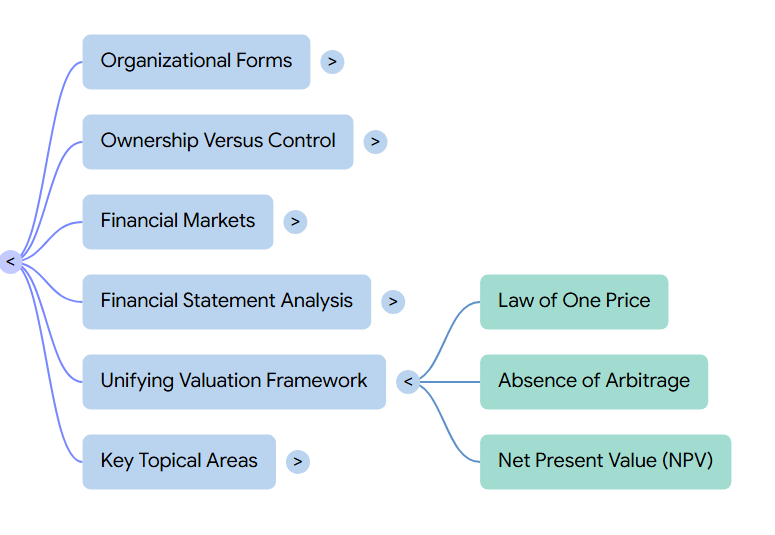
In corporate finance, the “Unifying Valuation Framework” is built upon the central principle that modern finance theory and practice are grounded in the Law of One Price and the absence of arbitrage. This framework serves as the “backbone” of the entire text and acts as a “compass” to keep financial decision-makers on the right track by connecting theoretical concepts to practical applications.
The Law of One Price and Absence of Arbitrage
The foundation of the framework is the idea that in competitive markets, equivalent investment opportunities must trade for the same price.
- Absence of Arbitrage: This concept implies that in a normal, efficient market, there are no opportunities to make a risk-free profit without any investment.
- A Unifying Principle: Corporate finance asserts that this single principle underlies all of financial economics, linking diverse topics such as the time value of money, bond pricing, and stock valuation.
The Valuation Principle
A key component of this framework is the Valuation Principle, which states that the value of an asset to a firm or its investors is determined solely by its competitive market price.
- Objective Measurement: By using market prices, managers can determine the cash value of a decision’s costs and benefits today, regardless of personal preferences.
- Wealth Maximization: When the market value of the benefits exceeds the market value of the costs, the decision will increase the overall market value of the firm.
Net Present Value (NPV) as the “Golden Rule”
The framework utilizes the NPV Decision Rule as the primary tool for evaluating investment opportunities.
- NPV Calculation: All costs and benefits are converted into a common unit—current dollars—using the appropriate market interest rate (discount rate).
- Maximizing Firm Value: According to corporate finance, to maximize the value of the entire firm, managers should accept all projects with a positive NPV, as the NPV represents a project’s contribution to the firm’s total value.
Separation and Value Additivity
Two other critical insights derived from this framework are the Separation Principle and Value Additivity:
- Separation Principle: This principle states that because security transactions in a normal market have an NPV of zero, a firm’s investment decisions (choosing projects) can be evaluated separately from its financing choices (how to pay for them).
- Value Additivity: Rooted in the Law of One Price, this concept holds that the value of a firm (or a portfolio) is equal to the sum of the values of its individual projects and investments. This allows managers to focus on the NPV of individual decisions as a direct measure of their impact on total firm wealth.
By integrating these principles, corporate finance provides a consistent methodology that allows managers to Master the complexities of financial decision-making across different asset classes and market conditions.
Law of One Price
In corporate finance, the “Unifying Valuation Framework” is described as the backbone of the entire discipline, grounded in the Law of One Price and the absence of arbitrage. This framework serves as a “compass” to keep financial decision-makers on the right track by connecting theoretical concepts to practical applications.
The Law of One Price (LOOP)
The core of this framework is the Law of One Price, which states that if equivalent investment opportunities trade simultaneously in different competitive markets, they must trade for the same price in all markets.
- Arbitrage and Market Efficiency: The Law of One Price is equivalent to the principle of no-arbitrage, which assumes that in a normal, competitive market, there are no opportunities to make a risk-free profit without investment. If prices diverge, arbitrageurs will immediately exploit the difference, buying in the cheap market and selling in the expensive one until the prices are equalized.
- A Unifying Principle: corporate finance asserts that this single principle underlies all of financial economics, linking diverse topics such as the time value of money, bond pricing, and stock valuation.
The Valuation Principle
Derived directly from the Law of One Price, the Valuation Principle states that the value of an asset to a firm or its investors is determined solely by its competitive market price.
- Objective Measurement: By using market prices, managers can determine the cash value of a decision’s costs and benefits today, regardless of personal tastes or opinions.
- Wealth Maximization: When the value of the benefits from a decision exceeds the value of the costs, the decision will increase the overall market value of the firm.
Net Present Value (NPV) as the “Golden Rule”
The framework utilizes the NPV Decision Rule as the primary tool for evaluating investment opportunities.
- NPV Calculation: All costs and benefits are converted into a common unit—present-day dollars—using the appropriate market interest rate.
- Maximizing Firm Value: According to corporate finance, to maximize the value of the entire firm, managers should accept all projects with a positive NPV, as the NPV represents a project’s contribution to the firm’s total value.
The Separation Principle and Value Additivity
The Unifying Valuation Framework provides two other critical insights that simplify complex corporate decisions:
- Separation Principle: This principle states that because security transactions in a normal market have an NPV of zero, a firm’s investment decisions (choosing projects) can be evaluated separately from its financing choices (how to pay for them). This allows managers to focus on creating value through real projects rather than financial “alchemy”.
- Value Additivity: Rooted in the Law of One Price, this concept holds that the value of a firm or a portfolio is equal to the sum of the values of its parts. This ensures that the NPV of an individual project is a direct measure of its impact on the total wealth of the firm.
By integrating these principles, corporate finance provides a consistent methodology that allows managers to apply the Law of One Price to value a vast range of financial securities and physical investment projects based on current market data.
Absence of Arbitrage
In corporate finance, the “Unifying Valuation Framework” is built upon the foundational principle that modern finance theory and practice are grounded in the absence of arbitrage. This principle serves as the “backbone” of the entire text and acts as a “compass” to guide financial decision-makers by connecting theoretical concepts to practical applications across diverse topics such as the time value of money, bond pricing, and stock valuation.
Arbitrage and the Normal Market
Arbitrage is defined as the practice of buying and selling equivalent goods in different markets to take advantage of a price difference. More generally, an arbitrage opportunity is any situation where it is possible to make a profit without taking any risk or making an initial investment. In corporate finance, a competitive market in which no such opportunities exist is referred to as a normal market. Because arbitrage opportunities have a positive Net Present Value (NPV), investors in financial markets race to exploit them immediately, causing prices to respond until the opportunity evaporates. Consequently, the normal state of affairs in competitive markets is the absence of arbitrage.
The Law of One Price (LOOP)
The absence of arbitrage is equivalent to the Law of One Price, which states that if equivalent investment opportunities trade simultaneously in different competitive markets, they must trade for the same price in all markets. If prices were to differ, arbitrageurs would profit by buying in the cheap market and selling in the expensive one until prices are equalized. This law allows practitioners to use any competitive market price to determine a cash value without having to check every possible market.
Practical Applications of the Framework
The Unifying Valuation Framework applies these principles to derive several core tools for financial decision-making:
- The Valuation Principle: This central idea states that the value of an asset to a firm or its investors is determined solely by its competitive market price. Costs and benefits should be evaluated using these prices; when the value of benefits exceeds the costs, the decision increases the firm’s market value.
- Net Present Value (NPV): The framework utilizes the NPV Decision Rule as the “golden rule” of finance. By converting all costs and benefits into a common unit—present-day dollars—managers can identify projects that create wealth.
- No-Arbitrage Pricing: The price of any security must equal the present value of all the cash flows it will pay. If the price deviates from this value, an arbitrage opportunity arises.
- Zero-NPV Trading: A critical insight in corporate finance is that trading securities in a normal market is a zero-NPV transaction that neither creates nor destroys value. True value is created by real investment projects, such as developing new products or improving production efficiency.
Theoretical Pillars: Separation and Value Additivity
The framework provides two key insights that simplify complex corporate decisions:
- Separation Principle: Because security transactions in a normal market have an NPV of zero, a firm’s investment decisions (choosing projects) can be evaluated separately from its financing choices (how to pay for them).
- Value Additivity: Rooted in the Law of One Price, this concept holds that the value of a firm (or a portfolio) is equal to the sum of the values of its individual projects and parts. This ensures that maximizing the NPV of individual decisions is equivalent to maximizing the total value of the firm.
Adjustments for Risk and Friction
While the core framework is often introduced using risk-free cash flows, corporate finance emphasizes that the Law of One Price also applies to risky investments. To determine the present value of risky cash flows, managers must discount the expected payoff at a rate that includes a risk premium appropriate for the investment’s sensitivity to overall economic risk. Additionally, in the presence of transaction costs (such as bid-ask spreads), the Law of One Price continues to hold, though prices may deviate within a narrow range defined by those costs.
Net Present Value (NPV)
In the study of corporate finance, the “Unifying Valuation Framework” is grounded in the Law of One Price and the absence of arbitrage, serving as the “backbone” of the entire discipline. Within this framework, Net Present Value (NPV) acts as the “golden rule” of financial decision-making, providing a consistent method to identify projects and investments that create wealth.
Theoretical Foundation: The Valuation Principle
The framework relies on the Valuation Principle, which states that the value of an asset is determined solely by its competitive market price. By using market prices to convert costs and benefits into present-day dollars, managers can objectively measure the impact of a decision regardless of their own preferences. NPV is the tool that implements this principle by calculating the difference between the present value (PV) of a project’s benefits and the present value of its costs.
The NPV Decision Rule
The framework utilizes the NPV Decision Rule as the primary criterion for evaluating opportunities:
- Maximizing Wealth: Managers should always take the alternative with the highest NPV, as choosing this option is equivalent to receiving its NPV in cash today.
- Accept/Reject Criteria: A firm should accept any project with a positive NPV, as it increases the firm’s total market value, and reject any project with a negative NPV.
- Indifference to Cash Needs: Regardless of a firm’s current cash requirements or an investor’s preference for present versus future spending, they should always maximize NPV first. They can then use financial markets to borrow or lend and adjust cash flows to their preferred timing.
Theoretical Pillars and Insights
The integration of NPV into this unifying framework provides several critical insights for corporate finance:
- Zero-NPV Trading: In a normal market where no arbitrage opportunities exist, the NPV of trading securities is zero. Consequently, financial transactions like buying and selling stocks or bonds do not create value on their own; instead, value is created through real investment projects.
- The Separation Principle: Because security transactions are zero-NPV, the framework establishes that a firm’s investment decisions (the NPV of projects) can be evaluated separately from its financing choices.
- Value Additivity: Derived from the Law of One Price, this concept holds that the value of a firm is the sum of the values of its individual projects. This ensures that maximizing the NPV of individual decisions is mathematically equivalent to maximizing the overall value of the entire corporation.
Adjustment for Risk
While often introduced using risk-free examples, the framework extends to risky investments. In these cases, NPV is calculated by discounting expected future cash flows at a rate that includes a risk premium appropriate for the investment’s sensitivity to broader economic risk. This consistency allows the Law of One Price to remain the unifying principle even in complex, uncertain environments.
— Linden Lake
This series:
→ Topic Review (1 of 6): Corporate Finance – Organizational Forms
→ Topic Review (2 of 6): Corporate Finance – Ownership Versus Control
→ Topic Review (3 of 6): Corporate Finance – Financial Markets
→ Topic Review (4 of 6): Corporate Finance – Financial Statement Analysis
→ Topic Review (5 of 6): Corporate Finance – Unifying Valuation Framework
→ Topic Review (6 of 6): Corporate Finance – Key Topical Areas
Leave a Reply