
In the context of bank management, the book describes financial services as an ever-expanding array of functions—including credit, savings, payments, and risk protection—that are essential to the well-being of individuals, businesses, and governments. Modern banks no longer limit themselves to traditional lending but have increasingly become “general financial-service providers” that act as “financial department stores” or “full-service financial institutions”.
The Spectrum of Financial Services
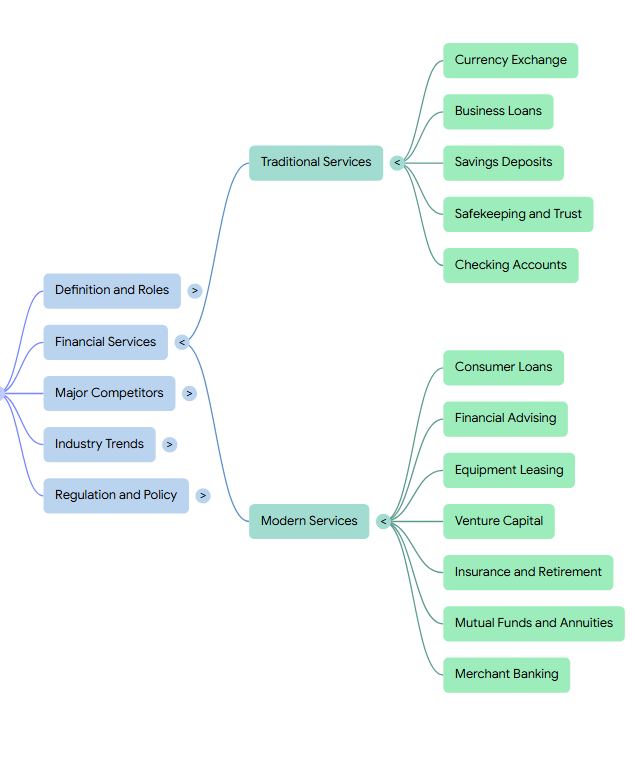
The book categorizes financial services into those offered for centuries and those that emerged more recently:
- Traditional Services: These include carrying out currency exchanges, discounting commercial notes, making business loans, offering savings deposits, providing trust services, and the safekeeping of valuables [123–135].
- Modern Services: Over the past century, the menu has grown to include consumer loans, financial advising, cash management, equipment leasing, venture capital loans, insurance policies, retirement plans, security brokerage, and investment banking [136–143].
The “Financial Department Store” and Convergence
A dominant theme in the book is convergence, a trend where different types of financial-service providers (such as banks, insurance companies, and security firms) invade each other’s territory. This leads to “universal banking,” where a single firm can meet all of a customer’s financial needs—banking, insurance, and security brokerage—under one roof. The book notes that this trend is often driven by a desire to find new revenue sources (service fees) that are not highly correlated with traditional lending, thereby stabilizing earnings and reducing overall risk.
Systemic Roles within the Financial System
Beyond individual products, financial services perform critical roles that maintain the “machinery” of the global economy:
- Intermediation: Encouraging savings and transferring those funds to those planning to invest in new projects, which fuels economic growth and creates jobs.
- Payments: Providing the infrastructure for commerce through checks, credit/debit cards, and electronic transfers.
- Risk Management: Assisting customers in preparing for financial losses through insurance, hedges, and derivative contracts.
- Agency and Fiduciary Roles: Acting as an agent for customers to manage and protect their property through trust departments.
The Influence of Technology and Innovation
The book emphasizes that the production and delivery of financial services have shifted toward automation and electronic systems. Innovations such as automated teller machines (ATMs), Point-of-Sale (POS) terminals, and Internet banking have depersonalized services but significantly lowered per-unit costs and increased customer convenience [157, 158, 511–512]. This technological evolution has turned the financial-services sector into a more capital-intensive, information-oriented industry.
Ultimately, the book suggests that the management of these services is the essence of modern banking; a firm’s success depends on its ability to identify the services the public demands, produce them efficiently, and sell them at a competitive price.
Traditional Services
In the larger context of financial services, the book defines traditional services as those functions that banks and their closest competitors have offered for centuries. While modern financial firms have expanded into diverse areas such as insurance and investment banking, these traditional offerings remain the core foundation of the industry.
Core Traditional Services
The book identifies several key services that characterize the historical role of financial institutions:
- Carrying Out Currency Exchanges: One of the earliest services involved trading one form of coin or currency for another in return for a fee, a function that was vital to travelers.
- Discounting Commercial Notes and Making Business Loans: Early bankers provided credit to merchants by purchasing their accounts receivable at a discount or granting direct loans for inventory and new facilities.
- Offering Savings Deposits: Banks attracted interest-bearing funds from savers to create a pool of money that could then be loaned out to borrowers at a higher rate of interest.
- Safekeeping of Valuables and Certification of Value: Historically, “goldsmiths” held gold and other valuables in secure vaults and certified their true market value for customers.
- Supporting Government Activities with Credit: For centuries, governments have relied on banks to purchase their bonds to fund wars and other public projects, often making this a requirement for receiving a bank charter.
- Offering Checking Accounts (Demand Deposits): Developed during the Industrial Revolution, these services allowed customers to write drafts for immediate payment, significantly increasing the safety and efficiency of the payments process.
- Offering Trust Services: Banks have long managed the property and financial affairs of individuals and businesses for a fee, acting as trustees for wills and managing estates.
Context within Modern Financial Services
The book explains that while these services were once the primary way to identify a bank, the industry has undergone a revolution toward “convergence“. Traditional services are now just one part of a massive array of offerings provided by institutions that function as “financial department stores” or “universal banks“.
In this broader context, the management of traditional services has become more complex. Modern financial-service providers must now cross-sell these traditional offerings alongside newer products like mutual funds and insurance to remain competitive. Ultimately, the book suggests that the success of a modern financial firm hinges on its ability to produce both traditional and modern services efficiently and sell them at a competitive price.
Currency Exchange
The book identifies currency exchange as one of the most fundamental traditional services, with roots that stretch back to the very origins of the banking profession. Within the larger context of traditional services—those functions that banks and their competitors have offered for centuries—currency exchange served as the cornerstone for early financial intermediation.
Historical Origins and the First Bankers
The book explains that the first bankers, more than 2,000 years ago, were essentially money changers. Historical records and etymology show that the words banque (French) and banca (Italian) referred to a “bench” or “money changer’s table” located in commercial districts. These early practitioners aided travelers by exchanging foreign coins for local money or replacing commercial notes for cash in return for a service fee.
The Mechanism of Currency Exchange
As a traditional service, the process is straightforward: a banker stands ready to trade one form of coin or currency (such as dollars) for another (such as euros or pesos). The book notes that this function has remained vital to travelers over the centuries because their survival and comfort often depend on gaining immediate access to local funds. This ability to mobilize and exchange funds across borders laid the groundwork for more complex services, such as supporting government activities with credit and facilitating the Industrial Revolution through new payment methods.
Modern Context: From Tables to FOREX
While it began as a simple exchange at a merchant’s table, the book highlights that this traditional service has evolved into the massive global Foreign Exchange (FOREX) market. In the modern context of international banking, this service has expanded to meet the needs of:
- Importers and Exporters: Who receive or must pay large amounts of foreign currency for goods and raw materials.
- Investors: Who require foreign currency to purchase international securities or complete cross-border mergers and acquisitions.
Today, the book notes that leading international banks—such as Citigroup, Deutsche Bank, and HSBC—routinely hold working balances of the most in-demand currencies. Trading volume in these markets now frequently exceeds a trillion dollars a day, reflecting how this core traditional service has become a vital component of the global financial system.
Business Loans
The book states that business loans, specifically the practice of discounting commercial notes and making direct business loans, are among the oldest services offered by banks, with roots extending back for centuries. Historically, this traditional service involved bankers purchasing accounts receivable from local merchants at a discount to provide them with immediate cash, which gradually evolved into granting direct credit for purchasing inventory or constructing new facilities.
Within the larger context of traditional services, business loans are identified as a primary economic function that fuels growth, creates jobs, and raises living standards by transferring savings from surplus-spending units to businesses planning new projects. The book identifies several key aspects of business loans in this traditional framework:
- Self-Liquidating Mechanics: A hallmark of traditional business lending is the self-liquidating inventory loan, which follows a firm’s natural cash cycle where funds are borrowed to acquire raw materials and then repaid as those finished goods are sold to customers.
- Economic Importance: For small businesses, banks are often the major source of credit needed to stock shelves or fund working capital, making this traditional role vital to the well-being of local communities.
- Role in Defining a Bank: Historically, the legal definition of a bank was based on two traditional services: offering deposits subject to withdrawal on demand and making loans of a commercial or business nature.
- Security and Trust: More than any other financial-service firm, banks have maintained a reputation for public trust through their traditional roles as counselors and lenders to the business sector.
The book notes that while these services have been offered for centuries, the modern landscape has changed, as traditional business loans are now part of a massive array of offerings provided by “financial department stores” that must compete with finance companies and securities markets. Despite this evolution, the book emphasizes that making loans to fund business investment remains the principal economic function of banks and their closest competitors.
Savings Deposits
The book identifies savings deposits as one of the fundamental services that banks have offered for centuries. Historically, these accounts consist of interest-bearing funds left with a depository institution for a period of time. Records from ancient Greece show that early banks used high interest rates to attract these deposits from wealthy patrons, then loaned those funds to Mediterranean ship owners at even higher rates to generate a profit spread.
In the larger context of traditional financial services, savings deposits—also referred to as “thrift deposits”—are designed to attract funds from customers who wish to set aside money for future expenditures or financial emergencies. While these accounts generally pay significantly higher interest rates than transaction (checking) deposits, they are typically less costly for the institution to process and manage. Traditionally, this service was offered through passbook savings accounts, which often required only a small opening balance and allowed for unlimited withdrawals.
Modern iterations of this traditional service include statement savings deposits, which are evidenced by computer entries rather than physical booklets. The book notes that while individuals, nonprofit organizations, and governments can hold savings deposits without many restrictions, business firms in the United States are generally limited to placing no more than $150,000 in such accounts.
From a management perspective, savings deposits are considered a relatively cheap and stable source of funds because they often carry the lowest annual interest yields (APY) among interest-bearing accounts. They are essential to the functioning of the global financial system, providing the necessary “raw material” that allows banks and their competitors to fund loans for businesses and households. Even as banking has evolved internationally, supplying these thrift instruments remains a core service for multinational institutions serving foreign markets.
Safekeeping and Trust
In the larger context of traditional services, the book identifies safekeeping and trust services as fundamental offerings that have characterized the financial-services industry for centuries. These services are rooted in a financial institution’s historic role as a fiduciary, responsible for managing and protecting customer property.
Historical Origins and the Role of Safekeeping
The book explains that safekeeping services began in the Middle Ages when bankers and other merchants, often referred to as “goldsmiths,” started holding gold and other valuables for their customers in secure vaults. This practice addressed the public’s fear of loss due to war, theft, or government expropriation.
Key aspects of this traditional service include:
- Certification of Value: Goldsmiths would assay valuables to certify their true market value, a process similar to modern property appraisal.
- Circulation of Certificates: Historically, the certificates issued by goldsmiths to depositors began to circulate as a form of money because they were more convenient and less risky to carry than the physical gold itself.
- A Foundation of Trust: This role provided a cornerstone for public confidence, as customers relied on the institution’s reputation for honesty and its ability to safeguard their wealth.
The Evolution and Scope of Trust Services
Trust services involve the management of property owned by customers, such as cash, land, buildings, and securities, in return for a fee. While the book notes that these services were once regarded as relatively staid and sometimes unprofitable due to the high-priced talent required, they remain a vital source of fee income and new deposits today.
According to the book, traditional trust roles include:
- Executing Wills and Estates: Acting as trustees for wills, trust departments manage the estates of deceased customers, pay claims against them, and ensure legal heirs receive their inheritance.
- Managing Retirement Plans: Trust departments are active in managing employee pension and profit-sharing programs for businesses.
- Corporate Agency Roles: They act as agents for corporations by issuing new stocks and bonds and managing the subsequent dividend and interest payments.
- Guardian and Fiduciary Responsibilities: Trust officers may act as guardians for assets held for minors or for adults judged legally incompetent to manage their own affairs.
Context within Traditional and Modern Services
Within the broader spectrum of traditional services, safekeeping and trust management are essential because they emphasize the agency role of financial firms—acting on behalf of customers to protect their interests. The book highlights that while these services have been offered for centuries, they are now part of a rapidly diversifying menu of offerings provided by “financial department stores”. Despite the rise of modern digital and electronic services, the fiduciary trust between a customer and their banker continues to be a defining characteristic of the industry.
Checking Accounts
Checking accounts, formally referred to by The book as demand deposits, are categorized as a fundamental traditional service that emerged during the Industrial Revolution. While they are not as old as currency exchange, they are considered “centuries-old” in the sense that they have long been a core offering of banks and their closest competitors.
According to The book, the primary characteristics and roles of checking accounts within the traditional service framework include:
- Payment Efficiency: Checking accounts permit depositors to write drafts to pay for goods and services, which the bank is obligated to honor immediately upon presentation. This innovation significantly improved the efficiency of the payments process, making transactions easier, faster, and safer than using physical cash.
- Legal Definitional Requirement: Historically, the legal definition of a bank was based on two traditional pillars: a business that both makes commercial loans and offers deposits subject to withdrawal on demand, such as checking accounts.
- A Component of the Payments Role: Checking accounts are the primary instrument through which financial institutions fulfill their “payments role” in the economy, providing the necessary infrastructure for commerce and markets to function.
- Expansion and Competition: Although once a hallmark of commercial banking, The book notes that these payment services are now also provided by credit unions, savings associations, and securities brokers.
- Modern Transformation: The traditional “checking account concept” has evolved in the modern era to include plastic debit cards that tap accounts electronically, “smart cards” that store spending power, and Internet-based payment systems.
Despite these modern technological shifts, The book emphasizes that the ability to offer a secure and reliable mechanism for making payments remains a cornerstone of the traditional relationship between a bank and its customers.
Modern Services
In the larger context of financial services, the book describes modern services as a rapidly expanding menu of nontraditional functions that have transformed banks from simple intermediaries into “general financial-service providers” or “financial department stores“. Developed primarily within the past century, these services are designed to meet the complex needs of modern households, businesses, and governments while creating new, noninterest revenue streams for financial institutions.
The Expansion of Modern Service Menus
According to the book, modern services encompass a diverse range of products that go far beyond traditional lending and deposit-taking:
- Consumer Lending: While banks once focused on business credit, they began aggressively pursuing individuals and families in the 20th century for automobile, home appliance, and personal loans.
- Financial Advising and Cash Management: Many firms now offer professional advice on building savings, preparing financial plans, and managing business cash collections and disbursements.
- Equipment Leasing and Venture Capital: Financial firms frequently purchase equipment to rent to customers or provide start-up capital for new, young businesses through specialized venture capital affiliates.
- Insurance and Retirement Planning: Following the removal of legal barriers like those in the Glass-Steagall Act, banks now sell and underwrite insurance policies and manage employee retirement and pension programs.
- Investment Banking and Security Brokerage: Modern institutions assist corporations and governments in raising new funds by underwriting security issues and executing buy/sell orders for stocks and bonds.
- Mutual Funds and Annuities: To compete with higher-yielding market instruments, many firms now offer professionally managed investment pools (mutual funds) and long-term income-generating savings plans (annuities).
- Risk Management and Hedging: Large banks dominate the field of risk intermediation, selling customers sophisticated tools like swaps, options, and futures contracts to protect against market fluctuations.
The Drivers of Modern Service Development
The book notes that the shift toward modern services is fueled by several powerful industry trends:
- Service Proliferation and Competition: Intense rivalry from nonbank firms (like mutual funds and insurance companies) has pressured banks to develop new services to prevent the erosion of their market share.
- Government Deregulation: Laws like the Gramm-Leach-Bliley Act have allowed different types of financial providers to converge, permitting “one-stop shopping” where a single firm meets all a customer’s financial needs.
- Technological Change: Advances in automation and the Internet have lowered the cost of producing and delivering high-volume modern services, though they have also depersonalized the customer relationship.
Risks and Regulatory Implications
While modern services offer higher profit potential through fees, the book emphasizes that they also introduce new challenges. Nontraditional investment products, for instance, are generally not insured by the FDIC and are subject to market loss, requiring strict disclosure rules to ensure customers are not misled. Furthermore, the complexity of modern risk-management tools can lead to less stable market conditions if not properly managed, as seen during recent credit crises. Ultimately, the book suggests that the management of these modern services is essential for the future viability of financial firms in a global, converging marketplace.
Consumer Loans
The book categorizes consumer loans as a central component of modern services, noting that while some financial functions have existed for centuries, aggressive lending to individuals and families is a development of the past hundred years.
The Emergence of Consumer Lending as a Modern Service
Historically, banks focused primarily on business credit, but early in the 20th century, they began to rely more heavily on consumers for deposits to fund large corporate loans. Increased competition for business accounts led bankers to view the consumer as a more loyal customer, and by the 1920s and 1930s, major institutions like Citibank and Bank of America established dedicated consumer loan departments. Following World War II, these services expanded rapidly, and today, household debt—including residential and nonresidential credit—exceeds $14 trillion in the United States alone.
Types of Modern Consumer Loans
Under the umbrella of modern services, loans to individuals and families are generally divided based on their purpose and repayment structure:
- Residential Loans: These include long-term mortgages for the purchase of land and buildings, as well as home equity loans, which allow homeowners to borrow against the residual value of their property.
- Nonresidential Installment Loans: These are short- to medium-term credits repayable in two or more consecutive payments, frequently used for “big-ticket” items like automobiles, appliances, and furniture.
- Noninstallment Loans: These are short-term loans for immediate cash needs, such as medical care or vacations, repayable in a single lump sum.
- Revolving Credit: Most commonly accessed via credit cards, this hybrid form of credit allows customers to charge purchases and choose between paying the balance in full or paying it off gradually.
Profitability, Risk, and Management
The book highlights that consumer loans are often among the most profitable services a lender can offer because they typically feature “sticky” interest rates that remain high even when market rates fall. However, as a modern service, they present unique management challenges:
- Risk Exposure: Consumer loans are highly sensitive to personal crises such as illness or job loss, and default rates are generally several times higher than those for business loans.
- Automation and Scoring: To handle the high volume of these services efficiently, modern lenders rely on automated credit-scoring systems (such as FICO) that use mathematical models to predict the probability of repayment.
- Regulatory Framework: Consumer lending is shaped by extensive disclosure rules, like the Truth-in-Lending Act, which requires lenders to quote the “true cost” of credit via the Annual Percentage Rate (APR), and antidiscrimination laws like the Equal Credit Opportunity Act.
Ultimately, the book argues that consumer loans have become a vital engine for economic growth, supporting the purchase of goods and services while providing financial firms with a more diversified and stable customer base.
Financial Advising
In the larger context of modern financial services, the book defines financial advising as a multifaceted service that banks and their competitors began offering primarily within the last century. This role has transformed many financial institutions into “financial department stores” that provide comprehensive advice alongside traditional credit and savings products.
Scope and Application of Financial Advising
According to the book, financial advising encompasses a broad spectrum of consulting services tailored for both individual and institutional clients:
- For Individuals: It involves assisting customers in fulfilling long-range life goals by helping them build and invest savings and prepare detailed financial plans.
- For Businesses and Institutions: Advising includes consulting on domestic and international marketing opportunities, as well as conducting feasibility studies.
- High-Net-Worth and Institutional Support: Specialized advising services focus on asset management, mergers, reorganizations, and raising capital.
The Strategic Role in Modern Services
The book highlights several reasons why financial advising has become a cornerstone of the modern service menu:
- Response to Disintermediation: As customers shifted their funds from traditional deposits into stocks, bonds, and mutual funds, banks began offering financial planning to win back business or at least manage those investment flows for their clients.
- Investment Banking Integration: Financial advising is a central component of the investment banking role, where specialists provide critical guidance to corporations and governments on raising capital, entering new markets, and executing mergers or acquisitions.
- Fee Income Generation: Like many modern services, financial advising provides a source of fee income that is often less sensitive to interest rate fluctuations than traditional lending, helping to stabilize a firm’s overall earnings.
Institutional and Regulatory Context
The book notes that financial advising is one of the “closely related to banking” activities that registered holding companies are permitted to acquire and operate under U.S. regulations. Furthermore, as financial firms have evolved into information-intensive businesses, advising allows them to use gathered customer data to design more personalized services, although this also triggers the need for strict customer privacy and disclosure rules.
Ultimately, the book suggests that the success of a modern financial firm depends on its ability to act as a counselor as well as a lender, using financial advising to deepen customer relationships and increase loyalty.
Equipment Leasing
The book identifies equipment leasing as a significant component of the modern services menu that banks and their competitors began offering primarily within the last century. This service has transformed traditional lenders into general financial-service providers that act as “financial department stores”.
Nature and Mechanics of Equipment Leasing
The book defines equipment leasing as a service in which a financial institution purchases equipment—such as machinery, vehicles, or business technology—on behalf of a business customer and then rents it to that customer for a stipulated period. The customer makes a series of periodic rental payments, which the book describes as the functional equivalent of a regular loan. On a bank’s balance sheet, these are typically recorded under the asset category of “Lease financing receivables”.
Strategic Importance within Modern Services
Equipment leasing serves several strategic roles for both the lender and the customer:
- Tax Advantages: A primary benefit for the lending institution is the ability to depreciate the leased equipment, which serves as a method to save on taxes.
- Revenue Diversification: As part of the trend toward service proliferation, leasing provides a source of interest and fee-based income that helps banks remain competitive against nonbank financial firms.
- Competitive Positioning: Large nonbank competitors, such as GE Commercial Finance, have moved aggressively into this market, offering operating leases and fleet management to businesses worldwide. To compete, many banks have established specialized leasing affiliates.
Organizational and Regulatory Context
The book notes that equipment leasing is one of the “closely related to banking” activities that registered holding companies are permitted to acquire and operate under U.S. regulations. It is categorized alongside other modern commercial offerings, such as venture capital loans and asset-based financing, which require specialized management skills to evaluate the underlying collateral and the borrower’s cash flow.
Ultimately, the book suggests that equipment leasing is a key example of convergence in the financial-services industry, where the lines between traditional lending and property management blur to provide business customers with more flexible financing options.
Venture Capital
The book categorizes venture capital loans as a key component of modern services, defined as those financial functions that banks and their competitors began offering primarily within the last century. Within the broader landscape of financial services, venture capital represents a shift from traditional lending toward specialized, high-risk financing aimed at supporting the growth of new businesses.
Nature and Purpose of Venture Capital
According to the book, venture capital involves financing the start-up costs of new, young companies. This service is designed to support entrepreneurs in the hope of turning a profit as these businesses mature. Because this type of financing carries significant “added risk,” the book notes that it is generally conducted through a separate venture capital firm or affiliate that raises money from investors to support these fledgling enterprises.
Strategic Role in Modern Financial Services
Venture capital is part of the “service proliferation” trend where leading financial firms expand their menus to create new revenue streams. It serves several strategic functions within the modern financial firm:
- Noninterest Revenue: Income generated from these activities is classified as “Venture capital revenue” and falls under the category of “Additional noninterest income” on a financial firm’s Report of Income.
- Convergence: The offering of venture capital services is an example of convergence, as banks and other financial conglomerates invade traditional investment territories to become “financial department stores”.
- Holding Company Activity: Under U.S. regulations, venture capital is recognized as a nonbank business activity “closely related to banking” that registered holding companies are permitted to own and control.
Ultimately, the book views venture capital as a sophisticated tool for modern commercial and investment banks to assist corporate customers in raising capital and entering new markets while diversifying the lending institution’s own revenue sources.
Insurance and Retirement
In the larger context of modern services, the book describes insurance and retirement products as vital nontraditional functions that have transformed financial institutions into “financial department stores” or “universal banks”. These services were primarily developed or permitted within the last century to meet the complex needs of modern households and businesses while creating new, noninterest revenue streams.
Insurance Services and Underwriting
Historically, the Glass-Steagall Act of 1933 prohibited U.S. banks from acting as insurance agents or underwriters due to fears of increased risk and potential conflicts of interest. However, the book notes that the Gramm-Leach-Bliley Act of 1999 overturned these barriers, allowing banking companies to acquire insurance firms and vice versa.
- Types of Products: Modern financial firms now sell and underwrite various policies, including life insurance (which protects against death and often includes a savings component), health insurance, and property/casualty insurance for homes, automobiles, and business risks.
- The Underwriting Role: Underwriters accept the risks associated with these policies, hoping to earn a profit by collecting premiums and investment income that exceed the claims paid out to policyholders.
- Regulatory Disclosures: Because insurance products are nontraditional, U.S. regulations require lenders to provide mandatory disclosures. Customers must be informed orally and in writing that these products are not FDIC-insured, are not deposits, and are subject to investment risk.
Retirement Plans and Annuities
The book identifies retirement services as a key growth area driven by an aging population and public concern over the adequacy of future savings.
- Plan Management: Banks, trust departments, mutual funds, and insurers are all active in managing retirement plans for individuals and employee pension programs for businesses.
- IRA and Keogh Accounts: Individuals can use Individual Retirement Accounts (IRAs) and Keogh plans (for the self-employed) to make tax-advantaged contributions toward retirement. To protect these specific savings, the U.S. Congress increased FDIC insurance coverage for qualified retirement deposits to $250,000.
- Annuities: These are long-term savings plans that promise a stream of income beginning at a future date, such as retirement. Fixed annuities provide a guaranteed rate of return, while variable annuities invest in a basket of assets (like stocks or mutual funds) with returns based on market performance.
Strategic Importance in Modern Banking
The integration of insurance and retirement services is a primary example of convergence, where different financial industries move toward each other to offer “one-stop shopping”.
- Fee Income: These services are critical sources of fee (noninterest) income, which is increasingly prioritized because it is often less sensitive to market interest rate fluctuations than traditional lending.
- Risk Diversification: The book explains that adding insurance and retirement products can stabilize a firm’s overall cash flow through the product-line diversification effect. If revenues from these nontraditional services are negatively correlated with traditional banking returns, the firm’s overall risk of failure is reduced.
- Trust and Fiduciary Roles: Trust departments often facilitate these modern services by acting as fiduciaries, managing a customer’s property and ensuring that retirement funds are invested prudently.
Top of Form
Bottom of Form
Mutual Funds and Annuities
In the larger context of modern services, the book identifies mutual funds and annuities as essential nontraditional investment products that have transformed banks into “financial department stores” or “universal banks”. Developed primarily within the past century, these services meet the complex needs of modern households while generating vital noninterest revenue (fee income) for financial institutions.
Mutual Fund Investment Products
The book defines mutual funds as professionally managed investment programs that pool savings from the public to acquire stocks, bonds, and other assets.
- Origins and Structure: While they appeared in Belgium as early as 1822, they became a major bank competitor in the U.S. during the 1920s. Each share grants the investor a pro rata portion of any dividends generated and a share of the fund’s net asset value (NAV) upon liquidation.
- Bank Roles: Under the Gramm-Leach-Bliley (GLB) Act, banks can offer these through financial holding companies (FHCs) in two ways. They may offer proprietary funds, where bank staff act as investment advisers and managers, or nonproprietary funds, where the bank acts merely as a broker for an unaffiliated fund, often earning a commission.
- Strategic Value: These funds are attractive because they provide professional money management and diversification, helping banks retain customers who might otherwise move their deposits into higher-yielding market instruments.
Annuity Investment Products
The book describes annuities as long-term savings plans that promise a stream of income starting at a designated future date, such as retirement.
- Types of Annuities:
- Fixed Annuities: These promise a guaranteed rate of return over the life of the contract.
- Variable Annuities: These invest a lump sum into a basket of stocks or mutual funds with no guaranteed return, meaning the future income stream fluctuates based on market performance.
- Equity-Index Annuities: A hybrid type that protects the initial principal while offering a bonus based on the performance of a stock index.
- Functional Nature: The book notes that annuities are essentially the “reverse of life insurance”; while life insurance hedges against dying too soon, annuities hedge against outliving one’s savings.
The Context of Modern Service Delivery
The expansion into mutual funds and annuities is a primary example of convergence, where banks, insurers, and security firms invade each other’s traditional territories.
- Fee Income Generation: These products are prioritized because they generate noninterest fee income, which is often less sensitive to market interest rate fluctuations than traditional lending.
- Regulatory and Risk Disclosures: Because these are nontraditional products, the book emphasizes that they carry significant risk and are not protected by federal deposit insurance. U.S. regulations mandate that customers be informed—both orally and in writing—that these products are not FDIC-insured, are not deposits or obligations of the bank, and are subject to the possible loss of principal.
- Management Challenges: Despite their popularity, the book notes that these services can be costly to start and may compete directly with a bank’s own deposit products. Furthermore, if performance is disappointing, it can damage the bank’s reputation for public trust.
Merchant Banking
In the larger context of modern services, The book identifies merchant banking as a specialized function that banks and their competitors began offering primarily within the last century. It is defined as a service where a financial firm supplies both debt and equity capital to businesses.
The Mechanism of Merchant Banking
According to The book, merchant banking consists of the temporary purchase of corporate stock to assist in launching a new business venture or to support the expansion of an existing company. By engaging in this activity, the merchant banker becomes a temporary stockholder and directly bears the risk that the purchased stock may decline in value.
Strategic Role within Modern Services
Merchant banking is part of the “service proliferation” trend where financial institutions expand their menus to become “financial department stores”. The book notes that U.S. financial-service providers are following the lead of major international institutions, such as Barclays Bank of Great Britain and Deutsche Bank of Germany, in offering these services to larger corporations. This role allows modern commercial and investment banks to assist corporate customers in raising capital and entering new markets.
Organizational and Regulatory Context
Within the U.S. regulatory framework, merchant banking is recognized as a nonbank business activity “closely related to banking” that registered holding companies are permitted to own and control. The book explains that under the Gramm-Leach-Bliley Act, financial holding companies (FHCs) are authorized to set up merchant banks that invest temporarily in the equity shares of selected businesses. This activity is often conducted through specialized affiliates to manage the significant “added risk” involved in financing start-up costs and business expansions.
— Linden Lake
This series:
→ Book Review (1 of 5): Bank Management and Financial Services – Definition and Roles
→ Book Review (2 of 5): Bank Management and Financial Services – Financial Services
→ Book Review (3 of 5): Bank Management and Financial Services – Major Competitors
→ Book Review (4 of 5): Bank Management and Financial Services – Industry Trends
→ Book Review (5 of 5): Bank Management and Financial Services – Regulation and Policy
Leave a Reply