
The book describes a financial services industry that has undergone dramatic structural shifts over the last 90 years, moving from a full-service model to a highly segmented one, and back toward a consolidated “universal” banking model. This evolution is marked by significant trends that have fundamentally altered the risk profiles of modern financial institutions (FIs).
Key Industry Trends
- Financial Conglomeration and Modernization: A major trend is the rise of financial services holding companies (FSHCs) that combine commercial banking, investment banking, and insurance under one corporate umbrella. This shift was accelerated by the Financial Services Modernization Act of 1999, which repealed historical barriers like those in the Glass-Steagall Act.
- Shift in Banking Models: The traditional “originate and hold” model, where banks keep loans on their balance sheets until maturity, has largely been replaced by an “originate to distribute” model. In this newer model, FIs originate loans and then quickly sell them or package them into asset-backed securities (ABS) through securitization.
- The Growth of Shadow Banking: The book highlights the emergence of a “shadow banking system” consisting of nonbank financial service firms—such as finance companies, credit hedge funds, and structured investment vehicles (SIVs)—that perform banking functions like credit and liquidity intermediation but operate with less regulatory oversight than traditional banks.
- Technological Innovation: Technology has transformed the production and delivery of financial services, moving from paper-based systems to electronic and mobile platforms. This trend has enabled new services like online banking and automated clearing houses while also increasing the speed and volume of global financial transactions.
Evolving Risk Landscape
These trends have introduced new complexities to the management of FI risks:
- Systemic and Market Risk: The shift to the “originate to distribute” model and the proliferation of complex derivatives contributed to a dramatic increase in systemic risk, as evidenced by the 2008-2009 financial crisis. Market risk has become more prominent as FIs actively trade these complex instruments rather than holding them for long-term funding.
- Credit and Counterparty Risk: Securitization and the use of credit derivatives (like credit default swaps) allow FIs to decouple credit risk from the lending process, but this can also weaken incentives for proper loan underwriting and monitoring. Furthermore, these instruments introduce counterparty credit risk, where the failure of one institution to perform its obligations can cause losses for others.
- Liquidity and Funding Risk: Shadow banks and SIVs, which often rely on short-term wholesale funding to finance long-term assets, are highly vulnerable to liquidity risk if lenders refuse to roll over that funding during a crisis.
- Operational and Technology Risk: The heavy reliance on IT systems has made FIs susceptible to operational risk from system failures, cybercrime, and internal fraud. The book notes that the impact of such crises on an FI’s market value can far exceed the actual direct costs.
- Affiliate and Regulatory Risk: The consolidation of FIs into large holding companies creates affiliate risk, where the failure of one subsidiary can threaten the stability of others. Additionally, the constant evolution of rules, like those under Basel III or the Volcker Rule, creates regulatory risk that can affect an institution’s profitability and competitive position.
In response to these evolving threats, the book emphasizes the growing importance of enterprise risk management (ERM), which seeks to manage the full spectrum of an FI’s risks as an interrelated portfolio rather than in isolated functional areas.
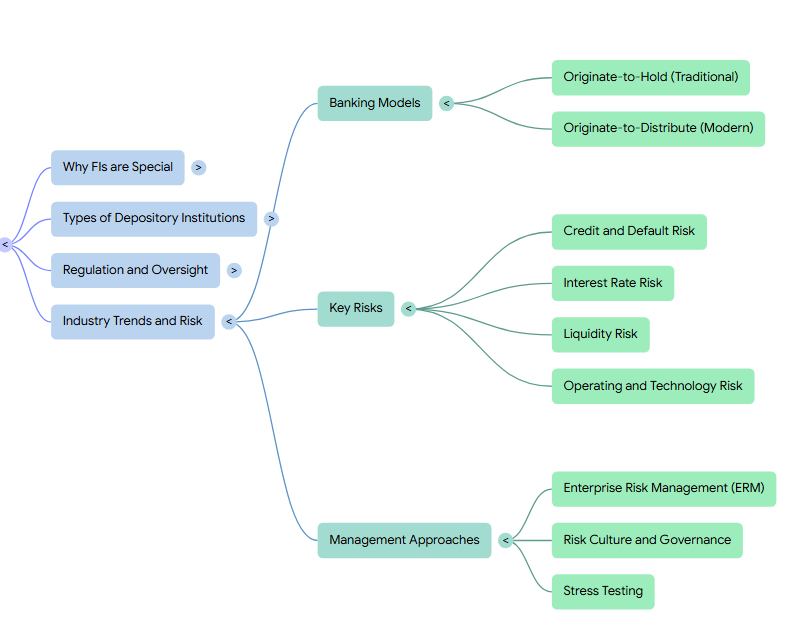
Banking Models
The book describes a significant shift in banking models as a central trend that has fundamentally changed the risk landscape of the financial services industry. Traditionally, banks operated under an “originate and hold” model, where they used short-term deposits to fund long-term loans and held those loans on their balance sheets until maturity. This model provided strong incentives for banks to screen and monitor borrowers carefully, as the institutions directly bore the credit, liquidity, and interest rate risks associated with the loans.
In recent years, the book notes a dramatic industry trend toward an “originate to distribute” model. In this newer model, financial institutions originate or warehouse loans and then quickly sell them or package them into asset-backed securities through the process of securitization. This shift allows banks to generate fee income while removing risk from their balance sheets and shifting it to other participants in the financial system.
The book explains that this transition between models has introduced substantial new risks to financial institutions management. Because originating institutions are often no longer exposed to the long-term credit risks of the loans they underwrite, they have significantly less incentive to monitor the activities of borrowers. This lack of monitoring, combined with the aggressive pursuit of low-quality borrowers in the “subprime market,” led to a deterioration in overall credit quality and a dramatic increase in consumer and corporate leverage.
Furthermore, the book highlights that the “originate to distribute” model was a major contributor to systemic risk during the financial crisis of the late 2000s. This model was facilitated by the growth of the “shadow banking system,” which includes participants like structured investment vehicles (SIVs) and special-purpose vehicles (SPVs) that perform banking functions with less regulatory oversight than traditional institutions. While the “originate to distribute” model can improve return-risk trade-offs for individual institutions, the book emphasizes that the failure of financial institutions to perform their specialized role in risk management can lead to a crisis of confidence and a worldwide breakdown in credit markets.
Finally, the book distinguishes these models based on the size of the institution; while large banks often rely on factual financial information and centralized computer models, small community banks continue to play an important role through “relationship banking,” basing their decisions on personal knowledge of their customers’ creditworthiness.
Originate-to-Hold (Traditional)
The book characterizes the traditional banking model as “originate and hold,” a system where depository institutions (DIs) take short-term deposits and other sources of funds to finance longer-term loans for businesses and consumers. In this model, these loans are typically held on the DI’s balance sheet until they reach maturity.
The following points summarize the traditional model within the larger context of financial institution management:
- Incentives for Screening and Monitoring: Because the originating institution retains the loan in its portfolio for the long term, it has a significant incentive to screen and monitor borrower activities both before and after a loan is made. The book suggests that under this model, banks might be reluctant to aggressively pursue low-credit-quality borrowers because they bear the full risk of default.
- Asset-Liability Mismatch and Risk: The traditional model fundamentally involves maturity mismatching—the process of using short-term liabilities (like deposits) to fund long-term assets (like mortgages). While this asset-transformation function is a “special” role that financial institutions perform, the book notes it inherently exposes the institution to potential interest rate risk, liquidity risk, and credit risk.
- Relationship Banking: The book distinguishes between the operations of large and small banks, noting that many small community banks still adhere to a form of the traditional model through “relationship banking”. These institutions often base their lending decisions on personal knowledge of their customers’ creditworthiness and an understanding of the specific conditions in the communities they serve, rather than relying solely on the factual financial information and computer models used by large institutions.
- Evolution and Competition: Over the last few decades, the traditional “originate and hold” model has increasingly been replaced or supplemented by the “originate to distribute” model. In this newer model, financial institutions originate loans and then quickly sell them or package them into asset-backed securities through securitization. The book notes that the emergence of the “shadow banking system” has facilitated this shift, as nonbank financial service firms now perform credit intermediation through a series of steps involving multiple entities rather than a single bank.
Originate-to-Distribute (Modern)
The book describes the originate-to-distribute model as a modern approach to banking where financial institutions (FIs) originate or warehouse loans and then quickly sell them or package them into asset-backed securities (ABS) through securitization. This model represents a dramatic shift from the traditional “originate-to-hold” model, in which banks kept loans on their balance sheets until maturity. By shifting to this modern model, FIs are able to generate significant fee income while removing liquidity, interest rate, and credit risks from their balance sheets.
The growth of this model has been facilitated by the shadow banking system, which consists of nonbank financial service firms such as special-purpose vehicles (SPVs), structured investment vehicles (SIVs), and credit hedge funds. In this system, the credit intermediation process is performed through a series of steps involving many different entities rather than a single bank. Technology has played a crucial role in this evolution by enabling the rapid production, packaging, and global distribution of these complex financial services.
However, the book highlights that the originate-to-distribute model has fundamentally changed the risk landscape of financial institutions management. Because the originating institutions often do not retain the long-term credit risk, they have significantly less incentive to screen and monitor borrower activities. This lack of monitoring contributed to a deterioration in credit quality, particularly in the subprime mortgage market, and led to a dramatic increase in consumer and corporate leverage.
Furthermore, the book notes that the failure of FIs to perform their specialized role in risk management under this model was a major contributor to the 2008–09 financial crisis. When mortgage borrowers began to default, FIs holding “toxic” mortgage-backed securities suffered massive losses, leading to a near meltdown of the global financial and economic systems. In the aftermath, legislation such as the Volcker Rule was introduced to reduce market risk by prohibiting depository institutions from engaging in certain proprietary trading activities associated with these models.
Key Risks
According to the book, while financial institutions (FIs) are often categorized by their specific functions—such as commercial banks or insurance companies—they face a set of common key risks that have been reshaped by modern industry trends. The book identifies ten primary risks: credit, interest rate, liquidity, foreign exchange, sovereign, market, off-balance-sheet, technology, operational, and insolvency risk.
Credit and Interest Rate Risk
The book describes credit risk as the possibility that promised cash flows from loans and securities will not be paid in full. A major industry trend impacting this risk is the shift from the traditional “originate-to-hold” model to the “originate-to-distribute” model, where FIs package loans into securities to sell to other investors. The book notes that this trend has reduced the incentives for FIs to screen and monitor borrowers, which contributed to the deterioration of credit quality seen during the subprime mortgage crisis. Interest rate risk arises when the maturities of an FI’s assets and liabilities are mismatched, a fundamental consequence of their “special” role in performing asset transformation.
Liquidity and Market Risk
Liquidity risk occurs when an FI’s liability holders demand immediate cash or when loan commitments are suddenly exercised, requiring the FI to liquidate assets at potentially low “fire-sale” prices. The book explains that this risk is exacerbated by the growth of the “shadow banking” system, which performs banking functions through nonbank firms with less regulatory oversight. Market risk has become more prominent as FIs increasingly rely on trading activity rather than traditional lending, exposing their portfolios to uncertainty from changes in asset prices, interest rates, and market volatility.
Off-Balance-Sheet and Technology Risk
The book highlights a striking trend in the growth of off-balance-sheet activities, such as derivative contracts and loan commitments, which create contingent assets and liabilities that do not appear on current balance sheets but impact future profitability. Technology risk is incurred when massive investments in technological infrastructure do not produce anticipated cost savings through economies of scale or scope. Closely related is operational risk, defined as the risk of loss from inadequate internal processes, people, and systems, including the threat of cybercrime and data breaches in an increasingly digital environment.
Global and Insolvency Risk
As FIs have expanded their operations internationally, they have become more exposed to foreign exchange risk—where changes in exchange rates affect the value of assets and liabilities denominated in foreign currencies—and sovereign risk, which involves the risk that foreign governments may interrupt debt repayments. Ultimately, the book frames insolvency risk as the consequence of one or more of these other risks, occurring when an FI’s capital is insufficient to offset a sudden decline in asset value. To manage these interrelated threats, the book notes that modern FIs are moving toward Enterprise Risk Management (ERM), which prioritizes the management of the full spectrum of risks as an integrated portfolio.
Credit and Default Risk
In the larger context of financial institution management, the book defines credit risk (or default risk) as the potential that promised cash flows from loans and securities held by financial institutions (FIs) will not be paid in full. This is one of ten primary “key risks”—including interest rate, liquidity, and sovereign risk—that FIs must manage to remain solvent.
The Role of FIs in Managing Credit Risk
According to the book, a fundamental reason FIs are considered “special” is their ability to transform the primary securities issued by corporations into secondary securities (like deposits) that are more attractive to savers. In this process, FIs act as delegated monitors and information producers, screening loan applicants and monitoring borrowers after a loan is made to ensure they remain creditworthy. Short-term loan contracts are particularly useful for this, as they allow bankers to update information frequently and act almost like “insiders” regarding a firm’s operations.
Types of Credit Risk: Firm-Specific vs. Systematic
The book distinguishes between two levels of credit risk:
- Firm-Specific Credit Risk: This is the risk of default associated with the specific types of projects or operations of a single borrowing firm. FIs can alleviate much of this risk by diversifying their portfolios across many different borrowers, thereby exploiting the law of large numbers.
- Systematic Credit Risk: This represents the risk of default associated with general economy-wide or macro conditions, such as a recession, which simultaneously increases the default probability for all borrowers. This type of risk cannot be easily diversified away.
Credit Risk and Industry Trends
The book highlights a major structural shift in the industry from the traditional “originate-to-hold” model to the modern “originate-to-distribute” model. In the traditional model, banks keep loans on their balance sheets until maturity, providing a strong incentive for careful screening and monitoring.
However, in the modern model, FIs originate loans and then quickly sell them or package them into asset-backed securities through securitization. The book notes that because these FIs often do not retain the long-term credit risk, their incentives to monitor borrowers are significantly reduced. This lack of monitoring, combined with the aggressive pursuit of low-quality “subprime” borrowers, led to a deterioration in credit quality and was a primary cause of the 2008–09 financial crisis.
Measurement and Modeling
FIs use a variety of models described in the book to calibrate their credit risk exposure:
- Qualitative Models (Expert Systems): These rely on a manager’s subjective judgment regarding borrower-specific factors like reputation, leverage, and collateral, as well as market factors like the business cycle.
- Quantitative Scoring Models: These use statistical techniques—such as linear probability or Altman’s Z-score—to sort borrowers into default risk classes based on financial ratios.
- Newer Market-Based Models: These include RAROC (risk-adjusted return on capital), which balances expected income against capital at risk, and option-based models, which view a firm’s equity as a call option on its assets to calculate an “expected default frequency” (EDF).
Interaction with Other Key Risks
Credit risk is often interdependent with other key risks. For instance, when interest rates rise, corporations and consumers find it more difficult to meet debt payments, causing credit and interest rate risks to be positively correlated. Furthermore, missed loan payments can disrupt an FI’s liquidity management, as the institution may have been counting on those funds to meet its own withdrawal obligations. Ultimately, unmanaged credit losses can lead to insolvency risk, where the FI’s capital is insufficient to offset the decline in asset value.
Interest Rate Risk
The book identifies interest rate risk as a fundamental hazard incurred by financial institutions (FIs) when the maturities of their assets and liabilities are mismatched. This risk is a direct consequence of the “special” asset-transformation function that FIs perform, which involves buying primary securities and issuing secondary securities with different maturity and liquidity characteristics.
Core Components of Interest Rate Risk
The book explains that interest rate risk manifests in two primary ways depending on the FI’s balance sheet structure:
- Refinancing Risk: This occurs when an FI is “short-funded,” meaning its liabilities have a shorter maturity than its assets. If interest rates rise, the cost of rolling over or reborrowing funds can increase above the returns being earned on long-term asset investments, leading to a negative profit spread.
- Reinvestment Risk: This arises when an FI is “long-funded,” holding assets with shorter maturities than its liabilities. In this case, if interest rates fall, the FI faces uncertainty about the rate at which it can reinvest funds from maturing assets, potentially leading to returns that fall below the fixed cost of its liabilities.
- Market Value Risk: Beyond immediate income effects, the book emphasizes that interest rate changes impact the market (or fair) value of an FI’s assets and liabilities. Because bond prices move inversely to interest rates, rising rates reduce the market value of an FI’s assets—and potentially its net worth—if those assets have longer durations than its liabilities.
The Larger Context of Key Risks
In the book’s broader framework, interest rate risk is one of ten primary risks FIs must manage, alongside others such as credit, liquidity, and foreign exchange risk. Its significance is magnified by its strong interdependence with other key risks:
- Correlation with Credit Risk: When interest rates rise, corporations and consumers often find it more difficult to meet debt payments, causing credit risk and interest rate risk to be positively correlated.
- Impact on Liquidity Risk: Missed loan payments resulting from rate spikes can disrupt an FI’s liquidity management, as the institution may have been counting on those funds to meet its own withdrawal obligations.
- Relationship with Foreign Exchange Risk: Changes in domestic interest rates resulting from Federal Reserve policy actions are highly correlated with changes in exchange rates, thereby linking these two areas of risk.
- Insolvency Risk: Ultimately, the book frames insolvency risk as a consequence of any or all of these primary risks; if interest rate volatility leads to a sudden decline in asset value relative to liabilities, an FI’s capital can be driven toward zero.
To manage these threats, the book notes that modern FIs are moving toward Enterprise Risk Management (ERM), which seeks to manage the full spectrum of an FI’s risks as an interrelated portfolio rather than in isolated functional areas.
Liquidity Risk
According to the book, liquidity risk is one of the ten primary hazards faced by financial institutions (FIs), occurring when a sudden surge in liability withdrawals or the exercise of off-balance-sheet loan commitments requires an FI to liquidate assets in a very short period. Within the larger context of key risks, liquidity risk is unique because it is a normal aspect of daily management, yet in extreme cases, it can escalate into a solvency crisis where the FI cannot generate enough cash to meet its promises.
Core Causes and Manifestations
The book identifies two primary sources of liquidity risk:
- Liability-Side Liquidity Risk: This arises when claim holders, such as depositors or insurance policyholders, demand immediate cash. Because FIs typically invest in longer-term, less liquid assets to generate returns, they may not have enough cash on hand to meet these sudden demands.
- Asset-Side Liquidity Risk: This occurs when borrowers exercise their right to take down funds from off-balance-sheet loan commitments. The FI must fund these loans immediately, creating an urgent need for liquidity.
A critical consequence of these surges is the potential need to sell assets at fire-sale prices, which are significantly lower than the fair market value the FI would receive if it had more time to negotiate a sale. If these losses are large enough, they can wipe out the FI’s equity, leading to insolvency risk.
Interaction with Other Key Risks
The book emphasizes that liquidity risk is highly interdependent with other risks:
- Interest Rate Risk: Mismatched maturities between assets and liabilities inherently expose FIs to both interest rate and liquidity risks. Furthermore, a spike in interest rates can lead to deposit drains as customers seek higher returns elsewhere.
- Credit Risk: If a borrower defaults, the FI loses expected cash inflows, which can disrupt its liquidity management and its ability to meet its own withdrawal obligations.
- Market Risk: Unexpected changes in interest rates can cause the value of an FI’s investment portfolio to fluctuate, potentially forcing the FI to replace lost value through costly borrowing or asset sales.
Measurement and Management
To manage this exposure, the book describes several tools and strategies:
- Measurement Tools: FIs use a financing gap (the difference between average loans and average core deposits), net liquidity statements, and a liquidity index to measure the potential loss from sudden asset disposal.
- Management Strategies: FIs can use stored liquidity management (liquidating cash reserves or selling assets) or purchased liquidity management (borrowing funds in the wholesale market).
- Regulatory Standards: Following the financial crisis, the Basel Committee introduced the Liquidity Coverage Ratio (LCR) to ensure FIs have enough high-quality liquid assets to survive a 30-day stress scenario, and the Net Stable Funding Ratio (NSFR) to encourage more stable, long-term funding.
Specific Institutional Impacts
The book notes that the severity of liquidity risk varies by FI type. Depository institutions are highly exposed due to the first-come, first-served nature of deposit contracts, which can trigger bank runs. Life insurance companies face risk from policy surrenders, while mutual funds mitigate this risk through pro rata distribution, where all shareholders share asset losses equally, reducing the incentive to “run” to be first in line.
Operating and Technology Risk
According to the book, technology and operational risk are two closely related hazards categorized within the ten primary “Key Risks” that every modern financial institution (FI) must manage. While other key risks like credit and interest rate risk relate to an institution’s asset-transformation functions, these risks arise from the real or production side of its operations. The book explains that because the production of financial services requires the use of real resources and back-office support systems, all institutions are exposed to operating risks.
The book draws a distinction between the two, defining technology risk as the potential for loss when massive investments in technological infrastructure do not produce the anticipated cost savings. In contrast, the book describes operational risk as the potential for loss when existing technology, auditing, monitoring, or other support systems malfunction or break down. The Bank for International Settlements (BIS) provides a broader definition for operational risk that includes losses resulting from inadequate or failed internal processes, people, and systems, or from external events.
A major driver for technological expansion, as noted in the book, is the objective of exploiting economies of scale and economies of scope. Economies of scale occur when the average unit costs of producing services fall as output increases, while economies of scope occur when an institution generates cost synergies by producing multiple products using the same inputs. Technology risk occurs specifically when these investments lead to “diseconomies,” such as excess capacity, redundant technology, or bureaucratic inefficiencies.
The book identifies five primary sources of operational risk: technology, employees, customer relationships, capital assets, and external events. Employee-related risks include human error, internal fraud, and “rogue trading,” such as the multi-billion dollar losses attributed to the “London Whale” at J.P. Morgan Chase. System-related risks are illustrated in the book through examples of massive software glitches and “flash crashes” that have led to significant market value losses for institutions. Furthermore, the book highlights that the rise of electronic and internet banking has introduced significant crime and fraud risk, including identity theft and the hacking of millions of customer records.
Finally, the book emphasizes that these risks are often interdependent with other key risks, particularly insolvency risk. If operational failures lead to losses that exceed an institution’s capital, the institution’s very survival is threatened. Consequently, the book notes that international regulators have moved to address these issues by requiring banks to hold a capital cushion specifically against operational risk. This regulatory focus includes various measurement approaches, such as the Basic Indicator, Standardized, and Advanced Measurement Approaches.
Management Approaches
According to the book, management approaches within financial institutions (FIs) have evolved significantly in response to shifting industry trends and the increasingly complex nature of modern financial risks. The central theme is that management must constantly balance the pursuit of value maximization with the necessity of rigorous risk management, as FIs essentially function as risk specialists in an imperfect market.
Enterprise Risk Management (ERM)
One of the most prominent modern management approaches highlighted in the book is Enterprise Risk Management (ERM). While FIs traditionally managed risks in isolated functional silos (such as separate departments for credit risk or liquidity risk), ERM recognizes the importance of prioritizing and managing the full spectrum of risks as an interrelated portfolio. This approach seeks to embed risk management into every critical decision made throughout the institution. The book notes that ERM came to the forefront following the 2008–2009 financial crisis, when many institutions realized that their highly analytical, siloed systems failed to account for behavioral biases and fundamental drivers of risk. Modern ERM stresses a strong risk culture supported by governance that explicitly aligns with the firm’s overall risk appetite.
Traditional versus Modern Banking Models
The book contrasts traditional management approaches with those necessitated by modern industry trends:
- Relationship Banking: This traditional approach is often still utilized by small community banks. It relies on “relationship banking,” where management decisions are based on personal knowledge of customers’ creditworthiness and local community conditions rather than just centralized computer models.
- The Shift to Underwriting: A major industry trend has been the move from an “originate and hold” model to an “originate to distribute” model. In this modern approach, management functions more like an underwriter, quickly selling or securitizing loans to generate fee income while removing risk from the balance sheet.
- Monitoring Risks: The book warns that this shift has fundamentally altered management’s incentive to monitor borrowers. Because the long-term credit risk is often transferred to other parties, institutions have less incentive to perform the traditional specialized role of “delegated monitor,” which contributed to the deterioration of credit quality seen during the subprime mortgage crisis.
Liquidity and Liability Management
Management approaches also differ in how they handle the constant threat of liquidity risk:
- Stored versus Purchased Liquidity: Traditional management often relied on stored liquidity management, which involves keeping a cushion of liquid assets on the balance sheet. In contrast, modern large-bank management frequently uses purchased liquidity management, turning to wholesale money markets to borrow funds as needed to meet deposit drains.
- Funding Risk Trade-offs: Management must navigate a “knife-edge” trade-off between the low cost of high-withdrawal-risk liabilities (like demand deposits) and the high cost of low-withdrawal-risk liabilities (like long-term CDs).
Technological and Data-Driven Management
The book emphasizes that technology has transformed the production side of financial services, requiring management to adopt new technical strategies. Advanced technology is now used to integrate multichannel information—such as online, mobile, and tablet data—to get a complete view of consumer habits and target products more effectively. Additionally, management must now utilize sophisticated technology-based risk management systems to detect complex forms of fraud and cybercrime that traditional manual processes cannot catch.
Regulatory and Structural Constraints
Finally, management approaches are increasingly dictated by the “net regulatory burden”. This represents the difference between the private costs of compliance (such as capital requirements and examination time) and the private benefits of being regulated (such as deposit insurance). Post-crisis legislation like the Volcker Rule has forced management at depository institutions to move away from proprietary trading and return to a more traditional model of deposit-taking and lending to reduce market risk.
Enterprise Risk Management (ERM)
The book defines Enterprise Risk Management (ERM) as a comprehensive approach that recognizes the importance of prioritizing and managing the full spectrum of risks faced by a financial institution (FI) as an interrelated risk portfolio. This modern management strategy seeks to embed risk management as a central component in all critical decisions throughout an institution, rather than treating risk as a secondary consideration.
The Shift from Silos to Integrated Portfolios
In the larger context of management approaches, the book distinguishes ERM from traditional methods that typically examined risk by isolated functional areas, such as separate departments for credit risk or liquidity risk. While these functional silos allowed for specialization, they often failed to account for how different risks interacted with one another. ERM replaces this fragmented view with a holistic perspective that treats the FI’s various exposures—including interest rate, credit, liquidity, market, and operational risks—as a single, integrated portfolio.
Impact of the Financial Crisis on Management
ERM came to the forefront of financial management following the 2008–2009 financial crisis. The book explains that many FIs had invested heavily in advanced, highly analytical risk measurement systems that nevertheless failed to detect the exposures leading up to the market meltdown. This failure prompted a realization that prior management approaches ignored fundamental behavioral drivers of risk and the subtle biases that influence senior management decisions. Consequently, post-crisis ERM stresses the importance of building a strong risk culture supported by governance arrangements that are explicitly aligned with a firm’s overall risk appetite.
Implementation and Governance
Within this framework, risk management is no longer just a technical exercise but a core part of organizational governance. Decisions under an ERM approach include:
- Setting Performance Targets: Aligning staff goals with the institution’s risk limits.
- Incentive Structures: Designing compensation to encourage risk awareness and personal accountability.
- Firm-wide Oversight: As illustrated by the J.P. Morgan Chase example in the book, ERM requires the involvement of the CEO, CFO, and Chief Risk Officer to set a framework that provides comprehensive controls across all business activities.
The Context of FIs as Risk Specialists
The book situates ERM as the primary tool for FIs to fulfill their “special” role in the economy. Because FIs function as risk specialists in imperfect markets, their goal is to maximize value for shareholders while carefully managing the inventory of risks they bear on behalf of their customers. As management approaches have evolved from the traditional “originate and hold” model to the modern “originate to distribute” model, ERM has become even more vital to ensure that the shift toward generating fee income does not lead to a dangerous neglect of long-term credit and systemic risk monitoring.
Risk Culture and Governance
According to the book, risk culture and governance have become fundamental components of modern management approaches, particularly within the framework of Enterprise Risk Management (ERM). The book defines ERM as a strategy that recognizes the importance of managing an institution’s full spectrum of risks as an interrelated portfolio, seeking to embed risk management into all critical decision-making processes. This approach represents a shift away from traditional methods that managed risks in isolated functional silos, which often failed to account for how different exposures interacted.
The book explains that the focus on culture and governance intensified following the 2008–2009 financial crisis. During this period, many institutions found that their advanced analytical systems failed to detect or control major exposures because they ignored subtle behavioral characteristics and biases that influence senior management. Consequently, the book highlights that modern ERM emphasizes building a strong risk culture supported by governance arrangements that are explicitly aligned with a firm’s overall risk appetite.
As illustrated by the book’s example of J.P. Morgan Chase, effective risk governance requires a structure where risk management is owned within every line of business and corporate function. This framework is typically developed by senior leadership, including the CEO, CFO, and Chief Risk Officer, who are responsible for providing comprehensive controls and fostering a culture of transparency and personal responsibility. The book notes that such governance is intended to ensure that risk issues are identified and escalated by all individuals within the firm.
To sustain this risk culture, the book points out that institutions must utilize ongoing employee training, development, and talent retention. Furthermore, a key element of this management approach is the use of integrated incentive compensation arrangements. These arrangements are designed to align staff performance targets with the institution’s risk limits, thereby encouraging a culture of risk awareness and accountability. Finally, the book observes that global regulators, such as the Basel Committee on Banking Supervision, are now incorporating these elements of culture and governance more explicitly into their regulatory standards.
Stress Testing
According to the book, stress testing has evolved into a vital component of modern financial management, particularly following the 2008–2009 financial crisis. Within the broader framework of management approaches, it is characterized as a proactive tool used to ensure that institutions remain properly capitalized even under “unlikely but plausible” adverse conditions.
Integration with Capital Planning
The book identifies stress testing as a central element of an institution’s capital planning process. For large bank holding companies, this is formalized through the Comprehensive Capital Analysis and Review (CCAR), where management must submit a capital plan supported by an assessment of expected sources and uses of capital under various stress scenarios. These tests evaluate whether an institution has enough capital to continue operating and lending during a protracted economic slump, such as a sharp decline in GDP or a significant drop in asset prices. The results of these tests directly impact management decisions regarding capital distributions, such as whether a firm can increase its dividend rates.
Complementing Risk Measurement Models
Management uses stress testing to address the limitations of other statistical risk measures like Value-at-Risk (VAR). While VAR estimates potential losses based on “normal” market behavior, stress testing is intended to capture risk in “abnormal” markets. For instance, large firms like J.P. Morgan Chase run weekly stress tests across various lines of business, assuming significant changes in factors like credit spreads, equity prices, and interest rates to identify vulnerabilities that traditional models might overlook.
Regulatory and Systematic Context
The book explains that stress testing is not only a management preference but also a mandate under the Wall Street Reform and Consumer Protection Act of 2010 (Dodd-Frank). Initially employed during the 2009 “stress test” of the 19 largest U.S. depository institutions, this approach forced banks to raise billions in new capital to withstand a potential economic slump. Beyond banking, the book notes that regulatory reforms have expanded stress testing requirements to other sectors, such as money market mutual funds, to address the risk of investor runs during periods of market stress.
Role in Enterprise Risk Management (ERM)
Situated within the larger context of Enterprise Risk Management (ERM), stress testing facilitates the identification and escalation of risk issues by all individuals within a firm. It is a key part of the supervisory review process (Pillar 2 of the Basel III framework), which encourages banks to develop sound internal processes for assessing their specific risk profiles and capital adequacy. Ultimately, the book frames stress testing as a management approach that helps safeguard the stability of both the individual institution and the broader financial system by preparing for extreme, negative externalities.
— Linden Lake
This Series
→ Book Review (4 of 4): Financial Institutions Management – A Risk Management Approach — Industry Trends and Risk
→ Book Review (3 of 4): Financial Institutions Management – A Risk Management Approach — Regulation and Oversight
→ Book Review (2 of 4): Financial Institutions Management – A Risk Management Approach — Types of Depository Institutions
→ Book Review (1 of 4): Financial Institutions Management – A Risk Management Approach — Why Financial Institutions Are Special
Leave a Reply