
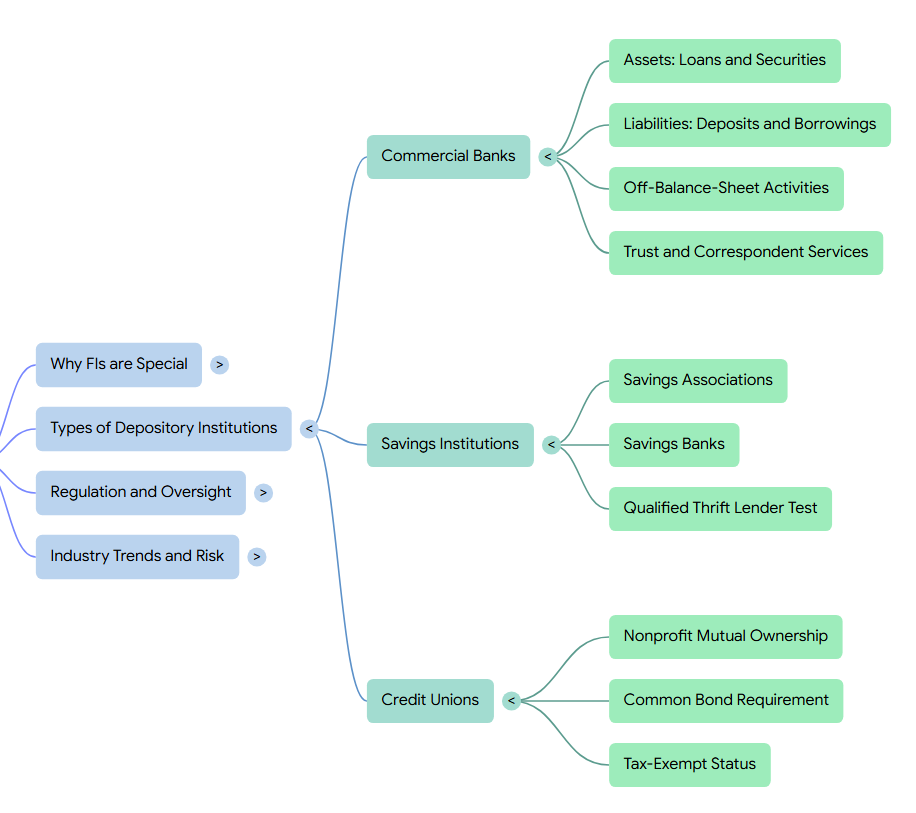
In the context of financial institutions management, the book defines depository institutions (DIs) by their unique role in obtaining a significant portion of their funding from customer deposits, which are then used to fund various types of loans. This creates a “joint-product” nature where DIs offer products on both sides of their balance sheets—loans as assets and deposits as liabilities—presenting specific management challenges in balancing risk and return. The book identifies three major groups of DIs:
1. Commercial Banks
Commercial banks represent the largest group of depository institutions measured by asset size. While they perform functions similar to other DIs, their asset and liability structures are much more varied, often including several types of nondeposit funding sources and a broad range of consumer, commercial, and real estate loans. Within this group, the book distinguishes three sub-types based on size and function:
- Community Banks: These institution are typically under $1 billion in assets and specialize in retail or consumer banking, focusing on local deposit bases and relationship-based lending.
- Regional and Superregional Banks: These engage in a complete array of wholesale commercial banking activities, accessing both retail deposits and the interbank federal funds market to finance their lending and investment activities.
- Money Center Banks: These large institutions rely heavily on nondeposit or borrowed sources of funds rather than retail branches and are major participants in foreign currency markets.
2. Savings Institutions
Savings institutions comprise savings associations (historically S&Ls) and savings banks. While they generally perform services similar to commercial banks today, they have historically specialized in residential mortgages. The book notes that these institutions are legally distinct due to the Qualified Thrift Lender (QTL) test, which requires them to maintain at least 65 percent of their assets in mortgage-related assets to retain their charter.
3. Credit Unions
Credit unions are nonprofit depository institutions that are mutually organized and owned by their members. Unlike commercial banks and savings institutions, they are prohibited from serving the general public; instead, they serve members who share a common bond of occupation, association, or geography. Because of their nonprofit status, their earnings are not taxed, which allows them to frequently offer higher interest rates on deposits and lower rates on consumer loans compared to other DIs.
Larger Context of FI Management
The book highlights several key themes in the modern management of these institutions:
- Risk Convergence: Regardless of their specific charter, all DIs face similar fundamental risks, including credit risk, interest rate risk, and liquidity risk.
- Structural Shifts: The industry has transitioned from an “originate and hold” model—where loans are held until maturity—to an “originate to distribute” model, involving the quick sale or securitization of loans, which changes how DIs monitor and manage credit risk.
- Universal Banking: Regulatory changes, such as the Financial Services Modernization Act of 1999, have allowed DIs to operate under financial services holding companies, enabling them to engage in banking, insurance, and securities activities simultaneously.
- Regulatory Discipline: DIs are the most heavily regulated of all financial institutions because their failure can impose massive negative externalities on the economy, such as bank runs and the destruction of household savings.
Commercial Banks
Assets: Loans and Securities
In the larger context of commercial bank management, the book identifies loans and investment securities as the primary earning assets of the industry. As of June 2015, these two categories combined for the vast majority of bank assets, with total loans representing approximately 52.9% and investment securities accounting for about 26.9%.
Loan Portfolio Composition and Trends
The book describes the commercial bank loan portfolio as being composed of four broad classes: real estate loans, commercial and industrial (C&I) loans, individual (consumer) loans, and other loans.
- Asset Size and Specialization: The composition of these loans varies significantly based on the size of the institution. Smaller community banks (typically under $1 billion in assets) focus more heavily on residential mortgages and relationship-based lending, with real estate loans making up more than 73% of their loan portfolios. In contrast, large banks have more varied portfolios and hold a proportionately higher percentage of C&I loans—approximately 22.8% compared to roughly 14.2% at smaller banks.
- Historical Shifts: The book notes significant long-term trends in asset allocation. While business loans were the dominant asset between 1965 and 1987, their relative importance has since declined. This shift is attributed to the growth of the commercial paper market, which provided major corporations with an alternative funding source, as well as the rise of mortgage securitization.
- Impact of the Financial Crisis: During the recession of 2008–09, banks experienced a reduction in all areas of lending. As a result, many institutions shifted their focus toward holding less risky securities, such as Treasury and U.S. government agency securities.
Investment Securities
Investment securities provide banks with interest income and serve as a vital source of liquidity, though they also expose the institution to interest rate risk.
- Portfolio Components: The book breaks down the investment portfolio into U.S. government securities (such as Treasury bonds) and other securities, which primarily include municipal securities and investment-grade corporate bonds. In mid-2015, U.S. government securities accounted for over $2 trillion of the industry’s $3.95 trillion investment portfolio.
- Trading vs. Investment: Large money center banks often act as primary dealers in government securities, maintaining active trading portfolios for short-term gains in addition to their longer-term investment holdings.
Managerial and Risk Implications
The heavy concentration of assets in loans means that credit or default risk is the major exposure faced by commercial bank managers. The book emphasizes that because banks are highly leveraged and hold relatively little equity, even a small number of loan defaults can wipe out a bank’s equity and lead to insolvency. Furthermore, the transition toward an “originate to distribute” model—where banks originate loans and then quickly sell them—has changed the traditional role of banks as long-term risk specialists, impacting how they monitor and manage these primary assets.
Liabilities: Deposits and Borrowings
In the larger context of commercial bank management, the book defines liabilities as the primary sources of funding used to support an institution’s asset base. A defining characteristic of commercial banks is their high degree of financial leverage; for example, in 2015, the industry had an average equity-to-assets ratio of only 11.26 percent, meaning that 88.74 percent of assets were funded by debt in the form of deposits or borrowed funds. The book highlights that this reliance on debt creates a “joint-product” nature for banks, as they must manage products and risks on both the asset (loans) and liability (deposits and borrowings) sides of their balance sheets.
Deposit Liabilities
Deposits represent the largest segment of bank funding, accounting for 75.7 percent of total liabilities and equity in mid-2015. The book categorizes these into three main types based on their liquidity and withdrawal risk:
- Transaction Accounts: These are checkable deposits that can be withdrawn on demand. They include non-interest-bearing demand deposits and interest-bearing negotiable order of withdrawal (NOW) accounts. Although these represent a low-cost source of funds, they carry high withdrawal risk.
- Small Nontransaction Accounts: This category includes retail savings accounts, money market deposit accounts (MMDAs), and retail time deposits or certificates of deposit (CDs) with face values under $100,000. In 2015, these accounts constituted 64.5 percent of total bank deposits, though their share has faced increasing competition from money market mutual funds.
- Large Time Deposits: Also known as wholesale CDs, these have face values over $100,000 and are often negotiable, meaning they can be resold in a secondary market. This negotiability reduces withdrawal risk for the bank, as the depositor can liquidate their position without requesting funds directly from the institution.
Nondeposit Borrowings
When deposits are insufficient to meet funding needs, banks turn to nondeposit liabilities, which accounted for approximately 14.7 percent of all bank liabilities in 2015. The book identifies several key instruments in this category:
- Federal Funds and Repurchase Agreements (RPs): These are short-term, often overnight, borrowings between institutions. While federal funds are uncollateralized loans of excess reserves, RPs are collateralized transactions where the bank temporarily sells securities (such as T-bills) with an agreement to buy them back.
- Other Borrowings: This broad category includes the issuance of notes and bonds at the longer end of the maturity spectrum, as well as bankers’ acceptances and commercial paper issued by a bank’s parent holding company.
Managerial Implications
The book emphasizes that the liability structure of a bank typically reflects a shorter maturity than its asset portfolio, which exposes managers to significant interest rate and liquidity risks. Historically, the industry has seen a shift away from high-withdrawal-risk transaction accounts toward liability-managed accounts, such as wholesale CDs and other borrowings, over which banks have greater control regarding supply. This represents a fundamental trade-off: while transaction accounts offer lower funding costs, they carry higher funding risk compared to the higher-cost, more stable wholesale instruments.
Off-Balance-Sheet Activities
In the larger context of commercial bank management, off-balance-sheet (OBS) activities are defined by the book as contingent assets and liabilities that do not appear on a bank’s current published balance sheet but affect its future shape. The book explains that an item is considered an OBS asset if it moves onto the asset side of the balance sheet upon the occurrence of a contingent event; conversely, it is an OBS liability if it moves onto the liability side.
Drivers for Bank Engagement
The book identifies several primary motivations for commercial banks to engage in OBS activities:
- Fee Income: Banks pursue these activities to earn noninterest fee income, which helps offset declining margins and spreads in their traditional lending businesses.
- Avoiding “Regulatory Taxes”: Because OBS activities are not held on the balance sheet, the book notes that banks can avoid certain regulatory costs, such as reserve requirements and deposit insurance premiums, which are typically not levied on these contingent items.
- Risk Management: The book highlights that many OBS instruments—such as forwards, futures, options, and swaps—are used by banks to hedge or manage their interest rate, foreign exchange, and credit risk exposures.
Major Types and Growth
The book lists several major types of OBS activities that banks must report, including:
- Loan Commitments: Contractual obligations to lend up to a stated amount at given interest rate terms in the future.
- Letters of Credit (LCs) and Standby Letters of Credit (SLCs): Contingent guarantees sold by a bank to underwrite the performance of a customer.
- Derivative Contracts: Agreements such as futures, forwards, swaps, and options that allow for the exchange of assets or cash flows at a predetermined price.
- Loans Sold: The book describes how banks increasingly originate loans and then quickly sell them, often without recourse, effectively acting more as brokers than traditional asset transformers.
The growth of these activities has been phenomenal; the book points out that the notional (face) value of OBS activities at commercial banks grew by 1,965 percent between 1992 and 2015, far outstripping the growth of on-balance-sheet assets.
Risks and the Financial Crisis
Despite their utility in hedging, the book warns that OBS activities involve significant risks that add to a bank’s overall insolvency exposure. The book states that at the heart of the financial crisis in the late 2000s were massive losses associated with OBS mortgage-backed securities and credit default swaps. These “toxic” assets eventually led to a near meltdown of the global financial system and the failure or acquisition of several major financial institutions. The book further explains that the “notional value” of these items often overestimates actual risk, as the potential gain or lose is based on market value changes over the life of the contract, which is typically a small fraction of the face value.
Regulatory Context
Because of the potential for OBS activities to impact solvency, the book notes that regulators now explicitly recognize these risks by imposing capital requirements on them. Additionally, the book discusses the Volcker Rule, implemented in 2014, which prohibits depository institutions from engaging in proprietary trading of most derivatives as a principal, thereby forcing a reduction in the volume of derivative securities held off the balance sheet by these institutions.
Trust and Correspondent Services
In the larger context of commercial bank management, trust and correspondent banking represent specialized fee-generating activities that do not appear directly on a bank’s standard balance sheet accounts. The book explains that trust services involve a bank’s trust department holding and managing assets for individuals or corporations. Due to the specialized staff required for these functions, they are typically offered only by the largest banks. Individual trusts, which include estate assets and funds delegated by less sophisticated investors, account for approximately half of all trust assets managed by banks. The book also identifies pension fund assets as the second-largest group, with banks serving as managers, bond trustees, and disbursement agents.
Correspondent banking is defined by the book as the provision of banking services to other banks that lack the resources to perform them in-house. These service packages commonly include check clearing and collection, foreign exchange trading, hedging services, and participation in large-scale loan and security issuances. Payment for these correspondent services is unique in that it usually takes the form of noninterest-bearing deposits held at the bank providing the service. According to the book, these activities are part of a broader trend where banks seek noninterest income to complement the declining margins in their traditional lending businesses.
Savings Institutions
In the broader context of depository institutions (DIs), the book defines savings institutions as a distinct category that specializes in providing residential mortgage loans to individuals, traditionally funded by short-term savings deposits. Along with commercial banks and credit unions, they form the three major groups of DIs, all of which are characterized by their “joint-product” nature of offering products on both the asset (loans) and liability (deposits) sides of the balance sheet.
Historical Origin and Distinction
The book explains that savings institutions were first established in the early 1800s to serve individuals who needed borrowed funds for home purchases, a market that commercial banks at the time ignored in favor of business enterprises. Today, this group comprises two types of entities:
- Savings Associations (SAs): Historically known as savings and loans (S&Ls), these institutions focus most heavily on residential mortgages.
- Savings Banks (SBs): Traditionally established as mutual organizations, savings banks tend to be more diversified than savings associations, holding commercial loans and corporate bonds in addition to their mortgage portfolios.
Core Functions and the QTL Test
A defining regulatory feature of savings institutions is the Qualified Thrift Lender (QTL) test. The book notes that to retain their charter, these institutions are legally required to maintain at least 65 percent of their assets in mortgage-related assets. This focus makes them more specialized and potentially more exposed to interest rate and credit risk within the housing market compared to commercial banks.
Balance Sheet Characteristics
According to the book, the asset and liability structures of savings institutions reflect their specialized nature:
- Assets: In mid-2015, mortgages and mortgage-backed securities accounted for approximately 63.35 percent of total assets, significantly higher than the 25.90 percent held by commercial banks.
- Liabilities: Total deposits remain the predominant source of funding, accounting for roughly 76.72 percent of total liabilities and net worth in 2015.
- Other Funding: The book highlights that savings institutions rely significantly on borrowings from the 12 Federal Home Loan Banks (FHLBs), which provide access to wholesale money markets to fund mortgage lending.
Regulatory Evolution
The regulatory landscape for these institutions has shifted dramatically due to past financial crises. The book details how the Financial Institutions Reform, Recovery, and Enforcement Act (FIRREA) of 1989 abolished the insolvent FSLIC insurance fund and created the Office of Thrift Supervision (OTS) to charter and examine federal savings institutions. However, following the financial crisis of the late 2000s, the OTS was consolidated into the Office of the Comptroller of the Currency (OCC) in 2011, which now regulates both national banks and federal savings institutions.
Historical Performance and Vulnerabilities
Savings institutions have historically been highly vulnerable to interest rate volatility. The book describes a severe crisis in the early 1980s when a surge in interest rates led to disintermediation, as depositors moved funds to higher-yielding money market mutual funds while the institutions were stuck with long-term, fixed-rate mortgages. More recently, the industry suffered during the mortgage market meltdown of the late 2000s, which led to the failure of Washington Mutual, the largest savings institution in the United States, and its subsequent sale to J.P. Morgan Chase. Since 2010, the industry has seen a slow recovery, with return on assets (ROA) and return on equity (ROE) gradually returning toward pre-crisis levels.
Savings Associations
The book defines savings associations (SAs) as one of the two primary groups within the savings institution industry, with the other being savings banks. Historically known as savings and loan (S&L) associations, these specialized institutions were established to provide long-term residential mortgages funded by short-term savings deposits. Within the larger category of savings institutions, the book notes that savings associations have traditionally maintained a heavier concentration in residential mortgages than savings banks, which tend to operate as more diversified entities.
Several key aspects of savings associations are highlighted in the book:
- The Qualified Thrift Lender (QTL) Test: A defining regulatory constraint for savings associations is the QTL test, which the book explains requires these institutions to maintain at least 65 percent of their assets in mortgage-related categories to retain their charter.
- Historical Crises and Evolution: The book describes a period of extreme instability for savings associations in the late 1970s and early 1980s, when a dramatic surge in interest rates led to negative interest spreads and massive “disintermediation” as depositors moved funds to higher-yielding money market mutual funds. This crisis, along with a collapse in real estate prices in the mid-1980s, resulted in a significant decline in the number of associations and the eventual insolvency of their original insurer, the FSLIC.
- Funding and Liabilities: On the liability side, the book states that total deposits remain the predominant source of funds for these institutions, supplemented significantly by borrowings from the 12 Federal Home Loan Banks (FHLBs), which provide access to wholesale money markets for mortgage funding.
- Regulatory Framework: The book details a major shift in oversight; the Office of Thrift Supervision (OTS), which once chartered and examined federal savings associations, was consolidated into the Office of the Comptroller of the Currency (OCC) in 2011. Additionally, their insurance fund was merged into the FDIC’s Deposit Insurance Fund (DIF) in 2007, subjecting them to the same regulatory structure as commercial banks.
The book concludes that while savings associations have streamlined and recovered since the crises of the 1980s and 2000s, they continue to face intense competition for mortgages from commercial banks and specialized mortgage bankers.
Savings Banks
In the larger context of savings institutions, the book defines savings banks (SBs) as a historically distinct subgroup that typically operates as a more diversified entity than its counterpart, the savings association. While both types of institutions focus on providing residential mortgage loans to individuals, savings banks exhibit several unique characteristics in their organizational structure, geographic focus, and asset composition.
Historical and Organizational Structure
The book notes that savings banks were originally established in the early 1800s to serve the home-borrowing needs of individuals, a market segment that was largely ignored by commercial banks at the time. Traditionally, these institutions were organized as mutual organizations, meaning the depositors are also the legal owners of the bank. Geographically, the book explains that savings banks have historically been concentrated on the East Coast, specifically in states like New York, New Jersey, and the New England area.
Asset and Liability Diversification
A key theme in the book is the relative diversification of savings banks compared to savings associations:
- Asset Portfolio: While savings associations focus almost exclusively on residential mortgages, the book states that savings banks are more diversified, holding corporate bonds and corporate stock in addition to their mortgage portfolios.
- Liability Structure: The book highlights that savings banks rely more heavily on customer deposits for funding and consequently utilize lower levels of borrowed funds than savings associations.
Performance and Vulnerability
The book details how the unique geographic and asset profiles of savings banks have led to different historical challenges:
- Exemption from Regional Shocks: Because they were not located in the Southwest, savings banks were largely insulated from the oil-based economic shocks that devastated savings associations in that region during the 1980s.
- New England Real Estate Crash: However, the book points out that savings banks faced their own crisis during the 1990–91 crash in New England real estate values. This period saw a large number of savings bank failures, contributing to a significant decrease in the size and number of institutions within this group.
Regulatory Environment
Like all savings institutions, savings banks are subject to the Qualified Thrift Lender (QTL) test, which the book explains requires them to maintain at least 65 percent of their assets in mortgage-related categories to retain their charter. Following regulatory shifts after the financial crisis of the late 2000s, federal savings banks—previously overseen by the Office of Thrift Supervision—are now regulated by the Office of the Comptroller of the Currency (OCC). Additionally, the book notes that their insurance fund is now part of the FDIC’s Deposit Insurance Fund (DIF), subjecting them to the same insurance regulatory structure as commercial banks.
Qualified Thrift Lender Test
The book defines savings institutions, comprising both savings associations and savings banks, as depository institutions that have historically specialized in providing residential mortgage loans to individuals. A core regulatory feature distinguishing these institutions from commercial banks is the Qualified Thrift Lender (QTL) test. To maintain their charter as a thrift, these institutions are legally required to keep at least 65 percent of their assets in mortgage-related categories.
The book highlights several key themes regarding the QTL test within the broader context of savings institution management:
- Credit Allocation and Social Service: The QTL test is a primary mechanism of credit allocation regulation, supporting sectors like residential real estate that policymakers have identified as being in special need of support. The book suggests that by providing credit to make housing more affordable, savings institutions contribute to the social welfare benefit of a more stable and productive society.
- Regulatory History: The book notes that the QTL test was formally imposed and strengthened under the Financial Institutions Reform, Recovery, and Enforcement Act (FIRREA) of 1989, which sought to address the thrift crisis by restricting the non-mortgage investment powers of these institutions.
- Asset Specialization and Risk: The book states that the QTL test forces savings institutions to be significantly more specialized than commercial banks. Consequently, it can be argued that the QTL test makes these institutions more rather than less risky, as it limits their ability to diversify their asset portfolios and leaves them heavily exposed to interest rate and credit risk inherent in the housing market.
- Balance Sheet Composition: This regulatory requirement is clearly reflected in the industry’s aggregate balance sheet; as of mid-2015, the book reports that mortgages and mortgage-backed securities accounted for approximately 63.35 percent of savings institutions’ total assets, compared to only 25.90 percent for commercial banks.
While savings institutions currently perform many services similar to commercial banks, the book characterizes the QTL test as the primary legal and regulatory hurdle that ensures they remain specialists in the residential mortgage market.
Credit Unions
In the broader context of depository institutions (DIs), credit unions are one of the three major groups alongside commercial banks and savings institutions. The book defines credit unions as nonprofit depository institutions that are mutually organized and owned by their member-depositors. While commercial banks and savings institutions may serve the general public, credit unions are prohibited from doing so and must restrict their services to individuals sharing a “common bond” of occupation, association, or geography.
Several key characteristics distinguish credit unions within the DI industry:
- Nonprofit and Tax-Exempt Status: Because they are nonprofit organizations, their net income is not taxed, and they are exempt from local investment requirements like those of the Community Reinvestment Act. The book explains that this status allows them to offer higher interest rates on deposits and lower rates on consumer loans than their for-profit counterparts. This has led to claims from the commercial banking industry that credit unions enjoy an unfair competitive advantage, equivalent to a significant annual subsidy.
- Asset and Liability Composition: Traditionally, credit unions have focused on small consumer loans, often under $10,000, and they tend to hold large amounts of government securities. As of 2015, member loans—consisting of home mortgages and consumer loans—accounted for 56.5 percent of their total assets. Their funding is primarily derived from member deposits, which accounted for 84.5 percent of their total funding in 2015.
- Organizational Structure: The book describes a three-tiered system: local credit unions at the bottom; “corporate credit unions” at the state or regional level that provide investment and liquidity services to local members; and the U.S. Central Credit Union at the national level, which serves as a “corporate’s corporate”.
- Regulatory Framework: Like other DIs, credit unions can be federally or state chartered. The National Credit Union Administration (NCUA) is the federal agency responsible for chartering and supervising these institutions. It also manages the National Credit Union Share Insurance Fund (NCUSIF), which provides deposit insurance guarantees of up to $250,000, matching the coverage offered to banks and savings institutions.
Regarding industry performance, credit unions as a whole survived the financial crisis of the late 2000s more profitably than commercial banks and savings institutions. The book attributes this to their emphasis on retail consumer lending and their mutual ownership status, which prioritizes member needs over stockholder profits. However, some corporate credit unions suffered severe losses during the crisis after investing in “toxic” mortgage-related and asset-backed securities, leading to the insolvency of five of the largest corporate credit unions in the country.
Nonprofit Mutual Ownership
The book defines credit unions as nonprofit depository institutions that are mutually organized and owned by their member-depositors. In the larger context of the financial services industry, this specific ownership structure distinguishes credit unions from for-profit commercial banks and savings institutions.
Nature of Mutual Ownership
The book explains that because credit unions do not issue common stock, the member-depositors are legally the owners. To join, a member typically pays an entrance fee and invests funds to purchase at least one deposit share in the institution. This mutual structure is tied to a “common bond” requirement, meaning the institution is prohibited from serving the general public and must instead restrict its services to individuals sharing a specific occupation, association, or geographic location.
Implications of Nonprofit Status
The book highlights several key economic and operational implications of this nonprofit mutual status:
- Tax-Exempt Status: Because they are nonprofit organizations, their net income is not taxed. Additionally, they are exempt from local investment requirements established under the Community Reinvestment Act.
- Pricing Advantages: The book states that their tax-exempt status and the absence of stockholders allow credit unions to offer higher interest rates on deposits and lower rates on consumer loans (such as new car loans) compared to for-profit depository institutions.
- Organizational Goals: Unlike stockholder-owned banks, the primary goal of a credit union is not profit maximization but rather serving the depository and lending needs of its members. Equity in a credit union is essentially the accumulation of past profits owned collectively by the members.
Industry Controversy and Competition
The book describes an ongoing tension between commercial banks and credit unions due to this ownership model. Bankers have claimed that the tax exemption provided by the nonprofit mutual structure gives credit unions an unfair competitive advantage, which the American Bankers Association has characterized as a significant annual subsidy.
Despite these challenges, the book notes that the nonprofit mutual model contributed to the industry’s stability during the financial crisis of the late 2000s. Because they prioritize member needs over stockholder profits and emphasize retail consumer lending, local credit unions as a whole remained more profitable during the crisis than many commercial banks and savings institutions.
Common Bond Requirement
The book defines credit unions as nonprofit depository institutions that are mutually organized and owned by their members, who are also their depositors. Unlike commercial banks and savings institutions, the book explains that credit unions are prohibited from serving the general public. Instead, the book states that members are required to share a “common bond” based on occupation, association, or a well-defined geographic area, such as a specific neighborhood or rural district. Examples of these common bonds provided by the book include police-based credit unions or those affiliated with a specific university.
The book highlights that the primary objective of these institutions is to satisfy the specific depository and lending needs of their members. Because of this focus on a specific member base, the book notes that credit unions have traditionally emphasized retail consumer lending, particularly small consumer loans and home mortgages. Furthermore, the book explains that the common bond requirement is a major reason why credit unions issue relatively few business or commercial loans compared to other depository institutions.
The book details significant legal and regulatory challenges surrounding the definition of the common bond. In 1997, the commercial banking industry filed lawsuits to narrow the membership rules, arguing that allowing occupation-based credit unions to accept unrelated member groups exploited an unfair advantage created by their tax-exempt status. While the Supreme Court initially sided with the banks in 1998 by ruling that credit unions could not accept members lacking a common bond, the book notes that Congress quickly passed legislation later that year to protect existing members and allow the acceptance of new groups, including small businesses. Despite these historical restrictions and legal battles, the book reports that credit union membership has grown to more than 102 million members who share various threads or bonds of association.
Tax-Exempt Status
The book defines credit unions as nonprofit depository institutions that are mutually organized and owned by their member-depositors. Because of this nonprofit status, the book explains that their net income is not taxed. Additionally, the book notes that credit unions are exempt from local investment requirements, such as those established under the 1977 Community Reinvestment Act.
In the larger context of credit union operations, the book states that this tax-exempt status provides a significant pricing advantage. Specifically, it allows these institutions to offer higher interest rates on member deposits and charge lower rates on consumer loans, such as those for new cars, compared to for-profit banks and savings institutions. The book highlights that because there are no stockholders to satisfy, any earnings can be returned to members through these favorable rates or used to attract new members.
However, the book also describes an ongoing controversy stemming from this tax-exempt status. Commercial bankers have argued that the exemption gives credit unions an unfair competitive advantage, with the American Bankers Association characterizing it as an annual subsidy worth approximately $1 billion. The book explains that this tension has led to legal challenges by the banking industry intended to narrow membership rules and limit the growth of credit unions. In response, as recorded in the book, the Credit Union National Association maintains that the loss in tax revenue is more than offset by the social good and financial benefits—ranging from $19 billion to over $47 billion annually—provided to their millions of members.
— Linden Lake
This Series
→ Book Review (4 of 4): Financial Institutions Management – A Risk Management Approach — Industry Trends and Risk
→ Book Review (3 of 4): Financial Institutions Management – A Risk Management Approach — Regulation and Oversight
→ Book Review (2 of 4): Financial Institutions Management – A Risk Management Approach — Types of Depository Institutions
→ Book Review (1 of 4): Financial Institutions Management – A Risk Management Approach — Why Financial Institutions Are Special
Leave a Reply