
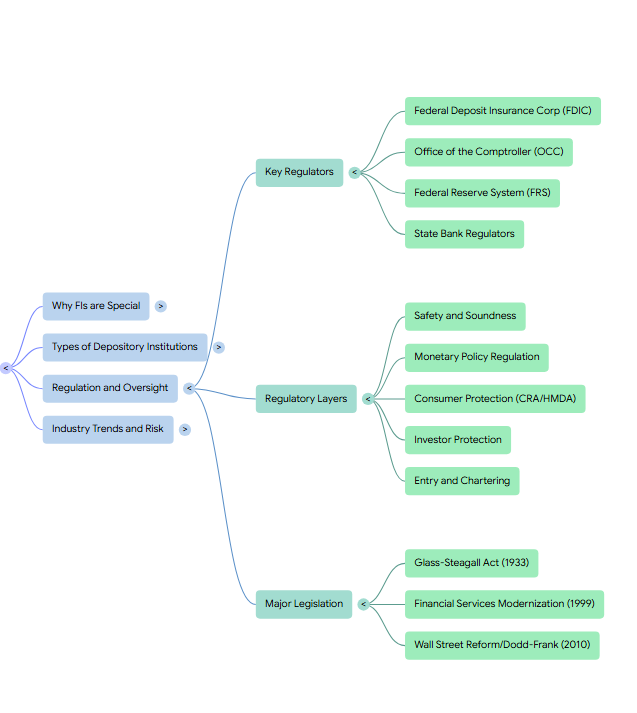
The book explains that regulation is necessary to protect the economy from the negative externalities that arise when a financial institution fails. These external costs can include the destruction of household savings or the restriction of credit to businesses. According to the book, there are six major types of regulation: safety and soundness, monetary policy, credit allocation, consumer protection, investor protection, and entry regulation. Safety and soundness regulation is implemented through multiple layers of protection, such as asset diversification requirements, minimum capital standards, and the provision of guaranty funds like the FDIC’s Deposit Insurance Fund. The book notes that depository institutions operate under a dual banking system, meaning they can be chartered and overseen by either state regulators or federal agencies like the Office of the Comptroller of the Currency.
The Federal Reserve serves as the central bank and holds regulatory power over bank holding companies and member banks. The book highlights the Wall Street Reform and Consumer Protection Act of 2010 as a sweeping overhaul of financial rules intended to prevent a repeat of the 2008 market meltdown. This legislation established the Financial Services Oversight Council to identify emerging systemic risks across the entire financial sector. For the securities industry, the book identifies the Securities and Exchange Commission (SEC) as the primary regulator, responsible for administering securities laws and prohibiting market manipulation. Additionally, the Financial Industry Regulatory Authority (FINRA) acts as an independent organization that handles the day-to-day regulation of trading practices.
The book states that mutual funds and investment advisors are regulated under the Investment Company Act of 1940 to prevent conflicts of interest and fraud. While hedge funds were historically exempt from many regulations, the book notes that the 2010 reform act now requires larger hedge fund advisors to register with the SEC. Insurance companies are primarily regulated at the state level, a framework confirmed by the McCarran-Ferguson Act of 1945. The book describes how the Federal Insurance Office was established to monitor the industry and identify regulatory gaps.
In the context of international management, the book discusses the Basel Agreement as a requirement for major industrialized countries to impose standardized risk-based capital ratios. Basel III, the most recent iteration of these accords, aims to raise the quality and transparency of the capital base to better withstand credit risk. The Volcker Rule is also highlighted in the book as a regulation that prohibits depository institutions from engaging in proprietary trading to reduce market risk. Finally, the book notes that the Consumer Financial Protection Bureau was created to protect consumers from unfair or deceptive practices across all financial products.
Key Regulators
In the larger context of regulation and oversight, the book describes a complex, multilayered system designed to protect the economy from the negative externalities of financial institution (FI) failures. Because depository institutions in the United States operate under a dual banking system, they can be chartered and overseen by either state regulators or federal agencies.
Depository Institution Regulators
According to the book, the oversight of banks and savings institutions is divided among several key federal and state bodies:
- Federal Deposit Insurance Corporation (FDIC): The book identifies the FDIC as a critical regulator that manages the Deposit Insurance Fund (DIF) to deter depositor runs. In addition to insuring deposits, the FDIC carries out bank examinations and acts as the receiver and liquidator when an insured bank is closed.
- Office of the Comptroller of the Currency (OCC): As the oldest bank regulatory agency, the OCC charters, examines, and has the power to close national banks. The book notes that following the 2010 Wall Street Reform and Consumer Protection Act, the OCC also assumed the responsibilities of the now-defunct Office of Thrift Supervision, making it the primary regulator for federal savings institutions as well.
- Federal Reserve System (the Fed): In addition to its role in monetary policy, the book explains that the Fed has regulatory power over bank holding companies and state-chartered banks that are members of the Federal Reserve System. Post-2010 reforms granted the Fed new authority to supervise any large, interconnected firms that could pose a threat to financial stability, even those that do not own banks.
- National Credit Union Administration (NCUA): The book describes the NCUA as the independent federal agency responsible for chartering, supervising, and insuring the nation’s credit unions through the National Credit Union Share Insurance Fund (NCUSIF).
Securities and Market Regulators
For the securities industry, the book highlights a different set of primary regulators:
- Securities and Exchange Commission (SEC): The book identifies the SEC as the primary regulator responsible for administering securities laws, reviewing registrations of new offerings to ensure full disclosure, and prohibiting security market manipulation.
- Financial Industry Regulatory Authority (FINRA): While the SEC sets standards, the book explains that FINRA—an independent, not-for-profit organization—handles the day-to-day regulation of trading practices, monitors for abuses like insider trading, and enforces rules governing securities firms’ capital positions.
Consumer and Systemic Oversight
Recent legislative changes have introduced new specialized regulators to address gaps identified during the 2008 financial crisis:
- Consumer Financial Protection Bureau (CFPB): The book notes that the CFPB was created to protect consumers across the entire financial sector from unfair, deceptive, or abusive practices involving products like mortgages and credit cards.
- Financial Services Oversight Council (FSOC): Established as part of the 2010 reforms, the FSOC is chaired by the Treasury and includes heads of the major federal financial regulators. The book explains that its primary mission is to identify emerging systemic risks that could threaten the broader financial system.
Insurance Regulation
Unlike other FIs, the book states that the insurance industry is primarily regulated at the state level, a framework confirmed by the McCarran-Ferguson Act of 1945. However, the book highlights the creation of the Federal Insurance Office (FIO) within the Treasury to monitor the industry, identify regulatory gaps, and address international insurance matters.
Federal Deposit Insurance Corp (FDIC)
The Federal Deposit Insurance Corporation (FDIC) is a central component of the U.S. regulatory framework, established in 1933 to deter bank runs and maintain stability in the financial system. The book describes the FDIC as one of four key regulators for depository institutions, operating alongside the Office of the Comptroller of the Currency (OCC), the Federal Reserve, and state bank regulators. While the OCC charters national banks and the Fed oversees bank holding companies, the FDIC specifically serves as the primary federal regulator for state-chartered banks that are not members of the Federal Reserve System.
The book highlights several primary functions and powers of the FDIC within the broader context of financial oversight:
- Fund Management and Insurance: The FDIC manages the Deposit Insurance Fund (DIF), which was created by merging the Bank Insurance Fund (BIF) and the Savings Association Insurance Fund (SAIF) in 2006. It provides insurance protection for depositors, which was increased from $100,000 to $250,000 per person per institution during the financial crisis of 2008–09 to instill confidence in the banking system.
- Examination and Monitoring: The book states that the FDIC carries out regular on-site bank examinations to ensure the safety and soundness of insured institutions. Following the passage of the FDIC Improvement Act (FDICIA) of 1991, the FDIC is required to perform these examinations annually and has implemented improved accounting standards, such as working toward market valuation of balance sheets, to better monitor net worth.
- Liquidation and Resolution: When an insured depository institution fails, the FDIC acts as the receiver and liquidator. The book explains that the FDIC is now legally mandated to use a “least-cost resolution” (LCR) strategy, which requires it to evaluate failure resolution alternatives on a present value basis and select the method that is least costly to the insurance fund.
- Risk-Based Premiums: To discourage moral hazard and excessive risk-taking, the book notes that the FDIC has employed a risk-based insurance premium system since 1993. These premiums are calculated based on an institution’s capital adequacy and supervisory ratings, with the most recent rules adjusting rates according to the size of the FDIC’s reserve ratio [19A, 585, 964].
The book also identifies the FDIC’s critical role during periods of economic distress. For example, during the technical insolvency of the insurance fund in the early 1990s, the FDIC was authorized to borrow from the U.S. Treasury to maintain its operations. More recently, in 2008, the FDIC enacted the Temporary Liquidity Guarantee Program (TLGP) to encourage liquidity by providing government backing for newly issued senior unsecured debt at eligible institutions. Additionally, the FDIC serves as a member of the Financial Services Oversight Council (FSOC), a body established by the Wall Street Reform and Consumer Protection Act of 2010 to identify systemic risks across the entire financial sector.
Office of the Comptroller (OCC)
The Office of the Comptroller of the Currency (OCC) is the oldest bank regulatory agency in the United States, established in 1863 as a subagency of the U.S. Treasury. The book identifies the OCC as one of the four key federal and state bodies responsible for the oversight of banks and savings institutions. Its primary function involves the chartering of national banks and the authority to close them when necessary. Beyond chartering, the book notes that the OCC conducts regular examinations of national banks and holds the power to approve or disapprove their merger applications.
In the larger context of key regulators, the OCC’s role expanded significantly following the passage of the Wall Street Reform and Consumer Protection Act of 2010. The book explains that this legislation mandated the consolidation of the Office of Thrift Supervision (OTS) into the OCC. Consequently, the OCC now regulates both national banks and federal savings institutions, assuming responsibilities for chartering and examining the latter that were previously held by the OTS.
The OCC operates within the framework of a dual banking system, where banks can choose to be chartered either at the federal level by the OCC or by one of fifty individual state bank regulatory agencies. The book highlights that while many large institutions choose national charters, the OCC shares supervisory responsibilities with other agencies like the Federal Reserve and the FDIC. For example, the OCC is a member of the Federal Financial Institutions Examination Council (FFIEC), which processes standardized mortgage transaction reports from thousands of institutions. Furthermore, the book states that the OCC works with other regulators to determine credit risk weights for assets under international capital standards like Basel III.
Federal Reserve System (FRS)
The book identifies the Federal Reserve System (the Fed) as the central bank of the United States, possessing extensive regulatory power over bank holding companies and state-chartered member banks. Beyond these traditional roles, the book explains that the 2010 Wall Street Reform and Consumer Protection Act granted the Fed significant new authority to supervise any large, interconnected firms whose failure could pose a threat to financial stability, regardless of whether they own a bank. The book highlights that the Fed acts as an umbrella supervisor for consolidated organizations, reviewing their risk management systems and capital adequacy to ensure that nonbank subsidiaries do not jeopardize the stability of associated depository institutions.
According to the book, the Fed is responsible for the transmission of monetary policy, using tools such as open market operations, setting reserve requirements, and determining the discount rate to influence the broader economy. The book notes that the Fed also oversees payment, clearing, and settlement systems, a responsibility that was further clarified and expanded by the 2010 reform legislation. In its capacity as a lender of last resort, the book describes how the Fed operates the discount window to provide short-term liquidity through primary, secondary, and seasonal credit programs to depository institutions.
The book also mentions that the Fed has become a major supervisor for the insurance industry, now overseeing approximately one-third of total industry assets due to its authority over insurance firms that own savings institutions or are designated as systemically important financial institutions. Additionally, the book states that the Fed serves as a key member of the Financial Services Oversight Council, a body tasked with identifying and managing emerging systemic risks across the entire financial sector. Finally, the book highlights that the Fed works in coordination with other key regulators, such as the OCC and the FDIC, to ensure the safety and soundness of the financial system.
State Bank Regulators
State bank regulators represent one of the four key regulatory bodies in the United States that oversee depository institutions, as described in the book. The book explains that these regulators function within a dual banking system, which allows banks to choose between a national charter from the OCC or a charter from one of 50 individual state regulatory agencies. According to the book, state agencies had chartered 4,445 banks by mid-2015, which collectively held approximately 32 percent of total commercial bank assets. The book notes that state-chartered banks have the option to join the Federal Reserve System, and 816 banks had chosen to do so as of June 2015. For the 3,629 state-chartered banks that are not members of the Federal Reserve, the book identifies the FDIC as their primary federal regulator. The book states that state bank regulators often share supervisory responsibilities with federal agencies, particularly when banks are owned by parent holding companies. In addition to commercial banks, the book highlights that the vast majority of state-chartered savings institutions are overseen by state agencies. The book also explains that credit unions can be state-chartered and are subject to state regulation in those instances. Furthermore, the book points out that while depository institutions have federal options, insurance companies are regulated almost entirely at the state level under the McCarran-Ferguson Act of 1945. Finally, the book mentions that state commissions use coordinated examination systems, such as IRIS for property-casualty insurers, to identify institutions with high-risk financial ratios.
Regulatory Layers
The book explains that financial institutions (FIs) are singled out for special regulatory attention because their failure can impose massive negative externalities on the economy, such as the destruction of household savings or the restriction of credit. To manage these risks, particularly within safety and soundness regulation, regulators have developed four distinct protective layers designed to maintain the credibility of the financial system.
The Four Layers of Protection
According to the book, the regulatory framework utilizes the following layers to ensure the stability of FIs:
- Asset Diversification (First Layer): This layer involves requirements that encourage FIs to diversify their asset portfolios to prevent excessive exposure to a single borrower. For example, commercial banks are generally prohibited from making loans to any one company or borrower that exceed 15 percent of their own equity capital.
- Minimum Capital Requirements (Second Layer): Owners of an FI must contribute a minimum level of capital to fund operations. This capital serves as a critical buffer, as losses on asset portfolios are legally borne by equity holders first; only after equity is completely exhausted are outside liability holders, such as depositors, affected. The book notes that in early 2009, regulators conducted “stress tests” on the 19 largest U.S. depository institutions to ensure they had sufficient capital to withstand a severe economic slump.
- Guaranty Funds (Third Layer): To meet insolvency losses for small claim holders, regulators provide guaranty funds such as the Deposit Insurance Fund (DIF) for depository institutions and the Securities Investors Protection Corporation (SIPC) for securities firms. By protecting claim holders when an FI fails, these funds also create a demand for the regulation and monitoring of participating institutions to protect the funds’ resources.
- Monitoring and Surveillance (Fourth Layer): This layer involves both on-site examinations and the requirement for FIs to produce timely accounting statements and reports for off-site evaluation. Just as individual savers use FIs as delegated monitors to oversee borrowers, society appoints regulators to monitor the behavior and performance of the FIs themselves.
The Larger Context of Regulation and Oversight
The book highlights that these layers are part of six major types of regulation: safety and soundness, monetary policy, credit allocation, consumer protection, investor protection, and entry regulation. While these layers provide social welfare benefits by preventing systemic meltdowns, they also impose a “net regulatory burden” on FIs. This burden represents the difference between the private benefits of regulation, such as insurance guarantees, and the private costs of compliance, such as capital requirements and the time managers spend on examinations.
Furthermore, the book notes that depository institutions operate under a dual banking system, meaning they can choose to be chartered and overseen at either the federal level (by agencies like the OCC) or the state level. Legislation like the Wall Street Reform and Consumer Protection Act of 2010 has expanded these oversight layers by establishing the Financial Services Oversight Council to identify emerging systemic risks across the entire financial sector.
Safety and Soundness
According to the book, safety and soundness regulation is a primary form of oversight intended to protect the entire economy from the negative externalities that arise when a financial institution (FI) fails. These negative externalities can include the destruction of household savings, a collapse in the supply of credit to businesses, and the potential for contagious bank runs that threaten even healthy institutions. To manage these systemic risks, the book outlines four distinct protective layers that regulators utilize to ensure the stability and credibility of the financial system.
The Four Layers of Protection
- Asset Diversification (First Layer): This layer involves regulatory requirements that encourage FIs to diversify their portfolios to prevent excessive exposure to a single borrower or sector. For instance, commercial banks are generally prohibited from making loans to any one party that exceed 15 percent of the bank’s own equity capital.
- Minimum Capital Requirements (Second Layer): The book emphasizes that an FI’s capital serves as a critical buffer against insolvency because losses on asset portfolios are legally borne by equity holders first. Only after this equity is completely exhausted are outside liability holders, such as depositors, affected. The book notes that following the 2008 financial crisis, regulators intensified this layer by conducting “stress tests” on the 19 largest U.S. depository institutions to ensure they held sufficient capital to survive a severe economic downturn.
- Guaranty Funds (Third Layer): To meet insolvency losses for small claim holders and deter panics, regulators provide guaranty funds. The most prominent example is the Deposit Insurance Fund (DIF) managed by the FDIC, which provides a safety net for depositors up to $250,000. Similar funds exist for other sectors, such as the Securities Investors Protection Corporation (SIPC) for securities firms.
- Monitoring and Surveillance (Fourth Layer): This layer consists of both on-site examinations and off-site evaluations of timely accounting statements and reports. The book explains that just as individuals use FIs as “delegated monitors” to watch over borrowers, society appoints regulators to monitor the behavior and performance of the FIs themselves.
The “Net Regulatory Burden”
While these layers provide significant social welfare benefits by preventing systemic meltdowns, the book points out that they also impose a net regulatory burden on FIs. This burden is the difference between the private benefits of regulation, such as deposit insurance, and the private costs of compliance, such as the time spent on examinations and the cost of maintaining minimum capital levels that may be higher than owners would otherwise choose. Despite these costs, the book suggests that these layers are essential for maintaining the smooth and efficient operation of the broader economy.
Monetary Policy Regulation
According to the book, monetary policy regulation is one of the six major types of regulation designed to enhance the social welfare benefits of financial intermediaries. It is distinct from safety and soundness regulation, which utilizes four specific protective layers—asset diversification, minimum capital requirements, guaranty funds, and monitoring—to maintain the stability of the financial system.
The Context of “Specialness”
The book explains that depository institutions are considered “special” because they serve as the primary conduit through which the Federal Reserve’s monetary policy actions impact the rest of the economy. Because the highly liquid deposits of these institutions are accepted as the most widely used medium of exchange, they are at the core of the money supply.
Inside vs. Outside Money
A central motivation for this type of regulation is the difference between “outside money” and “inside money”.
- Outside Money: This is the portion of the money supply produced directly by the government or central bank, such as notes and coin.
- Inside Money: This represents the bulk of the money supply and is produced by the private banking system in the form of deposits.
Regulatory Mechanisms
Because the central bank only directly controls outside money, it imposes formal controls on depository institutions to make the transmission of monetary policy more predictable. The most common mechanism is the imposition of minimum required cash reserves to be held against deposits. By varying these reserve requirements or the quantity of outside money, the Federal Reserve can directly affect a bank’s reserve position and its ability to create loans and deposits.
The Net Regulatory Burden
While these regulations are intended to provide social benefits, the book notes that they also impose a net regulatory burden on institutions. Required reserves are often viewed by financial institutions as a “tax” because they typically pay no interest or very little interest, increasing the cost of undertaking intermediation. This burden represents the difference between the private costs of compliance—such as holding these idle reserves—and the private benefits, such as access to the discount window or deposit insurance.
Consumer Protection (CRA/HMDA)
In the larger context of financial institution management, consumer protection regulation is one of the six major types of regulation identified in the book, alongside safety and soundness, monetary policy, credit allocation, investor protection, and entry regulation. The book explains that these regulations are intended to enhance the net social welfare benefits of financial services by protecting consumers from unfair, deceptive, or discriminatory practices.
The Role of CRA and HMDA
Two central pieces of legislation in the consumer protection framework are the Community Reinvestment Act (CRA) and the Home Mortgage Disclosure Act (HMDA).
- HMDA: Since 1975, the HMDA has required depository institutions to report standardized data on mortgage transactions to determine if they are meeting the needs of their local communities. The book notes that HMDA is specifically concerned with preventing discrimination based on age, race, sex, or income.
- CRA: Passed in 1977, the CRA was designed to prevent discrimination in lending and to encourage institutions to help meet the credit needs of the entire community in which they are chartered, including low- and moderate-income neighborhoods.
Regulatory Burden and Oversight
The book highlights that compliance with consumer protection laws imposes a significant net regulatory burden on financial institutions. For instance, in 2014 alone, the Federal Financial Institutions Examination Council (FFIEC) processed over 9.9 million mortgage transactions from more than 7,062 institutions, illustrating the massive information production costs involved.
Despite the costs, the book points out that regulators continue to monitor compliance rigorously. For example, the FDIC rates banks on their CRA performance, with categories ranging from “outstanding” to “substantial noncompliance”. The book also notes that credit unions, due to their nonprofit status, are currently exempt from CRA local investment requirements.
Evolution Post-Financial Crisis
The book explains that the Wall Street Reform and Consumer Protection Act of 2010 significantly expanded the consumer protection layer by creating the Consumer Financial Protection Bureau (CFPB). The CFPB is tasked with:
- Protecting consumers across the entire financial sector from unfair, deceptive, and abusive practices.
- Supervising both banks and nonbank financial firms, such as payday lenders and private education lenders.
- Improving the transparency and fairness of financial products like credit cards and mortgages.
Ultimately, the book frames consumer protection as a dynamic regulatory layer that continues to adapt to new technologies and financial products to maintain public confidence and equity in the financial system.
Investor Protection
Investor protection regulation is identified by the book as one of the six major types of regulation designed to enhance the net social welfare benefits provided by financial intermediaries. In the larger context of regulatory layers, this form of oversight specifically aims to protect individuals who use investment banks to purchase securities directly or who access securities markets indirectly through mutual and pension funds.
Objectives and Protections
According to the book, the primary objective of this regulatory layer is to shield investors from various abuses, including:
- Insider trading: Preventing the use of non-public information for unfair profit.
- Lack of disclosure: Ensuring all relevant financial information is revealed to potential investors.
- Malfeasance and Breach of Fiduciary Duty: Protecting against outright fraud or the failure of an institution to act in the best interest of its clients.
Key Legislation
The book highlights several landmark laws that form the backbone of investor protection in the United States:
- Securities Acts of 1933 and 1934: These established the framework for regulating new offerings and secondary market trading, including the creation of the Securities and Exchange Commission (SEC).
- Investment Company Act of 1940: This act provides rules specifically for mutual funds to prevent conflicts of interest and excessive fees.
- Wall Street Reform and Consumer Protection Act of 2010: This recent legislation sought to overhaul financial rules following the 2008 market meltdown, establishing new oversight bodies like the Financial Services Oversight Council.
Regulatory Context and Burden
Within the broader framework of financial oversight, investor protection is a critical component for maintaining public confidence in the financial system. However, the book notes that complying with these regulations imposes a “net regulatory burden” on financial institutions. This burden represents the difference between the private benefits of being a regulated entity and the private costs—such as the legal and administrative expenses of disclosure—required to adhere to these investor protection mandates. While these costs can reduce an institution’s operational efficiency, they are viewed as necessary to protect the economy from the negative externalities that arise when financial markets are manipulated or investor trust is destroyed.
Entry and Chartering
According to the book, entry and chartering regulation is one of the six major types of regulation designed to enhance the net social welfare benefits provided by financial institutions, alongside categories like safety and soundness, monetary policy, and consumer protection. Within the larger framework of financial oversight, this regulatory type functions as a gatekeeper, determining who can provide financial services and what specific activities they are permitted to perform under a given charter.
The Dual Banking System and Regulators
A central feature of entry and chartering in the United States is the dual banking system, which allows depository institutions to choose between being chartered at the federal level or the state level.
- National Charters: The book identifies the Office of the Comptroller of the Currency (OCC) as the oldest bank regulatory agency, responsible for chartering national banks. Following the consolidation of the Office of Thrift Supervision in 2011, the OCC also assumed responsibility for chartering federal savings institutions.
- State Charters: Depository institutions may instead seek charters from one of 50 individual state bank regulatory agencies. For insurance companies, the book notes that chartering is done entirely at the state level, a framework confirmed by the McCarran-Ferguson Act of 1945.
- Credit Unions: The National Credit Union Administration (NCUA) is the federal agency responsible for chartering and supervising federal credit unions.
Economic Impact and Charter Value
The book explains that entry regulation directly impacts the profitability of existing firms by controlling the cost of entering a financial sector.
- Barriers to Entry: Regulators can increase entry costs through high direct requirements, such as significant equity capital contributions, or indirect costs, such as restricting the types of individuals or organizations allowed to establish an institution. Heavily protected industries with high entry barriers generally produce larger profits for incumbent firms.
- Charter Value: The value of an institution’s charter is closely tied to the “scope of permitted activities” defined by regulations. The book highlights the Financial Services Modernization Act of 1999 as a landmark piece of legislation that broadened these scopes by allowing the creation of financial services holding companies that could engage in banking, securities, and insurance activities under one umbrella. Generally, the broader the set of permitted activities, the more valuable the charter becomes.
Context within Regulatory Layers
In the context of regulatory layers, entry and chartering requirements often overlap with safety and soundness protections. For instance, the second layer of safety and soundness protection—minimum capital requirements—often serves as a primary hurdle for new entrants seeking a charter. Owners must contribute a specific level of capital to fund operations, which acts as a buffer against insolvency and ensures that those entering the market have a meaningful equity stake at risk.
Ultimately, the book frames entry and chartering regulation as a balance between maintaining a competitive financial environment and imposing a net regulatory burden. While these regulations provide social welfare benefits by ensuring only sound participants enter the market, the private costs of compliance and the restrictions on activity scope can affect the overall efficiency and profitability of financial institutions.
Major Legislation
The book describes a century-long evolution of financial regulation in the United States, driven by shifting economic conditions, technological changes, and a series of major crises. Within the broader framework of regulation and oversight, this legislation has served to define the scope of permitted activities, manage systemic risk, and protect both consumers and the stability of the economy.
Foundational and Restrictive Legislation
Much of the early 20th-century regulatory framework was designed to impose rigid boundaries between different financial sectors:
- The McFadden Act of 1927: This act restricted the ability of nationally chartered banks to branch interstate, subjecting them to the same branching regulations as state-chartered banks in their respective regions.
- The Banking Act of 1933 (Glass-Steagall Act): Following the stock market crash of 1929, this landmark legislation sought to separate commercial banking from investment banking. It generally prohibited commercial banks from underwriting securities and established the Federal Deposit Insurance Corporation (FDIC) to restore confidence in the banking system.
- The Bank Holding Company Act of 1956 (and 1970 Amendments): These laws restricted the banking and nonbanking acquisition activities of multibank holding companies and limited their activities to those “closely related to banking”.
The Era of Deregulation (1980s)
The book notes that the 1980s were characterized by a push toward deregulation as depository institutions (DIs) struggled with high interest rates and competition from less regulated sectors:
- DIDMCA (1980) and DIA (1982): These acts phased out interest rate ceilings on deposits, authorized NOW accounts nationwide, and granted federally chartered thrifts expanded lending powers into consumer and commercial areas.
Crisis Response and Re-regulation
Following the collapse of the thrift industry and the insolvency of the FSLIC, Congress moved to strengthen oversight:
- FIRREA (1989): This act abolished the FSLIC, created the Office of Thrift Supervision (OTS), and introduced the Qualified Thrift Lender (QTL) test, which required savings institutions to maintain 65 percent of their assets in mortgage-related categories.
- FDICIA (1991): To address a rising number of bank failures, this act introduced prompt corrective action (PCA), which mandated specific regulatory interventions as a DI’s capital fell, and required annual on-site examinations.
Modernization and Interstate Banking
The 1990s marked a significant shift toward consolidating the industry and removing historical barriers:
- Riegle-Neal Act of 1994: This act effectively permitted full interstate banking for the first time in 70 years, allowing bank holding companies to consolidate out-of-state subsidiaries into a single branch network.
- Financial Services Modernization Act (FSMA) of 1999: Also known as the Gramm-Leach-Bliley Act, this legislation repealed the Glass-Steagall barriers, allowing for the creation of “financial services holding companies” that could engage in banking, securities underwriting, and insurance activities under one corporate umbrella.
Post-2008 Crisis Overhaul
The book highlights the Wall Street Reform and Consumer Protection Act of 2010 (Dodd-Frank) as the most extensive overhaul of financial rules since the Great Depression. Key features included:
- Systemic Oversight: Establishing the Financial Services Oversight Council (FSOC) to monitor risks across the entire financial sector.
- The Volcker Rule: Prohibiting DIs from engaging in proprietary trading and limiting their investments in hedge funds and private equity.
- Consumer Protection: Creating the Consumer Financial Protection Bureau (CFPB) to regulate products like credit cards and mortgages across all financial providers.
Other Specialized Regulations
- Consumer Protection: The Community Reinvestment Act (CRA) and Home Mortgage Disclosure Act (HMDA) were passed to prevent discrimination in lending and ensure institutions meet the needs of their local communities.
- Security and Secrecy: The USA Patriot Act of 2001 introduced new requirements for FIs to verify customer identities and deter money laundering to combat terrorist financing.
- Insurance: The McCarran-Ferguson Act of 1945 remains critical, as it confirms that the primary oversight of the insurance industry belongs to the states rather than the federal government.
Glass-Steagall Act (1933)
The Glass-Steagall Act, also known as the Banking Act of 1933, was foundational legislation enacted in response to the economic and industrial collapse of the early 1930s. The book describes this Act as a pivotal moment in financial history that sought to impose a rigid separation between commercial banking—the activity of deposit taking and lending—and investment banking, which involves underwriting, issuing, and distributing securities. This separation was largely driven by the findings of the Pecora Commission, which highlighted various abuses and inherent conflicts of interest that occurred when these two types of banking were mixed during the period leading up to the 1929 stock market crash.
According to the book, the Glass-Steagall Act included several key provisions that defined the U.S. financial landscape for nearly 70 years:
- Underwriting Restrictions: The Act generally prohibited commercial banks from underwriting securities, though it provided four notable exceptions: municipal general obligation bonds, U.S. government bonds, private placements, and real estate loans.
- Affiliate Limitations: Beyond direct activities, the Act limited the ability of banks and securities firms to engage in each other’s business indirectly through separately established affiliates.
- Establishment of the FDIC: A major component of the legislation was the creation of the Federal Deposit Insurance Corporation (FDIC) to provide government-backed insurance for bank deposits, aimed at restoring public confidence in the banking system.
- Interest on Deposits: The Act prohibited banks from paying interest on demand deposits.
The book places Glass-Steagall within a broader historical context of restrictive major legislation, such as the McFadden Act of 1927, which limited interstate branching, and the Bank Holding Company Act of 1956, which further restricted the nonbanking activities of banking organizations. For much of the 20th century, these laws ensured that the U.S. financial system remained segmented compared to the “universal” banking structures found in countries like Germany and the United Kingdom.
However, the book details how the barriers established by Glass-Steagall eventually eroded between 1963 and 1987 as banks successfully challenged restrictions on various activities, such as commercial paper underwriting and the management of mutual funds. In 1987, the Federal Reserve began allowing bank holding companies to establish “Section 20 affiliates” to engage in limited investment banking activities, provided that the majority of their revenue did not come from those restricted activities.
Ultimately, the book notes that the Glass-Steagall Act’s barriers were repealed by the Financial Services Modernization Act (FSMA) of 1999. This repeal allowed for the creation of “financial services holding companies” that can now engage in a full range of banking, securities, and insurance activities under one corporate umbrella. While this marked the end of the Glass-Steagall era, the book points out that recent post-crisis regulations, such as the “Volcker Rule,” represent a partial return to the principle of separating certain risky trading activities from traditional commercial banking.
Financial Services Modernization (1999)
The Financial Services Modernization Act of 1999, also known as the Gramm-Leach-Bliley Act, is characterized by the book as the most significant change in the regulation of financial institutions in nearly 70 years. This landmark legislation effectively ended the era of segmented financial services in the United States by repealing the 1933 Glass-Steagall barriers that separated commercial banking from investment banking. Its primary purpose was to remove the historical restrictions that prevented commercial banks, securities firms, and insurance companies from entering each other’s business territories.
A central feature of the act was the authorization of “financial services holding companies” (FSHCs). These structures allowed a single corporate umbrella to engage in a full spectrum of activities, including traditional commercial banking, investment banking, and insurance underwriting under one roof. By 2015, the book reports that over 850 banks had qualified as financial services holding companies. The act also permitted large national banks to conduct certain activities, such as some types of securities underwriting, through direct subsidiaries rather than just through holding company affiliates.
The book explains that this modernization moved the United States toward a “universal banking” model similar to those found in many other industrialized countries, where institutions can offer “one-stop shopping” for various financial products. Beyond product expansion, the act addressed the relationship between banking and commerce by allowing commercial banks within an FSHC to take a controlling interest in nonfinancial enterprises, provided the investment is held for a limited time and the bank does not become actively involved in the management of the firm. It also established a limit of 15 percent for nonfinancial assets within an FSHC.
Regarding oversight, the act introduced “functional regulation,” where each affiliate of an FSHC is overseen by its primary regulator: the SEC for securities activities, state agencies for insurance, and bank regulators for depository institutions. The Federal Reserve was designated as the “umbrella supervisor” for the consolidated organization, responsible for reviewing risk management systems to ensure that nonbank subsidiaries do not jeopardize the stability of associated depository institutions.
Finally, the act included provisions for consumer protection and risk mitigation. It granted customers the right to “opt out” of private information sharing with nonaffiliated third parties. Additionally, it prohibited FDIC assistance to the affiliates and subsidiaries of banks and savings institutions to prevent the federal safety net from directly subsidizing non-banking risks. While it opened the door for massive consolidation, the book notes that the subsequent financial crisis eventually led to a partial reversal of this deregulatory trend with the passage of the 2010 Volcker Rule, which once again restricted certain types of proprietary trading for depository institutions.
Wall Street Reform/Dodd-Frank (2010)
The Wall Street Reform and Consumer Protection Act of 2010, often referred to as Dodd-Frank, is described in the book as the most extensive overhaul of financial rules in the United States since the Great Depression. Enacted in response to the 2008–2009 financial crisis, the legislation sought to prevent a repeat of the market meltdown by addressing systemic risks, improving transparency, and protecting consumers and investors.
Key Objectives and Structural Reforms
According to the book, the Act set forth five key objectives to stabilize the financial system:
- Robust Supervision and Regulation: It established the Financial Services Oversight Council (FSOC) to identify emerging systemic risks across the entire financial sector. It also granted the Federal Reserve new authority to supervise large, interconnected firms that could pose a threat to financial stability, regardless of whether they own a bank.
- Comprehensive Supervision of Financial Markets: The legislation introduced the regulation of securitization markets and mandated comprehensive oversight of all over-the-counter (OTC) derivatives. It required some derivatives to be traded through clearinghouses to increase transparency.
- Consumer and Investor Protection: It created the Consumer Financial Protection Bureau (CFPB) to protect consumers from unfair, deceptive, or abusive practices involving financial products like mortgages and credit cards.
- Crisis Management Tools: The Act provided the government with a regime to resolve nonbank financial institutions whose failure could have serious systemic effects without a broader bailout.
- International Standards: It aimed to raise international regulatory standards, particularly regarding capital frameworks and the supervision of internationally active firms.
Impact on Specific Financial Sectors
The book details how the Act reshaped various industry segments:
- Depository Institutions and the Volcker Rule: One of the most significant provisions is the Volcker Rule, which prohibits U.S. depository institutions from engaging in proprietary trading and limits their investments in hedge funds or private equity funds. This rule was intended to reduce market risk and steer banks back toward a traditional model of deposit-taking and lending.
- Thrift Industry: The Act mandated the consolidation of the Office of Thrift Supervision (OTS) into the Office of the Comptroller of the Currency (OCC), making the OCC the primary regulator for federal savings institutions as well as national banks.
- Hedge Funds and Investment Advisors: The legislation significantly increased oversight for these entities, requiring larger hedge fund advisors (with more than $100 million in assets) to register with the SEC and report information necessary for assessing systemic risk.
- Insurance: While insurance remains primarily regulated at the state level, the Act established the Federal Insurance Office (FIO) within the Treasury to monitor the industry and identify regulatory gaps.
- Shadow Banking: The FSOC was empowered to designate nonbank financial firms as systemically important, subjecting them to Federal Reserve supervision and stricter capital and leverage standards.
Historical Context of Major Legislation
In the broader context of U.S. financial legislation, the book frames the 2010 Act as a partial reversal of the deregulatory trend that culminated in the Financial Services Modernization Act of 1999. While the 1999 Act repealed the Glass-Steagall barriers to allow for “one-stop shopping” under financial services holding companies, the 2010 reform once again sought to separate certain risky activities—like proprietary trading—from traditional banking. Ultimately, the book characterizes the Act as a monumental shift back toward more stringent oversight, intended to protect the economy from the negative externalities of institutional failure.
— Linden Lake
This Series
→ Book Review (4 of 4): Financial Institutions Management – A Risk Management Approach — Industry Trends and Risk
→ Book Review (3 of 4): Financial Institutions Management – A Risk Management Approach — Regulation and Oversight
→ Book Review (2 of 4): Financial Institutions Management – A Risk Management Approach — Types of Depository Institutions
→ Book Review (1 of 4): Financial Institutions Management – A Risk Management Approach — Why Financial Institutions Are Special
Leave a Reply