
The fixed-income universe is vast, diverse, and fundamentally shaped by the nature of its issuers and the markets in which they raise capital. Globally, fixed-income markets represent the largest subset of financial markets, far exceeding equity markets in both outstanding value and number of issuances. At the core of fixed-income analysis and mathematics is the characterization of different sectors, the unique credit and structural profiles of their issuers, and the analytical frameworks used to price their liabilities.
1. The Global Fixed-Income Landscape
The global debt market consists of debt securities—tradable instruments issued by corporations or governments—as well as non-securitized bank loans. As of March 2021, the global total of outstanding debt securities reached approximately $123 trillion, eclipsing the global equity market capitalization of $110 trillion.
A few dominant regions drive the supply of global debt:
- The five largest regions of issuance—the United States, the Eurozone, China, Japan, and the United Kingdom—comprise nearly 90% of the global outstanding total.
- In the United States, the total outstanding debt across all credit and loan instruments reached $76.4 trillion as of June 2021.
- Significant structural differences exist between these markets: corporations in the United States are far more likely to raise funds by issuing bonds directly to the public, whereas European, Japanese, and British corporations rely more heavily on bank loans.
Analytically, fixed-income markets are segmented by maturity:
- Money Markets: Debt instruments with an original maturity of one year or less (such as Treasury bills and commercial paper). These are generally annualized on a simple, non-compounded interest basis.
- Capital Markets: Securities issued with original maturities exceeding one year. Capital market yields are calculated on an annualized and compounded basis (such as the yield to maturity).
The broader market is further divided into three primary sectors: government and government-related, corporate, and structured finance (securitized).
2. Sovereign Issuers and the Benchmark Curve
Sovereign (or national) governments issue debt primarily for fiscal reasons to fund budget deficits when tax revenues fall short of expenditures. Highly rated sovereign bonds denominated in local currency (such as U.S. Treasuries, German Bunds, or Japanese Government Bonds) are perceived by market participants as having minimal credit risk, as national governments possess taxing authority and the power to print currency to service domestic obligations.
In the United States, sovereign securities are issued on a highly standardized auction schedule:
- Treasury Bills (T-bills): Non-coupon-bearing discount securities maturing in one year or less.
- Treasury Notes (T-notes): Coupon-bearing capital market securities with original maturities of 2, 3, 5, 7, or 10 years.
- Treasury Bonds (T-bonds): Coupon-bearing capital market securities with original maturities of 20 or 30 years.
- TIPS and Floating-Rate Notes: Sovereigns also issue Treasury Inflation-Protected Securities (TIPS), which protect against inflation by adjusting the principal balance in line with a consumer price index, and Floating-Rate Notes (FRNs) to lock in intermediate funding at variable short-term rates.
Analytical Significance:
The sovereign yield curve is the absolute foundation of fixed-income mathematics. It represents the “risk-free” benchmark curve against which all other risky debt is priced.
- On-the-run issues (the most recently auctioned sovereign bonds of a given maturity) are highly liquid and serve as the pricing benchmark.
- Off-the-run issues (older, seasoned bonds) are less liquid and often trade at slightly higher yields due to built-in liquidity premiums.
- Through bootstrapping, analysts extract zero-coupon spot rates from coupon-paying benchmark sovereign curves to construct a theoretical spot-rate curve, establishing the arbitrage-free “time value of money” for any discrete future cash flow.
3. Non-Sovereign, Quasi-Government, and Supranational Issuers
Beneath national governments, several other public or semi-public entities issue debt, each presenting unique credit and structural profiles:
- Non-Sovereign (Local) Governments: Provinces, states, regions, and cities issue bonds to fund local expenditures and infrastructure. In the United States, these are known as municipal bonds (munis), and their interest payments are typically exempt from federal (and often state) income tax.
- General Obligation (GO) Bonds are unsecured debt backed by the general taxing authority of the local government.
- Revenue Bonds are secured solely by the cash flows generated by the specific project they finance (e.g., toll roads or sewers) and are benched using the debt service coverage ratio (DSCR).
- Historically, municipal default rates are extremely low (a 10-year cumulative default rate of 0.09% compared to 11.06% for corporate debt), though credit events like the 2013 Detroit bankruptcy highlighted that certain GO claims can be treated as unsecured in restructuring.
- Quasi-Government Entities: Government-related agencies and government-sponsored enterprises (GSEs), such as Fannie Mae, Freddie Mac, Ginnie Mae, or postal services. Ginnie Mae is explicitly backed by the full faith and credit of the U.S. government, whereas GSEs like Fannie Mae and Freddie Mac are privately owned but operate under government conservatorship with a strongly perceived implicit guarantee.
- Supranational Agencies: Multilateral institutions established by international treaty (e.g., the World Bank, IMF, or European Investment Bank). Their bonds are backed by the paid-in capital of member states or the repayment of previous loans. They are highly rated and often serve as liquid benchmarks in markets lacking sovereign yield curves.
4. Corporate Issuers, Credit Capital Structure, and Covenants
Unlike sovereign entities, corporate issuers exist to generate profits. Debt issued by corporations is a contractual obligation and a prior claim on the company’s earnings and assets, making it inherently lower risk than the company’s common equity.
To fund operations, corporate issuers utilize several instruments:
- Commercial Paper (CP): Short-term, unsecured promissory notes used for working capital or bridge financing. CP is exempt from SEC registration if its maturity is under 270 days and its proceeds are used for short-term purposes. It carries rollover risk, requiring banks to provide backup lines of credit.
- Medium-Term Notes (MTNs): Debt instruments continuously offered to investors, allowing issuers to customize maturities and structures continuously under a shelf registration.
- Corporate Bonds: Longer-term debt securities that must be registered with public regulators.
Mathematical and Credit Analytics:
Corporate debt pricing is heavily defined by credit risk, which is decomposed into default probability and loss severity (loss given default, LGD).
- Seniority Ranking: In a default event, claims are satisfied systematically according to seniority: First Lien/Secured Debt (backed by specific collateral), Senior Unsecured Debt (the most common corporate bond, backed by general assets), Subordinated Debt, and finally Equity. Investors utilize notching to rate individual issues lower than the overall company rating based on capital seniority.
- Covenants: To manage credit risk, bond indentures include legally enforceable rules. Affirmative Covenants specify what the issuer is required to do (e.g., use of proceeds, pay taxes). Negative Covenants restrict what the issuer is prohibited from doing to protect credit quality (e.g., limits on leverage, dividend distributions, or negative pledges preventing the issuance of more senior debt).
- Spread Measures: To isolate credit and liquidity risk from macroeconomic interest rate movements, corporate bond yields are priced as a spread over the benchmark curve. Measures include the G-spread (yield over a benchmark government bond), the I-spread (interpolated spread over the swap curve) [138, 498n6, 957], and the Z-spread (the constant basis-point spread added to the entire benchmark spot curve to match the bond’s price).
5. Structured Finance and Special Purpose Vehicles
The structured finance (or securitized) sector represents a major innovation designed to disintermediate banks by converting private loan pools into publicly traded, liquid securities. This sector encompasses Mortgage-Backed Securities (MBS) and Asset-Backed Securities (ABS) backed by auto loans, student loans, or credit card receivables.
The Securitization Mechanism:
- Special Purpose Vehicle (SPV / SPE): The originator of the loans transfers the assets to an independent SPV. Crucially, the SPV is structured as a bankruptcy-remote vehicle. If the originating company defaults, its general creditors have no claim over the SPV’s collateral pool, allowing the securitized bonds to attain a credit rating higher than the originator itself.
- The Waterfall: Cash flows generated by the collateral pool are directed to investors through a structured “waterfall” of priority. Principal and interest are paid sequentially starting at the Senior Tranches (often rated AAA), moving down through Mezzanine Tranches, and finally to the Junior/Equity Tranche (the unrated “first-loss piece” that absorbs initial default losses).
- Tranching and Risk Redistribution:
- Credit Tranching establishes a senior/subordinated structure to redistribute default risk among investors.
- Time Tranching distributes prepayment risk (contraction and extension risk caused by borrowers refinancing or paying off loans early) by creating sequential-pay structures or Planned Amortization Class (PAC) tranches that offer stable cash flow schedules protected by companion tranches.
6. Analytical and Mathematical Models Across Sectors
The intersection of markets and issuers dictates the choice of mathematical models utilized by analysts:
- Sovereign Debt: Valued using static, non-path-dependent models. Because government cash flows are contractually certain, analysts use spot curves and implied forward curves. Interest rate risk is managed using Macaulay duration, modified duration, convexity, or key rate durations to measure shaping risk. Yield curve changes are modeled using principal components analysis (PCA) to explain shifting levels, steepness, and curvature.
- Corporate Debt with Options: Callable corporate bonds require arbitrage-free lattice models (binomial trees) to capture the interest-rate-dependent nature of call exercise. Because standard duration assume fixed cash flows, analysts must calculate effective duration and effective convexity by running coupon-paying trees under shocked rate scenarios. Credit default risk is mathematically predicted using structural models (which treat equity as a call option on firm assets via the Merton model) or reduced form models (which use stochastic default intensities and macroeconomic variables).
- Securitized Debt: Valued using highly complex, path-dependent pricing due to the “burnout” of prepayments. Standard lattices cannot be used because prepayments depend on the historical path interest rates have traveled. Instead, analysts utilize Monte Carlo simulations, generating thousands of random interest rate paths with added “drift terms” to ensure the paths are calibrated to replicate current liquid benchmark prices.
Issuer Categories
In fixed-income markets, bond issuers are classified into distinct categories based on their shared financial, structural, and credit characteristics. This taxonomy is highly significant because an issuer’s legal structure and economic nature determine how its cash flows are generated, how they are protected, and which mathematical models must be used to value its debt.
The three primary sectors of the fixed-income market are the government and government-related sector, the corporate sector, and the structured finance (securitized) sector. Within these sectors, analysts distinguish several specific categories of issuers:
1. Sovereign Governments
Sovereign (or national) governments issue debt primarily to fund national budget deficits when tax revenues fall short of expenditures.
- Repayment and Backing: Sovereign bonds are typically unsecured but are backed by the “full faith and credit” of the national government, including its power to levy taxes and print local currency.
- Credit Quality: Sovereign debt denominated in the issuer’s local currency is generally perceived as carrying minimal credit risk (and is historically treated as “default-free” for benchmark pricing). However, sovereign debt denominated in a foreign currency carries higher credit risk because a national government cannot print foreign currency and is constrained by what it can earn through exports or raise in capital markets.
- Analytical Significance: The sovereign yield curve is the benchmark curve used to value all other “risky” debt in that currency. The most recently issued sovereign bonds (on-the-run issues) are highly liquid and serve as the pricing reference.
- Mathematical Conventions: By market convention, sovereign coupon bonds typically utilize an Actual/Actual day-count convention, representing the precise calendar days in the compounding period.
2. Non-Sovereign (Local) Governments
Non-sovereign governments include states, provinces, regions, and cities. In the United States, these local authority issues are known as municipal bonds (munis).
- Repayment Structures: Non-sovereign debt is bifurcated based on the source of payment:
- General Obligation (GO) Bonds: Unsecured debt backed by the general taxing authority of the local government.
- Revenue Bonds: Secured solely by the cash flows generated by the specific public project they finance (e.g., toll roads, airports, or utility systems).
- Analytical Differences from Sovereigns: Unlike sovereign entities, local governments do not possess independent monetary policy or the power to print money. Furthermore, many are legally required to balance their operating budgets annually.
- Credit Quality: Municipalities historically experience extremely low default rates (e.g., a 10-year cumulative default rate of 0.09% compared to 11.06% for corporate debt).
- Tax Considerations: In certain jurisdictions, interest payments from non-sovereign bonds are exempt from federal and local income taxes. To attract taxable investors, taxable debt must offer a higher yield than tax-exempt municipals.
- Mathematical Conventions: Non-sovereign issues typically utilize a standardized 30/360 day-count convention. For revenue bonds, analysts calculate the Debt Service Coverage Ratio (DSCR) to evaluate whether project revenues adequately cover principal and interest payments.
3. Quasi-Government (Agency) Issuers
Quasi-government entities are organizations established, owned, or sponsored by national governments to perform public or semi-public functions.
- Explicit vs. Implicit Guarantees: Debt issued by true government agencies (such as Ginnie Mae in the United States) is backed by the full faith and credit of the national government, eliminating credit risk. In contrast, debt issued by Government-Sponsored Enterprises (GSEs) (such as Fannie Mae and Freddie Mac) does not carry an explicit sovereign guarantee, though market participants price them under the strong assumption of implicit backing—an expectation that was fully validated during the conservatorship rescues of the 2008 financial crisis.
- Repayment: These bonds are typically repaid from internal cash flows generated by the entity’s operations (such as purchasing and guaranteeing mortgage pools) or from the specific projects they fund.
- Mathematical Conventions: Like municipal bonds, agency securities typically use a 30/360 day-count convention.
4. Supranational Organizations
Supranational organizations are multilateral agencies established by international treaties among member sovereign states. Examples include the World Bank, the International Monetary Fund (IMF), and the European Investment Bank (EIB).
- Repayment and Backing: Supranational bonds are supported by paid-in capital from member states or the repayment of previous loans granted by the organization.
- Analytical Role: Because supranational agencies typically enjoy very high credit ratings, their large-scale, liquid issues often serve as benchmark curves in international capital markets where a highly liquid sovereign government curve is absent.
5. Corporate Issuers
Corporations issue debt to raise capital for short-term working capital needs (e.g., commercial paper) or long-term capital investments (e.g., medium-term notes and corporate bonds). Unlike governments, corporate issuers exist to generate profits, making their financial strength highly cyclical.
- Financial vs. Non-Financial: Market participants distinguish between financial issuers (such as banks and insurance companies, which utilize high leverage and short-term wholesale funding) and non-financial issuers (such as industrial and utility firms).
- Credit Quality and Sectors: The corporate market is broadly split by rating agencies into investment-grade (Baa3/BBB- or higher, indicating low default probability) and speculative-grade/high-yield/junk sectors (rated below BBB-, indicating higher leverage and greater default sensitivity).
- Capital Seniority and Recovery: Because corporate default is a real risk, corporate debt structures feature a strict seniority ranking. In a liquidation or restructuring, claims are satisfied systematically:
- Secured Debt: Backed by a direct pledge of assets (such as first mortgage liens or collateral trusts).
- Unsecured Debt (Debentures): Backed only by the general assets and operating cash flows of the issuer.
- Subordinated Debt: Ranks below senior unsecured debt and carries the lowest priority of claim and the highest loss severity.
- Legal Protections (Covenants): To manage credit risk, corporate indentures include legally binding covenants. Affirmative covenants dictate administrative actions the issuer must perform (e.g., pay taxes, insure assets), whereas negative covenants restrict highly risky business decisions that could dilute bondholders’ claims (e.g., limiting additional debt, restricting asset disposals, or capping dividend distributions).
6. Structured Finance (Special Purpose Vehicles – SPVs)
Structured finance represents an innovation that bypasses traditional bank intermediation by transforming pools of private, illiquid loans (such as mortgages, auto loans, or credit card receivables) into publicly traded, liquid securities.
- The Special Purpose Vehicle (SPV): The defining element of this category is that the debt is not issued by an operating corporation, but by a Special Purpose Vehicle (SPV) or trust.
- Bankruptcy Remoteness: The originator of the loans sells the assets to the SPV in a transaction legally recognized as a “true sale”. This makes the SPV a bankruptcy-remote vehicle. If the originating company files for bankruptcy, its general creditors have no claim over the SPV’s assets. This decoupling allows the SPV’s bond classes to achieve credit ratings significantly higher than those of the originator itself.
- The Waterfall and Tranching: The cash flows generated by the underlying collateral pool are directed to investors through a structured waterfall.
- Credit Tranching creates senior and subordinated classes; the subordinated tranches act as internal credit enhancement, absorbing initial default losses first.
- Time Tranching (such as in Collateralized Mortgage Obligations) redistributes prepayment risk, establishing sequential-pay structures to suit different investor horizons.
Sovereign Governments
Sovereign Governments as an Issuer Category
Sovereign (or national) governments represent a primary category of bond issuers, alongside supranational organizations, non-sovereign (local) governments, quasi-government entities, and corporate issuers. Sovereign bonds are issued primarily for fiscal reasons to fund national public spending when tax revenues are insufficient to cover expenditures. Consequently, the government sector constitutes one of the largest segments of global debt markets; for example, general government debt represents around 50% of all outstanding debt securities in the United States, the Eurozone, and the United Kingdom, and as much as 74% in Japan.
Backing and Repayment Sources
Unlike corporate bonds, which depend on a company’s operational cash flows, or securitized bonds, which rely on financial asset pools, sovereign debt is typically issued as unsecured obligations backed by the “full faith and credit” of the national government. This backing is supported by the sovereign’s power to raise tax revenues and print its own currency.
- Budget Status: When a national government runs a budget surplus, tax revenues serve as the primary source of funds to pay down debt; during a budget deficit, repayment relies on rolling over existing debt into new issues.
- Twin Surpluses: A sovereign is best positioned to service its debt obligations when it runs “twin surpluses”—meaning both a government budget surplus and a current account surplus.
Sovereign Risk and Credit Quality
Sovereign bonds denominated in a government’s local currency are generally considered the safest available investments and are often treated as a “default-free” benchmark, with highly rated issuers like Germany, Singapore, Switzerland, and the United Kingdom representing minimal credit risk. However, sovereign credit quality is still subject to changes:
- Domestic vs. Foreign Currency Ratings: Credit rating agencies differentiate between a sovereign’s local currency debt and its foreign currency debt. Because a government can print its own currency to pay local debt but cannot do so for foreign currency debt (which is limited by export earnings or financial market access), domestic currency ratings are often up to two notches higher than foreign currency ratings.
- Emerging Market Considerations: Developing countries often must issue bonds in major foreign currencies (such as the U.S. dollar or euro) because international investors are willing to accept the sovereign’s credit risk but not the exchange rate volatility of its local currency.
- Sovereign Immunity and Willingness to Pay: A crucial distinction in sovereign credit analysis is evaluating a government’s ability to pay versus its willingness to pay. Because of the legal principle of sovereign immunity, sovereign governments generally cannot be sued or legally forced by courts to honor their debts, making their political willingness to pay a critical credit consideration.
Debt Instruments and Maturity Classifications
Sovereign issuers utilize different instruments depending on maturity:
- Money Market Securities: Government debt with an original maturity of one year or less (such as U.S. Treasury bills) are pure discount bonds. They pay no coupons; instead, they are issued at a discount to par and redeemed at par, with the difference representing the implied interest.
- Capital Market Securities: Government debt issued with maturities longer than one year (such as U.S. Treasury notes and bonds) are coupon-bearing instruments that pay periodic interest (semi-annually or annually) and return the principal at maturity.
- On-the-Run Benchmark Curves: In secondary trading, the most recently issued sovereign bonds are known as on-the-run issues. These highly liquid, safe securities serve as the benchmark par curve against which all other risky private or corporate debt in that currency is valued and compared.
Non-Sovereign and Quasi-Government
1. Non-Sovereign (Local) Governments
Non-sovereign government issuers represent regional and local public entities below the national level, such as states, provinces, regions, and cities. In the United States, these are commonly referred to as municipalities, and their debt instruments are known as municipal bonds (munis). In the United Kingdom, they are called local authority bonds.
- Market Scale and Investor Base: The U.S. municipal market is vast, comprising approximately $3.7 trillion to $4 trillion in size, representing over 50,000 issuers and roughly 1 million individual bond issues. Unlike most other institutional fixed-income sectors, the municipal market is heavily dominated by retail investors, who hold over 70% of the outstanding principal directly or indirectly through mutual funds and other vehicles.
- Tax Considerations: A primary distinguishing feature of non-sovereign debt is its tax status. In many jurisdictions, interest payments from municipal bonds are exempt from federal (and often state/local) income taxes, provided the funds are used for public projects. Because of this tax exemption, municipal issuers can offer lower coupon rates than comparable taxable corporate or sovereign bonds. To avoid capital gains taxes on price appreciation (which are not tax-exempt), many munis are issued at a premium with high coupons (such as 5%) to minimize the likelihood of trading at a discount. About $500 billion of the U.S. municipal market consists of taxable municipal bonds, which are issued for private business development, working capital, or specific refinancing structures that do not qualify for federal tax exemptions.
- Day-Count Conventions: Market conventions for calculating the number of days in a coupon period and year differ from sovereign debt, with local governments typically utilizing different day-count standards (such as the 30/360 convention).
Structural Divisions of Non-Sovereign Debt
Non-sovereign bonds are broadly categorized based on their sources of repayment:
- General Obligation (GO) Bonds: These are unsecured obligations backed by the “full faith and credit” and general taxing authority of the issuing local government.
- Revenue Bonds: These are secured solely by the specific revenues generated by the public project the bond issue is financing (e.g., toll roads, sewer systems, bridges, or airports). Because they depend on a single, isolated source of revenue, revenue bonds are structurally more exposed to project-specific risk than GO bonds.
- Prerefunded or Defeased Bonds: These are municipal liabilities that have been effectively canceled by setting aside a dedicated portfolio of cash and sovereign Treasury securities (often bought as custom State and Local Government Series, or SLUGs) to fully fund all remaining interest and principal payments. This process collateralizes the bonds and elevates their credit quality to match that of sovereign debt.
Credit Analysis and Default Dynamics
Historically, non-sovereign debt exhibits extremely low default rates compared to corporate debt. For instance, Moody’s reports a 10-year average cumulative default rate (1970–2009) of just 0.09% for municipal bonds, compared to 11.06% for corporate debt.
However, the analytical landscape changed dramatically following the 2013 Detroit bankruptcy. Historically, GO bonds were viewed as safer than revenue bonds. During the Detroit restructuring, however, a court ruled that federal bankruptcy law trumped state-level pension protections, but negotiated settlements resulted in highly uneven recoveries:
- Holders of water and sewer revenue bonds (which possessed strong, secured legal claims on dedicated revenue streams) suffered no loss of principal.
- Unlimited tax GO bonds (which carried voter-approved, dedicated tax receipts) recovered only 74% of principal due to deteriorating tax bases.
- Limited tax GO bonds (which lacked dedicated tax receipts or unlimited tax pledges) were treated as unsecured claims and recovered only 34% of principal.
This precedent demonstrated that GO bonds could be treated similarly to unsecured corporate claims, leading credit analysts to focus more on underfunded pension and post-retirement obligations—which act as significant, off-balance-sheet debt-like liabilities.
Traditional municipal credit analysis evaluates local economic fundamentals (such as demographics, per capita income, and employment diversification) and structural factors (such as the requirement to balance operating budgets annually, unlike sovereign nations). For revenue bonds, analysts heavily rely on the Debt Service Coverage Ratio (DSCR) to evaluate whether net operating income (NOI) provides a sufficient cushion to cover scheduled interest and principal payments.
2. Quasi-Government (Agency) Issuers
Quasi-government entities are organizations established, owned, or sponsored by national governments to perform public or semi-public functions. While they possess both public and private characteristics, they are not formal administrative governmental departments. Examples include Government-Sponsored Enterprises (GSEs) in the United States (like Fannie Mae, Freddie Mac, and the Federal Home Loan Bank), or commercial entities like postal services (such as Correios in Brazil or La Poste in France).
- Explicit vs. Implicit Guarantees: Quasi-government debt (often called agency debt) carries varying levels of sovereign support:
- Explicit Guarantees: Some entities, such as the Government National Mortgage Association (Ginnie Mae), operate directly within a national government cabinet (the U.S. Department of Housing and Urban Development). Its securities are backed by the full faith and credit of the sovereign government, carrying zero credit risk. Other agencies, such as the Japan Bank for International Cooperation (JBIC), have their timely payments explicitly guaranteed by their respective national government.
- Implicit Guarantees: GSEs like Fannie Mae and Freddie Mac are privately owned but federally chartered. Their debt issues are not explicitly backed by the government, but they operate under government conservatorship. Market expectations of full government support for GSE debt were fully realized during the 2008 financial crisis, during which no holder of GSE debt or mortgage-backed securities (MBS) suffered a loss of principal or interest.
- Independent Revenues: Some federal agencies, such as the Tennessee Valley Authority (TVA), are wholly owned by the government but issue debt backed solely by their own operational revenues rather than any explicit sovereign guarantee.
- Repayment Sources: Because quasi-government entities typically lack direct taxing authority, their bonds are serviced and repaid using internal cash flows generated by their business operations or from the specific public projects they finance.
- Market Role: Agency debt represents a massive sector of the global capital markets. The agencies are the primary engines behind securitization. They purchase residential mortgages, assemble them into collateral pools, and issue highly liquid agency residential mortgage-backed securities (RMBS), which represent nearly 67% of outstanding U.S. residential mortgages. Quasi-government entities are also among the largest global issuers of variable interest rate debt, frequently utilizing floating-rate notes (FRNs) to manage their short-term funding and asset-liability mismatches.
- Credit Quality: Because of their explicit or strongly perceived implicit sovereign backing and very low historical default rates, quasi-government bonds are rated exceptionally high by credit rating agencies, often trading at only minor yield spreads over sovereign debt.
Supranational Agencies
Supranational agencies (also referred to as multilateral agencies) represent a highly distinct issuer category within the government and government-related sector of the fixed-income market. Established by international treaties, these international financial institutions are owned by several member sovereign governments.
The sources outline the unique repayment backing, structural characteristics, and market role of supranational bonds:
1. Unique Sources of Repayment
Unlike sovereign governments, which rely on direct taxing authority and the power to print local currency, supranational agencies lack these direct mechanisms. Instead, the principal and interest on supranational bonds are repaid using:
- Repayment of previous loans made by the organization to borrowing countries.
- Paid-in capital contributed by its member sovereign states.
- Member government guarantees: In some cases, member national governments act as guarantors for specific bond issues. If a supranational agency requires additional financing to cover its debt service, it typically has the legal right to call on its members to provide the necessary funds.
2. Standard Structures and the Benchmark Role
Supranational bonds are generally considered highly secure, safe-haven assets, and the agencies are required to secure credit ratings from major agencies (such as Moody’s, S&P, or Fitch) to facilitate public investment.
- Plain Vanilla Dominance: Supranational bonds are typically structured as plain vanilla bonds (paying fixed periodic coupons and a lump-sum principal at maturity), though they occasionally issue floating-rate notes, callable bonds, and short-term commercial paper.
- The World Bank and Global Bonds: Major supranationals like the World Bank are frequent issuers of global bonds. These are issued simultaneously in the Eurobond market and at least one domestic market to secure broad international demand.
- Liquid Benchmarks: Because of their exceptionally high credit ratings and large-sized issues, supranational bonds often serve as the pricing benchmarks in international capital markets where a highly liquid domestic sovereign yield curve is otherwise absent.
3. Central Bank Policy and the European Commission
Supranational debt has taken on an unprecedented scale in recent years, notably through the European Commission (EC). To finance economic recovery from the COVID-19 pandemic, the EC initiated massive debt issuances, including €100 billion of SURE bonds and €800 billion of NextGenerationEU bonds.
From the perspective of central bank operations (such as those of the European Central Bank), supranational debt is highly attractive because it is not subject to the strict cross-country purchase allocation constraints (capital keys) that govern the purchase of individual national sovereign bonds. However, to manage risk, central banks still place boundaries on these holdings; for example, the ECB is capped at investing no more than 10% of its portfolio in supranational debt and holding no more than 50% of any single supranational issuer’s debt.
Corporate Issuers (Financial and Non-Financial)
In the broader taxonomy of issuer categories, the global fixed-income market is segmented into three primary sectors: the government and government-related sector, the structured finance (securitized) sector, and the corporate sector. Within the corporate sector, market participants make a critical distinction between financial issuers (such as banks and insurance companies) and non-financial issuers (such as industrial and utility companies).
Unlike public entities, the primary goal of corporations is to generate profits to remain in existence, which makes profitability a central factor in their financing decisions. While common stock carries ownership rights, corporate bonds represent legal, contractual claims on the company’s assets and earnings, giving bondholders a prior claim on cash flows and assets but limiting their upside compared to equity holders.
1. Business Models and Funding Profiles
Financial and non-financial corporate issuers utilize debt differently due to their distinct business models and funding profiles.
- Financial Issuers: Financial institutions like commercial banks borrow heavily through deposits and short-term wholesale funding. To manage the balance sheet risk of having short-term liabilities but longer-term assets, financial issuers are major suppliers and demanders of floating-rate debt to hedge interest rate risk.
- Non-Financial Issuers: Non-financial corporate debt is typically issued to raise capital for corporate transactions, working capital, and long-term capital investments. In the United States, corporate and foreign bonds represent a massive $14.7 trillion sector (as of June 2021), comprised of issuances from US non-financial corporations (45%), US financial corporations (31%), and foreign corporations selling to US investors (24%).
2. Global Debt Volumes and Market Dominance
Outstanding debt volumes are heavily weighted toward financial corporate issuers globally. At the end of December 2010, global outstanding bonds issued by financial companies reached $42 trillion (representing 20% of total global outstanding debt and equity), compared to only $10 trillion (5%) for non-financial companies.
This dominance is particularly pronounced in developed nations such as the United States, the United Kingdom, Spain, and the Netherlands, where the corporate bond market is the largest credit sector, but the overwhelming majority of these bonds are issued by financial firms. For example, in global outstanding bond data from December 2011, US financial corporate debt totaled $14,938 billion (44% of total outstanding US bonds) versus US non-financial debt of $5,690 billion (17%).
3. Borrowing Life Cycles and Regional Funding Differences
Corporate liability structures reflect a progressive borrowing life cycle. Small or less-established corporations rely on family, bank loans, and private placements, whereas large and highly creditworthy corporate entities have broad access to public markets. These premier issuers raise roughly 30% of their financial liabilities via debt securities, primarily utilizing public commercial paper (CP), medium-term notes (MTNs), and corporate bonds.
Regional differences also dictate how corporate debt is raised:
- European corporations have historically relied much more heavily on bank financing, traditionally meeting 70% of their borrowing needs from banks and only 30% from the financial markets.
- However, following the 2008 global financial crisis, banks began deleveraging and reducing loan availability.
- As a result, high-credit-quality companies have shifted their funding strategies, turning increasingly to public debt markets to issue corporate bonds and lock in low interest rates.
Market Classifications
In fixed-income mathematics and portfolio management, market classifications organize the vast and diverse debt universe into standardized sectors. This taxonomy allows investors to identify expected performance, evaluate risk, and select appropriate assets based on key characteristics.
Based on the provided sources, the global fixed-income market is classified across several primary dimensions:
1. Classification by Type of Issuer
Sectors are broadly categorized into three dominant divisions:
- The Government and Government-Related Sector: This includes sovereign bonds issued by national governments, non-sovereign bonds issued by local authorities (such as states, provinces, and cities), quasi-government entities (agencies), and supranational organizations (like the World Bank or IMF).
- The Corporate Sector: Comprises debt issued by financial institutions (like commercial banks and insurance companies) and non-financial companies.
- The Structured Finance (or Securitized) Sector: Consists of bonds backed by collateral pools of private, cash-generating loans (such as residential mortgages, commercial mortgages, auto loans, or credit card receivables) that are moved into special purpose, bankruptcy-remote legal vehicles (SPVs).
2. Classification by Credit Quality
Rating agencies segment the bond market based on estimated default probability into two main categories:
- Investment-Grade Bonds: Securities rated Baa3 or higher by Moody’s and BBB- or higher by S&P and Fitch. These instruments exhibit lower credit risk and are often mandatory holdings for highly regulated financial intermediaries, such as banks and life insurance companies, which face strict statutory limitations on speculative assets.
- Non-Investment-Grade (High-Yield / Junk / Speculative) Bonds: Debt securities rated below Baa3/BBB-. These present higher credit and spread volatility, but offer higher yields to compensate investors for increased default risk. In general, investment-grade markets are characterized by significantly higher liquidity than high-yield corporate markets.
3. Classification by Maturity
Maturity is a critical determinant of yield type and interest rate risk:
- Money Market Securities: Instruments issued with an original maturity of one year or less (such as Treasury bills and commercial paper). These are quoted and annualized on a simple, non-compounded interest basis.
- Capital Market Securities: Securities issued with an original maturity exceeding one year (such as notes and bonds). They are evaluated using annualized, compounded yields to maturity.
4. Classification by Currency Denomination
The currency in which a bond’s cash flows are denominated is a primary driver of its price because it dictates which national market interest rates will affect the bond. For example, yen-denominated debt prices are fundamentally driven by Japanese interest rates rather than rates in the issuer’s home country. Approximately 79% of all international bonds are denominated in either US Dollars (USD) or Euros (EUR).
5. Classification by Type of Coupon
The coupon payment structure distinguishes how interest is distributed to investors:
- Fixed-Rate Bonds: Conventional (or plain vanilla) bonds that pay a fixed periodic interest rate over their entire life.
- Floating-Rate Notes (FRNs or Floaters): Debt instruments whose interest rates periodically reset based on a short-term reference rate (such as LIBOR or Euribor) plus a credit spread. Banks frequently issue and hold floaters as a balance sheet risk management tool to match their short-term floating-rate liabilities (such as deposits) with interest-rate-sensitive assets.
- Other Coupon Structures: These include zero-coupon bonds (issued at a discount and redeemed at par), step-up coupon bonds, credit-linked coupon bonds, payment-in-kind (PIK) bonds, and deferred coupon bonds.
6. Classification by Geography and Regulatory Jurisdiction
Based on where bonds are issued and traded, they are structured under specific regulatory frameworks:
- Domestic Bonds: Debt issued by a locally incorporated entity, denominated in the local currency, and sold in the domestic market (such as U.S. Treasuries in the United States).
- Foreign Bonds: Bonds issued by an entity incorporated in another country but sold in a specific domestic market, denominated in that domestic currency, and subject to national regulatory oversight. These carry colloquial nicknames, such as “Yankee bonds” in the United States, “Samurai bonds” in Japan, or “Bulldog bonds” in the United Kingdom.
- Eurobonds: Bonds issued internationally, outside the jurisdiction of any single country, and denominated in a currency other than that of the country of issue. Eurobonds are underwritten by an international banking syndicate, are subject to fewer regulatory and tax constraints than domestic or foreign bonds, and are typically issued as unregistered “bearer bonds”. Nearly 80% of international debt issuances occur in the Eurobond market.
- Global Bonds: Securities issued simultaneously in the Eurobond market and in at least one domestic market to secure maximum global demand for large offerings (such as World Bank bond issues).
7. Classification by Economic Development
- Developed Markets: Highly established, liquid, and stable credit markets with strong political stability, property rights, and contract enforcement.
- Emerging Markets: Capital markets in earlier stages of development. Due to political and legal uncertainties, emerging market debt exhibits higher volatility and requires higher credit spreads. Emerging market debt is divided into local-currency denominated issues and foreign-currency denominated issues (typically USD or EUR). Foreign currency is often used because international investors are willing to accept the credit risk of the sovereign but refuse to assume local currency exchange rate risk.
8. Classification by Tax Status and Inflation Protection
- Tax-Exempt Bonds: Interest payments are exempt from federal (and sometimes state/local) income taxes, such as US municipal bonds. This exemption allows municipal issuers to raise funds at lower coupon rates.
- Taxable Bonds: Subject to income taxes. To attract investors, taxable corporate and sovereign debt must offer higher yields than tax-exempt municipals.
- Inflation-Linked Bonds (Linkers): Offer direct protection against inflation risk by adjusting their coupon payments, principal repayments, or both in line with a consumer price index (such as the CPI or RPI).
Primary and Secondary Markets
1. The Lifecycle Classification: Primary vs. Secondary Markets
In fixed-income analysis, classifying debt markets by their trading stage distinguishes between the creation of debt and its subsequent circulation:
- Primary Bond Markets are platforms where issuers sell newly created bonds to investors for the first time to raise capital .
- Secondary Bond Markets (commonly referred to as the “aftermarket”) are where previously issued, existing bonds are subsequently traded among investors .
Within the primary market, a fundamental division exists between public offerings (open to any member of the investing public) and private placements (restricted to a select, pre-specified group of investors) .
2. Primary Market Issuance Mechanisms
The methods used to introduce new debt securities to the market vary widely based on the issuer’s identity and the credit profile of the security:
Public Offerings
- Underwritten Offerings (Firm Commitment): In this mechanism, an investment bank (or a syndicate of banks in a “syndicated offering”) guarantees the sale of the bond issue at a negotiated offering price . The underwriter buys the entire issue directly from the issuer, thereby assuming the complete risk of failing to resell the bonds to dealers or investors .
- Best Effort Offerings: The investment bank serves strictly as a broker rather than a principal . It receives a commission for selling the debt but does not guarantee the sale of any specific amount, resulting in lower risk for the bank but less certainty for the issuer .
- Shelf Registrations: This mechanism allows well-established, highly rated issuers to file a single, master prospectus that describes a broad range of future bond issuances over an extended period . The issuer can then offer individual tranches continuously or opportunistically to the public by providing a simple, short update document, bypassing the time and expense of preparing a separate registration for each individual deal .
- Auctions: Public auctions are highly standard for issuing sovereign debt (such as U.S. Treasuries) . Bidders submit either non-competitive bids (accepting whatever rate is determined at auction) or competitive bids (specifying the minimum acceptable yield) .
- Single-price auctions (utilized in the U.S.) award all winning bidders the same yield/coupon rate based on the highest accepted competitive bid, which minimizes the government’s borrowing costs by encouraging aggressive bidding .
- Multiple-price auctions (utilized in Germany and Canada) result in winning bidders paying different prices depending on their specific bids .
- A group of authorized financial institutions known as primary dealers are contractually obligated to participate meaningfully in these sovereign auctions .
Private Placements
A private placement is a non-underwritten, unregistered offering sold directly to one or a small group of institutional investors (such as insurance companies or pension funds) . While privately placed bonds are exempt from formal public registration, they trade with severely limited secondary liquidity . In some jurisdictions, rules like Rule 144A in the United States allow these restricted securities to be traded among “qualified institutional buyers” . Despite their illiquidity, private placements are highly valued because they allow lenders to directly negotiate customized, highly protective covenants and collateral terms with the issuer .
3. Secondary Market Trading, Liquidity, and Settlement
Once a bond is issued, its secondary trading characteristics differ significantly from those of equities:
Venues of Trade: OTC vs. Exchanges
While some bonds trade on organized, centralized exchanges, the vast majority of secondary bond transactions occur over-the-counter (OTC) . In an OTC market, buy and sell orders from geographically dispersed participants are matched through electronic communication networks (ECNs) or directly through dealer desks . Historically, this OTC structure has made bond trading less transparent than exchange-traded stocks, though mandatory transaction reporting systems (such as the Trade Reporting and Compliance Engine, or TRACE, in the U.S.) have improved price transparency .
The Dual Dimensions of Liquidity
Secondary market analysis is heavily defined by liquidity—the ability to trade a desired volume of securities quickly and easily at a price close to fair market value . Dealers facilitate this by “making a market” (holding bond inventories on their balance sheets) and quoting bid-ask spreads .
- Bid-Ask Spread: The difference between the bid price (what the dealer pays to buy the bond) and the ask or offer price (what the dealer charges to sell the bond) . Liquid, highly active issues feature tight spreads (e.g., 5 bps for World Bank issues), while thinly traded, illiquid corporate bonds have much wider spreads or may have no quoted price at all .
- On-the-Run vs. Off-the-Run: The most recently issued bonds of a given maturity are called on-the-run or benchmark issues . These absorb the overwhelming majority of secondary market volume and liquidity . Older, seasoned issues are known as off-the-run bonds; they tend to be accumulated by buy-and-hold investors and trade much less frequently, often commanding a liquidity yield premium .
Settlement and Clearing Conventions
Once a secondary trade is executed, it must be cleared and settled:
- Sovereign government debt typically settles on a T+1 basis (one business day after the trade date) .
- Corporate debt typically settles on a T+3 basis (and up to T+7 in some jurisdictions) .
- Clearing and settlement are paperless, book-entry operations handled electronically through centralized international clearinghouses like Euroclear and Clearstream, which simultaneously exchange ownership of the global note for cash on their books .
- Pricing Conventions: Secondary bonds are quoted on trading screens at their flat (clean) price, which excludes accrued interest . However, the actual invoice amount paid at settlement is the full (dirty) price, which equals the flat price plus the accrued interest earned linearly by the seller during the current coupon period . Quoting clean prices prevents investors from being misled by the jagged, cyclical “coupon-drop” patterns of the dirty price .
4. Integration into the Larger Context of Market Classifications
Primary and secondary market lifecycles do not operate in isolation; they are deeply intertwined with other primary fixed-income classifications:
- Classification by Type of Issuer: Sovereign governments raise the vast majority of their funds through public auctions in the primary market , whereas corporate issuers rely heavily on underwritten syndicated offerings or private placements .
- Classification by Credit Quality: Regulated institutional investors (like banks and life insurers) are often legally restricted to purchasing investment-grade debt (rated Baa3/BBB- or higher) . As a result, when an issuer is downgraded to speculative-grade (junk) status, these portfolio constraints trigger forced liquidations in the secondary market, creating massive temporary pricing inefficiencies and spread widening .
- Classification by Geography and Regulation: Investors distinguish between domestic, foreign, and Eurobond markets .
- Domestic and foreign bonds (e.g., Yankee, Samurai, or Bulldog bonds) must be registered with local national regulators (like the SEC in the U.S.) and comply with strict national disclosures and tax requirements .
- Eurobonds are issued internationally outside the jurisdiction of any single nation . Underwritten by international banking syndicates, they are typically issued as unregistered bearer bonds (which ensures anonymity of ownership) and are subject to far fewer regulatory and tax constraints . Consequently, approximately 80% of international debt issuers choose to raise capital through the Eurobond market rather than foreign bond markets .
Legal and Regulatory
In fixed-income markets, legal and regulatory frameworks represent the essential architecture that governs how debt capital is raised, how transactions are structured, and how the rights of various market participants are protected. Because fixed-income instruments are fundamentally contractual obligations, legal rules dictate the precise mechanisms of repayment, the recourse available to creditors, and the operating constraints placed on different categories of issuers and financial intermediaries.
The provided sources outline how these legal and regulatory parameters dynamically shape the interactions between issuers and markets:
1. Sovereign Issuers and the Principle of Sovereign Immunity
Sovereign (or national) debt is typically issued as unsecured obligations backed by the “full faith and credit” and taxing authority of the national government. However, the legal relationship between sovereign issuers and investors is fundamentally unique due to sovereign immunity:
- Willingness to Pay: Because of sovereign immunity, sovereign governments generally cannot be sued or legally forced by courts to honor their debts. Consequently, credit analysis of national debt must focus heavily on a government’s political willingness to pay rather than just its mathematical ability to pay.
- Domestic vs. Foreign Currency: Regulatory rating agencies distinguish between local currency and foreign currency sovereign debt. Because a government can print its own currency to service domestic obligations but cannot do so for foreign-denominated liabilities, local currency ratings are often up to two notches higher than foreign currency ratings. Emerging market sovereigns frequently must comply with international preferences by issuing debt in major foreign currencies (such as US dollars or euros) to satisfy foreign investors unwilling to bear local exchange-rate risk.
2. Local Governments: Balanced Budget Mandates and Municipal Precedents
Local government (or municipal) debt issuers operate under distinct statutory constraints compared to sovereign nations:
- Operating Restrictions: Unlike sovereign governments, almost all U.S. municipalities are legally required to balance their operating budgets annually, and they lack independent monetary authority or the power to print currency. Additionally, U.S. municipal bonds are legally restricted to funding public projects to retain their federal income-tax-exempt status.
- The Detroit Precedent: The legal landscape of municipal debt shifted following the 2013 Detroit bankruptcy. In that case, a federal judge ruled that federal bankruptcy law trumped state-level pension protections. Furthermore, the final court-approved settlements established a critical legal precedent: holders of secured revenue bonds suffered no loss of principal, whereas General Obligation (GO) bonds (traditionally perceived as the safest local debt) suffered significant, negotiated principal losses.
3. Corporate Issuers, Indentures, and SEC Exemptions
Corporate debt represents a legal claim on a company’s cash flows and assets that is contractually senior to common equity. This relationship is regulated through several legal structures:
- The Indenture and Covenants: The governing legal contract for corporate debt is the bond indenture (or trust deed), which is managed by an independent financial institution serving as a trustee in a fiduciary capacity for the bondholders. Indentures include legally enforceable rules called covenants. These are split into affirmative covenants (administrative duties, such as paying taxes and maintaining insurance) and negative covenants (restrictions designed to prevent the dilution of claims, such as limits on debt levels, dividend payments, and asset disposals).
- SEC Registration and Exemptions: In the United States, public corporate bonds must be formally registered with the Securities and Exchange Commission (SEC). To bypass the high costs and time associated with standard registration, issuers utilize several regulatory exemptions:
- Commercial Paper: Legally exempt from SEC registration if the maturity is under 270 days and the proceeds are used solely for short-term purposes.
- Private Placements: Unregistered offerings sold directly to “sophisticated” institutional investors, which legally restricts their secondary market liquidity.
- Shelf Registrations: Allowed for well-established, highly rated issuers to file a single, all-encompassing master prospectus to continuously and opportunistically offer individual tranches over several years.
4. Securitization and Bankruptcy-Remote Special Purpose Vehicles (SPVs)
The structured finance (or securitized) sector relies entirely on the legal segregation of assets:
- The SPV: Originating lenders pool financial assets (like residential mortgages or auto loans) and transfer them to a separate legal entity, a Special Purpose Vehicle (SPV) or SPE, structured as a trust, partnership, or limited liability company.
- True Sale and Bankruptcy Remoteness: The transfer of assets from the originator to the SPV is legally designated as a “true sale”. This makes the SPV a bankruptcy-remote vehicle. If the originating company defaults or enters bankruptcy, its general creditors have no legal claim over the SPV’s assets, ensuring that payments of principal and interest to the asset-backed bondholders remain entirely intact.
5. Regulatory Jurisdictions: Domestic, Foreign, and Eurobonds
A bond’s legal and regulatory overhead is heavily dictated by its market classification:
- Domestic and Foreign Bonds: Subject to the strict legal and disclosure requirements of the national regulatory authority in the specific country where they are issued and traded.
- The Eurobond Market: This market was created specifically to bypass the legal, regulatory, and tax constraints imposed by national jurisdictions (particularly in the United States). Eurobonds are issued internationally outside the jurisdiction of any single country, are typically unsecured, and trade as unregistered bearer bonds to preserve owner anonymity. U.S. dollar-denominated Eurobonds legally cannot be sold to U.S. investors at initial issuance because they are not registered with the SEC.
6. Post-Crisis Financial Institution Regulations
Following the 2007–2009 financial crisis, regulatory overhauls fundamentally transformed the behavior of institutional debt participants:
- Bank Regulations: Regulators implemented stringent capital and liquidity requirements, including the Liquidity Coverage Ratio (LCR), Net Stable Funding Ratio (NSFR), and the Supplementary Leverage Ratio (SLR). Additionally, the Volcker Rule severely restricted banks from trading for their own accounts. These rules penalize large balance sheets, legally discouraging banks from committing capital to hold bond inventories or supply liquidity to the Treasury repo market.
- Money Market Fund (MMF) Reforms: Regulated by the SEC under Rule 2a-7. Post-crisis reforms required institutional prime MMFs to let their share prices float with the fund’s actual Net Asset Value (NAV), and legally empowered fund boards to impose redemption fees of up to 2% and temporary withdrawal gates during periods of high stress to prevent run-on-the-bank scenarios.
- Derivatives Clearing and Safe Harbors: Under the Dodd-Frank Act, liquid interest rate swaps must legally be cleared through Central Counterparties (CCPs) and traded on swap execution facilities. Legally, swap agreements enjoy a safe harbor from the standard bankruptcy stay, allowing non-defaulting parties to immediately terminate contracts, net obligations, and liquidate posted collateral upon default. Post-crisis regulations slightly narrowed this safe harbor to give governmental resolution authorities a brief stay window to orderly liquidate failing, systemically important institutions before their derivatives books are terminated.
Bond Indenture
1. The Legal and Contractual Foundation: The Indenture
In the legal and regulatory framework of the fixed-income market, the bond indenture (also widely referred to as the trust deed) serves as the core governing credit agreement. Because bonds are fundamentally debt instruments representing legal, contractual obligations, the indenture is the master legal contract written in the name of the issuer that defines the relationship between the borrowing entity and its creditors.
The indenture documents all primary structural features and cash flow terms of the debt issue:
- Payment Terms: Stated principal (par) value, the coupon rate (fixed or floating), coupon frequency, interest payment dates, and the final maturity date.
- Funding Sources: Precise details regarding the cash flow streams or assets designated to service the interest payments and secure the principal repayment.
- Credit Protections: Explicit definitions of any collateral (assets or guarantees pledged beyond the issuer’s general promise to pay) and credit enhancements used to reduce default risk.
- Contingency Provisions: Specific clauses governing embedded options, such as put provisions, conversion features, and call schedules. For example, if a bond includes a make-whole call provision, the indenture contractually defines the specific make-whole premium and the Treasury-matched discount rate to be used in calculating the early redemption price.
Standard template indentures are typically utilized for plain-vanilla offerings, whereas highly exotic bonds require tailored documents that can span hundreds of pages. While corporate bond covenants and terms are summarized in the bond prospectus for investors, the indenture is the actual, legally binding credit agreement incorporated by reference in those marketing documents.
2. The Fiduciary Role of the Trustee
Because public bond issues are purchased by thousands of geographically dispersed, fragmented retail and institutional investors, it is practically impossible for an issuer to enter into individual contracts with each creditor. To resolve this, the indenture is held by an independent third-party trustee.
The trustee is a financial institution with trust powers (such as a bank’s trust department) appointed by the issuer to act strictly in a fiduciary capacity to protect the legal rights of the bondholders:
- Administrative Duties: Under normal conditions, the trustee’s role is largely administrative, including maintaining documents, appraising and holding title to collateral, invoicing the issuer for coupon payments, and holding cash in trust before distributing it to paying agents.
- Discretionary Default Powers: If the issuer defaults or violates the terms of the indenture, the legal powers of the trustee expand dramatically. The trustee is contractually responsible for calling bondholder meetings, organizing creditor committees, and bringing direct legal action against the issuer on behalf of all bondholders.
3. Protecting Creditor Claims: Bond Covenants
To protect bondholders from actions that management might take to benefit shareholders at the expense of creditors, the indenture embeds legally enforceable rules called covenants. These represent a critical area of credit analysis, as they outline the exact boundaries of the issuer’s operational discretion:
- Affirmative Covenants: These dictate what the issuer is required to do. They are generally administrative, imposing minimal costs on the issuer, such as promises to pay interest and principal on time, comply with local laws, maintain and insure the physical assets backing the debt, pay taxes, and file audited financial statements with the trustee.
- Negative (Restrictive) Covenants: These dictate what the issuer is prohibited from doing, protecting bondholders from claim dilution or asset stripping. Negative covenants restrict corporate actions such as taking on additional debt, offering pledges that would structurally subordinate existing creditors (negative pledges), selling key assets, making risky outside investments, executing mergers without successor liability, or making excessive dividend distributions or share buybacks.
A violation of any covenant constitutes a formal breach of contract under the indenture and is classified as a default event unless resolved within a contractually specified cure period or waived by a vote of the bondholders.
4. Structuring Seniority and Priority of Claims
In the larger context of legal protections, the indenture establishes the priority of claims—the contractually defined seniority ranking of where a bondholder stands in the capital structure relative to other lenders.
Under the waterfall of payment priority defined in the indenture, claims are systematically satisfied in the event of default:
- Secured Debt: Backed by a direct legal pledge of assets (such as first mortgages on properties or equipment trust certificates), secured holders have a first claim to those specific assets. If the value of the collateral is insufficient to cover their claims, the unpaid balance is legally treated as a senior unsecured claim.
- Senior Unsecured Debt: Backed only by the general assets and operating cash flows of the issuer, senior unsecured creditors must be paid in full before any junior or subordinated creditors receive consideration.
- Subordinated/Junior Debt: These obligations have the lowest priority of claim and the highest potential loss given default. Because of their subordinate status, rating agencies utilize notching to rate these specific issues lower than the issuer’s overall credit rating.
While the legal priority of claims is “absolute” in a liquidation, in corporate reorganizations under bankruptcy courts, the strict priority is often compromised. Because protracted legal battles consume the cash value of the estate, senior and junior creditors often negotiate compromises within the voting process to allow the firm to emerge from bankruptcy quickly, meaning subordinated holders occasionally recover some value without senior claims being paid 100% in full.
Affirmative and Negative Covenants
In the legal and regulatory framework of the fixed-income market, bond covenants represent the legally enforceable contract rules agreed upon by borrowers and lenders at the time of a new debt issuance. Described in the bond prospectus and legally codified in the bond indenture (or trust deed), covenants serve as the primary legal mechanism to protect creditors’ claims.
Because corporate management’s primary fiduciary duty is to act in the interest of its shareholders, a bond is legally treated strictly as a contract where the issuer’s only obligation to creditors is to fulfill the terms of the indenture. Without protective covenants, management has the legal flexibility to prioritize shareholders at the expense of bondholders—such as by distributing excessive dividends, initiating massive stock buybacks, taking on senior debt that subordinates existing creditors, or selling the company in a leveraged buyout. Covenants constrain this behavior by dividing management’s parameters into two distinct categories: affirmative covenants and negative covenants.
1. Affirmative Covenants (Positive Covenants)
Affirmative covenants enumerate the specific administrative duties that the issuer is contractually required to perform. Because they are largely administrative, they typically do not impose significant operational costs or materially restrict management’s daily business discretion.
Common examples of affirmative covenants found in indentures include:
- Making timely contractual payments of interest and principal.
- Filing audited financial statements with the trustee on a scheduled basis.
- Complying with all local laws and regulations.
- Maintaining and insuring the physical assets or collateral that back the debt.
- Paying taxes as they fall due.
- Maintaining the issuer’s current lines of business.
2. Negative Covenants (Restrictive Covenants)
In contrast, negative covenants enumerate what issuers are strictly prohibited from doing. These provisions are designed to prevent the dilution of credit claims and the stripping of corporate assets. Because they directly limit corporate decision-making, they are frequently costly and materially constrain the issuer’s business discretion.
Crucial types of negative covenants include:
- Restrictions on Debt: Regulating the issuance of additional debt by mandating maximum leverage (or gearing) ratios and minimum interest coverage ratios, thereby preventing the dilution of existing claims.
- Negative Pledges: Prohibiting the issuer from creating new debt that would rank senior to or ahead of the current bondholders’ claims.
- Restrictions on Prior Claims: Protecting unsecured bondholders by preventing the issuer from turning currently unencumbered (uncollateralized) assets into collateral for other lenders.
- Restrictions on Distributions: Limiting dividends and stock buybacks/repurchases to a specified percentage of earnings, preventing management from draining cash that should support the debt.
- Restrictions on Asset Disposals: Restricting the cumulative percentage of gross corporate assets that can be sold during the bond’s life to prevent a breakup of the company.
- Restrictions on Investments: Blocking highly speculative or risky non-core investments to force the issuer to devote its capital to its going-concern business.
- Restrictions on Mergers and Acquisitions: Prohibiting corporate combinations unless the company is the surviving entity, or the acquirer delivers a supplemental indenture expressly assuming the existing bond obligations.
- Change of Control Puts: Giving bondholders the right to force the issuer to buy back their debt (often at par or a small premium) if the company is acquired, protecting them from suddenly being exposed to a highly leveraged, weaker credit profile.
3. Legal and Regulatory Enforcement and Limitations
Default and Cure Periods
Covenants are legally binding; therefore, any covenant violation constitutes a formal breach of contract and represents a default event. If the issuer fails to remedy the breach within a contractually designated “cure period”—or fails to obtain a formal waiver from the bondholders—the trustee can declare a default and accelerate the repayment of the debt.
The Risk of Overly Restrictive Covenants
Although covenants are vital for credit protection, overly restrictive covenants are not in the bondholders’ best interest if they trigger a default that could have been avoided. For example, a rigid restriction on debt might legally block an issuer from raising the short-term financing needed to survive a temporary cash crunch; likewise, strict disposal limits could prevent a company from selling a subsidiary to raise vital liquidity to pay coupons. Because of this, bondholders generally try to balance security with sufficient management flexibility.
Negotiation and the Fragmented Investor Base
In the public debt markets, the bondholder base is highly fragmented and consists of thousands of distinct institutional and retail investors. Legally, public bondholders cannot act as a syndicate to negotiate terms. As a result, public bond issuers often present covenants on a “take-it-or-leave-it” basis, with covenant protections only strengthening when weak market conditions force issuers to yield to investor demands.
By contrast, private placements (which are unregistered offerings sold directly to a small group of sophisticated institutional investors) allow lenders to directly negotiate highly customized, restrictive covenants to protect their holdings.
Relationship with Bank Covenants
High-yield and corporate analysts must also monitor the covenants embedded in an issuer’s bank credit agreements. Bank covenants are typically much more restrictive than bond covenants, frequently featuring maintenance covenants (such as regular quarterly leverage or coverage ratio tests). If an issuer violates a bank covenant, the bank can immediately freeze credit lines and accelerate payment, legally triggering a cross-default across the issuer’s public bonds.
Credit Enhancements
In the legal and regulatory framework of fixed-income markets, credit enhancements are legally binding provisions designed to reduce the credit risk of a bond issue. Legally documented in the bond prospectus and contractually codified in the bond indenture (trust deed), these provisions protect investors by providing additional collateral, insurance, or third-party guarantees. From a regulatory and market perspective, credit enhancements are crucial because they systematically increase a bond issue’s credit quality (credit rating) and decrease its yield, allowing the issuer to access cheaper funding.
While public agency mortgage-backed securities (MBS) like Ginnie Mae are backed by the full faith and credit of the government (or carry GSE guarantees from Fannie Mae and Freddie Mac), non-agency residential mortgage-backed securities (RMBS) and other asset-backed securities (ABS) do not have sovereign backing. Consequently, non-agency structured offerings must legally employ credit enhancements to satisfy credit-rating agency standards and achieve the investment-grade ratings required by conservative institutional investors.
These enhancements are divided into two primary legal and structural categories: internal and external.
1. Internal Credit Enhancements: Structural Legal Protections
Internal credit enhancements rely on structural features built directly into the cash flow waterfall of the special purpose vehicle (SPV):
- Subordination (Senior/Subordinated Structure): This is the most prevalent internal credit enhancement technique. The cash flows of the underlying collateral pool are directed sequentially to tranches of varying seniority. Subordinated (junior) tranches serve as a protective cushion; in default scenarios, losses are absorbed from the “bottom up” (starting with the most junior tranche), protecting the senior-most tranche from impairment.
- The Shifting Interest Mechanism: Because voluntary prepayments and defaults dynamically alter subordination levels over time, the indenture may embed a shifting interest mechanism. This legal rule temporarily locks out subordinated tranches from receiving principal payments if the credit enhancement for senior tranches deteriorates, protecting senior investors from collateral underperformance.
- Overcollateralization: The process of contractually posting more collateral than the aggregate par value of the outstanding bonds issued by the SPV. For example, a pool of $120 million in mortgages might back a $100 million bond issue, with the extra $20 million absorbing default losses.
- Excess Spread: The difference between the interest cash flow collected from the underlying assets and the interest paid out to bondholders and servicers. This excess interest is deposited into a reserve account to serve as the first line of defense against losses. Under a process called turboing, the excess spread can also be legally directed to rapidly retire the principal of senior tranches.
2. External Credit Enhancements: Third-Party Guarantees and Credit Risks
External credit enhancements rely on third-party financial guarantees:
- Surety Bonds and Bank Guarantees: Contractual promises to reimburse investors for losses up to a maximum guaranteed amount (the penal sum). Bank guarantees are issued by banks, whereas surety bonds are typically written by rated and regulated insurance companies, traditionally monoline insurers.
- Letters of Credit (LoC): A financial institution provides the SPV with a credit line to cover cash flow shortfalls from the underlying assets.
The Legal Vulnerability: Counterparty Risk
A critical risk of relying on external enhancements is third-party (or counterparty) risk—the legal possibility that the guarantor itself faces financial distress and cannot meet its obligations. This vulnerability became prominent following the 2007–2009 financial crisis when downgrades of monoline insurers and banks automatically triggered downgrades of the credit-enhanced bonds they backed.
To mitigate this legal risk, structured transactions utilize Cash Collateral Accounts (CCA). Instead of relying on a future promise to pay, the issuer immediately borrows the credit-enhancement amount and deposits it in a cash account invested in highly rated, short-term commercial paper. Because the cash is physically deposited, a subsequent credit downgrade of the account provider does not automatically result in a downgrade of the underlying bonds.
3. The Structural Integration: SPVs and Bankruptcy Remoteness
The efficacy of credit enhancements in structured finance is legally dependent on the Special Purpose Vehicle (SPV or SPY). Originating entities sell their receivables in an arm’s-length transaction to the SPV, which is legally structured as a bankruptcy-remote vehicle.
In a standard corporate liquidation, bankruptcy judges occasionally compromise the strict “absolute priority rule,” meaning secured creditors may not be paid fully in a reorganization. In contrast, because the SPV is a separate legal entity, the bankruptcy of the originating company has no legal claim on the SPV’s assets. The structured priority of payments and the credit enhancement protections within the SPV remain legally insulated and intact. This allows a low-credit-quality corporation to utilize high-quality collateral and structural enhancements to issue investment-grade (or even AAA-rated) securities through the SPV.
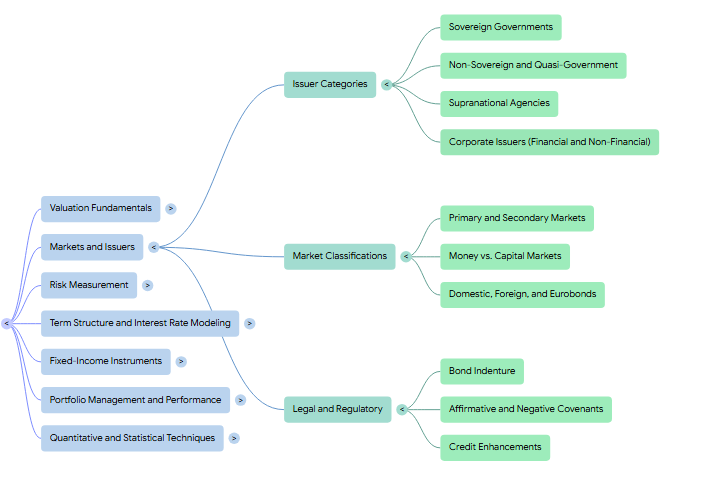
— Linden Lake
This series:
→ Topic Review (1 of 7): Fixed Income – Valuation Fundamentals
→ Topic Review (2 of 7): Fixed Income – Markets and Issuers
→ Topic Review (3 of 7): Fixed Income – Risk Measurement
→ Topic Review (4 of 7): Fixed Income – Term Structure and Interest Rate Modeling
→ Topic Review (5 of 7): Fixed Income – Fixed-Income Instruments
→ Topic Review (6 of 7): Fixed Income – Portfolio Management and Performance
→ Topic Review (7 of 7): Fixed Income – Quantitative and Statistical Techniques
References:
Reference 1, Reference 2, Reference 3
Leave a Reply