
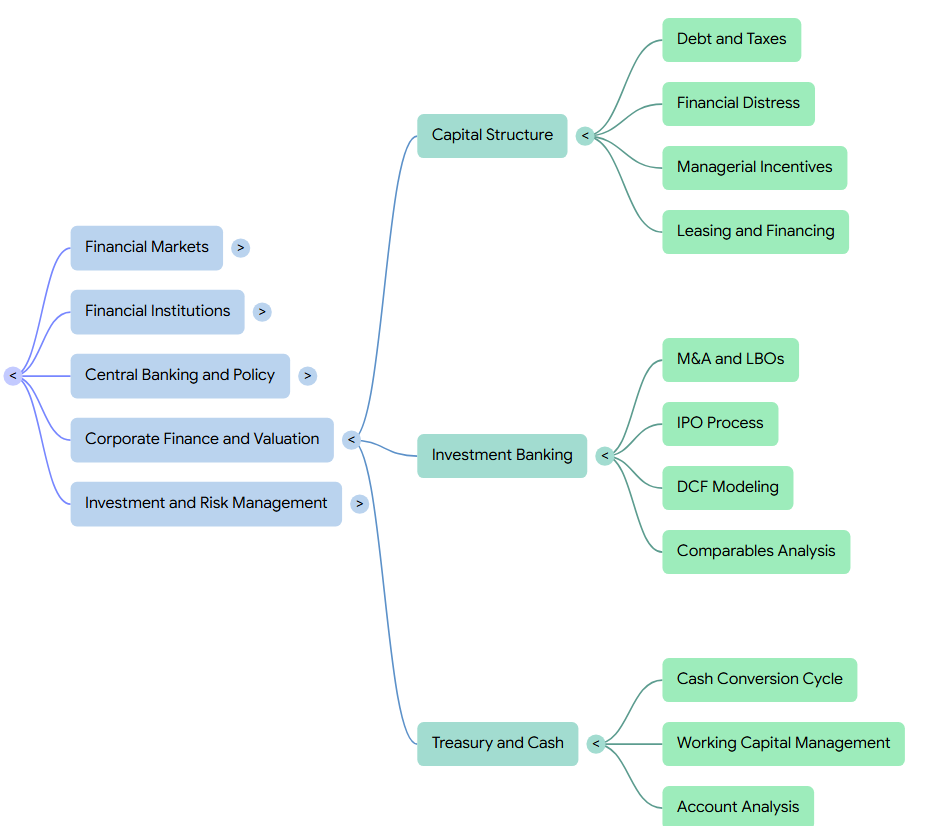
In the broader landscape of money, banking, and financial markets, corporate finance serves as the microeconomic engine that drives the allocation of capital through three primary tasks: investment decisions, financing decisions, and managing cash flows. Valuation acts as the universal metric, linking firm-level decisions to the expectations of the global financial system.
1. The Objectives of Corporate Finance
The fundamental objective of corporate management is to maximize shareholder wealth, which is interpreted as maximizing the market value of the firm’s common stock.
- The Rational Goal: This objective is considered sensible because shareholders with access to well-functioning financial markets can use the increased wealth to satisfy their own unique preferences for consumption and risk.
- Stakeholder Considerations: While shareholder primacy is dominant in “Anglo-Saxon” models, modern finance increasingly incorporates ESG (Environmental, Social, and Governance) factors. Creating value for shareholders often requires building long-term relationships with stakeholders like employees and customers; otherwise, the firm may face higher costs or lower productivity.
- Agency Problems: A core challenge is the principal-agent problem, where managers may pursue personal interests (e.g., “empire building” or excessive perks) at the expense of owners. Corporate governance—the set of rules, incentives, and monitoring systems—is required to align these interests.
2. Foundational Valuation Principles
Valuation is grounded in the Law of One Price, which states that in competitive markets, equivalent investment opportunities must trade at the same price.
- The Valuation Principle: This principle dictates that the value of an asset to a firm is determined by its competitive market price.
- Time Value of Money: A core tenet is that a dollar today is worth more than a dollar tomorrow.
- Net Present Value (NPV): To maximize firm value, managers should accept all projects with a positive NPV, where the present value of benefits exceeds the present value of costs. This decision can be separated from the firm’s financing choice—a concept known as the Separation Principle.
3. Primary Valuation Methodologies
The sources identify three dominant approaches used to determine what a business is worth:
- Discounted Cash Flow (DCF) Analysis: This is the most academically rigorous method, valuing a company as the present value of its projected free cash flows (FCF).
- Enterprise DCF values the entire business (for both debt and equity holders) by discounting FCF at the Weighted Average Cost of Capital (WACC).
- Equity DCF (or Dividend Discount Models) values the equity directly by discounting cash flows available only to shareholders.
- Relative Valuation (Multiples): This “market-based” approach establishes value by comparing the target to peer companies using ratios like P/E (Price-to-Earnings), EV/EBITDA, or P/B (Price-to-Book). While quick and reflective of current sentiment, it can be distorted by market irrationality or “apples-to-oranges” comparisons.
- Asset-Based Valuation: Used primarily for distressed firms, this method estimates the liquidation value or replacement cost of a firm’s tangible assets.
4. Capital Structure and the Financing Decision
Capital structure is the specific mix of debt and equity a firm uses to fund its operations.
- The MM Benchmark: Modigliani and Miller (MM) famously proposed that in a “perfect” market, capital structure is irrelevant to the total value of the firm.
- Trade-off Theory: In the real world, firms weigh the interest tax shield (the tax deductibility of debt interest) against the costs of financial distress (bankruptcy risk and agency conflicts).
- Pecking Order Theory: Due to asymmetric information (managers knowing more than investors), firms prefer internal financing first, then debt, and finally equity as a last resort to avoid the “lemons problem” of issuing underpriced shares.
5. The Cost of Capital
The cost of capital is the “hurdle rate” that investments must exceed to create value.
- WACC: It is the blended, after-tax cost of all the firm’s permanent funding sources.
- CAPM: The Capital Asset Pricing Model is the standard tool for estimating the cost of equity, relating a stock’s required return to its beta (systematic risk) relative to the overall market.
6. Integration with the Broader Financial System
Corporate finance does not operate in a vacuum; it is deeply integrated with financial institutions and markets.
- The Intermediation Process: Banks and other intermediaries facilitate corporate finance by channeling funds from “lender-savers” to “borrower-spenders”.
- Market Efficiency: The Efficient Market Hypothesis (EMH) suggests that security prices already reflect all available information, meaning managers cannot easily “fool” the market with accounting gimmicks; value creation must come from real operations.
- Nuance for Banks: Unlike industrial firms, the valuation of commercial banks is uniquely complex because their “raw material” is money itself. Analysts often use Residual Income or Equity DCF models for banks because separating operating value from financing value (interest) is nearly impossible.
Capital Structure
Capital structure refers to the specific mixture of long-term debt, equity, and other securities a firm uses to fund its operations and growth. In the context of corporate finance and valuation, the primary goal of managing capital structure is to find the financing mix that minimizes the Weighted Average Cost of Capital (WACC), thereby maximizing the total market value of the firm.
The Modigliani-Miller (MM) Benchmark
The modern theory of capital structure begins with the Modigliani-Miller propositions, which establish a benchmark in perfect capital markets (no taxes, no transaction costs, and no information asymmetries).
- MM Proposition I (Irrelevance): The total value of a firm is independent of its capital structure. Firm value is determined solely by the cash flows generated by its assets and the risk of those assets, not by how those cash flows are “sliced” between debt and equity holders.
- MM Proposition II (Risk and Return): While debt may appear “cheaper” because it has a lower required return than equity, using more debt increases the financial risk for equity holders. This causes the cost of equity to rise by exactly enough to offset the benefit of the lower-cost debt, leaving the firm’s WACC unchanged.
- Homemade Leverage: Investors can replicate the effects of corporate leverage by borrowing or lending on their own account, meaning the firm’s financing choice adds no unique value to investors.
Market Imperfections and the Role of Taxes
In the real world, capital structure matters because of market frictions, most notably corporate taxes.
- Interest Tax Shield: Most tax codes allow corporations to deduct interest payments from taxable income, whereas dividends are paid from after-tax profits. This creates an incentive to use debt, as the government effectively subsidizes a portion of the interest expense.
- Value of the Levered Firm: Under these conditions, the value of a levered firm () equals its unlevered value () plus the present value of the interest tax shield.
- Personal Taxes: The tax advantage of debt may be partially offset at the investor level if personal taxes on interest income are higher than taxes on dividends and capital gains.
Financial Distress and the Trade-off Theory
The trade-off theory posits that firms choose an optimal capital structure by balancing the tax benefits of debt against the costs of financial distress.
- Direct and Indirect Costs: Direct costs include legal and administrative fees during bankruptcy. Indirect costs, often more significant, include business erosion, where customers, suppliers, and key employees flee a struggling firm.
- Optimal Leverage: As leverage increases, firm value initially rises due to tax shields, but eventually, the rising probability of financial distress causes value to peak and then decline. The point of maximum value is the optimal capital structure.
Agency Costs and Benefits
Capital structure also influences the behavior of managers and creates conflicts between stakeholders.
- Agency Costs of Debt: Highly levered firms face the asset substitution problem (risk-shifting), where shareholders have an incentive to take on high-risk, negative-NPV projects because they capture the upside while debt holders bear the downside. They also face debt overhang (under-investment), where shareholders may reject positive-NPV projects because the benefits would largely accrue to creditors.
- Agency Benefits of Debt: Debt can act as a disciplinary mechanism under the free cash flow hypothesis. By committing to fixed interest payments, managers have less “excess” cash to waste on perquisites or unprofitable “empire building” acquisitions.
Asymmetric Information and the Pecking Order
The pecking order theory suggests that because managers know more about the firm than investors (asymmetric information), the timing and type of security issuance send signals to the market.
- The Hierarchy: Firms prefer to fund investments using internal funds (retained earnings) first, then debt, and finally equity as a last resort.
- Signaling: Issuing equity is often viewed as a negative signal that management believes the stock is overvalued, leading to a drop in the share price upon announcement. In contrast, issuing debt is often a neutral or positive signal of confidence in future cash flows.
Valuation Methodologies with Leverage
To value a firm with a complex capital structure, several methodologies are employed:
- WACC Method: Discounts unlevered free cash flows at the after-tax WACC. It is the most common approach and assumes the firm maintains a constant debt-to-value ratio.
- Adjusted Present Value (APV): Values the firm’s operations as if all-equity financed and then separately adds the present value of financing side effects, such as tax shields and distress costs. APV is preferred when the debt level is expected to change over time (e.g., in a Leveraged Buyout).
- Flow-to-Equity (FTE): Values the cash flows available specifically to shareholders (after debt service) by discounting them at the cost of equity.
- Equity as an Option: In structural models (like the Merton model), equity is viewed as a call option on the firm’s assets, where the strike price is the face value of the debt. This view is particularly useful for assessing default risk and agency conflicts.
Capital Structure in Practice
Actual debt ratios vary widely across industries based on asset characteristics. Mature, asset-intensive industries (e.g., utilities, airlines) support high leverage because their tangible assets serve as collateral. Conversely, high-growth, R&D-intensive firms (e.g., biotechnology, software) typically maintain low or even negative net debt to preserve financial flexibility and avoid high distress costs.
Debt and Taxes
In the larger context of capital structure, the relationship between debt and taxes serves as a primary driver for a firm’s financing decisions. The fundamental incentive stems from the asymmetrical treatment of capital costs: interest payments on debt are generally tax-deductible expenses, whereas dividend payments to equity holders are not.
The Corporate Interest Tax Shield
The most direct benefit of debt is the interest tax shield, defined as the reduction in corporate taxes resulting from the ability to deduct interest payments.
- Impact on Firm Value: According to the modified Modigliani-Miller theorem, the total value of a levered firm () exceeds that of an unlevered firm () by the present value of the interest tax shield. For permanent debt in a simple tax environment, this value is often estimated as the corporate tax rate () multiplied by the amount of debt ().
- Cost of Capital Reduction: Because interest is tax-deductible, the after-tax cost of debt—expressed as —is significantly lower than the pretax cost. This lower cost typically drives down the firm’s Weighted Average Cost of Capital (WACC) as leverage increases, potentially enhancing the firm’s total market value.
Personal Taxes and the “Miller” Offset
The tax advantage of debt at the corporate level may be partially or fully offset by personal taxes paid by investors.
- Tax Asymmetry: Historically, interest income has been taxed at higher ordinary income rates, while equity income (dividends and capital gains) often receives preferential lower rates or can be deferred until the asset is sold.
- Effective Tax Advantage (): To determine the “true” benefit of debt, firms must evaluate the combined effect of corporate and personal taxes. If personal taxes on debt are high enough relative to equity, the net tax advantage of borrowing can diminish or even disappear for certain investor groups.
The Trade-Off Theory
The trade-off theory of capital structure posits that firms choose their debt levels by balancing the corporate tax benefits against the costs of financial distress.
- Optimal Leverage: As a firm adds debt, its value initially rises due to the tax shield. However, increasing leverage also raises the probability of bankruptcy and business erosion. The optimal capital structure is reached at the point where the marginal benefit of the tax shield is exactly offset by the marginal increase in the present value of potential distress costs.
- Industry Variation: Firms with stable, taxable income and tangible assets (e.g., utilities) can support high leverage to maximize tax shields. Conversely, growth-oriented or R&D-intensive firms often maintain low debt because they have fewer profits to shield and face higher distress costs.
Legislative and Practical Constraints
- TCJA Limitations: Under the Tax Cuts and Jobs Act of 2017 (TCJA), large U.S. corporations face a cap on interest deductions, limited to 30% of EBIT (or EBITDA in earlier years). Once this limit is reached, additional debt provides no further incremental tax benefit, potentially altering the optimal leverage point.
- Tax Loss Carryforwards: Firms with significant past losses may have Net Operating Losses (NOLs) to carry forward, which act as a non-debt tax shield. If a firm can shield its income using NOLs or accelerated depreciation, the marginal incentive to use debt for tax purposes decreases.
- International Tax Arbitrage: Multinational corporations (MNCs) use debt placement to exploit differences in tax rates across jurisdictions. They may increase leverage in high-tax countries to maximize deductions while shifting profits to low-tax “tax havens”.
Specialized Instruments
- Municipal Bonds: These are uniquely attractive because their interest is exempt from U.S. federal (and often state) income taxes, allowing them to trade at lower pretax yields than comparable corporate bonds.
- Preferred Stock: While debt interest is deductible for the issuer, preferred dividends are not. However, for corporate investors, 50% (or more) of dividends received may be excluded from taxable income, making it a tax-efficient investment for corporations.
- Leasing: Leasing can be a tax-driven alternative to debt. A lessor (often in a higher tax bracket) can “sell” depreciation tax shields to a lessee in the form of lower lease payments.
Financial Distress
Financial distress occurs when a corporation has difficulty meeting its debt obligations, typically resulting in business disruption, insolvency, or bankruptcy. In the context of capital structure, financial distress is the primary constraint on the amount of debt a firm should carry, as high leverage significantly increases the probability of default.
1. Relationship Between Leverage and Distress
According to the trade-off theory, firms determine their optimal capital structure by balancing the tax benefits of debt (the interest tax shield) against the potential costs of financial distress.
- Asset-Intensive Firms: Companies with stable cash flows and tangible assets that can be easily sold (e.g., utilities, real estate) typically maintain higher leverage because their assets serve as collateral, lowering the expected costs of distress.
- R&D-Intensive Firms: High-growth or technology-based firms whose value resides in human capital and intangible assets generally maintain low debt. For these firms, the “fire sale” value of assets is low, and the risk of losing key employees or customers during distress is very high.
2. The Costs of Financial Distress
Distress costs are categorized into direct and indirect types, which reduce the total value of the firm.
- Direct Costs: These include legal, accounting, and professional fees paid to advisors such as investment bankers and turnaround consultants during bankruptcy proceedings. Studies suggest these costs range from 3% to 4% of pre-bankruptcy asset value for large firms and up to 12% to 40% for smaller entities.
- Indirect Costs: Often much larger than direct costs, these arise even before a formal bankruptcy filing.
- Loss of Customers and Suppliers: Customers may refuse to buy products requiring long-term service (like autos or software), while suppliers may demand “cash on delivery” and refuse to ship on credit.
- Loss of Employees: High-quality workers may leave for job security elsewhere, and hiring new talent becomes difficult and expensive.
- Fire Sales: Distressed firms may be forced to sell assets quickly to raise cash, often receiving 15% to 40% less than the assets’ fair market value.
3. Agency Costs of Leverage in Distress
When a firm is near insolvency, conflicts of interest between equity holders and debt holders—known as agency problems—lead to poor decision-making that further destroys value.
- Asset Substitution (Risk-Shifting): Shareholders have an incentive to “gamble” by investing in high-risk, negative-NPV projects because they capture the upside if the gamble succeeds, while creditors bear the losses if it fails.
- Debt Overhang (Under-investment): Shareholders may reject positive-NPV projects because the resulting increase in firm value primarily benefits the bondholders rather than the equity owners.
- Cashing Out: During distress, shareholders may attempt to withdraw cash from the firm through liquidating assets cheaply to pay immediate dividends before creditors can seize the remaining value.
- Leverage Ratchet Effect: Once debt is in place, shareholders may prefer to increase leverage further but resist reducing it (by issuing equity to retire debt) because the benefits of reduced bankruptcy risk would accrue to bondholders.
4. Resolution and Restructuring
Firms in distress may attempt to stay afloat through various mechanisms:
- Consensual Workouts: Restructuring debt “out-of-court” to avoid the time and expense of formal bankruptcy.
- Chapter 11 Reorganization: An in-court process where management remains “in possession” (DIP) and attempts to develop a plan to keep the business as a going concern.
- Debtor-in-Possession (DIP) Financing: New debt issued during bankruptcy that is senior to all existing claims, providing the liquidity needed to continue operations.
- Liquidation (Chapter 7): A total shutdown where assets are sold off sequentially according to the Absolute Priority Rule, which dictates that senior creditors are paid in full before any value trickles down to junior claimants or shareholders.
Managerial Incentives
In the larger context of capital structure, managerial incentives are a central focus of agency theory, which analyzes the inherent conflicts of interest between a firm’s owners (principals) and its managers (agents). The sources state that the way a firm chooses to finance its assets—through debt or equity—significantly shapes these incentives, serving either to align the manager’s interests with those of shareholders or to create costly distortions.
1. Agency Costs of Equity: The Case for Leverage
When ownership is separated from control, managers (who typically own only a small fraction of the firm) may lack the incentive to maximize profits and instead pursue their own self-interest. Leverage is viewed as a mechanism to mitigate several specific agency problems:
- Reduction of Wasteful Spending and Perks: In an all-equity firm, managers do not bear the full cost of “private benefits,” such as lavish offices, corporate jets, or indulgent perquisites. They may engage in expense-preference behavior, valuing fringe benefits over shareholder returns. Using debt forces managers to bear a larger portion of these costs by concentrating their ownership stake.
- The Free Cash Flow Hypothesis: Managers are often tempted to engage in empire building, undertaking unprofitable (negative NPV) projects or overpaying for acquisitions to increase the firm’s size, which is frequently linked to higher prestige and compensation. Debt acts as a disciplinary tool, committing the firm to future interest payments and “disgorging” excess cash that might otherwise be wasted on inefficient investments.
- Mitigating Management Entrenchment: Managers may prefer low leverage to reduce the risk of financial distress and the personal job loss that would follow, effectively seeking a “quiet life”. High leverage ties their hands, forcing them to run the firm with greater vigor and efficiency to meet contractual obligations.
2. Agency Costs of Debt: The Risks of High Leverage
While debt can discipline managers, the sources emphasize that excessive leverage introduces a different set of agency costs arising from the conflict between shareholders (acting through managers) and debt holders:
- Asset Substitution (Risk-Shifting): Because equity holders have limited liability and receive the upside of success, they have an incentive to “gamble” with creditors’ money. This leads managers to favor high-risk, even negative-NPV projects that increase the volatility of firm assets, as this increases the value of the “equity call option” at the expense of bondholders.
- Debt Overhang (Under-investment): In highly levered firms, shareholders may reject positive-NPV projects because the resulting increase in firm value primarily benefits existing creditors rather than themselves.
- The Leverage Ratchet Effect: Once debt is in place, shareholders may resist reducing leverage (even if it would increase total firm value) because the benefits of reduced default risk would accrue to bondholders, not the equity owners.
- Gambling for Resurrection: When a firm is near insolvency, managers may take extreme, unjustifiable risks in a desperate attempt to ensure company survival and save their jobs.
3. Alignment via Incentive Contracts
To bridge the “wedge” between managerial control and cash flow rights, firms use various compensation mechanisms:
- Stock-Based Compensation: Granting managers stocks or stock options is intended to align their financial outcomes with those of shareholders. However, theSources note that the call-option-like nature of these fees can also encourage excessive risk-taking, as managers benefit from high volatility but face limited downside.
- Clawback Clauses and Deferred Bonuses: In response to the 2008 crisis, many financial institutions introduced systems where bonuses are spread over several years and can be revoked if performance later proves illusory, discouraging “short-termism”.
- Venture Capital and Private Equity: These structures provide particularly high-powered incentives by requiring managers to have significant “skin in the game” (direct wealth investment) and by staging funding so managers cannot “sit back and relax”.
4. External Monitoring and Market Discipline
The sources highlight that managerial incentives are also constrained by external forces within the financial system:
- Board of Directors: Acts as the primary guardian of shareholder interests, with the power to replace underperforming management teams.
- Market for Corporate Control: The threat of a hostile takeover forces managers to keep the stock price high and maintain efficiency; otherwise, they risk being “turfed out” by an acquirer.
- Lender Oversight: Debt holders and rating agencies monitor firm behavior closely, often imposing restrictive covenants that limit a manager’s ability to pay excessive dividends, take on more debt, or engage in risky acquisitions.
Leasing and Financing
In the larger context of capital structure, leasing functions as a vital financing method that serves as a direct substitute for debt, allowing firms to acquire and use tangible assets without the immediate cash outlay required for a purchase. While it is often viewed simply as an operational decision, the sources emphasize that leasing is a fundamental component of the capital structure decision, impacting a firm’s leverage, tax efficiency, and financial flexibility.
Leasing as a Debt Substitute
The sources characterize signing a long-term financial lease as being economically equivalent to borrowing funds to purchase an asset.
- Debt-Equivalent Obligations: Just as a company is contractually obligated to make interest and principal payments on a loan, a lessee is committed to a series of fixed lease payments. Failure to meet these obligations can lead to financial distress or the loss of the asset.
- Impact on Leverage: When a firm leases an asset, it effectively increases its financial leverage. Credit analysts and rating agencies typically treat long-term lease commitments as “hidden leverage” or debt-like liabilities when calculating solvency ratios like debt-to-equity.
- Matching Principle: Firms often apply the matching principle to leasing, using short-term operating leases for temporary needs or rapidly obsolescing equipment, while using long-term financial leases for permanent assets.
The Evolution of Accounting and Off-Balance-Sheet Financing
Historically, leasing was a popular tool for off-balance-sheet financing, which allowed firms to hide liabilities and “window-dress” their financial statements.
- Operating vs. Finance Leases: Under older standards, operating leases were reported only as rental expenses on the income statement, leaving the associated liability off the balance sheet. This practice artificially improved ratios such as return on assets (ROA) and lowered perceived leverage.
- The 2019 Regulatory Shift: Following significant changes by the FASB and IASB (e.g., ASC 842 and IFRS 16), nearly all leases with terms exceeding 12 months must now be capitalized on the balance sheet as “right-of-use” assets and corresponding lease liabilities. This shift ensures that the firm’s true level of indebtedness is visible to investors.
Tax Incentives and Capital Structure Efficiency
Tax considerations are a primary driver for incorporating leasing into a firm’s capital structure.
- Exploiting Tax Brackets: A “true tax lease” allows the lessor (owner) to claim depreciation deductions. This is advantageous if the lessor is in a higher tax bracket than the lessee; the lessor can then pass on a portion of these tax savings to the lessee in the form of lower lease payments.
- Interest Deductibility Limits: Under the Tax Cuts and Jobs Act (TCJA), large corporations face a cap on interest deductions (30% of EBITDA or EBIT). Leasing provides a way to sidestep this limitation, as the entire lease payment is typically deductible as an operating expense, whereas only the interest portion of a loan is deductible.
Strategic Financing Applications
Leasing offers unique structural advantages that traditional debt cannot always provide:
- Sale-and-Leaseback: A firm can sell an owned asset (like a headquarters building) to raise immediate cash and then lease it back to retain its use. This allows the firm to redeploy capital from illiquid real estate into its core business while potentially recognizing a capital gain on the sale.
- Mitigating Debt Overhang: Leasing can solve the debt overhang problem by allowing a firm in financial distress to acquire new productive assets that are segregated from the claims of existing creditors.
- Bankruptcy Advantage: In a “true lease,” the lessor retains legal title and may be able to repossess the asset immediately if the lessee defaults, whereas a secured lender might be tied up for years in bankruptcy court. This reduced risk to the provider of capital can lead to more favorable financing terms for the firm.
Motivations and Risks
Management’s choice between leasing and traditional financing often hinges on a trade-off between efficiency and flexibility. Leasing is highly attractive for assets with high technological obsolescence risk (like medical or IT equipment) because it allows the firm to transfer the risk of low residual value to the lessor. However, leases are often non-cancellable and can carry large early-termination penalties, which reduces the firm’s ability to respond quickly to changing market conditions compared to owning the asset outright.
Investment Banking
Investment banking serves as the specialized financial engine that facilitates the flow of capital from investors to corporations and governments, acting as a crucial intermediary in the broader context of corporate finance and valuation. Unlike traditional commercial banks that focus on deposit-taking and lending, investment banks primarily advise on and execute complex financial transactions, such as the issuance of securities and mergers and acquisitions (M&A).
The Intermediation and Underwriting Process
The core function of investment banking is assisting clients in raising debt and equity capital. This process typically involves three distinct phases:
- Origination: Bankers consult with issuers on the characteristics of a potential security issue, the underlying legal documentation, and the optimal timing to enter the market.
- Underwriting: The bank acts as a principal by purchasing a block of securities from the issuer at a predetermined price, thereby assuming the price and marketing risks. Alternatively, they may work on a “best-efforts” basis, acting solely as agents for a fee.
- Distribution: Through a syndicate of other banking firms, the underwriters market and sell the securities to institutional and retail investors.
For companies going public for the first time, this is known as an Initial Public Offering (IPO), a transformational event that requires extensive SEC filings (such as the S-1), roadshows to generate investor interest, and the bookbuilding process to determine the clearing price.
Strategic Advisory and M&A
Investment banks are central to the M&A landscape, providing critical advice on whether a company should acquire, merge, or divest parts of its business.
- Sell-Side Advisory: Bankers manage the auction or negotiation process to maximize value for the seller, helping to frame price expectations and identify the most likely buyers.
- Buy-Side Advisory: For an acquirer, the bank performs merger consequences analysis to fine-tune the purchase price, financing mix (debt vs. equity), and potential synergies.
- Leveraged Buyouts (LBOs): IBs play a dual role in LBOs as both M&A advisors and providers of stapled financing, which is a pre-packaged debt structure offered to potential financial sponsors.
The Central Role of Valuation
Valuation is described in the sources as the “core” and “lifeblood” of investment banking. Accurate valuation is required for setting IPO offer prices, determining exchange ratios in mergers, and assessing whether a public company is over- or undervalued. The primary methodologies employed by bankers include:
- Comparable Companies Analysis (“Comps”): Benchmarking the target against similar public companies using trading multiples like EV/EBITDA or P/E.
- Precedent Transactions Analysis: Analyzing the multiples and premiums paid in recent acquisitions within the same sector.
- Discounted Cash Flow (DCF) Analysis: Estimating the intrinsic value by calculating the present value of a firm’s projected free cash flows.
- LBO Analysis: Determining the maximum price a financial sponsor could pay while still achieving a target internal rate of return (IRR).
Institutional Evolution and Ethics
The industry has undergone dramatic structural shifts, particularly following the repeal of the Glass-Steagall Act and the 2008 Global Financial Crisis. The crisis led to the demise of the independent “stand-alone” investment banking model as major firms like Goldman Sachs and Morgan Stanley converted to bank holding companies to access more stable deposit-based funding.
This convergence between commercial and investment banking has raised concerns regarding conflicts of interest. To mitigate these, firms maintain “Chinese Walls”—internal information barriers designed to prevent the exchange of material non-public information between the advisory (private-side) and research/trading (public-side) divisions. Regulators also closely monitor practices like “spinning,” where bankers allocate hot IPO shares to favored corporate executives to secure future investment banking business.
M&A and LBOs
Within the financial ecosystem, investment banking serves as a specialized intermediary that facilitates the flow of capital and provides critical advisory services for Mergers and Acquisitions (M&A) and Leveraged Buyouts (LBOs). While traditional commercial banking focuses on deposit-taking and lending, investment banks earn significant fees by acting as “deal makers,” helping corporations restructure, grow, or monetize their holdings through complex transactions.
Mergers and Acquisitions (M&A)
M&A is a broad term for the combination of two businesses, serving as a primary alternative to organic growth.
- Strategic Rationales: Firms pursue M&A to achieve economies of scale and scope, vertical or horizontal integration, access to new technologies, and synergies. Synergies typically include cost savings (e.g., reducing headcount or duplicate facilities), which flow directly to the bottom line, and more speculative revenue growth (e.g., cross-selling or entering new geographies).
- Transaction Types: A merger typically suggests a combination of similarly sized firms (a “merger of equals”) using stock consideration, whereas an acquisition implies a larger firm purchasing a smaller target. Transactions can also be friendly (consented by the target’s board) or hostile (opposed by management, often involving a tender offer directly to shareholders).
- The Sale Process: Investment banks manage auctions—either broad (to dozens of potential bidders to maximize price) or targeted (to a select group of strategic or financial buyers)—or negotiated sales, which prioritize speed and confidentiality through direct dialogue with a single party.
Leveraged Buyouts (LBOs)
An LBO is a specialized acquisition where a financial sponsor (private equity firm) purchases a company using a disproportionately large amount of debt (often 60–90% of the purchase price) and a smaller equity contribution.
- LBO Candidate Characteristics: Ideal targets are mature companies with stable, predictable cash flows (to service high debt payments), low capital expenditure requirements, and a strong base of undervalued tangible assets that can serve as collateral.
- Return Levers: LBOs generate returns—typically measured by Internal Rate of Return (IRR)—through three primary levers: deleveraging (using cash flows to pay down debt principal), EBITDA growth (operational improvements and cost-cutting), and multiple expansion (selling the firm at a higher multiple than the entry price).
- Management Involvement: If the current management leads the buyout to take the company private, it is called a Management Buyout (MBO). Sponsors typically require management to have “skin in the game” by rolling over or investing equity to align their incentives.
The Role of the Investment Bank
Investment banks provide the essential “nuts-and-bolts” techniques used to execute these deals.
- Advisory: Banks act as sell-side advisors (assessing the target, creating marketing documents like the Confidential Information Memorandum (CIM), and running the auction) or buy-side advisors (performing valuation, merger consequences analysis, and bidding strategy).
- Valuation: Bankers use four primary methodologies to determine what a business is worth: Comparable Companies, Precedent Transactions, Discounted Cash Flow (DCF), and LBO analysis. LBO analysis is often used as a “floor valuation” to determine the maximum a financial sponsor could pay while meeting their IRR threshold.
- Financing: For LBOs and large acquisitions, investment banks act as underwriters for the debt. They may provide bridge loans—interim financing that ensures a deal can close even if market conditions prevent the immediate sale of bonds. They may also offer stapled financing, a pre-packaged debt structure offered to potential bidders during a sell-side process.
Institutional and Ethical Context
The investment banking industry has undergone radical structural shifts. The 1999 repeal of the Glass-Steagall Act allowed commercial banks to aggressively enter the M&A and LBO advisory business. However, the 2008 Global Financial Crisis marked the “demise of large, free-standing investment banks,” as firms like Goldman Sachs and Morgan Stanley converted to bank holding companies to access more stable deposit-based funding and Fed emergency lending.
To manage conflicts of interest—such as the potential for an advisory team to leak sensitive info to a trading desk—firms maintain “Chinese Walls”. These internal barriers are crucial because a bank’s reputation is its most valuable asset in the high-stakes world of dealmaking.
IPO Process
In the context of investment banking, an initial public offering (IPO) is the process by which a privately held company sells its equity to the public for the first time. Investment banks serve as the “midwives” of this process, acting as intermediaries between the issuing corporation and the investing public. While IPOs are part of a broader menu of investment banking services—including M&A advisory and leveraged buyouts—they are often among the most profitable and high-profile activities a firm undertakes.
Strategic Motivations for Going Public
Companies pursue an IPO for several situational reasons beyond just raising capital:
- Liquidity and Monetization: Providing a path for founders, venture capitalists, and private equity sponsors to “cash out” or diversify their personal holdings.
- Growth Capital: Securing funds for R&D, geographic expansion, or new product launches.
- Acquisition Currency: Establishing a liquid public stock that can be used to acquire other companies.
- Deleveraging: Using proceeds to repay high-cost debt, particularly common for companies exiting a leveraged buyout (LBO) structure.
- Image and Talent: Solidifying the company’s legacy and enabling stock-based compensation to attract and retain top-tier talent.
The Multi-Stage IPO Process
The process is intensive, typically spanning several months (or even years of preparation) and is divided into distinct stages:
1. Organization and Preparation
The company selects its IPO team, including lead bookrunners, legal counsel, and auditors. A formal “bake-off” is often held where banks compete for the lead role based on their sector expertise and valuation views. The team manages “corporate housekeeping,” such as ensuring financial statements are SEC-compliant and refining the company’s strategy and projections.
2. Due Diligence, Drafting, and Filing
Underwriters perform exhaustive business, financial, and legal due diligence to ensure the registration statement (Form S-1) is accurate. This document contains a detailed prospectus outlining the business model, financial performance, and risk factors. Companies may choose confidential submission to work through SEC comments before publicly announcing the deal.
3. Marketing and Roadshow
Once the preliminary prospectus (the “red herring”) is ready, the company launches a roadshow. Senior management travels to meet institutional investors (mutual funds, hedge funds) to promote the company and build an order book. This “bookbuilding” process allows the underwriters to gauge market demand and adjust the estimated price range.
4. Pricing and Allocation
The afternoon the registration statement is declared effective, the company and lead bookrunners agree on the final offer price. The goal is to maximize proceeds for the company while ensuring a high-quality investor base. Shares are then allocated, typically favoring “blue chip” institutional investors who are expected to be long-term holders.
Underwriting Mechanisms and Risks
Investment banks handle IPOs using different risk-sharing structures:
- Firm Commitment: The underwriter guarantees the sale by purchasing the entire block of securities from the issuer and reselling them to the public. The bank bears the price risk if the shares cannot be sold at the offer price.
- Best Efforts: The banker acts solely as an agent, attempting to sell the shares for a fee but providing no guarantee that the entire issue will be placed.
- The Syndicate: For larger deals, the lead bookrunner forms a syndicate of other banks to share the underwriting risk and broaden the distribution network.
IPO Puzzles and Market Dynamics
The sources highlight several “puzzles” inherent in the IPO market:
- Underpricing (“Money on the Table”): On average, IPOs are priced below their market value, often seeing a significant “pop” on the first day of trading. This is sometimes used as a strategy to attract investors who fear the “winner’s curse”—receiving a full allocation only when demand is low.
- Cyclicality: IPO activity is highly sensitive to market conditions; the pipeline flows during “bull” markets and dries up during downturns.
- Grandstanding: Younger venture capital firms may push companies to IPO prematurely to build their own reputation and secure future fund-raising.
Modern Alternatives: SPACs and Direct Listings
In recent years, alternatives to the traditional IPO have gained prominence:
- Direct Listings: Companies list existing shares directly on an exchange without underwriters or a new capital raise (though rules have evolved to allow some capital raising). This avoids the underwriting spread (typically 7%) and lock-up periods.
- SPACs (Special Purpose Acquisition Companies): A “blank check” shell company raises funds via an IPO to acquire a target private firm within a set period. This provides targets with a faster, negotiated path to becoming a public company.
DCF Modeling
In the larger context of investment banking, Discounted Cash Flow (DCF) analysis is a fundamental intrinsic valuation methodology used by bankers to determine the value of a company, division, or collection of assets. Unlike market-based approaches such as comparable companies or precedent transactions—which rely on prevailing market sentiment—the DCF is premised on the principle that the value of a target is derived from the present value of its projected free cash flow (FCF).
The Strategic Role of DCF in Investment Banking
Investment bankers utilize DCF modeling across various scenarios, including M&A advisory (buy-side and sell-side), Initial Public Offerings (IPOs), restructurings, and general investment decisions.
- A Check on the Market: It serves as a critical “sanity check” on market valuations, which can be distorted by irrational exuberance or temporary economic shocks.
- Self-Sufficiency: The DCF is particularly vital when “pure play” peer companies or recent comparable acquisitions do not exist to provide a reliable market benchmark.
- Flexibility: It allows bankers to run multiple operating scenarios, modeling the impact of different growth rates, margin improvements, or capital expenditure requirements.
The Five-Step DCF Process
Investment banks typically follow a structured five-step approach to construct a defensible DCF model:
- Study the Target and Determine Key Performance Drivers: Bankers perform deep due diligence to understand a company’s business model, competitive positioning, and financial trends to craft realistic projections.
- Project Free Cash Flow: FCF is projected for a period where the company reaches a “steady state,” typically five years. The model uses unlevered FCF, which is the cash available to all capital providers before interest payments.
- Calculation: EBIT × (1 – Tax Rate) + Depreciation & Amortization – Capital Expenditures – Increase in Net Working Capital.
- Calculate Weighted Average Cost of Capital (WACC): WACC is the discount rate reflecting the target’s business and financial risks. It represents the weighted average of the after-tax cost of debt and the cost of equity (often calculated via CAPM).
- Determine Terminal Value: Because companies are potentially immortal, bankers use a terminal value to capture all value beyond the explicit projection period.
- Exit Multiple Method (EMM): Applies a terminal year multiple (e.g., EV/EBITDA) based on peer group averages.
- Perpetuity Growth Method (PGM): Assumes the terminal FCF grows at a constant rate forever (typically 2%–4%).
- Calculate Present Value and Determine Valuation: The projected FCFs and terminal value are discounted to the present using the WACC. A mid-year convention is often applied to account for the fact that cash is received throughout the year rather than at year-end.
Assumptions and Sensitivity Analysis
The sources emphasize that a DCF is only as strong as its underlying assumptions. Because slight changes in the WACC or terminal value can result in massive valuation swings, bankers never rely on a single value. Instead, they perform sensitivity analysis (often displayed in data tables) to produce a range of implied enterprise values.
The results are typically plotted on a “football field” chart alongside other methodologies to help an investment banking deal team triangulate a defensible valuation range for their client.
Nuances for Financial Institutions
In a significant departure from industrial DCF modeling, investment banks value commercial banks using a levered DCF or Equity DCF approach. This is because interest income and expense are integral to a bank’s core operations, making it impossible to separate operating decisions from financing decisions. In these models, cash flows to equity are discounted at the cost of equity rather than the WACC to arrive directly at equity value.
Comparables Analysis
Comparable companies analysis (often called “trading comps” or simply “comps”) is one of the primary valuation methodologies used in investment banking to determine the value of a company, division, or collection of assets. It provides a market benchmark by establishing valuation parameters for a target based on its relative positioning among peer companies that share similar business and financial characteristics, performance drivers, and risks.
The Role of Comps in Investment Banking
Within an investment bank, comps are described as part of the “lifeblood” of the corporate financier’s work. They are utilized across several high-stakes scenarios:
- M&A Advisory: To help buy-side and sell-side clients determine appropriate purchase or sale prices.
- Initial Public Offerings (IPOs): To establish an indicative valuation range for a company going public, often with a heavy emphasis on forward-looking multiples to capture growth.
- Fairness Opinions: To provide a formal assessment of whether a proposed transaction price is “fair” from a financial perspective.
- General Investment Decisions: To assess whether a public company is currently overvalued or undervalued by the market.
The Step-by-Step Methodology
Investment banks follow a structured, five-step process to perform a defensible comps analysis:
- Select the Universe of Comparable Companies: This is the foundation of the analysis. Bankers look for peers in the same sector or sub-sector with similar size (market cap, enterprise value), profitability, and growth profiles.
- Locate Financial Information: Historical data is sourced from SEC filings (10-K, 10-Q), while forward-looking estimates are pulled from consensus research provided by services like Bloomberg or S&P Capital IQ.
- Spread Key Statistics, Ratios, and Multiples: Bankers “spread” the data in spreadsheets, calculating LTM (Last Twelve Months) statistics, calendarizing financials for companies with different fiscal year-ends, and scrubbing the data to remove non-recurring items or one-time events.
- Benchmarking: Peer companies are ranked against the target and one another to determine relative strength. This helps identify the “closest comparables”—typically the two or three firms most similar to the target—which will carry the most weight in the final valuation.
- Determine Valuation: The trading multiples of the closest peers (e.g., EV/EBITDA or P/E) are applied to the target’s relevant financial statistics to extrapolate an implied valuation range.
Key Metrics and Multiples
The sources distinguish between multiples that flow to different capital providers:
- Enterprise Value (EV) Multiples: Ratios like EV/EBITDA, EV/EBIT, and EV/Sales are widely used because they are independent of a company’s capital structure and tax regime.
- Equity Value Multiples: P/E (Price-to-Earnings) is the most common, but it can be heavily distorted by differences in leverage.
- Sector-Specific Multiples: Specialized metrics may be used for certain industries, such as EV/AUM for asset managers or EV/Subscribers for media firms.
Comparables for Financial Institutions
Valuing commercial banks requires a specialized approach. Because a bank’s core operations are fundamentally tied to interest income and expense, it is impossible to separate operating value from financing value. Consequently, bankers use equity-value multiples for banks, specifically P/E and P/B (Price-to-Book), rather than enterprise value multiples.
Comparison with Other Valuation Methods
- Vs. Precedent Transactions: Precedents (transactions comps) typically yield a higher valuation than trading comps because they include a control premium and potential synergies paid by an acquirer.
- Vs. DCF Analysis: While trading comps reflect “current” market sentiment, a Discounted Cash Flow (DCF) analysis provides intrinsic value based on projected cash flows. A DCF is often used as a sanity check on comps when market sentiment is deemed irrational or when “pure play” peers are unavailable.
Limitations: Art vs. Science
Despite its structured approach, comps involve significant subjective judgment. Critics note that no two companies are truly identical, making every analysis an “apples and oranges” comparison to some degree. Furthermore, if an entire industry is overvalued (e.g., during the 1990s tech bubble), comps will fail to detect the overvaluation because they only provide relative value, not absolute value.
Treasury and Cash
In the larger context of corporate finance and valuation, treasury and cash management represent the critical functions that oversee the efficient use of a firm’s financial assets to ensure liquidity, support strategic goals, and ultimately maximize shareholder value. While “cash management” is a subset focused on day-to-day liquidity, “treasury management” encompasses broader responsibilities, including long-term financing, capital structure, and financial risk management.
The Strategic Role of the Treasury Function
The primary objective of treasury is to provide the financial flexibility necessary for a firm to achieve its objectives.
- Corporate Structure: The Treasurer typically oversees daily liquidity, short- and long-term investing, and the arrangement of external financing, reporting to the Chief Financial Officer (CFO).
- Banking Context: In a bank, the treasury function acts as the “guardian of the balance sheet,” managing asset-liability management (ALM), capital adequacy, and interest rate risk. It often functions as an internal “bank” for various business units through Funds Transfer Pricing (FTP), which transfers market and liquidity risks from front-line units to a central treasury desk.
- Multinational Optimization: Global firms use centralized cash management to reduce the total amount of cash needed across subsidiaries, eliminate excess liquidity pools, and minimize foreign exchange (FX) transaction costs.
Cash: The “Water of Life” for Operations
Cash is the most liquid asset, yet it presents a fundamental trade-off: it provides immediacy but generally earns little to no interest, creating an opportunity cost.
- Motivations for Holding Cash: Firms hold cash for three primary reasons: transactions balance (to pay day-to-day bills), precautionary balance (to buffer against uncertainty or shocks), and bank requirements (such as compensating balances to pay for services).
- The Cash Conversion Cycle (CCC): This metric measures the time it takes for a firm to turn cash outflows for resources into cash inflows from sales. Shortening the CCC—by collecting receivables faster, turning inventory quicker, or extending payables—directly releases “trapped cash” for more productive uses.
- Liquidity Risk: This is the danger of being unable to meet payments as they fall due. In banking, this is often caused by maturity transformation (funding long-term assets with short-term liabilities), which requires constant access to rollover funding.
Cash and Treasury in Firm Valuation
Valuation models treat cash and treasury activities as foundational drivers of firm value.
- The Valuation Principle: An asset’s value is the present value (PV) of its future cash flows, discounted at an appropriate rate reflecting risk.
- Free Cash Flow (FCF): In corporate finance, FCF is the “gold standard” for valuation because it represents the cash available to pay all providers of capital (debt and equity) after all operating expenses and necessary investments (CAPEX and working capital) are met.
- Enterprise Value (EV) and “Negative Debt”: In calculating EV—the value of the underlying business—cash and marketable securities are subtracted because they can be used to pay off debt. Consequently, excess cash is often viewed as “negative debt”.
- Conservation of Value: This principle states that financial transactions (like issuing debt to buy back shares) do not create value unless they increase the underlying cash flows or reduce risk. Value is created by real investment projects, not by “repackaging” claims through treasury maneuvers in a perfect market.
- Market Perceptions: Investors generally value a dollar of cash at a premium (e.g., $1.20) in firms with high growth opportunities but may value it at less than par in distressed firms where managers might “waste” it on operating losses.
Treasury Risk and Deployment Strategies
Treasury management involves active decisions on how to deploy cash surpluses and mitigate risks.
- Cash Deployment Hierarchy: Value-minded firms prioritize cash for organic growth (investments where ROIC > WACC), followed by acquisitions, and finally payouts (dividends and share repurchases) when no further attractive reinvestment opportunities exist.
- Financial Hedging: Treasury uses derivatives (forwards, futures, options, swaps) to reduce the variability of future cash flows caused by fluctuations in interest rates, commodity prices, or FX rates. Smoothing these cash flows reduces the probability of financial distress and can lower a firm’s cost of capital.
- Capital Structure: Treasury aims for an optimal capital structure that minimizes the Weighted Average Cost of Capital (WACC). While debt provides tax shields, treasury must maintain a “war chest” or financial slack to avoid the high costs of financial distress or being forced to pass up positive-NPV projects.
Cash Conversion Cycle
In the larger context of treasury and cash management, the cash conversion cycle (CCC) is a vital metric that explains the sequence of operating cash flows and measures the time required to convert cash outflows (for production/inventory) back into cash inflows (from sales collections). It serves as a primary tool for treasury professionals to assess working capital efficiency and ensure the organization maintains sufficient liquidity to meet its short-term obligations.
Components and Calculation
The CCC represents the “timing difference” between the payment of accounts payable and the collection of accounts receivable. It is calculated using three specific components:
- Days’ Inventory (DI): The average number of days that elapse from the purchase of raw materials to the sale of finished goods.
- Days’ Receivables (DR): The average number of days required to collect on credit sales.
- Days’ Payables (DP): The average number of days between the receipt of materials and the actual issuance of payment to suppliers.
The mathematical formula is expressed as: .
The Treasury Perspective: Releasing “Trapped Cash”
From a treasury standpoint, the CCC is used to identify and release “trapped cash” within working capital.
- Liquidity Management: A shorter CCC is generally preferred because it implies the firm recovers its investment in working capital faster, which significantly improves liquidity and reduces the need for external financing.
- Cash Turnover: Treasury managers use the cash turnover ratio () to determine how many cycles the firm completes in a year. A higher turnover ratio indicates more efficient use of current assets and liabilities.
- Negative CCC: In some industries, firms achieve a negative CCC (e.g., Amazon or Tesla), meaning they receive cash from customers before they are required to pay their suppliers, effectively using supplier capital to fund operations.
Strategies for Optimization
Treasury professionals collaborate with other departments to influence the components of the cycle:
- Inventory Management: Implementing Just-in-Time (JIT) production philosophies treats inventory as undesirable and seeks to minimize holding periods to avoid tying up cash.
- Receivables Management: Treasury works to shorten DR by speeding up the order-to-cash timeline, implementing electronic invoicing, and monitoring accounts receivable balance patterns to identify slow-paying customers.
- Payables Management: To maximize working capital, firms may “stretch” payables by delaying payment until the end of established trade terms, though treasury must balance this against the risk of losing supplier goodwill or cost-saving trade discounts.
Risks and Trade-offs
The sources warn that optimization must be weighed against potential operational disruptions. Overly aggressive attempts to shorten the cycle can lead to:
- Lost Sales: Caused by overly strict credit standards or stock-outs from inadequate inventory.
- Production Stoppages: Resulting from JIT systems failing or suppliers refusing to ship due to late payments.
- Higher Costs: Suppliers may raise prices if individual orders become too small or if they perceive the firm as a higher credit risk.
Ultimately, the CCC provides treasury with a “moving target” for cash flow forecasting and informs strategic decisions regarding short-term investment horizons and borrowing requirements.
Working Capital Management
In the larger context of treasury and cash management, working capital management (WCM) is a core strategic function focused on optimizing a firm’s current assets and liabilities to ensure sufficient liquidity while maximizing firm value. While cash management handles day-to-day liquidity, treasury management oversees the broader working capital cycle, balancing the opportunity cost of holding low-yielding liquid assets against the risk of financial distress.
The Foundational Framework: The Cash Conversion Cycle
The primary metric used by treasury professionals to assess WCM efficiency is the cash conversion cycle (CCC). It measures the time elapsed from when a firm disburses cash for resources until it recovers cash from the sale of goods or services.
- Components: The CCC is calculated as Days’ Inventory (DI) + Days’ Receivables (DR) – Days’ Payables (DP).
- The “Trapped Cash” Concept: Treasury aims to shorten the CCC to release “trapped cash” from the balance sheet. A shorter cycle improves liquidity and reduces the need for expensive external financing.
- Cash Turnover: A related metric, cash turnover, indicates how many conversion cycles the firm completes annually (); higher turnover implies greater efficiency.
Treasury’s Strategic Investment and Financing Choices
Treasury must determine both the appropriate level of investment in current assets and how to finance them.
- Current Asset Investment Strategies:
- Restrictive Strategy: Minimizes holdings of cash, inventory, and receivables relative to sales to boost returns, but increases the risk of stock-outs or lost sales.
- Relaxed Strategy: Maintains high levels of current assets to support sales and buffer against shocks, though at the cost of lower overall profitability (ROA).
- Financing Strategies:
- Maturity-Matching: Finances permanent working capital (the minimum asset base needed to stay in business) with long-term debt and fluctuating needs with short-term sources.
- Conservative Strategy: Uses long-term financing for both permanent and a portion of fluctuating assets, resulting in higher liquidity but also higher interest costs.
- Aggressive Strategy: Uses short-term debt to finance all fluctuating and a portion of permanent current assets, exposing the firm to higher rollover risk and interest rate volatility.
Managing Component Accounts
Treasury professionals collaborate with other departments to manage the specific “levers” of working capital:
- Accounts Receivable: Treasury monitors Days’ Sales Outstanding (DSO) and aging schedules to identify collection delays. Speeding up collections through electronic payments or discounts (if the benefit outweighs the cost) directly improves the cash position.
- Inventory: While often managed by operations, treasury handles inventory financing. Techniques like just-in-time (JIT) minimize the cash tied up in raw materials and finished goods.
- Accounts Payable: Treasury manages the “procure-to-pay” timeline, striving to maximize trade credit by paying vendors exactly when due—never early—unless an attractive cash discount is offered.
Multinational and Strategic Impact
In a global context, treasury utilizes sophisticated tools to manage working capital across borders:
- Netting and Pooling: Multilateral netting reduces the number of cross-border payments, while cash pooling allows subsidiaries to share liquidity, minimizing the total precautionary cash required by the group.
- Leading and Lagging: Treasury may speed up (lead) or delay (lag) inter-subsidiary payments based on expected currency movements to protect the home-currency value of cash flows.
- Impact on Valuation: Efficient WCM creates value because any reduction in required working capital generates positive free cash flow (FCF) that can be distributed to shareholders or reinvested. McKinsey & Company notes that improving capital productivity (using less working capital per dollar of sales) is a powerful driver of Return on Invested Capital (ROIC).
Account Analysis
In the larger context of treasury and cash management, account analysis serves as a specialized billing and relationship-management tool, primarily used by the U.S. commercial banking system. It provides a periodic record of the services provided to a customer, transaction volumes, and the detailed calculation of earnings credits used to offset service charges.
1. The Earnings Credit System
A central feature of account analysis is the earnings credit, which is imputed interest earned on demand deposit account (DDA) balances.
- Historical Context: This system evolved due to federal regulations (such as Regulation Q) that historically barred banks from paying explicit interest on commercial checking accounts.
- The Earnings Credit Rate (ECR): Banks apply an ECR—often negotiable and frequently tied to the 90-day U.S. Treasury bill rate—to a firm’s “investable” balances to calculate a dollar value of credit.
- Offsetting Fees: These credits are not paid out in cash but are used to reduce or eliminate the fees a firm owes for bank services like wire transfers, lockbox processing, and account maintenance.
2. Key Components and Terminology
Account analysis statements utilize specific balance measurements to determine how much credit a firm receives:
- Average Ledger Balance: The sum of daily ending balances (positive and negative) divided by the number of days in the period.
- Average Deposit Float: The portion of the ledger balance that represents checks in the process of collection and is not yet available for use.
- Average Collected Balance: Calculated as the average ledger balance minus average deposit float.
- Reserve Requirement: Historically, banks deducted a percentage (e.g., 10%) from collected balances to account for non-earning reserves they must hold at the Federal Reserve.
- Investable (Available) Balance: The final amount (Collected Balance – Reserve Requirement) that the bank can actually invest to generate the earnings credit for the customer.
3. Core Calculations
Treasury professionals use two primary formulas to manage these accounts:
- Earnings Credit (EC): .
- Collected Balance Required (CB): To determine the exact amount of cash that must be left in an account to result in “free” banking services, the formula is rearranged: .
4. Strategic Treasury Decisions: Fees vs. Balances
Treasury departments must choose between compensating the bank with explicit fees or by maintaining idle balances.
- Motives for Balance Compensation: Earnings credits are not taxable, whereas interest income from short-term investments is. Additionally, maintaining high balances can lead to more favorable pricing for other services, such as loans.
- Motives for Fee Compensation: Firms may prefer fees if their opportunity cost (e.g., the yield on short-term investments or the cost of paying down high-interest debt) is significantly higher than the ECR offered by the bank.
5. Monitoring and Industry Standards
Because terminology and service descriptions vary widely between banks, the treasury function relies on standardized tools to monitor costs:
- AFP Service Codes: Standardized six-character alphanumeric codes used to identify and compare bank services across different providers.
- Electronic Reporting: Many firms receive analysis data via the ASC X12 822 transaction set, allowing for automated reconciliation and fee auditing in Treasury Management Systems (TMS).
- Benchmarking: Treasury professionals use external reports, such as The Blue Book of Bank Prices, to validate that their negotiated pricing remains competitive.
6. Global Perspective
Outside the United States, account analysis is less common. International banks typically use value dating—where the value of funds is forward-credited on deposits or back-debited on withdrawals—and charge explicit fees while paying actual interest on positive balances.
— Linden Lake
This series:
→ Domain Overview (1 of 5): Financial Markets
→ Domain Overview (2 of 5): Financial Institutions
→ Domain Overview (3 of 5): Central Banking and Policy
→ Domain Overview (4 of 5): Corporate Finance and Valuation
→ Domain Overview (5 of 5): Investment and Risk Management
→ Domain Mapping Methodology
Leave a Reply