
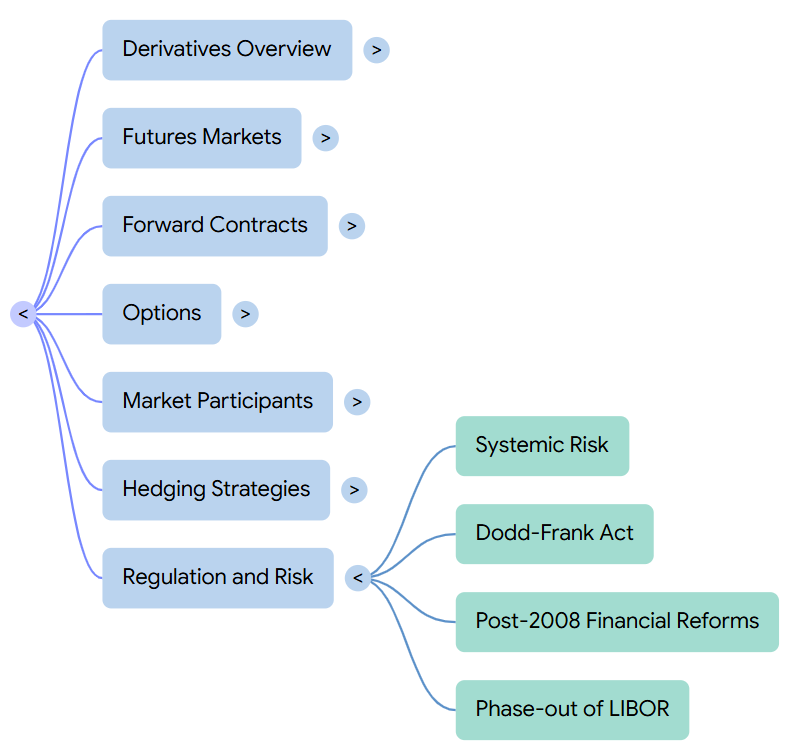
In the book, the relationship between regulation and risk is framed as a continuous evolution, where systemic failures and financial crises repeatedly reshape how derivatives markets are governed. This dynamic spans international banking standards, over-the-counter (OTC) market transparency, clearing mechanics, and internal corporate controls.
1. Systemic Risk and the Overhaul of the OTC Market
Prior to the 2007–2008 financial crisis, the over-the-counter (OTC) derivatives market was largely unregulated. The massive collapse of Lehman Brothers—which had over a million outstanding derivatives transactions with roughly 8,000 different counterparties—highlighted the severe danger of systemic risk. Systemic risk is defined as the hazard that a default by one financial institution will create a “ripple effect” (or domino effect) of defaults across other institutions, threatening the stability of the entire financial system.
In response, international regulators introduced reforms designed to make the OTC market function more like exchange-traded markets. Under legislation like the Dodd-Frank Act in the United States, three critical changes were mandated for standardized OTC transactions between financial institutions:
- Swap Execution Facilities (SEFs): Standardized OTC contracts must be traded on electronic platforms similar to exchanges, where market participants can post and accept bid-ask quotes.
- Central Counterparties (CCPs): Standardized trades must be cleared through a CCP. The CCP acts as a clearing house, standing between the counterparties to absorb and manage credit risk.
- Central Repositories: All derivatives transactions must be reported to a central repository to guarantee market transparency.
2. Credit Risk, Collateralization, and Margin Requirements
A major focus of regulation is managing credit risk—the risk that a counterparty will default on its obligations—which is much more difficult to hedge than market risk (the risk of losses from price or interest rate movements). To mitigate credit risk, regulators have heavily targeted the posting of collateral:
- Cleared Trades: Clearing house members and CCP members are required to deposit both initial margin and daily variation margin to act as a buffer against default.
- Bilateral Trades: For OTC transactions cleared bilaterally (not routed through a CCP), regulations introduced in 2016 mandated that financial institutions must exchange both initial and variation margin, with the initial margin posted to a third-party custodian.
- Pricing Adjustments (XVAs): Because of these stringent counterparty risks and capital rules, derivatives dealers now dynamically adjust their valuations using the XVA framework. This includes Credit Valuation Adjustment (CVA) for counterparty default risk, Debit Valuation Adjustment (DVA) for the bank’s own default risk, and Capital Valuation Adjustment (KVA) to reflect the cost of required regulatory capital.
3. International Banking Supervision: Basel I to Basel IV
Global banking activities are regulated by the Basel Committee on Banking Supervision, which determines the capital banks must hold to buffer against various risks:
- Basel I & II: Basel I (1988) introduced international capital requirements for credit risk, while Basel II (implemented in 2007) added requirements for market and operational risks.
- Basel II.5: Developed in the wake of the 2007–2008 crisis, this accord drastically increased the capital required to cover market risk.
- Basel III: Implemented through 2019, it raised both the quantity and quality of required capital and introduced strict liquidity requirements. These liquidity rules are designed to prevent banks from exposing themselves to catastrophic liquidity risk by relying too heavily on short-term liabilities for long-term funding needs.
- Basel IV: Scheduled for implementation between 2022 and 2027, this framework reduces the ability of banks to use their own proprietary internal models to determine capital requirements, enforcing standardized approaches instead.
In tandem with these global rules, individual jurisdictions have restricted bank activities, such as the US Volcker rule (restricting proprietary trading by deposit-taking banks), and UK/EU proposals to ring-fence retail banking from high-risk investment activities.
4. Internal Corporate Controls & “Rogue Trader” Risks
The book stresses that external regulation is only half the battle; financial institutions and corporations must maintain rigorous internal controls. Because derivatives offer massive leverage, they can easily be abused.
The book highlights several high-profile “rogue trader” disasters where employees with low-risk hedging or arbitrage mandates bypassed compliance to take unauthorized, speculative directional bets:
- Nick Leeson (Barings Bank): Mandated to arbitrage Nikkei index futures, he instead made speculative bets that lost $1 billion, bankrupting the 200-year-old bank.
- Jérôme Kerviel (Société Générale): Mandated to find arbitrage opportunities in equity indices, he took unauthorized speculative positions that resulted in a €4.9 billion loss.
- John Rusnak (Allied Irish Bank): Hidden speculative foreign exchange trades resulted in a $700 million loss.
To prevent these mishaps, the book outlines critical risk management lessons:
- Define Unambiguous Risk Limits: Risk limits must be set clearly at the board level and monitored daily. Exceeding risk limits must carry severe penalties even if the trader makes a profit; otherwise, a culture of complacency is fostered.
- Separate Office Functions: It is crucial to strictly separate the front office (traders executing deals), middle office (risk managers monitoring exposures), and back office (record-keeping and accounting). Both Leeson and Kerviel took catastrophic advantage of back-office access or control to hide their speculative losses.
- Do Not Blindly Trust Models: Over-reliance on “marking to model” for highly exotic instruments can lead to massive losses if the underlying assumptions are incorrect.
- Do Not Sell Inappropriate Products: Financial institutions must avoid selling overly complex, high-risk products to corporate clients who do not understand them (as occurred with Bankers Trust in 1994), which can lead to severe litigation and reputational damage.
Systemic Risk
In the book, systemic risk is defined as the danger that a default by one financial institution will trigger a “ripple effect” of defaults across other financial institutions, ultimately threatening the stability of the entire financial system. This risk is primarily driven by the massive web of over-the-counter (OTC) transactions that link banks. If Bank A defaults, Bank B may face severe losses on its outstanding trades with Bank A, which could cause Bank B to default in turn. This chain reaction can quickly spread to Bank C and other institutions, severely disrupting the wider financial sector. While the financial system survived notable historic defaults like Drexel in 1990 and Lehman Brothers in 2008, governments during the 2007–2008 crisis frequently chose to bail out distressed institutions rather than letting them fail specifically because they feared systemic consequences.
The book highlights that credit default swaps (CDSs) were viewed by regulators as a major source of systemic vulnerability during the 2007–2008 credit crisis. Because the volume of outstanding CDSs on a single company can easily exceed its actual debt, a default can trigger immense losses for the protection sellers, creating a cascade of defaults among counterparties. A notable example is the insurance giant AIG, which had sold massive amounts of protection on AAA-rated tranches of asset-backed security collateralized debt obligations (ABS CDOs). When the underlying subprime mortgages performed poorly, AIG was unable to meet the resulting multi-billion-dollar collateral calls and had to be bailed out by the government to prevent a systemic collapse.
In the broader context of Regulation and Risk, the book outlines several key regulatory overhauls aimed at directly reducing systemic risk:
- OTC Market Centralization: Standardized OTC derivatives between financial institutions must be traded on Swap Execution Facilities (SEFs), reported to a central repository, and cleared through central counterparties (CCPs).
- Central Counterparties (CCPs): A CCP manages credit risk by acting as the clearing house that stands between the trading parties. It mitigates default risks by requiring clearing members to post initial margin, deposit daily variation margin, and contribute to a joint guaranty fund.
- Bilateral Margin Rules: For transactions that are not cleared through a CCP, regulations implemented starting in 2016 mandate that financial institutions must exchange both initial margin (which must be posted with a third-party custodian) and daily variation margin.
- Basel Capital and Liquidity Accords: Under international standards established by the Basel Committee on Banking Supervision, banks must hold sufficient capital and liquidity to buffer against credit, market, and operational risks. The Basel III accord introduced strict liquidity requirements to prevent banks from relying excessively on highly volatile, short-term wholesale funding to finance long-term assets. This mismatch in funding had previously caused devastating liquidity failures during the financial crisis, such as at Northern Rock, Bear Stearns, and Lehman Brothers.
Dodd-Frank Act
In the book, the Dodd-Frank Act (signed into law in the United States in 2010) is presented as a landmark regulatory framework designed to protect consumers and investors, prevent future bailouts, and monitor the stability of the financial system more closely. Introduced in the aftermath of the 2007–2008 financial crisis and the catastrophic bankruptcy of Lehman Brothers, the act directly targets the mitigation of systemic risk—the danger that the default of a single financial institution will initiate a domino effect of failures across the wider financial system.
Overhauling the Over-the-Counter (OTC) Market
Prior to the 2007–2008 crisis, the over-the-counter derivatives market operated with very little regulatory oversight. To address the vulnerabilities of this massive market, the Dodd-Frank Act introduced measures to make the OTC market function more like highly transparent, exchange-traded markets. Under the act, standardized OTC derivatives transactions between financial institutions must comply with three major requirements:
- Trading on Swap Execution Facilities (SEFs): Standardized OTC derivatives must, whenever possible, be executed on SEFs. SEFs are electronic platforms similar to exchanges where participants can post and trade on bid and ask quotes, ensuring price transparency.
- Clearing through Central Counterparties (CCPs): Standardized trades must be processed through CCPs. A CCP acts as a clearing house, standing between the two trading parties to eliminate bilateral default risk. To manage credit risks, CCPs require clearing members to deposit initial and daily variation margins.
- Reporting to Central Repositories: To guarantee transparency and allow regulators to monitor the concentration of risk, all derivatives trades must be reported to a central repository.
Expanded Roles for Regulators
The Dodd-Frank Act significantly expanded the federal authority of the Commodity Futures Trading Commission (CFTC). While the CFTC was historically responsible for looking after the public interest in exchange-traded futures, Dodd-Frank gave the agency direct responsibility for establishing and enforcing rules governing the trading of standard OTC derivatives on SEFs and their clearing through CCPs.
The Volcker Rule and Banking Restrictions
Beyond market centralization, Dodd-Frank introduced structural partitions to separate speculative activities from commercial banking. A primary mechanism for this is the Volcker rule (proposed by former Federal Reserve Chairman Paul Volcker), which severely restricts proprietary trading and other similar high-risk activities of deposit-taking financial institutions.
Under the book’s analysis of the financial crisis, investment banks like Lehman Brothers collapsed because they took on massive speculative positions using volatile short-term funding without being subject to commercial bank capital regulations. The Volcker rule aims to insulate retail-facing, deposit-taking commercial banks from these speculative trading risks to protect the public and the financial system from bank failures.
Post-2008 Financial Reforms
Following the 2008 financial crisis, the regulatory landscape for derivatives and banking underwent a massive transformation. The book explains that prior to the crisis, over-the-counter (OTC) derivatives markets were largely unregulated. In the aftermath of systemic failures, global regulators introduced comprehensive reforms to mitigate systemic risk—the danger that the default of one financial institution would trigger a domino effect of failures across the financial system.
Post-2008 reforms restructured financial markets, capital adequacy, structural banking, and institutional risk management through several key pillars:
1. Overhauling and Centralizing the OTC Market
To reduce systemic risk and increase transparency, regulators enacted rules forcing the massive OTC derivatives market to function more like exchange-traded markets. Standardized OTC transactions between financial institutions are now subject to three primary mandates:
- Swap Execution Facilities (SEFs): Standardized OTC derivatives must, whenever possible, be traded on SEFs, which are electronic platforms similar to exchanges where participants trade by posting and accepting bid-ask quotes.
- Central Counterparties (CCPs): Standardized trades must be cleared through CCPs, which stand between the two trading parties to act as a clearing house. CCPs absorb credit risk by requiring clearing members to post initial margin, deposit daily variation margin, and contribute to a default fund.
- Central Repositories: All derivatives transactions must be reported to a central repository to provide regulators with market transparency.
- Compression: To manage outstanding exposures and capital requirements, firms increasingly use compression, a process where multiple counterparties restructure trades to reduce the total underlying principal. This practice has significantly constrained the net growth of the OTC market since 2007.
2. Regulating Bilateral Clearing and Collateral
For derivatives that are not standardized enough to be routed through CCPs, the resulting bilaterally cleared transactions are now subject to strict, legally mandated collateral rules rather than terms left entirely to the discretion of the counterparties. Starting in 2016, international regulations required financial institutions to exchange both daily variation margin and initial margin, with the initial margin mandatorily posted with a independent, third-party custodian to protect it in the event of default.
3. The Evolution of Global Banking Standards (Basel I to Basel IV)
The Basel Committee on Banking Supervision progressively tightened global banking rules to address capital and liquidity weaknesses exposed during the crisis:
- Basel II.5: Implemented in 2012, this framework sharply increased the capital banks were required to hold to cover market risk in their trading books.
- Basel III: This accord increased both the overall quantity and quality of capital (forcing banks to maintain a much higher proportion of equity). Crucially, it introduced strict liquidity requirements designed to prevent banks from exposing themselves to catastrophic liquidity risk by relying too heavily on highly volatile, short-term wholesale funding to finance long-term assets. Mismatches in this short-term funding were the direct cause of high-profile failures like Northern Rock, Bear Stearns, and Lehman Brothers.
- Basel IV: Scheduled for implementation between 2022 and 2027, this framework implements the Fundamental Review of the Trading Book, which transitions the banking industry from measuring market risk capital using Value at Risk (VaR) at a 99% confidence level to expected shortfall (ES) at a 97.5% confidence level. Basel IV also limits the extent to which banks can utilize their own highly complex proprietary internal models, enforcing standardized, committee-developed approaches instead.
4. Structural Bank Ring-Fencing and Proprietary Trading Bans
To isolate deposit-taking commercial banks from high-risk, speculative trading activities, governments introduced structural partitions:
- The Volcker Rule: In the United States, under the Dodd-Frank Act, this rule severely restricts proprietary trading and similar speculative activities at deposit-taking financial institutions.
- Ring-Fencing: In the United Kingdom, the Vickers committee proposed ring-fencing banks’ retail operations from their investment banking arms. The Liikanen committee in the European Union similarly recommended a structural separation between high-risk investment activities and commercial banking.
5. Realigning Compensation and Incentives
The book notes that the pre-crisis system of origination, securitization, and trading was riddled with agency costs—conflicts of interest where employees prioritized short-term personal gains over long-term risk. Specifically, traditional year-end bonuses represented “short-term compensation” that rewarded immediate profits but left the bank to absorb any subsequent losses. Post-2008 reforms have placed bank bonuses under greater scrutiny, increasingly spreading payments over multiple years and introducing clawback provisions so that bonuses can be recovered if the underlying trades subsequently perform poorly.
Phase-out of LIBOR
The phase-out of the London Interbank Offered Rate (LIBOR) represents a fundamental regulatory reform designed to address severe structural risks and vulnerabilities in global financial markets. In the book, this transition is examined as a major structural shift that directly alters how reference rates are calculated, how credit risk is priced, and how outstanding derivative portfolios are valued.
1. Regulatory Motives: Why LIBOR Is Being Phased Out
Historically, LIBOR served as the reference rate for hundreds of trillions of dollars of financial transactions globally. However, bank regulators initiated plans to discontinue it due to two primary weaknesses:
- Lack of Transactional Grounding: There was insufficient interbank borrowing to ground the panel banks’ quotes in actual market transactions.
- Vulnerability to Manipulation: Because actual transactions were scarce, LIBOR submissions relied heavily on bank judgment, exposing the rate to potential manipulation.
Regulators, uncomfortable with this systemic vulnerability, mandated the transition to more transparent, transaction-based benchmarks.
2. The New Reference Benchmarks
The replacement framework relies on overnight reference rates (RFRs) derived from actual, robust transaction volumes:
- In the United States, the replacement rate is the Secured Overnight Financing Rate (SOFR), which is a secured rate based on overnight repo transactions.
- In other major jurisdictions, the rates are unsecured overnight interbank rates, such as SONIA (U.K.), €STR (Eurozone), SARON (Switzerland), and TONAR (Japan).
3. Structural and Valuation Risks of the Transition
The shift from LIBOR to overnight reference rates introduces significant structural differences that impact derivatives pricing and risk management:
- Risk-Free vs. Credit-Risky Rates: LIBOR incorporates an unsecured interbank credit spread reflecting the credit risk of creditworthy banks. The new overnight reference rates are essentially risk-free.
- The Credit Spread Dilemma in Stressed Markets: During market stress, bank credit spreads naturally widen. Historically, LIBOR rose automatically under stress—such as when the spread between three-month LIBOR and overnight-rate-based equivalents spiked to an all-time high of 364 basis points in October 2008. This allowed banks to align their interest income with their funding costs when lending at a reference rate plus a spread. Since the new risk-free reference rates do not widen in this manner, banks face new exposures and have requested that risk-free rates be augmented by credit spread measures to create “risky” reference rates.
- Forward-Looking vs. Backward-Looking: LIBOR is a forward-looking rate determined at the beginning of an accrual period, allowing parties to know their interest payments in advance. Conversely, the replacement rates are backward-looking; they are calculated using a daily compounding or “averaging process” over the period, meaning the final interest payment is only known at the very end of the period.
- Model and Software Adjustments: Because of these differences, derivatives pricing models and software must be modified to calculate zero curves and value instruments without a LIBOR focus.
4. Transition Risks in Legacy Contracts (The Swaps Market)
The phase-out presents acute operational and valuation challenges for the swaps market:
- Legacy Swaps: Many LIBOR-for-fixed swaps negotiated in the past have long lives (such as a 20-year swap negotiated at the end of 2013) that extend far beyond the LIBOR discontinuation dates.
- The Fallback Problem: Because legacy contracts depend on LIBOR, the market has had to agree on fallback mechanisms to estimate LIBOR from the new risk-free rates. For example, three-month U.S. LIBOR must be estimated synthetically by taking three-month SOFR and adding a historical average spread (denoted as ) to compensate for the missing interbank credit risk premium.
— Linden Lake
This series:
→ Book Review (1 of 7): Options, Futures, and Other Derivatives – Derivative Overview
→ Book Review (2 of 7): Options, Futures, and Other Derivatives – Futures Markets
→ Book Review (3 of 7): Options, Futures, and Other Derivatives – Forward Contracts
→ Book Review (4 of 7): Options, Futures, and Other Derivatives – Options
→ Book Review (5 of 7): Options, Futures, and Other Derivatives – Market Participants
→ Book Review (6 of 7): Options, Futures, and Other Derivatives – Hedging Strategies
→ Book Review (7 of 7): Options, Futures, and Other Derivatives – Regulation and Risk
Leave a Reply