
In the taxonomy of financial derivatives, a forward contract is characterized as a relatively simple, privately negotiated agreement to buy or sell an asset at a designated future time for a specified price. Unlike exchange-traded instruments, forward contracts are traded exclusively in the over-the-counter (OTC) market, typically between two financial institutions or a financial institution and its corporate client.
Mechanics of Long and Short Positions
A forward contract represents a binding commitment where both parties agree to terms today for execution in the future.
- The party that agrees to buy the underlying asset on the future date is said to hold a long position. At maturity, the payoff to a long position on one unit of the asset is calculated as: ST−K , where ST is the spot price of the asset at maturity and is the agreed-upon delivery price.
- The party that agrees to sell the asset on that same future date holds a short position. The payoff to a short position on one unit of the asset is : K−ST
These payoffs can be positive or negative. Because it costs nothing to enter into a forward contract initially, the final payoff represents the trader’s total gain or loss from the contract.
Forwards in the Larger Context of Derivatives
According to the book, forward contracts occupy a distinct conceptual space when compared to options and futures:
- Forwards vs. Options: An option gives the holder the right to buy or sell an asset, meaning they are under no obligation to act. Conversely, a forward contract represents a strict obligation where both parties must perform. Additionally, while a forward contract has no up-front cost, acquiring an option requires paying an upfront premium. Consequently, hedging with forward contracts neutralizes risk by completely locking in a price, whereas options act as insurance, protecting against adverse price moves while allowing the holder to benefit from favorable ones.
- Forwards vs. Futures: While both are agreements to transact in the future, they differ structurally. Forwards are private, non-standardized contracts that specify a single delivery date and are settled in full at maturity, exposing the parties to some credit risk. Futures are standardized, exchange-traded contracts with a range of delivery dates that are settled daily (marked to market), reducing credit risk to virtually zero. Due to daily settlement, a futures trader realizes gains and losses day-by-day, whereas a forward trader’s gains and losses are realized as a single sum at the end of the contract’s life.
Pricing and Valuation of Forward Contracts
To prevent riskless arbitrage, the book explains that the forward price today (F0) is mathematically tied to the current spot price (S0) and the cost of financing the asset over the life of the contract (T ) at the continuously compounded risk-free rate (r). The pricing formula adjusts based on the income characteristics of the underlying asset:
- For an asset providing no income: F0=S0erT
- For an asset providing a known cash income with a present value of I : F0=(S0−I)erT
- For an asset providing a known continuous yield of q : F0=S0e(r−q)T
When a forward contract is first initiated, the delivery price K is set equal to the current forward price F0, meaning the contract’s initial value (f) is exactly zero. As time passes and the market fluctuates, the delivery price K remains fixed, but the market forward price changes, causing the contract to acquire a positive or negative value. For a long position, the value of the contract at any intermediate point is the present value of the difference between the current forward price and the delivery price: f = (F0 − K)e−rT
In theory, if interest rates are constant or predictable over time, the forward price of a contract is exactly equal to its futures price. However, when interest rates vary unpredictably in the real world, forward and futures prices can diverge slightly depending on how strongly the underlying asset’s price correlates with interest rate movements.
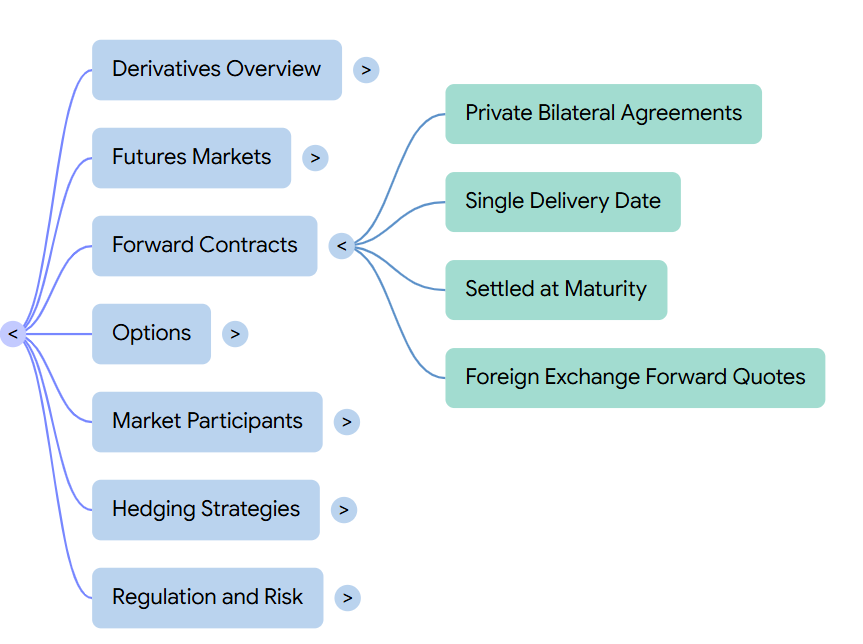
Private Bilateral Agreements
The book explains that a forward contract is a relatively simple derivative consisting of an agreement to buy or sell an asset at a designated future time for a specified price. Unlike standardized futures contracts that trade publicly on exchanges, forward contracts exist as private bilateral contracts negotiated directly between two parties in the over-the-counter (OTC) market. Because they are privately negotiated, forward contracts are not standardized; instead, they are highly flexible and can be customized to meet the exact hedging or speculative needs of the counterparties.
The Legal Structure of Bilateral Agreements
When counterparties agree to an OTC transaction like a forward contract, they can choose to clear the trade through a central counterparty (CCP) or clear it bilaterally. Under bilateral clearing, the relationship is governed by a private legal contract covering all outstanding transactions between the two parties. In the OTC market, the standard contract used is the International Swaps and Derivatives Association (ISDA) Master Agreement.
This private bilateral agreement establishes a comprehensive legal framework, defining:
- The exact circumstances that constitute an event of default or allow outstanding transactions to be terminated.
- How settlement amounts are calculated if transactions are terminated early.
- Netting provisions, which dictate that in the event of default, all covered derivatives are consolidated and treated as a single transaction. Netting prevents a non-defaulting party from having to pay out on losing contracts while receiving nothing on winning ones, which drastically reduces credit exposure.
Managing Credit Risk and Collateralization (CSAs)
Because forward contracts are private bilateral agreements settled only at maturity, they do not benefit from the default guarantees of exchange clearing houses and are inherently exposed to counterparty credit risk. To manage this default risk, bilateral agreements commonly include an annex known as the Credit Support Annex (CSA).
The CSA dictates the mechanics for exchanging collateral (margin) to cover fluctuations in the portfolio’s value:
- Daily Valuations: The outstanding transactions are valued each day.
- Variation Margin: If the net value of the portfolio shifts in favor of one party by an amount X, the other party is required to post equivalent collateral worth X to cover the exposure.
- Acceptable Assets and Haircuts: The CSA specifies which assets (such as cash or marketable securities) are acceptable. If securities are posted, a haircut is applied to reduce their valuation for margin purposes to protect against price volatility.
Economic and Operational Distinctions
The private, bilateral nature of forward contracts leads to distinct economics compared to exchange-traded markets:
- Delayed Settlement: While exchange-traded futures are settled daily (marking the contract’s value back to zero each day), forward contracts are typically held to maturity without daily settlement.
- Interest on Collateral: Because bilateral forwards are not settled daily, cash variation margin posted under a CSA functions as held collateral rather than a final settlement. For this reason, cash variation margin in the bilateral OTC market earns interest (typically at overnight index swap rates), whereas variation margin on futures does not.
Single Delivery Date
In the book, a defining feature of a forward contract is that it normally specifies a single, exact delivery date (or a particular day in the future) on which the transaction is to be executed. This singular date shapes the legal structure, cash flow dynamics, and risk profile of forward agreements, distinguishing them from other derivative instruments.
Contrast with Futures and Swaps
The single delivery date serves as a primary point of contrast in the broader derivatives market:
- Forwards vs. Futures: While a forward contract specifies one exact delivery date, a standardized futures contract typically offers a range of eligible delivery dates (often spanning an entire delivery month). In a futures contract, the party with the short position (the seller) generally holds the option to choose when physical delivery occurs within that range.
- Forwards vs. Swaps: Whereas a forward contract represents a commitment to exchange cash flows on just one future date, a swap is structured to lead to multiple cash flow exchanges taking place across several future dates over the life of the contract.
Settlement and Payoff Dynamics
The presence of a single delivery date dictates how gains, losses, and settlements are handled:
- Deferred Settlement: Because there is only one specified delivery date, a forward contract is not usually settled until the end of its life. At that maturity date, the contract is settled in full, typically resulting in actual physical delivery of the underlying asset or a final cash settlement.
- Realization of Profits: Unlike futures contracts—which are marked to market and settled daily—the entire gain or loss on a forward contract is realized as a single lump sum on the delivery date. For example, if a trader enters a 90-day forward contract, the total profit or loss is realized on the 90th day, whereas an identical futures contract would distribute that same cumulative gain or loss day-by-day.
- Valuation and Discounting: Because the final cash flow is deferred to a single delivery date, any change in the forward price today does not yield immediate cash. Instead, the current value of a forward contract (its mark-to-market value) is calculated as the present value of the change in the forward price, discounted at the risk-free rate from the delivery date back to the present.
Customizable Exceptions
Although standard forward contracts specify a single delivery date, the private, over-the-counter (OTC) nature of these agreements allows for customization. The book notes that if a company is uncertain about the exact day it will receive or pay a foreign currency, it can negotiate a nonstandard forward contract with a bank that specifies a range of dates (a delivery period). This grants the company the right to choose the exact delivery date within that period to better align with its corporate cash flows.
Settled at Maturity
In the book, the concept of being settled at maturity (or at the end of its life) is a defining structural and economic characteristic of forward contracts. Unlike futures contracts, which are marked to market and settled daily, forward contracts defer all cash exchanges and profit realizations until the contract’s final delivery date.
Deferred Realization of Gains and Losses
Under a forward contract, no money changes hands at initiation (excluding potential collateral requirements), and the entire gain or loss is realized as a single lump sum on the delivery date.
- For example, if a trader enters into a 90-day forward contract to buy £1 million and the exchange rate rises favorably by maturity, the entire $200,000 profit is realized on the 90th day.
- In contrast, a trader holding an identical futures contract would realize the exact same cumulative profit, but it would be distributed day-by-day throughout the 90 days due to the exchange’s daily settlement procedures.
High Rate of Physical Delivery or Cash Settlement
Because forward contracts are intended to be held to the end of their life and settled at maturity, actual physical delivery of the underlying asset or a final cash settlement usually takes place. This differs significantly from the futures market, where physical delivery is highly unusual; the vast majority of futures contracts are closed out early by taking offsetting positions before the delivery period begins.
Pricing, Valuation, and the Time Value of Money
The deferred nature of forward contract settlement directly impacts how they are valued prior to maturity:
- Present Value of Gains: When the forward price of an asset fluctuates, a forward contract gains or loses value, but because the contract is only settled at maturity, the profit or loss cannot be immediately accessed. Thus, the marked-to-market value of a forward contract is the present value of the change in the forward price, discounted at the risk-free rate from the maturity date back to today.
- The “Systems Error” Example: This distinction can cause confusion on trading desks. As highlighted in the book, if a forward exchange rate and a futures exchange rate both move favorably by the same amount, a futures trader immediately receives the cash profit due to daily settlement, whereas the forward trader’s calculated profit is slightly lower because it must be discounted back from the single settlement date at maturity.
Conceptual Simplicity in Analysis
Because forward contracts do not have the operational complexity of daily variation margin cash flows, the book notes that they are much easier to analyze and value than futures contracts. Their valuation is straightforward because it requires analyzing only a single cash flow at maturity rather than a sequence of daily payouts.
Foreign Exchange Forward Quotes
According to the book, forward contracts on foreign exchange are among the most popular over-the-counter (OTC) derivatives. Large international banks actively employ spot and forward foreign-exchange traders, quoting exchange rates for various future maturities to help corporations and financial institutions manage currency risk.
Quoting Conventions in the FX Forward Market
A key detail discussed in the book is that forward prices are always quoted in the same way as spot prices. This is an important distinction between the forward market and the exchange-traded futures market, where futures prices (with the U.S. dollar as the domestic currency) are always quoted as the number of U.S. dollars or cents per unit of the foreign currency.
For forward contracts, the quoting convention depends on the specific currency pair:
- Direct Quotes (USD per Unit of Foreign Currency): For the British pound (GBP), the euro (EUR), the Australian dollar (AUD), and the New Zealand dollar (NZD), forward quotes show the number of U.S. dollars per single unit of the foreign currency. Because of this, forward quotes for these currencies are directly comparable with futures quotes.
- Indirect Quotes (Foreign Currency per USD): For other major currencies, forward quotes show the number of units of the foreign currency per single U.S. dollar.
- The Canadian Dollar (CAD) Example: The book highlights that a futures price quote of 0.7500 USD per CAD corresponds to a forward price quote of 1.3333 CAD per USD (calculated as 1/0.7500).
Bid-Ask Spreads and Forward Maturities
In the FX forward market, large banks act as market makers, quoting both bid prices (the price at which the bank is prepared to buy the foreign currency) and ask prices (the price at which the bank is prepared to sell it).
Using the GBP/USD quotes presented in the book, we can see how these quotes change as the maturity of the contract extends:
- Spot: Bid 1.2217 / Ask 1.2220
- 1-Month Forward: Bid 1.2218 / Ask 1.2222
- 3-Month Forward: Bid 1.2220 / Ask 1.2225
- 6-Month Forward: Bid 1.2224 / Ask 1.2230
As the maturity increases, the bid-ask spread (the difference between the buy and sell prices) typically widens. For example, the spot spread is 3 points (0.0003), whereas the 6-month forward spread widens to 6 points (0.0006). This widening reflects the additional risk, time value, and funding costs associated with locking in rates further into the future.
Application of Quotes in Currency Hedging
These quoted forward rates represent binding bilateral commitments. The book illustrates how a corporate treasurer can use these quotes to eliminate exchange rate risk:
- If a U.S. importer knows it must pay £10 million in 3 months, it can buy £10 million in the 3-month forward market at the ask rate of 1.2225, locking in a total payment of $12,225,000 regardless of how the spot exchange rate moves.
- Conversely, a U.S. exporter expecting to receive £30 million in 3 months can sell the sterling forward at the bank’s bid rate of 1.2220, securing exactly $36,660,000.
By fixing the exchange rate up front, the forward contract neutralizes the foreign exchange risk by establishing a single, definite cash flow on the contract’s maturity date.
— Linden Lake
This series:
→ Book Review (1 of 7): Options, Futures, and Other Derivatives – Derivative Overview
→ Book Review (2 of 7): Options, Futures, and Other Derivatives – Futures Markets
→ Book Review (3 of 7): Options, Futures, and Other Derivatives – Forward Contracts
→ Book Review (4 of 7): Options, Futures, and Other Derivatives – Options
→ Book Review (5 of 7): Options, Futures, and Other Derivatives – Market Participants
→ Book Review (6 of 7): Options, Futures, and Other Derivatives – Hedging Strategies
→ Book Review (7 of 7): Options, Futures, and Other Derivatives – Regulation and Risk
Leave a Reply