
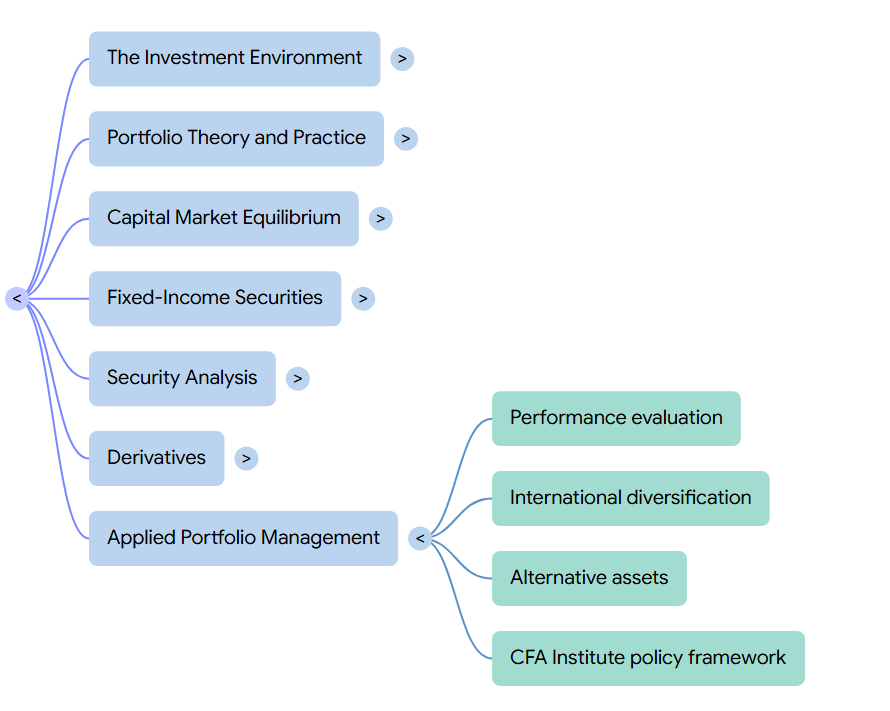
In the larger context of investments, the book describes Applied Portfolio Management as the final, practical stage where investment theories—such as the Capital Asset Pricing Model (CAPM) and the Efficient Market Hypothesis (EMH)—are put into operation to meet the specific needs of diverse households and institutions. This process is not a simple mechanical algorithm but a dynamic feedback loop comprising planning, execution, and feedback.
The Core Framework: Planning and Execution
Applied management follows a disciplined structure endorsed by the CFA Institute, beginning with the creation of an Investment Policy Statement (IPS).
- Objectives: Managers must quantify a client’s return requirements and risk tolerance. For example, a young investor may be more risk-tolerant about financial wealth, whereas a retiree requires conservation of principal.
- Constraints: Portfolios are tailored based on five primary constraints: liquidity needs, investment horizon, regulatory requirements, tax considerations, and unique needs (such as ethical or ESG concerns).
- Asset Allocation: Top-down portfolio construction begins by establishing “neutral” weights across broad asset classes (stocks, bonds, cash), which the book identifies as the primary determinant of a portfolio’s risk-return profile.
Evaluation and Attribution
A critical component of applied practice is performance evaluation, which determines whether a manager has added value relative to a passive benchmark or “bogey”.
- Risk-Adjusted Measures: Managers are evaluated using the Sharpe ratio (for overall portfolios), Jensen’s alpha (for abnormal returns), and the Information Ratio (for evaluating active positions added to a diversified base).
- Performance Attribution: This procedure decomposes total excess returns into three specific decision levels: broad asset allocation (market timing), sector selection within those markets, and individual security selection.
Expanding the Universe: International and Alternative Assets
Applied management seeks to improve the risk-return trade-off by diversifying beyond traditional domestic markets.
- International Diversification: Including global markets shifts the efficient frontier upward, though it introduces new complexities like exchange rate risk and political risk.
- Alternative Assets: Managers may incorporate hedge funds, private equity (venture capital and leveraged buyouts), and real assets. These assets often have low correlation with traditional stocks and bonds, acting as “return engines” for large endowments and foundations.
Active Management Theory
The book presents the Treynor-Black and Black-Litterman models as the primary quantitative tools for active management.
- The Search for Alpha: Active management is the attempt to improve performance by identifying mispriced securities (alpha) or timing market movements.
- Managing Forecast Precision: A key practical challenge is that portfolio weights are extremely sensitive to alpha forecasts. To prevent “wild” or infeasible portfolio positions, managers must “shrink” alpha forecasts toward zero based on the analyst’s historical accuracy and may impose constraints on tracking risk relative to the benchmark.
Ultimately, the book frames Applied Portfolio Management as a process of “alpha transfer” or portable alpha, where managers invest where they find skill-based value, hedge away unwanted market exposure, and use passive products to maintain the client’s desired broad market orientation.
Performance evaluation
In the larger context of Applied Portfolio Management, the book describes performance evaluation as the critical “Feedback” stage of the investment process. This stage completes a dynamic loop—following planning and execution—by assessing whether a manager has successfully attained investor objectives and added value relative to passive benchmarks.
Measuring Investment Returns
The book distinguishes between two primary methods for calculating average returns, noting that the choice depends on the purpose of the evaluation:
- Time-Weighted (Geometric) Returns: These assign equal weight to each time period and are the standard for comparing the performance of different portfolio managers, as they are unaffected by the timing of cash inflows or outflows.
- Dollar-Weighted Returns: Calculated as the internal rate of return (IRR), these measure the actual growth of the investor’s specific dollar balance, making them sensitive to the timing and magnitude of additions or withdrawals.
Risk-Adjusted Performance Measures
Because raw returns are not useful without considering the risk taken to achieve them, the book details several quantitative benchmarks for risk adjustment:
- Sharpe Ratio: This measures the reward-to-volatility trade-off by dividing excess return by the portfolio’s total standard deviation. It is the most appropriate measure when evaluating a portfolio that represents an investor’s entire risky investment.
- Treynor Measure: This calculates excess return per unit of systematic risk (beta). It is best used when evaluating subportfolios that will be mixed with other assets to form a larger, diversified whole.
- Jensen’s Alpha: Defined as the average return beyond that predicted by the Capital Asset Pricing Model (CAPM), a positive alpha is a fundamental requirement for any active strategy to be considered attractive.
- Information Ratio: This divides alpha by “tracking error” (nonsystematic risk). It measures the efficiency with which a manager earns abnormal returns through security selection while departing from a diversified benchmark.
- Interpretable Refinements ( and ): To make these ratios more intuitive, the measure translates the Sharpe ratio into an easy-to-read percentage of differential return relative to a benchmark index by equalizing their volatilities. The measure does the same for the Treynor ratio by matching the portfolio’s beta to the market.
Performance Attribution
A central tool in applied practice is performance attribution, which decomposes a manager’s total excess return into three specific decision levels:
- Asset Allocation: The value added by overweighting broad market sectors (e.g., equity vs. fixed-income) that performed well relative to a “neutral” baseline.
- Sector Selection: The impact of choosing to overweight specific industries or styles within those broad markets.
- Security Selection: The additional return derived from picking individual assets within a sector that outperformed the sector’s index.
Practical Challenges and Biases
The book warns that performance evaluation is often confounded by real-world complexities. Market timing can make conventional measures unreliable because it involves constantly shifting portfolio betas, which can make a successful manager appear riskier than they actually are. Furthermore, performance manipulation can occur when managers adjust leverage at the end of an evaluation period to “game” their Sharpe ratios; for this reason, the book highlights the Morningstar Risk-Adjusted Rating (MRAR) as a manipulation-proof alternative. Finally, when evaluating historical records, analysts must be wary of survivorship bias, where the failure of poorly performing funds leads to an artificially inflated average return for those that remain.
International diversification
In the larger context of Applied Portfolio Management, the book presents international diversification as a critical extension of traditional portfolio selection, allowing investors to move beyond domestic constraints to improve their risk–return trade-offs. While the fundamental principles of diversification remain the same, international investing introduces unique complexities such as exchange rate risk, political risk, and differing regulatory environments.
The Rationale for Global Diversification
The primary motivation for investing internationally is the potential for significant risk reduction. The book notes that because different national economies do not move in perfect lockstep, a global portfolio can achieve lower volatility than one limited to a single country.
- Shifting the Efficient Frontier: By including a broader universe of assets, the efficient frontier shifts “up and left,” providing a steeper capital allocation line (CAL) and a higher Sharpe ratio than a purely domestic portfolio could offer.
- The Myopia of Home-Country Bias: Despite these benefits, the book highlights a pervasive “home-country bias,” where investors tend to disproportionately overweight domestic securities relative to their actual weight in the world market.
Key Risks and Challenges
International investing is not without its specific hurdles, which must be carefully managed in an applied setting:
- Exchange Rate Risk: The dollar-denominated return on a foreign investment depends on both the security’s performance in its local currency and the movement of the exchange rate. While this risk can be hedged using futures or forward markets, a perfect hedge is only possible if the foreign investment’s return is known in advance.
- Political Risk: This encompasses a wide range of uncertainties, including government stability, social tensions, and the legal protections afforded to investors. The book points to specialized services, such as the PRS Group, which provide comprehensive ratings to help managers quantify these risks.
- Correlation in Crises: A significant concern raised by the book is that international correlations tend to increase during periods of extreme market turbulence, such as the crashes of 1987 and 2008. This means that diversification benefits may diminish precisely when they are most needed.
Implementation in Applied Management
In practice, international diversification requires a disciplined framework for asset allocation and evaluation:
- Benchmark Selection: Managers typically use broad international indexes such as the MSCI World index or the EAFE (Europe, Australasia, Far East) index as their “bogey” for comparison.
- Performance Attribution: To understand the sources of a portfolio’s returns, the book details an attribution procedure that decomposes excess returns into four distinct decision levels: currency selection, country selection, stock selection within countries, and cash/bond selection.
- Investment Vehicles: For most investors, international exposure is gained through manageable vehicles such as American Depositary Receipts (ADRs), international mutual funds, or country-specific Exchange-Traded Funds (ETFs) like iShares.
Ultimately, the book argues that in a world where the U.S. accounts for less than half of total equity capitalization, an active manager or sophisticated individual investor who forgoes international markets is ignoring a vast array of opportunities to enhance portfolio performance.
Alternative assets
In the broader context of Applied Portfolio Management, the book characterizes alternative assets—primarily hedge funds, private equity, real assets, and structured products—as critical tools for expanding the investable universe beyond traditional stocks and bonds to enhance a portfolio’s risk-return profile. While these assets were once considered too speculative for fiduciary management, a 1979 regulatory clarification of the “prudent person rule” allowed managers to include them as long as they serve a specific role in a diversified portfolio.
Role in Diversification and the Efficient Frontier
The primary appeal of alternative assets in applied management is their low correlation with traditional asset classes.
- Shifting the Frontier: Including alternatives like venture capital, leveraged buyouts, and real estate shifts the efficient frontier “up and left,” providing a steeper capital allocation line (CAL) and a higher Sharpe ratio than a purely traditional portfolio.
- Return Engines: Large institutional investors, such as the Yale and Princeton endowments, aggressively use alternatives as “return engines” for long-term capital growth and preservation.
Hedge Funds: Pure Alpha and Portable Alpha
The book details how hedge funds allow managers to separate “alpha” (skill-based returns) from “beta” (market exposure).
- Market-Neutral Strategies: Many hedge funds use long/short positions to isolate bets on specific mispriced securities while hedging away broad market risk.
- Portable Alpha: This strategy allows a manager to find alpha in one sector (like a specific stock pick), hedge its systematic risk, and then “transfer” that alpha to a different desired market exposure using index products.
- Statistical Arbitrage: Managers use quantitative algorithms to exploit many small, temporary price misalignments, relying on the law of averages to ensure profits.
Private Equity: Venture Capital and LBOs
Unlike passive traditional investments, private equity involves active stewardship of portfolio companies.
- Venture Capital (VC): VCs provide capital and management expertise to start-ups through various stages (seed, early, and late-stage), aiming for a high-return “exit” via an IPO or acquisition.
- Leveraged Buyouts (LBOs): These funds acquire mature, public firms using significant debt to restructure operations and governance, seeking to improve efficiency and value before selling the firm.
Challenges in Applied Evaluation
The book warns that alternative assets present unique hurdles for performance evaluation that do not exist for traditional assets:
- Liquidity Risk: Alternatives often impose “lock-up periods” and redemption notices, meaning a portion of their reported “alpha” may actually be a fair premium for holding illiquid assets.
- Reporting Biases: Because these funds are not required to report publicly, databases often suffer from survivorship bias (only successful funds report) and backfill bias (funds only join databases after a period of good performance), which can artificially inflate average returns.
- Tail Events (Black Swans): Some alternative strategies may appear highly successful for years but remain vulnerable to rare, extreme “tail events” that can result in catastrophic losses.
- Complex Fee Structures: Most alternative funds charge both a management fee (1–2%) and an incentive fee (typically 20% of profits), which the book notes is functionally equivalent to the manager holding a call option on the portfolio’s performance.
CFA Institute policy framework
In the larger context of Applied Portfolio Management, the book presents the CFA Institute policy framework as a systematic, high-quality approach to translating diverse investor aspirations into concrete investment decisions. This framework is not a mechanical algorithm but a dynamic process designed to handle the complexities of both individual households and multi-stakeholder institutional investors.
The Three Pillars of the Investment Process
The book details the CFA Institute’s division of investment management into a continuous feedback loop consisting of three main elements:
- Planning: This stage focuses on establishing the necessary inputs for decision-making. It involves identifying the client’s specific objectives (risk tolerance and return requirements) and constraints (liquidity, horizon, regulations, taxes, and unique needs). This information, combined with capital market expectations, results in the strategic asset allocation.
- Execution: In this phase, the broad policy guidelines are put into action. It involves the actual construction and revision of the portfolio, including tactical asset allocation, portfolio optimization, and security selection.
- Feedback: This is the process of monitoring and adapting to changes. It includes rebalancing the portfolio as market prices shift and conducting regular performance evaluation to ensure objectives are being met.
The Investment Policy Statement (IPS)
A central component of this framework is the creation of a formal Investment Policy Statement (IPS), which serves as a strategic guide for the entire program. The book highlights several desirable components for an IPS, particularly for individual and high-net-worth investors:
- Scope and Purpose: Defining the context (e.g., source of wealth), the investor, and the governance structure, including the “standard of care” (such as a fiduciary standard).
- Governance: Clearly assigning responsibility for determining and executing policy, monitoring results, and engaging or discharging external advisers.
- Investment, Return, and Risk Objectives: Explicitly stating requirements for growth, distributions (spending), and permissible asset classes with their corresponding benchmarks.
- Risk Management: Establishing how performance and risk will be measured and defining the process for portfolio rebalancing.
Application Across Different Investors
The book emphasizes that while the framework is general, it must be tailored to the unique circumstances of different investor classes. For instance:
- Individual Investors: Objectives are often driven by their stage in the life cycle (e.g., saving for retirement or a child’s education) and their specific risk tolerance, which often decreases as they age.
- Pension Funds: Their objectives depend on whether the plan is defined contribution (where the employee bears the risk) or defined benefit (where the employer promises a specific payout).
- Endowment Funds: Typically focus on producing a steady flow of income while maintaining the real value of the portfolio for future generations.
Ultimately, the book frames the CFA Institute policy framework as an essential tool for professional practitioners to provide disciplined, accountable, and objective investment management, especially during periods of market disruption.
— Linden Lake
This series:
→ Book Review (1 of 7): Investments – The Investment Environment
→ Book Review (2 of 7): Investments – Portfolio Theory and Practice
→ Book Review (3 of 7): Investments – Capital Market Equilibrium
→ Book Review (4 of 7): Investments – Fixed-Income Securities
→ Book Review (5 of 7): Investments – Security Analysis
→ Book Review (6 of 7): Investments – Derivatives
→ Book Review (7 of 7): Investments – Applied Portfolio Management
Leave a Reply