
In the larger context of investments, the book presents capital market equilibrium as the state where security prices have adjusted so that the supply of securities exactly equals the demand from investors. This state is maintained by a highly competitive environment where thousands of analysts constantly search for mispriced assets; their collective actions drive prices toward their “correct” or “fair” values.
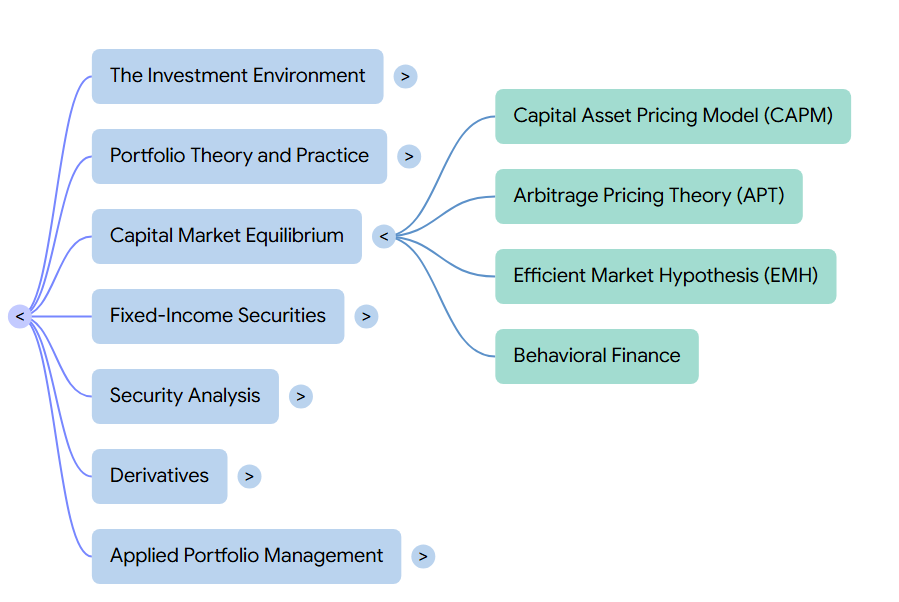
The book explores capital market equilibrium through several foundational frameworks:
The Capital Asset Pricing Model (CAPM)
The CAPM is the centerpiece of equilibrium theory in the book, providing a precise prediction of the relationship between an asset’s risk and its expected return.
- The Market Portfolio: In equilibrium, all investors arrive at the same optimal risky portfolio, which must be the market portfolio—a value-weighted portfolio of all assets in the investable universe.
- The Reward for Risk: The equilibrium risk premium on the market portfolio is determined by the “market price of risk,” which is proportional to both the variance of market returns and the degree of risk aversion of the average investor.
- The Security Market Line (SML): This graphical representation of the expected return–beta relationship shows that, in equilibrium, all securities should offer a “fair” return commensurate with their systematic risk (beta).
- The Zero-Alpha Prediction: A central tenet of the CAPM is that in equilibrium, the alpha (excess return beyond the fair risk premium) for every stock should be zero. If a stock offers a positive alpha, investors will bid up its price until the expected return falls to a level consistent with its risk.
Arbitrage Pricing Theory (APT) and No-Arbitrage
While the CAPM relies on the assumption that all investors are mean-variance optimizers, the APT builds its equilibrium on the “no-arbitrage condition”.
- The Law of One Price: This fundamental principle states that if two assets are equivalent in all economically relevant respects, they must have the same price.
- Arbitrage Activity: If mispricing occurs, arbitrageurs will simultaneously buy the cheap asset and sell the expensive one. These large-scale, zero-net-investment positions exert immediate pressure on prices, quickly restoring equilibrium without the need for a large number of investors to act.
The Efficient Market Hypothesis (EMH)
The EMH characterizes equilibrium in terms of informational efficiency.
- Information Reflection: In an efficient market, security prices fully and rapidly reflect all available information concerning the value of the security.
- Random Walk: Because prices in equilibrium only change in response to new (and therefore unpredictable) information, price changes must follow a “random walk”.
- The “No-Free-Lunch” Theme: A unifying theme of the book is that well-developed markets are “nearly efficient,” meaning that obvious bargains or “free lunches” are rare.
Real-World Refinements
The book acknowledges that the theoretical ideal of equilibrium is often complicated by real-world factors:
- Liquidity: Investors demand higher average returns for holding less-liquid securities, meaning the “illiquidity premium” modifies the standard equilibrium relationships.
- Systemic Risk: The 2008 financial crisis illustrated that equilibrium can be fragile; a breakdown in one market can spill over and disrupt others, demonstrating the importance of transparency and stability in the financial environment.
- Behavioral Biases: Psychological factors and “limits to arbitrage” (such as fundamental risk or model risk) can prevent prices from immediately reaching their intrinsic values, allowing mispricing to persist longer than traditional models predict.
Capital Asset Pricing Model (CAPM)
In the larger context of capital market equilibrium, the book describes the Capital Asset Pricing Model (CAPM) as a foundational set of predictions regarding the relationship between an asset’s risk and its expected return. It serves as a benchmark for evaluating possible investments and helps estimate the required rates of return for assets not yet traded.
The Nature of Equilibrium in the CAPM
The CAPM envisions an equilibrium state where security prices have adjusted so that the market portfolio is the unique mean-variance efficient portfolio. This equilibrium is maintained through several key mechanisms:
- The Market Portfolio: Because the CAPM assumes all investors use the same input list (homogeneous expectations), they all identify the same optimal risky portfolio. In equilibrium, this must be the market portfolio—a value-weighted portfolio of all assets in the investable universe.
- The Zero-Alpha Prediction: A central tenet of the book is that in equilibrium, the alpha (the difference between a stock’s actually expected return and its fair return) for every stock should be zero. If a stock offers a positive alpha, investors will bid up its price until the expected return falls to a level consistent with its risk.
- Efficiency of Passive Strategies: In the equilibrium of the CAPM, the market portfolio is the tangency portfolio on the efficient frontier. Consequently, the book notes that a passive strategy (holding the market index and T-bills) is efficient, as beating the market would require differential insight that is hard to find in a competitive environment.
The Expected Return–Beta Relationship
The book identifies the Security Market Line (SML) as the graphical representation of capital market equilibrium.
- Systematic vs. Firm-Specific Risk: The CAPM predicts that only systematic risk (risk that cannot be diversified away) will be rewarded with a risk premium. In equilibrium, firm-specific risk should not be priced because it can be eliminated through diversification.
- Beta as the Measure of Risk: The appropriate measure of risk in equilibrium is beta, which measures a security’s sensitivity to market movements or its contribution to the variance of the overall market portfolio.
- The Reward for “Worrying”: The total expected rate of return is the sum of the risk-free rate (compensation for the time value of money) and a risk premium (compensation for systematic risk). This risk premium is directly proportional to both the asset’s beta and the risk premium of the market portfolio.
Extensions and Equilibrium Refinements
While the simple CAPM provides a starting point, the book acknowledges several extensions that refine the state of market equilibrium:
- Zero-Beta Model: When risk-free borrowing is restricted, the equilibrium relationship is modified, and the SML typically becomes flatter than predicted by the basic model.
- Multifactor Equilibrium (ICAPM): In a multi-period world where investors seek to hedge extra-market risks (like inflation or interest rate changes), the equilibrium gives way to a multifactor version of the SML.
- Consumption CAPM (CCAPM): This model suggests that equilibrium should be centered on aggregate consumption rather than wealth, relating risk premiums to a “consumption-tracking portfolio”.
- Liquidity Effects: In real-world equilibrium, investors demand higher returns as compensation for illiquidity costs and the risks associated with those costs.
Ultimately, the book characterizes the CAPM as a powerful, if simple, model of equilibrium that remains in wide use despite empirical shortcomings because it highlights the fundamental distinction between systematic and diversifiable risk.
Arbitrage Pricing Theory (APT)
In the larger context of capital market equilibrium, the book describes arbitrage pricing theory (APT) as an alternative framework to the CAPM for predicting the relationship between an asset’s risk and its expected return. Developed by Stephen Ross, the APT builds its equilibrium on the foundation of the “no-arbitrage condition,” which posits that in a rational market, risk-free profit opportunities cannot persist.
The Mechanism of Equilibrium: Arbitrage vs. Dominance
The book highlights a fundamental difference in how APT and the CAPM explain the restoration of market equilibrium:
- The Law of One Price: This principle, central to the APT, states that if two assets are equivalent in all economically relevant respects, they must have the same price.
- Arbitrage Activity: An arbitrage opportunity arises when an investor can earn riskless profits without making a net investment. If mispricing occurs, arbitrageurs simultaneously buy the cheap asset and sell the expensive one. Because these positions are riskless, investors will pursue them on an “infinitely large scale,” exerting immediate pressure on prices until the opportunity vanishes.
- Dominance Arguments (CAPM): In contrast, the CAPM relies on a “dominance argument” where equilibrium is restored by a large number of mean-variance optimizers making small, limited changes to their portfolios. The book notes that implications derived from no-arbitrage arguments are considered “stronger” because they only require a few aggressive players to mobilize large dollar amounts to restore equilibrium prices.
Well-Diversified Portfolios and Factor Risk
The APT relies on three key propositions: security returns can be described by a factor model, there are enough securities to diversify away idiosyncratic risk, and arbitrage opportunities are ruled out.
- Pure Plays: For a “well-diversified” portfolio, the book explains that firm-specific (nonsystematic) risk is negligible, meaning its return is determined completely by systematic macro factors.
- The SML Relationship: To preclude arbitrage, all well-diversified portfolios with the same sensitivity to macro factors (beta) must have the same expected return. This requirement establishes that risk premiums must be proportional to beta, arriving at a security market line (SML) identical to that of the CAPM in a single-factor world.
Multifactor Equilibrium
While the simple CAPM is a single-index model, the APT is easily generalized to a multifactor APT to accommodate multiple sources of systematic risk, such as unanticipated changes in GDP, interest rates, or inflation.
- Factor Portfolios: The benchmark for equilibrium in a multifactor world is a set of “factor portfolios,” which are well-diversified portfolios constructed to have a beta of 1 on one specific factor and a beta of zero on all others.
- Multidimensional SML: The total risk premium for a security is predicted to be the sum of the risk premiums required for each source of systematic risk to which it is exposed.
Comparison with the CAPM
The book identifies several advantages and limitations of the APT relative to the CAPM:
- Appealing Assumptions: The APT is seen as more appealing because it does not require the CAPM’s restrictive assumptions that all investors are mean-variance optimizers or that a single, unobservable “market portfolio” of all assets exists. Instead, it can use broad, observable index portfolios as benchmarks.
- Scope of Application: A major shortcoming of the APT is that it only guarantees the expected return–beta relationship for well-diversified portfolios and “almost all” individual securities. It cannot strictly rule out a violation of the SML for any single specific asset, whereas the CAPM provides an “unequivocal statement” for all securities.
- Factor Identification: Unlike the CAPM, which specifies the market portfolio as the unique risk factor, the APT provides no guidance on which specific macroeconomic factors should be included in the model. This has led to the emergence of “empirically based” factors, such as those in the Fama-French three-factor model.
Efficient Market Hypothesis (EMH)
In the larger context of capital market equilibrium, the book presents the Efficient Market Hypothesis (EMH) as the characterization of a market where security prices fully and rapidly reflect all available information concerning an asset’s value. This state of equilibrium is maintained by a highly competitive environment where thousands of analysts constantly search for mispriced assets; their collective actions drive prices toward “fair” levels where expected returns are exactly commensurate with risk.
The Core Logic: Random Walks
A central tenet of the EMH is that if prices already reflect all current knowledge, they can only change in response to new information. Because new information is by definition unpredictable, price changes must follow a random walk. The book emphasizes that randomness in price changes is actually a sign of market rationality and efficiency, rather than irrationality.
The Three Forms of Efficiency
The book distinguishes among three versions of the EMH, which differ based on the definition of “all available information”:
- Weak-Form: Asserts that stock prices reflect all information derived from past trading data, such as history of prices and trading volume.
- Semistrong-Form: States that prices reflect all publicly available information, including fundamental data on product lines, quality of management, and earnings forecasts.
- Strong-Form: Asserts that prices reflect all relevant information, including information available only to company insiders. The book notes this version is extreme, as insiders can often profit before information becomes public, though such activity is regulated.
Implications for Investment Strategy
The EMH has profound implications for how participants behave in the investment environment:
- Technical Analysis: The book argues that if weak-form efficiency holds, technical analysis (searching for patterns in past prices) is fruitless because any such signals are already impounded in prices.
- Fundamental Analysis: Similarly, if semistrong-form efficiency holds, fundamental analysis is only profitable if an analyst has unique insights that are superior to the consensus, as common information is already reflected in the market price.
- Active vs. Passive Management: EMH proponents generally advocate for passive investment strategies, such as index funds, which offer broad diversification at extremely low costs. Active management is viewed as a largely wasted effort because competitive pressure makes finding “free lunches” nearly impossible.
- The Role of the Portfolio Manager: Even in a perfectly efficient market, the book identifies a vital role for portfolio managers: tailoring a diversified portfolio to meet a client’s specific needs regarding risk aversion, taxes, and life-cycle constraints.
Challenges to Efficiency: Anomalies and Bubbles
The book acknowledges that the EMH is a matter of ongoing debate and presents several “anomalies” that appear to contradict it:
- Market Anomalies: These include the small-firm effect, the book-to-market effect, and momentum. While these may represent market inefficiencies, the book notes they could also be viewed as risk premiums for factors not captured by simple models like the CAPM.
- Speculative Bubbles: Historical episodes like the “tulip mania” or the dot-com boom of the late 1990s suggest that prices can sometimes depart dramatically from intrinsic value, driven by “irrational exuberance”.
- Limits to Arbitrage: Behavioral finance theorists argue that even when mispricing is obvious, “limits to arbitrage”—such as fundamental risk or implementation costs—can prevent rational traders from immediately forcing prices back to fair value.
Ultimately, the book concludes that well-developed security markets are “nearly efficient“. While obvious bargains are rare, the very competition that maintains efficiency ensures that profit opportunities exist for the most diligent and creative investors.
Behavioral Finance
In the larger context of capital market equilibrium, the book describes behavioral finance as a critical alternative to conventional financial theory, which typically assumes all investors are rational mean-variance optimizers. While traditional models like the Capital Asset Pricing Model (CAPM) envision an equilibrium where security prices match intrinsic values due to intense competition, behavioral finance argues that human irrationality can cause prices to deviate from these “fair” levels.
Challenging the Rational Equilibrium
The behavioral critique of market equilibrium rests on two main legs:
- Information-Processing Errors: The book notes that real investors often fail to process information correctly, leading them to infer incorrect probability distributions for future returns. These errors include overconfidence in one’s own abilities, conservatism (being too slow to update beliefs), and representativeness bias (inferring a pattern too quickly from a small sample).
- Behavioral Biases: Even with correct information, investors often make systematically suboptimal decisions. The book identifies biases such as framing (where choices are affected by how they are described), mental accounting (segregating decisions into different “mental layers”), and regret avoidance (avoiding unconventional decisions that might lead to more self-blame if they turn out poorly).
Limits to Arbitrage
A central tenet of traditional equilibrium theory is that mispriced securities are quickly corrected by rational arbitrageurs. However, the book argues that several factors, known as “limits to arbitrage,” prevent this corrective action from being fully effective:
- Fundamental Risk: The book explains that even if an asset is mispriced, attempting to exploit it is risky because the mispricing can widen before it corrects, potentially bankrupting the investor in the interim.
- Model Risk: Arbitrageurs must always worry that their valuation models are faulty and that the “apparent” mispricing is not real.
- Implementation Costs: Frictions such as transaction costs and difficulty in short-selling certain securities (like the Palm/3Com carve-out example) can prevent arbitrage from restoring the Law of One Price.
Impact on Market Efficiency and Asset Pricing
Behavioral finance suggests that because of these limits, mispricing can survive even if some rational investors try to exploit it. This challenges the first implication of the Efficient Market Hypothesis (EMH)—that prices are always “right”—by suggesting that market sentiment can drive speculative bubbles, such as the dot-com boom or the 2008 housing crisis, where prices depart dramatically from intrinsic value.
Furthermore, the book suggests that behavioral factors may explain various market anomalies. For instance, momentum in stock prices might be driven by the “disposition effect” (the tendency to hold onto losers to avoid realizing a paper loss) or investor overconfidence. Similarly, the “value premium” might reflect a risk premium for “out-of-favor” stocks that investors avoid due to regret avoidance.
Practical Implications for Investors
Despite the critique of market efficiency, the book notes that behavioral finance often leads to similar policy conclusions as the EMH. Because beating the market is extremely difficult even if prices are “wrong,” many behavioral advocates still recommend passive, indexed strategies as a way for investors to avoid their own behavioral minefields. Simultaneously, the existence of slow-moving price adjustments to fundamentals provides the theoretical motivation for technical analysis, which attempts to exploit these behaviorally induced patterns.
— Linden Lake
This series:
→ Book Review (1 of 7): Investments – The Investment Environment
→ Book Review (2 of 7): Investments – Portfolio Theory and Practice
→ Book Review (3 of 7): Investments – Capital Market Equilibrium
→ Book Review (4 of 7): Investments – Fixed-Income Securities
→ Book Review (5 of 7): Investments – Security Analysis
→ Book Review (6 of 7): Investments – Derivatives
→ Book Review (7 of 7): Investments – Applied Portfolio Management
Leave a Reply