
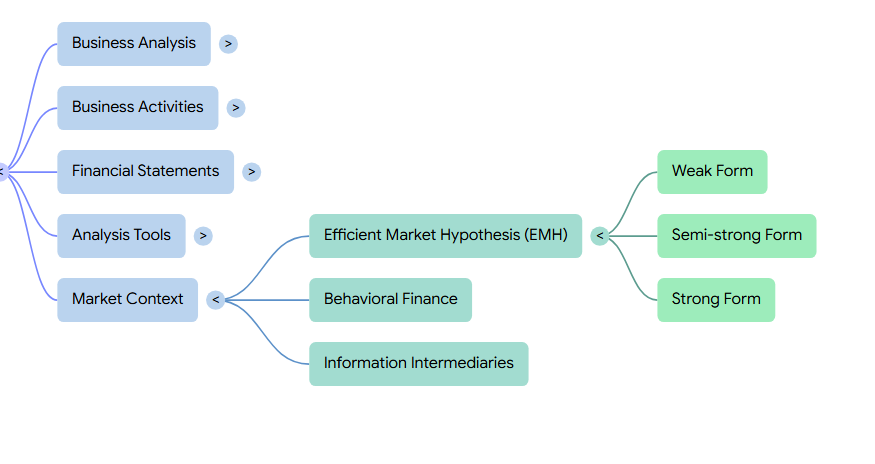
In the book, the market context is presented as the essential environment that both surrounds and competes with financial statement analysis. While financial statements are a primary source of information, their utility is defined by how they interact with external economic forces, alternative information sources, and the mechanics of market efficiency.
The Reporting Environment and Alternative Information
The book identifies that financial statements do not exist in a vacuum but compete with a variety of alternative information sources that are often more timely and forward-looking.
- Economic, Industry, and Company News: Investors use macroeconomic data—such as economic growth, interest rates, and trade balances—to update company-specific forecasts.
- Information Intermediaries: Security analysts and credit agencies synthesize diverse raw information into forecasts and recommendations, often moving faster than the periodic release of financial statements.
- Voluntary Disclosures: Management may release information outside of statutory reports to manage market expectations or signal “good news” to the market.
- The Feedback Role: The book notes that much of the stock price reaction to financial news occurs upon the initial earnings announcement rather than the later release of full statements, meaning accounting information often serves a “feedback role” to confirm or revise prior beliefs already held by the market.
Market Efficiency (EMH)
A critical aspect of market context discussed in the book is the Efficient Market Hypothesis (EMH), which deals with how market prices react to information.
- Forms of Efficiency: The book describes three forms: weak (prices reflect historical price movements), semistrong (prices reflect all public information), and strong (prices reflect all information, including inside info).
- The Analyst Paradox: The book highlights a paradox where analysts are assumed to keep the market efficient through their work, yet the theory implies they cannot earn excess returns from those same efforts.
- Interpretation vs. Information: The book argues that market efficiency depends not just on the availability of information, but on its correct interpretation. Competent analysis requires an “information mosaic” to fit new data into a meaningful interpretation of a company’s position.
Market Risks and External Forces
Market context also involves external risks that can fundamentally alter a company’s financial health, regardless of internal management.
- Specific Market Risks: Companies are exposed to fluctuations in commodity prices, foreign currency exchange rates, and interest rates.
- Management Response: To mitigate these risks, companies use derivative financial instruments such as futures, options, and swaps as hedges.
- Industry Drivers: The book emphasizes that a company’s profitability is largely driven by its industry structure—such as the bargaining power of consumers and the threat of substitute products—requiring an interdisciplinary perspective for effective business analysis.
Impact on Analysis and Valuation
The book stresses that the market context directly influences specific analytical tasks, particularly forecasting and valuation.
- Forecasting Sales: Projecting the income statement requires incorporating the expected level of macroeconomic activity and the competitive landscape.
- Value Driver Reversion: In equilibrium, competitive forces tend to drive a company’s Return on Equity (ROE) toward the cost of capital as abnormal profits are “competed away”.
- The Business Cycle: Earning power is best measured over an entire business cycle to avoid the distortions of a single year’s results.
Ultimately, the book positions financial statement analysis as a collection of analytical processes within a broader framework of business analysis, which must always consider the company’s economic and industry circumstances to be meaningful.
Efficient Market Hypothesis (EMH)
In the book, the Efficient Market Hypothesis (EMH) is a central pillar of the market context, dealing with how stock prices react to financial and other information. It serves as a competitive benchmark for financial statement analysis, as extreme proponents of EMH suggest that if all information is instantly reflected in prices, then the rewards of detailed analysis are minimal.
Three Forms of EMH
The book describes three common forms of market efficiency, each defined by the type of information already incorporated into prices:
- Weak Form: Asserts that current prices fully reflect all information contained in historical price movements.
- Semistrong Form: Asserts that prices fully reflect all publicly available information, such as financial statements and news announcements.
- Strong Form: Asserts that prices reflect all information, including non-public or “inside” information.
The Analyst Paradox
The book highlights an inherent paradox within EMH: it assumes that competent, well-informed analysts using tools of analysis keep the market efficient by evaluating and acting on new data. However, the theory simultaneously implies that these same analysts cannot earn excess returns from their efforts because the information is already “priced in”. The book argues that the very speed and efficiency of the market are evidence of these analysts at work, motivated by the hope of personal rewards.
Information vs. Proper Interpretation
A critical distinction made in the book is that while information may be available, its proper interpretation is not guaranteed. Market efficiency depends not just on the availability of data but on the aggregate market’s ability to evaluate it correctly. Competent analysis requires:
- A Sound Knowledge Base: Understanding the technicalities of accounting and finance.
- An Information Mosaic: The ability to fit separate pieces of new data into a meaningful whole to evaluate a company’s true position.
Research Anomalies and Inefficiencies
While early evidence strongly supported EMH, the book notes that more recent research has uncovered “anomalies” suggesting the market is not always perfectly efficient. These include:
- Calendar Patterns: Such as the “January effect,” where stock prices (especially for small companies) increase abnormally in that month.
- Valuation Anomalies: Findings that stocks with low price-to-earnings or price-to-book ratios often outperform those with high ratios.
- Post-Earnings Announcement Drift: The phenomenon where stock prices continue to “drift” in the direction of an earnings surprise for months after the announcement.
- Size Effects: The book notes that markets for larger companies are generally more efficient because they are followed by more analysts than smaller, less prominent firms.
Ultimately, the book positions EMH within the market context not as an absolute truth, but as a “first approximation”. It emphasizes that while the market is frequently efficient, a proficient analyst who can create a superior “information mosaic” can still identify undervalued or overvalued securities.
Weak Form
In the book, the weak form is identified as one of the three common levels of the Efficient Market Hypothesis (EMH), which describes how market prices react to information.
Definition and Core Assertions
The weak form of EMH asserts that current stock prices fully reflect all information contained in historical price movements. Under this hypothesis, the following conditions are assumed to exist:
- No Predictable Patterns: Stock prices are “serially uncorrelated,” meaning there are no predictable patterns in prices that can be exploited for profit.
- Futility of Technical Analysis: Because all historical data is already “priced in,” the book suggests that using past price or volume history to predict future movements—a practice known as technical analysis or charting—should not consistently yield excess returns.
Evidence and Support
The book notes that early research in the United States provided a wealth of evidence suggesting that markets were indeed weak-form efficient. Proponents of this view point to the fact that stock prices seem to respond rapidly to new information and that investment managers, on average, struggle to consistently outperform market indexes like the S&P 500.
Weak Form Inefficiencies and Anomalies
Despite early support, the book highlights that more recent research has uncovered several “anomalies” that suggest the market exhibits some weak-form inefficiency. These systematic patterns include:
- Calendar Patterns: The most famous is the January effect, where stock prices, particularly those of smaller companies, tend to increase abnormally during that month.
- Time-of-Year Effects: Research cited in the book indicates that returns on the Dow Jones Industrial Average for the six months from November through April have historically been more than four times higher than for the other six-month period.
- Day-of-the-Week Patterns: Data shows that stock returns often vary by day; for example, Monday is frequently the worst-performing day, while Wednesday and Friday tend to be the best.
Ultimately, while the book acknowledges that current stock prices are a “reasonable first approximation” of company value, it cautions that blind faith in weak-form efficiency may be misplaced due to these documented irrationalities and emotional factors in the market.
Semi-strong Form
In the book, the semistrong form of the Efficient Market Hypothesis (EMH) is defined as the assertion that stock prices fully and immediately reflect all publicly available information. This includes financial statements, earnings announcements, dividend changes, and any other data released to the public.
Core Assertions and Support
The semistrong form suggests that because all public data is already “priced in,” an investor cannot consistently earn excess returns by simply analyzing public records or financial reports. The book notes that:
- Rapid Response: Markets typically respond with extreme speed to new information, such as earnings surprises or changes in dividend policy.
- Informational Filtering: The market appears to “filter” information, making it difficult for companies to fool investors with purely cosmetic accounting changes (such as switching between LIFO and FIFO) that have no real economic impact.
- Manager Performance: A primary piece of evidence cited in the book for semistrong efficiency is the “dismal performance” of investment managers, the majority of whom fail to consistently outperform market indexes like the S&P 500.
The Role of Interpretation
A critical distinction made in the book is that market efficiency depends not only on the availability of information but on its proper interpretation. Even if data is public, a security can be under- or overvalued if the aggregate market incorrectly evaluates that data. This creates a role for the proficient analyst who can build an “information mosaic”—fitting separate pieces of new data into a meaningful whole to reveal a company’s true financial position.
Documented Inefficiencies and Anomalies
Despite early support for the semistrong form, the book highlights several research “anomalies” that suggest the market is not always perfectly efficient at processing public data:
- Valuation Ratios: Evidence suggests that “value-based” strategies—such as buying stocks with low price-to-earnings (P/E) or low price-to-book (P/B) ratios—can sometimes outperform the broader market.
- Post-Earnings Announcement Drift (PEAD): This is one of the best-known accounting anomalies, where the stock prices of companies with good or bad earnings news continue to “drift” in that same direction for months after the public announcement.
- Accrual Manipulations: Recent research cited in the book suggests that a strategy of buying stocks with low accruals and selling those with high accruals can “beat the market,” indicating that investors may sometimes be “fooled” by accrual-based accounting distortions.
- Model-Based Valuation: The book notes that the residual income valuation model has shown an ability to identify over- and undervalued stocks, suggesting that fundamental analysis can still find market mispricings.
Ultimately, while the book views the semistrong form of EMH as a “reasonable first approximation” of how markets work, it concludes that the proliferation of these anomalies suggests that “blind faith in market efficiency is misplaced”.
Strong Form
In the book, the strong form is identified as the most extreme of the three common levels of the Efficient Market Hypothesis (EMH), which describes how market prices react to information .
Definition and Scope
The strong form of EMH asserts that current stock prices fully reflect all information, whether it is publicly available or not . This means that prices are assumed to incorporate:
- Historical price movements (Weak Form) .
- All publicly available information, such as financial statements and earnings news (Semistrong Form) .
- Inside (private) information known only to company insiders or specific individuals .
Under this hypothesis, even those with “inside” information would be unable to earn consistent excess returns because that information is already “priced in” by the market .
Market Validity and Evidence
While the book notes that there is significant evidence supporting the weak and semistrong forms of efficiency in U.S. markets, it explicitly states that “no one maintains that markets are strong form efficient” .
The rejection of the strong form is supported by several factors mentioned in the book:
- Analyst Performance: The book attributes the very speed and efficiency of the market to the work of proficient analysts motivated by personal rewards, implying that those with superior knowledge or better interpretation of data can indeed identify value gaps.
- Behavioral Paradigms: The rise of behavioral finance suggests that markets are prone to emotional factors and irrationalities, which contradicts the idea that all information (especially private info) is perfectly and immediately processed into prices.
- Information Mosaic: The book argues that market efficiency depends on the proper interpretation of data. Proficient analysts who can build a superior “information mosaic” from various data points can identify mispriced securities, a feat that would be impossible if the strong form held true.
Ultimately, while the book views current stock prices as a “reasonable first approximation” of a company’s value, it positions the strong form of EMH more as a theoretical benchmark than a reflection of real-world market behavior.
Behavioral Finance
In the book, behavioral finance is presented as an alternative paradigm to the Efficient Market Hypothesis (EMH), arising from research that has uncovered numerous market “anomalies” and systematic patterns of inefficiency. While EMH generally assumes that market prices react rationally and rapidly to new information, behavioral finance suggests that markets are frequently prone to irrationalities and emotion.
Context within Market Efficiency
The book positions behavioral finance as a response to the growing body of evidence that contradicts the more extreme versions of market efficiency. Key factors within this context include:
- Challenge to Rationality: Unlike the EMH, which relies on the aggregate behavior of rational investors to set fair prices, behavioral finance highlights that human emotion and cognitive biases can lead to mispricing.
- Explaining Anomalies: The book notes that while the market is often a reasonable approximation of value, systematic patterns—such as “calendar effects” (e.g., the January effect), day-of-the-week trends, and the “post-earnings announcement drift”—suggest that information is not always processed perfectly or instantaneously.
- Limitations of Blind Faith: The book explicitly states that the proliferation of these findings suggests that “blind faith in market efficiency is misplaced”.
Implications for Financial Statement Analysis
Within the broader market context, the existence of behavioral factors creates a vital role for the financial statement analyst. The book argues that if markets were perfectly efficient at all times, detailed analysis would be futile. However, because human irrationality can cause prices to deviate from intrinsic value, a proficient analyst can add value by:
- Creating an Information Mosaic: Using a sound knowledge base to fit separate pieces of new data into a meaningful interpretation that the aggregate market may have missed.
- Exploiting Mispricing: Identifying undervalued or overvalued securities when the market incorrectly evaluates public information.
- Recognizing Selective Efficiency: The book points out that certain market segments, such as those for smaller, less prominent companies, may be less efficient because they are followed by fewer analysts, leaving more room for behavioral biases to impact price.
Ultimately, while the book views market prices as a “reasonable first approximation” of value, it uses behavioral finance to remind readers that the market is frequently, but not always, efficient.
Information Intermediaries
In the book, information intermediaries are defined as an industry involved in collecting, processing, interpreting, and disseminating information about the financial prospects of companies. Within the larger reporting environment, they play a unique and vital role as both a sophisticated group of financial statement users and the most significant source of alternative information for the market.
Types and Functions of Intermediaries
The book identifies several key players in this industry, including security analysts, investment newsletters, investment advisers, and debt raters. It distinguishes between two primary types of security analysts:
- Buy-Side Analysts: Employed by investment companies or pension funds (such as Vanguard or Fidelity) to conduct analysis for internal use.
- Sell-Side Analysts: Provide research, forecasts, and recommendations to the public for a fee or to their firm’s clients.
These intermediaries create value by synthesizing raw data into a form useful for business decisions through four primary functions: information gathering, information interpretation, prospective analysis (forecasting earnings and cash flows), and making specific recommendations (e.g., buy, hold, or sell).
Competition with Financial Statements
In the context of the reporting environment, information intermediaries compete directly with statutory financial statements for investor attention. The book notes that intermediaries often offer advantages that financial statements lack:
- Timeliness and Frequency: Analysts update their forecasts on a near real-time basis as soon as new information becomes available, whereas financial statements are only released periodically.
- Forward-Looking Perspective: Intermediaries focus on future prospects and the “information mosaic,” while financial statements are largely historical and subject to recognition lags.
Because of this, the book suggests that the growth of the information intermediary industry has, in some respects, reduced the relative importance of periodic financial statements to capital markets.
Role in Market Efficiency
The book places information intermediaries at the center of the Efficient Market Hypothesis (EMH). This creates what the book calls the “analyst paradox”: the theory assumes that competent, well-informed analysts keep the market efficient by constantly acting on new data, yet it simultaneously implies that these same analysts cannot earn excess returns because their very efforts ensure information is already “priced in”.
Ultimately, the book argues that the speed and efficiency of the market are direct evidence of these analysts at work. They are motivated by personal rewards to expend the resources necessary to interpret complex data correctly, moving information from a proficient segment of users to the less-informed aggregate market.
— Linden Lake
This series:
→ Book Review (1 of 5): Financial Statement Analysis – Business Analysis
→ Book Review (2 of 5): Financial Statement Analysis – Business Activities
→ Book Review (3 of 5): Financial Statement Analysis – Financial Statements
→ Book Review (4 of 5): Financial Statement Analysis – Analysis Tools
→ Book Review (5 of 5): Financial Statement Analysis – Market Context
Leave a Reply