
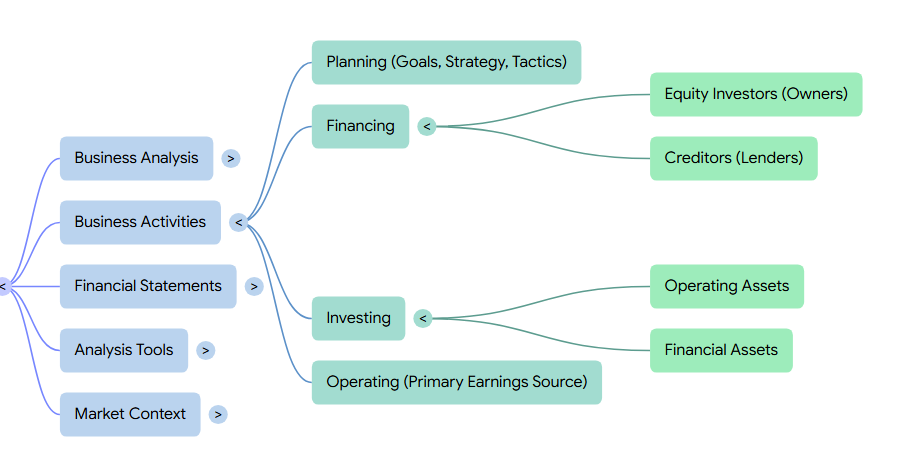
In the book, business activities are identified as the four core processes a company pursues to provide products or services and yield a return on investment: planning, financing, investing, and operating. Understanding these activities is presented as an essential prerequisite to effective financial statement analysis because the statements themselves are designed to report on these very functions.
The Four Major Business Activities
The book categorizes business activities as follows:
- Planning Activities: A company begins with specific goals and objectives, which are captured in a business plan describing its purpose, strategy, and tactics. For the analyst, insights into these plans—often found in the Letter to Shareholders or the Management’s Discussion and Analysis (MD&A)—help gauge the soundness of a company’s opportunities and estimate business risk.
- Financing Activities: To carry out its plan, a company must raise funds. The book identifies two primary external sources: equity investors (owners) and creditors (lenders). Creditors can be further divided into debt creditors, who provide direct loans, and operating creditors, such as suppliers or employees to whom the company owes money as part of its daily operations.
- Investing Activities: These refer to the acquisition and maintenance of assets for the purpose of selling products or providing services, as well as investing excess cash. The book distinguishes between operating assets (such as inventory, PPE, and patents) and financial assets (such as marketable securities).
- Operating Activities: This represents the “carrying out” of the business plan through research, procurement, production, marketing, and administration. Operating activities are a company’s primary source of earnings, and their success is measured by how efficiently a company manages its mix of these components to generate a return on its investment.
Financial Statements as a Reflection of Activities
Financial statement analysis is essentially the study of how these four activities are captured in reported numbers. The book explains that the statements report on these activities at different intervals:
- Point-in-Time Reporting: The balance sheet reports on the status of a company’s investing (assets) and financing (liabilities and equity) activities at a specific moment. It is based on the identity: Total Investing = Total Financing.
- Period-of-Time Reporting: The income statement, statement of cash flows, and statement of changes in shareholders’ equity summarize operating activities (and changes in financing/investing) over a period of time.
Integration and Articulation
A key concept in the book is the articulation of financial statements, meaning they are linked by design to explain the movement between point-in-time balance sheets through period-of-time operating results. For example, the statement of cash flows explains how all four activities—operating, investing, and financing—collectively changed the cash balance from the beginning to the end of a year.
The book’s pedagogical structure also mirrors these activities. The section on accounting analysis (Chapters 3 through 6) is organized specifically around financing (liabilities and equity), investing (assets), and operating (income) activities to show how to adjust reported numbers to better reflect the economic reality of each business function.
Planning (Goals, Strategy, Tactics)
In the book, planning activities are identified as one of the four major business activities—alongside financing, investing, and operating—that a company pursues to provide products or services and yield a return on investment. Planning is the foundational process where a company defines its goals and the methods it will use to achieve them.
Goals, Strategy, and Tactics in the Business Plan
The book explains that a company’s specific goals and objectives are formally captured in a business plan. This plan serves as a roadmap for management, consisting of three primary layers:
- Purpose and Goals: These are the high-level objectives the company seeks to implement. For example, the book notes that Colgate’s goals include delivering consistent business results and superior shareholder returns.
- Strategy: This refers to the overarching business decisions and the company’s approach to establishing a competitive advantage. Strategy analysis involves scrutinizing a company’s product mix and cost structure to identify growth potential.
- Tactics: These are the specific actions and maneuvers used to execute the broader strategy. Tactically, a company might focus on initiatives such as deploying consumer insights to develop products regionally before rolling them out globally.
The Role of Planning in Business Analysis
From the perspective of an analyst, understanding the planning activities is critical for several reasons:
- Structuring the Decision Task: Insight into the business plan helps an analyst gauge the soundness of a company’s business opportunities and strategies. It allows for an evaluation of whether a company’s tactical initiatives are aligned with its long-term goals.
- Identifying Opportunities and Obstacles: A well-articulated plan helps managers and analysts identify expected market demands, competitive threats, and potential obstacles.
- Forecasting and Risk Assessment: Planning is fraught with uncertainty—such as changes in consumer tastes or raw material costs. Financial statement analysis helps estimate the degree of risk associated with these plans, reducing reliance on “hunches” in favor of an evidence-based assessment of a company’s prospects.
Sources of Information for Planning Activities
The book highlights two primary sources within the financial reporting system where planning information is communicated:
- Management’s Discussion and Analysis (MD&A): This section is an excellent starting point for performing a business environment and strategy analysis, as management must highlight favorable or unfavorable trends and identify significant uncertainties affecting the company’s future.
- Letter to Shareholders: Also known as the Chairperson’s Letter, this provides qualitative information regarding company objectives, tactics, and sales strategies.
Ultimately, the book positions planning as the driver for the other business activities: a company must raise funds (financing) to carry out its plan, acquire assets (investing) to support its goals, and execute its daily functions (operating) to realize the profits envisioned in the original plan.
Financing
In the book, financing activities are identified as one of the four core business activities—alongside planning, investing, and operating—that a company pursues to provide products or services and generate a return on investment. Financing activities refer to the specific methods companies use to raise the money required to carry out their business plans, such as purchasing raw materials, paying employees, and funding research and development.
Primary Sources of External Financing
The book identifies two main external sources for raising funds:
- Equity Investors: These are the owners or shareholders of the company who provide financing in exchange for a share of the earnings. Their return on investment comes in two forms: earnings distribution (direct or indirect dividends) or earnings reinvestment (internal financing through retained earnings). Equity financing can be raised through private offerings to specific individuals or organizations, or through public offerings on organized stock exchanges.
- Creditors: These are lenders who provide funds in exchange for a promise of repayment with interest. The book distinguishes between two types: debt creditors, who provide direct financing through loans or securities like bonds; and operating creditors, such as suppliers, employees, or the government, to whom the company owes money as part of its daily operations. Unlike equity investors, creditors have a contractual right to be repaid with interest at specific future dates.
Strategic Impact and Risk
Decisions regarding the composition of financing activities are influenced by conditions in the financial markets and have significant implications for the company. These choices determine the company’s organizational structure, affect its potential for growth, and influence its exposure to risk. For example, a high proportion of debt in the capital structure can leverage returns for equity shareholders but also increases riskiness due to higher financial leverage. Conversely, equity capital is often viewed as a “cushion” or safeguard because equity holders have a residual interest, meaning they are the first to absorb losses in the event of liquidation.
Financial Statement Representation
Financing activities are primarily reflected on the balance sheet, which reports a company’s financing and investing status at a specific point in time. The accounting equation () represents the identity between a company’s total investing and its total financing. Specifically, the right-hand side of the balance sheet represents the sources of funds, distinguishing between creditor financing (liabilities) and owner financing (equity). The statement of cash flows and statement of shareholders’ equity further explain how these financing activities have changed over a period of time.
Equity Investors (Owners)
In the book, equity investors (also referred to as owners or shareholders) are identified as one of the two primary external sources of financing required for a company to execute its business plan. Equity capital is considered a fundamental component of a company’s capital structure, representing the funds provided by owners in exchange for the risks and rewards of ownership.
The Nature of Risk Capital
The book describes equity financing as “risk capital” because it acts as a safeguard or “cushion” for all other forms of senior financing, such as debt. Unlike debt capital, which must be repaid at specified times with periodic interest regardless of the company’s financial condition, equity capital is characterized by a degree of permanence and the absence of any mandatory repayment pattern or dividend requirements.
Residual Interest and Symmetric Risk
A defining characteristic of equity investors is that they hold a “residual interest” in the company. This has significant implications for their risk and return profile:
- Subordination: Equity holders are the most junior claimants; in the event of liquidation, they are the first to absorb losses and are only entitled to distributions after all senior claims, including interest and preferred dividends, are met.
- Unlimited Upside: While their potential for loss is typically limited to the amount invested, equity investors enjoy unlimited upside potential when a company prospers.
- Symmetric Analysis: Because they are affected by both downside risks and unlimited rewards, the book notes that equity analysis is “symmetric,” whereas credit analysis focuses primarily on downside risk.
Mechanisms for Return on Investment
The book explains that equity investors provide financing in the desire for a return, which represents their share of company earnings. This return is achieved through two primary methods:
- Earnings Distribution: The payment of dividends to shareholders, which can occur directly (cash or stock dividends) or indirectly (through stock repurchases).
- Earnings Reinvestment: Also called internal financing, this involves retaining earnings within the company for use in its business activities, thereby increasing the value of the owners’ stake.
Capital Structure and Financial Leverage
From a shareholder’s perspective, debt is often used as a supplement to equity to increase returns through financial leverage. Companies that use equity capital as a borrowing base to reap excess returns are said to be “trading on the equity“. While this can magnify earnings for owners in good years, it also increases the risk of loss during downturns if the return on net operating assets falls below the cost of debt.
Financial Statement Representation
On the balance sheet, owner financing is reflected as shareholders’ equity, which consists of contributed capital (funding invested by owners) and retained earnings (accumulated profits not yet distributed). The book emphasizes the accounting identity where total investing must always equal the sum of creditor financing and owner financing. Consequently, if a company is profitable, both its assets and its equity levels increase.
Creditors (Lenders)
In the book, creditors (or lenders) are identified as one of the two primary external sources of financing, providing the necessary funds for a company to execute its business plan, such as purchasing raw materials, paying employees, and funding research and development. Unlike equity investors, creditors have a contractual right to be repaid their principal with interest at specific future dates.
Classification of Creditors
The book distinguishes between two main types of creditors based on the nature of their relationship with the company:
- Debt (or Nontrade) Creditors: These provide direct financing to a company in exchange for a formal promise of repayment with interest. This includes public debt, such as bonds and debentures issued to the public, and private debt, such as loans from banks or other financial institutions.
- Operating (or Trade) Creditors: These are entities to whom the company owes money as part of its daily operations, such as suppliers for goods and services, employees for unpaid wages, or the government for taxes. Trade credit is typically short-term (30 to 60 days), and these creditors generally earn a return from the profit margins on the business transacted rather than through explicit interest.
Nature of the Creditor Relationship
The relationship between a company and its creditors is defined by several unique economic characteristics:
- Fixed Benefits: A creditor’s potential returns are usually limited to the contracted interest rate or the profit margins on goods delivered. Even if the company prospers significantly, the creditor does not share in the “upside” beyond these fixed amounts.
- Repayment Obligations: Debt is temporary financing that must be repaid regardless of the company’s financial condition. This differentiates it from equity, which has no mandatory repayment pattern.
- Asymmetric Risk: Creditors face an asymmetric risk-return profile; while their gains are capped, they bear the significant downside risk of default, where interest and principal may be jeopardized if the borrower encounters financial difficulties.
Creditor Protections
Because creditors are concerned with the risk of default, the book explains that they often utilize three primary mechanisms to protect their investments:
- Seniority: This refers to the order of payment during a company’s dissolution. Creditors are typically senior to equity holders, and certain “senior” debts may have priority over “junior” or “subordinated” debts.
- Security (Collateral): Creditors may require the company to set aside specific assets, such as inventory or real estate, to satisfy their claims in the event of default.
- Covenants: These are contractual provisions that either require management to take specific actions (affirmative covenants) or limit behaviors that might be harmful to lenders, such as excessive dividend payments or further borrowing (negative covenants).
Analytical Perspective for Lenders
From an analytical standpoint, creditors use credit analysis to evaluate a company’s creditworthiness, or its ability to pay its bills and honor its obligations. Because of their fixed return, the main focus of a creditor’s analysis is on downside risk—specifically liquidity (short-term cash needs) and solvency (long-term viability)—rather than overall profitability. Creditors view a company’s earnings primarily as a “cushion” or margin of safety for meeting these fixed commitments.
Investing
In the book, investing activities are identified as one of the four core business activities—alongside planning, financing, and operating—that a company pursues to provide products or services and generate a return on investment. These activities refer to a company’s acquisition and maintenance of resources used to support its business goals and the deployment of its excess cash.
Classification of Assets
The book distinguishes between two primary types of assets that result from investing activities:
- Operating Assets: These are resources acquired for the specific purpose of conducting a company’s business operations. Examples include tangible assets like land, buildings, equipment, and inventories, as well as “soft” assets like information systems, human capital (managers and employees), and legal rights such as patents, licenses, and copyrights.
- Financial Assets: These represent the temporary or permanent investment of excess cash in securities such as corporate and government bonds, other companies’ equity stock, and money market funds.
Categorization by Duration
Investing activities are further categorized based on the expected time frame for converting the resulting assets back into cash:
- Current Assets: These are short-term resources expected to be sold, collected, or used within one year or the operating cycle, whichever is longer. They include cash, cash equivalents, short-term receivables, and inventories.
- Noncurrent (Long-Term) Assets: These are resources expected to benefit the company for periods beyond the current period, such as property, plant, and equipment (PPE), and intangible assets.
Investing Decisions and Strategic Impact
The book emphasizes that investing decisions involve several factors, including the type of investment necessary, the amount required, the timing of acquisition, and the asset’s location. Like financing activities, these decisions determine a company’s organizational structure, affect its growth, and influence the overall riskiness of its operations.
A key takeaway from the book is that the size of an investment does not necessarily determine a company’s success. Instead, success is determined by the efficiency and effectiveness with which a company manages its assets to generate earnings and returns for its owners. For example, the book notes that Dell Inc. manages its operating activities with significantly fewer long-term operating assets than its competitors, freeing up cash for more productive purposes and reducing overhead costs like depreciation and maintenance.
Financial Statement Representation
Investing activities are primarily reflected on the balance sheet, which reports a company’s investing status at a specific point in time. The book highlights a fundamental accounting identity: Total Investing = Total Financing. This means that the total value of a company’s assets must always equal the sum of the financing obtained from creditors and owners. Changes in these investing activities over a period of time are summarized in the statement of cash flows, which separates cash inflows and outflows related to investing from those related to operating and financing.
Operating Assets
In the larger context of investing activities, the book defines operating assets as the resources a company acquires and maintains for the specific purpose of conducting its business operations and generating profit. While investing also includes the deployment of excess cash into financial assets, operating assets typically constitute the majority of an enterprise’s asset base.
Operating vs. Financial Assets
The book distinguishes between two primary types of assets resulting from investing activities:
- Operating Assets: These are resources used to produce and sell products or services, such as land, buildings, equipment, inventories, and “soft” assets like patents, copyrights, and information systems.
- Financial Assets: These represent the temporary or permanent investment of excess cash in securities like corporate bonds, other companies’ equity, or money market funds. Unlike operating assets, which are expected to yield returns exceeding the company’s weighted-average cost of capital, financial assets typically yield returns equal to their risk-adjusted cost of capital.
Categories by Duration
Within the investing framework, operating assets are further categorized by their expected life:
- Current (Short-term) Operating Assets: These are resources expected to be converted to cash, sold, or used within one year or the operating cycle. Key examples include accounts receivable and inventories.
- Noncurrent (Long-term) Operating Assets: These are resources expected to benefit the company for multiple periods, such as property, plant, and equipment (PPE) and various intangible assets.
Management and Efficiency
The book emphasizes that the mere size of an investment in operating assets does not determine success. Instead, performance is driven by the efficiency and effectiveness with which management utilizes these assets.
- Asset Productivity: Companies aim to minimize the investment in long-term operating assets required to generate a dollar of sales, thereby freeing up cash for more productive purposes and reducing overhead costs like maintenance and depreciation.
- The Dell Example: The book highlights Dell Inc. as a model of efficient operating asset management. By using a just-in-time manufacturing model, Dell carries significantly less inventory and fewer long-term operating assets than its competitors, which contributes to a higher return on equity.
Valuation Principles
Under traditional accounting rules, operating assets are usually reported on the balance sheet at historical cost. This involves a process of capitalization (putting the cost on the balance sheet) followed by allocation (systematically expensing the cost over the asset’s useful life through depreciation, amortization, or depletion). If the fair value of an operating asset falls below its carrying value, it is deemed impaired and must be written down.
Financial Assets
In the book, financial assets are defined as resources representing the temporary or permanent investment of excess cash in securities such as corporate and government bonds, other companies’ equity stock, and money market funds. Within the larger context of investing activities, the book distinguishes these from operating assets, which are acquired for the specific purpose of conducting a company’s central business operations.
Strategic Role and Returns
Investing activities involve both the acquisition of resources to support business goals and the deployment of excess cash into financial assets. The book notes a key distinction between these categories:
- Operating Assets: These are usually valued at cost and are expected to yield returns that exceed the company’s weighted-average cost of capital.
- Financial Assets: These are typically valued at fair (market) value and are expected to yield returns equal to their risk-adjusted cost of capital.
For most non-financial companies, these assets constitute a relatively minor share of total assets and are not considered an integral part of core operations. However, for financial institutions and insurance companies, investment securities are considered important operating assets.
Classification and Accounting
The book explains that the accounting for financial assets is determined by their classification, which is based on management’s intent and the degree of influence over the investee.
- Debt Securities: These are classified into three categories: Trading (purchased for short-term profit, reported at fair value with gains/losses in net income), Held-to-maturity (reported at amortized cost), and Available-for-sale (reported at fair value with unrealized gains/losses in comprehensive income).
- Equity Securities: These are classified based on ownership percentage: No Influence (under 20% holding, treated as trading or available-for-sale), Significant Influence (20% to 50%, requiring the equity method), and Controlling Interest (above 50%, requiring consolidation).
Analysis Implications
A primary objective when analyzing financial statements is to separate operating performance from investing (and financing) performance.
- Operating vs. Investing Income: The book stresses that an analyst should remove all gains and losses relating to financial assets—such as dividends, interest, and realized or unrealized gains—when evaluating a company’s true operating performance.
- Asset Categorization: When determining return on net operating assets (RNOA), financial assets should be excluded from the numerator and denominator to avoid distorting core performance measures.
- Evaluating Performance: The book suggests evaluating the performance of financial assets using a Return on Investment (ROI) metric based on fair values, comparing the realized ROI against a benchmark with a similar risk profile.
- Accounting Distortions: Analysts must be alert to “gains trading,” where management may sell securities with unrealized gains to boost net income while holding onto those with unrealized losses. For analysis purposes, the book recommends adjusting all investment securities, including those held-to-maturity, to their fair values on the balance sheet to reflect economic reality.
Operating (Primary Earnings Source)
In the book, operating activities are identified as one of the four core business activities—alongside planning, financing, and investing—that a company pursues to yield a return on investment. These activities represent the “carrying out” of the business plan and are described as a company’s primary source of earnings.
Nature and Components of Operating Activities
Operating activities encompass the earning-related functions of an enterprise, involving the company’s success in buying from input markets and selling in output markets. The book identifies at least five possible components of these activities:
- Research and Development
- Procurement
- Production
- Marketing
- Administration
Management is responsible for deciding on the most efficient and effective mix of these components to establish a competitive advantage. The success or failure of a company is largely determined by how well it devises its strategies and manages these daily business functions.
Financial Statement Representation
Operating activities are summarized over a period of time, typically a year or a quarter, rather than at a single point in time. They are reflected in two primary financial reports:
- Income Statement: This is the financial representation of a company’s operating activities for a period, with the “bottom line” net income purporting to measure the amount earned. These earnings are determined using the accrual basis of accounting.
- Statement of Cash Flows: This report summarizes the cash inflows and outflows specifically related to operating activities. Cash flow from operations provides a broader view than net income because it includes the cash demands of operating functions, such as investing in customer receivables and inventories, as well as the financing provided by suppliers.
Impact and Integration
Operating activities are inextricably linked to a company’s other business functions. A company must raise funds through financing to carry out its operating plan and acquire the necessary resources through investing. In turn, successful operating activities increase the company’s asset base and owner financing (equity) levels, while unprofitable operations cause them to decline.
From an analytical perspective, the book emphasizes that a company’s ability to generate cash from operations is vital to its long-term financial health, as no business survives in the long run without it. Analysts often relate these operating cash flows to net income to assess the quality of earnings and the sustainability of a company’s earning power.
— Linden Lake
This series:
→ Book Review (1 of 5): Financial Statement Analysis – Business Analysis
→ Book Review (2 of 5): Financial Statement Analysis – Business Activities
→ Book Review (3 of 5): Financial Statement Analysis – Financial Statements
→ Book Review (4 of 5): Financial Statement Analysis – Analysis Tools
→ Book Review (5 of 5): Financial Statement Analysis – Market Context
Leave a Reply