
In the book, Managing for Value represents the active, practical application of corporate valuation principles to the strategic decisions that executives face daily. While earlier sections construct the technical and accounting frameworks for measuring value, the book shifts its focus here toward managing that value. It asserts that managing for value is a long-term endeavor that prioritizes maximizing a company’s collective, intrinsic value to its shareholders, now and in the future, rather than chasing short-term metrics like earnings per share (EPS) or attempting to artificially pump up today’s share price.
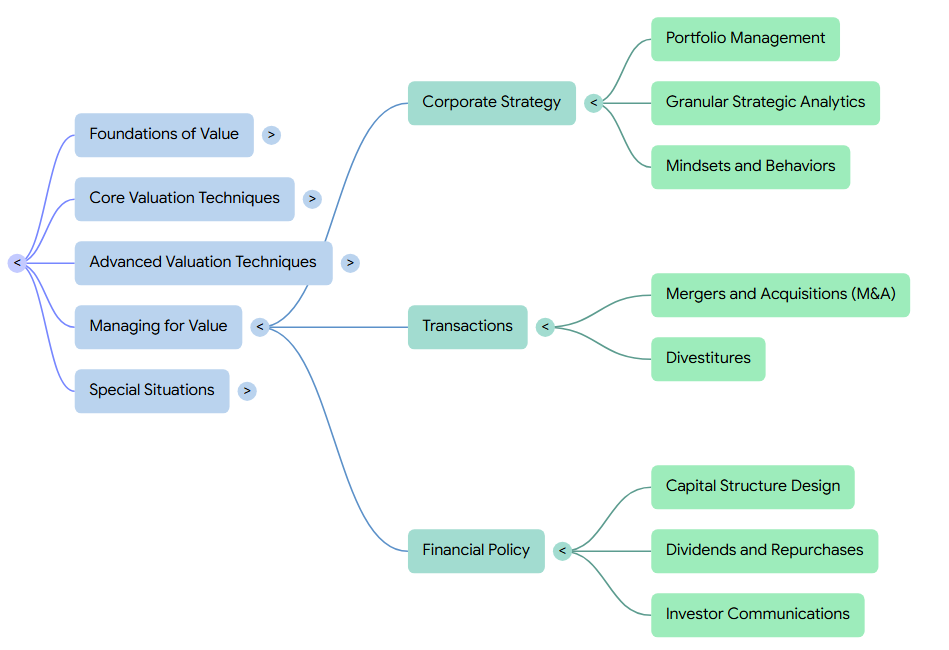
This strategic discipline is organized around five main pillars:
1. Corporate Portfolio Strategy and the “Best Owner” Principle
Deciding which businesses to operate is one of the most critical determinants of corporate destiny. The book highlights that:
- The Best Owner Principle: Value is maximized when a business is owned by the organization that can generate the highest cash flows and extract the most value from it. Because the optimal owner changes over a business unit’s life cycle, portfolios must be dynamically rebalanced.
- Active Over Passive Portfolio Management: Companies that systematically buy and sell businesses—pursuing programmatic acquisitions and proactive divestitures—generate significantly higher returns than those with passive portfolios.
- The Myth of Diversification: Holding a diversified portfolio of businesses solely to “smooth cash flows” does not create value. Instead, unnecessary diversification adds bureaucratic complexity and destroys value. High-performing diversified companies succeed only by acting like private-equity firms: enforcing rigorous capital allocation and maintaining a lean corporate center.
2. Strategic Management: Granular Analytics and Process Governance
Strategic management must be supported by a combination of rigorous analytics and supportive governance processes:
- Adopting a Granular Perspective: Corporate averages mask underperformance and pockets of value creation. Strategic planning should drill down to at least 20 to 50 granular segments or “value cells” to evaluate true performance.
- Taking an Enterprise View: Rather than allocating capital on a divisional or historical-inertia basis, companies should pool all investment proposals and rank them globally by risk-adjusted return. This enterprise-wide view helps mitigate the natural loss aversion of individual managers.
- Utilizing Value Driver Trees: To monitor long-term company health, managers must move beyond standard backward-looking financial metrics and track tailored short-, medium-, and long-term value drivers (such as brand strength, customer satisfaction, or product pipelines).
- Strong Governance & Debiasing: Successful management requires a long-term vision, aligned top-management incentives, and the courage to sustain long-term investments even during short-term profit dips. Decision-making processes must be systematically “debiased” to neutralize overoptimism and confirmation bias.
3. Mergers, Acquisitions, and Divestitures as Allocation Tools
In a dynamic economy, M&A and divestitures are the vital mechanisms for reallocating corporate resources:
- Thematic M&A: Successful acquirers do not buy targets randomly; they construct a programmatic deal pipeline centered around two or three explicit, strategic themes where they can act as the “best owner” and generate tangible synergies.
- Proactive Divestment: Selling a business unit that would be worth more to another owner is a strategic success, not a failure. The book warns managers to ignore short-term earnings dilution or size reductions resulting from divestitures, as the market values a company based on its cash-generating potential, not its absolute size.
4. Integrated Capital Structure and Payout Policies
Shaping a company’s financial profile is an integral part of its operating strategy:
- The Cash Deployment Hierarchy: Capital structure, debt, dividends, and share repurchases must be managed under a unified cash allocation plan. High-value-creating organic growth and acquisitions take top priority. Returning cash to shareholders via dividends or buybacks is a residual payout, appropriate only when no attractive investment opportunities exist.
- Maintaining Financial Flexibility: For their capital structures, large companies should target a solid investment-grade credit rating (between A+ and BBB-). Overleveraging to capture minor tax shields is a value-destroying trap, as the loss of flexibility in difficult times far outweighs the marginal efficiency gains of debt.
5. Intrinsic-Value Investor Communications
Finally, managing for value alters how a company interacts with the financial markets:
- Aligning Market and Intrinsic Value: The objective of investor communications is to align the stock price with management’s perspective of intrinsic value, preventing both overvaluation (which invites short-termism) and undervaluation (which invites hostile takeovers).
- Focusing on Intrinsic Investors: Rather than appealing to short-term traders, executives must focus their communications on intrinsic investors. These sophisticated, long-term investors support long-term strategies, value transparency, and prioritize long-term growth over short-term earnings misses.
- Abandoning EPS Guidance: Providing quarterly earnings (EPS) guidance does not improve valuations or reduce volatility, but it does encourage short-term manipulation. Instead, companies should provide range-based guidance on the operational value drivers shaping long-term cash flow.
This systematic approach ensures that corporate strategy is fully aligned with financial realities, enabling managers to build healthy, value-creating companies for the long term.
Corporate Strategy
In the book, corporate strategy is framed as the ultimate driver of a company’s long-term destiny. Within the larger context of managing for value, corporate strategy represents the active, analytical process of shaping a company’s business portfolio, allocating its resources, and aligning its internal organization to maximize long-term cash flows and economic value rather than chasing short-term accounting metrics.
The book structures this strategic discipline around several core pillars:
1. Corporate Portfolio Strategy and the “Best Owner” Principle
At the highest corporate level, strategy is defined by the fundamental decision of which businesses a company should own and operate. The book stresses that picking an attractive industry (the “horse”) is more critical to long-term value creation than relying solely on brilliant management (the “jockey”). However, value is fully maximized only when a business is owned by its best owner—the parent organization that can generate the highest cash flows and extract the most value from it.
According to the book, a parent company adds value and qualifies as the “best owner” by bringing specific, non-replicable advantages to a business unit:
- Unique Links with Other Businesses: Sharing physical infrastructure, raw materials, or marketing and distribution channels that duplicate and reduce costs. For example, General Mills dramatically increased Pillsbury’s operating profits by 70 percent after acquiring it from Diageo by sharing purchasing, manufacturing, and distribution, and leveraging its established sales presence in schools.
- Distinctive Skills: Applying superior functional or proprietary managerial capabilities, such as the famous Danaher Business System, to systematically improve the operating margins of acquired companies.
- Better Governance: Providing a stronger performance culture, replacing weak management quickly, and giving business leaders the freedom and long-term incentives to focus on a five-year horizon rather than short-term compliance.
- Better Insight and Foresight: Anticipating structural market shifts to incubate innovative ideas, such as Alibaba launching Alipay to resolve a lack of trust in online transactions.
- Distinctive Access to Stakeholders: Having unique relationships to secure capital, top talent, and regulatory approvals, which is highly advantageous for conglomerates operating in emerging markets.
Because a business unit matures and its competitive landscape shifts, the identity of its best owner changes over the best-owner life cycle. The book notes that a company must have a structured strategy process to test whether its business units have reached their “sell-by date” and proactively divest them to a new best owner.
2. Active Portfolio Management vs. the “Diversification Myth”
The book notes that outstanding corporate performance requires active portfolio management—proactively acquiring and divesting businesses. A McKinsey study cited in the book revealed that companies with a passive portfolio approach (holding on to businesses or only selling under pressure) systematically underperformed active portfolio managers.
Furthermore, the book debunks several common myths regarding corporate diversification:
- The Smoothing Fallacy: Diversifying into unrelated industries under the guise of “smoothing cash flows” or protecting against industry cycles does not create value. Investors can diversify their own personal stock portfolios much more cheaply and quickly than a corporation can reshape its real business portfolio.
- The TSR Constraint: Conglomerates actually “chop off” the top end of potential shareholder returns; none of the conglomerates in a cited study exceeded an annualized total shareholder return (TSR) of 20 percent, whereas focused firms topped out above 30 percent.
High-performing diversified conglomerates succeed only when they act as internal private-equity firms. They do this by establishing a lean corporate center, programmatically rebalancing their portfolios, and aggressively managing capital allocation globally—ensuring that all excess cash is transferred to the parent company to be sent where it is most productive.
3. Strategic Management: Operationalizing the Strategy (Analytics)
To prevent corporate strategy from becoming a static paper exercise, it must be supported by rigorous analytics:
- Adopting a Granular Perspective: Consolidated corporate or divisional averages mask pockets of severe value creation and destruction. The book recommends that corporate strategy be executed at a granular level, drilling down to 20 to 50 distinct segments or projects (valued around $50 million to $200 million each) rather than high-level divisions.
- Taking the Enterprise View: Resources must not be trapped within divisional silos. To maximize value, all investment proposals across the entire company should be pooled and ranked globally based on risk-adjusted expected return. This “enterprise view” actively counters corporate resource inertia and mitigates the extreme loss aversion of individual division managers.
- Tracking Long-Term Health Drivers: Corporate targets must move past short-term profits. Managers must track a tailored value driver tree that monitors short-term, medium-term, and long-term health metrics (such as customer churn, brand strength, product pipelines, and environmental/social criteria) to ensure today’s profits are not being generated by shortchanging the company’s future.
4. Overcoming Mindset Barriers and Biases
A major disconnect in corporate strategy is that strategic plans frequently fail to translate into actual budgets. The book cites a survey where only 30 percent of executives reported that their ultimate capital budget matched their strategic plan. To solve this, corporate leaders must build strong governance and debiased decision-making processes:
- Commitment to Long-Term Vision: CEOs and boards must have the courage to protect and sustain critical, long-term investments (like R&D or marketing) even when they depress short-term accounting profits or dilute near-term earnings per share (EPS).
- Challenging Biases: Strategic decisions are often hijacked by stability bias (inertia)—the tendency to fund business units in the exact same proportions year after year—as well as confirmation bias and overoptimism. The book advocates using formal debiasing techniques, such as assigning a devil’s advocate to depersonalize dissent, conducting pre-mortems to explicitly map out how a strategy might fail, and taking the “outside view” to benchmark forecasts against a statistical reference class of similar historic projects.
- In-Year Flexibility: Finally, companies should avoid rigid, static budgets by introducing stage-gating. Under a stage-gating framework, funding is released progressively as milestones are hit, allowing managers to quickly kill failing projects and reallocate resources to higher-value opportunities.
Portfolio Management
In the book, corporate portfolio strategy is defined by one fundamental question: What businesses should a company own?. Deciding which industries to operate in is one of the most vital strategic choices a senior executive makes, as a company’s market and competitive environment largely dictate its potential for value creation.
1. “The Horse vs. The Jockey” and the Best Owner Principle
To illustrate the relationship between business choice and management, the book references the classic question of whether to bet on the horse (the industry/competitive advantage) or the jockey (the management team). Venture capital research demonstrates that having a durable competitive advantage (the horse) is significantly more important than having a brilliant management team (the jockey); a strong business can survive a weak manager (who can always be replaced), but even extraordinary managers cannot turn a fundamentally weak industry structure with poor economics into a highly profitable winner.
However, for any given business, some parent organizations are far better positioned to extract cash flows and maximize value than others—a concept known as the “Best Owner” principle. A company qualifies as the best owner of a business unit by bringing specific, non-replicable advantages to it:
- Unique Links with Other Businesses: Sharing physical infrastructure, distribution channels, raw materials, or marketing departments to duplicate and eliminate redundant costs. For example, General Mills’ acquisition of Pillsbury from Diageo created $400 million in annual cash flow synergies by integrating Pillsbury’s refrigerated logistics with General Mills’ distribution.
- Distinctive Skills: Applying superior functional or proprietary managerial capabilities (such as the Danaher Business System) to radically improve the margins of acquired units.
- Better Governance: Replicating the performance culture of private equity, which includes replacing weak managers quickly, aligning incentives, and allowing business leaders to focus on a 5-year strategic horizon rather than short-term accounting metrics.
- Better Insight and Foresight: Spotting structural shifts early to incubate and fund new growth models (like Alibaba launching Alipay to facilitate online transaction trust).
- Distinctive Access to Stakeholders: Utilizing deep relationships to secure capital, top talent, and regulatory approvals, which is especially powerful for conglomerates in emerging markets where capital markets are less developed.
Because a business unit matures and its competitive landscape shifts, the identity of its best owner changes over the best-owner life cycle. Thus, the book stresses that a healthy corporate strategy must include a regular process to test whether existing business units have reached their “sell-by date” and should be divested to a new, better owner.
2. Active Portfolio Management vs. The Diversification Myth
To maximize long-term shareholder value, companies must engage in active (dynamic) portfolio management. A McKinsey study cited in the book of 200 large companies showed that passive players (who held on to businesses or only divested under outside pressure) systematically underperformed active portfolio managers who programmatically acquired and divested businesses. For instance, General Dynamics created immense value by divesting half its revenues during a defense downturn in the early 1990s, and then aggressively acquiring businesses once the industry stabilized.
The book strongly debunks the myth of corporate diversification, which historically attempted to justify holding unrelated businesses under a single corporate umbrella:
- The Smoothing Fallacy: Diversifying to “smooth cash flows” over different industry cycles does not create value. Investors can diversify their own personal portfolios much more cheaply and efficiently than a corporation can reshape its real-world business portfolio.
- The TSR Constraint: Conglomerates often “chop off” the top end of potential shareholder returns; none of the conglomerates in a cited study exceeded an annualized total shareholder return (TSR) of 20 percent, whereas focused firms topped out above 30 percent.
- The PE Model for Conglomerates: Diversified companies can succeed only if they act as internal private-equity firms. This requires a lean corporate center (focusing strictly on setting targets, monitoring results, and appointing leaders), aggressive capital allocation (taking all excess cash from mature units to send where returns are highest), and a complete lack of unnecessary corporate-wide bureaucracy.
3. A Systematic Framework for Constructing the Portfolio
To apply these principles, the book outlines a structured methodology to analyze and rebuild a corporate portfolio:
- Evaluate Business Units: Assess each unit using primary factors (market attractiveness, competitive advantage, best-owner advantage, expansion scope, and future inflection points) and secondary factors (risk impact on the parent, cash generation vs. consumption, absolute size, and management time required).
- Run Multi-Scenario Valuations: Value each business unit under four distinct scenarios:
- Baseline (Momentum) Case: Growth in line with underlying markets with no performance changes.
- Planned Operating Improvements: Value derived from raising margins and capital efficiency.
- Alternative Owners: What the unit would be worth to a strategic buyer who can capture higher synergies.
- New Growth Opportunities: Value added through future innovation or acquisitions.
- Execute Strategic Restructuring: Using these scenarios, management must make bold capital decisions. In the case study of Hexa Corporation, this systematic approach revealed a massive “value gap” where cash was being drained from a highly profitable consumer unit to fund low-performing, value-destroying divisions. By executing targeted divestitures (Foodco, Propco, Newsco), liquidating failing operations (Finco), and reinvesting cash into the core consumer business, Hexa unlocked a 78 percent increase in equity value.
Ultimately, the book demonstrates that a successful corporate strategy treats the portfolio as a dynamic entity, continually reallocating resources away from low-return mature businesses toward high-value-creating units where the parent company remains the undisputed best owner.
Granular Strategic Analytics
According to the book, granular strategic analytics is the practice of shifting strategic planning and performance management away from high-level corporate or divisional averages down to the level of individual business segments, product lines, or geographical regions—typically representing units with $50 million to $200 million in sales. For a typical $10 billion company, the book recommends that corporate executives actively track at least 20 to 50 (or more) of these granular units or “value cells” rather than relying on aggregated divisional portfolios [1026, 1026n2].
Within the larger context of Corporate Strategy, this granular analytical discipline is crucial because broad corporate or divisional averages systematically hide underlying value creation and destruction.
1. The Fallacy of Divisional Averages
The book demonstrates the danger of relying on aggregated divisional metrics through a case study of a diversified industrial company. When viewed at the divisional level, the company’s four main divisions appeared to exhibit only minor underperformance, with each falling just 5 to 10 percent short of their economic-profit targets. However, a granular, segment-level review of the company’s 150 underlying business segments revealed a starkly different reality:
- Two-thirds of the segments were underperforming their economic-profit goals by as much as 40 percent.
- The remaining third were outperforming their targets so significantly that they skewed the divisional averages upward, masking massive value destruction.
Without granular analytics, corporate centers remain blind to where capital is actively being squandered and where it is creating supernormal returns.
2. Core Strategic Benefits of Granular Analytics
The book outlines three primary strategic advantages of implementing granular analytics:
- Surfacing Hidden Opportunities and Threats: Aggregated growth metrics can lead to false confidence. For example, the book highlights a global company that celebrated an Asian consumer goods unit for consistently delivering double-digit top-line growth. Granular market analysis, however, revealed that the unit was actually losing market share because the local market segments were expanding even faster.
- Understanding and Forecasting Trends: A business unit is rarely homogeneous; it comprises multiple segments with vastly different growth rates and Return on Invested Capital (ROIC) profiles. Because the relative weights of these segments shift dynamically over time, the aggregate business unit’s performance metrics will fluctuate constantly even if the individual segments are highly stable. Thus, accurate long-term forecasting is impossible without segment-level analytics.
- Enabling Direct, Radical Interventions: Granular transparency allows the corporate center to bypass divisional silos and neutralize misaligned incentives. The book cites an industrial company where divisional heads repeatedly cut breakthrough R&D investments in renewable energy to protect their division-wide short-term profit targets. Recognizing this via granular tracking, corporate management intervened, separated the project into an independent unit reporting directly to the executive team, and successfully stabilized its long-term funding.
3. Integrating Granularity with the “Enterprise View”
Ultimately, the book explains that gathering granular data is only half the battle; corporate strategists must pair these analytics with an “Enterprise View” of resource allocation.
Instead of delegating massive capital pools to divisional heads who then distribute them based on historical inertia, the corporate center should pool all granular project proposals from across the entire company and rank them globally by their expected risk-adjusted return.
This unified, granular ranking process delivers two key strategic payoffs:
- Overcoming Strategic Inertia: It prevents the “stability bias” where companies allocate identical capital budgets to the same divisions year after year. The book notes that firms utilizing this active, cross-enterprise capital reallocation strategy generate, on average, 30 percent higher total shareholder returns (TSR).
- Mitigating Loss Aversion: Individual division managers are naturally risk-averse and tend to pass up high-risk, high-return granular projects due to fear of failure. By elevating these proposals to a centralized corporate portfolio, the corporate center can aggregate these “small gambles,” allowing their uncorrelated risks to cancel each other out and unlocking massive, risk-diversified value.
By enforcing granular analytics, a company transitions from a passive holding company of divisional averages into an active, strategic allocator of capital, placing resources precisely where they generate the highest economic profit.
Mindsets and Behaviors
In the book, even the most analytically flawless corporate strategy will fail if a company cannot overcome the internal organizational barriers, behavioral biases, and deeply ingrained mindsets of its management team. Durably linking corporate strategy to action requires fluency in two distinct yet corporate-wide disciplines: strong strategic analytics to identify value and an aligned corporate culture built on the right mindsets, behaviors, and streamlined processes.
1. The Disconnect Between Strategy and Action
While executives invest significant time in strategic planning, they frequently struggle to turn plans into aligned corporate actions. Only 30 percent of surveyed executives report that their company’s budgets—including capital expenditures, R&D, and marketing—are closely aligned with their long-term strategic plans.
This disconnect is primarily driven by a pervasive corporate mindset of short-termism:
- The EPS Focus: Faced with intense pressure to meet near-term earnings targets, fully 80 percent of CFOs surveyed would reduce discretionary spending on value-creating activities like R&D and marketing.
- Borrowing from the Future: Additionally, 39 percent of CFOs would offer steep, short-term customer discounts to pull future sales into the current quarter, destroying long-term value simply to meet immediate quarterly earnings per share (EPS) targets.
- The Source of Pressure: This shortsighted mindset is often generated internally; most executives and board members identify their own executive teams and boards—rather than external investors—as the primary sources of pressure for short-term performance.
2. Overcoming Cognitive Biases in Corporate Strategy
To manage strategically, organizations must establish processes that systematically neutralize the behavioral biases that naturally distort human thinking:
- Inertia (Stability Bias): This is the natural tendency of organizations to resist change. Historically, there is a greater than 90 percent correlation in spending allocations across business units from year to year; for a third of companies, the correlation is a staggering 99 percent. This means corporate resources are virtually glued to legacy silos regardless of strategic shifts. In contrast, companies with the mindset to actively reallocate resources away from maturing units to higher-value opportunities generate 30 percent higher total shareholder returns (TSR) on average.
- Groupthink: The psychological drive for harmony and consensus often silences critical dissent and leads to watered-down strategic compromises. To counter groupthink, the book advocates depersonalizing debate. This can be achieved by assigning a devil’s advocate to represent opposing scenarios, conducting secret ballots early in meetings to give dissenting voices cover, or setting up structured red-team/blue-team debates for major capital commitments.
- Confirmation Bias and Overoptimism: Managers tend to form strategic hypotheses early and search only for supporting data while ignoring contrary evidence, while overoptimistically assuming that every aspect of a project will go flawlessly. To combat this, the book recommends pre-mortems (where a team explicitly imagines a project has failed and maps out the causes) and adopting the “outside view” (benchmarking project forecasts against a statistical reference class of similar historic projects to check overly aggressive assumptions).
3. Mitigating Corporate Loss Aversion
According to behavioral psychology, individuals naturally place significantly more weight on potential losses than on equivalent gains. In corporate hierarchies, this manifests as excessive loss aversion, where managers pass up high-return, positive expected-value projects because they fear the personal career fallout of a potential failure.
To overcome this bias and encourage calculated risk-taking, the book recommends two key adjustments:
- Aggregation of Risk: Elevating smaller investment decisions to a centralized corporate level. While an individual manager sees a single project as a career-risking gamble, the corporate center can aggregate multiple uncorrelated “small gambles” into a diversified portfolio, where individual project risks cancel out.
- Celebrating “Noble Failures”: Redesigning performance incentives so that managers are only held accountable for the quality of their execution, not the unpredictable outcomes of well-planned strategic risks. By tolerating and even celebrating “noble failures” (well-planned projects with contingencies that ultimately failed due to external market forces), organizations build a psychologically safe environment where employees feel comfortable proposing high-value, calculated risks.
4. Strategic Governance: Redesigning Mindsets and Processes
Finally, turning strategy into action requires a fundamental shift in how top executives view governance, target-setting, and capital allocation:
- Adequate Investment Where It Counts: CEOs and boards must demonstrate the courage to sustain critical R&D and marketing investments even when doing so dilutes short-term EPS or dampens current accounting margins.
- Embracing the “Funnel” Over Endless Consensus: Rather than dragging out decisions to achieve broad, diluted consensus, the CEO, CFO, and COO should act as a decisive “funnel”. They should host open debates across the organization to source ideas, but narrow down final resource allocation decisions in a smaller, closed setting.
- The “Best Owner” Mindset: Strategists must remain emotionally unattached to their portfolio companies, adopting a disciplined “best owner” mindset. This requires proactively planning to divest business units once they have reached their “sell-by date” in the best-owner life cycle, ignoring short-term size reductions to maximize total corporate value.
Transactions
In the book, transactions—specifically mergers, acquisitions, and divestitures—are not viewed as isolated financial events, but as the primary operational mechanisms used to reallocate capital and corporate resources to their highest-value use. Within the larger framework of managing for value, active portfolio rebalancing through transactions is a key driver that helps companies ascend to the top ranks of global value creators.
These transactions are governed by universal economic principles, primarily the conservation of value and the “best owner” principle.
1. Acquisitions as Resource Reallocation Tools
Acquisitions create genuine economic value only when the combined cash flows of the two companies increase after they are merged. The book outlines several key rules for managing value through M&A:
- The Synergy-Premium Balance: For an acquisition to create value for the acquiring company’s shareholders, the present value of the operating and capital improvements (synergies) must exceed the acquisition premium paid to the target’s shareholders. Because target shareholders typically capture a 30 percent premium, the buyer must improve the target’s value by more than 30 percent just to break even.
- The Power of Programmatic M&A: The book’s empirical research shows that companies pursuing a programmatic acquisition strategy (completing multiple small-to-medium deals annually built around explicit strategic themes) systematically outperform companies that rely on occasional, large “transformational” mergers. Large, high-stakes deals are highly prone to integration failures and value destruction.
- Targeting Performance Improvements: To ensure value creation, acquisitions must fit specific, tangible archetypes. The most common of these is buying a low-margin company and radically reducing its cost base or accelerating its market access. It is mathematically much easier to double the value of a low-margin, low-ROIC company than a highly efficient, high-margin peer.
- Focusing on Cash Flows Over EPS: A major pitfall in M&A governance is focusing on whether a transaction will be accretive to earnings per share (EPS). The book proves that transactions can easily be earnings-accretive while simultaneously destroying shareholder value, and that the stock market ignores superficial accounting gains to price only the transaction’s expected impact on intrinsic cash flows.
2. Proactive Divestitures and the “Best Owner” Principle
Divesting a business is a strategic success, not an admission of failure. The book highlights that an active portfolio strategy must continually test whether the parent company remains the “best owner” of every business unit in its lineup:
- The “Best Owner” Rationale: A company qualifies as the best owner only if it can generate higher cash flows from a business unit than any other potential owner. If a business unit is mature, or if its required capabilities have diverged from the parent’s core strengths (as occurred historically when chemical and pharmaceutical giants split), it should be sold to a new owner who can capture superior synergies.
- The Siemens Case Study: Siemens represents a prime example of a company that utilized systematic portfolio restructuring—combining targeted acquisitions with major divestitures (such as spinning off its lighting division and carving out its health-care business)—to actively realign its portfolio toward long-term attractive sectors.
- Overcoming Earnings Dilution Fears: Many executives resist divestitures because they fear shrinking the company’s size or diluting near-term EPS. However, the book notes that divested units are typically mature, low-multiple businesses; selling them often increases the remaining company’s valuation multiple and returns capital to shareholders to be deployed more productively.
3. Integrating Transactions into the Capital Allocation Hierarchy
Ultimately, transactions must compete for resources under a unified corporate strategy and capital allocation plan. The book establishes a clear cash deployment hierarchy:
- Organic Reinvestment: High-value-creating organic growth projects take top priority because they carry the highest returns and do not require paying an upfront acquisition premium.
- Acquisitions: Inorganic expansion is prioritized below organic growth because buyers must pay a premium to capture those cash flows.
- Divestitures as a Source of Funds: Divestitures of noncore businesses should be treated as an essential funding source to support the company’s overall cash deployment.
- Capital Payouts: Returning cash to shareholders via dividends or share buybacks is a residual payout, appropriate only when the company generates excess cash that cannot be reinvested in operations at returns above the cost of capital.
Mergers and Acquisitions (M&A)
In the larger context of corporate transactions, the book views mergers and acquisitions (M&A) as the primary operational mechanisms used to reallocate capital and corporate resources to their highest-value use. While acquisitions tend to create value for the overall economy through cost and revenue synergies, the distribution of this value is heavily lopsided, with target shareholders capturing the bulk of the gains. For an acquiring company, M&A is a highly disciplined, risk-intensive strategic tool that succeeds only when grounded in fundamental cash flow economics rather than accounting illusions.
1. The Value Creation Framework
To evaluate any M&A transaction, the book establishes a straightforward economic blueprint:
Value Created for Acquirer=Value Received−Price Paid
The value received includes the target’s stand-alone value plus the present value of any post-acquisition performance improvements (synergies). The price paid is the target’s market value plus the acquisition premium. Consequently, when the target’s stand-alone value equals its market price, value is created for the acquirer’s shareholders only if the value of the operational improvements exceeds the premium paid (which typically averages 30 percent). If the synergies do not outsize the premium, the transaction merely transfers wealth from the buyer’s shareholders to the seller’s.
2. Empirical Reality: Who Actually Wins?
Empirical research cited in the book highlights a stark warning for corporate buyers:
- The Buyer’s Penalty: Collectively, acquisitions create value—raising the combined value of the acquirer and target by an average of 5.8 percent. However, large acquisitions on average destroy value for the acquiring company’s shareholders. Announcements of large deals typically lower the acquirer’s stock price by 1 to 3 percent, and buyers underperform comparable peers by 5 percent on shareholder returns over the three years following the deal.
- Programmatic Acquirers Outperform: Companies that succeed at M&A avoid occasional, massive “transformational” mergers. Instead, programmatic acquirers—those completing multiple small-to-medium deals annually built around explicit strategic themes—perform the best, delivering a median outperformance of 0.9% Total Shareholder Return (TSR) per year.
- Industry Dynamics Matter: Large acquisitions are more successful in slow-growing, mature industries where buyers can consolidate and shut down excess capacity. Conversely, large deals in fast-growing sectors tend to underperform because the complex integration process diverts management’s attention from necessary product innovation.
3. Six Value-Creating Archetypes
The book asserts that if an acquisition does not fit at least one of these six strategic archetypes, it is unlikely to create value:
- Improve the Target’s Performance: Buying a company and radically reducing its cost base to improve margins and cash flows. This is the core private-equity strategy, typically generating an average margin expansion of 2.5 percentage points above peers. Notably, it is mathematically much easier to double the value of a low-margin, low-ROIC company than a highly efficient one.
- Consolidate to Remove Excess Capacity: Consolidating competitors in mature industries to shut down underproductive facilities, which is easier to execute across a combined entity.
- Accelerate Market Access: Pushing a target’s innovative products through the acquirer’s massive, established global sales force (e.g., IBM acquiring smaller software firms to scale their sales).
- Acquire Skills or Technologies Faster/Cheaper: Buying key intellectual property or technological capabilities rather than attempting to build them in-house (e.g., Apple purchasing Siri or Beats).
- Exploit Industry-Specific Scalability: Combining assets to share massive fixed capital costs, such as auto manufacturers sharing vehicle platforms (e.g., Audi, Porsche, and VW sharing underlying SUV platforms).
- Pick Winners Early: Purchasing young, innovative companies early in their life cycles and using corporate resources to develop and turbocharge their product launches (common in medical devices).
In contrast, longer-odds strategies like roll-ups often fail because they invite copycats that bid up prices. “Buying cheap” is highly elusive due to the “winner’s curse” (where the most overoptimistic bidder wins a competitive auction) and management hubris.
4. Synergy Realization: Costs vs. Revenues
When estimating operating improvements, the book notes that acquirers are far more successful at capturing cost savings than revenue improvements. In a study of 90 acquisitions, 86 percent of acquirers captured at least 70 percent of their cost-saving goals. Conversely, nearly half realized less than 70 percent of expected revenue synergies.
This shortfall occurs because mergers frequently disrupt existing customer relationships, lead to the loss of key salespeople, or prompt dual-source customers to move their business to maintain multiple suppliers. To build realistic synergy models, the book advises constructing detailed operational baselines and directly involving experienced line managers rather than relying on high-level financial averages.
5. Debunking the Accounting Illusions
A major trap in M&A governance is focusing on whether a transaction will be accretive to Earnings Per Share (EPS). The book strongly warns that a deal can easily be EPS-accretive while simultaneously destroying immense shareholder value.
For example, an acquirer can borrow cheap cash to buy a low-return target with an ROIC below the WACC. While the low interest rate on the debt will mathematically increase consolidated EPS, the transaction fails to earn its cost of capital on the total investment, thereby destroying intrinsic value. The book also debunks the “multiple expansion” (or “rerating”) illusion—the belief that the market will automatically apply the acquirer’s higher P/E multiple to the target’s earnings. In reality, the stock market is highly sophisticated: it completely ignores EPS accretion/dilution and prices a transaction strictly on its expected impact on intrinsic cash flows.
6. Payment Structure: Cash vs. Stock
The choice of transaction payment dictates how risk is distributed:
- Cash Transactions: The acquiring company’s shareholders carry 100 percent of the risk of capturing synergies and overpaying. If the synergies fail to materialize, the target’s shareholders still walk away with their cash premium.
- Stock Transactions: The target’s shareholders receive shares in the new combined entity, meaning they participate in the implementation and integration risks.
- Strategic Selection: Acquirers should pay in stock if they suspect their own shares are overvalued, or if they wish to share downside risk. Paying in cash is optimal if the buyer is highly confident in capturing synergies. However, the buyer must ensure that borrowing cash to fund a transaction does not overextend their capital structure, destroy financial flexibility, or invite bankruptcy.
Divestitures
The book explains that divestitures are not a sign of corporate failure, but a vital strategic tool for active portfolio management . In the larger context of corporate transactions, outstanding long-term value creators do not merely acquire; they programmatically buy and sell businesses to ensure that they remain the “best owner” of every asset in their portfolio . When a business unit matures, or when its required capabilities diverge from the parent’s core competencies, its intrinsic value is maximized by divesting it to a new owner who can exploit superior synergies .
1. Empirical Evidence of Value Creation
Unlike mergers and acquisitions (which frequently destroy value for the buying company), divestitures have a highly documented track record of creating substantial shareholder value :
- Announcement Returns: The stock market consistently reacts positively to divestment announcements . Event studies show positive cumulative abnormal returns (CAR) across all major transaction types, with a sample-size-weighted average CAR of 3.3% for spin-offs, 1.8% for carve-outs, and 1.2% for asset sales .
- Operational Step-ups: This market optimism is grounded in real operational turnarounds. In the five years following a spin-off, the operating margins of both the parent and the spun-off subsidiary improve significantly, and the growth rate of the spun-off business nearly doubles . This performance boost is driven by sharpened focus, tailored capital structures, and improved management incentives .
- Execution Speed: Velocity dictates success. Large divestitures completed within 12 months generate average excess returns of 6%, whereas sluggish transactions taking 13 to 24 months drag returns down to -11% due to business erosion and the loss of key personnel during the delay .
2. Overcoming the “EPS Dilution” Trap
Many corporate executives hesitate to pursue divestitures because they are overly focused on short-term earnings per share (EPS) and fear that selling a business will dilute their reported earnings . The book uses mathematical modeling to show that EPS dilution is almost always an unavoidable accounting certainty, but it is economically irrelevant to value creation .
Because divested units are usually mature, low-multiple divisions, the interest rate earned on the cash proceeds—or the interest saved by paying down debt—will naturally be lower than the underlying earnings yield of the sold business . Even if the entire proceeds are used to repurchase shares, minor EPS dilution typically occurs . However, the stock market looks past this accounting optical illusion, recognizing that the parent company’s equity value increases as its post-divestiture multiple expands and resources are allocated away from low-return divisions .
3. The Economics of Divestiture (The Value Equation)
To mathematically determine whether a transaction will create value, the book defines the net value of a divestiture through a strict economic equation :
This framework forces managers to weigh the purchase price against three key factors:
- Lost Synergies: The operational benefits given up, such as cross-selling channels or pooled procurement volume discounts .
- Disentanglement Costs: The highly complex, one-time expenses required to physically separate the systems (such as IT reconfiguration, legal fees, and transitional support agreements) and any tax liabilities triggered by the deal structure .
- Stranded Costs: Redundant corporate overhead (like central HR, legal, and shared services) that remains with the parent company after the unit is gone . The book notes that successful sellers do not allow these costs to linger; they use the divestiture as a forcing mechanism to restructure and downsize parent overhead, restoring long-term margins .
4. Deciding on Transaction Type
A parent company can structure the divestiture through either private or public transactions depending on its goals :
- Private Transactions (Trade Sales & Joint Ventures): Typically create the most immediate value for shareholders because they allow the parent to capture a control premium immediately from a strategic or financial buyer who can unlock superior synergies .
- Spin-Offs: The parent distributes subsidiary shares to its existing shareholders . This provides complete strategic flexibility, eliminates conflicts of interest, and enjoys significant tax-free status in jurisdictions like the U.S., UK, and Europe .
- Carve-Outs: The parent IPOs a minority stake in the subsidiary to raise cash . The book warns that carve-outs must be managed with an explicit, public commitment toward eventual full independence (e.g., Philips carving out and systematically selling down its stake in Signify) . If the parent maintains a permanent controlling stake, long-term shareholder returns are historically negative due to governance conflicts .
- Tracking Stock: A separate class of shares designed to track a subsidiary’s results while keeping it under the parent’s legal umbrella . The book strongly advises against this structure, as it maintains dual liabilities and restricts flexible capital raising, typically destroying long-term value .
Financial Policy
In the book, financial policy is not viewed as a primary driver of value creation, but rather as a critical mechanism to support a company’s operating strategy and shield it from value destruction. While operating and investment decisions (ROIC and growth) dictate the actual size of the value “pie,” financial policy—which encompasses decisions regarding capital structure, debt, dividends, and share repurchases—determines how that value is preserved, protected, and ultimately returned to investors.
Making the right financial policy choices may only marginally optimize value, but making the wrong choices can destroy immense amounts of it by exposing a company to financial distress or forcing it to pass up lucrative growth opportunities.
1. The Cash Deployment Hierarchy
Within the book’s framework for managing for value, financial policy is subordinated to operating strategy. Cash must be managed under a unified cash deployment hierarchy where priorities are ranked strictly by their potential to create value:
- Priority 1: Organic Reinvestment (Organic Growth): Reinvesting cash into core business operations remains the absolute highest-value use of capital, provided the expected Return on Invested Capital (ROIC) exceeds the Weighted Average Cost of Capital (WACC).
- Priority 2: Acquisitions: Using cash for inorganic growth is ranked second. While valuable, acquisitions typically carry lower economic returns than organic growth because the buyer must pay a premium to acquire the assets.
- Priority 3: Financing (Capital Structure Adjustment): Adjusting leverage to find a balance between tax efficiency and financial flexibility is ranked below business investments. It is treated as a necessary means of securing the capital required for future growth, rather than an end in itself.
- Priority 4: Shareholder Payouts (Dividends and Share Repurchases): Payouts sit at the bottom of the hierarchy. Returning cash to shareholders is a residual decision, appropriate only when a company generates structural cash surpluses that cannot be reinvested in operations or acquisitions at returns above the cost of capital.
2. Capital Structure: The Trade-Off Between Flexibility and Efficiency
When choosing a capital structure (the mix of debt and equity), the book describes a fundamental trade-off between financial flexibility and efficiency:
- The Benefits of Debt (Efficiency): Raising debt creates tax shields because interest payments are tax-deductible. Additionally, under the free-cash-flow hypothesis, debt imposes strict capital discipline on managers by forcing them to make interest and principal payments, which prevents them from wasting excess cash on value-destroying investments.
- The Cost of Debt (Lost Flexibility): Higher debt dramatically reduces a company’s financial flexibility. Highly leveraged companies face restrictive covenants, have limited credit access during tight markets, and risk business erosion as customers, employees, and suppliers defect due to the fear of financial distress.
- The Superiority of Flexibility: Empirical research cited in the book demonstrates that the losses from a lack of flexibility far outweigh the minor gains from tax shields. Consequently, the book advises large corporate entities to target solid investment-grade credit ratings (between A+ and BBB-) to preserve their ability to weather economic downturns and execute their strategies without restriction.
3. Shareholder Payout Policy: Value-Neutrality and Market Signaling
A cornerstone of the book’s financial policy is that returning cash to shareholders is fundamentally value-neutral. Distributing cash merely repackages the claims on a company’s assets; it cannot create value because it does not alter the underlying operating cash flows of the business. However, the manner of payout carries major strategic and signaling implications:
Dividends: Set for the Bottom of the Cycle
Because investors expect regular dividends to be sustained, they interpret dividend cuts as a highly negative signal regarding the company’s future cash-generating health. A dividend cut typically triggers sharp declines in share prices (averaging 9 percent on the day of announcement). Therefore, the book mandates that regular dividends must be anchored to a level that the company can comfortably sustain even under plausible downside or recessionary scenarios.
Share Repurchases: The Flexible Payout Tool
Because buybacks do not represent a long-term commitment, they are the preferred tool to return temporary, variable cash surpluses that exceed the sustainable dividend baseline. the book debunks two pervasive myths surrounding share buybacks:
- The EPS Accretion Illusion: Many executives believe repurchases create value because they mechanically increase Earnings Per Share (EPS). In reality, the stock market is highly sophisticated: the increase in leverage resulting from the buyback raises the company’s financial risk, which compresses the equity multiple and completely offsets the EPS gain, leaving shareholder value unchanged.
- The Timing Myth: While buying back undervalued stock theoretically transfers value to holding shareholders, empirical evidence shows that the vast majority of S&P 500 companies are poor at timing repurchases, routinely buying back shares when prices are high and conserving cash when prices are low.
4. Designing a Value-Creating Financial Policy
To operationalize these guidelines, the book outlines a disciplined four-step approach to integrate financial policy with corporate strategy:
- Project and Stress-Test Cash Flows: Model the company’s future cash flows under a base case and multiple severe downside or competitive-disruption scenarios.
- Develop a Capital Structure Target: Translate the company’s risk profile into a target credit rating (ideally investment grade) and a corresponding target coverage ratio (such as net-debt-to-EBITDA).
- Estimate Surplus or Deficit Cash Flows: Combine the operating cash flows with the target capital structure to calculate the annual cash surplus or deficit.
- Decide on Payout and Financing Tactics: Return structural, long-term surpluses via dividends, return transient surpluses via share repurchases, and address any deficits by securing debt, raising equity, or proactively divesting noncore businesses.
Capital Structure Design
In the book, capital structure design is positioned not as a primary engine of value creation, but as a critical supportive mechanism within the broader architecture of Financial Policy. While operating and investment decisions (ROIC and growth) dictate the actual size of a company’s value, capital structure—the mix of debt and equity—determines how that value is protected, preserved, and funded.
According to the book, making the correct capital structure decisions will only marginally optimize corporate value, but making the wrong choices (such as overleveraging) can destroy immense amounts of it by causing financial distress or forcing the company to pass up lucrative growth opportunities.
This design discipline is framed around several core principles and a structured operational approach:
1. The Cash Deployment Hierarchy
Within the book’s framework, financial policy is subordinated to operating strategy. Cash must be managed under a unified value creation hierarchy where priorities are ranked strictly by their potential to generate returns above the cost of capital:
- First Priority (Organic Growth): Reinvesting cash into core operations carries the absolute highest value-creation potential, assuming Return on Invested Capital (ROIC) exceeds the Weighted Average Cost of Capital (WACC).
- Second Priority (Acquisitions): Using cash for growth by acquisitions is ranked second. While valuable, acquisitions typically carry lower economic returns because the buyer must pay a premium to acquire the assets.
- Third Priority (Leverage Adjustments / Capital Structure): Adjusting leverage is treated as a necessary means of securing the capital required for future growth, rather than an end in itself.
- Fourth Priority (Payouts): Returning cash to shareholders (dividends and buybacks) sits at the bottom of the hierarchy. It is a residual decision, appropriate only when the company lacks attractive operating or inorganic reinvestment opportunities.
2. The Core Design Trade-Off: Flexibility vs. Efficiency
When choosing the target debt-to-equity mix, capital structure design must balance financial efficiency against financial flexibility:
- The Benefits of Debt (Efficiency): Raising debt creates valuable interest tax shields because interest payments are tax-deductible. Additionally, under the free-cash-flow hypothesis, debt imposes strict capital discipline on managers by forcing them to make interest and principal payments, preventing them from wasting surplus cash on low-return projects.
- The Cost of Debt (Lost Flexibility): Higher debt dramatically reduces a company’s financial flexibility. Highly leveraged companies face restrictive covenants, limited credit access during market contractions, and potential business erosion—where customers, employees, and suppliers defect due to the fear of financial distress.
- The Asymmetry (“More to Lose Than to Gain”): The book notes that the tax-related benefits of debt do not change enterprise value dramatically for investment-grade firms. Conversely, the losses from a lack of flexibility due to overleveraging are far more severe and costly than carrying too little debt.
3. Industry-Specific Capital Structure Strategies
Effective capital structure design is not one-size-fits-all; it depends heavily on the company’s operating risk profile and asset base:
- High Leverage: Appropriate for mature, asset-intensive industries with stable, predictable profits, low growth, and fungible assets that can be easily redeployed or used as collateral (e.g., cement, consumer packaged goods, and utilities). These businesses benefit from high tax savings and need debt to enforce capital discipline.
- Low Leverage: Required for high-growth, high-risk sectors with volatile earnings, intangible assets, or highly specific capabilities (e.g., software, biotechnology, and high-tech start-ups). These firms have minimal near-term taxable profits to shield, require immense capital freedom to capture growth, and face extreme costs of business erosion if they experience distress.
4. Target Design: Credit Ratings and Coverage Ratios
Rather than chasing a theoretically perfect “optimal” capital structure, the book advises managers to target an effective capital structure:
- Target S&P Rating (A+ to BBB-): Large companies should target a solid investment-grade credit rating between A+ and BBB-. This range preserves adequate flexibility to weather downturns. Ratings above AA- leave tax benefits on the table, while sub-investment grade ratings (BB+ or lower) introduce restrictive covenants and narrow the pool of available credit providers.
- Target Coverage Ratios: To implement this target, credit ratings must be translated into target coverage ratios—specifically net-debt-to-EBITDA or interest coverage ratios (EBITDA-to-interest). Ratios must be adjusted for industry-specific cash flow volatility; companies in highly volatile sectors (like semiconductors or basic materials) require much higher interest coverage to maintain the same credit rating as stable food or utility companies.
5. A Disciplined Four-Step Approach to Execution
To design and operationalize this financial policy, the book details a systematic four-step approach:
- Project and Stress-Test Operating Cash Flows: Forecast the company’s future cash flows under a base case and multiple severe downside or competitive-disruption scenarios.
- Develop a Capital Structure Target: Translate the company’s risk profile into a target credit rating (ideally investment grade) and a corresponding target coverage ratio (such as net-debt-to-EBITDA).
- Estimate Surplus or Deficit Cash Flows: Combine the operating cash flows with the target capital structure to calculate the annual cash surplus or deficit over the planning horizon.
- Decide on Payout and Financing Tactics: Return structural, long-term surpluses via regular dividends (anchored to sustainable levels at the bottom of the cycle), use share repurchases to return transient surpluses, and address any deficits by securing debt, raising equity, or proactively divesting noncore businesses.
Dividends and Repurchases
In the book, decisions regarding how to return cash to shareholders—namely through dividends and share repurchases—are not isolated financial events, but critical components of a company’s broader financial policy. Financial policy itself typically boils down to three core decisions: how much to invest, how much debt to carry, and how much cash to return to shareholders. While making the right capital structure and payout decisions may only marginally optimize value, making the wrong calls can destroy tremendous amounts of it by causing financial distress or forcing the company to pass up growth opportunities. The primary objective of financial policy should be to ensure that the company has enough capital to pursue its strategic goals and weather any cash shortfalls along the way.
1. The Cash Deployment Hierarchy
Within the larger context of managing for value, the book subordinates shareholder payouts to business investments:
- The Reinvestment Priority: The first and highest priority for cash deployment is organic growth, which carries the highest potential for value creation, followed by acquisitions.
- The Residual Nature of Payouts: Returning cash to shareholders sits at the bottom of the value creation hierarchy. Payouts do not drive value directly, but are residual decisions that should only be pursued when a company generates structural cash surpluses that cannot be reinvested in operations or acquisitions at returns above the cost of capital.
- Value Neutrality: Distributing cash to shareholders is fundamentally value neutral over the long term because payouts merely distribute the cash flows already generated by operations rather than changing those underlying cash flows.
- Short-Term Signaling: However, payouts can temporarily boost share prices in the short term by signaling management discipline and confidence in the business outlook, which raises market expectations.
2. Dividends: Sustainable Baselines
Because dividend policy establishes long-term commitments, the book details strict rules for its design:
- Set for the Downturn: Dividends must be set at a level that a company can comfortably sustain under plausible adverse conditions, such as during the bottom of the earnings cycle.
- The Penalty of a Cut: Shareholders expect that regular dividends will be cut only during severe setbacks. Consequently, the market severely penalizes dividend cuts—leading to an average 9 percent decline in share price on the day of announcement—because investors interpret cuts as a negative signal regarding the company’s future cash-generating health.
- Variable Dividends for Flexibility: To avoid being forced into value-destroying choices (such as liquidating assets or passing up growth projects to sustain a fixed dividend), some companies (like BHP and Rio Tinto) employ a variable dividend policy that links payouts directly to underlying business results, thereby preserving financial flexibility.
3. Share Repurchases: The Flexible Payout Tool
Because share repurchases do not carry the same long-term commitment as regular dividends, they are the preferred tool to return temporary or variable cash surpluses. However, the book strongly debunks two persistent corporate myths regarding buybacks:
- The Timing Myth: Many executives believe they can create value by repurchasing shares when they are undervalued. However, empirical studies show that companies are historically poor at timing repurchases, typically buying back shares when prices are high and conserving cash when prices are low.
- The EPS Accretion Myth: Executives frequently assume repurchases create value because they mechanically boost earnings per share (EPS). The book explains that while buybacks funded with excess cash or debt do raise EPS, the transaction is value-neutral because the resulting increase in leverage and financial risk drives up the cost of equity. This increased risk depresses the company’s P/E multiple, perfectly offsetting the EPS growth and leaving the intrinsic share value unchanged. Indeed, when controlling for revenue growth and ROIC, there is no correlation between a company’s share repurchase intensity and its long-term shareholder returns.
- Legitimate Benefits: Despite being value-neutral, repurchases offer several genuine advantages:
- They provide flexibility to adapt payouts to unexpected investment needs without sending negative signals to the market.
- They allow shareholders the choice of whether to participate (incurring transaction costs only if they sell).
- In many jurisdictions, they are more tax-efficient than dividends because capital gains may be taxed at lower rates or deferred.
- They enforce capital discipline by reducing the likelihood that management will squander excess cash on low-return, value-destroying investments.
Investor Communications
In the book, investor communications are not viewed as a superficial marketing exercise to “talk up” a company’s stock, but as a strategic discipline designed to align a company’s market share price with management’s perspective of its intrinsic value. In the larger context of financial policy—which governs capital structure, dividends, and share repurchases—effective communication is critical. Because investors operate with less information than corporate insiders, financial policy decisions act as powerful signaling mechanisms. If these signals are mismanaged or misaligned with long-term strategy, a company risks severe value destruction.
The book structures the intersection of investor communications and financial policy around several core realities:
1. Financial Policy as a Credible Signaling Channel
Because information asymmetry exists between management and external shareholders, investors look past public relations statements to analyze a company’s concrete financial policy actions:
- Dividends as Commitments: A dividend increase is interpreted by the market as a highly credible signal that management is confident in the long-term sustainability of its operating cash flows. However, because the market views regular dividends as a permanent commitment, cutting a dividend is heavily penalized, triggering an average 9 percent drop in share price on announcement.
- Repurchases as a Discipline Tool: While share repurchases are technically value-neutral, they signal that management believes the stock is undervalued or that it is practicing capital discipline by preventing excess cash from being squandered on low-return projects.
2. Communicating the Cash Deployment Hierarchy
A major goal of investor communications is to explain how the company’s financial policy supports its operating strategy. The book advocates a strict value creation hierarchy for cash deployment:
- Organic growth (reinvesting in high-ROIC operating projects).
- Acquisitions (where returns are lower due to transaction premiums).
- Capital structure adjustments (leveraging or paying down debt).
- Shareholder payouts (dividends and buybacks).
Sophisticated investors do not believe that returning cash via payouts creates value in and of itself. Instead, they demand payouts as a residual decision. Excellent investor relations must proactively communicate this hierarchy, assuring the market that cash is only returned when there are no attractive operating opportunities available to reinvest at returns above the cost of capital.
3. Targeting “Intrinsic Investors” Over Traders
To stabilize a company’s market valuation, executive communications must be targeted at the right segment of the market. The book classifies institutional investors into four categories: intrinsic investors, traders, mechanical investors, and closet indexers.
- Traders focus on short-term catalysts and near-term EPS targets, dominating daily transaction volume. However, they do not align market prices with intrinsic value.
- Intrinsic investors are long-term institutional shareholders who conduct deep, fundamental research on a company’s competitive advantages. When they trade, they do so in massive blocks that ultimately drive the long-term price of the stock.
- By focusing communication efforts on educating intrinsic investors about long-term strategy, management builds a loyal shareholder base that will support the company’s financial policies and purchase shares during temporary market dips.
4. Moving Past the EPS Guidance Trap
Many executives believe that managing short-term earnings per share (EPS), smoothing earnings, or providing quarterly guidance reduces stock volatility and raises valuation multiples. The book debunks these practices as costly fallacies:
- There is no empirical evidence linking earnings guidance to higher multiples, reduced stock volatility, or long-term total shareholder returns.
- In fact, the pressure to meet consensus quarterly forecasts often drives managers to engage in destructive operational behaviors—such as cutting R&D, deferring maintenance, or offering deep short-term customer discounts to pull sales forward—which systematically destroys long-term value just to keep up with the stock market “expectations treadmill”.
Instead of quarterly EPS guidance, the book recommends communicating ranges for the operational value drivers that dictate future cash flows—such as target volumes, customer churn rates, cost-reduction milestones, and capital productivity metrics. This level of strategic transparency builds deep management credibility, which is the most critical variable that long-term investors weigh when allocating capital.
— Linden Lake
This series:
→ Book Review (1 of 5): Valuation – Foundations of Value
→ Book Review (2 of 5): Valuation – Core valuation Techniques
→ Book Review (3 of 5): Valuation – Advanced Valuation Techniques
→ Book Review (4 of 5): Valuation – Managing for Value
→ Book Review (5 of 5): Valuation – Special Situations
Leave a Reply