
In the larger context of real estate finance and investments, financing typically entails a borrower obtaining capital from a lender to purchase real estate, using the acquired property as security for the loan. This transaction relies on two distinct legal instruments: the promissory note and the mortgage document. Together, these instruments serve as the primary mechanisms for allocating, controlling, and shifting risk between the borrower and the lender over long investment horizons.
The Promissory Note: Evidence of the Debt
A promissory note is a legal document that serves as the explicit evidence that a debt obligation exists between the borrower and the lender. It details the financial terms under which the loan must be repaid, including the principal amount borrowed, the interest rate (fixed or adjustable), the amount and due dates of periodic payments, and the maturity date.
Crucially, the book notes that unless a specific nonrecourse clause is inserted into the note, the borrower is held personally liable for the repayment of the debt (making the loan “with recourse”).
- Recourse Debt: Under a recourse note, if a default occurs, the lender has the legal right to bring action to attach and force the sale of the borrower’s other personal assets—such as stocks, bonds, or other real estate—to satisfy any outstanding balance.
- Nonrecourse Debt: Conversely, a nonrecourse clause limits the lender’s remedy strictly to forcing the sale of the property serving as security, completely releasing the borrower from personal financial liability. This clause is a highly critical feature for real estate investors and developers.
The Mortgage Instrument: Pledging the Collateral
While the note establishes the personal obligation to pay, the mortgage is a separate document that officially pledges the designated real property to the lender as security for that obligation. Because the mortgage involves the transfer of an interest in real estate, the Statute of Frauds dictates that it must be in writing to be legally valid and enforceable.
Standardized commercial and residential mortgages generally require certain minimum elements, including the proper identification of the parties, a precise legal description of the property, and covenants of seisin and warranty. In the United States, residential mortgage lending has become highly standardized due to the widespread adoption of uniform mortgage forms established by the Federal National Mortgage Association (Fannie Mae) and the Federal Home Loan Mortgage Corporation (Freddie Mac) to facilitate secondary-market trading.
The Interrelation of the Note and Mortgage
The book emphasizes that the note and the mortgage are executed contemporaneously, providing the lender with two separate legal avenues to recover their funds. The lender can look to both the borrower (who is personally liable under the note) and the physical property (which is pledged as collateral under the mortgage).
In the event of a default, the lender may elect to sue on the note, foreclose on the mortgage, or pursue both actions simultaneously. If a foreclosure sale fails to realize enough proceeds to cover the outstanding debt, the lender can seek a deficiency judgment, which represents a continuing, unsecured claim against the borrower’s other assets.
Mortgageable Interests in Real Estate
Although most individuals associate mortgages with full fee simple absolute ownership, the book explains that in legal theory, any interest in real estate that can be sold, granted, or assigned can be mortgaged. Therefore, a wide variety of property interests can serve as collateral, including:
- Fee simple estates
- Life estates
- Leasehold interests (such as an estate for years)
- Future interests (such as remainders and reversions)
- Options to purchase real estate
While these lesser interests are legally mortgageable, the book notes that whether a lender will actually accept them as collateral is a separate question of sound business judgment. For example, the uncertainty surrounding the lifespan defining a life estate makes it highly risky and generally unacceptable to traditional commercial mortgage lenders.
Lender Risk Control through Mortgage Covenants
Because real estate loans are outstanding for long periods, lenders utilize mortgage covenants—binding promises made by the borrower—as anticipatory tools to protect the value of the collateral over the life of the loan. Crucial covenants include requirements that the borrower pay all property taxes, maintain hazard insurance, and preserve the property in good repair while preventing waste (the destructive use or abuse of property that impairs its value) [93, 95n5].
If a borrower fails to comply with any of these promises, they have breached the covenant, allowing the lender to declare the loan in default and accelerate the debt, demanding immediate payment of the entire outstanding balance. Even if the borrower is making their monthly principal and interest payments on time, breaching a physical or administrative covenant still constitutes a “technical default”.
Default, Workouts, and the Foreclosure Process
A mortgage default occurs when a borrower fails to fulfill any contractual covenant, most commonly the scheduled payment of principal and interest [79, 141n2]. When a default occurs, lenders often seek workouts—collaborative agreements to avoid the time and expense of formal court proceedings. The book outlines several workout alternatives, including:
- Restructuring the loan: Temporarily or permanently modifying the interest rate, amortization schedule, or payment amounts to fit the borrower’s current capacity.
- Transfer of mortgage: Finding a new buyer willing to purchase the property and either assume the mortgage liability or take the property “subject to” the existing debt.
- Voluntary conveyance: The borrower voluntarily transfers the property title to the lender via a deed in lieu of foreclosure in exchange for a complete release from the mortgage debt.
- Friendly foreclosure: A streamlined foreclosure process where the borrower cooperates with the lender to shorten the litigation timeline.
- Prepackaged bankruptcy: An agreement between the borrower and creditors on reorganization terms before officially filing a bankruptcy petition to minimize court costs.
- Short sale: The lender agrees to discount the outstanding loan balance, allowing the property to be sold to a third party for less than the mortgage balance.
If a workout is unfeasible, the lender will pursue foreclosure, where the court decrees a judicial sale of the mortgaged property to satisfy the unpaid debt. The purchaser at a foreclosure sale cuts off the rights of the mortgagor and junior lienholders who were parties to the suit. However, any pre-existing senior liens or unrecorded title defects are not wiped out, meaning the foreclosure buyer takes the property subject to those senior claims.
The Promissory Note
In the context of real estate finance, the book describes a promissory note as a vital legal document that serves as the explicit, written evidence that a debt obligation exists between a borrower and a lender. Normally executed contemporaneously with a mortgage, the note creates the personal obligation to repay the loan according to its specified terms. While the note represents the financial debt itself, the mortgage is a separate document that secures the note by pledging the real property as collateral.
Personal Liability: Recourse vs. Nonrecourse Debt
Under the legal framework of notes, a borrower is personally liable for the payment of all outstanding amounts unless a specific nonrecourse clause is added.
- Recourse Debt: When a loan is made “with recourse,” the lender is not limited to foreclosing on the property in the event of default. They can also pursue legal action to attach and force the sale of the borrower’s other personal assets—such as stocks, bonds, or other real estate—to satisfy any remaining debt.
- Nonrecourse Debt: Conversely, a nonrecourse clause releases the borrower from personal liability, confining the lender’s remedy strictly to forcing the sale of the property serving as security. This clause is highly valued by real estate developers and investors.
Key Provisions of a Promissory Note
To govern the borrowing relationship, promissory notes typically contain several standard, essential provisions:
- Financial Terms: The note details the exact amount borrowed, the interest rate (whether fixed or adjustable, with adjustment specifications), the payment schedule (including dollar amounts, due dates, and number of installments), and the maturity date when all remaining debt must be repaid.
- Application of Payments: It provides explicit instructions stating that payments are applied first to late charges, fees, or penalties, then to interest, and lastly to principal reduction.
- Prepayment Provisions: A prepayment privilege allows borrowers to make unscheduled early payments or pay off the balance before maturity. This is a privilege rather than a right and is commonly granted in residential mortgages, though it is often highly restricted or carries penalties in commercial real estate finance.
- Default, Forbearance, and Acceleration: The note defines what constitutes default (usually the failure to meet payments) and dictates the lender’s obligation to provide a notification of default. An acceleration clause allows the lender to demand the immediate payment of the entire outstanding balance upon a borrower’s default. However, notes may also feature forbearance provisions—grace periods during which a borrower can make up late payments with penalties before default is officially declared. Lenders grant forbearance if they believe the benefits of giving the borrower time to recover outweigh the time and cost of executing a foreclosure.
- Assumability, Assignment, and Future Advances: A loan assumability clause outlines the conditions under which a new buyer can assume the loan payments, which lenders can restrict using a “due on sale” clause. An assignment clause grants the lender the right to sell the note to a third party without the borrower’s approval. Finally, a note may include provisions for future advances (allowing additional borrowing up to a limit under the original terms) and an agreement for the release of the lien once the debt is fully repaid.
The Note’s Relationship to the Mortgage
Because the note and mortgage are distinct but interrelated legal instruments, they provide the lender with dual avenues of recovery. In the event of a borrower’s default, the lender is not legally obligated to foreclose first; they may elect to disregard the mortgage and sue directly on the note. In practice, however, the lender will normally elect to sue on the note and foreclose on the mortgage simultaneously.
Furthermore, the covenants in a mortgage (such as preserving the property from waste or paying property taxes) are frequently repeated in the promissory note, or the note may incorporate them entirely by referencing the mortgage document.
Loan Amount and Interest
Building on our previous discussion of the promissory note—which serves as the legal evidence of a debt and establishes the borrower’s personal liability—the loan amount and the interest rate are the two primary financial pillars defined in this document. Together, they dictate the borrower’s total financial obligation and how payments are dynamically applied over time.
1. The Loan Amount (Amount Borrowed)
The loan amount identifies the exact sum of money borrowed and establishes the principal balance that the borrower is legally required to repay. The book outlines several key legal rules regarding how this amount is stated and disbursed under a promissory note:
- The Face Amount: The loan amount is typically the “face amount” of the note and is generally advanced to the borrower in a single lump-sum payment when the loan agreement is executed.
- The Construction Loan Exception: In the case of construction and development lending, the full loan amount is not disbursed at closing. Instead, the note specifies a maximum limit, and the loan is “taken down” in stages (referred to as monthly draws) as physical construction progresses.
- Future Advances: Promissory notes may feature a future advances clause (frequently used in open-end mortgages or home equity lines of credit). This allows the borrower to request additional funds over time under the same terms up to a maximum forecasted limit or percentage of property value.
2. The Interest Rate
The interest rate is the charge levied by the lender for the use of the borrowed funds, representing a key determinant of the lender’s yield and the borrower’s cost.
- Fixed vs. Adjustable Rates: The note must specify whether the interest rate is a fixed rate (remaining constant over the loan term) or an adjustable rate. If the loan has an adjustable rate, the note must explicitly detail exactly how, when, and based on what index the interest rate will adjust.
- Nominal vs. Effective Interest Rates: Stated interest rates on promissory notes are almost universally quoted as a nominal annual rate of interest. The nominal rate does not account for the frequency of compounding or payment intervals. Because mortgage payments are typically calculated and paid monthly, the effective annual interest rate (or effective annual yield) is higher than the nominal rate. For example, a 12 percent nominal annual interest rate compounded monthly is equivalent to an effective annual rate of 12.6825 percent compounded annually.
- The Accrual Rate: For a given period, the rate at which interest actually accumulates on the outstanding loan balance is known as the accrual rate (the nominal interest rate divided by 12 for monthly compounding).
3. The Financial Interrelation on the Note
The loan amount and interest rate do not exist in isolation on the promissory note; rather, they interact to dictate how payments are allocated and how the outstanding balance amortizes:
- Strict Application of Payments: Promissory notes contain an explicit application of payments clause. When the borrower makes a periodic payment, the funds are legally distributed in a strict order:
- First, to cover any late charges, fees, or penalties.
- Second, to cover the accrued interest due for that period (calculated using the accrual rate on the outstanding loan amount).
- Third, to principal reduction (which reduces the outstanding loan amount).
- Pay Rate vs. Accrual Rate: The interaction between the pay rate (which determines the borrower’s actual monthly payment) and the accrual rate determines the behavior of the loan balance over time. If the monthly payment is greater than the accrued interest, the principal loan amount amortizes (declines). If the payment is equal to the accrued interest, the loan is “interest-only” and the loan amount remains unchanged. If the payment is less than the accrued interest, negative amortization occurs, meaning the unpaid interest shortfall is compounded and added to the principal loan amount, causing the total debt to increase.
Recourse vs Nonrecourse
As we have established in our previous discussions about the promissory note, this document serves as the legal evidence of a debt obligation. Within the framework of real estate financing, one of the most critical decisions negotiated within the note is whether the loan is structured as recourse or nonrecourse.
According to the book, this distinction dictates the extent of the borrower’s personal liability and determines what assets a lender can legally pursue in the event of a default.
Recourse Debt: Personal Liability by Default
In real estate finance, unless the promissory note explicitly states otherwise, the borrower is held personally liable for the payment of all amounts due. These loans are made “with recourse” to the borrower.
- Lender Remedies: If a default occurs on a recourse loan, the lender is not limited to foreclosing on the mortgaged property. The lender has the legal right to bring action on the promissory note, which can result in a judgment to attach and force the sale of the borrower’s other assets (such as stocks, bonds, or other real estate) to satisfy the remaining debt.
- The Note vs. The Mortgage: Because the note makes the borrower personally liable, a lender facing default can elect to bypass the mortgage foreclosure entirely and sue directly on the note. The lender can then attach the resulting judgment to other properties owned by the borrower to recover the claim more quickly.
Nonrecourse Debt: Releasing Personal Liability
In contrast, a nonrecourse clause is a specific provision inserted into the promissory note whereby the lender agrees not to hold the borrower personally liable in the event of default.
- Lender Remedies: Under a nonrecourse note, the lender’s legal remedy is strictly confined to forcing the sale of the physical property serving as security. The borrower is entirely released from personal liability, meaning the lender cannot pursue the borrower’s other personal assets if the foreclosure sale fails to cover the outstanding loan balance.
- Significance: This clause is of paramount importance to real estate investors and developers, as it insulates their broader portfolios and personal wealth from the failure of any single property investment.
The Economic Trade-Offs and “Put Option” Dynamics
Because structuring a loan as nonrecourse shifts substantial risk from the borrower to the lender, the book notes that it introduces distinct financial trade-offs:
- Lender Compensation: To compensate for the lesser amount of loan security, lenders will typically charge an additional fee and/or a higher interest rate to structure a loan as nonrecourse.
- The Put Option Framework: From the investor’s perspective, a nonrecourse provision essentially functions as a put option. If the market value of the property drops below the outstanding mortgage balance, the investor has the option to “put,” or deliver, the deed of the property to the lender to satisfy the debt.
- Cost of the Option: The “price” the borrower pays for exercising this option is the loss of any equity they had accumulated in the property, combined with the upfront nonrecourse fees paid to the lender at closing.
Acceleration Clause
In the book, the promissory note acts as the legal evidence of a debt and outlines the borrower’s personal liability to repay the borrowed capital. Within this contract, the acceleration clause (typically coupled with a notification of default requirement) serves as one of the lender’s most critical risk-control mechanisms.
The Core Mechanic of Acceleration
Under the terms of the promissory note, if a borrower defaults on their obligations, the lender is required to notify them of the default. If the default is not cured, the acceleration clause permits the lender to demand that all remaining principal and accrued interest owed under the loan agreement be paid immediately.
Without this clause, a lender would have no legal basis to demand the full repayment of the debt at once upon default, which would severely restrict their ability to recover the outstanding balance efficiently.
Triggers for Acceleration
While the acceleration clause is a standard feature of the promissory note, its activation can be triggered by several events across both the note and the mortgage covenants:
- Payment Default: The most common trigger is a borrower’s failure to meet scheduled monthly principal and interest payments on the note.
- Covenant Defaults: Failing to pay property taxes or letting hazard insurance premiums lapse can constitute a default, which may subsequently precipitate an acceleration of the debt and a foreclosure action.
- The Due-on-Sale Clause: This is a specific type of acceleration clause. It is triggered if the borrower transfers the property, or any beneficial interest in it, to a third party without the lender’s prior written consent. Upon such an unapproved transfer, the lender can accelerate the debt to make the outstanding balance and accrued interest immediately due and payable.
The Borrower’s Right to Reinstate
Even after the lender has accelerated the debt and initiated foreclosure, the borrower is not necessarily without options. The book notes that mortgage instruments typically contain a clause granting the borrower the right to reinstate the original repayment terms.
To halt the foreclosure and deactivate the acceleration, the borrower must satisfy several conditions before a court enters a final foreclosure judgment:
- Pay the lender all past-due sums that would have been owed had no acceleration occurred.
- Cure any other active defaults or broken covenants.
- Reimburse the lender for all expenses incurred in enforcing the mortgage.
- Take any reasonable actions required by the lender to ensure their secured interest and the borrower’s obligations remain unchanged.
Assignment Clause
The promissory note serves as the primary written evidence that a debt obligation exists between a borrower and a lender, outlining the specific repayment terms, rights, and responsibilities of both parties. Within the list of standard provisions typically found in a promissory note, the assignment clause plays a key role in defining the lender’s rights regarding the transferability of the debt.
Key Mechanics of the Assignment Clause
- Lender’s Transfer Rights: The assignment clause explicitly grants the lender the right to sell or transfer the promissory note to a third party.
- No Borrower Consent Required: Under this clause, the lender can execute the transfer without obtaining the approval or consent of the borrower.
Larger Context: Why Lenders Assign Notes
In the broader landscape of real estate finance and investments, the ability to assign notes is a critical mechanism that supports liquidity, risk-sharing, and capital flow:
- Facilitating the Secondary Market: Real estate lenders often sell mortgage loans to institutions (such as Fannie Mae or Freddie Mac) or place them in mortgage pools to replenish their funds and originate new loans. The assignment clause is what legally enables this transaction to occur seamlessly without requiring individual borrower consent.
- Recording and Notice: Once a note and mortgage are assigned, the transaction is typically covered under state recording acts. Recording the assignment provides “constructive notice” to the world, protecting the assignee’s priority against subsequent claimants. While mortgage assignments are commonly recorded, the book notes that assignments of a deed of trust do not need to be recorded (and in some states are not eligible for recordation) because the original deed of trust already gives notice of the lien, and only the trustee holds the power to clear the record through a reconveyance of the property.
- Mortgageability of Transferable Interests: From a legal standpoint, any property interest that is subject to sale, grant, or assignment—including lesser interests like leaseholds or future estates—is considered a mortgageable interest in legal theory.
Ultimately, while the assignment clause is a standard, relatively brief provision in a promissory note, it serves as the legal foundation that allows individual mortgage debts to be packaged, traded, and integrated into the global financial system.
The Mortgage Instrument
While the promissory note serves as the legal evidence of a debt obligation, the book explains that the mortgage instrument is the separate legal document that officially pledges real property as security for that debt. In its most general sense, a mortgage is created when a borrower (the mortgagor) pledges real estate to a lender (the mortgagee) to secure an obligation.
Understanding the mortgage instrument requires examining its relationship to the note, the legal requirements for its validity, the interests it can encumber, and the protective covenants used by lenders to preserve collateral value over time.
1. The Relationship of the Note to the Mortgage
The note and the mortgage are executed contemporaneously, providing the lender with two distinct sources of repayment:
- Dual Sources of Recovery: The lender can look to the borrower, who is personally liable under the note (unless a nonrecourse clause is present), and to the physical property pledged under the mortgage.
- Lender Remedies upon Default: In the event of a default, the mortgagee is not legally required to foreclose first. The lender may elect to sue directly on the note, attach the resulting judgment to other properties owned by the borrower, or—as is standard in practice—sue on the note and foreclose on the mortgage simultaneously.
- Covenant Integration: Covenants regarding the duties and responsibilities of the borrower are typically established in the mortgage and are frequently repeated in the promissory note, or incorporated into the note by referencing the mortgage document.
2. Interests That Can Be Mortgaged
Although mortgages are conventionally associated with full fee simple absolute ownership, the book emphasizes that any interest in real estate that can be transferred can be mortgaged. Legally, mortgageable interests include:
- Fee simple estates.
- Life estates.
- Estates for years (such as leasehold interests).
- Future interests (such as remainders and reversions).
- Options to purchase real estate.
While these lesser interests are legally mortgageable, whether a lender will actually accept them as collateral is a matter of sound business judgment. For example, the absolute uncertainty of a lifespan defining a life estate makes it highly risky and generally unacceptable to traditional lenders.
3. Minimum Legal and Formatting Requirements
Because a mortgage involves the transfer of an interest in real estate, the book notes that it is subject to the Statute of Frauds and must be in writing to be legally enforceable.
While there is no single mandated form, a valid mortgage must contain wording that clearly expresses the intent of the parties to create a security interest in the property, along with any other items required by the state in which the property is located. A standard, formal mortgage document should always include:
- Appropriate identification of the mortgagor and mortgagee.
- A proper legal description of the property serving as security.
- Covenants of seisin and warranty (seisin representing the promise that the grantor legally owns the quantum of title being conveyed).
- Provisions for the release of dower or curtesy rights.
- Any other desired covenants, including those referenced from the note.
Due to the rise of the secondary mortgage market, residential lending has become highly standardized. Agencies like Fannie Mae (FNMA) and Freddie Mac (FHLMC) have adopted joint uniform mortgage forms that have largely replaced individual institutional mortgage documents nationwide.
4. Crucial Mortgage Covenants
Because mortgages represent long-term obligations, lenders rely on mortgage covenants—binding promises made by the borrower—to protect the value of the collateral over the life of the loan. Key covenants include:
- Funds for Taxes and Private Mortgage Insurance (Escrow): Requires the borrower to pay property taxes and mortgage insurance premiums in monthly advance installments. These funds are held in an escrow account managed by the lender to prevent superior tax liens from wiping out the mortgage and to prevent insurance coverage from lapsing.
- Charges and Liens: Obligates the mortgagor to pay all taxes, assessments, and prior claims to ensure no superior liens extinguish the lender’s security interest.
- Hazard Insurance: Requires the borrower to maintain insurance against fire and other natural hazards up to the amount of the mortgage debt.
- Preservation and Maintenance: Obligates the borrower to keep the property in good repair and prohibits waste (the abuse or destructive use of property that impairs its value and damages the lender’s security).
- Due-on-Sale Clause: Allows the lender to accelerate the debt (declare the entire balance and accrued interest immediately due) if the property is transferred without the lender’s prior written consent.
- Right to Reinstate: Grants the borrower the right to stop foreclosure proceedings before a final judgment is entered by paying all past-due sums, curing defaults, and reimbursing the lender’s enforcement expenses.
Failing to comply with any of these covenants constitutes a default—even if the borrower continues to make timely principal and interest payments—enabling the lender to declare a “technical default” and initiate foreclosure.
Covenants (Insurance, Taxes)
In the book, a mortgage is a separate legal instrument wherein a borrower (the mortgagor) pledges real property to a lender (the mortgagee) as security for an obligation. Within this instrument, covenants represent the binding promises, duties, and responsibilities made by the borrower to the lender. Because real estate loans are outstanding for long periods, lenders rely on these covenants as anticipatory tools to protect their interests and preserve the value of the collateral over the life of the loan. Among the most critical of these protective clauses are the covenants relating to property taxes and insurance.
1. Covenants for Taxes and Assessments
- The Escrow Clause (Funds for Taxes): This clause requires the borrower to pay property taxes in monthly installments in advance of when they are actually due. These funds are kept in an escrow account managed by the lender, who uses them to pay the taxing authorities on the borrower’s behalf. This structure ensures that the lender does not have to rely on the borrower to make timely payments, thereby protecting the lender’s security interest against superior tax liens.
- The Threat of Tax Liens (Charges and Liens Clause): Because unpaid property taxes represent a prior lien that takes priority over a first mortgage, a default on taxes can completely wipe out the lender’s security interest at a tax sale. To mitigate this risk, tax covenants permit the lender to pay any delinquent taxes themselves and add those disbursements to the outstanding mortgage debt to keep the property from being sold.
2. Insurance Covenants
- The Hazard Insurance Clause: This covenant obligates the borrower to obtain and maintain insurance coverage against damage from fire and other natural hazards. This clause acknowledges that the lender has an insurable interest in the property, which is equal to the outstanding amount of the mortgage debt. Just as with property taxes, lenders typically require the borrower to prepay monthly insurance installments (equivalent to of the annual premium) into escrow to ensure that coverage does not lapse.
- Private Mortgage Insurance (PMI): For loans where the loan-to-value ratio exceeds 80 percent, lenders also require the borrower to prepay monthly mortgage insurance premiums into the escrow account. This escrow acts as a cushion, ensuring that the default insurance policy does not lapse even if the borrower experiences financial difficulty.
3. Consequences of Breach
A failure to comply with these tax or insurance covenants constitutes a default under the mortgage. Even if the borrower is making all principal and interest payments on schedule, breaching a tax or insurance covenant represents a technical default. Upon such a breach, the lender possesses the legal right to declare the entire loan in default, accelerate the debt, and initiate foreclosure proceedings to protect the underlying collateral.
Due-on-Sale Clause
Within the legal framework of real estate financing, the book describes the due-on-sale clause as a critical covenant in the mortgage instrument that dictates what happens when a borrower attempts to transfer property rights to a third party. Typically cataloged under the section “Transfer of Property or a Beneficial Interest in Borrower,” this clause serves as a primary risk-management tool for lenders.
Core Mechanics and Purpose of the Due-on-Sale Clause
When a property owner decides to sell or transfer their real estate, a due-on-sale clause gives the lender (mortgagee) the lawful right to accelerate the debt. This means the lender can take action to make the entire outstanding loan balance, along with any accrued interest, immediately due and payable if the property (or any interest in it) is transferred without the lender’s prior written consent.
According to the book, the clause serves two main purposes for the lender:
- Protecting the Secured Interest: It ensures that the lender has the opportunity to review and approve the creditworthiness of any new owner before they take over the property and assume its liabilities.
- Resetting Interest Rates to Market: It allows the lender to increase the interest rate on the loan to match current market rates. This reduces the possibility of a new buyer assuming a legacy loan that carries an attractively low, below-market interest rate, thereby protecting the lender’s yield.
The Larger Context: Federal Preemption and Creative Financing
- Federal Preemption: Although real estate and mortgage laws have historically fallen under individual state jurisdictions, the book highlights that the federal government has stepped in to directly preempt state law in certain residential lending areas. Notably, this federal intervention included overturning state-level restrictions on the operation of due-on-sale clauses, establishing a more uniform national standard for their enforcement.
- Impact on Alternative Financing: The presence of a due-on-sale clause can heavily disrupt creative financing strategies. For example, the book notes that if a seller attempts to use a wraparound loan to keep their existing low-rate first mortgage intact while securing additional financing, an active due-on-sale clause (or a prohibition against further encumbrances) in the original mortgage instrument can completely preclude the use of such an arrangement.
Ultimately, the due-on-sale clause ensures that the original mortgage cannot be treated as a freely transferable asset, giving lenders tight control over both their borrower risk and their interest rate exposure when a property changes hands.
Junior Mortgages
In the hierarchy of real estate financing, any mortgage recorded after a senior or prior mortgage (known as a first mortgage) is classified as a junior mortgage. While the senior mortgage has primary claim to the property in the event of default, junior mortgages occupy a subordinate position. Understanding junior mortgages requires looking at how they are defined, how priority is established under the legal system, and how they behave during foreclosures and other property transfers.
1. Nature and Role of Junior Mortgages
In simple financing transactions, the book notes that landowners often utilize a senior mortgage alongside one or more junior mortgages.
- Bridging the Gap: A common type of junior lien is a second mortgage, which is frequently used to bridge the gap between the purchase price of the property, the amount of the first mortgage, and the buyer’s down payment.
- Risk and Pricing: Because junior mortgages are subordinate to the first mortgage, they carry significantly higher default risk. Consequently, second mortgages are traditionally structured as short-term obligations and carry a higher rate of interest than first mortgages to compensate lenders for this additional risk.
2. Legal Priority and the Role of Recording
The legal relationship and priority between senior and junior mortgages are heavily governed by state recording acts.
- Priority by Timeline: Technically, recording a mortgage is not required for it to be legally valid between the borrower and the lender. However, the act of recording is what gives constructive notice to the public, and the priority of successive liens is generally determined by the exact time they are accepted for record.
- The Unrecorded Senior Mortgage Risk: If a senior mortgagee fails to record their mortgage, they run a severe risk. In most states, if a junior lender records their mortgage and has no notice of the pre-existing, unrecorded senior mortgage, the junior lender will leapfrog in priority, taking a position senior to the original mortgagee. Once a mortgage is recorded, subsequent filings cannot displace its priority.
- Subordination Clauses: Alternatively, a senior lender can voluntarily yield its priority position. Through a subordination clause, a first mortgage holder agrees to make its mortgage junior in priority to the mortgage of another lender (such as a land seller subordinating their purchase-money mortgage to a bank’s construction loan).
3. Foreclosure Mechanics: “Redeem Up, Foreclose Down”
When a borrower defaults, the legal priority of the mortgages dictates how the foreclosure process is executed. The book highlights distinct rules depending on which lender initiates the foreclosure:
- Senior Lender Foreclosure: When a senior lender forecloses, they must join all junior mortgage holders in the foreclosure suit. If joined, the purchaser at the foreclosure sale takes the property completely free of both the senior mortgage and all junior liens.
- Distribution of Surplus: Any surplus proceeds from the foreclosure sale, after satisfying the senior debt and sales costs, are distributed to the junior lienholders in order of their priority.
- The Wiped-Out Junior Lender: If the foreclosure sale does not generate a surplus, the junior mortgagees are completely wiped out of their security interest. The underlying debt is not extinguished, but the junior lenders lose their lien and are demoted to the status of unsecured, general creditors. To protect themselves, junior lenders have the legal right to step in and buy the property at the foreclosure sale, paying off or taking over the senior mortgage.
- Junior Lender Foreclosure: If a junior mortgagee initiates the foreclosure, they do not join the senior lenders in the suit. Instead, they must sue subject to the senior lien, meaning the senior mortgage remains active and in place. This dynamic is encapsulated by the traditional English legal maxim: “redeem up, but foreclose down”. This means a junior mortgagee must respect and honor the prior position of senior mortgagees, but has the power to legally wipe out any claims and liens junior to theirs.
4. Impact of Junior Liens on Voluntary Conveyances
Because junior liens are actual, legally recognized property encumbrances, they prevent a borrower from simply handing the property back to a senior lender to avoid foreclosure.
If a borrower defaults and offers a deed in lieu of foreclosure (a voluntary conveyance), the transfer does not eliminate outstanding junior liens. If the senior lender accepts the deed, they take title subject to those junior claims, which means the junior lenders are now in an even stronger position. For this reason, senior lenders will routinely reject a voluntary conveyance and insist on going through a formal, judicial foreclosure solely because it provides them with a lawful method to extinguish the junior claims and clear the title.
Subordination Clause
In the mortgage framework described in the book, a mortgage is a legal document that officially pledges real property as security for a debt. The legal priority of claims on a property is highly critical because a senior (or first) mortgage has priority over any subsequently recorded junior mortgages in the event of a foreclosure. While priority is typically determined by the exact timeline in which instruments are accepted for public record, a subordination clause is a specific covenant within the mortgage instrument that actively alters this default rule by allowing a first mortgage holder to voluntarily agree to make their mortgage junior in priority to the mortgage of another lender.
The Mechanics and Purpose of a Subordination Clause
A subordination clause ensures that a mortgage, even if executed and recorded first, will legally yield its priority to a subsequently recorded loan. This is most commonly utilized in seller financing and purchase-money mortgages:
- The Development Scenario: If a seller provides financing to a buyer by “taking back” a mortgage to help finance the land purchase, but the buyer also needs to secure a construction or development loan from a bank to build improvements, the bank will almost universally demand first mortgage priority.
- Securing First Priority: Because institutional financial institutions will generally not lend unless they hold a first lien, the land seller must agree to include a subordination clause in their purchase-money mortgage. This legally establishes that the seller’s mortgage is subordinate to the bank’s loan, regardless of which document was logged first in the public records.
Application in Land and Project Development
In the larger context of financing land development projects, securing subordination agreements is a standard legal requirement during the loan submission and closing process.
- Subordinating Land Acquisition Debt: If a developer uses seller financing or other debt to acquire raw land before constructing infrastructure, the land development lender will require evidence that those prior lienholders are willing to subordinate their claims to the new development loan.
- Stipulated Terms: Under these agreements, the developer typically repays the subordinated seller’s mortgage over time using a portion of the sales proceeds generated as individual subdivided parcels are sold to builders. The subordination agreement must explicitly outline the exact amounts to be repaid from the development loan’s advances and the precise nature of any parcel releases.
Ultimately, the subordination clause is a vital risk-shifting tool within the mortgage instrument. It allows developers to arrange multiple tiers of debt and equity—such as a land seller’s lien and a bank’s construction loan—while giving the primary construction lender the absolute security of a first mortgage position.
Default and Workouts
Default is fundamentally defined in the book as a failure to fulfill a contract, agreement, or duty, particularly a financial obligation such as a promissory note. While the most common cause of default is a borrower’s failure to meet scheduled monthly payments of principal and interest, default can also be triggered by any breach of the mortgage covenants. This includes failing to pay property taxes or hazard insurance premiums, both of which can lead to debt acceleration and foreclosure.
Furthermore, the book notes that failing to maintain the property in good repair constitutes a technical default. Because technical defaults (like broken repair covenants) can usually be resolved by the borrower, they rarely lead directly to a foreclosure sale. Lenders may also find it difficult to prove a repair covenant breach unless there is obvious evidence of waste—defined as the physical neglect or destructive use of the property that diminishes the lender’s security value. However, if a technical default is accompanied by the borrower abandoning the property, lenders will typically act immediately to protect the asset from vandalism, neglect, and waste, even if the mortgage payments are technically current.
Workouts: Alternatives to Foreclosure
Because formal judicial foreclosure is highly time-consuming, expensive, and carries the risk of property damage during litigation, lenders frequently prefer workouts. A workout encompasses the various mutual agreements and activities undertaken when a borrower is in financial distress. Often, the parties execute a formal workout agreement in which the lender agrees to temporarily suspend legal remedies while the borrower agrees to specific conditions, such as sharing financial details or depositing rents into a cash account subject to lender oversight.
According to the book, there are six primary workout alternatives to foreclosure:
- Restructuring the Mortgage Loan: Loan terms can be recast either temporarily or permanently to fit the borrower’s adjusted payment capacity. This restructuring can involve lowering interest rates, extending maturity dates, or allowing interest to accrue. If the original loan was nonrecourse, the lender may demand personal recourse as a condition of the restructuring. Lenders may also demand a “participation” in the property’s financial performance (such as a percentage of any increase in income) to capture upside potential as compensation for modifying the loan. When recasting a loan, lenders must ensure they do not lose their lien priority to intervening junior lienholders.
- Transfer of the Mortgage to a New Owner: Distressed borrowers may find a buyer willing to take over the property and either assume the mortgage or take title “subject to” the existing debt. If the buyer assumes the loan, they become primarily liable, though the original seller remains personally liable as a surety unless formally released by the lender. If the buyer takes title “subject to” the mortgage, they assume no personal liability for the debt. In this scenario, the buyer has essentially purchased an option: they will continue making payments if the property value rises, but can walk away with no liability (losing only their initial equity investment) if values remain depressed.
- Voluntary Conveyance (Deed in Lieu of Foreclosure): The borrower agrees to voluntarily transfer the property title to the lender via a warranty or quitclaim deed in exchange for a release from the mortgage debt. This approach provides speed, avoids the negative publicity of foreclosure, and minimizes legal expenses. However, a voluntary conveyance does not extinguish junior liens. If junior liens are present, the senior lender will typically reject a deed in lieu and insist on a formal foreclosure, as foreclosure is the only legal mechanism to cut off junior claims and deliver a clean title. Additionally, voluntary conveyances run the risk of being voided as preferential transfers in subsequent bankruptcy proceedings.
- Friendly Foreclosure: This is a streamlined foreclosure action where the borrower submits to the court’s jurisdiction, waives the right to present defenses or file appeals, and cooperates with the lender. While it takes more time than a voluntary conveyance, it is much faster than an contested foreclosure, cuts off subordinate liens, and offers better legal protection if the borrower subsequently files for bankruptcy.
- Prepackaged Bankruptcy: To mitigate the risk of a borrower using the threat of bankruptcy to stall proceedings, a prepackaged bankruptcy may be negotiated. Before officially filing a bankruptcy petition, the borrower and all creditors agree on a plan to turn over assets in exchange for a discharge of liabilities, saving significant time and administrative costs.
- Short Sale: In a short sale, the lender agrees to discount the outstanding mortgage balance because of the borrower’s financial hardship. The borrower sells the property to a third party for less than the loan balance and turns over the proceeds to the lender in full satisfaction of the debt. Lenders accept short sales when they believe it will result in a smaller financial loss than executing a foreclosure. If the lender waives their right to a deficiency judgment, the forgiven debt may be treated as taxable income for the borrower.
Restructuring Loan Terms
In the larger context of real estate finance, a default represents a borrower’s failure to perform a contractual covenant, most commonly the scheduled payment of principal and interest. Because formal judicial foreclosures are expensive, time-consuming, and carry risks of property neglect or vandalism, lenders often prefer a workout—a mutual agreement where the lender temporarily refrains from exercising legal remedies while the borrower addresses their financial distress. Under the workout framework outlined in the book, restructuring the mortgage loan (also known as recasting the mortgage) is a primary alternative used to temporarily or permanently modify the original terms to avoid or cure a default.
Methods of Restructuring Loan Terms
The book explains that loans can be restructured in several ways to align with the borrower’s altered financial capacity:
- Lowering Interest Rates: The lender can reduce the interest rate on the loan to lower the required monthly payments.
- Interest Accruals: The restructured terms may allow interest to accrue rather than being paid currently in cash. This unpaid interest is deferred, compounded, and added to the outstanding loan balance.
- Extending Maturity Dates: The lender can grant a mortgage extension agreement, which lengthens the amortization period of the remaining principal balance or provides a temporary grace period for payments.
- Informal Payment Waivers: Instead of executing a formal, recorded modification, a lender can informally agree to temporarily waive or forgive payments in whole or in part. These adjusted payments match the borrower’s current capacity, with the expectation that the originally scheduled payments will resume once the borrower’s financial condition improves.
Risk-Shifting and Lender Compensation
Because modifying a loan contract increases a lender’s risk exposure, the book notes that lenders often negotiate compensating terms to protect their interests:
- Recourse Conversion: If the original note contained a nonrecourse clause, the lender may demand personal recourse against the borrower as a condition for restructuring the loan. This shifts substantial personal downside risk back to the borrower if the restructured workout ultimately fails.
- Property Performance Participation: To capture upside potential, the lender may demand an equity or income “participation” in the property. For example, the lender might require a percentage of any increase in the property’s net operating income over its current level.
- Favorable Rate Adjustments: If the borrower is not in a position to refinance elsewhere, the lender may demand a future increase in the interest rate as part of a formal extension agreement.
Legal Pitfalls and Constraints in Restructuring
Lenders must exercise extreme caution during the recasting process to avoid compromising their legal position:
- Lien Priority Risk: Once a mortgage is recorded, its priority is protected. However, if the mortgage terms are restructured—specifically by altering the interest rate, payment amounts, or the total amount of indebtedness—courts will carefully protect intervening junior lienholders from being prejudiced. If the modifications place additional burdens on the mortgagor, the lender risks losing priority to those intervening lienholders. Note that a mere extension of the payment timeline does not generally impair priority.
- The Release of Sureties: If the property has been sold and the mortgage was assumed by a new buyer, the original borrower stands in the legal position of a surety. If the lender executes a formal loan extension or alters the terms of the mortgage without the consent of the original borrower, those changes can legally release the surety from liability. Lenders must secure the consent and signatures of all sureties on the extension agreement to protect their right to pursue a deficiency judgment against them.
Short Sale
In the book, a short sale is defined as a sale of real estate in which the proceeds realized from the sale fall short of the outstanding balance owed on the mortgage loan securing the property. Within the broader framework of real estate finance, a short sale represents one of the six primary workout alternatives that lenders and financially distressed borrowers consider to resolve a default and avoid the lengthy, costly process of a formal judicial foreclosure.
1. The Mechanics of a Short Sale
During a short sale, the homeowner/borrower takes the initiative to sell the mortgaged property to a third-party buyer for a market-driven price that is less than the loan’s outstanding balance. The borrower then turns over the entirety of the sale proceeds to the mortgagee (lender).
Because the proceeds are insufficient to pay off the debt, a short sale cannot be completed without the lender’s active involvement. Specifically, the book notes that:
- Lender Approval: The lender possesses the absolute right to approve or disapprove the proposed sale price and terms.
- Discounting the Debt: To facilitate the transaction, the lender must agree to discount or forgive the remaining mortgage loan balance.
2. Economic Rationale for the Lender and Borrower
Although a short sale requires the lender to take a financial loss by discounting the outstanding debt, it is often preferred over foreclosure because of the mutual benefits it offers:
- For the Lender: Foreclosure is highly time-consuming, administratively expensive, and carries the risk of property damage or neglect. Lenders generally prefer to collect outstanding debts rather than own and liquidate real estate assets. Therefore, a lender will typically approve a short sale if they believe it represents the most economical path to recovery and will result in a smaller financial loss than executing a foreclosure.
- For the Borrower: A short sale allows the borrower to cleanly divest from an “underwater” property. Furthermore, if the borrower has successfully maintained their monthly payments up until the time the short sale is approved, the transaction may not adversely affect their credit report because the lender formally agreed to discount the loan. This stands in stark contrast to the severe credit damage caused by an contested foreclosure.
3. Critical Legal and Tax Pitfalls
While short sales are highly effective workout tools, the book highlights two critical legal and financial caveats that borrowers must navigate:
- The Risk of a Deficiency Judgment: Although short sale proceeds are “usually” accepted in full satisfaction of the loan, the lender legally retains the right to pursue a deficiency judgment against the borrower for the unpaid shortfall unless they explicitly waive this right in the agreement.
- Taxable Debt Forgiveness: If the lender does waive their right to a deficiency and forgives the remaining debt, the Internal Revenue Service (IRS) generally treats this forgiven debt as taxable income for the borrower. For an investor or homeowner in a high tax bracket, this can create a significant, unexpected tax liability at the end of the year, reducing the net economic benefit of the workout.
Deed in Lieu of Foreclosure
In the book, a deed in lieu of foreclosure (often referred to interchangeably as a voluntary conveyance) is classified as a primary workout option when a borrower falls into financial distress and faces default. Under this arrangement, the mortgagor voluntarily transfers the property’s title directly to the mortgagee (lender) in exchange for being released from the outstanding mortgage debt. Since formal judicial foreclosure is highly time-consuming, costly, and carries the risk of property damage or neglect in the interim, both parties frequently look to this workout as a mutually beneficial compromise.
Mutual Benefits and Motivations
- For the Lender: Accepting a deed in lieu has the distinct advantage of speed, bypassing the hassle, expense, and uncertainty of protracted foreclosure litigation. Additionally, because lenders are generally not in the business of long-term property management and liquidation, they may find that the cost of foreclosure outweighs the expected benefit of pursuing it. If the property’s value exceeds the mortgage balance, the lender may even pay the borrower for their equity; if it is worth less, the lender may still accept the deed to minimize total losses.
- For the Borrower: The deed in lieu of foreclosure allows them to cleanly divest from the property while avoiding the negative publicity and reputational damage associated with a public foreclosure auction or a bankruptcy filing.
Critical Legal and Financial Caveats
Despite these clear benefits, the book highlights three major legal and practical constraints that make a deed in lieu difficult to execute:
- The Subordinate Lien Problem: A deed in lieu of foreclosure does not legally cut off or extinguish junior liens or subordinate interests on the property. If junior claims are present, they remain attached to the property, meaning the senior lender who accepts the deed takes the title subject to those junior claims. Because those junior lienholders are often left in a stronger position than before, senior lenders will routinely reject a voluntary conveyance and insist on a formal foreclosure instead, as foreclosure is the only lawful method to wipe out junior claimants and clear the title.
- Bankruptcy Risk: Lenders must navigate potential bankruptcy pitfalls, as the transfer of the deed can be challenged and subsequently voided by a court as a “preferential transfer” if the borrower files for bankruptcy shortly after the transaction is finalized.
- The Necessity of a Personal Release: Borrowers must actively insist on obtaining a formal, legal release from the note and mortgage when transferring the title. If the note is not formally cancelled, or if the borrower transfers title without a clear release, they may discover that they still carry a personal obligation to pay the mortgage note.
Judicial Foreclosure
When cooperative workout alternatives—such as loan restructurings, short sales, or voluntary deeds—are either unfeasible or rejected, formal foreclosure becomes necessary. The book explains that judicial foreclosure is the primary, court-supervised process used by lenders to protect their secured interest and liquidate a property to satisfy an unpaid debt.
In the broader context of real estate default and workouts, judicial foreclosure serves as the ultimate legal remedy for lenders, particularly in states that adhere to the lien theory of mortgages.
1. Legal Mechanics and Dual Remedies
Under the judicial foreclosure framework, a defaulting borrower faces a civil lawsuit initiated by the lender. In this court proceeding, the lender generally possesses and simultaneously pursues two distinct types of legal remedies:
- Action on the Debt (Personal Judgment): The lender can sue the borrower directly on the promissory note to obtain a personal judgment. Because this judgment is against the borrower personally, the assets the lender can target through attachment and execution are not limited to the mortgaged real estate. Instead, the lender can legally levy the judgment against any of the borrower’s non-exempt personal or real property (such as stocks, bonds, or other real estate) to satisfy the claim.
- Foreclosure Decree and Public Sale: Simultaneously, the lender sues to obtain a decree of foreclosure and sale. If the court rules in the lender’s favor, it enters a judicial declaration terminating the borrower’s equitable rights and directs a public official (typically the sheriff) to sell the mortgaged property at a public auction.
2. The Auction and the “Credit Bid” Advantage
The judicial foreclosure process culminates in a public auction, which operates under the legal assumption that a public sale is the most satisfactory way to establish a property’s fair market value.
In practice, the book notes that true public bidding is rare; the foreclosing lender is usually the only or highest bidder. Lenders enjoy a unique advantage at these sales: they can execute a “credit bid,” using their outstanding mortgage claim as a medium of exchange to purchase the property without needing to produce actual cash (except to cover immediate court and sale costs). Because lenders prefer to avoid the administrative burden and carrying costs of owning “Real Estate Owned” (REO) assets, they will generally only bid up to the outstanding amount of their claim.
3. Financial Outfall: Surplus vs. Deficiency
Once the sheriff’s sale is executed, the financial proceeds are distributed in a strict legal order:
- Surplus Proceeds: If the property sells for more than the outstanding debt and the costs of the sale, the excess cash is distributed to junior lienholders who were joined in the suit, with any remaining balance returned to the mortgagor.
- Deficiency Judgments: If the sale proceeds fail to satisfy the lender’s claims, the remaining deficit becomes a deficiency judgment. This judgment acts as an unsecured, continuing claim against the borrower. However, the book notes that some states strictly limit or prohibit deficiency judgments, and their practical value is often heavily degraded if the borrower files for bankruptcy protection.
4. Resolving the “Junior Lien” Problem
One of the most critical reasons lenders will insist on a tedious judicial foreclosure—even when a borrower is willing to cooperate via a voluntary conveyance (deed in lieu)—is the presence of junior liens.
While a deed in lieu of foreclosure does not wipe out subordinate claims (meaning a lender accepting the deed would take the title subject to those junior debts), a properly executed judicial foreclosure successfully extinguishes junior liens. To achieve this, the foreclosing senior lender must conduct a thorough title search and join all junior claimants (including second mortgagees, judgment creditors, and tax lienholders) in the foreclosure suit. If a junior lienor is omitted from the lawsuit, their claim is not cut off by the sale, and they could potentially leapfrog into a senior title position, severely clouding the foreclosure purchaser’s title.
5. The Borrower’s Right of Redemption
Throughout the judicial foreclosure process, the legal system provides safety valves for the borrower to save their property through redemption:
- Equity of Redemption: Up until the exact moment the foreclosure sale is officially completed and confirmed by the court, the borrower has the right to cure the default, pay off the full debt plus accrued interest and costs, and reclaim unencumbered title to the property.
- Statutory Redemption: In about half of U.S. states, the law extends this protection after the sale has occurred. Through statutory redemption, a borrower is granted a set period (typically six months to one year after the auction) to repurchase the property from the foreclosure buyer by paying the sale price plus statutory interest and fees.
Statutory Redemption
Within the progression of a mortgage default and subsequent foreclosure, the book highlights statutory redemption as a critical legal safety valve that allows borrowers to reclaim their property even after a foreclosure sale has occurred.
To understand its role in default and workouts, it is necessary to contrast it with pre-sale redemption rights:
- The Equity of Redemption: This is the historic right of a borrower to cure a default and redeem their property prior to the foreclosure sale. It is accomplished by paying the full outstanding debt, accrued interest, and any legal and administrative costs incurred by the lender. Once the court confirms the foreclosure sale, the equity of redemption is officially cut off.
- The Right of Statutory Redemption: This is a purely statutory right created by state legislatures that extends the borrower’s redemption window beyond the foreclosure auction. In states where this right is active, the borrower (mortgagor) has a designated period after the auction is completed to repurchase the property from the foreclosure buyer by paying the sale price plus statutory interest and fees.
Key Attributes of Statutory Redemption
According to the book, several important factors govern how statutory redemption operates in practice:
- State-by-State Variation: Unlike the equity of redemption, which is universally recognized, the right of statutory redemption is only available in about half of the states.
- The Redemption Window: Where it exists, the statutory redemption period typically runs for six months to one year after the foreclosure sale.
- The Delay Alternative: In a number of states that do not offer a statutory right to redeem after the auction, state laws instead postpone the foreclosure sale itself. This statutory delay achieves a similar borrower-protection goal by giving the defaulting owner a longer period of time to raise the capital required to cure the debt before they lose title.
- Parallel in Tax Defaults: A similar statutory protection applies when a property owner defaults on their local property taxes. If the taxing authority holds a tax sale, the successful bidder receives a tax certificate rather than an immediate deed. This certificate is subject to a statutory redemption period—typically two to three years in nearly all states—during which the delinquent taxpayer can pay the back taxes, interest, and penalties to reclaim their property.
Ultimately, statutory redemption introduces an extra layer of uncertainty for foreclosure buyers (including lenders taking back Real Estate Owned, or REO, property), as the confirmed sale remains subject to being completely undone by the borrower during the statutory period.
Bankruptcy
In the larger context of Financing: Notes and Mortgages, the book highlights that bankruptcy represents a profound risk because it directly impacts the value, accessibility, and enforcement of the real estate serving as collateral. Because a mortgage note represents a personal debt obligation and the mortgage instrument pledges real property as security, a borrower’s bankruptcy filing fundamentally alters the legal landscape of debt collection.
The Core Conflict: Secured vs. Unsecured Claims in Bankruptcy
Under the Bankruptcy Code, the court takes over the debtor’s property to satisfy the claims of creditors. For mortgage lenders, the financial consequences of a bankruptcy filing depend heavily on the market value of their collateral relative to the outstanding debt:
- The Collateral Cushion: If the market value of the real estate exceeds the outstanding mortgage balance, a secured lender will normally be paid in full.
- The Deficiency Risk: If the collateral is worth less than the outstanding debt, the book notes that the deficiency portion is treated as an unsecured debt. Since unsecured claims have a much lower priority in asset distribution, the lender’s ability to recover this shortfall is severely degraded. This dramatically reduces the real-world value of any personal recourse provisions in the promissory note.
How Different Bankruptcy Chapters Reshape Lender Rights
The specific impact on a lender’s ability to foreclose and recover funds depends on the chapter under which the borrower files:
1. Chapter 7: Liquidation
Known as “straight bankruptcy,” Chapter 7 aims to give the debtor a fresh start by discharging all debts and liquidating nonexempt assets.
- Foreclosure Freeze: To proceed with a foreclosure sale on the debtor’s property, the secured lender cannot act independently and must first petition the bankruptcy court to proceed.
- Reaffirming the Debt: If the debtor is not behind on mortgage payments and wishes to retain the property, they have the option to reaffirm the mortgage debt. This involves entering into a new post-discharge agreement to remain legally obligated to repay the loan.
2. Chapter 11: Business Reorganization
Available to business owners, Chapter 11 focuses on preserving the debtor’s assets and rehabilitating the business through a court-supervised plan of reorganization.
- Collateral Tied Up for Years: Chapter 11 is of great concern to mortgage lenders because their collateral can be tied up in court for years during reorganization. Lenders may be prevented from foreclosing even on a personal residence if doing so would interfere with the reorganization plan.
- Cramdown Provisions: The debtor can restructure or scale down the mortgage debt. Over the objections of dissenting lenders, the court can judicially confirm these changes through a “cramdown”.
- Lender Protections: To enforce a cramdown, the court must ensure the dissenting secured lender receives specific statutory protections, such as: receiving present or deferred payments equal to the collateral’s present value; a sale of the collateral with the lender’s lien attaching to the proceeds; or realizing the “indubitable equivalent” of their claim.
3. Chapter 13: Wage Earner Reorganization
Designed for individual wage earners with regular income, Chapter 13 creates a court-confirmed repayment plan over a three-to-five-year period.
- Preferred Treatment for Personal Residences: Under Chapter 13, the repayment plan may not modify the rights of mortgagees whose liens are secured solely by the debtor’s personal residence. This “preferred treatment” is granted because disrupting the debtor’s housing could jeopardize the success of the entire reorganization.
- Right to Cure and Reinstate: Despite this protection, filing a Chapter 13 petition still halts an imminent foreclosure. It allows the borrower to cure past mortgage arrearages by paying them off over the life of the plan while maintaining regular ongoing payments, effectively reinstating the original mortgage.
Bankruptcy’s Influence on Workouts and Foreclosure Strategies
Because bankruptcy can severely restrict a lender’s remedies, it heavily influences pre-default negotiations and workout strategies:
- The Threat of Bankruptcy: Borrowers can use the threat of filing for bankruptcy as leverage to force lenders into restructuring loan terms.
- Prepackaged Bankruptcy: To avoid the administrative drag and delays of a contested bankruptcy, the parties may negotiate a prepackaged bankruptcy before officially filing. Under this arrangement, the borrower and creditors agree beforehand on how assets will be turned over in exchange for a discharge of liabilities.
- Workout Pitfalls (Preferential Transfers): If a lender accepts a deed in lieu of foreclosure (voluntary conveyance), they must navigate potential bankruptcy risks. If the borrower files for bankruptcy shortly after the transfer, the bankruptcy court may challenge and void the deed transfer as a “preferential transfer”.
- The Safety of Friendly Foreclosure: To protect against this risk, lenders often prefer a friendly foreclosure over a deed in lieu. A friendly foreclosure cuts off subordinate liens and offers far better legal protection against subsequent bankruptcy challenges.
Chapter 7: Liquidation
In the larger context of bankruptcy—which the book defines as a court-supervised proceeding where the court takes over a debtor’s property to satisfy the claims of creditors and relieve the debtor of liabilities—Chapter 7: Liquidation represents “straight bankruptcy”. Its primary purpose is to provide a distressed debtor with a fresh start by completely discharging their debts and liquidating their nonexempt assets.
While restructuring paths like Chapter 11 and Chapter 13 focus on rehabilitation and creating court-supervised repayment plans, Chapter 7 is designed for the orderly liquidation of the debtor’s assets and the distribution of those proceeds according to creditors’ legal priorities.
1. Mechanics of a Chapter 7 Filing
According to the framework detailed in the book, Chapter 7 operates under several strict administrative and legal guidelines:
- Eligibility: Chapter 7 is available to any person, regardless of the size of their assets or the extent of their liabilities.
- Voluntary vs. Involuntary: A petition can be filed voluntarily by the debtor, or it can be initiated involuntarily by petitioning creditors. However, the book notes that farmers are legally exempt and cannot be forced into an involuntary Chapter 7 proceeding.
- The Interim Trustee: Once a petition is filed, the court appoints an interim trustee. The trustee is responsible for evaluating the debtor’s financial state, reporting whether assets are available for distribution to unsecured creditors, managing the actual liquidation of nonexempt assets, and verifying creditor claims.
- Filing Frequency: To prevent abuse, a debtor is legally restricted from filing a Chapter 7 bankruptcy petition more than once every six years.
2. Impact of Chapter 7 on Secured Mortgage Lenders
Because a mortgage loan represents a personal obligation (the note) secured by real property (the mortgage), a borrower filing for Chapter 7 fundamentally alters the lender’s remedies:
- Foreclosure Restrictions: A secured real estate lender cannot immediately proceed with a foreclosure sale upon a borrower’s Chapter 7 filing. Instead, the lender is legally required to first petition the bankruptcy court for permission to foreclose and sell the property.
- Collateral Value and Payment: If the market value of the real estate exceeds the outstanding mortgage balance, the secured lender will normally be paid in full.
- Reaffirming the Debt: If the debtor is not behind on their mortgage payments and wants to keep their home, they have the option to reaffirm the mortgage debt. This requires the debtor to enter into a new agreement after their general discharge, legally binding themselves to continue repaying the mortgage loan despite the bankruptcy.
- Deficiency Judgments as Unsecured Claims: If the property’s value is lower than the outstanding mortgage balance, the deficiency is treated as an unsecured debt. Because unsecured claims have a very low priority in asset distribution, the lender’s chances of recovering this shortfall are severely degraded, effectively neutralizing the value of personal recourse on the note.
Chapter 11: Reorganization
Following our previous discussion of Chapter 7 liquidation, the book presents Chapter 11 reorganization as a primary alternative available to business owners. While Chapter 7 focuses on straight liquidation to discharge debts, the fundamental goal of a Chapter 11 proceeding is the preservation and rehabilitation of the debtor’s business assets under court supervision.
The Reorganization Plan
To initiate the rehabilitation process, the debtor is required to file a formal plan of reorganization with the court, typically within 120 days of filing the bankruptcy petition.
- Classification and Treatment: The plan must classify all claims against the business’s assets and outline exactly how each class of debt will be treated.
- Redefining Obligations: Under a typical reorganization plan, the debtor’s obligations are redefined in one of two ways: restructuring the debt to allow for reduced payments over an extended period, or scaling down the debt to reduce the total obligation to an amount less than the original claim.
Plan Confirmation and the “Cramdown”
Once the plan is filed, the debtor (as the proponent) must solicit approval from its creditors.
- Standard Approval: To secure standard confirmation, the plan must be accepted by a majority of the total number of claim holders representing at least two-thirds of the total dollar amount of claims within each class.
- The Cramdown Provision: If one or more creditor classes dissent, the court can still judicially confirm the plan over their objections if certain statutory requirements are met. This court-ordered confirmation is known as a cramdown.
- Incentive to Reorganize: The cramdown provision is vital because it prevents secured lenders from blocking the entire reorganization. Without it, a dissenting secured lender could easily refuse the plan and foreclose on the major assets of the business, forcing a liquidation.
Impact on Secured Lenders and Statutory Protections
Chapter 11 is of grave concern to mortgage lenders because their collateral can be tied up in court for years while the business’s financial affairs are restructured. Even lenders holding mortgages on a debtor’s personal residence can be blocked from foreclosing if doing so would interfere with the broader business reorganization plan.
Because a reorganization plan can seriously impair a secured lender’s claim, the Bankruptcy Code provides three specific legal protections for dissenting secured lenders who do not approve the plan:
- Retention of Property with Payments: The debtor may keep the secured property, but the dissenting lender must receive present or deferred payments with a present value equal to the value of the collateral.
- Sale of Collateral: The collateral can be sold, but the lender’s lien must attach directly to the proceeds of that sale.
- Indubitable Equivalent: The plan must provide the secured lender with the “indubitable equivalent” of their original claims.
Chapter 13: Wage Earner
In the larger context of bankruptcy—which is defined as a court-supervised proceeding where the court takes over a debtor’s property to satisfy the claims of creditors and relieve the debtor of liabilities—Chapter 13: Wage Earner serves as an attractive alternative to straight Chapter 7 liquidation. Rather than liquidating the debtor’s assets, Chapter 13 focuses on the rehabilitation of the debtor through a structured repayment plan funded by the debtor’s future wages and earnings.
Eligibility and General Structure
- Qualifications: To qualify for Chapter 13 relief, an individual must have a regular income, unsecured debts of less than $100,000, and secured debts of less than $350,000. Because of these requirements, Chapter 13 is the bankruptcy option most commonly utilized by individual debtors.
- The Repayment Plan: At the heart of Chapter 13 is a debtor-proposed repayment plan, which typically spans a three- to five-year period. This plan is subject to court confirmation and can be approved even over the objections of creditors.
- Filing Frequency: Unlike Chapter 7 or Chapter 11 bankruptcies—which individuals can only file once every six years—a Chapter 13 plan has no such time limit. It can be filed immediately following the completion of a prior bankruptcy liquidation or payment plan, provided the filing is made in good faith.
Creditor Protections and Debt Discharge
Once a Chapter 13 plan is active, creditors are legally required to accept payments as outlined in the plan and are strictly prohibited from pursuing independent collection efforts. Upon the successful completion of the repayment plan, the debtor receives a formal discharge of all debts covered under the plan, with the exception of certain long-term obligations whose payments naturally extend beyond the plan’s duration.
Preferred Treatment of Personal Residences
The book emphasizes a critical restriction within Chapter 13 designed to protect housing stability: the repayment plan cannot modify the rights of mortgagees whose liens are secured solely by the debtor’s personal residence. This “preferred treatment” is legally justified because forcing a debtor to seek alternative shelter during a foreclosure would severely disrupt their affairs and jeopardize the entire financial reorganization plan.
Foreclosure Prevention and the Right to Cure
Despite this preferred status for residential lenders, filing a Chapter 13 petition remains a highly powerful tool for homeowners facing default:
- Halting Foreclosure: The filing of a Chapter 13 bankruptcy will likely halt an imminent foreclosure action.
- Right to Cure and Reinstate: It grants the borrower the right to cure the mortgage default by allowing them to spread out and pay off the past-due arrearages over the reasonable duration of the plan.
- Reinstating the Mortgage: As long as the debtor maintains their regular ongoing mortgage payments and uses the plan to cure the accrued arrearages, courts will typically approve the plan because it does not materially or adversely affect the lender’s original contract rights.
Cramdown
In the larger context of Chapter 11 bankruptcy, the book describes a cramdown as a powerful legal mechanism that allows the bankruptcy court to judicially confirm a plan of reorganization despite the explicit objections or dissent of one or more creditor classes.
The Purpose and Importance of Cramdown
Under Chapter 11, once a debtor files a plan of reorganization, they must solicit approval from their creditors. Ordinarily, this requires assent from a majority of the number of claim holders representing at least two-thirds of the total dollar amount of claims in each class. If a class of creditors dissents, the cramdown provision prevents those dissenting creditors from entirely halting the rehabilitation of the business.
According to the book, cramdown provisions are absolutely essential for keeping borrowers whole during a reorganization. Without this option, secured lenders would hold veto power over the plan; they could easily block the proposed restructuring and proceed to foreclose on the borrower’s primary assets, inevitably forcing the business into liquidation. By enabling a cramdown, the Bankruptcy Code gives borrowers the legal leverage to restructure both their secured (e.g., mortgages) and unsecured debts to get back on their feet.
Impact and Protections for Secured Lenders
Because a cramdown can significantly impair a secured lender’s original claims, the law establishes three strict protective standards to ensure fairness to dissenting secured creditors:
- Retention of Property with Payments: The debtor may retain the collateral, but the dissenting lender must receive present or deferred payments with a present value that is at least equal to the value of the collateral.
- Sale of the Collateral: The collateral may be sold, but the lender’s lien must immediately attach to the proceeds of that sale.
- Indubitable Equivalent: The plan must provide the secured lender with the “indubitable equivalent” of their claims—acting as a statutory catch-all protection.
Additionally, the book notes that while cramdowns are historically tied to business reorganizations, Congress introduced legislation in 2009 to propose a legislated form of cramdown for residential property owners. This would allow federal judges to modify home mortgages (such as reducing the outstanding loan balance, lowering the interest rate, or extending the maturity) to help homeowners avoid foreclosure.
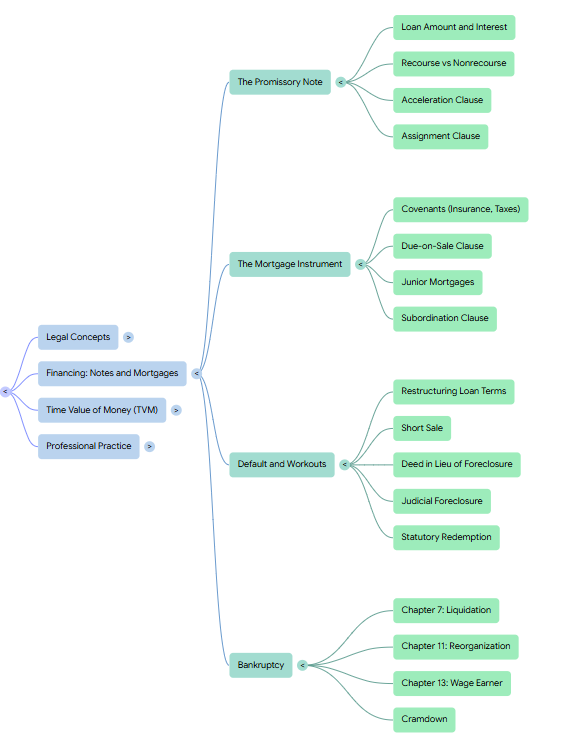
— Linden Lake
This series:
→ Book Review (1 of 4): Real Estate Finance and Investments – Legal Concepts
→ Book Review (2 of 4): Real Estate Finance and Investments – Financing: Notes and Mortgages
→ Book Review (3 of 4): Real Estate Finance and Investments – Time Value of Money(TVM)
→ Book Review (4 of 4): Real Estate Finance and Investments – Professional Practice
Leave a Reply