
In the book, professional practice in real estate finance and investments is presented as a highly specialized, multi-disciplinary field that requires a rigorous blending of financial analysis, legal literacy, and exhaustive market research. The concepts and quantitative techniques of the discipline are utilized across a wide spectrum of professional careers, including investing, development financing, appraising, consulting, managing portfolios, leasing, and managing real estate investment funds.
Several key themes define the nature of professional practice within the industry:
1. Specialization of Labor and the Developer as a “Facilitator”
The real estate industry is composed of economic functions that are highly specialized and distinct from the core business activities of the tenants who occupy commercial space. Managing these functions requires specialized skills—including land acquisition, development planning, marketing, leasing, property management, and ongoing market research.
Because of this complexity, a professional developer in land or project development frequently acts as a facilitator rather than executing all tasks directly. In practice, developers coordinate a diverse team of external professionals, including land planners, civil engineers, landscape architects, general contractors, and specialized subcontractors to implement the overall development plan.
2. Strict Standards of Appraiser Independence
For lenders and investors to manage risk, professional practice relies heavily on independent fee appraisers. To maintain professional integrity, an appraiser must be entirely unrelated to the parties involved in a transaction and hold no vested or financial interest in the property being valued.
The appraiser’s role is to provide an objective estimate of “market value” (the most probable price under competitive market conditions). This acts as a vital safeguard, helping lenders determine whether a transaction price is a market “outlier” before advancing mortgage capital.
3. Technological and Analytical Competence
Modern professional practice has moved far beyond simple guesswork, relying heavily on quantitative rigor. Real estate professionals are expected to blend financial theory with practical applications by utilizing financial calculators, Excel spreadsheets, and advanced cloud-based discounted cash flow (DCF) software to perform lease-by-lease investment analyses and valuations.
Furthermore, conducting thorough due diligence is a mandatory professional practice before committing capital. This requires professionals to be adept at utilizing internet resources to gather data on national and local market trends, interest rates, and regional economic drivers.
4. Legal Literacy and Fiduciary Duties
Although real estate practitioners are not lawyers, they must possess enough legal background to understand property rights and ask the right questions during negotiations. Professionals must routinely navigate state-specific laws regarding deeds, title assurance methods (such as attorney opinions and title insurance), and public recording acts.
In institutional settings, investment fund managers operate under strict fiduciary duties, meaning they must legally place the interests of their investors or pension plan beneficiaries above their own. Under regulatory frameworks like ERISA and the SEC, they are required to proactively manage, eliminate, or disclose any potential conflicts of interest.
5. Regulatory Recognition of Professionals
The distinction of being a real estate professional also carries significant weight in federal tax policy. Under the Tax Act of 1993, active real estate professionals (such as brokers and sales associates) who demonstrate “material involvement” in the business are granted special relief, allowing them to deduct unlimited real estate losses under passive activity loss (PAL) rules.
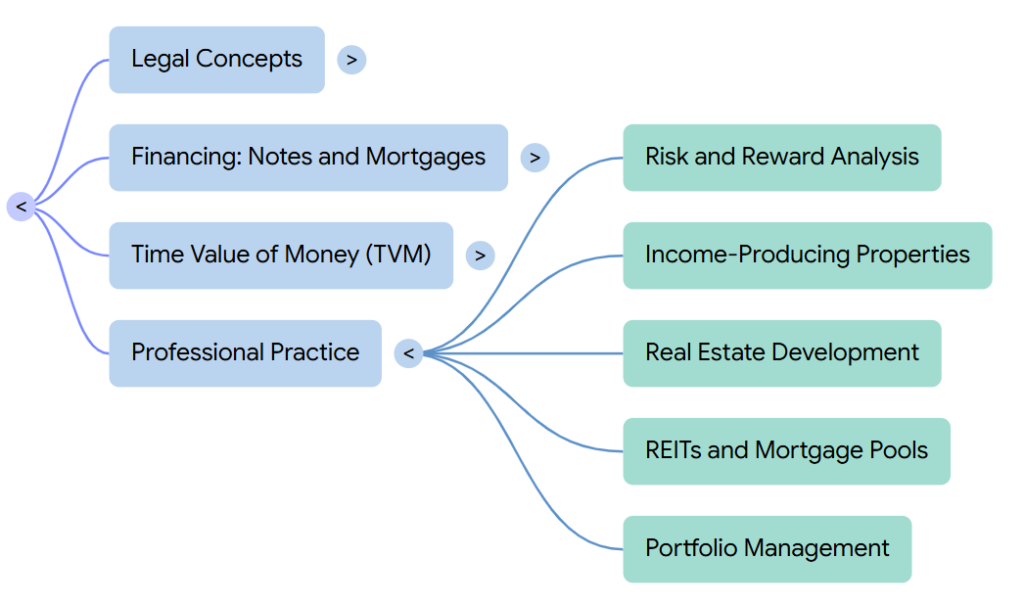
Risk and Reward Analysis
In the larger context of professional practice, the book emphasizes that risk and reward analysis is the absolute core of commercial and residential real estate operations. Whether a real estate professional is engaged in investing, appraising, consulting, development financing, or managing real estate portfolios and investment funds, they must possess a deep quantitative and qualitative understanding of how to evaluate the risks and returns of various transactions.
Several key concepts and methodologies define how risk and reward analysis is executed in modern professional practice:
1. Due Diligence as a Professional Necessity
Real estate practitioners must utilize due diligence before committing capital—defined by the book as the systematic process of discovering information needed to assess whether an investment’s risk is suitable given a set of investment objectives. This comprehensive investigation requires professionals to analyze:
- Government Compliance: Verifying zoning ordinances, permitted uses, setback lines, height restrictions, and parking ratios.
- Environmental Protection: Assessing the potential presence of toxic wastes, ground contamination, or hazardous materials like asbestos through Phase 1 and Phase 2 environmental reviews.
- Physical and Structural Integrity: Performing site surveys to evaluate the physical condition of structures, utility systems, and compliance with accessibility regulations.
- Lease Audits: Confirming rents, expense pass-throughs, tenant default risks, and renewal options.
2. The Interrelated Risk Perspectives of Investors and Lenders
In professional practice, the analysis of risk and return is not performed in a vacuum; the financial interests of borrowers and lenders are tightly coupled. Lenders act as investors when they advance mortgage capital and expect to earn a competitive rate of return.
Because lenders face default risk (the possibility that the borrower will fail to meet payment obligations) and foreclosure risks, they must evaluate properties using many of the same quantitative risk-assessment techniques as the equity investors. When underwriting loans, lenders manage risk by utilizing strict benchmark limits, such as a maximum loan-to-value (LTV) ratio to protect against declines in property value, and a minimum debt coverage ratio (DCR) (typically 1.20 or higher) to ensure a property’s net operating income has an adequate cushion to cover monthly debt service.
3. Pricing Multi-Dimensional Real Estate Risks
Professionals must analyze and price different categories of risk that inject variability into real estate cash flows and property values:
- Business Risk: Volatility in operating income caused by shifting local economic conditions, vacancy rates, or expiring tenant leases.
- Financial Risk: Risk associated with the use of debt financing.
- Interest Rate Risk: Price fluctuations in real estate assets and required yield rates driven by broader shifts in capital market rates.
- Liquidity Risk: The risk of being unable to quickly sell an illiquid asset without taking a substantial loss.
- Legislative Risk: Sudden regulatory shifts, such as changes in federal tax codes or local rent controls.
When lenders price a mortgage loan, they must establish an interest rate (i) that incorporates a real rate of return (r), a premium for expected inflation (f), and a risk premium (p) that is high enough to compensate for these multi-dimensional default, liquidity, and legislative risks.
4. Risk and the Volatility of Financial Leverage
A critical aspect of professional investment analysis is evaluating the impact of financial leverage (the use of debt). While borrowing money at an interest cost lower than the property’s unleveraged return creates positive leverage and magnifies the investor’s yield, the book cautions that leverage is never a free lunch.
The use of debt dramatically increases financial risk by magnifying the variability and standard deviation of the investor’s equity returns. Under a pessimistic scenario, if a property’s operating performance falls below the cost of debt, leverage becomes highly negative, compounding losses and exponentially increasing the standard deviation of returns.
5. Advanced Risk-Analysis Methodologies
Modern professional practice utilizes rigorous quantitative tools to model risk and uncertainty dynamically:
- Sensitivity and Scenario Analysis: Practitioners perform “what-if” analyses to test how sensitive a project’s Internal Rate of Return (IRR) or Net Present Value (NPV) is to changes in a single uncertain variable (such as market rents or land costs) or a combination of pessimistic and optimistic economic conditions.
- Partitioning the IRR: Professionals break down a projected IRR into its two primary cash flow components: cash flow from annual operations and cash flow from the eventual sale of the property (reversion). If a disproportionately high percentage of the IRR relies on future resale proceeds rather than stable, leased operating income, the investment is classified as carrying significantly higher risk.
- Monte Carlo Simulation: This technique allows professionals to specify probability distributions (such as a triangular distribution) for uncertain inputs like NOI growth. By using computer models to run thousands of trials, practitioners obtain a realistic probability distribution of the expected returns and their standard deviation.
- Real Options: Professionals value the strategic flexibility inherent in land ownership and development. By analyzing the “real option” to delay construction or phase a project sequentially, developers can mitigate downside risk by waiting to commit capital until market conditions are proven to be favorable.
Income-Producing Properties
In the financial and investment landscape, the book notes that concepts and techniques related to income-producing properties are central to a wide range of professional careers, including property management, appraising, portfolio management, leasing, and the administration of real estate investment funds. These assets—primarily categorized as apartments, office buildings, retail shopping centers, and warehouses—constitute a highly specialized segment of the market where the interests of property owners, managers, and corporate tenants intersect.
Within the larger context of professional practice, several key principles dictate how these properties are evaluated, managed, and positioned:
1. The Separation of Real Estate Operations from Core Business
Contrary to popular belief, the vast majority of real estate utilized by business firms is leased rather than owned. Specifically, over 80 percent of office and retail space and 63 percent of industrial/warehouse space is leased to tenant-users.
the book explains that corporate users generally prefer leasing because:
- Owning requires a massive commitment of capital that could otherwise be deployed into the firm’s highly profitable core business operations.
- It avoids putting the tenant “in the real estate business,” which requires highly specialized, non-core operational skills.
- Leasing preserves operating flexibility, allowing a business to easily expand, contract, or relocate when a lease expires without the time-consuming burden of selling a physical asset.
- It eliminates the distractions of facility maintenance, repairs, and the leasing of excess space to third parties, which are handled more cost-effectively by specialized real estate firms.
Because corporate users view real estate as an operating input combined with labor to generate profit, the real estate industry has evolved as a highly specialized field separate from the tenant’s primary business.
2. Rigorous Underwriting of Tenants and Leases
In professional practice, the lease is not merely an occupancy agreement; it is a legal contract that represents a vital asset for the property owner and a liability for the tenant. Consequently, professionals must conduct thorough tenant underwriting before executing an agreement. This includes analyzing the tenant’s financial statements, credit ratings, bank relationships, existing lease/debt obligations, and broader industry health.
Because existing lease terms are legally binding on subsequent buyers, underwriters and investors must audit every active agreement. In fact, many practitioners consider the present value of cash flows from active leases to be the primary determinant of a commercial property’s overall market value.
3. Strict Cash Flow and Net Operating Income (NOI) Focus
A cornerstone of professional real estate analysis is the calculation of Net Operating Income (NOI), which represents the property’s net cash inflow over a normal one-year operating cycle. Real estate professionals are cautioned to strictly distinguish NOI from GAAP accounting income.
Because industry accounting treatments can be highly non-uniform, a skilled practitioner must carefully evaluate how non-operating and non-recurring cash outlays are factored into the pro forma:
- Leasing Commissions: Fees paid to brokers to secure tenants must be factored into cash flow projections.
- Tenant Improvements (TIs): Landlord-funded allowances to build out or customize a tenant’s space can be substantial and must be tracked on a lease-by-lease basis.
- Capital Expenditures (CAPEX): Allowances for recurring and non-recurring replacements of physical building systems (such as roofing or HVAC) must be deducted to find true operating cash flows.
4. Structuring Portfolios via Specialized Investment Styles
Because property markets are highly fragmented, competitive, and prone to overdevelopment, income property performance is inherently cyclical. To navigate the real estate cycle and manage risk efficiently, professional portfolio managers align their acquisitions with distinct, standardized investment strategies:
- Core Strategy: Focuses on existing, seasoned, low-risk properties that are at least 80 percent leased to high-credit tenants to generate stable, predictable cash flows.
- Core “Plus” Strategy: Combines core properties with minor, targeted capital improvements or leasing programs designed to increase rents and value.
- Value-Added Strategy: Focuses on properties with operational inefficiencies, utilizing renovations, re-tenanting, or financial restructuring to optimize performance.
- Opportunistic Strategy: Features higher risk, involving the acquisition of highly distressed properties, raw land, or ground-up developments requiring extensive stabilization.
Real Estate Development
Within the broader framework of real estate professional practice, real estate development is presented as a highly complex, multi-disciplinary career path that is fundamentally distinct from managing or financing existing, occupied properties. While operating stabilized properties centers on preserving and managing existing cash flows, development is defined as the process of actively creating new value by combining raw land with physical improvements.
According to the book, several core dynamics define the professional practice of real estate development:
1. The Developer as a “Facilitator”
In professional practice, a land or project developer rarely executes every task in-house. Instead, the developer operates primarily as a facilitator who coordinates a diverse, specialized team of external professionals. This team typically includes land planners, civil engineers, landscape architects, general contractors, and specialized subcontractors. The developer’s professional skill lies in aligning these distinct disciplines to execute the overall development concept.
2. The Stages of Value Creation
To be considered an economic success, a development must achieve “value creation”—meaning the market value of the completed, leased project must exceed the sum total of the land acquisition, construction, financing, and soft costs expended to build it. Professionals navigate this process through five distinct phases:
- Land Acquisition: Securing the site, often initially using option contracts to perform feasibility and soil studies during a “free look” period.
- Construction: Implementing infrastructure (utilities, roads, drainage) and building improvements.
- Completion and Occupancy: Executing “finish-out” work and launching leasing programs to secure tenants.
- Management: Operating and maintaining the asset after completion.
- Sale: Exercising an exit strategy to harvest the created value.
3. Professional Business and Exit Strategies
Professional developers align their operations with one of three primary business strategies based on their risk tolerance and capital structure:
- Long-Term Hold: Developing projects with the explicit intention of owning, leasing, and managing them for many years as an ongoing business.
- Build and Sell: Developing and leasing the property to “stabilized” occupancy, and then immediately selling the asset to long-term institutional investors (such as pension funds or insurance companies) to capture immediate development profits.
- Master-Planned Leasing: Specializing in land development and the sequential construction of speculative or “build-to-suit” facilities within master-planned business or industrial parks.
4. Navigating Development and Construction Risk
Development is the highest-risk sector of real estate practice because it requires fronting massive capital during a period when the project generates zero rental income. Risk starts at land acquisition, peaks during construction, and only begins to decline once lease-up commitments materialize and the property is “stabilized”.
To manage this risk, developers must coordinate a complex web of financing and contractual commitments:
- Specialized Debt Structures: Developers utilize Land Acquisition and Development Loans (ADLs) or Construction and Development Loans (C&Ds). Because these loans are highly risky, lenders disburse funds in monthly “draws” tied to verified construction progress, require personal liability from the developer, and strictly limit the financing of intangible “soft costs”.
- The Take-Out Chain: To repay construction lenders, developers must secure a “take-out” mechanism. This can take the form of pre-leasing space to credit tenants to reduce lease-up risk, securing a permanent loan commitment from an institutional lender that funds once specific occupancy thresholds are met, purchasing a standby loan commitment to act as a temporary financial bridge, or entering into a presale agreement with an institutional buyer prior to construction.
REITs and Mortgage Pools
In the modern real estate industry, REITs (Real Estate Investment Trusts) and mortgage pools represent the peak of real estate securitization. According to the book, these vehicles are designed to pool capital and package debt, allowing professionals in investing, portfolio management, development, and fund advisory to manage risk, capture yields, and maintain market liquidity on a massive scale.
Within the broader context of professional practice, these vehicles have fundamentally transformed how real estate is financed, owned, and analyzed.
1. REITs in Professional Practice: From Passive Conduits to Active Operators
Historically, REITs were created by Congress in 1960 to act as passive investment conduits—similar to mutual funds—enabling everyday retail investors to buy shares in highly diversified portfolios of income-producing real estate. To maintain this tax-exempt “conduit” status, REITs must legally adhere to strict asset, income, and distribution requirements, such as distributing at least 90% of their taxable income to shareholders as dividends.
However, the book highlights a major evolution in professional REIT management:
- Self-Administration and Vertically Integrated Operators: Prior to the Tax Reform Act of 1986, REIT managers were restricted to passive oversight and had to outsource property management to independent third parties. The relaxation of these rules allowed modern REITs to become vertically integrated, internally managed operating companies. Today’s REIT professionals do not merely hold assets; they actively manage, lease, develop, and acquire properties to drive growth.
- UPREITs and Structural Engineering: Professionals must navigate sophisticated tax-deferral mechanisms. The creation of the UPREIT (Umbrella Partnership REIT) structure in 1992 allowed developers and property owners to transfer their real estate portfolios to a REIT in exchange for Operating Partnership (OP) units. Because this transaction is treated as an exchange of partnership interests, it is a non-taxable event, giving professionals a highly powerful tool to acquire properties from tax-sensitive sellers.
- Specialized Financial Metrics: In professional REIT analysis, standard GAAP metrics like Earnings Per Share (EPS) are insufficient because real estate depreciation artificially depresses reported net income. Professionals instead evaluate performance using Funds from Operations (FFO)—which adds back depreciation and excludes gains or losses from property sales—to measure true distributable cash flow.
2. Mortgage Pools and the Secondary Market: Driving Systemic Liquidity
A mortgage pool is a packaged collection of individual real estate loans against which securities are issued and traded. In professional practice, the creation of mortgage pools serves as the primary mechanism for replenishing funds for primary lenders (like mortgage companies and commercial banks). Instead of holding loans to maturity and tying up capital, originators package loans into pools, securitize them, and sell them to global investors—thereby clearing their balance sheets to originate new mortgages.
Professional mortgage underwriters and securitization specialists manage these pools through several sophisticated frameworks:
- Standardization of Underwriting: The secondary mortgage market is dominated by government-sponsored enterprises (GSEs) like Fannie Mae and Freddie Mac. To make mortgage pools marketable nationwide, these GSEs mandate uniform documents (such as standardized appraisal forms) and rigid underwriting guidelines for “conforming” loans. Consequently, residential originators, appraisers, and brokers must strictly adhere to these standardized industry benchmarks in daily practice.
- Structuring Homogeneous Pools: To make cash flows and prepayment speeds predictable for investors, professionals carefully structure pools to be as homogeneous as possible. Loans within a single pool are typically grouped by payment patterns (e.g., all ARMs or all fixed-rate), maturity terms, and underlying security types (such as single-family homes).
- Prioritizing Risk via Tranches (CMOs and CMBS): In advanced practice, simple pass-through pools are carved into multiple security classes called tranches. In a Collateralized Mortgage Obligation (CMO), cash flows are prioritized so that fast-pay tranches (Class A) are retired first, while accrual tranches (Class Z) defer interest payments until senior debt is cleared. Similarly, Commercial Mortgage-Backed Securities (CMBS) utilize senior and subordinated “A and B pieces” to allocate default risk. The senior tranche is protected because the subordinated tranche absorbs the “first loss position” if commercial borrowers default on their nonrecourse loans.
3. The Institutional Portfolio Context: Fiduciary Duty and Benchmarking
For investment managers, fiduciaries, and pension fund sponsors, REITs and mortgage-backed securities are invaluable tools for executing institutional asset-allocation strategies. Because real estate returns historically exhibit a low correlation with common stocks and corporate bonds, incorporating these securitized real estate assets into a traditional portfolio significantly reduces overall portfolio risk and shifts the efficient frontier upward.
Professional fund managers continuously evaluate these investments against standardized performance benchmarks:
- NCREIF Property Index (NPI): An unleveraged, appraisal-based index representing the direct, “free and clear” performance of institutional properties.
- NFI-ODCE Index: A fund-level, time-weighted index that tracks open-end diversified core equity commingled funds, incorporating the real-world effects of cash drag, leverage, and management fees.
By utilizing attribution analysis against these benchmarks, institutional consultants can mathematically isolate whether a real estate fund manager’s outperformance was driven by superior individual property selection or highly tactical sector allocation across different property types and geographic regions.
Portfolio Management
In the context of real estate investment and finance, portfolio management represents one of the most advanced and rigorous areas of professional practice. While individual property management or development focuses on the day-to-day operations and physical execution of a single asset, portfolio managers operate at a strategic macro-level. They are responsible for structuring capital, mitigating risk through diversification, and systematically reporting performance to institutional investors under strict guidelines.
According to the book, several core principles define the practice of professional portfolio management:
1. Fiduciary Duty and Fund Structure
Many private real estate investment funds are created by professional investment managers and private equity firms for institutional clients, such as pension fund sponsors, endowments, and sovereign wealth funds. Because these funds hold capital in trust on behalf of pension plan beneficiaries, portfolio managers operate under strict fiduciary duties. They are legally required to place the interests of the beneficiaries above their own, actively manage conflicts of interest, and operate under regulatory frameworks such as ERISA.
To align with their investors’ risk and return goals, managers structure their offerings around three distinct strategies:
- Core Funds: Strive for stable, income-focused returns with very low leverage (<35%) by acquiring existing, highly occupied properties in primary markets. These are typically organized as open-end funds, allowing investors to buy or redeem shares periodically.
- Value-Added Funds: Target underperforming properties, allowing the manager to “add value” through physical renovations or aggressive re-tenanting. They employ moderate leverage (up to 75%) and are usually closed-end funds with a fixed life.
- Opportunistic Funds: Seek high appreciation by taking on the risk of ground-up developments, distressed assets, or international acquisitions, typically utilizing high leverage.
Professionals must diligently avoid style drift—the practice of making investments that depart from the fund’s stated risk-return style—which can expose investors to unapproved volatility.
2. Elements of Portfolio Theory and Diversification
In professional practice, real estate is not evaluated in isolation; instead, managers assess how an asset’s return pattern interacts with a broader portfolio of stocks and bonds. Under portfolio theory, combining assets with low or negative correlation coefficients allows a manager to reduce total portfolio risk (standard deviation) without sacrificing expected returns.
Portfolio managers achieve this critical diversification across several dimensions:
- Property Type: Spreading capital across office, retail, industrial, and apartment sectors helps insulate the portfolio since these property types are driven by different market fundamentals and are rarely perfectly correlated.
- Geographic Location: Diversifying across different metropolitan statistical areas (MSAs) or regions reduces exposure to localized economic shocks.
- Global Diversification: Investing cross-border yields further diversification benefits due to the relatively low historical correlations between international property markets and the United States.
3. Strategic Rebalancing and Portfolio Balancing
A portfolio is not a static instrument; it requires active rebalancing. When making property disposition (sale) decisions, a professional manager must analyze how selling an asset affects the mix and risk profile of the remaining holdings. If a portfolio is overweighted in a lagging sector (such as office space during a downturn), the manager may sell properties to rebalance the portfolio toward more favorable sectors.
Professionals frequently use tax-deferred exchanges (Section 1031) to execute these strategies, allowing the fund to swap a single, management-intensive property for multiple properties to enhance geographic or sector diversification without triggering immediate capital gains taxes.
4. Performance Measurement, Benchmarking, and TWR
A key aspect of professional practice is the transparent reporting of performance against established industry benchmarks. The primary benchmarks used are:
- NCREIF Property Index (NPI): An unleveraged, appraisal-based index tracking the performance of private commercial properties.
- NFI-ODCE Index: A fund-level index tracking open-end diversified core equity commingled funds, which incorporates real-world factors like cash drag and leverage.
When calculating historical returns, portfolio managers must choose the appropriate metric. For open-end funds—where the manager does not control when investors choose to contribute or redeem capital—professionals must report Time-Weighted Returns (TWR). Unlike the Internal Rate of Return (IRR), which is highly sensitive to the dollar magnitude of capital additions and withdrawals, the TWR chain-links periodic returns. This ensures the manager’s performance evaluation is not distorted by external investor decisions.
5. Sector Attribution Analysis
To demonstrate value to institutional clients, managers use attribution analysis to explain why their fund’s return differed from the benchmark. This analysis decomposes excess returns (or underperformance) into two key active management decisions:
- Selection Effect: The value added (or lost) by the manager’s ability to select superior individual properties within a given sector compared to the benchmark.
- Allocation Effect: The value added (or lost) by successfully overweighting sectors or regions that outperform the overall benchmark, or underweighting those that lag.
By utilizing mathematical frameworks like the Brinson-Fachler method, portfolio managers can pinpoint exactly which strategic allocation decisions added or detracted from the fund’s benchmark-relative return.
— Linden Lake
This series:
→ Book Review (1 of 4): Real Estate Finance and Investments – Legal Concepts
→ Book Review (2 of 4): Real Estate Finance and Investments – Financing: Notes and Mortgages
→ Book Review (3 of 4): Real Estate Finance and Investments – Time Value of Money(TVM)
→ Book Review (4 of 4): Real Estate Finance and Investments – Professional Practice
Leave a Reply