
In the book, the success and immense liquidity of the derivatives markets are directly attributed to their ability to attract a diverse range of market participants. These participants enter options, futures, forwards, and swaps markets with different motivations, risk tolerances, and operational roles.
1. The Three Primary Categories of Traders
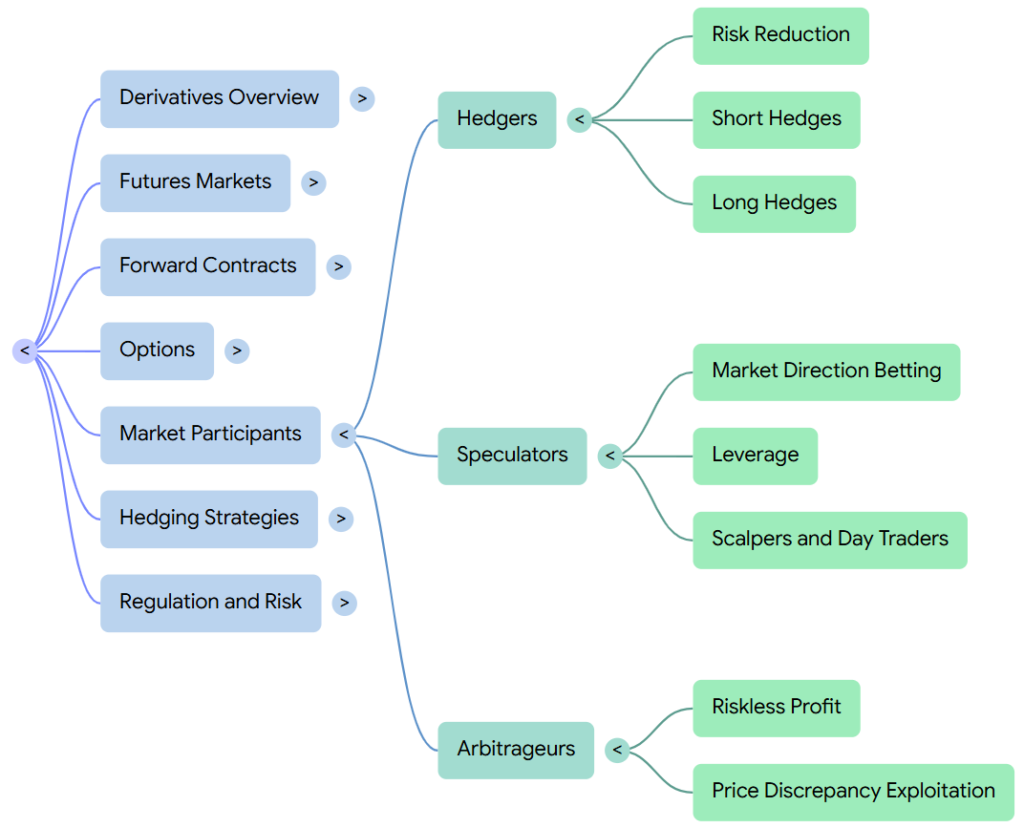
The book identifies three broad classifications of traders who drive activity in derivatives markets: hedgers, speculators, and arbitrageurs.
- Hedgers: These participants are motivated by risk reduction. They already face exposure to potential price fluctuations in an underlying asset (such as a foreign currency, interest rate, or commodity) and use derivatives to neutralize or insure against this risk.
- Forwards/Futures Hedging: Hedgers use forward and futures contracts to neutralize risk by completely locking in a price. For example, an importer might buy foreign currency forward to lock in a payment amount, while a short hedge is used by an exporter or commodity producer expecting to sell an asset in the future.
- Options Hedging: Alternatively, hedgers use options as insurance. This allows them to protect themselves against adverse price movements while still retaining the ability to benefit from favorable ones, in exchange for an up-front option premium.
- Speculators: Unlike hedgers, speculators actively seek out risk to bet on the future direction of market variables. They do not own the underlying asset but want to profit from price movements. Speculators are heavily drawn to derivatives because both futures and options provide leverage, allowing them to take very large positions with a relatively small up-front cash outlay (in the form of margin accounts or option premiums).
- While futures speculators face theoretically unlimited risk on both the upside and downside, options speculators have their potential losses strictly capped at the premium paid for the contract.
- Arbitrageurs: Arbitrageurs seek to lock in a risk-free profit by simultaneously entering into offsetting transactions in two or more markets. For example, if a stock trades for different equivalent prices on the New York and London stock exchanges, an arbitrageur will buy in the cheaper market and sell in the more expensive one.
- Because arbitrageurs are highly competitive and trade in massive volumes, their activities quickly eliminate price discrepancies. Consequently, the very existence of arbitrageurs keeps market prices closely aligned with theoretical models, and the book notes that most derivative pricing models are constructed under the assumption that no arbitrage opportunities exist.
2. Specialized Roles in Futures and Options Markets
Within exchanges and over-the-counter (OTC) platforms, market participants assume specialized operational roles:
- Market Makers: Common in both options exchanges and the OTC market, market makers facilitate trading and provide vital liquidity. They continuously quote a bid price (the price at which they are prepared to buy) and an ask price (the price at which they are prepared to sell). They make their profits from the bid-ask spread.
- Locals vs. Futures Commission Merchants (FCMs): In futures markets, those executing trades are divided into FCMs, who act as brokers executing trades on behalf of clients for a commission, and locals, who trade strictly on their own personal accounts.
- Speculator Classifications: Speculators are further categorized by their trading time horizons:
- Scalpers: Watch for ultra-short-term trends, holding positions for only a few minutes to profit from minor price changes.
- Day Traders: Hold positions for less than one trading day to avoid overnight market-moving news.
- Position Traders: Hold positions for much longer periods to capture major, long-term market trends.
3. Institutional and Structural Participants
The broader ecosystem includes highly structured institutional participants:
- Hedge Funds: These are prominent buy-side participants that accept capital only from professional managers or sophisticated individuals. Relatively free from the strict regulations governing mutual funds, hedge fund managers use derivatives extensively for complex, proprietary trading strategies. These include convertible arbitrage (buying undervalued convertible bonds and shorting the underlying equity) and long/short equities (buying undervalued stocks and shorting overvalued ones to minimize overall market exposure).
- Clearing Houses and Central Counterparties (CCPs): To protect the financial system from default risk, clearing houses (for exchanges) and CCPs (for standardized OTC trades) act as institutional intermediaries. They step in between the original buyer and seller, legally becoming the “buyer to every seller and the seller to every buyer”. They manage systemic risk by requiring clearing members to maintain strict margin requirements.
Hedgers
Hedgers represent one of the three primary categories of participants in the derivatives markets, alongside speculators and arbitrageurs. While speculators seek out risk to obtain leverage, and arbitrageurs attempt to lock in riskless profits by exploiting pricing discrepancies across different markets, the core motivation of hedgers is risk reduction. Most nonfinancial corporations are in the business of manufacturing, retailing, or providing services, and do not possess unique expertise in forecasting volatile market variables like interest rates, exchange rates, or commodity prices. By using derivatives, hedgers seek to neutralize or insure against these exposures, allowing them to focus on their primary business activities.
Hedging Instruments: Forwards vs. Options
As explained in the book, hedgers typically employ different derivative structures depending on whether they wish to lock in a price or buy protection:
- Forward Contracts (Neutralizing Risk): Forward contracts are designed to completely lock in the price that the hedger will pay or receive for an underlying asset, thereby neutralizing risk. For instance, a U.S. importer (ImportCo) expecting to pay a foreign currency in the future can buy the currency forward to fix their domestic currency cash outflow. Conversely, an exporter (ExportCo) expecting to receive foreign currency can sell it forward to lock in their revenue. Both parties make a binding commitment, meaning they forfeit any potential gains if the spot rate moves in their favor.
- Option Contracts (Insurance): Unlike forwards, options provide a form of insurance. They allow hedgers to protect themselves against adverse price movements while still retaining the ability to benefit from favorable ones. This asymmetric protection requires the payment of an upfront fee, known as the option premium. For example, a stock investor concerned about a decline in their portfolio over the next two months can buy put options, establishing a price floor while keeping the upside open.
Hedging with Futures: Short vs. Long Hedges
When using futures contracts, hedgers partition their strategies into two main approaches:
- Short Hedges: A short hedge involves taking a short position in futures contracts. It is appropriate when a hedger already owns an asset and expects to sell it in the future, or expects to acquire and sell the asset later. For example, an oil producer can short crude oil futures to lock in a selling price for its future production.
- Long Hedges: A long hedge involves taking a long position in futures contracts. This is appropriate when a company knows it must purchase a certain asset in the future and wants to lock in a price today. For example, a copper fabricator can buy copper futures to guarantee its raw material costs.
Complications and Risks in Hedging
In practice, a perfect hedge—one that completely eliminates all risk—is extremely rare. Hedgers face several structural risks and calculations:
- Basis Risk: This arises from the uncertainty regarding the “basis,” which is defined as the difference between the spot price of the asset to be hedged and the futures price of the contract used. Basis risk increases if the asset being hedged is different from the asset underlying the contract (cross hedging), if the exact transaction date is uncertain, or if the hedge must be closed out before the contract’s delivery month.
- Minimum Variance Hedge Ratio (h∗): To minimize the variance of a hedged position, hedgers must calculate the optimal hedge ratio. When daily settlement is ignored, this ratio depends on the correlation (ρ) between changes in the spot and futures prices, and the ratio of their standard deviations. When daily settlement is considered, the ratio must be adjusted because daily cash flows create a series of one-day hedges rather than a single static hedge. Hedgers can also “tail” the hedge to account for the interest earned or paid on daily margin balances over the life of the hedge.
- Stack and Roll: If a hedger’s horizon extends beyond the maturity of liquidly traded futures contracts, they can employ a stack and roll strategy. This involves entering a liquid short-term contract, closing it out near expiration, and rolling the position into a contract with a later delivery date. However, this strategy introduces massive liquidity risk. If the spot price moves adversely, the hedger will face immediate daily cash outflows on their futures positions (margin calls) long before realizing the offsetting gains on their physical business. The book highlights the collapse of Metallgesellschaft, which lost $1.33 billion when severe cash flow pressures forced the company to abandon its rolled hedges.
Why Companies Choose Not to Hedge
Despite the clear benefits of risk reduction, many corporate exposures are left unhedged due to several theoretical and practical considerations:
- Shareholder Diversification: Some argue that individual shareholders can diversify risks far more easily and cheaply within their own stock portfolios, meaning corporations do not need to hedge on their behalf.
- Industry and Competitor Norms: If a company hedges its raw material costs but its competitors do not, the company’s profit margins may fluctuate while its competitors’ remain stable. If commodity prices fall, the unhedged competitors will benefit from lower costs and lower product prices, while the hedged company is locked into higher costs, potentially destroying its profit margin.
- Internal Corporate Dynamics: Hedging is designed to reduce risk, not to guarantee a better financial outcome. If a company hedges and the market moves favorably, the company will perform worse than if it had not hedged. Corporate treasurers are often reluctant to hedge because they fear intense post-hoc criticism from senior executives or boards who focus on the “losses” incurred in the derivatives market without understanding that those losses were offset by gains in the physical business.
Risk Reduction
In the book, risk reduction is defined as the primary motivation for hedgers, who use derivatives to neutralize or insure against potential losses arising from volatile market variables. Unlike speculators who seek risk to gain leverage, or arbitrageurs who exploit price discrepancies across different markets, hedgers enter derivatives markets to seek stability and certainty.
The Core Philosophy: Risk Reduction vs. Profit Maximization
A fundamental principle emphasized in the book is that the purpose of hedging is solely to reduce risk, not to maximize profits. There is absolutely no guarantee that a company’s financial outcome with a hedge will be better than without it. In fact, if the market moves favorably for the underlying physical asset, a hedged company will perform worse than if it had remained unhedged. However, if the market moves adversely, the hedge provides crucial protection. For hedgers, reducing the variance of future cash flows is the true measure of a successful risk reduction strategy.
Mechanisms for Reducing Risk
To achieve risk reduction, hedgers typically choose between two main categories of derivatives depending on their risk management objectives:
- Neutralizing Risk (Forwards and Futures): Forward and futures contracts are designed to completely lock in a price, thereby neutralizing the risk of subsequent price fluctuations.
- Short Hedges: A hedger takes a short position (agreeing to sell) when they already own, or expect to acquire, an asset and want to protect against a potential price decline before the sale. For example, an oil producer might short crude oil futures to secure a specific price for its upcoming production.
- Long Hedges: A hedger takes a long position (agreeing to buy) when they must purchase an asset in the future and want to lock in their raw material costs today. For instance, a copper fabricator might buy copper futures to guarantee its input prices.
- Insuring Against Risk (Options): Unlike forwards or futures, options act as insurance. They require an upfront cash payment (the premium) but allow the hedger to establish a protective price floor or cap while still retaining the ability to benefit from highly favorable market moves. For example, an investor concerned about a stock market drop can buy put options to guarantee a minimum selling price for their shares while keeping the upside open if stock prices rise.
The Business Case for Hedging
For most nonfinancial corporations—which specialize in manufacturing, wholesaling, or providing services—hedging is highly logical because they do not possess unique skills or expertise in predicting interest rates, exchange rates, or commodity prices. By using derivatives to reduce these risks, corporate managers can avoid “unpleasant surprises” and focus their organizational resources on their core business activities.
Why Corporate Hedgers May Choose Not to Reduce Risk
Despite the clear benefits of risk reduction, the book details several reasons why many corporate exposures are left unhedged in practice:
- Shareholder Diversification: Under financial theory, individual shareholders can diversify risk far more efficiently and cheaply in their personal portfolios than a corporation can. If a firm’s shareholders are well-diversified, corporate-level hedging may be viewed as redundant.
- Competitive and Industry Dynamics: If competitors within an industry do not hedge, a single company that chooses to hedge may actually increase the volatility of its profit margins. For instance, if raw material prices drop, unhedged competitors will lower their wholesale product prices to capture market share, while the hedged company remains locked into higher input costs, severely squeezing its margins.
- The “Treasurer’s Dilemma” and Internal Politics: Hedging can lead to highly uncomfortable internal corporate dynamics if the market moves favorably. If commodity prices rise, an unhedged company gains, but a hedged company must realize offsetting losses on its derivatives positions. Senior executives or board members who do not fully grasp derivatives may criticize the treasurer for “losing” money on the hedge, ignoring the fact that those losses were fully offset by gains in the physical business.
To overcome these internal barriers to effective risk reduction, the book advises that hedging strategies must be approved by a company’s board of directors and clearly communicated to executives, ensuring everyone understands that the objective is risk reduction rather than speculative profit.
Short Hedges
In the book, a short hedge is defined as a hedging strategy that involves taking a short position in futures (or forward) contracts. It is one of the primary risk-reduction mechanisms used by market participants who have exposure to declining prices.
When a Short Hedge is Appropriate
The book outlines two main scenarios where a short hedge is utilized by a hedger:
- When the hedger already owns an asset and expects to sell it at some point in the future. For example, a farmer who owns hogs and knows they will be ready for sale at the local market in two months can use a short hedge to protect against a drop in hog prices before the sale date.
- When the hedger does not currently own the asset but expects to acquire it and have it ready for sale in the future. For instance, a U.S. exporter who expects to receive a payment of euros in three months faces the risk that the euro will decrease in value relative to the U.S. dollar. By taking a short futures position in euros, the exporter offsets this currency risk.
Examples of Short Hedging in Action
To illustrate how short hedges function, the book provides detailed examples of how producers lock in prices:
- The Oil Producer: An oil producer negotiates a contract on May 15 to sell 1 million barrels of crude oil in three months at whatever the spot market price is on August 15. To hedge the risk of falling oil prices, the producer shorts 1,000 futures contracts (representing 1 million barrels) at the current August futures price of $49 per barrel. If the spot price in August falls to $45, the producer receives $45 million from their physical sales contract and gains $4 million from the short futures position, netting a total of $49 million. If the spot price rises to $55, the producer sells the oil for $55 million but loses $6 million on the futures contracts, still netting exactly $49 million. Thus, the short hedge locks in the $49 price regardless of market direction.
- Gold Mining Companies: It typically takes gold mining companies several years to extract gold from a mine, exposing them to massive risk if gold prices plunge. To protect their multi-year investment, some gold mining companies choose to hedge by estimating their future monthly gold production and entering into short futures or forward contracts to lock in selling prices in advance.
The Larger Context of Hedgers
Within the broader spectrum of derivatives traders—which includes speculators who seek out risk for leverage, and arbitrageurs who exploit price discrepancies—hedgers are distinguished strictly by their goal of risk reduction.
The book places short hedges into a larger strategic context, emphasizing several key principles:
- Risk Reduction vs. Profit Maximization: The core purpose of hedging is to reduce or neutralize risk, not to secure a profit. A company might perform worse with a hedge than without one if the market moves in a highly favorable direction (e.g., if oil prices skyrocket, the oil producer with a short hedge misses out on those gains). However, the hedge succeeds because it removes the uncertainty and stabilizes future cash flows.
- Forwards vs. Options: Hedgers must choose how they want to manage risk. A short hedge using a forward or futures contract completely neutralizes risk by locking in a single price, but requires both parties to fulfill a binding commitment. Alternatively, a hedger can buy put options, which act as insurance. Buying put options establishes a guaranteed price floor (letting the holder exercise if the asset price falls) but allows them to still benefit if the asset price rises. Unlike futures, however, options require the payment of an upfront premium.
- Risks in Hedging: In the real world, a perfect hedge is rare. Hedgers taking short positions face basis risk, which is the risk that the spot price of the asset being hedged and the futures price of the contract used do not converge perfectly when the hedge is closed out. Basis risk can widen if the underlying asset of the futures contract differs from the physical asset being hedged (known as cross hedging).
Long Hedges
In the book, a long hedge is defined as a hedging strategy that involves taking a long position in a futures (or forward) contract. This strategy is appropriate when a company knows it will have to purchase a certain asset in the future and wants to lock in a purchase price today to protect against rising market prices.
The Locking-In Mechanism
A long hedge is used to neutralize risk by securing a stable purchase price for a required commodity or asset.
- The Mechanism in Action: If a copper fabricator knows in January that it will require 100,000 pounds of copper in May, it can enter a long position in futures contracts to lock in the price. If the spot price of copper subsequently rises by the maturity date, the fabricator pays the higher spot price to its supplier but realizes an offsetting gain on its long futures contracts. Conversely, if the spot price falls, the fabricator pays a lower spot price to its supplier but experiences an equivalent loss on the futures contracts.
- The Net Outcome: In either scenario, the net cost to the fabricator remains stabilized at approximately the initial futures price. By utilizing a long hedge, a corporate treasurer avoids “unpleasant surprises,” such as a sharp rise in the price of raw materials.
Basis Risk and its Impact on Long Hedges
In the real world, a perfect hedge is rare, and long hedgers must contend with basis risk—the uncertainty associated with the difference between the spot price of the asset and the futures price of the contract used (the basis) at the time the hedge is closed out.
- Effective Price Formula: Mathematically, the effective price paid with a long hedge is calculated as: Effective Price = F1 + b2
where F1 is the initial futures price and b2 is the final basis at the time the hedge is closed out.
- Basis Movements: The behavior of the basis directly affects the outcome of the long hedge. If the basis strengthens (increases) unexpectedly, the company’s position worsens because the effective price they pay for the asset rises. If the basis weakens (decreases) unexpectedly, the company’s position improves as the effective price paid falls.
Managing Delivery and Timing Risks
Long hedgers must make strategic choices regarding contract specifications to manage operational risks:
- Avoiding Delivery Costs: While short hedgers hold the option to initiate delivery of a physical asset, long hedgers are generally required to accept delivery if they hold a contract into its delivery month. Because taking physical delivery of a commodity can be highly expensive and logistically inconvenient, long hedgers normally close out their futures contracts before the delivery month (specifically prior to the first notice day) and buy the physical asset from their usual suppliers.
- The Delivery Month Rule of Thumb: To minimize basis risk, a long hedger should choose a delivery month that is as close as possible to, but later than, the expiration of the hedge. This prevents them from being forced into a costly delivery process while keeping the contract highly liquid.
- Daily Settlement: Daily settlement (marking to market) means that the cash flows from a futures contract are realized day-by-day throughout the life of the hedge, rather than as a single lump-sum payoff at the end, which slightly affects the overall performance of the hedge.
Speculators
In the ecosystem of derivatives markets, speculators represent one of the three primary categories of traders, alongside hedgers and arbitrageurs. While hedgers aim to avoid risk by neutralizing price exposures and arbitrageurs look to exploit price discrepancies for riskless gains, speculators deliberately seek out and assume risk. Their fundamental objective is to take a directional position in the market, betting that the price of an underlying asset will either rise or fall, in order to generate a profit.
Classifications of Speculators
According to the book, speculators are not a uniform group; they are typically classified by their trading time horizons and behavior:
- Scalpers: These traders monitor ultra-short-term trends, holding positions for only a few minutes to capture and profit from very small, quick changes in contract prices.
- Day Traders: These participants hold their positions for less than a single trading day. They close all positions before the market closes because they are unwilling to assume the risk of overnight, market-moving news.
- Position Traders: These speculators maintain their positions for much longer periods. Rather than chasing minor intraday fluctuations, they hope to capture and profit from major, long-term market movements.
The Role of Leverage in Speculation
A key reason speculators gravitate toward derivatives rather than spot markets is the availability of leverage, which allows them to amplify their potential returns on a relatively small up-front capital outlay.
- Futures Speculation: When speculating with futures, a trader does not need to pay the full value of the underlying asset. Instead, they are only required to deposit a relatively small amount of cash into a margin account. For example, in the book’s illustration of speculating on the British pound, a spot transaction of £250,000 requires an up-front investment of $305,500, whereas the same exposure can be achieved in the futures market with an initial margin of just $20,000. However, futures speculation carries immense risk: if the market moves against the speculator, both the potential losses and potential gains are extremely large.
- Options Speculation: Options also provide significant leverage. To illustrate, the book compares investing $2,000 in a $20 stock versus buying $22.50-strike call options for $1 each. If the stock price rises to $27, the stock investment yields a $700 profit, whereas the call options generate a $7,000 profit. Crucially, options speculation differs from futures because a buyer’s downside risk is strictly capped: no matter how adversely the market moves, the speculator’s loss is limited to the premium paid for the options.
Institutional Speculators: Hedge Funds
On an institutional level, hedge funds are prominent speculative participants in derivatives markets. Unlike mutual funds, which are heavily regulated regarding their use of leverage and investment transparency, hedge funds are relatively free from these constraints. This operational freedom allows hedge fund managers to execute sophisticated, proprietary speculative strategies—such as Global Macro (speculating on global macroeconomic trends) or Long/Short Equities (buying undervalued shares and shorting over valued ones).
The Dangers of Unauthorized Speculation
A major systemic danger occurs when traders with a mandate to hedge or arbitrage begin speculating, either consciously or unconsciously. Because derivatives offer high leverage, unauthorized speculation can quickly lead to catastrophic losses:
- Jérôme Kerviel (Société Générale): Hired to perform low-risk equity index arbitrage, Kerviel bypassed compliance controls to make massive, unhedged speculative bets on the direction of European equity indices, resulting in a €4.9 billion loss when the positions were unwound in 2008.
- Nick Leeson (Barings Bank): Mandated to arbitrage Nikkei 225 futures between Singapore and Osaka, Leeson instead made unauthorized speculative bets using futures and options, losing $1 billion and bankrupting the 200-year-old institution.
- John Rusnak (Allied Irish Bank): Lost $700 million through unauthorized foreign exchange trading, hiding his speculative losses by fabricating fictitious option trades.
To prevent these disasters, the book stresses that firms must establish clear, unambiguous risk limits and closely monitor traders’ daily activities to ensure they do not pivot from hedging or arbitrage into speculation.
Market Direction Betting
In the book, market direction betting is the defining activity of speculators, who enter derivatives markets specifically to back their “hunches” about whether a market variable will rise or fall. Unlike hedgers, who use derivatives to escape risk, speculators willingly assume risk in search of financial gain.
The Two Primary Mediums for Betting: Futures vs. Options
Speculators have two main avenues for executing their market direction bets, each offering a different risk-and-reward profile:
- Betting with Futures: When a speculator bets on market direction using futures, they gain significant leverage. For instance, a speculator betting that a currency will strengthen can go long futures contracts by posting a relatively small amount of cash in a margin account instead of deploying the massive cash outlay required to buy the physical currency in the spot market. However, this strategy carries symmetric risk: if the market goes against the speculator’s bet, both the potential gains and the potential losses are exceptionally large.
- Betting with Options: Options also provide highly leveraged betting vehicles. A speculator betting on an upward stock movement can buy call options. If the stock price rises significantly, the options strategy can yield profits several times higher than a direct stock purchase. Crucially, unlike futures, options offer asymmetric risk: if the bet is wrong and the market moves adversely, the speculator’s total loss is strictly limited to the premium paid for the contract.
The Systemic Danger of Disguised Speculative Bets
A major focus of the book is the severe danger that arises when traders who are mandated to perform low-risk activities (such as arbitrage or hedging) begin secretly betting on market direction instead.
- Jérôme Kerviel (Société Générale): Mandated to find arbitrage opportunities in equity indices, Kerviel instead used his knowledge of back-office procedures to take massive, unhedged speculative bets on the direction of European indices, hiding them with fictitious offsetting trades. This resulted in a €4.9 billion loss when the positions were unwound.
- Nick Leeson (Barings Bank): Tasked with low-risk arbitrage of Nikkei 225 futures between Singapore and Osaka, Leeson similarly chose to make huge speculative bets on the direction of the index using futures and options, ultimately bankrupting the 200-year-old institution.
To protect against these unauthorized directional bets, the book emphasizes that both financial and nonfinancial firms must establish unambiguous risk limits and rigorously monitor traders’ activities on a daily basis.
Leverage
In the book, leverage is described as the primary mechanism that attracts speculators to the derivatives markets, allowing them to magnify the financial consequences of their market direction bets with a relatively small upfront capital outlay. Speculators use both futures and options to obtain this leverage, though the risk profiles of the two instruments differ significantly.
Leverage in Futures Speculation
When speculating with futures, a trader is not required to deploy the full value of the underlying asset. Instead, they only need to deposit a relatively small amount of cash as “initial margin”.
- The book illustrates this with an example of a speculator who wants to back a bullish view on the British pound to the tune of £250,000. Buying the currency in the spot market requires an upfront investment of $305,500. In contrast, taking a long position in four futures contracts to gain the same exposure requires an initial margin of only $20,000.
- The primary danger of futures leverage is its symmetric risk profile. If the market moves against the speculator’s bet, they face symmetric risk where both the potential gains and the potential losses are exceptionally large, easily exceeding their initial margin.
Leverage in Options Speculation
Options also provide powerful leverage but feature an asymmetric risk profile.
- The book compares a $2,000 investment in 100 shares of a $20 stock against buying 2,000 call options with a $22.50 strike price for $1 each. If the stock price rises to $27, the stock purchase yields a $700 profit, whereas the highly leveraged options strategy yields a $7,000 profit.
- Unlike futures, if the market moves adversely, the options simply expire worthless. The option speculator’s maximum loss is strictly capped at the upfront premium paid.
The Systemic Dangers of High Leverage
While leverage is highly attractive to speculators, the book details how excessive leverage can lead to catastrophic institutional failures:
- Lehman Brothers: As an investment bank, Lehman was not subject to the same capital regulations as commercial banks. By 2007, its leverage ratio grew to an extreme 31:1, meaning a minor 3% to 4% decline in its asset values was sufficient to completely wipe out its capital. When a loss of confidence occurred, short-term funding evaporated, forcing the firm into bankruptcy.
- Long-Term Capital Management (LTCM): In the 1990s, this hedge fund used collateralized bilateral derivatives agreements to build a highly leveraged arbitrage portfolio. When the Russian debt default of 1998 triggered a global “flight to quality,” the spreads on its liquid and illiquid positions widened dramatically instead of converging. Because of its high leverage, LTCM could not meet its massive margin calls and collapsed, losing $4 billion.
Scalpers and Day Traders
In the larger context of derivatives markets, the book identifies speculators as participants who enter options and futures markets to take a directional position and bet on the future movement of a market variable. To achieve this, speculators utilize the high leverage offered by derivative contracts to amplify their potential financial returns.
Within this speculative framework, traders are categorized primarily by their trading time horizons. Under this classification, scalpers and day traders represent the most short-term, active participants in the market:
Scalpers
- Time Horizon: Scalpers operate on an ultra-short-term scale, usually holding their trading positions for only a few minutes.
- Trading Strategy: They closely monitor very short-term trends and attempt to extract quick profits from small changes in the contract price.
Day Traders
- Time Horizon: Day traders hold their positions for a slightly longer duration than scalpers, but still keep them for less than one trading day.
- Risk Mitigation: Their defining characteristic is that they enter and close out their positions on the same day. They do this because they are unwilling to take the risk that adverse, market-moving news will occur overnight while the markets are closed.
- Market Impact: The high-frequency activity of day traders can heavily influence daily trading metrics. Because they constantly enter and close out contracts within a single day, a large presence of day traders can cause the daily trading volume to exceed the total open interest (the number of outstanding contracts) recorded at the start or end of the day.
The Broader Speculative Spectrum
Scalpers and day traders stand in contrast to position traders, the third category of speculators, who hold their positions for much longer periods of time to capture profits from major, long-term market movements.
Regardless of whether a speculator trades over minutes or months, they all rely on the liquidity provided by the exchange to easily enter and close out positions. However, their risk exposure depends on the chosen instrument: those who speculate using futures face large, symmetrical downside risks, whereas those who speculate by purchasing options have their maximum potential loss strictly limited to the premium paid.
Arbitrageurs
In the book, arbitrageurs represent one of the three primary categories of traders who populate the derivatives and financial markets, alongside hedgers and speculators. While hedgers seek to reduce risk, and speculators deliberately take on risk to secure leverage, arbitrageurs focus on locking in a riskless profit. They do this by simultaneously entering into transactions in two or more markets to exploit pricing discrepancies.
How Arbitrage Operates
Arbitrage is conceptually straightforward. The book illustrates this with a classic, simplified example of a stock dually listed on both the New York Stock Exchange and the London Stock Exchange:
- If the stock trades for $120 in New York, and the sterling price in London is £100 at a time when the exchange rate is $1.2300 per pound, an arbitrage price mismatch exists.
- An arbitrageur can simultaneously purchase 100 shares in New York for $12,000 and sell them in London for £10,000 (which converts to $12,300), locking in a risk-free profit of $300.
While transaction costs would typically erase such a small profit for retail traders, large investment banks face exceptionally low transaction costs in both the equity and foreign exchange markets, making these opportunities highly lucrative.
The Vital Market Function of Arbitrageurs
Although arbitrageurs act out of self-interest to secure riskless profits, their collective activity serves a crucial economic function by enforcing market efficiency and price alignment:
- Price Convergence: As arbitrageurs rush to buy the undervalued asset (e.g., the stock in New York) and sell the overvalued one (e.g., the stock in London), the forces of supply and demand quickly close the gap. The buying pressure drives the New York price up, while the selling pressure drives the London price down until they align.
- Elimination of Discrepancies: Because arbitrageurs are highly competitive and trade in massive volumes, major pricing disparities cannot persist for long. Consequently, only very small, short-lived arbitrage opportunities are observed in actual quoted market prices.
- The Foundation of Derivative Pricing Models: Because arbitrageurs keep prices tightly bound to their theoretical values, the book notes that almost all mathematical frameworks for pricing forwards, futures, and options are constructed under the strict assumption that no arbitrage opportunities exist. If a derivative’s market price deviates from its theoretical “no-arbitrage” value, arbitrageurs will immediately trade against the mispricing until equilibrium is restored.
Limits to Arbitrage
In real-world conditions, arbitrage is not always seamless. For example, the book highlights index arbitrage, where traders use computerized program trading systems to exploit differences between a stock index futures contract and the underlying portfolio of stocks. During extreme market disruptions, such as the Black Monday crash of October 19, 1987, processing delays and market overloads made it impossible to execute trades quickly enough to keep the markets aligned. As a result, the index futures contract ended up trading at an unprecedented 18% discount to the index itself, demonstrating that systemic failures can temporarily halt the arbitrage mechanism.
The Danger of Disguised Speculation
The book flags a severe institutional risk when traders with a mandate to execute low-risk arbitrage start making speculative bets instead. Because arbitrage positions are typically low-risk, they are often granted large limits. If a trader bypasses compliance controls to speculate under the guise of arbitraging, they can quickly accumulate disastrous exposures:
- Jérôme Kerviel (Société Générale): Mandated to find low-risk arbitrage opportunities in European equity indices, Kerviel bypassed compliance tracking to take massive, unhedged directional bets, ultimately resulting in a €4.9 billion loss when his positions were unwound.
- Nick Leeson (Barings Bank): Originally tasked with low-risk arbitrage of Nikkei 225 futures between Singapore and Osaka, Leeson secretly transitioned into unauthorized speculation, losing $1 billion and bankrupting the 200-year-old institution.
To avoid these outcomes, the book emphasizes that financial institutions must define unambiguous risk limits and strictly monitor traders’ daily activities.
Riskless Profit
In the book, the concept of riskless profit (or risk-free profit) is the central objective of arbitrageurs. Unlike hedgers, who trade to reduce existing risks, or speculators, who deliberately take on risk in search of leveraged returns, arbitrageurs enter the derivatives and financial markets specifically to lock in a riskless profit by exploiting pricing discrepancies between different instruments or markets.
1. The Mechanism of Arbitrage
Arbitrage operates by simultaneously entering into offsetting transactions in two or more markets. The book illustrates this with a classic, simplified example of a stock dually listed on both the New York Stock Exchange and the London Stock Exchange:
- If the stock trades for $120 in New York, and the sterling price in London is £100 at a time when the exchange rate is $1.2300 per pound, a price mismatch exists.
- An arbitrageur can simultaneously buy 100 shares in New York for $12,000 and sell them in London for £10,000 (which converts to $12,300), locking in a risk-free profit of $300 in the absence of transaction costs.
While transaction costs would typically erase such a small profit for a retail trader, large investment banks face exceptionally low transaction costs in both the equity and foreign exchange markets, making these opportunities highly attractive and viable.
2. The Market Role of Arbitrageurs
Although arbitrageurs act out of self-interest to secure riskless profits, their collective activity serves a crucial economic function by enforcing market efficiency and price alignment:
- Price Convergence: As arbitrageurs rush to exploit a pricing discrepancy, their very trades cause the discrepancy to disappear. In the dual-listing example, buying pressure in New York drives the dollar price up, while selling pressure in London drives the sterling price down.
- Elimination of Discrepancies: Because arbitrageurs are highly competitive and trade in massive volumes, major pricing disparities are resolved almost instantly. Consequently, in practice, only very small, short-lived arbitrage opportunities are ever observed in quoted market prices.
- The Foundation of Pricing Models: Because the market is kept highly efficient by these traders, the book notes that almost all mathematical frameworks for pricing forwards, futures, and options are constructed under the strict assumption that no arbitrage opportunities exist.
3. Locking in Riskless Profit in Forward and Futures Pricing
Arbitrageurs enforce pricing relationships across forwards and futures by executing trades whenever prices drift from their theoretical “no-arbitrage” values:
- Investment Assets with No Income: The theoretical forward price of a non-dividend-paying asset must be F0 = S0erT. If the forward price is too high (F0 > S0erT), an arbitrageur can borrow funds at the risk-free rate, buy the spot asset, and short a forward contract, locking in a riskless profit. If the forward price is too low, they do the reverse (shorting the asset and buying forward).
- Investment Assets with Known Income or Yield: If the forward price of a coupon-bearing bond or a foreign currency deviates from its theoretical adjusted value, arbitrageurs can execute similar offsetting spot and forward transactions to capture a guaranteed riskless profit.
- Commodities: For commodity investment assets (like gold and silver), if the futures price exceeds the spot price plus the present value of storage costs, an arbitrageur will borrow money, buy the physical commodity, pay the storage costs, and short futures to lock in a riskless profit.
4. Locking in Riskless Profit in Options Markets
Arbitrageurs also police pricing relationships within options markets to prevent deviations from mathematical equilibrium:
- Put-Call Parity: For European options on a non-dividend-paying stock, the pricing relationship must strictly satisfy c + Ke−rT = p + S0 . If this relationship does not hold, the two portfolios will have different costs today but identical values at maturity. An arbitrageur will buy the undervalued portfolio and short the overvalued one, locking in an arbitrage profit equal to the pricing difference.
- Box Spreads: A European box spread is a combination of a bull call spread and a bear put spread with the same two strike prices ( K1 and K2), meaning its payoff at maturity is always guaranteed to be exactly K2−K1. Its theoretical value today must be the discounted present value of this payoff. If the market price deviates from this, arbitrageurs will buy or sell the box spread to lock in a riskless profit.
5. The Danger of Disguised Speculation
Because genuine arbitrage is designed to secure riskless profits, financial institutions typically grant arbitrageurs very large trading limits. The book warns of the severe systemic and institutional dangers that arise when traders with an arbitrage mandate secretly cross the line into speculation:
- Jérôme Kerviel (Société Générale): Mandated to find low-risk arbitrage opportunities in European equity indices, Kerviel bypassed compliance tracking to take massive, unhedged directional bets, ultimately resulting in a €4.9 billion loss when his speculative positions were unwound.
- Nick Leeson (Barings Bank): Originally tasked with low-risk arbitrage of Nikkei 225 futures between Singapore and Osaka, Leeson instead made massive, unauthorized speculative bets using futures and options, losing $1 billion and bankrupting the 200-year-old institution.
To avoid these disasters, the book emphasizes that financial institutions must establish clear, unambiguous risk limits and rigorously monitor traders’ daily activities to ensure they are actually capturing riskless arbitrage profits rather than taking on speculative exposures.
Price Discrepancy Exploitation
In the book, price discrepancy exploitation is the core mechanism of arbitrage, a trading strategy focused on locking in a riskless profit by simultaneously entering into offsetting transactions in two or more markets. Arbitrageurs constantly police financial markets, exploiting temporary price mismatches across various asset classes.
Mechanisms of Price Discrepancy Exploitation
Arbitrageurs monitor and exploit price discrepancies through several structured market transactions:
- Dually Listed Equities: If a stock is traded on two different exchanges (such as the New York Stock Exchange and the London Stock Exchange), and the exchange-rate-adjusted prices differ, an arbitrageur will simultaneously buy the stock in the cheaper market and sell it in the more expensive one. For example, the book illustrates a scenario where a dually listed stock trades at $120 in New York and £100 in London when the exchange rate is $1.23/£. By purchasing 100 shares in New York for $12,000 and selling them in London for £10,000 (equivalent to $12,300), the arbitrageur exploits this discrepancy to lock in a risk-free profit of $300 before transaction costs.
- Index Arbitrage: This involves exploiting price discrepancies between a stock index futures contract and the actual portfolio of stocks underlying that index. If the futures price exceeds its theoretical fair value relative to the spot price, an arbitrageur will buy the underlying stocks and short the futures contract. If the futures price is undervalued, the reverse transaction is executed. This is typically implemented via computerized program trading systems to ensure rapid, simultaneous execution.
- Foreign Exchange Parity: Arbitrageurs exploit deviations from interest rate parity (the relationship between spot exchange rates, forward exchange rates, and the interest rate differentials of two currencies). If a forward quote deviates from this mathematical equilibrium, arbitrageurs execute a series of borrowing, spot conversion, investing, and forward market transactions to capture a guaranteed profit.
- Commodity Futures Convergence: During a futures contract’s delivery period, if the futures price is higher than the spot price of the underlying commodity, arbitrageurs will immediately exploit the discrepancy by shorting the futures contract, buying the physical commodity at the spot price, and making delivery. This guaranteed profit opportunity forces the futures price to converge to the spot price at maturity.
The Structural Impact on Market Efficiency
While arbitrageurs act out of self-interest, the book highlights that their collective activity serves a crucial economic function by enforcing market efficiency and price alignment:
- Rapid Convergence: The very act of exploiting a discrepancy eliminates it. Buying the undervalued asset drives its price up, while selling the overvalued asset drives its price down.
- Elimination of Large Disparities: Because of highly competitive, high-volume trading by institutional arbitrageurs, major price discrepancies cannot persist. Consequently, only very small, short-lived arbitrage opportunities are ever observed in real-world quoted prices.
- The No-Arbitrage Pricing Foundation: Because arbitrageurs keep markets highly aligned, the book notes that almost all mathematical frameworks for pricing forwards, futures, and options are constructed under the strict assumption that no arbitrage opportunities exist.
Limits and Breakdowns of Exploitation
In real-world conditions, the ability to exploit price discrepancies can break down due to systemic overloads or regulatory interventions. The book cites the Black Monday crash of October 19, 1987, as a prime example.
On that day, the New York Stock Exchange’s systems became so heavily overloaded that execution orders were delayed by up to two hours. Because traders could not execute trades in the underlying stocks and the futures market simultaneously, index arbitrage became impossible. As a result, the S&P 500 futures contract traded at an unprecedented discount of up to 18% to the underlying index, demonstrating that physical and operational limits can temporarily halt the arbitrage mechanism.
Dangers of Disguised Arbitrage
Because genuine arbitrage positions are designed to be riskless, financial institutions typically grant arbitrageurs very large trading limits. The book warns of the severe systemic dangers that arise when traders with an arbitrage mandate secretly cross the line into speculation, using their massive limits to bet on market direction instead of exploiting price discrepancies:
- Jérôme Kerviel (Société Générale): Mandated to find low-risk arbitrage opportunities between index futures and underlying stock prices, Kerviel instead bypassed compliance controls to take massive, unhedged speculative bets on the direction of European equity indices, resulting in a €4.9 billion loss when his positions were uncovered and unwound in 2008.
- Nick Leeson (Barings Bank): Tasked with arbitraging Nikkei 225 futures price discrepancies between Singapore and Osaka, Leeson instead made unauthorized speculative bets using futures and options, losing $1 billion and bankrupting the 200-year-old bank.
To prevent these disasters, the book stresses that financial institutions must establish clear, unambiguous risk limits and strictly monitor traders’ daily activities to ensure they are actually capturing riskless price discrepancies rather than accumulating speculative exposures.
— Linden Lake
This series:
→ Book Review (1 of 7): Options, Futures, and Other Derivatives – Derivative Overview
→ Book Review (2 of 7): Options, Futures, and Other Derivatives – Futures Markets
→ Book Review (3 of 7): Options, Futures, and Other Derivatives – Forward Contracts
→ Book Review (4 of 7): Options, Futures, and Other Derivatives – Options
→ Book Review (5 of 7): Options, Futures, and Other Derivatives – Market Participants
→ Book Review (6 of 7): Options, Futures, and Other Derivatives – Hedging Strategies
→ Book Review (7 of 7): Options, Futures, and Other Derivatives – Regulation and Risk
Leave a Reply