
The Core Nature of Options
According to the book, an option is a financial derivative whose value depends on or is derived from the values of other underlying variables. Unlike forward and futures contracts, which represent a binding commitment to buy or sell an asset at maturity, an option gives the holder the right to execute the transaction, but they are under no obligation to do so.
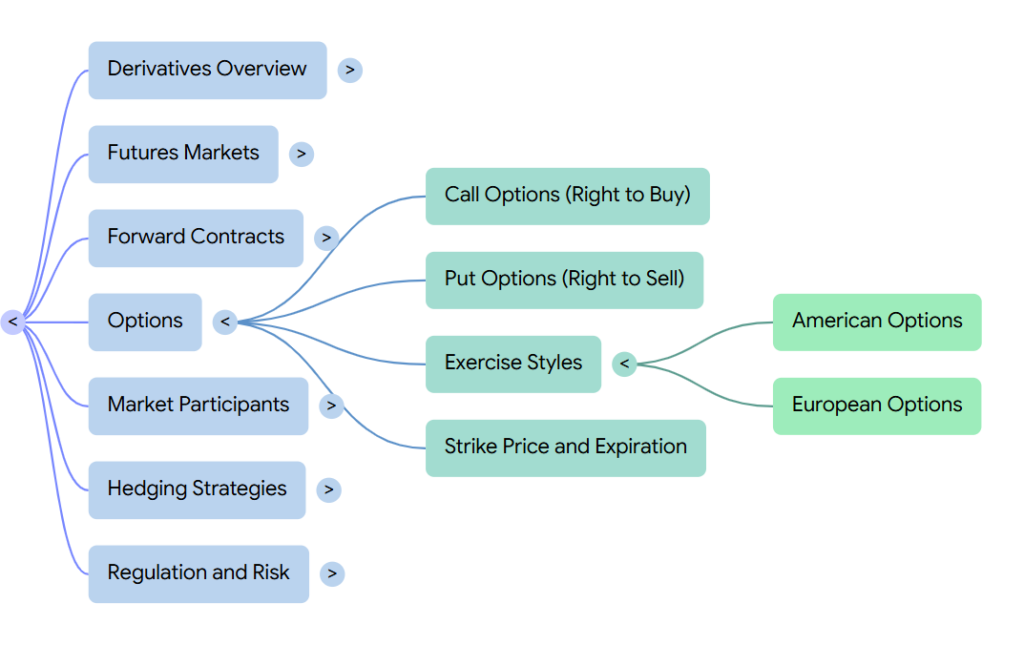
There are two primary types of options:
- Call Option: Gives the holder the right to buy the underlying asset by a certain date for a certain price.
- Put Option: Gives the holder the right to sell the underlying asset by a certain date for a certain price.
The specified price in the contract is known as the exercise price or strike price (K), and the final date in the contract is the expiration date or maturity (T ).
Options can be categorized by their exercise style:
- American Options: Can be exercised at any time up to the expiration date.
- European Options: Can be exercised only on the expiration date itself.
Most options traded on public exchanges are American-style. Because options do not obligate the holder to act, they serve as a form of insurance rather than risk neutralization. While forwards and futures cost nothing to enter initially, acquiring an option requires an upfront cash payment known as the option premium.
Option Positions and Payoffs
There are four primary market participants and positions in the options market: the buyers of calls, sellers of calls (writers), buyers of puts, and sellers of puts. Buyers hold long positions, whereas sellers hold short positions (also known as writing the option).
At expiration, the payoff to each position is calculated based on the terminal price of the underlying asset (ST ) and the strike price (K ):
- Long Call Payoff: max(ST −K, 0)
- Short Call Payoff: min(K −ST, 0)
- Long Put Payoff: max(K −ST, 0)
- Short Put Payoff: min(ST −K, 0)
For a call option, the price decreases as the strike price increases. For a put option, the price increases as the strike price increases. Both options generally become more valuable as their time to maturity increases.
Exchange-Traded vs. Over-the-Counter (OTC) Markets
Options trade in two distinct environments:
1. Exchange-Traded Markets
Exchange-traded options are highly standardized. Public option exchanges—such as the Chicago Board Options Exchange (CBOE), which pioneered standardized call options in 1973 and puts in 1977—trade options on thousands of individual stocks, stock indices, currencies, and futures contracts.
- Contract Specifications: Standardized contract sizes exist to facilitate liquidity; in the United States, a standard equity option contract represents the right to buy or sell exactly 100 shares.
- The Options Clearing Corporation (OCC): The OCC stands as an intermediary between buyers and writers. It guarantees that option writers will fulfill their obligations, managing credit risk through strict margin requirements.
- Position and Exercise Limits: Exchanges specify position limits (the maximum number of contracts a trader can hold on “one side of the market”) and exercise limits to prevent any individual or group from unduly influencing the market. For this purpose, long calls and short puts are grouped together, as are short calls and long puts.
- Regulatory Oversight: In the U.S., exchange-traded stock, index, currency, and bond options are federally regulated by the Securities and Exchange Commission (SEC), while options on futures are regulated by the Commodity Futures Trading Commission (CFTC).
2. Over-the-Counter (OTC) Markets
The OTC options market is significantly larger than the exchange-traded market. Its primary participants are banks, financial institutions, fund managers, and corporations.
- Customization and Exotics: Unlike exchange options, OTC contracts can be tailored with nonstandard strike prices, expiration dates, and contract sizes. These include highly structured nonstandard products known as exotic options.
- Credit Risk: Because no exchange clearing house is involved, OTC buyers are exposed to the default risk of the option writer. To mitigate this risk, bilateral collateral agreements are frequently required.
Margin Requirements
Because option buyers pay the premium in full upfront, they have no future obligations and are not subject to margin requirements. Conversely, option writers face potential liabilities if an option is exercised and must maintain funds in a margin account.
The margin requirements depend heavily on the position’s risk profile:
- Buying Options on Margin: In the U.S., options with maturities under 9 months cannot be bought on margin. For options with maturities greater than 9 months (such as LEAPS), investors can borrow up to 25% of the option’s value on margin.
- Writing Naked Options: A naked option is an option written without an offsetting stock position. The CBOE requires margin for a naked call to be the greater of two calculations:
- 100% of the option premium plus 20% of the stock price, minus any out-of-the-money amount.
- 100% of the option premium plus 10% of the stock price. (For index options, the 20% parameter is reduced to 15% due to lower volatility).
- Covered Calls: A covered call involves writing a call option on shares of a stock that the investor already owns. Since this position is far less risky, no margin is required on the written option itself.
Moneyness, Intrinsic Value, and Time Value
The book outlines the standard terminology used to describe options based on the relationship between the stock price (S ) and the strike price (K ):
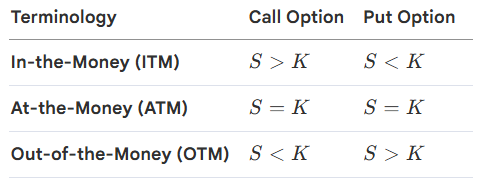
- Intrinsic Value: The value an option would have if it were exercised immediately. For a call, it is max(S−K, 0); for a put, it is max(K−S, 0).
- Time Value: The excess of the option’s total market value over its intrinsic value. An American option is always worth at least its intrinsic value because the holder can choose to exercise it immediately.
Underlyings and Non-Exchange Options
Options are highly versatile and trade on various underlying assets:
- Stocks and ETPs: Options on individual equities and exchange-traded products (like ETFs).
- Currencies, Indices, and Futures: Traded to hedge foreign exchange, stock market portfolios, or commodity contracts.
- FLEX Options: Exchange-traded contracts on equities and indices where traders can agree to customized, nonstandard terms (such as European-style exercise on a stock option).
The book draws an important distinction between exchange-traded stock options and corporate options:
- Warrants, Employee Stock Options, and Convertibles: These are call options issued directly by a corporation on its own stock. When they are exercised, the company issues new shares and sells them to the option holder, which dilutes the equity of existing shareholders.
- Exchange-Traded Options: When an exchange-traded option is exercised, the writer must purchase existing shares in the market to deliver to the buyer. The underlying company is not involved, and no share dilution occurs.
Contract Adjustments for Corporate Actions
The terms of exchange-traded options are adjusted to keep the relative positions of the buyer and writer unchanged during certain corporate events:
- Stock Splits and Stock Dividends: The strike price is reduced and the number of shares under the contract is increased. For instance, a 2-for-1 stock split converts a call option to buy 100 shares at $30 into a call to buy 200 shares at $15.
- Cash Dividends: Standard exchange-traded options are not adjusted for cash dividends. A cash dividend causes the stock price to drop on the ex-dividend date, which naturally decreases call values and increases put values. (An exception is made for large cash dividends exceeding of the stock price, where the OCC may reduce the strike price).
Factors Affecting Option Prices
There are six main factors that determine the price of a stock option:
- Current Stock Price (S0): Higher stock prices increase call values and decrease put values.
- Strike Price (K ): Higher strike prices decrease call values and increase put values.
- Time to Expiration (T ): For American options, a longer time to expiration always increases or maintains value because it offers more exercise opportunities.
- Volatility of the Stock Price (σ ): Higher volatility increases the values of both calls and puts because it increases the probability of extreme favorable outcomes while downside risk is capped.
- Risk-Free Interest Rate (r ): Higher interest rates in the economy increase call option values and decrease put option values.
- Amount of Future Dividends (D ): Dividends expected during the option’s life reduce the stock price on the ex-dividend date, which decreases call prices and increases put prices.
Put-Call Parity
For European call and put options with the same strike price (K ) and expiration date (T ) on a non-dividend-paying stock, a strict pricing relationship known as put-call parity must hold to prevent arbitrage: c+ Ke−rT=p+S0
If the market prices deviate from this equation, arbitrageurs can lock in a riskless profit by buying the undervalued side and shorting the overvalued side of the portfolio.
Early Exercise of American Calls
A fundamental result in the book is that it is never optimal to exercise an American call option on a non-dividend-paying stock early. There are two main reasons for this:
- Time Value of Money: It is always better to pay the strike price later rather than sooner to keep earning interest on those funds.
- Insurance Protection: A call option held instead of the stock provides insurance against the stock price falling below the strike price; exercising the option early forfeits this insurance.
If an investor wants to exit their position in an American call, they are always better off selling the option rather than exercising it, as the market price of the option will be higher than its immediate exercise (intrinsic) value.
Call Options (Right to Buy)
In the book, a call option is defined as a financial contract that gives the holder the right, but not the obligation, to buy an underlying asset by a certain date (the expiration date or maturity) for a certain price (the strike price or exercise price).
This right to choose distinguishes call options from forward and futures contracts, which represent binding obligations to perform. Because the holder of a call is not obligated to act, the option acts as a form of insurance (offering protection against adverse upward price moves while letting the holder benefit from favorable ones). Unlike forwards and futures, which cost nothing to enter initially, a call option requires an up-front payment called the option premium.
1. Call Option Positions and Payoffs
At expiration, the financial performance of a call option depends on the terminal price of the underlying asset (ST) relative to the strike price (K):
- Long Call (The Buyer): The buyer pays the premium up front to obtain the right to buy the asset. At maturity, the payoff is: max(ST−K, 0)
If the asset price ends up below the strike price, the buyer chooses not to exercise, losing only the initial premium paid. If the asset price is above the strike price, the option is exercised.
- Short Call (The Writer/Seller): The seller writes the option, receiving the premium up front but assuming the potential liability of delivering the asset if the buyer exercises. The seller’s payoff at maturity is the exact opposite of the buyer’s: min(K−ST, 0)
Because call writers face theoretically unlimited upside risk if the asset price rises sharply, they are subject to strict margin requirements to guarantee they will not default on their obligations.
Moneyness, Intrinsic Value, and Time Value
The book explains that the relationship between the current asset price (S) and the strike price (K) determines the call’s “moneyness”:
- In-the-Money (ITM): S > K (the option has positive intrinsic value).
- At-the-Money (ATM): S = K .
- Out-of-the-Money (OTM): S < K.
The total value of a call option prior to expiration is the sum of its intrinsic value (max(S−K, 0) —the value of the option if exercised immediately) and its time value (the excess of the option’s price over its intrinsic value).
2. European vs. American Calls and Early Exercise
A key structural distinction exists between European call options (which can only be exercised on the expiration date itself) and American call options (which can be exercised at any time up to the expiration date). This difference dictates their early-exercise behavior:
- On Non-Dividend-Paying Stocks: A fundamental tenet in the book is that it is never optimal to exercise an American call option on a non-dividend-paying stock early. There are two economic reasons for this:
- Time Value of Money: It is always better to pay the strike price K later rather than sooner, allowing the investor to keep earning interest on those funds in the meantime.
- Insurance Protection: A call option provides insurance against the stock price falling below the strike price; exercising the option early converts the option into stock, which immediately forfeits this downside insurance. Consequently, on a non-dividend-paying stock, an American call is worth exactly the same as a European call (C=c ).
- On Dividend-Paying Stocks: When a stock pays dividends, the stock price drops on the ex-dividend date. This drop is unfavorable for call holders. Therefore, it can be optimal to exercise an American call early, but only immediately before an ex-dividend date. It is never optimal to exercise early at any other time.
3. Pricing Boundaries and Put-Call Parity
To prevent risk-free arbitrage in financial markets, the price of a call option must fall within strictly defined mathematical bounds:
- Upper Bound: A call option can never be worth more than the underlying asset itself. Thus, the current stock price (S0) serves as an absolute upper bound for both European and American calls (c ≤ S0 and C ≤ S0 ).
- Lower Bound (No Dividends): A European call option on a non-dividend-paying stock is always worth at least: max(S0−Ke−rT, 0)
- Lower Bound (With Dividends): If a stock pays dividends with a present value of during the option’s life, the lower bound is adjusted to: max(S0−D−Ke−rT, 0)
- Put-Call Parity: For European options with the same strike price (K ) and expiration (T ) on a non-dividend-paying stock, put-call parity establishes a strict pricing relationship between calls (c), puts (p), and the spot stock price (S0): c + Ke−rT = p + S0
If dividends are paid, this relationship is modified to c + D + Ke−rT= p + S0 .
4. Exchange-Traded vs. Corporate Call Options
The book draws a critical distinction between standardized, exchange-traded call options and call options issued directly by corporations:
- Exchange-Traded Calls: These options are standardized contracts cleared through a central clearing house (like the Options Clearing Corporation). When a buyer exercises an exchange-traded call, the clearing house assigns a short position writer to deliver existing shares purchased in the market. No new shares are created, and no share dilution occurs.
- Corporate Call Options (Warrants, Employee Stock Options, Convertibles): These are call options written directly by a company on its own stock. When these corporate instruments are exercised, the company must issue brand-new shares of stock and sell them to the holder for the strike price. This process increases the total number of outstanding shares and dilutes the equity of existing shareholders.
- Employee Stock Options: Because employee stock options cannot be sold to a third party, employees who want to realize a cash benefit or diversify their portfolios are forced to exercise their vested options early and sell the acquired stock, leading to a much higher rate of early exercise than is seen with standard exchange-traded American options.
5. The Black-Scholes-Merton Call Formula
For European call options (or American calls on non-dividend-paying stocks), the Black-Scholes-Merton pricing formula is defined as:
c = S0N(d1) − Ke−rTN(d2)
Where:
In this model, N (d2) has a very simple interpretation: it represents the exact probability that the call option will be exercised in a risk-neutral world. Meanwhile, the term S0N (d1)erT represents the expected stock price at maturity in a risk-neutral world, counting stock prices less than the strike price as zero.
Put Options (Right to Sell)
In the book, a put option is defined as a financial contract that gives the holder the right, but not the obligation, to sell an underlying asset by a certain date (the expiration date, or maturity T ) for a certain price (the strike or exercise price K ). Unlike call options, which represent the right to buy and are used to benefit from rising prices, put options are designed to protect against or speculate on declining asset prices.
1. Put Option Positions, Payoffs, and Moneyness
There are two main participants on the put side of the options market: buyers of puts (who hold long positions) and sellers of puts (who write puts and hold short positions).
- Long Put (The Buyer): The buyer pays an up-front premium to purchase the option, which acts as a form of insurance. At maturity, the payoff of a long European put option on one unit of stock is: max(K−ST, 0)
where ST is the terminal spot price of the asset. The buyer’s potential loss is strictly limited to the initial premium paid.
- Short Put (The Writer/Seller): The seller writes the put, receiving the premium up front but assuming the obligation to buy the stock at the strike price if the option is exercised (assigned). The short put’s payoff at maturity is: min(ST−K, 0)
which exposes the writer to significant downside risk if the asset price falls sharply.
Moneyness and Intrinsic Value
The relationship between the current spot price of the stock (S) and the strike price (K) determines the put’s moneyness:
- In-the-Money (ITM): S < K (the option has positive intrinsic value).
- At-the-Money (ATM): S = K .
- Out-of-the-Money (OTM): S > K .
The total value of a put option is the sum of its intrinsic value (max(K − S, 0), which is what the option would be worth if exercised immediately) and its time value (the option price minus its intrinsic value).
2. Factors Affecting Put Option Prices
According to the book, there are six main variables that govern the value of a stock put option:
- Current Stock Price (S0): A higher stock price reduces the likelihood of the put option expiring in the money, decreasing the put’s value.
- Strike Price (K): A higher strike price increases the potential payoff upon exercise, making the put option more valuable.
- Volatility (σ): Higher volatility increases the probability that the asset price will make extreme downward movements, which increases the value of the put (since downside risk is capped at the premium).
- Risk-Free Interest Rate (r): Higher interest rates in the economy reduce the present value of the strike price received in the future, which decreases the put option’s value.
- Amount of Future Dividends (D): Dividends reduce the stock price on the ex-dividend date. Because a lower stock price increases a put’s value, expected dividends are favorable to put options.
- Time to Expiration (T ):
- American Puts: A longer time to expiration always increases or maintains the value of an American put, as it offers more exercise opportunities.
- European Puts: The relationship with time to maturity is uncertain (?). A longer-life European put can sometimes be less valuable than a shorter-life European put (for instance, if the option is deep-in-the-money and early exercise would be optimal but is blocked, or if a large dividend is paid during its life).
3. Pricing Boundaries and Put-Call Parity
To prevent risk-free arbitrage, put option prices must fall within strict boundaries:
- Upper Bounds: An American put can never be worth more than its strike price (P ≤ K). A European put can never be worth more than the present value of the strike price ( p ≤ Ke−rT).
- Lower Bounds (No Dividends): A European put option on a non-dividend-paying stock is always worth at least: max(Ke−rT − S0, 0)
- Lower Bounds (With Dividends): If a stock pays dividends with a present value of during the option’s life, the lower bound is adjusted to: max(D + Ke−rT –S0, 0)
- Put-Call Parity: For European options with the same strike price (K) and expiration (T ), put-call parity establishes a fundamental equilibrium between calls (c), puts (p), and the spot price of the stock (S0): c + Ke−rT = p + S0
If the stock pays dividends, this relationship is modified to c + D + Ke−rT = p + S0 . If market prices deviate from these equations, arbitrageurs can lock in riskless profits.
4. American Puts and the Early Exercise Decision
A key distinction in the book is that it can be optimal to exercise an American put option on a non-dividend-paying stock early. This stands in direct contrast to American call options, which should never be exercised early if there are no dividends.
- The Trade-off of Early Exercise: Exercising an American put early is a trade-off between the time value of money (the benefit of receiving the cash strike price K immediately to earn interest) and the insurance value of the put (the benefit of keeping the option open to see if the stock price drops even further).
- Extreme Case: If the underlying stock price drops to virtually zero, an investor who exercises immediately realizes a gain of K. Waiting can never yield more than K (since stock prices cannot be negative) but delays receiving the money. Therefore, the option should be exercised immediately.
- Key Drivers: Early exercise of an American put becomes more attractive as the stock price S0 decreases, the risk-free rate increases, and the volatility σ decreases.
- Valuation Impact: Because early exercise is sometimes optimal, an American put is always worth more than its European counterpart (P > p). Consequently, a European put can sometimes sell for less than its intrinsic value, whereas an American put must always be worth at least its intrinsic value (P ≥ max(K − S0, 0).
5. Margin Requirements for Put Writers
While put option buyers pay the premium in full up front and face no future obligations or margin requirements, put writers face ongoing liabilities and must maintain a margin account.
The initial and maintenance margin required by exchanges (such as the CBOE) for a written naked put option is calculated daily and must be the greater of:
- 100 of the option premium proceeds plus 20 of the underlying share price, minus any amount by which the option is out of the money.
- 100 of the option premium proceeds plus 10 of the exercise price.
6. The Black-Scholes-Merton Pricing Formula for European Puts
The pricing formula for a European put option on a non-dividend-paying stock under the Black-Scholes-Merton model is:
p = Ke−rTN(−d2) − S0N(−d1)
Where:
In this model, the term N(−d2) represents the probability that the put option will be exercised in a risk-neutral world, while the term S0N(−d1) is related to the discounted expected value of the stock price at maturity when only stock prices below the strike price are counted.
Exercise Styles
In the book, exercise styles define when the holder of an option is contractually permitted to exercise their right to buy or sell the underlying asset. These styles do not refer to the geographic location of the option or the exchange, but rather describe the timing rules established by the contract specifications. The three primary exercise styles discussed are European, American, and Bermudan.
European Options
- Definition: A European option can be exercised only on the expiration date itself.
- Analytical Advantages: Because exercise is restricted to a single future date, European options are generally easier to analyze and value than American options. Exact pricing models, such as the analytic Black-Scholes-Merton formula, are readily used for European-style contracts.
- Pricing Behaviors: Unlike American options, European options do not automatically become more valuable as their time to expiration increases. For instance, if a large dividend is expected during the life of a long-dated European call, the stock price decline on the ex-dividend date can make a longer-maturity European call less valuable than a shorter-maturity one. Similarly, deep-in-the-money European puts can sometimes be worth less than shorter-maturity puts because early exercise is prohibited.
American Options
- Definition: An American option can be exercised at any time up to and including the expiration date.
- Market Dominance: Most options traded on public exchanges are American-style.
- Value and Expiration Relationship: Because the holder of an American option has all the exercise opportunities of a European counterpart plus more, an American option is always worth at least as much as an otherwise identical European option. Consequently, an American option’s price will always increase or stay the same as the time to expiration increases.
- Early Exercise Decisions: A major focus of the book is evaluating when the early exercise of an American option is economically optimal:
- Calls on Non-Dividend Stocks: It is never optimal to exercise an American call on a non-dividend-paying stock early. This is because early exercise forfeits the option’s insurance value (protection against the stock falling below the strike price) and the interest that can be earned by delaying the strike price payment. Therefore, these options are worth exactly the same as European calls.
- Calls on Dividend Stocks: When a stock pays dividends, it can be optimal to exercise an American call early, but only immediately before an ex-dividend date.
- Puts: It can be optimal to exercise an American put early, particularly when it is sufficiently deep in the money. Early exercise represents a trade-off between the time value of money (receiving the strike price immediately to earn interest) and the insurance value of the put (waiting to see if the stock price drops even further).
Bermudan and Nonstandard Styles
- Bermudan Options: Commonly traded in the over-the-counter (OTC) market, a Bermudan option allows early exercise only on specified dates during its life. Its name is a geographical play on words, as Bermuda lies between Europe and America.
- Other Nonstandard American Options: The OTC market also features options with other custom exercise styles, such as those with an initial “lock-out” period where early exercise is restricted for a portion of the option’s life, or options where the strike price changes during the life of the contract.
- FLEX Options: Standard exchanges, such as the CBOE, offer Flexible (FLEX) options that allow institutional traders to customize options by changing standard exercise styles—for example, making an equity option European when it is conventionally American.
American Options
In the taxonomy of exercise styles, the book defines American options by their defining timing rule: they can be exercised at any time up to and including the expiration date. This is in direct contrast to European options, which restrict exercise solely to the expiration date itself. While European options are often simpler to analyze analytically, most exchange-traded options are American-style.
The Boundary and Pricing Relationships
Because of their flexible exercise style, American options exhibit distinct pricing behaviors compared to their European counterparts:
- The European Pricing Floor: An American option provides all the rights of an identical European option plus additional timing flexibility. Consequently, an American option is always worth at least as much as an otherwise identical European option (meaning C ≥ c and P ≥ p ).
- The Intrinsic Value Floor: Because the holder can choose to exercise the option immediately, an American option must always be worth at least its intrinsic value prior to expiration (i.e., C ≥ max(S0−K, 0) and P ≥ max(K−S0 , 0)).
- Put-Call Parity Limits: While put-call parity is a strict equation for European options, it does not hold for American options. Instead, arbitrageurs can only establish upper and lower bounds on the difference between American call and put prices on a non-dividend-paying stock: S0 − K ≤ C − P ≤ S0 − Ke−rT
The Early Exercise Decision Across Asset Classes
A central theme of the exercise style discussion in the book is determining exactly when a rational investor should forgo the remaining life of an American option and exercise it early. This decision depends heavily on the type of option and the underlying asset:
1. American Calls on Stocks
- Non-Dividend-Paying Stocks: It is never optimal to exercise an American call option early if the underlying stock pays no dividends. There are two main economic reasons for this:
- Time Value of Money: Delaying exercise is always preferable because it allows the holder to keep the cash strike price (K ) in their pocket to earn interest for a longer period.
- Insurance Protection: A call option provides downside insurance, protecting the holder against the stock falling below the strike price. Exercising early converts the option into stock, which immediately forfeits this insurance. Because early exercise is never optimal, an American call on a non-dividend stock is worth exactly the same as its European counterpart (C=c).
- Dividend-Paying Stocks: When a stock pays dividends, the stock price drops on the ex-dividend date. This drop is unfavorable for call holders. Consequently, it can be optimal to exercise an American call early, but only immediately before an ex-dividend date.
2. American Puts on Stocks
Unlike calls, it can be optimal to exercise an American put option on a non-dividend-paying stock early, particularly if the option is sufficiently deep in the money.
- This represents a trade-off between the time value of money (the benefit of receiving the cash strike price K immediately to earn interest) and the insurance value of the put (the benefit of keeping the option open to see if the stock price drops even further).
- If the stock price drops to virtually zero, waiting can never yield more profit (since stock prices cannot be negative) but delays receiving the funds. Therefore, immediate exercise is optimal. Because early exercise is sometimes optimal, an American put is always worth more than a European put (P>p).
3. Currency and Index Options
Because foreign currencies and stock indices act as assets providing known yields, their early-exercise dynamics are adjusted:
- Currencies: The foreign risk-free rate (rf ) acts like a dividend yield. American call options on high-interest currencies (which are expected to depreciate) and American put options on low-interest currencies are the most likely to be exercised early.
- Indices: The dividend yield (q) plays the same role. Call options on high-dividend indices and put options on low-dividend indices are the most likely to be exercised prior to maturity.
4. Futures Options
Traded futures options are usually American-style. Assuming a positive risk-free rate, there is always some chance that it will be optimal to exercise an American futures option early, making them worth more than their European counterparts.
5. Employee Stock Options
While regular call options are transferable, employee stock options cannot be sold to a third party. To realize any cash benefit or diversify their portfolios, employees are forced to exercise their vested options early and sell the stock, leading to a much higher rate of early exercise than is seen with standard exchange-traded options.
European Options
European options are defined strictly by their exercise timing rule: they can be exercised only on the expiration date itself. In the book, this style is contrasted with American options, which permit exercise at any time during the option’s life. This distinction is purely contractual and has nothing to do with geography, as some options traded on North American exchanges are European-style [41 note 3, 255].
Standard exchange-traded equity options in the United States are typically American-style, but index options (such as the SPX, NDX, and DJX) are commonly European-style. Furthermore, exchange-traded FLEX options allow institutional traders to customize contracts, such as making an equity option European when it is conventionally American.
1. Analytical Simplicity and Valuation
European options occupy a central place in derivatives pricing because they are generally much easier to analyze and value than American options. In fact, several key analytical concepts in the book rely on this style:
- The Black-Scholes-Merton Model: The famous closed-form Black-Scholes-Merton formulas are exact solutions derived specifically for the prices of European call and put options on non-dividend-paying stocks.
- Deducing American Properties: Because European options can be valued analytically, traders and financial engineers frequently deduce the properties of American options from their European counterparts.
- Numerical Convergence: When pricing options numerically using a binomial tree, as the number of time steps increases toward infinity, the calculated European option price converges exactly to the analytical Black-Scholes-Merton price [442, 469, 845 note 1].
2. Pricing Bounds and the Early Exercise Decision
The inability to exercise early creates several distinct pricing boundaries and relationships for European options:
- The American Premium: Because an American option offers all the rights of an identical European option plus early exercise flexibility, an American option is always worth at least as much as its European counterpart (C ≥ c and P ≥ p).
- Equivalence for Calls (No Dividends): In the absence of dividends, it is never optimal to exercise an American call option early. Consequently, an American call option on a non-dividend-paying stock is equivalent in value to a European call (C = c).
- The Put Discrepancy: Conversely, it can be optimal to exercise an American put option early when it is deep in the money. Because the European put forbids early exercise, an American put is worth more than its European counterpart (P > p). This restriction means a European put option can sometimes sell for less than its intrinsic value, whereas an American put must always be worth at least its intrinsic value.
3. Time to Expiration Anomalies
Unlike American options, which always increase or maintain their value as their maturity extends, European options do not automatically become more valuable as the time to expiration increases. This is due to cash flows or exercise restrictions during the option’s life:
- Dividends and Calls: If a stock is expected to pay a very large dividend during the option’s life, a shorter-term European call can be worth more than a longer-term European call because the dividend payment causes the stock price to decline on the ex-dividend date.
- Prohibition of Put Exercise: For deep-in-the-money puts where early exercise would be optimal but is prohibited, a shorter-maturity European put option can end up being more valuable than a longer-maturity European put option.
4. Put-Call Parity and Implied Volatility
A fundamental pricing relationship known as put-call parity holds strictly for European options. For options on a non-dividend-paying stock, the relationship is: c + Ke−rT = p + S0
And for dividend-paying stocks (where is the present value of expected dividends), it is adjusted to: c + D + Ke−rT = p + S0 .
Because this relationship is based on a risk-free arbitrage argument that does not assume any particular probability distribution for the future asset price, the dollar pricing error of the Black-Scholes-Merton model is identical for both European calls and puts. This ensures that the implied volatility of a European call option is exactly equal to the implied volatility of a European put option with the same strike price and maturity. If market prices deviate from these parity equations, arbitrageurs can lock in risk-free profits by buying the underpriced side and shorting the overpriced side of the parity equation.
Strike Price and Expiration
In the book, the strike price (also referred to as the exercise price) and the expiration date (or maturity) are the two foundational parameters that define any option contract. While standard exchange-traded options have these terms strictly codified by the exchange, over-the-counter (OTC) and FLEX options allow for customized strike prices and expiration dates to fit the precise needs of market participants.
The Strike Price (Exercise Price)
The strike price (K) is the specified price in the option contract at which the holder has the right to buy (in the case of a call option) or sell (in the case of a put option) the underlying asset.
1. Exchange Standardization and Spacing
For standard exchange-traded stock options, the exchange chooses the strike prices at which options can be written. They are typically spaced at standardized intervals depending on the price of the stock:
- $2.50 spacing when the stock price is between $5 and $25.
- $5.00 spacing when the stock price is between $25 and $200.
- $10.00 spacing for stock prices above $200.
2. Moneyness and Intrinsic Value
The relationship between the current asset price (S) and the strike price (K) determines the option’s “moneyness” and its intrinsic value:
- Moneyness: Options are categorized as in-the-money, at-the-money, or out-of-the-money depending on whether immediate exercise would yield a positive payoff. For example, a call is in-the-money when S > K, while a put is in-the-money when S < K.
- Intrinsic Value: This is the value of an option if it were exercised immediately. For a call, it is calculated as max(S−K, 0), and for a put, it is max(K−S, 0). Consequently, as the strike price increases, a call option becomes less valuable, while a put option becomes more valuable.
3. Adjustments for Corporate Actions
Although the strike price is generally fixed, standard exchanges adjust the terms of option contracts to prevent corporate actions from unfairly altering the wealth of options buyers and writers:
- Stock Splits: In an -for- stock split, the strike price is reduced to m/n of its previous value (and the number of shares covered by the contract is increased by n/m). For example, a 2-for-1 split converts a call option with a strike price of $30 on 100 shares into a contract for 200 shares at a strike price of $15.
- Stock Dividends: Stock dividends are treated in the same manner as stock splits. A 20% stock dividend is essentially a 6-for-5 split, which reduces the strike price to 5/6 of its previous value.
- Rights Issues: The strike price is reduced by the calculated theoretical price of the rights.
- Cash Dividends: Standard exchange-traded options are not adjusted for ordinary cash dividends. However, for large, unexpected cash dividends exceeding 10% of the stock price, a committee of the Options Clearing Corporation (OCC) may reduce the strike price by the dividend amount.
The Expiration Date (Maturity)
The expiration date (T ) is the final date specified in the option contract. Once this date passes, the option expires and the contract ceases to exist.
1. Standard Expiration Dates and Cycles
For standard exchange-traded stock options in the United States, the precise expiration date is the third Friday of the expiration month. Stock options trade on monthly cycles (such as the January, February, or March cycles) to ensure that short-term maturities are always available.
- Weeklys: Options that expire on Fridays other than the third Friday of a month are known as “weeklys”.
- LEAPS (Long-Term Equity Anticipation Securities): Exchanges also offer longer-term options that can have expiration dates up to 39 months in the future. For equity LEAPS, the expiration date is always the third Friday of a January.
2. The Impact of Time to Expiration on Option Prices
Maturity is a critical pricing factor because options generally lose value over time, a phenomenon known as time decay (measured by theta). However, the exact impact of extending the time to maturity differs by exercise style:
- American Options: A longer time to expiration always increases or maintains the value of an American option (C or P ). This is because the holder of a long-life American option has all the exercise opportunities of a short-life option, plus more.
- European Options: A longer time to expiration usually increases European option values, but this relationship is not guaranteed:
- European Calls: If a stock is expected to pay a very large dividend during the life of a longer-term option, the drop in the stock price on the ex-dividend date can make a 2-month European call worth less than an otherwise identical 1-month European call.
- European Puts: Because early exercise is sometimes optimal for deep-in-the-money puts, but is contractually forbidden for European-style puts, a shorter-maturity European put option can sometimes be more valuable than a longer-maturity European put option.
The Option Series
Together, the strike price and the expiration date uniquely identify a traded contract. In the options market, all options of the same type (calls or puts) on a stock are referred to as an option class (e.g., Apple calls). Within that class, a specific contract defined by an exact strike price and expiration date is called an option series (e.g., Apple 320 September 2020 calls).
— Linden Lake
This series:
→ Book Review (1 of 7): Options, Futures, and Other Derivatives – Derivative Overview
→ Book Review (2 of 7): Options, Futures, and Other Derivatives – Futures Markets
→ Book Review (3 of 7): Options, Futures, and Other Derivatives – Forward Contracts
→ Book Review (4 of 7): Options, Futures, and Other Derivatives – Options
→ Book Review (5 of 7): Options, Futures, and Other Derivatives – Market Participants
→ Book Review (6 of 7): Options, Futures, and Other Derivatives – Hedging Strategies
→ Book Review (7 of 7): Options, Futures, and Other Derivatives – Regulation and Risk
Leave a Reply