
According to the book, a futures contract is a standardized agreement between two parties to buy or sell an asset at a certain time in the future for a certain price. Unlike privately negotiated over-the-counter (OTC) forward contracts, futures contracts are traded on regulated exchanges, which establish standardized features to facilitate active trading.
The Evolution and Structure of Futures Exchanges
The roots of modern futures markets began with agricultural trade. The book highlights key milestones in this evolution:
- The Chicago Board of Trade (CBOT): Established in 1848, its initial purpose was to standardize the quantities and qualities of traded grains. This effort quickly led to “to-arrive” contracts, the precursors to modern futures, which attracted speculators interested in trading the contract itself rather than the physical grain.
- The Chicago Mercantile Exchange (CME): Founded in 1919, the CME eventually merged with the CBOT to form the CME Group, which also includes the New York Mercantile Exchange (NYMEX) and the Kansas City Board of Trade (KCBT).
- The Shift to Electronic Trading: Historically, futures exchanges relied on the physical open outcry system, where traders met in pits and used shouts and hand signals to transact. Today, exchanges have almost entirely replaced this system with electronic trading, where computers automatically match orders entered via keyboards. This transition has also fueled the rise of algorithmic high-frequency trading (HFT).
Contract Standardization
To enable high liquidity, the exchange strictly defines the specifications of each futures contract so that traders only need to negotiate the price. These standardized specifications include:
- The Underlying Asset: For commodities, the exchange defines the acceptable grades (such as “No. 2 Yellow” corn, with standard price adjustments allowed for other grades). Financial assets, such as stock indices, currencies, and Treasury bonds, are also precisely defined.
- Contract Size: The exchange must balance the needs of different market participants. If a contract size is too large, smaller retail traders are excluded; if it is too small, trading becomes expensive. To address this, exchanges often introduce “mini” contracts (such as the Mini S&P 500) to attract smaller traders.
- Delivery Locations and Months: The exchange specifies exact locations (especially important for physical commodities with high transportation costs) and the precise delivery months and periods during which delivery can occur.
- Price and Position Limits: The exchange defines price quotation conventions and establishes daily price limits (limit up or limit down) to prevent speculative excesses. Position limits are also set to restrict the maximum number of contracts a speculator can hold to prevent them from exercising undue influence on the market.
Margin Accounts and Daily Settlement
One of the most critical distinctions between forward and futures contracts is how they handle cash flows and default risk. While a forward contract is settled only at maturity, a futures contract is settled daily through a process called marking to market.
- Initial and Maintenance Margin: When entering a contract, a trader must deposit funds into a margin account (the initial margin). The exchange clearing house sets minimum margin levels based on the price variability of the underlying asset. If the balance falls below a designated maintenance margin (usually about 75% of the initial margin), the broker issues a margin call requiring the trader to top up the account to the initial margin level.
- Variation Margin: At the end of each trading day, the margin account is adjusted to reflect the contract’s gain or loss, resetting the contract’s value back to zero. This daily flow of funds is referred to as variation margin. Unlike the OTC market, cash variation margin on exchange-traded futures does not earn interest.
- Symmetry of Shorting: Because of the margin system, taking a short position in the futures market is just as easy as taking a long position, which is not the case in the spot market where shorting involves complex borrowing of assets.
The Clearing House Intermediary
Every transaction executed on an exchange is routed to the exchange clearing house. The clearing house acts as a centralized intermediary, legally stepping in to become the buyer to every seller and the seller to every buyer. Consequently, market participants do not need to worry about the creditworthiness of their counterparties.
The robustness of this system was famously demonstrated during the October 19, 1987, stock market crash. Despite the bankruptcy of some brokers whose clients defaulted on margin calls, the clearing houses held sufficient funds to guarantee that every trader with a winning short position was paid in full.
Convergence and Close-Outs
Although the possibility of final delivery is what ties the futures price to the spot price, the vast majority of futures contracts are never actually delivered. Instead, traders choose to close out their positions prior to the delivery period by entering into an equal and opposite transaction.
If a contract is held to maturity, the futures price converges directly to the spot price of the underlying asset. If the futures price were higher than the spot price during the delivery period, an arbitrageur would short the futures, buy the spot asset, and deliver it for an instant, riskless profit. This arbitrage activity forces the prices to align. Depending on the contract, final settlement occurs either through physical delivery (exchanging a warehouse receipt or wire transfer for cash) or through cash settlement (used for contracts like stock index futures where physical delivery of the underlying portfolio is impractical).
The Three Categories of Traders
The efficiency and liquidity of futures markets are driven by three groups of participants:
- Hedgers: They use futures to reduce or eliminate a pre-existing risk. A short hedge is used when a trader already owns (or expects to own) an asset and wants to lock in a future sales price. A long hedge is appropriate when a company knows it must purchase an asset in the future and wants to lock in a purchase price now.
- Speculators: Rather than avoiding risk, they take positions in the market to bet on the future direction of prices. Speculators highly value futures because the margin system provides them with leverage, allowing them to take large positions with a relatively small up-front cash outlay. Speculators are categorized as scalpers (holding positions for minutes), day traders (closing positions before the end of the day), or position traders (holding positions for long periods).
- Arbitrageurs: They exploit temporary pricing discrepancies between different markets to lock in a riskless profit. Their continuous search for mispricing ensures that futures prices align closely with theoretical values.
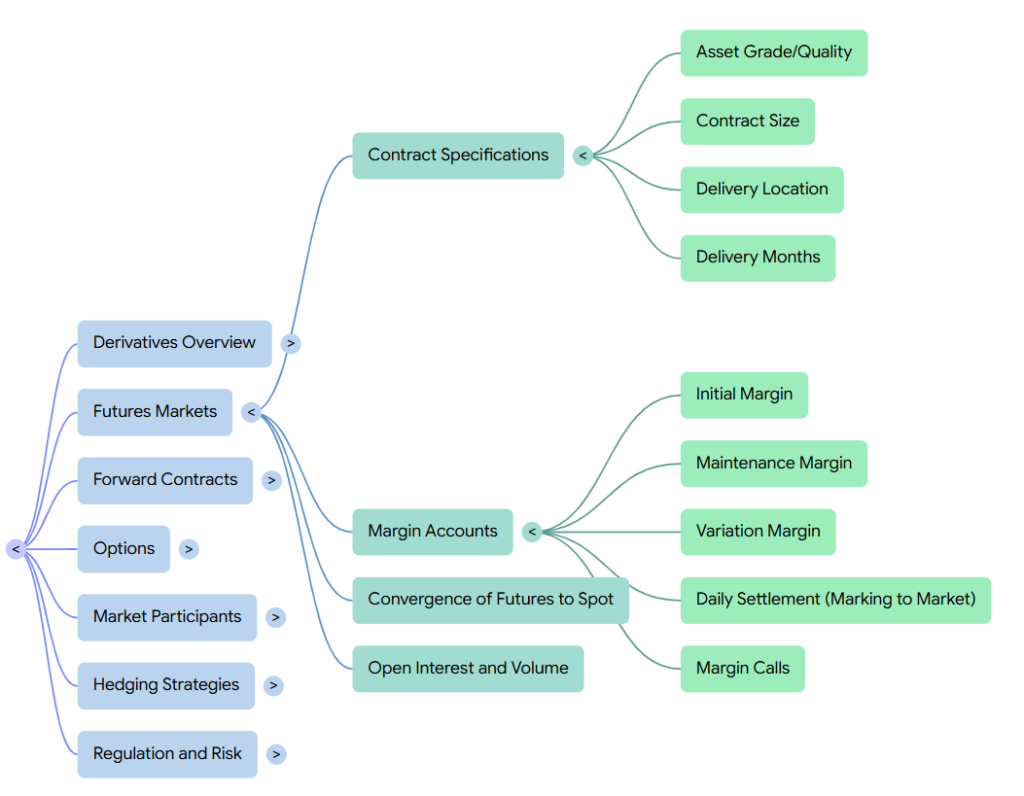
Contract Specifications
In the book, contract specifications are described as the detailed, standardized terms defined by a futures exchange that govern the exact nature of the agreement between the buyer (long position) and the seller (short position). Because futures contracts are traded publicly on exchanges rather than negotiated privately, standardization is essential to create a highly liquid market where participants only need to agree on price. Under U.S. regulation, new contracts must be approved by the Commodity Futures Trading Commission (CFTC) before trading can begin.
According to the book, when developing a new futures contract, the exchange must specify several critical parameters in detail:
1. The Underlying Asset and Quality
For physical commodities, where the quality of the asset can vary significantly, the exchange must stipulate the acceptable grade or grades.
- Quality Standardization: For example, the Intercontinental Exchange (ICE) specifies that the asset for its orange juice contract must be U.S. Grade A frozen concentrates with a Brix value of at least 62.5 degrees.
- Substitutions and Price Adjustments: Often, the exchange allows alternative grades for delivery, but adjusts the final price received depending on the chosen grade. In the CME Group’s corn futures contract, the standard grade is “No. 2 Yellow,” but No. 1 Yellow can be delivered for a premium of 1.5 cents more per bushel, while No. 3 Yellow is deliverable at a discount of 2 to 4 cents less per bushel.
- Financial Assets: Financial assets are generally well-defined and unambiguous (e.g., there is no need to specify the quality grade of a Japanese yen). However, they still have unique eligibility specifications. For instance, the Chicago Board of Trade (CBOT) Treasury bond contract specifies that any U.S. Treasury bond with a maturity between 15 and 25 years is deliverable, using a formula to adjust the price received based on the coupon and maturity date of the delivered bond.
2. Contract Size
The contract size specifies the exact quantity of the underlying asset to be delivered under a single contract. The book notes that exchanges face a key balancing act when deciding contract size:
- The Size Trade-off: If the contract size is too large, smaller retail hedgers or speculators will be unable to use the contract due to the high financial exposure. Conversely, if the size is too small, trading becomes inefficient and expensive because transaction costs are incurred on a per-contract basis.
- Varying Scales: Consequently, the contract value for physical commodities typically ranges from $10,000 to $20,000, whereas financial futures represent much higher values (e.g., the face value of the underlying in a CBOT Treasury bond futures contract is $100,000).
- Mini Contracts: To attract smaller retail participants, exchanges often introduce “mini” contracts, such as the CME Group’s Mini Nasdaq-100 contract, which covers 20 times the index instead of the regular contract’s 100 times.
3. Delivery Arrangements and Timing
Since physical delivery can be highly expensive and logistically complex, exchanges must standardize where and when delivery occurs.
- Delivery Locations: This specification is particularly crucial for commodities with substantial transportation costs. For example, delivery for ICE’s frozen concentrate orange juice is restricted to exchange-licensed warehouses in Florida, New Jersey, or Delaware. If alternative locations are permitted, the price received by the short position may be adjusted depending on the chosen location.
- Delivery Months: Futures contracts are named after their designated delivery months. The exchange defines the precise period during that month when delivery can take place, which often spans the entire month. Trading in a specific contract ceases a few days before the final delivery dates.
- Short Party Options: Generally, when contract specifications allow alternatives for delivery locations or asset grades, the party with the short position (the seller) has the right to choose which options to exercise.
4. Price Quotes, Price Limits, and Position Limits
To ensure orderly trading, the exchange sets precise rules on how prices are communicated and how much market participants can trade:
- Quotation Conventions: The exchange defines the exact pricing units. For instance, crude oil futures are quoted in dollars and cents, whereas Treasury bond and note futures are quoted in dollars and thirty-seconds of a dollar per $100 of face value.
- Daily Price Limits: Most contracts specify maximum daily price movements. If a price drops by the daily limit from the previous day’s close, it is limit down; if it rises by that amount, it is limit up. Normally, trading halts for the day once a limit move is reached. The primary purpose of these limits is to prevent extreme, volatile price swings driven by speculative excesses.
- Position Limits: These represent the maximum number of contracts a speculator is allowed to hold. The exchange implements position limits to prevent any single speculator from exercising undue, stabilizing influence over market prices.
Asset Grade/Quality
In the book, when an exchange develops a new futures contract, it must specify the contract terms in detail to make trading possible. A critical component of these contract specifications is defining the underlying asset’s grade and quality, particularly when dealing with physical commodities.
The Necessity of Specifying Asset Grade and Quality
For physical commodities, there is often significant variation in the quality of the assets available in the marketplace. Therefore, the exchange must explicitly stipulate the acceptable grade or grades of the commodity in the contract specifications. If the quality of the underlying asset were left incompletely specified, it would create significant issues for market participants.
To maintain strict quality control, some contracts define very precise standards:
- ICE Orange Juice Futures: The Intercontinental Exchange (ICE) specifies that the asset must be frozen concentrates of U.S. Grade A with a Brix value of not less than 62.5 degrees.
Substitutions, Premiums, and Discounts
To prevent squeezes and facilitate a more flexible delivery process, exchanges often allow a range of alternative grades to be delivered, adjusting the final price received depending on the grade chosen.
- CME Group Corn Futures: The standard deliverable grade is “No. 2 Yellow”. However, the contract specifications allow substitutions:
- No. 1 Yellow can be delivered at a premium of 1.5 cents per bushel more than the standard No. 2 Yellow price.
- No. 3 Yellow can be delivered at a discount of 2 to 4 cents per bushel less than the standard price, depending on specific indicators of quality.
The Short Party’s Delivery Option
When the exchange specifies alternative grades for delivery, the party with the short position (the seller) has the right to choose which grade of the asset will actually be delivered. When the short party is ready to initiate delivery, they file a “notice of intention to deliver” with the exchange clearing house, which specifies the exact grade of the commodity they have selected to deliver. The price paid is adjusted accordingly based on the rules established by the exchange.
Financial Assets vs. Commodities
In contrast to physical commodities, the book notes that the financial assets underlying futures contracts are generally well-defined and unambiguous; for instance, there is no need to specify the “grade” of a Japanese yen. However, some financial contracts still require a form of standardization for deliverable assets. For example, in the Chicago Board of Trade’s (CBOT) Treasury bond futures, the underlying asset can be any U.S. Treasury bond with a maturity between 15 and 25 years. Rather than adjusting for physical quality, the exchange uses a standardized formula (the conversion factor) to adjust the cash received by the short position based on the coupon and maturity date of the specific bond delivered.
Contract Size
In the book, when a derivatives exchange develops a new contract, it must specify its terms in detail to enable public trading. A critical component of these contract specifications is the contract size, which defines the exact quantity of the underlying asset that must be delivered under a single contract.
The Key Trade-Off in Setting Contract Size
Exchanges face a delicate balancing act when deciding the size of a contract:
- If the contract size is too large: Many retail traders who want to take small speculative positions, or businesses wishing to hedge relatively small exposures, will find the contract inaccessible because they are unable to utilize the exchange.
- If the contract size is too small: Trading becomes highly inefficient and expensive because a transaction cost is associated with each individual contract traded.
Standard vs. Mini Contracts
The correct size of a contract depends heavily on its likely user. For example, the book notes that while the value delivered under agricultural futures contracts is typically around $10,000 to $20,000, the value is much higher for some financial futures. For instance, under the Treasury bond futures contract traded by the CME Group, instruments with a face value of $100,000 are delivered.
To attract smaller retail traders and expand access, exchanges frequently introduce “mini” contracts. For example, while a regular Nasdaq 100 futures contract covers 100 times the index, the CME Group offers a Mini Nasdaq 100 contract that represents only 20 times the index.
Contract Size in Options Markets
Standardization of contract size is similarly essential in the options market. In the United States, a standard exchange-traded stock option contract represents the right to buy or sell exactly 100 shares of the underlying stock. This contract size is highly convenient because the underlying shares themselves are conventionally traded in standard lots of 100.
Delivery Location
In a futures contract, the delivery location is a critical component of the contract specifications set by the exchange. Under the “Delivery Arrangements” of these specifications, the exchange must explicitly state where the underlying asset can be delivered.
Importance for Physical Commodities
Specifying the delivery location is highly critical for physical commodities because these assets often involve significant transportation costs. Unlike financial assets, physical goods must be moved logistically, and the location of delivery directly impacts the total cost of fulfilling the contract. For example, the book highlights that for the Intercontinental Exchange (ICE) frozen concentrate orange juice contract, the delivery location is restricted to exchange-licensed warehouses in Florida, New Jersey, or Delaware.
The Short Position’s Option
In many commodity futures contracts, the exchange specifies multiple alternative delivery locations. As a general rule, when alternatives are available, the party with the short position (the seller) has the right to choose the specific location where delivery will occur.
When the short party is ready to deliver, they communicate their chosen location to the exchange clearing house by filing a notice of intention to deliver. Once the location is established, the actual delivery typically involves the buyer accepting a warehouse receipt in exchange for immediate payment.
Price Adjustments based on Location
To ensure fairness and prevent geographic arbitrage, the price received by the short position is often adjusted according to the location they choose. The book notes that the delivery price tends to be adjusted upward—meaning the seller receives a premium—for delivery locations that are relatively far from the main sources of the commodity to compensate for the additional transport costs.
Delivery Months
In the book, the delivery month is the designated month that characterizes a futures contract and indicates when the underlying asset is to be delivered. As a core part of contract specifications, the exchange dictates the precise rules, timing, and choices regarding delivery months to ensure orderly trading.
Specifications of Delivery Months
Exchanges define and structure delivery months according to several parameters:
- The Delivery Period: The exchange specifies the exact period within the delivery month when delivery can take place. For many futures contracts, this designated delivery period spans the entire month.
- Targeted Months: Delivery months vary from contract to contract and are selected by the exchange to match the specific needs of market participants. For instance, corn futures traded on the CME Group have designated delivery months of March, May, July, September, and December.
- Trading Lifecycle: At any given time, contracts are actively traded for the closest delivery month as well as multiple subsequent delivery months. The exchange determines the exact date when trading for a specific delivery month begins, as well as the last day on which trading can occur for that contract. Trading typically ceases a few days before the final delivery day of the month.
Critical Days and Avoiding Unintended Delivery
To prevent contract defaults and manage the physical delivery process, the book highlights three critical days that traders must monitor:
- First Notice Day: This is the earliest day on which a seller (short position) can submit a “notice of intention to deliver” to the exchange clearing house.
- Last Notice Day: The final day on which a notice of intention to deliver can be submitted.
- Last Trading Day: The final day of trading for the contract, which generally occurs a few days prior to the last notice day.
Because actual physical delivery of a commodity (such as accepting a warehouse receipt and paying warehousing or animal-care costs) is often expensive and inconvenient, the vast majority of traders choose to close out their positions. To completely avoid the risk of being assigned a delivery notice by the exchange, a trader holding a long position must close out their contracts prior to the first notice day.
The Choice of Delivery Month in Hedging
In the broader context of hedging, selecting the correct delivery month is a vital decision that directly impacts a firm’s exposure to basis risk. The book outlines several key rules for selecting the optimal delivery month:
- Avoid the Exact Expiration Month: If a hedge is scheduled to expire during a delivery month, traders usually do not select that specific contract month. This is because futures prices can become highly erratic during the delivery month, and long hedgers run the risk of being forced to take physical delivery.
- The “Close but Later” Rule: Since basis risk increases as the time gap between the hedge’s expiration and the contract’s delivery month widens, a standard rule of thumb is to choose a delivery month that is as close as possible to, but later than, the hedge expiration. For example, if a contract has delivery months of March, June, September, and December, a company with a hedge expiring in December, January, or February would choose the March contract.
- Liquidity Considerations: This selection rule assumes there is sufficient liquidity to execute the trades. Because market liquidity is typically greatest in short-maturity contracts, hedgers sometimes choose to use short-maturity contracts and dynamically “roll” them forward into later months.
Margin Accounts
A margin account is the central mechanism used by derivatives exchanges to organize trading, prevent defaults, and guarantee that both buyers and sellers fulfill their contract obligations. While it costs nothing to enter into a futures contract, traders are required to deposit funds into a margin account.
Initial Margin and Daily Settlement (Marking to Market)
- Initial Margin: The amount of capital a trader must deposit at the time a futures contract is initiated is the initial margin.
- Daily Settlement (Marking to Market): Unlike forward contracts which are settled only at the end of their lifecycle, futures contracts are settled daily. At the end of each trading day, the margin account is adjusted to reflect the trader’s gains or losses. This process is referred to as marking to market, and it effectively closes out the existing contract and rewrites it at a new price each day, bringing the contract’s net value back to zero.
- Variation Margin: The daily flow of cash between the long and short positions to reflect these gains and losses is known as variation margin. If the contract’s value increases, the trader is entitled to withdraw any balance in the margin account that exceeds the initial margin.
Maintenance Margin and Margin Calls
For retail traders, brokers establish a maintenance margin, which is typically lower than the initial margin (usually about 75% of the initial margin level).
- Margin Call: If the balance in a trader’s margin account drops below the maintenance margin threshold, the trader receives a margin call.
- Topping Up: The trader is expected to top up the account back to the initial margin level (not just to the maintenance margin level).
- Close-Out: If the trader fails to provide this variation margin within a short period, the broker will automatically close out the position by entering into an equal and opposite trade to neutralize the contract.
The Economics of Margin Deposits
- Interest on Margins: Most brokers pay traders interest on cash balances held in margin accounts, meaning the deposit does not represent a true cost if the rate is competitive.
- Variation Margin vs. Initial Margin: A key distinction in the book is that cash provided as initial margin usually earns interest. However, the daily variation margin provided by a clearing house member for futures contracts does not earn interest because it constitutes the daily settlement of the contract’s value.
- Securities and Haircuts: Rather than cash, traders can often deposit marketable securities (such as Treasury bills or shares) to satisfy the initial margin requirement. To protect against market volatility, the exchange applies a haircut—reducing the value of the securities for margin purposes (e.g., Treasury bills are typically accepted at about 90% of their market value, and shares at about 50%).
- Symmetry of Shorting: Margin requirements are identical for both long and short positions, making shorting an asset just as easy as going long in the futures market—a symmetry that does not exist in the spot market.
Clearing House Margin and Netting
Every trade on an exchange is routed to the exchange clearing house, which acts as a centralized intermediary, legally becoming the buyer to every seller and the seller to every buyer.
- Clearing Margin: Clearing house members must maintain their own margin accounts (clearing margin) with the clearing house, where the maintenance margin is set equal to the initial margin. Brokers who are not members must clear their trades and post margin through an active member.
- Netting: To calculate member margin requirements, outstanding contracts are typically calculated on a net basis rather than a gross basis. This means that the short positions a clearing member handles for clients are netted against the long positions.
- 99% Confidence and Guaranty Funds: The margin levels set by the clearing house are mathematically designed to ensure that the clearing house is about 99% certain the margin on hand will cover any default losses. To guard against extreme events that exceed a member’s margin, members must also contribute to a guaranty fund.
Historical Performance
The robustness of the margining system has made exchange-traded futures remarkably safe. Its strength was famously tested during the October 19, 1987 stock market crash, when the S&P 500 index fell over 20%. Even though several brokers went bankrupt because their retail clients failed to pay negative margin balances, the clearing houses held sufficient margin and guaranty funds to ensure that every winning short futures position was paid in full.
Initial Margin
Initial margin is the critical up-front capital that a market participant must deposit when establishing a derivatives position to guarantee performance and protect the market against the risk of default. According to the book, initial margin plays a central role across different types of margin accounts, and its operation, rules, and economic characteristics vary depending on whether the trade is exchange-traded or cleared in the over-the-counter (OTC) market.
The Mechanics of Initial Margin in Futures Accounts
In futures markets, when a trader enters into a contract, they do not pay anything up-front to acquire the contract itself; instead, they must deposit initial margin into a margin account.
- Purpose and Default Protection: The exchange clearing house—which acts as an intermediary to every trade—uses these margin deposits to manage credit risk and ensure both parties honor their obligations.
- Daily Marking to Market: At the end of each trading day, the margin account is adjusted to reflect the trader’s gain or loss. This daily flow of cash between long and short positions to reflect gains and losses is known as variation margin. This daily marking-to-market process effectively resets the contract’s net value back to zero.
- Relation to Maintenance Margin: Individual traders are subject to a maintenance margin, which is typically lower than the initial margin (usually about 75% of the initial margin level). If the account balance falls below this maintenance threshold due to adverse price moves, the trader receives a margin call and must immediately “top up” the account back to the initial margin level. If they fail to do so, the broker will automatically close out the position.
- Symmetry of Positions: Unlike the physical spot market, margin requirements are identical for both long and short positions, making shorting an asset just as straightforward as going long.
- Margin Levels and Volatility: Minimum initial margin levels are established by the exchange clearing house and are directly determined by the price variability of the underlying asset; assets with higher volatility require higher initial margin levels.
Initial Margin for Clearing House Members
For brokers and clearing house members, the rules are slightly different:
- Clearing Margin: Clearing house members must post initial margin (referred to as clearing margin) reflecting the total volume of contracts they clear. Unlike retail accounts, the maintenance margin for clearing members is set equal to the initial margin.
- Netting: To calculate a clearing member’s initial margin requirement, the clearing house usually nets outstanding client positions. For example, if a member represents a client with 20 long contracts and another with 15 short contracts, the initial margin is calculated on a net basis of just 5 contracts.
- Mathematical Safety: Initial margin levels are designed to ensure the clearing house is about 99% certain that the posted funds will cover potential losses if a member defaults.
Acceptable Assets and Interest on Initial Margin
A key distinction made in the book is what assets can be posted and the interest they earn:
- Interest on Cash Margin: Cash deposited as initial margin (whether for futures, central counterparties, or under a bilateral OTC agreement) usually earns interest. This is a major contrast to variation margin in exchange-traded futures, which represents a final cash settlement of the contract value and does not earn interest.
- Non-Cash Collateral and Haircuts: To satisfy initial margin requirements (but not subsequent margin calls), traders can often deposit marketable securities instead of cash. To protect against market volatility, these securities are subjected to a haircut—meaning they are valued below their market price. For instance, Treasury bills are typically accepted at about 90% of their market value, and equity shares at about 50%.
Initial Margin in the Over-the-Counter (OTC) Market
Historically, under bilateral clearing in the OTC market, the Credit Support Annex (CSA) rarely required the exchange of initial margin. However, following regulatory reforms enacted after the 2007–2008 financial crisis:
- Mandatory Bilateral Initial Margin: Since 2016, regulations require both initial and variation margin for bilaterally cleared transactions between financial institutions (such as banks, insurance companies, pension funds, and hedge funds) [126, 127 note 4]. Most nonfinancial corporations remain exempt from these mandates [127 note 4].
- Third-Party Custody: To ensure safety in the event of bankruptcy, this bilateral initial margin cannot be held directly by either counterparty; it must be posted with an independent third-party custodian.
- Central Counterparties (CCPs): For standardized OTC transactions cleared through a CCP, members are similarly required to post initial margin, which is valued and updated daily.
Initial Margin in Option and Stock Accounts
- Buying Options vs. Margin: Option buyers face no initial margin requirements for options with maturities under 9 months because they must pay the option price in full up-front and have no future obligations. However, for long-dated options (maturities over 9 months), investors can buy on margin by borrowing up to 25% of the option’s value.
- Writing Options: Option writers (sellers) have potential liabilities and are subject to strict initial margin requirements. For naked options (written options not paired with an offsetting stock position), the initial margin required by exchanges like the CBOE is determined using specific formulas based on whether the option is in or out of the money. The up-front premium proceeds from writing the option can be used to satisfy this initial margin.
- Short Selling Stocks: Investors who short sell shares of stock must also maintain a margin account with their broker to guarantee they will close out the short position later. The initial margin is required up-front, and the cash proceeds from selling the borrowed stock typically form part of this initial margin.
Maintenance Margin
In the book, the maintenance margin is a key risk-management threshold within a margin account that protects brokers and clearing houses from default. It represents the minimum amount of equity that must be maintained in a margin account after a trade has been initiated.
The Trigger and the “Topping Up” Process
- The Margin Call: While daily fluctuations in futures prices are settled at the end of each day (marking to market), a retail trader is permitted to let the account balance decline to a certain degree. However, if adverse market movements push the balance in the margin account below the maintenance margin level, the trader immediately receives a margin call.
- Topping Up to Initial Margin: When a margin call is triggered, the trader is required to deposit additional funds (referred to as variation margin) to top up the account. Crucially, the account must be restored all the way back to the initial margin level, rather than just back to the maintenance margin threshold.
- Automatic Close-Out: If the trader fails to provide the required funds within a short period, the broker will automatically close out the position by executing an equal and opposite trade to neutralize the existing contract.
Key Structural Rules of Maintenance Margins
- Typical Levels: Minimum initial and maintenance margin levels are established by the exchange clearing house, though individual brokers are free to require higher margins from their clients. Typically, the maintenance margin is set at approximately 75% of the initial margin.
- Volatility-Based Pricing: These margin limits are directly tied to the price volatility (variability) of the underlying asset. If an asset’s price becomes highly variable, the clearing house will revise and increase the margin requirements to buffer against the heightened risk.
- Clearing House Members Exception: For clearing house members who clear trades directly with the exchange clearing house, the rules differ. In these professional accounts, the maintenance margin is set equal to the initial margin. If the value of the transactions being handled by a clearing member loses money in total at the end of a day, they must provide the full variation margin to cover the loss.
These mechanisms ensure that margin accounts remain highly robust, protecting traders and the financial system from default even during extreme market events.
Variation Margin
Within the larger framework of margin accounts, the book defines variation margin as the daily flow of cash between counterparties that reflects the gains and losses resulting from price fluctuations. Unlike initial margin—which is deposited up-front as a performance guarantee—variation margin is the operational mechanism of the daily settlement (or marking-to-market) process, constantly adjusting account balances to keep the net value of outstanding contracts at zero.
Variation Margin in Exchange-Traded Futures
In exchange-traded futures markets, variation margin plays a vital role in protecting brokers and clearing houses from default:
- Daily Settlement Flows: At the end of each trading day, transactions are marked to market. If the futures price increases, funds flow directly from traders with short positions to traders with long positions; if the price decreases, the cash flows in the opposite direction.
- Topping Up Accounts: For retail margin accounts, if adverse price movements push the account balance below the designated maintenance margin, the trader receives a margin call. The trader must immediately deposit variation margin to top the account balance back up to the initial margin level. If they fail to provide this variation margin, the broker will automatically close out and neutralize the position.
- Strict Cash Requirement: Unlike initial margin, which can often be satisfied by depositing marketable securities (subject to a haircut), variation margin for futures contracts must be provided strictly in the form of cash [74 note 6, 175].
- Clearing House Settle-Up: At the institutional level, clearing house members must settle all transactions daily through the clearing house. If a member’s net portfolio of client trades has lost money in total over the day, they must provide variation margin to the clearing house; if there has been a gain, they receive variation margin.
- Intraday Demands: During periods of extreme market volatility, the clearing house is empowered to demand intraday variation margin from its members to buffer against rapid price swings.
Variation Margin in Over-the-Counter (OTC) Markets
The concept of variation margin was adapted from exchange-traded futures into the over-the-counter (OTC) market to mitigate bilateral and systemic credit risks:
- CSA Collateral Exchange: In bilaterally cleared OTC trades governed by an ISDA Master Agreement, a Credit Support Annex (CSA) dictates the rules for daily valuations. If the net value of the portfolio shifts in favor of one party by an amount , the other party must post collateral worth , which serves as the variation margin in the bilateral OTC space.
- Mandatory Requirements: Following post-crisis regulatory reforms, the exchange of variation margin is now legally mandated for outstanding derivatives transactions between financial institutions.
- Central Counterparties (CCPs): For standardized OTC transactions cleared through a CCP, clearing members are similarly required to exchange daily variation margin payments.
The Critical Economic Difference: Interest on Variation Margin
One of the most important distinctions highlighted in the book is how interest is treated on variation margin between the futures and OTC markets:
- Futures Contracts (No Interest): Daily variation margin for exchange-traded futures does not earn interest. Because futures contracts are settled daily, the variation margin represents a final cash transfer of the contract’s value (marking the contract value back to zero) [72, 300 note 3]. The money belongs entirely to the recipient [300 note 3].
- OTC and CCP Swaps (Earns Interest): Swaps and other OTC transactions (whether cleared bilaterally under a CSA or centrally through a CCP) are typically not settled daily [72, 300 note 3]. As a result, the variation margin posted continues to function as collateral rather than a final settlement. Because of this, cash variation margin posted in the OTC/CCP markets earns interest (typically at overnight index swap reference rates), which must be paid to the party that posted it [72, 300 note 3].
Funding Implications and Valuation Adjustments (XVAs)
Because variation margin in the OTC and cleared markets involves massive, daily cash movements, it has direct funding implications for financial institutions:
- Funding Needs and Benefits: If a bank enters into an uncollateralized swap with a corporate end-user but hedges its market risk with an exactly offsetting swap cleared through a CCP, a decline in the value of the CCP swap requires the bank to immediately post cash variation margin to the CCP. Because the bank cannot collect collateral from the uncollateralized corporate client, it has its cash tied up in the CCP, creating a funding cost. Conversely, if the CCP swap gains value, the bank receives variation margin from the CCP, creating a funding benefit.
- Funding Valuation Adjustment (FVA): The net effect of these daily margin flows on the bank’s external funding costs is captured in the Funding Valuation Adjustment (FVA), which reduces the derivative’s value by the excess of the expected future funding costs (Funding Cost Adjustment, or FCA) over expected future funding benefits (Funding Benefit Adjustment, or FBA).
Daily Settlement (Marking to Market)
In the book, daily settlement (also referred to as marking to market) is the core operational mechanism of futures margin accounts. It serves as the primary system for managing credit risk, preventing defaults, and ensuring that gains and losses are realized almost immediately.
Mechanics and Daily Cash Flows
- The Marking to Market Process: When a trader enters into a futures contract, they must deposit an up-front initial margin. At the end of each trading day, the margin account is adjusted to reflect the trader’s gain or loss based on that day’s settlement price (the price used for calculating daily gains, losses, and margin requirements). A trade is first settled at the close of the day on which it takes place, and is subsequently settled at the close of trading on each subsequent day.
- Contract Re-writing: Unlike forward contracts, which are settled only at the end of their lifecycle, a futures contract is settled daily. The daily addition or subtraction of gains and losses brings the net value of the futures contract back to zero. In effect, the contract is closed out and rewritten at a new price each day.
- Variation Margin: Daily settlement results in a continuous flow of cash between long and short positions. If the futures price increases from one day to the next, funds flow from traders with short positions to traders with long positions; if the price decreases, the funds flow in the opposite direction. This daily flow of funds to reflect price fluctuations is known as variation margin and must be provided strictly in the form of cash.
Interaction with Account Thresholds
- Maintenance Margin & Margin Calls: Individual retail traders are subject to a maintenance margin, which is typically lower than the initial margin (usually about 75%). If adverse price movements push the margin account balance below the maintenance threshold, the trader receives a margin call.
- Restoring the Balance: Upon receiving a margin call, the trader is expected to deposit additional variation margin to top the account all the way back up to the initial margin level. If they fail to provide this margin within a short period, the broker will automatically close out and neutralize the position by entering into an equal and opposite trade.
Clearing House Settlement
- Clearing Member Settlement: Daily settlement also occurs at the institutional level. At the end of each day, the transactions handled by each clearing house member are settled through the clearing house. If a member’s aggregate portfolio of client trades has lost money in total, they must pay variation margin to the clearing house; if it has gained, they receive it.
- Intraday Margins: In times of significant price volatility, the clearing house can also demand intraday variation margin from its members. If a member fails to meet these requirements, they are closed out.
Economic and Valuation Implications
- Interest on Margin: A major economic difference highlighted in the book between futures and over-the-counter (OTC) derivatives relates to daily settlement. Because futures variation margin represents a final daily settlement of the contract’s value, cash variation margin for futures does not earn interest. Conversely, because OTC transactions are typically not settled daily, cash variation margin posted under a Credit Support Annex (CSA) or centrally through a CCP continues to function as collateral and earns interest.
- Realization of Gains: In a forward contract, the entire gain or loss is realized only at maturity. In a futures contract, the exact same cumulative gain or loss is realized, but it is spread out day-by-day.
- Convexity Adjustments: Because daily settlement causes cash flows to occur dynamically throughout the life of the contract rather than solely at maturity, it has pricing and valuation implications. For long-dated interest rate contracts, if interest rates are positively correlated with the underlying asset, a long futures position is slightly more attractive than a similar long forward contract. This is because daily gains are received when interest rates are high (allowing them to be reinvested at higher rates), while losses are suffered when rates are low (meaning they can be financed at lower rates). This discrepancy between forward and futures rates requires a convexity adjustment to reconcile the two.
Margin Calls
In the book, a margin call is a critical risk-management mechanism designed to protect brokers, clearing houses, and the broader financial system from counterparty defaults. It represents a demand for additional funds when adverse price movements erode the equity in a trader’s margin account below a specified threshold.
The Trigger and the “Topping Up” Mechanism in Futures
- The Maintenance Margin Threshold: In futures trading, individual retail clients are subject to a maintenance margin, which is set somewhat lower than the initial margin (typically about 75% of the initial margin level). If daily price fluctuations—which are updated via daily marking to market—push the account balance below this maintenance margin level, a margin call is immediately triggered.
- Restoring to the Initial Margin: When a trader receives a margin call, they are required to deposit additional funds—referred to as variation margin—to restore the account balance all the way back to the initial margin level, rather than just back to the maintenance threshold.
- A Numerical Example: To illustrate, the book provides a case study of a long position in two gold contracts with an initial margin of $12,000 and a maintenance margin of $9,000. On Day 7, after several days of price drops, the account balance falls to $7,980 (which is $1,020 below the maintenance margin). This drop triggers a margin call of $4,020 to bring the account back up to the full $12,000 initial margin level.
- Failure to Pay (Close-Out): If the trader does not provide the required variation margin within a short period, the broker will automatically close out the position by entering into an equal and opposite trade to neutralize the contract and prevent further loss accumulation.
Margin Calls in Other Brokerage Accounts
While commonly associated with futures, the book explains that margin calls also occur across other financial instruments:
- Buying Stocks on Margin: In the United States, investors can borrow up to 50% of a stock’s purchase price from their broker (known as buying on margin). If the share price subsequently declines so that the loan is substantially more than 50% of the stock’s current value, the broker issues a margin call demanding cash. If the margin call is not met, the broker sells the stock.
- Short Selling Stocks: Investors who short sell borrowed shares must maintain a margin account to guarantee they will close out their short position later. If the stock price experiences adverse increases, additional margin (effectively a margin call) is required, and failure to provide it results in the short position being closed out.
- Writing Naked Options: While option buyers are not subject to margin calls (since they pay the premium in full up front), option writers have ongoing liabilities and must maintain a margin account. The required margin for a written naked option is recalculated daily. If a calculation indicates that the required margin exceeds the current balance in the writer’s margin account, a margin call is made.
Systematic Default and Credit Events
Failing to meet margin calls can have profound systemic consequences during periods of extreme market stress:
- The 1987 Stock Market Crash: On October 19, 1987, when the S&P 500 index declined by over 20%, many traders with long futures positions found themselves with negative margin balances. Those who failed to meet their margin calls were closed out but still owed their brokers money. Because some clients did not pay, several brokers went bankrupt. However, the clearing houses held sufficient margin to ensure that every trader with a winning short position was paid in full.
- The AIG Liquidity Crisis: In the over-the-counter (OTC) market, a variation of a margin call occurs through collateral agreements governed by a Credit Support Annex (CSA). During the 2007–2008 financial crisis, the credit ratings of the insurance giant AIG were downgraded below AA, triggering downgrade clauses in their credit default swap agreements. This triggered immediate, massive collateral (margin) calls from their counterparties. Because AIG could not meet these multi-billion-dollar demands, it faced a severe liquidity crisis, avoiding bankruptcy only through a government bailout.
Convergence of Futures to Spot
As the delivery period for a futures contract is approached, the futures price converges to the spot price of the underlying asset. When the delivery period is actually reached, the futures price equals—or is very close to—the spot price. While the vast majority of futures contracts are closed out early rather than held to maturity, the book notes that it is the possibility of eventual delivery that forces the futures price and spot price to align.
The Arbitrage Mechanism Behind Convergence
If the futures price deviates from the spot price during the delivery period, market participants can exploit risk-free profit opportunities, which rapidly forces the prices back together:
- If the futures price is above the spot price: Traders have a clear arbitrage opportunity. They can short (sell) a futures contract, buy the underlying asset in the spot market, and make delivery. This sequence guarantees a profit equal to the amount by which the futures price exceeds the spot price. As arbitrageurs exploit this opportunity, their collective selling of futures forces the futures price to fall.
- If the futures price is below the spot price: Companies looking to acquire the asset will find it highly attractive to buy long futures contracts and wait for delivery rather than purchasing the asset directly in the spot market. This buying pressure causes the futures price to rise.
Pricing Prior to Expiration
Before the delivery period is reached, the futures price does not have to equal the spot price. It may sit above the spot price (as illustrated in Figure 2.1a of the book) or below the spot price (as shown in Figure 2.1b). The specific pricing patterns observed prior to expiration depend on the underlying asset’s characteristics (such as storage costs, investment yields, or convenience yields), but these pricing differences are systematically eliminated as expiration arrives to prevent arbitrage.
Open Interest and Volume
In the book, trading volume and open interest are two of the most fundamental metrics used to monitor activity, liquidity, and participant behavior in futures markets. While they are closely related, they represent entirely different aspects of market depth.
Defining Trading Volume and Open Interest
- Trading Volume: This is the total number of contracts traded during a single day. It measures the velocity of trading activity over a specified period.
- Open Interest: This is the total number of contracts outstanding at any given time. It represents the total number of active long positions, or equivalently, the total number of active short positions (it is not the sum of the two). It measures the amount of capital committed to the market.
How Individual Trades Affect Open Interest
Every transaction in the futures market involves a buyer (long) and a seller (short). However, a trade’s impact on open interest depends entirely on whether the participating traders are opening new positions or closing existing ones:
- Open Interest Increases by One: This occurs when a new buyer (entering a new long position) transacts with a new seller (entering a new short position). A new contract is created.
- Open Interest Remains Unchanged: This occurs when one party is entering a new position while the other is closing an existing one. For example, if a new buyer purchases a contract from an existing long seller who is closing out their position, the contract is simply transferred to the new holder.
- Open Interest Decreases by One: This occurs when an existing long buyer looking to close their position transacts with an existing short seller looking to close theirs. Both parties are executing offsetting trades, which neutralizes and eliminates the contract.
An Illustrative Numerical Example
To show how these dynamics interact over a trading day, consider a scenario from the book where there are 2,000 total trades executed in a specific contract. This means there are 2,000 buyers and 2,000 sellers:
- Of the 2,000 buyers, 600 are entering new positions (new longs) and 1,400 are closing out existing positions (closing longs).
- Of the 2,000 sellers, 800 are entering new positions (new shorts) and 1,200 are closing out existing positions (closing shorts).
To find the net impact on open interest, we can look at either side of the market:
- From the Long Side: 600 new long positions are created, while 1,400 existing long positions are closed. Net change = 600−1,400=−600 contracts.
- From the Short Side: 800 new short positions are created, while 1,200 existing short positions are closed. Net change = 800−1,200=−600 contracts.
Thus, despite a daily trading volume of 2,000 contracts, the net effect of the day’s trading is a decrease of 600 contracts in open interest.
The Role of Day Traders
If there is a large amount of trading conducted by day traders—market participants who enter into a position and close it out before the end of the same trading day—the daily trading volume can easily become greater than either the beginning-of-day or end-of-day open interest. Because day traders open and close their positions within the same session, they generate substantial transaction volume without leaving any outstanding open interest by the time the market closes.
The Pre-Delivery Month Decline in Open Interest
According to the book, open interest typically experiences a sharp decline during the month preceding a contract’s delivery month.
This decline occurs because the vast majority of futures contracts are entered into for hedging or speculative purposes and do not lead to physical delivery. Physical delivery is often logistically complex and highly expensive. Consequently, to avoid the risk of being forced to make or take physical delivery of the underlying asset, traders holding open positions will systematically close them out (by entering into equal and opposite offsetting trades) prior to the first notice day. This wave of position close-outs automatically collapses the outstanding contracts, driving open interest down as the delivery month approaches.
— Linden Lake
This series:
→ Book Review (1 of 7): Options, Futures, and Other Derivatives – Derivative Overview
→ Book Review (2 of 7): Options, Futures, and Other Derivatives – Futures Markets
→ Book Review (3 of 7): Options, Futures, and Other Derivatives – Forward Contracts
→ Book Review (4 of 7): Options, Futures, and Other Derivatives – Options
→ Book Review (5 of 7): Options, Futures, and Other Derivatives – Market Participants
→ Book Review (6 of 7): Options, Futures, and Other Derivatives – Hedging Strategies
→ Book Review (7 of 7): Options, Futures, and Other Derivatives – Regulation and Risk
Leave a Reply