
A derivative is a financial contract between two parties for a future transaction, whose value depends on (or is derived from) the values of other underlying variables. While these underlying variables are frequently the prices of traded assets such as stocks or bonds, they can also depend on almost any variable—ranging from agricultural commodity prices to the amount of snowfall at a ski resort.
The Two Primary Derivatives Markets
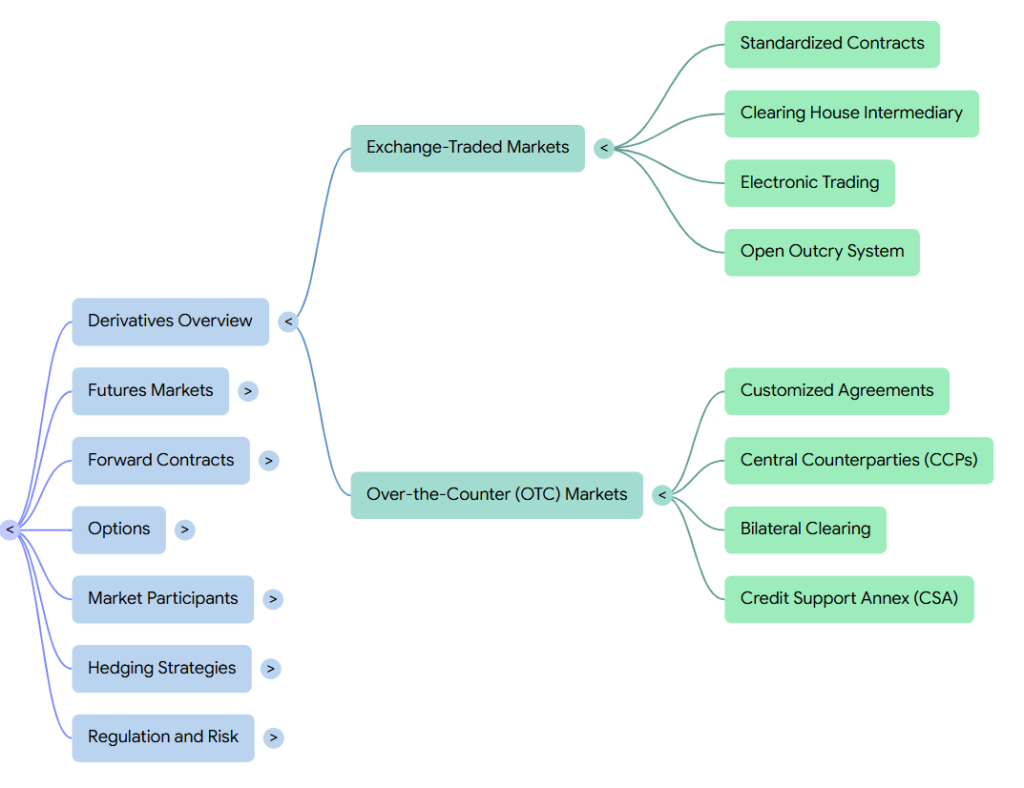
According to the book, derivatives are traded in two distinct types of markets:
- Exchange-Traded Markets: These are regulated exchanges where individuals and companies trade standardized contracts defined by the exchange (such as the CME Group or the CBOE). The exchange clearing house stands between the traders to manage credit risk, requiring participants to post margin to guarantee their obligations. Over time, these markets have transitioned from physical “open outcry” pits to electronic trading, facilitating algorithmic and high-frequency trading.
- Over-the-Counter (OTC) Markets: This is a vast, historically less regulated network where banks, financial institutions, fund managers, and corporations trade directly with one another. OTC transactions can be cleared bilaterally (with signed Master Agreements and negotiated collateral) or routed through a Central Counterparty (CCP), which functions similarly to an exchange clearing house. The book highlights that the OTC market is significantly larger than the exchange-traded market; for instance, in December 2019, the OTC derivatives market was estimated at $558.5 trillion in outstanding principal compared to $96.5 trillion for exchange-traded contracts.
Following the 2007–2008 financial crisis and the historic bankruptcy of Lehman Brothers, regulatory reforms have forced the OTC market to adopt exchange-like characteristics, requiring standardized derivatives to be traded on swap execution facilities (SEFs) and cleared through CCPs.
Core Types of Derivatives Contracts
The book details several fundamental contracts that serve as the building blocks for the derivatives universe:
- Forward Contracts: These are customized, private agreements traded in the OTC market where one party agrees to buy (long position) and the other agrees to sell (short position) an asset at a specific future time for a set price. No money exchanges hands initially, and the entire payoff is realized at maturity.
- Futures Contracts: Similar to forwards, futures are agreements to buy or sell an asset at a future date. However, they are standardized, exchange-traded, and settled daily through a marking-to-market process in margin accounts. Because of daily settlements, almost all futures contracts are closed out prior to maturity rather than leading to physical delivery.
- Options: Traded on both exchanges and OTC markets, options differ fundamentally from forwards and futures because they grant the holder the right, but not the obligation, to buy or sell an asset. A call option gives the right to buy, and a put option gives the right to sell at a set strike price. Because of this asymmetrical right, options require an up-front premium payment. American options can be exercised at any time up to expiration, while European options can only be exercised on the expiration date itself.
- Swaps: Private OTC agreements between two companies to exchange cash flows over multiple future dates according to a prearranged formula. These typically involve interest rate swaps (exchanging a fixed interest rate on a notional principal for a floating reference rate) or currency swaps (exchanging interest and principal payments in different currencies). Swaps are essentially portfolios of forward contracts.
Three Broad Categories of Traders
The liquidity and success of derivatives markets are driven by three types of market participants:
- Hedgers: They use derivatives to reduce or eliminate a pre-existing risk they face due to market volatility. Forwards and futures allow them to lock in a price and eliminate risk, while options act as insurance, letting them protect against downside risks while retaining potential upside benefits.
- Speculators: Rather than avoiding risk, speculators seek out risk, betting on the future direction of market variables to make a profit. They highly value derivatives for the leverage they provide, which allows them to take large speculative positions with a relatively small up-front cash outlay (such as a margin deposit or option premium).
- Arbitrageurs: They exploit price discrepancies by simultaneously entering into transactions in different markets to lock in a riskless profit. Their active trading ensures that prices align and market inefficiencies are quickly eliminated.
The Dangers and Evolution of Derivatives
While derivatives are highly versatile and beneficial for risk transfer, the book warns that their speculative misuse can be catastrophic. Traders with a mandate to hedge or seek arbitrage can easily slide into unauthorized speculation, resulting in spectacular multi-billion-dollar losses (such as Jérôme Kerviel at Société Générale or Nick Leeson at Barings Bank). This underscores the vital importance of strict corporate internal controls, risk limits, and maintaining a separate “front office” (traders) from the “middle office” (risk management) and “back office” (record-keeping/accounting).
Additionally, the modern landscape described in the book is characterized by several key structural evolutions:
- The LIBOR Phase-out: A major transition is underway as the interbank rate LIBOR is phased out in favor of risk-free, transaction-based overnight reference rates—most notably SOFR (Secured Overnight Financing Rate) in the US and SONIA in the UK.
- XVAs: Valuation practices have grown increasingly sophisticated, with dealers applying multi-layered price adjustments (collectively known as XVAs) to account for counterparty default risks (CVA), their own default risk (DVA), funding costs (FVA), margin costs (MVA), and regulatory capital charges (KVA).
- Machine Learning: Artificial intelligence and machine learning are increasingly integrated into derivatives pricing, hedging strategies, and portfolio management.
Exchange-Traded Markets
In the book, exchange-traded markets are characterized as structured, regulated derivatives exchanges where individuals and companies trade standardized contracts that are strictly defined by the exchange itself.
The Historical Evolution of Derivatives Exchanges
Derivatives exchanges have a long history, with their roots in agricultural trade. The book highlights several key milestones in their development:
- The Chicago Board of Trade (CBOT): Established in 1848, its initial purpose was to standardize the quantities and qualities of traded grains. This quickly led to the creation of the first futures-type contract, known as a “to-arrive” contract, which rapidly attracted speculators who preferred trading the contract itself over the physical grain.
- The Chicago Mercantile Exchange (CME): Founded in 1919 as a rival futures exchange, it eventually merged with the CBOT to form the CME Group, which now also includes the NYMEX and KCBT.
- The Chicago Board Options Exchange (CBOE): Launched in 1973, the CBOE succeeded in creating an orderly, standardized market for options, starting with call options on 16 stocks. It introduced put options in 1977, and today trades options on thousands of stocks, stock indices, foreign currencies, and futures contracts.
Standardized Contracts and the Role of the Clearing House
A defining feature of exchange-traded markets is the standardization of contracts. The exchange dictates the exact terms of each agreement—including the underlying asset, the contract size, delivery locations, and delivery dates.
Once two traders agree to a trade on an exchange, the transaction is handled by the exchange clearing house. The clearing house stands between the two traders, effectively becoming the buyer to every seller and the seller to every buyer. This structure provides a massive benefit to the market: traders do not need to worry about the creditworthiness of their counterparties because the clearing house guarantees the contract’s performance.
To manage its own credit exposure, the clearing house employs a robust margining system:
- Margin Accounts: Both parties must deposit initial margin funds. Minimum levels for both the initial margin and maintenance margin are set directly by the clearing house.
- Daily Settlement (Marking to Market): At the end of each trading day, the margin account is adjusted to reflect the contract’s daily gain or loss.
- Default Protection: This variation margin system ensures that funds are always available to pay out profitable positions. The success of this system was demonstrated during the stock market crash of October 19, 1987, when the S&P 500 dropped over 20%; despite some broker bankruptcies due to non-paying clients, the clearing houses had enough funds to ensure all short futures positions were paid in full.
The Shift to Electronic and High-Frequency Trading
Historically, exchanges relied on the open outcry system, which required traders to physically gather on the exchange floor, shouting and using a complex system of hand signals to execute trades. Today, this traditional format has been almost entirely replaced by electronic trading, where keyboard-entered orders are automatically matched by computers.
This electronic migration has directly fueled the rise of high-frequency trading, where algorithmic systems initiate and execute massive volumes of trades without human intervention.
Exchange-Traded vs. Over-the-Counter (OTC) Markets
To understand exchange-traded markets, they must be viewed in contrast with the over-the-counter (OTC) market:
- Transaction Volume and Size: The exchange-traded market processes a far higher number of individual transactions per year than the OTC market, but the average size of exchange-traded transactions is significantly smaller.
- Market Size: Despite the high transaction count of exchanges, the OTC market is vastly larger. As of December 2019, the estimated value of outstanding exchange-traded contracts was $96.5 trillion, compared to $558.5 trillion for the OTC market.
- Post-Crisis Convergence: Historically, OTC trading was private, bilateral, and largely unregulated, carrying substantial credit risk. However, regulatory reforms following the 2007–2008 financial crisis (such as the Dodd-Frank Act) have forced the OTC market to adopt exchange-like characteristics to mitigate systemic risk. Today, standardized OTC derivatives must be cleared through Central Counterparties (CCPs) (which function exactly like exchange clearing houses) and traded on exchange-like electronic platforms known as Swap Execution Facilities (SEFs)
Standardized Contracts
Standardized contracts are the foundational bedrock of exchange-traded derivatives markets. Unlike the over-the-counter (OTC) market where contracts are privately customized, a derivatives exchange is a regulated marketplace where individuals and companies trade contracts with uniform, pre-defined terms. The book notes that contract standardization dates back to the Chicago Board of Trade (CBOT) in 1848, which originally standardized grain quantities and qualities to simplify trading and reduce transactional friction.
Specifications of Futures Contracts
To make liquid exchange trading possible, the exchange specifies several standardized dimensions in its contracts:
- The Underlying Asset and Quality: The exchange defines the exact asset being traded. For agricultural and other physical commodities where quality naturally varies, the exchange stipulates the acceptable grade or grades. For instance, the book notes that the CME Group’s corn futures contract specifies “No. 2 Yellow” as the standard, but allows other grades (such as No. 1 or No. 3 Yellow) with standardized price adjustments. For financial assets, the underlying is typically unambiguous, though specific eligibility parameters are defined (such as Treasury bonds maturing within a 15-to-25-year window).
- Contract Size: This determines the exact quantity of the underlying asset covered by a single contract (such as 5,000 bushels of corn, 100 ounces of gold, or 12.5 million Japanese yen). The book explains that exchanges face a trade-off when setting contract sizes: if the size is too large, smaller retail traders and hedgers are excluded; if it is too small, trading becomes expensive due to transaction costs per contract. To balance this, exchanges often introduce “mini” contracts (such as the Mini Nasdaq-100 or Mini S&P 500) to attract smaller participants.
- Delivery Locations and Times: For physical commodities where shipping is costly, the exchange standardizes the precise locations (such as licensed warehouses) where delivery must occur and the exact delivery months and periods during which the short position can initiate delivery.
- Price Quotes and Trading Limits: Exchanges define how price quotes are formatted (e.g., in thirty-seconds of a dollar for Treasury notes). They also establish standardized daily price limits (limit up or limit down) to curb speculative excesses, as well as position limits to restrict the maximum number of contracts a single speculator can hold.
Specifications of Exchange-Traded Options
Exchange-traded stock options are similarly standardized to maintain orderly trading. Standard options contracts are defined by specific parameters:
- Contract Size: In the United States, a standard stock option contract represents the right to buy or sell exactly 100 shares of the underlying stock.
- Expiration Dates and Strike Prices: Expiration dates are standardized to occur on the third Friday of the designated expiration month. Strike prices are also standardized, trading at set intervals such as $2, $5, or $10 depending on the price of the stock.
- Adjustments for Corporate Actions: While exchange-traded options are not adjusted for ordinary cash dividends, they are subject to standardized adjustments for stock splits, stock dividends, and rights issues to ensure the economic positions of both the writer and the buyer remain unchanged.
- FLEX Options: To compete with the customizability of the OTC market, the Chicago Board Options Exchange (CBOE) offers FLEX options, which allow institutional traders to agree on nonstandard strike prices, custom expiration dates, or choose European-style exercise for options that are normally American.
The Role of Standardization in Market Mechanics
Standardized contracts are vital to the broader exchange ecosystem for several reasons:
- Generating Liquidity: Because contract terms are uniform, buyers and sellers only need to agree on price, which is determined efficiently by supply and demand. This attracts diverse market participants (hedgers, speculators, and arbitrageurs), creating a highly liquid environment.
- Mitigating Credit Risk: Since traders do not negotiate directly and often do not know their counterparties, the exchange clearing house acts as an intermediary, becoming the buyer to every seller and the seller to every buyer. Because the contracts are standardized, the clearing house can easily manage systemic risk by implementing standard margin requirements and daily settlements (marking to market).
- Regulatory Post-Crisis Reforms: In the wake of the 2007–2008 financial crisis, the safety and transparent pricing of standardized contracts led regulators to force the vast, historically unregulated OTC market to adopt exchange-like characteristics. Standardized OTC derivatives between financial institutions must now be traded on exchange-like electronic platforms called Swap Execution Facilities (SEFs) and cleared through Central Counterparties (CCPs).
Clearing House Intermediary
In exchange-traded derivatives markets, the exchange clearing house plays a critical role as an intermediary that stands between buyers and sellers to manage and eliminate counterparty credit risk. Once two traders agree to a transaction on an exchange, the clearing house steps in legally. For example, if Trader A enters into a futures contract to buy gold from Trader B, the contract is processed so that Trader A has a contract to buy from the clearing house, and Trader B has a contract to sell to the clearing house. Because of this structure, market participants do not need to worry about the creditworthiness of their counterparties; they rely entirely on the clearing house to guarantee the performance of each transaction.
How the Clearing House Manages Risk
According to the book, the clearing house manages the credit risk inherent in these contracts through several tightly regulated mechanisms:
- The Margining System: To ensure that all parties honor their obligations, the clearing house requires traders to maintain funds in a margin account. The clearing house sets the minimum levels for both the initial margin and the maintenance margin. These levels are determined by the price variability of the underlying asset and are revised whenever necessary.
- Clearing Members and Netting: The clearing house operates through a network of clearing members. Brokers who are not members themselves must channel their business and post margin through an active member. At the end of each day, the clearing house keeps track of all transactions to calculate the net position of each member. Margin requirements for these members are typically calculated on a net basis (where client short positions are netted against long positions) rather than a gross basis.
- Daily Settlements (Variation Margin): Transactions are settled daily through the clearing house. If a member’s transactions lose value in total over a day, they must provide variation margin in cash to the clearing house to cover the loss; if there has been a gain, they receive variation margin [122, 166, 136 note 6]. During periods of extreme price volatility, the clearing house can also demand intraday variation margin. If a member fails to meet these requirements, their position is closed out.
- The Guaranty Fund: The calculation of margin requirements is designed so that the clearing house is about 99% certain that the margin on hand will cover any default losses. To protect against cases where a default exceeds a member’s posted margin, clearing members are required to contribute to a guaranty fund.
Proven Resilience in Stressed Markets
The safety provided by this system has proven highly successful and resilient. As documented in the book, this intermediary structure was famously tested during the stock market crash of October 19, 1987, when the S&P 500 index declined by over 20%. Although several individual brokers went bankrupt because their clients failed to meet margin calls, the clearing houses held sufficient funds to ensure that every trader with a winning short position was paid in full.
By acting as a centralized intermediary, the clearing house ensures that exchange-traded markets remain liquid, orderly, and virtually free of counterparty default concerns.
Electronic Trading
In the book, the transition from traditional floor-based trading to modern computerized networks represents one of the most critical structural shifts in exchange-traded derivatives markets.
The Transition from Open Outcry to Keyboards
Historically, exchange-traded derivatives relied on the open outcry system. This traditional method required floor traders to physically gather in trading pits, shouting and utilizing a highly complex system of hand signals to execute transactions.
As detailed in the book, exchanges have almost completely replaced this physical process with electronic trading. In an electronic market, traders enter their orders at a keyboard, and a central computer matches buyers and sellers automatically. Consequently, traders no longer need to physically meet to complete a transaction.
The Structure of Modern Electronic Exchanges
Contract execution and liquidity on modern electronic platforms are defined by several key developments:
- Pioneering Electronic Options: The International Securities Exchange (ISE) launched the first all-electronic options market for equities in the United States in May 2000.
- Dominance of Electronic Order Flow: The shift online has been near-total; today, over 95% of orders at the Chicago Board Options Exchange (CBOE) are processed electronically. The remaining small fraction of trades completed physically on the floor mostly consists of exceptionally large or complex institutional orders that require the specialized negotiation skills of floor traders.
- Seamless Risk Management: Once an electronic trade is matched, it is immediately routed to the exchange clearing house. The clearing house sits between the matched parties as the buyer to every seller and the seller to every buyer, completely neutralizing counterparty credit risk through its margining and daily settlement procedures.
The Rise of High-Frequency Trading (HFT)
The migration to electronic matching engines has also directly fueled the growth of high-frequency trading (HFT). This practice relies on automated mathematical algorithms to initiate and execute enormous volumes of trades in fractions of a second, often entirely without human intervention. Algorithmic high-frequency trading has now become a prominent and permanent fixture of modern derivatives markets.
Open Outcry System
The open outcry system is the traditional physical trading method that historically powered exchange-traded derivatives markets. Under this system, floor traders representing buyers and sellers would physically assemble in trading pits on the exchange floor to negotiate and determine contract prices.
Mechanics of the Open Outcry System
According to the book, the mechanics of open outcry are defined by direct physical and verbal interaction:
- Physical Gathering: Floor traders representing each party had to meet face-to-face on the floor of the exchange in a physical area (traditionally referred to as trading pits) to execute transactions.
- Communication Methods: Transaction execution relied on traders shouting out their bids or offers and utilizing a highly complicated, standardized set of hand signals to indicate the trades they wanted to carry out.
- Price Determination: Prices were determined dynamically on the floor through the immediate laws of supply and demand as floor traders negotiated directly.
The Context of Exchange Evolution and the Shift to Electronic Trading
Historically, major exchanges such as the Chicago Board of Trade (CBOT) and the Chicago Mercantile Exchange (CME) relied on this open outcry method to bring buyers and sellers together, particularly for agricultural commodity futures. Traditionally, exchanges had to build and maintain massive physical floor spaces (a “large open area”) to accommodate these large groups of meeting individuals.
However, the book emphasizes that exchange-traded markets have undergone a profound structural shift, largely replacing the physical open outcry system with electronic trading. In the modern electronic marketplace:
- Traders enter their desired trades using a keyboard rather than gathering on a physical floor.
- An exchange’s central computer automatically matches buyers and sellers, meaning traders no longer need to physically meet to complete a transaction.
- This transition has been near-total; for instance, over 95% of orders at the Chicago Board Options Exchange (CBOE) are now processed electronically, with the remaining physical floor trades mostly consisting of complex or exceptionally large institutional orders that still benefit from the specialized negotiation skills of floor traders.
Although the open outcry system still has its advocates, it has become less and less used as electronic trading has expanded, subsequently fueling the growth of algorithmic and high-frequency trading.
Over-the-Counter (OTC) Markets
The over-the-counter (OTC) market is a vast, decentralized network of financial institutions, fund managers, and corporations that trade derivatives directly with one another rather than on regulated exchanges. As highlighted in the book, the OTC derivatives market is significantly larger than the exchange-traded market. For instance, in December 2019, the estimated total outstanding principal in the OTC market was $558.5 trillion, compared to $96.5 trillion for exchange-traded contracts. While this principal is massive, the actual gross market value of these contracts was estimated to be much smaller, at about $11.6 trillion. Since the 2007–2008 financial crisis, the OTC market has seen very little net growth, largely due to the adoption of compression—a portfolio-restructuring procedure that allows counterparties to compress redundant contracts to reduce their outstanding principal.
Core Participants and Market Makers
The primary participants in OTC derivatives trading are large banks, financial institutions, fund managers, and corporate treasurers. Within this market, large banks often act as market makers. This means they stand ready to facilitate liquidity by constantly quoting a bid price (the price at which they are prepared to buy or take one side of a contract) and an ask price (the price at which they are prepared to sell or take the opposite side). Common instruments traded in this manner include custom forward contracts, swaps, and over-the-counter options (with options on foreign exchange and interest rates being particularly popular).
Managing Credit Risk: Bilateral vs. Central Clearing
Because OTC trades are privately negotiated rather than exchange-standardized, they have historically carried significant credit risk (the risk of a counterparty defaulting). According to the book, OTC transactions are cleared in one of two ways:
- Bilateral Clearing: The two parties trade directly under a signed legal contract, typically an International Swaps and Derivatives Association (ISDA) Master Agreement [39, 129 note 3]. The contract’s Credit Support Annex (CSA) dictates the rules for posting collateral (margin) to mitigate credit risk. Regulations introduced in 2016 expanded these requirements, forcing financial institutions to post both initial margin (held with a third party) and variation margin for bilaterally cleared trades.
- Central Counterparty (CCP) Clearing: Alternatively, the agreed trade can be presented to a Central Counterparty (CCP), which steps in to legally become the buyer to the seller and the seller to the buyer. Much like an exchange clearing house, the CCP neutralizes counterparty risk by requiring its members to provide initial margin, daily variation margin, and contributions to a central guaranty fund.
A unique distinction noted in the book is that cash variation margin in the OTC market (whether cleared bilaterally or through a CCP) generally earns interest, whereas daily variation margin on exchange-traded futures does not. This is because futures are settled daily (wiping the contract’s value back to zero), while OTC trades are typically not settled daily, meaning the margin functions as collateral. Furthermore, when participants post securities instead of cash as collateral, the market value of those securities is reduced by a set percentage, known as a haircut, to protect against price volatility.
Systemic Risk and Post-Crisis Regulatory Reforms
Prior to the 2007–2008 financial crisis, the OTC derivatives market was largely unregulated. However, the historic bankruptcy of Lehman Brothers—which was highly active in the OTC space with over a million outstanding trades across 8,000 counterparties—exposed the severe threat of systemic risk. Systemic risk represents a “ripple effect” where the default of one heavily interconnected financial institution triggers a chain of defaults across other institutions.
To minimize this threat and improve overall market transparency, global regulators introduced massive reforms that pushed the OTC market to adopt several exchange-like characteristics:
- Swap Execution Facilities (SEFs): Standardized OTC derivatives between financial institutions in the United States must, when possible, be traded on SEFs, which are electronic platforms similar to exchanges where participants post and trade on bid-ask quotes.
- Mandatory CCP Clearing: Regulators in most parts of the world now require standardized OTC transactions between financial institutions to be cleared through CCPs rather than bilaterally.
- Trade Repositories: All OTC derivatives transactions must be reported to a central repository to ensure regulators can monitor total market exposure.
Customized Agreements
In the over-the-counter (OTC) derivatives market, customized agreements represent a major advantage over exchange-traded markets because they can be tailored to meet the precise risk management or speculative needs of corporate treasurers, fund managers, and financial institutions. Unlike the standardized contracts defined by exchanges, OTC instruments allow counterparties to negotiate bespoke terms, such as choosing nonstandard exercise dates, customized strike prices, and unique contract sizes.
The Legal Framework: ISDA Master Agreements
Because customized OTC contracts are private, bilaterally negotiated arrangements, they have historically carried significant counterparty credit risk. To manage this risk and establish a unified legal framework, bilaterally cleared transactions are typically governed by a Master Agreement. The most common standard in the industry is the International Swaps and Derivatives Association (ISDA) Master Agreement [36 note 3, 370].
According to the book, a Master Agreement serves several critical functions for customized portfolios:
- Netting Provisions: The agreement usually dictates that in the event of a default, all outstanding derivatives covered under the agreement between the two parties are netted and treated as a single transaction. This prevents a non-defaulting party from having to pay out on losing contracts while receiving nothing on winning ones, significantly mitigating total credit exposure.
- Default and Termination Terms: It defines the exact circumstances that constitute an “event of default” (such as a failure to post collateral or a bankruptcy filing) and outlines how settlement amounts are calculated if transactions are terminated early.
- Collateral and the Credit Support Annex (CSA): To further neutralize default risk, Master Agreements frequently include a Credit Support Annex (CSA). The CSA defines how much collateral must be posted by each side, how it is calculated daily, and what “haircuts” apply to reduce the value of posted securities for margin purposes.
Confirmations for Individual Trades
While the Master Agreement establishes the overarching legal and collateral terms for the entire relationship, each individual trade requires a signed legal document known as a confirmation. The confirmation details the specific, customized features of that particular transaction—such as the exact trade dates, notional principals on each side, payment frequencies, compounding rules, and day count conventions.
Through this combination of customized confirmations and standardized Master Agreements, the OTC market is able to balance the high demand for custom, tailored financial solutions with robust credit risk management.
Central Counterparties (CCPs)
The book describes a Central Counterparty (CCP) as a clearing house for standardized over-the-counter (OTC) derivatives that performs essentially the same role as an exchange clearing house. Once two parties agree to an OTC transaction, they can present it to a CCP. If accepted, the CCP steps in to legally become the counterparty to both sides—the buyer to every seller and the seller to every buyer—neutralizing direct counterparty default risk. For example, in a forward contract, the CCP agrees to buy the asset from the seller and sell it to the buyer, taking on the credit risk of both parties.
How CCPs Manage Credit and Systemic Risk
According to the book, CCPs protect the financial system from defaults through rigorous risk-management frameworks:
- The Margining System: All clearing members of a CCP must post initial margin and make or receive daily variation margin payments based on the daily valuation of their transactions.
- Guaranty Fund: Members are also required to contribute to a default or guaranty fund, which the CCP can utilize to cover losses if a member defaults and their individual margin is insufficient.
- Access for Non-Members: OTC market participants who are not direct clearing members of a CCP can still clear their trades by channeling them through an active CCP member and posting margin to that member.
The Regulatory Shift to Central Clearing
Historically, OTC derivatives were bilaterally negotiated and cleared with minimal oversight, creating high levels of credit and systemic risk—the risk that a default by one interconnected financial institution would trigger a “ripple effect” of failures throughout the system. The bankruptcy of Lehman Brothers in 2008 exposed this vulnerability.
In response, global regulators introduced reforms that reshaped the OTC market to make it more like exchange-traded markets:
- Mandatory Central Clearing: In most jurisdictions, standardized OTC derivatives transactions between financial institutions (including banks, insurance companies, pension funds, and hedge funds) must be cleared through CCPs [37, 128, 134 note 4].
- Regulatory Oversight: In the United States, the Dodd-Frank Act of 2010 expanded the authority of the Commodity Futures Trading Commission (CFTC) to enforce these clearing mandates.
- Corporate Exemptions: While transactions between financial institutions are strictly regulated, transactions involving most nonfinancial corporations remain exempt from mandatory central clearing [134 note 4].
In practice, because there are multiple CCPs operating internationally and not all contracts are standardized, the modern OTC market exists as a hybrid of centralized CCP clearing and bilateral agreements.
A Key Distinction in Margin Economics
An interesting structural detail highlighted in the book is how variation margin is treated. Unlike exchange-traded futures contracts, where daily variation margin represents a final cash settlement (marking the contract value back to zero), swap transactions in a CCP are typically not settled daily [136, 500 note 3]. Therefore, any daily variation margin posted in the form of cash actually earns interest (typically at overnight index swap reference rates), whereas futures variation margin does not [136, 500 note 3].
Funding Implications and XVAs
The transition of the OTC market to a central clearing model has significantly impacted pricing and valuation, giving rise to XVAs (valuation adjustments):
- Margin Valuation Adjustment (MVA): When a bank trades uncollateralized derivatives with a corporate end user and hedges that exposure with an offsetting transaction cleared through a CCP, the bank must post initial margin to the CCP. Funding this initial margin at a cost higher than the interest received from the CCP creates a drag on profits, which is accounted for as an MVA.
- Funding Valuation Adjustment (FVA): If the cleared hedge loses value, the bank must immediately post variation margin to the CCP. Since the bank cannot collect collateral from the uncollateralized corporate client, it must secure external funds, creating a funding cost (the Funding Cost Adjustment, or FCA). Conversely, if the cleared hedge gains value, the bank receives variation margin from the CCP, creating a funding benefit (the Funding Benefit Adjustment, or FBA). FVA is the net adjustment reflecting these expected future funding costs and benefits.
Bilateral Clearing
In the over-the-counter (OTC) derivatives market, once a transaction is agreed upon, the counterparties can choose to clear the trade either through a central counterparty (CCP) or bilaterally. Bilateral clearing represents a direct, decentralized arrangement between two market participants without a centralized clearing house intermediary. As described in the book, because these transactions do not rely on a central clearing entity to guarantee performance, both parties are directly exposed to counterparty credit risk.
The Legal Framework: ISDA Master Agreements and Confirmations
To establish a unified legal and risk-mitigation structure, bilaterally cleared transactions are typically governed by a Master Agreement. According to the book, the standard contract used throughout the industry is the International Swaps and Derivatives Association (ISDA) Master Agreement.
The Master Agreement covers several critical aspects of the bilateral relationship:
- Default and Early Termination: It defines what constitutes an “event of default” (such as a failure to pay, bankruptcy, or failure to post collateral) and outlines how early termination is declared. Upon termination, a settlement amount is calculated reflecting the net value of the outstanding derivatives, which is adjusted for transaction replacement costs (such as half of the applicable bid-ask spreads).
- Netting Provisions: In the event of a default, netting dictates that all outstanding transactions covered under the agreement are treated as a single transaction. This prevents the non-defaulting party from having to pay out on losing contracts while receiving nothing on winning ones, which massively reduces credit risk. For example, the book notes that netting can reduce a bank’s total exposure to a counterparty from a gross total of $40 million to a netted exposure of $15 million.
Alongside the overarching Master Agreement, each individual swap or transaction requires a confirmation that documents the exact customized terms of that specific trade.
Collateralization and the Credit Support Annex (CSA)
To manage credit risk, Master Agreements commonly feature an annex known as the Credit Support Annex (CSA), which governs the exchange of collateral. The CSA details how the required collateral is calculated and specifies what assets (such as cash or marketable securities) are acceptable.
- Daily Valuations and Variation Margin: Typically, the portfolios of outstanding transactions are valued each day. If the value of the contracts shifts in favor of one party by a certain amount, the other party must post equivalent collateral (which functions as variation margin) to cover the exposure.
- The Shift to Initial Margin: Historically, bilateral CSAs rarely required initial margin. However, the book explains that following post-crisis regulatory reforms starting in 2016, financial institutions—such as banks, insurance companies, pension funds, and hedge funds—are now required to exchange both variation margin and initial margin (which must be posted with a third party) for bilaterally cleared transactions. Most transactions with nonfinancial corporations remain exempt from these mandatory margin requirements.
- Haircuts: If marketable securities are used as collateral instead of cash, their value is reduced by a set percentage, known as a haircut, to protect against market price volatility.
Economics of Cash Collateral
In the exchange-traded futures market, daily variation margin represents a final cash settlement that resets the contract value to zero, meaning variation margin does not earn interest. In contrast, bilaterally cleared OTC derivatives are typically not settled daily; thus, cash variation margin functions as posted collateral and earns interest (typically at overnight index swap or federal funds rates). If a default occurs, the non-defaulting party is entitled to keep the posted collateral up to the calculated settlement amount, and any excess collateral must be returned.
Downgrade Triggers
Another credit risk mitigation tool sometimes written into the Master Agreement between a bank and a nonfinancial counterparty is a downgrade trigger. This clause grants the bank the option to demand collateral or terminate and close out all outstanding derivatives at their current market value if the counterparty’s credit rating drops below a specified level (such as BBB). However, the book notes that downgrade triggers do not protect against sudden, massive credit downgrades to default and can create severe systemic liquidity pressures if a struggling company has triggers across many dealers—as occurred during the 2008 bailout of AIG.
Credit Support Annex (CSA)
According to the book, the Credit Support Annex (CSA) is a crucial legal document that functions as an annex to the International Swaps and Derivatives Association (ISDA) Master Agreement. Within the massive over-the-counter (OTC) derivatives market, when two parties choose to clear their trades bilaterally (directly with one another rather than through a Central Counterparty), the CSA establishes the rules and mechanics for the exchange of collateral to manage and mitigate counterparty credit risk.
Here is a detailed breakdown of what the book explains about the role, mechanics, and evolution of CSAs:
1. How Collateralization Works under a CSA
The primary function of a CSA is to govern the bilateral posting of collateral, which is adjusted dynamically to reflect market movements:
- Daily Valuations: Portfolios of outstanding derivatives covered under the Master Agreement are valued each day.
- Two-Way Exchange (Variation Margin): If the value of the net transactions shifts in favor of one party by an amount X, the other party is required to post collateral worth X. This cash or security transfer functions similarly to the variation margin used in exchange-traded markets. If the net portfolio value reverses the next day, collateral is returned accordingly.
- Uncollateralized Exposure vs. Netting: Under the Master Agreement, netting provisions ensure that if a default occurs, all transactions are treated as a single netted transaction. The collateral held under the CSA is then used to cover this net exposure.
2. Collateral Types, Interest, and Haircuts
The book notes that a CSA specifies exactly what forms of collateral are acceptable—typically cash or marketable securities—and how their value is calculated:
- Interest on Cash Collateral: A major economic distinction between exchange-traded futures and OTC derivatives is that cash variation margin posted under a CSA earns interest (typically at overnight reference rates like the federal funds rate). Because OTC transactions are not settled daily (meaning the contract value is not wiped back to zero each day), the posted cash is treated as held collateral and must earn a competitive rate.
- Haircuts on Securities: If a counterparty posts marketable securities (such as government bonds) instead of cash, the CSA defines a haircut. This is a percentage reduction applied to the market value of the securities to protect the holder against market volatility during a default liquidation.
3. The Regulatory Shift to Mandatory Initial Margin
Historically, it was relatively rare for a CSA to require the exchange of initial margin (upfront collateral meant to buffer against future potential exposure). However, in the wake of the 2007–2008 financial crisis, global regulations began reshaping the bilateral OTC market:
- Post-2016 Regulations: Starting in 2016, rules were introduced requiring both initial margin and variation margin for bilaterally cleared transactions between financial institutions (which include banks, insurance companies, pension funds, and hedge funds) [131, 132 note 4].
- Third-Party Custody: Under these rules, initial margin cannot be held directly by the counterparty; it must be posted with a third-party custodian to prevent it from being misused or lost in a bankruptcy.
- Nonfinancial Corporate Exemptions: Notably, transactions involving most nonfinancial corporations remain exempt from these mandatory initial margin requirements under the CSA [132 note 4].
4. The “Cure Period” in Risk Modeling
In a bank’s internal credit risk calculations (such as estimating the Credit Valuation Adjustment (CVA)), the parameters of the CSA are vital. When modeling a potential default, banks assume a cure period (or margin period of risk), which is typically 10 or 20 days.
The valuation model assumes that a defaulting counterparty will stop posting required collateral or returning excess collateral days before the actual default occurs. Therefore, the bank’s exposure at early termination is calculated using the collateral levels defined by the CSA c days prior.
— Linden Lake
This series:
→ Book Review (1 of 7): Options, Futures, and Other Derivatives – Derivative Overview
→ Book Review (2 of 7): Options, Futures, and Other Derivatives – Futures Markets
→ Book Review (3 of 7): Options, Futures, and Other Derivatives – Forward Contracts
→ Book Review (4 of 7): Options, Futures, and Other Derivatives – Options
→ Book Review (5 of 7): Options, Futures, and Other Derivatives – Market Participants
→ Book Review (6 of 7): Options, Futures, and Other Derivatives – Hedging Strategies
→ Book Review (7 of 7): Options, Futures, and Other Derivatives – Regulation and Risk
Leave a Reply