
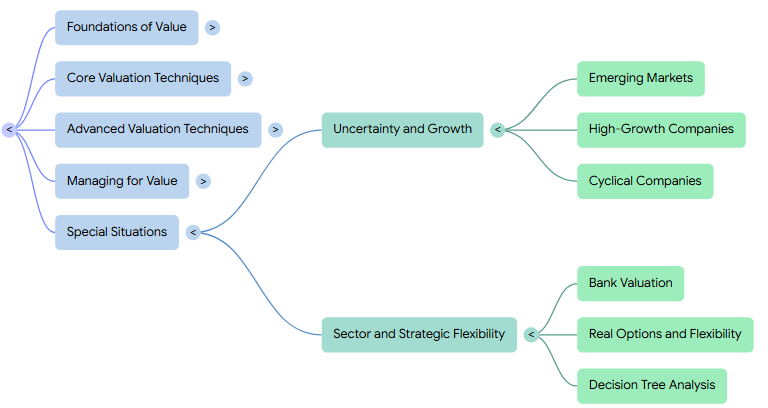
In the book, Part Five is explicitly dedicated to Special Situations, which represent complex corporate contexts where standard valuation models require careful adaptations. In these situations—such as emerging markets, high-growth startups, cyclical commodity producers, highly leveraged banks, or projects with significant managerial options—relying on a single standard valuation path can lead to severely distorted estimates.
To maintain the core economic principles of valuation, the book outlines specific frameworks to adjust for the unique operating realities of these five special situations:
1. Emerging Markets: Navigating Country Risk and Macroeconomic Crises
Valuing companies in emerging markets requires handling extreme macroeconomic volatility, high inflation, and potential government actions.
- The Flaw of Country Risk Premiums: A common, yet flawed, practice is to add an arbitrary country risk premium to the Weighted Average Cost of Capital (WACC) to discount a single “business-as-usual” forecast. The book warns that this approach overpenalizes long-term cash flows because a WACC markup compounds over time. It also incorrectly assumes that sovereign default risk directly correlates with a private company’s operational risk.
- The Scenario DCF Solution: Instead, the book recommends using a Scenario DCF approach. Analysts should model at least two distinct cash flow paths—a “business-as-usual” scenario and a “downside distress” scenario—and discount them at the unadjusted, global cost of capital. The final enterprise value is the probability-weighted average of these scenarios.
- Cost of Capital Alignment: Under this framework, the cost of equity should be estimated using a global CAPM adjusted primarily for local inflation differentials, rather than using volatile localized market risk premiums.
2. High-Growth Companies: Valuing the Intangible Future
Young, fast-growing companies present a major valuation challenge because they routinely post near-term operating losses, and their heavy investments in growth are typically expensed as intangibles (like R&D or marketing) rather than capitalized on the balance sheet.
- Working Backward From the Future: For established companies, valuation begins with historical analysis. For high-growth companies, the book dictates the reverse: start from a stable future and work backward.
- The Stable State Baseline: Analysts must project 10 to 15 years out to a point where the company’s economics stabilize. At this “stable state,” you estimate the total size of the addressable market, the company’s sustainable market share, and its long-term operating margin. Once this target state is defined, the analyst interpolates backward to connect it to the company’s current performance.
- Probability-Weighted Scenarios: Because long-term projections are highly uncertain, analysts must establish multiple long-term scenarios (ranging from a “market winner” to “failed adoption”) and apply probability weights to each to find the expected value.
3. Cyclical Companies: Neutralizing the Profit Cycle
The earnings of cyclical companies—such as those in the paper, steel, and chemical sectors—fluctuate aggressively as commodity prices and industry capacity shift.
- The Peak-to-Trough Illusion: Market prices and equity analysts’ forecasts frequently suffer from “anchoring bias,” treating a cyclical peak as a permanent upward trend and a trough as a permanent decline.
- Canceling Out the Volatility: The book highlights that under a proper DCF model, a cyclical company’s intrinsic value is far less volatile than its annual cash flows. Over a typical 5-to-10-year cycle, the high cash flows of peak years cancel out the negative cash flows of trough years.
- Normalized Continuing Value: When estimating the company’s continuing value, the terminal NOPAT and ROIC must be anchored to a normalized level of profits (reflecting the midpoint of the cycle) rather than the peak or trough of the final forecast year. The valuation should blend a “normal cycle” scenario with a “new long-term trend line” scenario based on the industry’s supply-demand dynamics.
4. Banks: Valuing Financial Intermediaries
Standard valuation models separate operating decisions from financing decisions. However, for financial institutions, operations and financing are inextricably linked, and the balance sheet operates under extreme leverage.
- The Equity DCF Method: Because a bank’s core revenue is interest-driven, you cannot separate operating cash flows from financing flows. The book therefore recommends using the Equity DCF method (discounting projected cash flows to equity holders at the levered cost of equity) rather than WACC-based enterprise models.
- Economic-Spread Analysis: To understand where and how a bank actually creates value, the book details an economic-spread analysis. This isolates the interest rate earned on loans and paid on deposits against a matched-opportunity rate (the cost of capital for a traded financial asset of similar risk and duration). It then deducts operating expenses and subtracts a specific tax penalty on equity risk capital (since equity funding, unlike deposits or debt, provides no tax deductions) to reveal the bank’s true economic profit.
5. Flexibility: Incorporating Real Options and Decision Trees
In standard valuations, uncertainty is modeled across fixed cash flow paths. However, in many projects, managers have the flexibility to actively change their decisions in response to future events—such as deferring, expanding, contracting, or abandoning an investment.
- Contingent Valuation: Standard NPV systematically undervalues projects with flexibility because it assumes managers will blindly follow a single path even when a project fails. To capture this hidden value, the book mandates contingent valuation approaches.
- Decision Tree Analysis (DTA): DTA is recommended when the prevailing uncertainty is driven by technological or diversifiable risks that are not priced in the wider capital markets (such as pharmaceutical R&D trials or product launches).
- Real-Option Valuation (ROV): ROV utilizes replicating portfolios or risk-neutral probabilities derived from financial option-pricing models. It is the theoretically correct tool when the prevailing uncertainty is driven by nondiversifiable market risks (such as commodity prices in mining or oil extraction).
Uncertainty and Growth
In the book, Special Situations represent complex corporate environments—such as high-growth startups, emerging markets, cyclical commodity producers, and projects with high managerial flexibility—where standard, single-path valuation techniques can produce highly distorted estimates of growth and value due to extreme uncertainty. Rather than attempting to eliminate uncertainty, the book prescribes structured, scenario-based frameworks to transparently model, value, and manage both growth and uncertainty across these distinct contexts.
1. High-Growth Companies: Estimating the Intangible Future under Extreme Uncertainty
Valuing high-growth companies is exceptionally challenging because they are characterized by rapid revenue expansion coupled with massive uncertainty. Historical financial results offer few clues about their future prospects, as their heavy investments in growth are typically expensed immediately as intangibles under traditional accounting. To value these enterprises, the book dictates a reverse process: start from a stable future state and work backward. Analysts must project 10 to 15 years out to estimate the total addressable market size, long-term market share, and sustainable operating margins, and then interpolate backward to connect to current performance.
Furthermore, uncertainty is a persistent reality because identifying the eventual winner in a nascent competitive field is highly speculative; most startups will fail or remain obscure while only a few “win big”. To handle this, analysts should never rely on a single forecast but must build multiple probability-weighted scenarios (ranging from market winner to failure) to reflect the full range of potential outcomes.
2. Emerging Markets: Protecting Growth from the Compounding Penalty of Risk Premiums
In emerging markets, companies often exhibit high growth potential but face severe country risks, such as currency devaluations, economic crises, or asset expropriations. The book warns that the common practice of adding an arbitrary “country risk premium” to the Weighted Average Cost of Capital (WACC) systematically overpenalizes long-term growth. High-growth emerging-market firms typically generate negative free cash flows in their early years as they reinvest heavily to scale up. Because a risk premium added to the discount rate compounds over time, it aggressively discounts these back-ended positive cash flows, leading to a massive undervaluation.
Instead, the book recommends a Scenario DCF approach. Under this framework, analysts model a “business-as-usual” scenario alongside “distress” scenarios, discounting the expected cash flows at the unadjusted global cost of capital. This treats country risk as a diversifiable, cash-flow-specific risk, which is far more precise and prevents viable projects from being prematurely rejected.
3. Managerial Flexibility: Capitalizing on Uncertainty to Create Value
Within the context of special situations, the book draws a sharp distinction between uncertainty and flexibility. Uncertainty refers to unpredictable future states that depend on a single, initial decision (e.g., whether to launch a new product). Flexibility, in contrast, refers to the ongoing choices managers can make between alternative plans in response to events as they unfold (e.g., staging investments, expanding, or abandoning a project).
Real options thrive on uncertainty; greater underlying uncertainty directly increases the value of managerial flexibility. When a project’s standard net present value (NPV) is close to zero (a “close call”), incorporating the value of options to defer, expand, or abandon becomes critical. A standard DCF calculation that ignores this flexibility will systematically underestimate a project’s true value. Therefore, contingent valuation approaches—such as Decision Tree Analysis (DTA) or Real-Option Valuation (ROV)—are required to capture how managers can actively mitigate downside risks while preserving upside growth under highly volatile conditions.
4. Cyclical Companies: Distinguishing Cycle Volatility from Long-Term Growth Trends
For cyclical companies, earnings fluctuate aggressively due to shifts in commodity prices and industry capacity. This short-term earnings volatility introduces immense uncertainty, which often causes the stock market to anchor on current performance and misprice the business. Because predicting the exact inflection points of a cycle is nearly impossible, single-point forecasts are routinely wrong. To accurately assess value, analysts must neutralize the cycle by basing continuing value calculations on a normalized, cycle-midpoint level of profits and growth, rather than the peak or trough of the final forecast year.
Emerging Markets
In the book, emerging markets—which represent 86 percent of the world’s population and accounted for approximately 59 percent of global GDP in 2017—are characterized as high-growth yet highly volatile environments. Valuing companies in these regions requires a careful and structured approach to modeling both uncertainty (such as macroeconomic volatility, regulatory changes, or political crises) and growth potential.
Traditional valuation methods often distort these variables, but the book provides a mathematically consistent framework to capture the economic reality of emerging markets.
1. The Core Conflict: Scenario DCF vs. Country Risk Premiums
A pervasive yet deeply flawed practice in emerging-market valuation is adding an arbitrary country risk premium (typically 3 to 5 percent or more) to the Weighted Average Cost of Capital (WACC) to discount a single, “business-as-usual” cash flow projection. The book systematically rejects this approach due to several fundamental logical and empirical failures:
- Sovereign Risk is Not Corporate Risk: The risk of lending to a government (sovereign default) is mathematically and operationally distinct from the risk of investing in a private enterprise. While governments like Russia, Argentina, and Nigeria have historically defaulted on their debt, many private consumer packaged-goods (CPG) companies within those countries easily survived the crises and rebounded quickly. In fact, some Brazilian corporate debt is rated investment grade even when the sovereign debt is not.
- The Overcompensation Trap: When analysts apply high, arbitrary country risk premiums, they unwittingly undervalue assets. To force their models to align with actual, higher market prices, they are often driven to construct unrealistically aggressive growth and return forecasts. For example, in a valuation of a Brazilian chemicals company, an adviser utilizing an 11 percent risk premium was forced to forecast real sales growth of 10 percent per year and a long-term ROIC of 46 percent (unheard of in a competitive commodity sector) just to justify a standard market multiple.
- Warped P/E Ratios: The book’s empirical research shows that high risk premiums do not reflect stock market reality. If a 3 to 5 percent country risk premium were genuinely priced into emerging markets like Brazil, implied price-to-earnings (P/E) ratios would hover around 8.3 times. Yet, historical Brazilian index P/Es typically trade between 10 and 17 times. Reverse-engineering these P/Es reveals an implied nominal cost of equity of 10 to 12 percent (6 to 8 percent in real terms), indicating that the actual market-implied country risk premium is closer to 1 percent than 3 to 5 percent.
- Country Risk is Diversifiable: For a global investor, many extreme country-specific risks—such as expropriation, currency devaluations, and local crises—are largely diversifiable. When aggregated into a global portfolio, the localized volatility of individual emerging markets tends to cancel out, meaning a cost of capital markup is theoretically unjustified.
2. Modeling Growth: Why Risk Premiums Penalize High-Growth Firms
The most damaging aspect of using a WACC risk premium markup is its disproportionate penalty on long-term growth [1381, 1383n3].
High-growth companies in emerging markets often require heavy upfront capital expenditures, generating negative free cash flows in their early years and pushing positive cash flows far into the future. Because a risk premium added to WACC compounds over time, it aggressively discounts back-ended cash flows.
This is highlighted in the book’s case study of ConsuCo, a Brazilian retail company with a strong growth outlook:
- Using the recommended Scenario DCF approach (modeling a 30% probability of a downside economic crisis), ConsuCo’s equity value is estimated at 32 reais per share.
- Using a standard country risk premium WACC markup of just 1 to 2 percent, the estimated value plunges to below 20 reais per share.
Because the WACC markup compounds, it overpenalizes the long-term cash flows that represent the bulk of a high-growth company’s intrinsic value, whereas scenario probabilities affect all future years equally.
3. The Recommended Solution: The Scenario DCF Approach
To accurately value emerging-market growth while respecting uncertainty, the book mandates using a Scenario DCF approach:
- Model at Least Two Scenarios: Develop a “business-as-usual” scenario reflecting normal growth and margins, and a “downside distress” scenario reflecting a severe economic contraction.
- Calibrate Downturn Frequencies: Historical data across 20 emerging economies since 1985 indicates that severe economic distress (defined as a real GDP decline of over 5 percent) occurs about once every five years. This justifies assigning a 20 to 30 percent probability to the downside scenario.
- Reflect Operational Downturn Realities: In the downside scenario, model specific operational pain points. For example, in the ConsuCo case, a crisis is modeled as a 10 to 15 percent real-terms sales decline and a temporary drop in operating margins to negative levels (-10% to -5%) for up to five years, followed by a gradual recovery.
- Discount at a Clean Cost of Capital: Discount the cash flows of each scenario using a WACC that is unadjusted for country risk, and then probability-weight the resulting valuations. This forces management to explicitly debate cash-flow-specific risks and formulate direct mitigation strategies rather than hiding behind a vague, adjusted discount rate.
4. Estimating the Cost of Capital and Handling Complications
When constructing the cost of capital in emerging markets, analysts must maintain rigorous macroeconomic and monetary consistency:
- Cost of Equity: Estimate the cost of equity using the CAPM. Start with a global benchmark (like the 10-year U.S. Treasury yield) and add the projected long-term inflation differential between the U.S. and the local country. Use a global market risk premium of 4.5 to 5.5 percent, and estimate beta against a well-diversified global index to prevent localized industry concentrations from warping the risk measure.
- Cost of Debt: The local cost of debt should equal the U.S. or Euro risk-free rate plus the systematic credit spread and the local inflation differential.
- Exchange Rate Volatility and PPP: While exchange rates revert to Purchasing Power Parity (PPP) in the long run, short-term deviations can be massive. For primarily local companies, the book recommends performing the DCF in the local currency first. To represent exchange rate uncertainty to international investors, translate the final local valuation into foreign currency using both the current spot exchange rate and the PPP-adjusted exchange rate to establish a sensible valuation range.
- Capital Market Inefficiencies: Analysts must adjust for structural market anomalies common in emerging economies, including limited share float, the dominance of unsophisticated retail investors (such as in China, where retail traders own 75% of holdings and drive speculative price swings), and complex governance structures featuring dual-class voting/nonvoting shares.
- Conglomerate Structures and Nonoperating Assets: Emerging-market firms are often highly diversified conglomerates with massive pools of nonoperating assets. For example, India’s Reliance Industries carries $11 billion in book-value investments against a $105 billion market capitalization. These nonoperating assets must be stripped out and valued separately (e.g., using peer multiples) to avoid distorting core operating margins and ROIC.
Ultimately, by separating macroeconomic uncertainty from WACC, modeling explicit operational downturns, and triangulating the results with regional peer multiples, managers can confidently identify value-creating growth opportunities in the world’s most dynamic economies.
High-Growth Companies
In the book, valuing high-growth companies is acknowledged as an exceptional challenge—with some practitioners even describing it as hopeless—due to the extreme uncertainty that surrounds their future trajectory. However, the book asserts that the core economic principles of valuation still apply. Rather than attempting to eliminate uncertainty, analysts must utilize structured frameworks to bound, quantify, and model both growth and risk.
1. The Realities of Growth and Uncertainty
High-growth companies (defined as those with organic revenue growth exceeding 15 percent annually) operate in highly volatile environments [1413, 1429n1]. The book highlights several fundamental economic realities regarding their growth and uncertainty:
- The Winner-Take-All Challenge: Much of the uncertainty stems from the difficulty of identifying the eventual winner in a nascent competitive field. History shows that while a few players will “win big,” the vast majority will eventually toil in obscurity.
- Persistent Stock Volatility: This competitive uncertainty drives extreme stock price volatility. Because investors must struggle daily to incorporate new and changing information, share prices undergo massive swings. However, as the company’s business model and competitive positioning begin to stabilize, the range of potential outcomes tightens, and stock volatility naturally decreases.
- The Growth Decay Rule: Sustaining high growth is exceptionally difficult—far more so than sustaining a high return on invested capital (ROIC). Empirical data demonstrates that high growth rates decay very quickly. Within five to ten years, the growth of even the fastest-growing companies typically converges toward a moderate rate of 5 percent or lower.
- The Portfolio Treadmill: To beat this natural decay, a company must continuously find, launch, and successfully scale new products. As a company grows larger, it must find progressively larger replacement products just to maintain its growth rate—a phenomenon known as the “portfolio treadmill” effect.
2. The Valuation Process: “Starting from the Future”
Because historical financials offer very few clues about a high-growth company’s long-term prospects, the book prescribes reversing the traditional valuation process. Instead of starting with historical analysis, valuation must start with the future and work backward:
- Define a Stable Future State: Look 10 to 15 years into the future to a point where the company and its industry are expected to reach maturity and stable, moderate growth.
- Bound the Future with Operational Metrics: This stable state must be built from the bottom up using concrete operational metrics. Analysts must size the potential total addressable market, estimate the long-term sustainable market share the company will capture, project its mature operating margins, and estimate the capital investments required to achieve that scale.
- Work Backward to the Present: Once this stable future state is defined, the analyst interpolates backward to connect those long-term projections to current performance.
3. Reconnecting to the Present: Accounting Distortions
When working backward to reconnect future expectations with current performance, traditional accounting statements can severely distort an analyst’s view.
The book notes that high-growth companies invest heavily in intangible assets—such as research and development (R&D), software, and customer acquisition. Under standard accounting rules, these outlays must be expensed immediately rather than capitalized on the balance sheet. This creates two major distortions:
- Understated Capital and Inflated ROIC: Because these massive investments are expensed, both early accounting profits and the company’s formal invested capital base are heavily understated. As a result, as soon as a high-growth company achieves even minor profitability, it may report an unreasonably high, distorted ROIC because its true capital denominator is missing from the balance sheet.
- The Capitalization Solution: To evaluate the true economic health and performance of the business, the book recommends capitalizing these expensed intangible investments when preparing pro forma statements.
4. Navigating Uncertainty: Probability-Weighted Scenarios
To deal with the massive uncertainty inherent in high-growth companies, the book strongly advises against relying on single-point forecasts. Single-point estimates imply a level of precision that does not exist and dangerously obscure the critical risks that drive value.
Instead, the preferred approach is to construct multiple probability-weighted scenarios:
- Constructing Consistent Scenarios: Analysts should model a range of distinct future states, such as an optimistic “market winner” scenario and a pessimistic “failed adoption” or “sluggish penetration” scenario. Every variable within a scenario (revenue, margins, tax rates, and capital expenditures) must be logically consistent with that scenario’s underlying story.
- Transparency Over Complexity: Using a few well-defined, probability-weighted scenarios is far more practical and transparent for decision-makers than complex modeling techniques like Monte Carlo simulations or real options. It forces managers to explicitly debate operating assumptions and risk-mitigation strategies.
- Deriving Equity Value: The final intrinsic equity value of the high-growth company is estimated by calculating the discounted DCF value under each individual scenario and weighting those values by their estimated probability of occurrence.
Cyclical Companies
In the book, cyclical companies are defined as those whose earnings demonstrate a repeating pattern of significant rises and falls. These fluctuations are driven by dramatic changes in product prices as supply and demand dynamics shift, often exacerbated by the fact that the companies themselves create excess capacity.
When analyzing cyclical companies within the broader context of uncertainty and growth, the book highlights a fundamental challenge: distinguishing temporary cyclical movements from long-term structural growth trends. Misjudging these factors leads to severe valuation distortions and value-destroying strategic decisions.
1. Intrinsic Value vs. Market Volatility (Cycle Uncertainty)
The book notes a striking divergence between how a cyclical company’s intrinsic value behaves compared to its volatile reported earnings and stock prices:
- The DCF Stability Principle: In a theoretically sound discounted-cash-flow (DCF) model with perfect foresight, a cyclical company’s intrinsic value is actually remarkably stable. Because DCF reduces all future expected cash flows to a single present value, any single year is relatively unimportant—the high cash flows of peak years cancel out the negative or low cash flows of trough years. Only the long-term trend line truly matters.
- The Anchoring and Forecast Bias: In the real world, share prices of cyclical companies are far more volatile than the DCF approach would predict. This is because the market frequently exhibits a cognitive bias of anchoring on current earnings. Furthermore, equity analysts’ consensus forecasts often ignore cyclicality entirely, showing a flat, upward-sloping trend line whether the company is at a peak or a trough. This occurs partly because predicting cycles (especially inflection points) is incredibly difficult, and analysts have institutional incentives to avoid forecasting downturns.
- The “Blended” Pricing Reality: The stock market ultimately prices cyclical stocks along a “blended” path—roughly representing a 50/50 mix of perfect foresight and zero foresight (anchoring on current trends). This behavior reflects the fundamental uncertainty that an industry might break out of its old cycle and establish a completely new, permanent long-term trend line.
2. A Structured Approach to Valuing Cyclical Growth
Because single-point estimates are inevitably wrong under these conditions, the book recommends a disciplined, scenario-based DCF approach to model growth and uncertainty:
- The Normal Cycle Scenario: Value the company assuming it continues to follow its historical cycle. Crucially, the continuing value must be anchored to a normalized level of profits (reflecting the midpoint of the long-term trend line) rather than the peak or trough of the final forecast year.
- The New Trend Line Scenario: Value the company under the assumption that its recent performance represents a permanent shift to a new long-term trend line.
- Economic Rationale and Probability Weighting: Evaluate industry-specific supply-demand balances, competitor capacity additions, and technological disruptions to assign probability weights to each scenario and calculate a weighted expected value.
- The “Crack Spread” Metric: For commodity-linked cyclical businesses, the book suggests modeling the “crack spread” (the margin between the finished product’s price and raw material costs) rather than raw revenues and costs. The spread is dictated by the industry’s supply-demand balance and remains a far more reliable profit indicator when raw material input prices are highly volatile.
3. Managing Growth: Overcoming the Supply-Side Herding Trap
One of the most profound insights in the book is that fluctuations in customer demand do not drive cyclical profit volatility; producer supply decisions do.
- The Investment Herding Cycle: Collectively, cyclical companies destroy value by overinvesting in massive chunks of capacity when prices and returns are high. This herding behavior is driven by short-term psychological and operational factors: cash is highly available, board approvals are easy to secure during profit peaks, and managers fear that rivals will grow faster. When all this lumpy capacity comes online simultaneously, capacity utilization plunges, driving down prices and crushing ROIC.
- The Contrarian Value Strategy: To capture growth and outperform peers, the book advocates a contrarian management style that capitalizes on cyclical uncertainty:
- Countercyclical Capital Spending: Restrain capital expenditures at the peak of the cycle, and accelerate capacity expansions during troughs when capital costs are lower.
- Financial Arbitrage: Proactively issue equity to raise cash when the stock trades at peak multiples, and aggressively repurchase shares at the trough of the cycle.
- Opportunistic M&A: Acquire competitors at a deep discount at the bottom of the cycle (“buying cheap”) and divest non-core assets at peak valuations.
While a simulation of this optimal cycle-timing strategy proves it can dramatically increase shareholder returns, the book cautions that executing it in the real world is extremely difficult. A CEO must possess the rare courage and credibility to stand before the board and bankers to expand the business when the industry outlook is gloomy and competitors are retrenching.
Sector and Strategic Flexibility
In the book, strategic flexibility is examined as a critical component of Part Five’s “Special Situations”. The book stresses that managerial flexibility and uncertainty are distinct concepts: while uncertainty represents an unpredictable future state that depends on a single initial choice, flexibility refers to the ongoing options managers have to adjust plans as events unfold.
1. The Economics of Strategic Flexibility
Standard Net Present Value (NPV) techniques often undervalue capital projects because they assume managers will passively follow a single, predetermined path regardless of how the business environment shifts. To capture the true value of flexibility, the book advocates contingent valuation approaches.
Under a contingent approach, a project’s contingent NPV is calculated as the expected value of the best decisions made after uncertainty is resolved. Consequently, a project’s contingent NPV is mathematically always greater than or equal to its standard NPV.
The options created by this strategic flexibility conventionally include the options to defer investments, make follow-on investments, expand capacity, contract operations, or abandon a project entirely.
2. Sector-Specific Applications of Flexibility
One of the most important insights in the book is that the choice of contingent valuation tool—specifically Decision Tree Analysis (DTA) versus Real-Option Valuation (ROV)—depends heavily on the sector and the nature of its prevailing risks:
- Commodity and Resource Sectors (ROV): Real-Option Valuation is the theoretically correct tool for capital-intensive, commodity-linked sectors such as oil and gas extraction, chemicals, metals and mining, power generation, and refining. In these sectors, the prevailing risk is nondiversifiable market price risk, which is actively priced in liquid public markets. ROV relies on replicating portfolios or risk-neutral probabilities derived from these market prices to determine option value.
- Technology, Pharmaceutical, and R&D Sectors (DTA): For sectors driven primarily by technical or geological development risks—such as pharmaceutical clinical trials, speculative technology R&D, or geographical site exploration—the book recommends Decision Tree Analysis. Because these risks are diversifiable and not priced in capital markets, DTA provides a highly transparent, straightforward, and practical approximation of flexibility value.
- E-Commerce and Digital Start-up Sectors: The book warns against loosely classifying young digital businesses as “growth options” using nonfinancial metrics (such as unique website visitors) without a concrete path to profitability. An option only carries value if it is linked to a sustainable, competitive business model capable of generating future cash flows.
3. The Managerial Mandate
Finally, the book stresses that strategic flexibility only translates into real-world corporate value if managers actively manage it. Managers must remain disciplined and be willing to exercise their options—such as killing a project when trials fail—while entirely ignoring historical sunk costs, which are economically irrelevant to future cash-flow decisions.
Bank Valuation
In the book, bank valuation is framed as one of the most complex valuation exercises because of the unique structural, regulatory, and operating characteristics of the financial sector . Unlike nonfinancial companies, where operating and financing decisions are evaluated independently, a bank’s core operations and capital structure are completely intertwined .
1. The Core Principle of Bank Valuation
Because separating a bank’s operations from its financing flows requires making unnecessary and complex assumptions, the book notes that standard enterprise DCF models are difficult to implement correctly . Instead, the book strongly recommends the Equity Discounted Cash Flow (Equity DCF) method as the most appropriate framework for bank valuation . Under this approach, the value of the bank is determined by projecting the cash flows available to equity holders (net income minus retained earnings required to support growth) and discounting them at the levered cost of equity .
2. Segmenting the Universal Bank (Sector Complexity)
Most major financial institutions are universal banks that participate in multiple business lines . Because these segments carry widely divergent economics, growth dynamics, and risk profiles, the book advises valuing a bank by its individual parts rather than as a single, consolidated enterprise :
- Interest-Generating Activities (Commercial & Retail Banking): These are evaluated using economic-spread analysis . A bank creates true operating value in lending only when the loan rate exceeds a matched-opportunity rate (MOR)—which is the market rate on a traded security of similar risk and duration .
- Fee- and Commission-Generating Activities (M&A Advisory & Asset Management): These segments require minimal physical capital . In asset management, value is driven by growing the volume of assets under management and optimizing the fees earned on those assets .
- Trading Activities: Trading returns are highly volatile across the cycle . They are modeled around position size, trading results relative to the risk taken (Value at Risk or VaR), and the required equity capital to support those positions .
3. Solvency Constraints and the Limits of Financial Flexibility
A bank’s strategic and operational flexibility is heavily bound by regulatory solvency requirements, which are vastly different from the flexible capital structures of industrial firms:
- Risk-Weighted Assets and Basel III: To protect customers and the financial system, regulators require banks to maintain a minimum Common Equity Tier 1 (CET1) capital ratio relative to their risk-weighted assets (RWA) . For systemically important banks, countercyclical capital buffers impose even stricter equity holding requirements .
- The Tax Penalty on Equity capital: Carrying this required equity capital is economically expensive . While interest paid on deposits or debt is tax-deductible, equity dividend payouts are not . As a result, carrying high levels of equity capital generates a “tax penalty” (taxes paid on risk-free asset returns that cannot be shielded) which directly degrades the bank’s return on equity .
4. Maturity Mismatches: Distinguishing Income from Value
A classic strategy for retail banks is to exploit interest rate flexibility through a maturity mismatch—funding long-term assets (like mortgages) with short-term liabilities (like customer deposits) to capture spread along the yield curve .
While a yield curve mismatch increases reported net interest income, the book stresses that mismatching maturities does not create intrinsic value for shareholders once risk is adjusted . In a true economic valuation, the portion of interest income driven by duration differences must be neutralized by a mismatched-capital charge to compensate for the interest rate risk being carried . Over the long term, forward interest rates will converge, and this mismatch income will gradually decline .
5. Managing Sector Volatility Through Scenarios
Because banks are highly leveraged, minor shifts in credit loss provisions or interest margins lead to dramatic, non-linear swings in return on equity and equity value .
To manage this uncertainty, the book advises against relying on single-point consensus forecasts, which historically fail to predict cycle turnarounds . Instead, analysts should model multiple, probability-weighted scenarios (such as a “business-as-usual” base case and an explicit “downside credit crisis” scenario modeled on historical downturn frequencies) to realistically bound the bank’s future equity cash flows .
Real Options and Flexibility
In the book, strategic flexibility and real options represent critical concepts within Part Five’s “Special Situations,” providing managers with a robust framework to value, structure, and manage business opportunities under volatile and uncertain conditions. The book emphasizes that traditional capital budgeting often fails to capture the true value of a project because it assumes managers must passively follow a single, predetermined path regardless of how the business environment changes.
Integrating real options and flexibility into corporate strategy allows companies to bridge the gap between strategic intuition and financial discipline.
1. Uncertainty vs. Strategic Flexibility
The book draws a fundamental distinction between uncertainty and flexibility:
- Uncertainty refers to unpredictable future states that depend on a single initial choice (e.g., whether to launch a new product line or construct a factory).
- Flexibility refers to the ongoing options managers have to adjust their plans in response to events as they unfold (e.g., staging investments, expanding capacity, or abandoning a project).
While high uncertainty generally depresses standard valuation estimates, greater uncertainty directly increases the value of flexibility. When managers have the option to act only after uncertainty is resolved, they can capture the upside of favorable outcomes while completely avoiding the downside of unfavorable ones.
2. Standard NPV vs. Contingent NPV
Traditional Discounted Cash Flow (DCF) models utilize a standard NPV approach, which forces an investment decision today based on current expectations of future cash flows. Mathematically, standard NPV is defined as the maximum, decided today, of the expected discounted cash flows or zero:
Standard NPV=max(E[PV]−Investment,0)
In contrast, contingent NPV models flexibility by evaluating the expected value of the best decisions made after information arrives. It is calculated as the expected value of the maximums of the discounted cash flows in each future state or zero:
Contingent NPV=E[max(PVi−Investmenti,0)]
Because managers can discard value-destroying paths, a project’s contingent NPV is mathematically always greater than or equal to its standard NPV. Incorporating flexibility is most critical when a project’s standard NPV is close to zero (a “close call”), as the value of the embedded options can easily turn a rejected project into an accepted one.
3. The Six Drivers of Real Option Value
Derived from financial option-pricing theory, the book identifies six core drivers that dictate the value of a real option:
- Value of the Underlying Asset (+): Higher expected operating cash flows from the project increase option value.
- Uncertainty/Volatility (+): Greater variance in future cash flows widens the spread of potential outcomes, raising the value of the upside while the downside remains capped at zero.
- Risk-Free Interest Rate (+): Higher risk-free rates reduce the present value of the required future investment (the strike price), boosting the option’s value today.
- Option Lifetime (+): A longer time horizon gives more opportunity for favorable information to arrive, increasing the option’s value.
- Investment Cost (-): Higher capital expenditures required to exercise the option (the strike price) decrease its value.
- Lost Cash Flows (-): Cash flows given up or forfeited while holding the option (analogous to dividend payments on a stock) reduce the value of deferring the investment.
4. Classification of Real Options
Managers can actively design and embed several types of real options into their corporate strategies:
- Option to Defer: Postponing a capital commitment to observe how the market develops (e.g., waiting to build a mine or launch a product).
- Option to Expand: Increasing capacity or scaling up operations if early demand exceeds expectations.
- Option to Contract: Scaling down capacity or operations to limit losses if demand is weak.
- Option to Abandon: Terminating a project mid-life and capturing its salvage or liquidation value.
- Option to Switch: Alternating between different operational inputs or outputs (e.g., a power plant switching fuels depending on current commodity spreads).
- Option to Stage Investments: Breaking an investment down into sequential phases (common in R&D or pharmaceutical trials), where proceeding to the next stage is contingent on the success of the prior one.
5. Sector-Specific Applications: DTA vs. ROV
Within Sector and Strategic Flexibility, the book outlines that the choice of contingent valuation tool depends entirely on the nature of the prevailing risk:
| Feature | Real-Option Valuation (ROV) | Decision Tree Analysis (DTA) |
| Primary Sector | Commodity & Capital-Intense Sectors (Oil & gas, mining, chemicals, power generation) | Technology, Pharmaceuticals, & R&D (Clinical trials, software development, site exploration) |
| Nature of Risk | Nondiversifiable (Market) Risk (Traded prices of oil, metals, electricity) | Diversifiable (Technological/Geological) Risk (R&D success, product adoption, geological reserve size) |
| Methodology | Replicating portfolios or risk-neutral probabilities based on traded market assets | Standard probabilities with discounted components (asset flows at WACC, investments at risk-free rate) |
| Data Source | Valuation and volatility are derived from traded assets | Asset value and variance are largely judgmental or estimated |
| Key Benefit | High theoretical accuracy for market-priced risk | High transparency and simplicity for executive decision-making |
The book warns that when technological or diversifiable risk dominates, using complex ROV models is unnecessary; DTA provides a highly transparent, practical, and virtually identical approximation of value.
6. The Four-Step Process to Valuing Flexibility
To systematically value flexibility, the book details a disciplined four-step process:
- Estimate NPV without Flexibility: Value the project using a traditional, single-path DCF model to establish the baseline asset value.
- Model Uncertainty using an Event Tree: Map out how the underlying asset value evolves over time based on volatility, using unadjusted probabilities and WACC, excluding any decision points.
- Model Flexibility using a Decision Tree: Transform the event tree into a decision tree by embedding decision nodes (expand, contract, abandon, or proceed) at the relevant intervals.
- Estimate Contingent NPV: Work backward through the tree from right to left. If risk is diversifiable, discount asset cash flows at WACC and investments at the risk-free rate (DTA). If risk is nondiversifiable, apply risk-neutral probabilities and discount all flows at the risk-free rate (ROV).
Finally, the book stresses that real options have value only if managers actively exercise them. This requires a disciplined organizational mindset that entirely ignores sunk costs (which are economically irrelevant to future cash flows) and incentives that reward managers for executing value-maximizing decisions, such as killing an underperforming project early.
Decision Tree Analysis
In the larger context of Sector and Strategic Flexibility, the book presents Decision Tree Analysis (DTA) as a practical, transparent contingent valuation tool designed to model and value managerial flexibility when a company faces future choices between alternative plans. While standard Net Present Value (NPV) assumes managers must passively follow a single predetermined path, DTA allows organizations to capture the value of being able to adapt to new information as it arrives.
The book structures the role and application of DTA around several core economic principles:
1. DTA’s Strategic Sweet Spot: Diversifiable Risk
When deciding whether to use DTA or Real-Option Valuation (ROV), the book outlines a clear division of labor based on the nature of the prevailing risk in a given sector:
- Nondiversifiable (Market-Priced) Risk: ROV is the theoretically correct tool for capital-intensive, commodity-linked sectors (such as oil and gas, mining, chemicals, and power generation) because the underlying uncertainty (commodity prices) is directly priced in liquid public markets.
- Diversifiable (Private) Risk: DTA is the preferred and most effective tool for sectors driven by technological, geological, or customer-acceptance risks—such as pharmaceutical clinical trials, technology R&D, or geographical site exploration. Because these risks are unique to the project and can be diversified away by holding a broad portfolio of investments, they are not priced in the wider capital markets.
Furthermore, the book notes that in many real-world strategic settings, the technological risk is the only uncertainty that actually drives the investment decision. For example, in drug development, if the clinical trial succeeds (technological risk resolved), the drug is almost always highly profitable to launch regardless of minor fluctuations in final market value. In these scenarios, DTA and ROV generate identical valuation results, making the more complex mathematics of market-risk-adjusted ROV unnecessary.
2. Methodological Rigor: The “Double Discounting” Rule
DTA calculates contingent value by modeling sequential decision nodes in a tree structure and working backward from right to left. However, the book warns against a major, value-distorting error commonly committed by practitioners:
- The Overvaluation Trap: Many analysts discount the entire decision tree—including the required future capital investments—at the project’s standard Weighted Average Cost of Capital (WACC). Because the contingent payoffs of an option are highly leveraged, they are mathematically far riskier than the underlying asset itself, meaning their implied cost of capital is much higher than the asset’s WACC. Using a flat WACC across the tree will systematically overstate and overvalue the project’s worth.
- The Double Discounting Solution: To resolve this, the book prescribes a refined DTA discounting method:
- Discount the operating cash inflows (the asset’s payoffs in each state) at the underlying asset’s WACC.
- Discount the future investment requirements (the “strike price” to execute the option) at the risk-free rate. This dual-discounting approach ensures DTA approximates the correct financial option-pricing values.
3. Practical and Strategic Advantages of DTA
- Executive Transparency over Complexity: While ROV is theoretically superior for market risks, its underlying mathematics (relying on replicating portfolios or risk-neutral probabilities) can be difficult for managers to interpret and defend. DTA provides a highly visual, intuitive, and transparent framework that is easy to explain to senior decision-makers.
- Avoiding False Precision under Extreme Uncertainty: In young or highly innovative industries, there are no traded “twin securities” or historical data points to cleanly estimate asset volatility. Under these conditions, attempting to use ROV introduces a high degree of subjective speculation. In such cases, the book argues that DTA is far more practical because it avoids the illusion of mathematical precision, instead forcing managers to explicitly debate concrete operating scenarios, milestones, and direct risk-mitigation strategies.
- The Sunk Cost Mandate: Finally, DTA highlights that strategic flexibility only translates into real-world corporate value if managers are actually willing to act on the tree’s branches. This requires an organizational culture that completely ignores sunk costs—which are economically irrelevant to future cash-flow decisions—and possesses the discipline to halt underperforming projects at the designated decision nodes.
— Linden Lake
This series:
→ Book Review (1 of 5): Valuation – Foundations of Value
→ Book Review (2 of 5): Valuation – Core valuation Techniques
→ Book Review (3 of 5): Valuation – Advanced Valuation Techniques
→ Book Review (4 of 5): Valuation – Managing for Value
→ Book Review (5 of 5): Valuation – Special Situations
Leave a Reply