
In the book, Part Three is dedicated to Advanced Valuation Techniques, which serve as the analytical toolkit required to handle complex, technical, and often “slippery” corporate finance issues that go beyond standard financial accounting. While core valuation techniques establish the general architecture of NOPAT, Invested Capital, and WACC-based DCF models, advanced techniques focus on digging into the footnotes of annual reports to strip out accounting distortions and align reporting with economic reality.
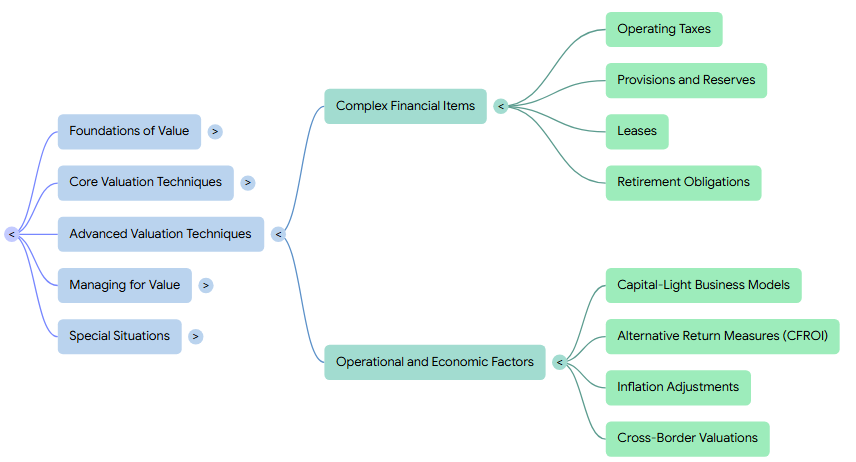
Within the larger context of corporate valuation, these advanced techniques ensure that a company’s financial representation reflects its true cash-generating capacity and risk profile. The book organizes these techniques across several major themes:
1. Operating Taxes and Deferred Taxes (Chapter 20)
Tax accounting is highly complex, and reported effective or statutory tax rates are generally poor predictors of core operating cash taxes. The book provides a structured methodology to estimate operating taxes on EBITA and convert them to operating cash taxes.
- Deferred Tax Treatment: A critical housekeeping rule is that operating Deferred Tax Assets (DTAs) and Liabilities (DTLs) must be treated as equity equivalents on the reorganized balance sheet, rather than being included in invested capital. If they are mistakenly included in invested capital, their impact is double-counted in free cash flow (once in NOPAT via cash taxes and again when taking the change in invested capital).
- Tax Loss Carryforwards: These represent valuable future tax savings but must be treated as nonoperating assets, evaluated separately, and discounted at the unlevered cost of equity rather than being mixed into core operations.
2. Nonoperating Items, Provisions, and Reserves (Chapter 21)
Traditional income statements frequently commingle ongoing operating results with one-time, nonoperating charges. To prevent these from warping performance metrics, the book establishes a rigorous classification system for provisions and reserves:
- Ongoing Operating Provisions: (e.g., product returns and warranties) are deducted from operating assets to find invested capital, and the provision is modeled directly within free cash flow.
- Long-Term Operating and Nonoperating Provisions: (e.g., plant decommissioning costs, severance reserves, or litigation liabilities) are treated as debt equivalents. Their present value is deducted from enterprise value to determine equity value, and their drawdowns do not flow through free cash flow to prevent double-counting.
- Income-Smoothing Provisions: Must be entirely eliminated from NOPAT (converting them back to a cash basis) and their reserves treated as equity equivalents.
- Acquisition Amortization: The amortization of acquired intangibles is excluded from NOPAT because it is a noncash expense that double-penalizes acquiring firms (which are already expensing the marketing and selling costs to replenish those brands).
3. Operating Leases (Chapter 22)
Operating leases are essentially debt-financed assets. While IFRS automatically capitalizes almost all leases (eliminating the need for manual adjustment), U.S. GAAP operating leases require a disciplined capitalization process to ensure consistent benchmarking:
- Statement Adjustments: The analyst must add a capitalized “right-of-use” asset to invested capital and a corresponding lease liability to debt.
- NOPAT Reclassification: EBITA must be adjusted upward by removing the implicit interest expense embedded in rental payments. Failing to do so double-counts lease costs (once in operating expenses and once when subtracting lease debt from enterprise value), which systematically undervalues the equity.
- Perpetuity Asset Method: To prevent understating the assets deployed in short-term leases of long-lived assets, the book outlines an alternative perpetuity-based model to estimate the true value of leased assets, facilitating an apples-to-apples comparison across firms with different ownership models.
4. Retirement Obligations (Chapter 23)
Unfunded pension and postretirement medical obligations are financial claims that take priority over common equity and must be treated as debt equivalents deducted from enterprise value on an after-tax basis.
- NOPAT Separation: The pension expense must be split so that only the actual operating service cost remains in NOPAT, while nonoperating pension expenses (like interest costs and expected plan asset returns) are stripped out.
- Cost of Capital Adjustments: When calculating the cost of capital, pensions must be removed from the unlevering and relevering of equity beta. This prevents the investment risks of the pension fund’s assets from artificially inflating the cost of equity used to discount core operating cash flows.
5. Capital-Light Businesses and Intangibles (Chapter 24)
Standard accounting rules conservatively expense intangible investments (such as R&D, software, or brand-building) in the period they occur, which understates invested capital and heavily overstates ROIC for knowledge-based or capital-light companies.
- Intangible Capitalization: The book outlines how to capitalize these expenditures, building an intangible asset base on the balance sheet and replacing current-year R&D expenses with ongoing amortization in NOPAT. This process stabilizes ROIC at a level that represents the company’s true economic return.
- The ROIC Volatility Problem: For businesses that require almost no physical capital, minor changes in working capital cause ROIC to fluctuate wildly or become mathematically unmeasurable. In these situations, the book recommends using economic profit or economic profit scaled by revenues as a more robust and stable measure of value creation.
6. Alternative Return-on-Capital Measures (Chapter 25)
To overcome the limitations of ROIC (such as its failure to account for asset age or inflation), various alternative return metrics exist:
- Cash Flow Return on Investment (CFROI): This metric measures returns based on inflation-adjusted operating cash flows and gross invested capital. It is highly useful in rare, capital-lumpy industries (like infrastructure or hydroelectric plants) where book value and depreciation do not represent the ongoing cash capacity of assets.
- Flawed Cash Returns: The book strongly advises against using simpler cash-return metrics (such as CROCI or CashROA) that divide operating cash flow by gross or net invested capital. Because these metrics fail to account for the depletion of the asset base (by ignoring depreciation), they systematically overstate the true internal rate of return (IRR).
7. Inflation (Chapter 26) and Cross-Border Valuations (Chapter 27)
- Inflationary Distortions: High inflation overstates nominal revenue growth, distorts capital turnover, and artificially inflates margins due to low historical depreciation. To resolve this, the book recommends a hybrid forecasting model: project operating performance in real terms (to keep capital expenditures and depreciation aligned), but calculate taxes and working capital changes in nominal terms.
- Cross-Border Consistency: Cross-border valuations can be performed via the spot-rate method or the forward-rate method; if consistent monetary and inflation assumptions are used, both yield the exact same domestic value.
- WACC Currency Alignment: When using WACC globally, analysts must distinguish between a domestic-capital WACC (assuming the business is financed and taxed at parent interest and tax rates) and a foreign-capital WACC (assuming local financing and tax rules) to ensure tax shields are priced correctly.
Complex Financial Items
In the book, complex financial items—specifically hybrid securities, nonequity claims, and noncontrolling interests—represent a challenging frontier within Advanced Valuation Techniques. Traditional balance sheets typically draw a sharp line between straight debt and common equity, but modern corporate finance relies heavily on complex instruments that resist easy classification.
Because the values of these hybrid and nonequity claims are often highly dependent on the overall value of the enterprise, the book mandates that analysts move beyond simple accounting book values and employ specialized, option-based valuation techniques to isolate the true value belonging to common shareholders.
1. The Challenge of Hybrid Securities
The book defines hybrid securities as financial claims that possess both debt and equity characteristics but are not yet part of owners’ equity. The three most common varieties are convertible debt, preferred stock, and employee stock options.
Because their payoffs change dynamically with the company’s performance, using accounting book values (or carrying values) is a poor proxy that can seriously underestimate the hybrid’s value and overstate the remaining common equity value. Instead, these claims must be valued in conjunction with estimates of enterprise value using option-pricing models.
2. Valuing Convertible Securities and Hedges
A convertible bond represents a package containing a straight corporate bond and a call option to convert that bond into common stock at a predetermined ratio. To determine the value of convertibles, the book outlines four primary methods:
- Company-Disclosed Fair Value: Analysts can rely on the “fair value of financial instruments” reported in the notes to the financial statements, provided the company’s overall enterprise value has not changed significantly since the last reporting date.
- Market Price: If the convertible bonds are actively traded, analysts should pull current market-clearing prices from databases such as FINRA’s TRACE system.
- Black-Scholes Value: When a company’s operating performance has altered its enterprise value, straight debt cash flows must be valued separately (by discounting coupon and principal payments at default-adjusted market yields) and added to the option value calculated via the Black-Scholes option-pricing model.
- Conversion Value: This simplified approach assumes immediate exchange for equity and ignores the remaining time value of the option. While easy to implement, the book warns that it is only appropriate when the conversion option is deep “in the money”.
Convertible Note Hedges
Some issuers purchase derivative overlays (convertible note hedges and warrants) alongside their convertible bonds to synthetically raise the strike price. These hedges protect current shareholders from dilution. The book advises analysts to carefully review the notes to adjust the valuation and model the synthetic, higher strike price.
3. Valuing Employee Stock Options
Employee stock options affect a corporate valuation in two distinct ways, and the book stresses that they must be treated differently depending on their status:
- Future Option Grants: The expected value of options to be granted in the future represents an ongoing compensation expense. This must be modeled directly within the free cash flow projections (or subtracted in a separate DCF) and must not be treated as a nonequity claim.
- Outstanding Options: Options currently held by employees must be treated as a prior nonequity claim and subtracted from enterprise value.
To value outstanding options, analysts can use company-disclosed fair value (from the footnotes), option-pricing models (such as Black-Scholes or binomial lattice models to capture volatility and exercise rates), or the exercise value approach. The book advises against the exercise value approach because it assumes immediate exercise and completely ignores the option’s time value, underestimating the prior claim.
4. Valuing Noncontrolling Interests
A noncontrolling interest (formerly minority interest) occurs when a parent company holds majority control over a subsidiary but does not own 100 percent of its equity. Because accounting standards require the parent to fully consolidate the subsidiary’s assets, liabilities, and core operating cash flows on its own balance sheet, the portion of value belonging to outside investors must be deducted to isolate common equity.
Because a noncontrolling interest is a claim strictly on the subsidiary’s assets—not the parent company as a whole—its value must be estimated based on the specific unit’s economics. Analysts should value the subsidiary separately using a discounted cash flow approach, multiples, or a tracking portfolio, and then deduct the outsiders’ proportional share.
5. Key Safeguards: Double-Counting and the Undiluted Shares Rule
When integrating these complex financial items into the final valuation buildup, the book highlights two critical technical guardrails to maintain model integrity:
- Avoid Double-Counting nonequity claims: Analysts must be mathematically consistent. For example, if you deduct a pension shortfall or capitalized operating lease liability as a debt equivalent from the enterprise value, you must not model those ongoing pension cash contributions or lease outflows within your free cash flow projections. Doing so double-penalizes and systematically understates the equity value.
- The Undiluted Shares Rule: Once all prior debt equivalents, hybrid claims, and options are valued separately and subtracted as nonequity claims, you must divide the residual equity value by the current number of undiluted shares outstanding. Dividing by diluted shares in this scenario is a major analytical error that double-counts the dilutive impact of those options and convertibles, artificially depressing the estimated value per share.
Operating Taxes
In the book, operating taxes represent the hypothetical taxes a company would pay if it generated only operating income and was financed entirely with equity. In the broader framework of corporate valuation, separating these operating taxes from the tax effects of complex financial items—such as hybrid securities, noncontrolling interests, operating leases, and unfunded pensions—is critical to isolate core operating performance (NOPAT) from nonoperating and financing decisions.
This separation creates a clear division in how taxes are handled across different sections of the reorganized financial statements:
1. Operating Cash Taxes vs. Nonoperating Deferred Taxes
Operating cash taxes are estimated by taking operating taxes on an accrual basis and adjusting for the change in operating deferred tax assets (DTAs) and operating deferred tax liabilities (DTLs). These operating deferred tax accounts (such as those arising from accelerated depreciation or accrued liabilities) are treated as equity equivalents on the reorganized balance sheet. Because they adjust operating taxes, they are already embedded in the free cash flow and core operating value.
Conversely, deferred taxes related to complex financial items—such as pension liabilities, tax loss carryforwards, or convertible debt—are classified as nonoperating deferred taxes. The book dictates that these must never be included in the calculation of NOPAT or operating cash taxes. Instead, they are excluded from invested capital and valued separately alongside their corresponding nonoperating parent account:
- Unfunded Pensions: Since pension contributions are tax-deductible, the net pension liability is treated as a debt equivalent and deducted from enterprise value on an after-tax basis (multiplying the unfunded liability by 1-Tm ).
- Tax Loss Carryforwards: These represent future tax savings and are recorded on the balance sheet as deferred tax assets. They are classified as nonoperating assets, projected and discounted at the weighted average cost of capital (WACC) or unlevered cost of equity, and added separately to the operating value.
2. Weeding Out Double-Counting and the NOPAT Reconciliation
To ensure the technical accuracy of the model, the book mandates a rigorous NOPAT-to-net-income tax reconciliation.
- Taxes on Nonoperating Accounts: Reported income taxes are heavily distorted by interest expense, lease interest, and nonoperating gains/losses. During the reorganization, taxes related to nonoperating accounts are calculated using the statutory tax rate and stripped from NOPAT. This keeps NOPAT independent of capital structure.
- The Double-Counting Trap: If a complex financial item like an unfunded pension shortfall is deducted as a debt equivalent on an after-tax basis, you must not also model the future tax-deductible pension cash contributions within your free cash flow projections. Doing so would double-count the liability (once in the cash flows via higher taxes/lower FCF, and once as a debtlike claim), systematically underestimating the equity value.
3. Acquired Intangibles and NOPAT Multiples
Under traditional accounting, companies must recognize a deferred tax liability at the time of an acquisition because the amortization of acquired intangibles is typically nondeductible. To balance this DTL, the assets are “grossed up” on the balance sheet.
- Because the book computes operating taxes on EBITA rather than EBIT, it ignores the amortization tax shield in NOPAT and free cash flow.
- Consequently, the DTL related to acquired intangibles is treated as nonoperating and is netted directly against the acquired intangibles on the reorganized balance sheet, rather than adjusting operating taxes or NOPAT.
Provisions and Reserves
In the book, provisions are defined as noncash expenses that reflect future costs or expected losses, while reserves are the corresponding liabilities recorded on the balance sheet to cover those anticipated outlays. Within the larger framework of moving from enterprise value to equity value, select reserves are categorized as nonequity claims (specifically, debt equivalents). These represent financial claims against enterprise value that do not scale with revenue and whose expenses are excluded from Free Cash Flow (FCF), requiring analysts to value them separately and subtract them from enterprise value to isolate the value belonging to common shareholders.
To prevent these liabilities from distorting performance metrics like Net Operating Profit After Taxes (NOPAT) and Return on Invested Capital (ROIC), the book organizes provisions and reserves into a strict four-fold classification system:
1. Ongoing Operating Provisions
These reflect routine, short-term operating costs, such as reserves for product warranties and customer returns.
- Treatment: The provision is deducted from revenues to determine NOPAT. The corresponding reserve on the balance sheet is netted directly against operating assets to determine invested capital.
- Valuation Impact: Because these provisions are built directly into NOPAT and FCF, their cash flows are already captured in the core value of operations. Consequently, their reserves are not treated as nonequity claims and are not deducted from enterprise value.
2. Long-Term Operating Provisions
These represent future operating liabilities that are payable over the very long term, most notably expected plant-decommissioning and asset-retirement costs.
- Treatment: The operating portion of the provision (depreciation of the capitalized decommissioning asset) is deducted to determine NOPAT. However, the “accretion expense”—which represents the interest-like growth of the reserve over time—is classified as a nonoperating financing charge and is excluded from NOPAT.
- Valuation Impact: The corresponding reserve on the balance sheet is treated as a debt equivalent. Because its financing costs are excluded from NOPAT, the present value of the reserve is subtracted from enterprise value to determine equity value.
3. Nonoperating Restructuring Provisions
These include one-time, nonoperating charges, such as future severance payments or plant closure costs resulting from layoffs.
- Treatment: The accrual provision is treated as nonoperating and is excluded from EBITA and NOPAT calculations.
- Valuation Impact: Because the expense is excluded from core operations, the restructuring reserve is treated as a debt equivalent. The estimated cash-based outflows must be modeled separately on a cash basis (by subtracting the change in the reserve from the restructuring expense), discounted to the present, and subtracted from the value of operations.
4. Income-Smoothing Provisions
These are provisions set up on the balance sheet for the sole purpose of moving income from one period to another to smooth reported profits.
- Treatment: To evaluate a company’s true performance, these provisions must be entirely eliminated from EBITA and NOPAT, effectively converting the accounting entries back to a cash basis.
- Valuation Impact: The reserve is treated as an equity equivalent. Because they are entirely noncash and have their operating effects undone, they do not impact the final valuation and are not deducted from enterprise value.
The Double-Counting Guardrail
A key technical warning emphasized in the book is avoiding the double-counting trap when managing reserves. If an analyst subtracts the present value of a reserve (such as an unfunded pension shortfall or a restructuring provision) as a debt equivalent from enterprise value, they must ensure that the future cash payouts to settle that reserve are not modeled inside the free cash flow projections. If both are done, the company is penalized twice for the same liability, which systematically and incorrectly undervalues its equity.
Tax and Deferred Tax Implications
Provisions also have significant tax implications. Because provisions are typically tax-deductible for fiscal purposes only when cash is actually disbursed rather than when the expense is recognized, they give rise to Deferred Tax Assets (DTAs).
When reorganizing the balance sheet, operating-related DTAs and deferred tax liabilities (DTLs) associated with provisions must be treated as equity equivalents in the equity section of total funds invested, rather than being included in invested capital. This prevents their cash tax effects from being double-counted in free cash flow (once in NOPAT via cash taxes and again in the change in invested capital).
Leases
In the book, operating leases are classified as debt equivalents under the umbrella of nonequity claims. These claims represent prior financial obligations that take precedence over common equity. Consequently, their values must be determined at market rates and deducted from the overall enterprise value to isolate the residual equity value belonging strictly to common shareholders.
1. The Dynamic of the 2019 Accounting Standards (IFRS vs. U.S. GAAP)
Historically, operating leases were kept off the balance sheet. However, the updated standards implemented in 2019 require companies to capitalize nearly all leases greater than one year. This change aligns reporting much more closely with the economic principles advocated in the book. Still, the two primary accounting frameworks handle this capitalization differently, which requires careful analytical separation:
- International Financial Reporting Standards (IFRS 16): Under IFRS, virtually all leases are treated as finance leases. Leased assets and liabilities are automatically capitalized on the balance sheet, and lease expense is already split between operating depreciation and nonoperating interest expense. Because the statements are already in economic format, standard valuations can be completed under IFRS without manual adjustments.
- U.S. GAAP (ASC 842): U.S. GAAP maintains a dual-classification system, splitting leases into “finance” and “operating” leases. For operating leases, the entire payment is recorded as a single operating rental expense within costs like cost of sales. This commingles operating costs and financing costs, requiring the analyst to manually restructure the statements.
2. The Strict “Three-Action” Reorganization Protocol
To prevent operating leases from warping profitability and investment metrics, the book mandates a disciplined three-action process that must be fully implemented to value the equity consistently:
- Adjust Operating Profit (NOPAT): EBITA must be adjusted upward by removing the implicit interest expense embedded within the lease payments. If this implicit interest is not removed, it will be double-counted—once as an operating cost in free cash flow, and again as a debt deduction from enterprise value—which systematically undervalues the equity.
- Adjust Gross Investment (Free Cash Flow): The year-over-year change in the capitalized “right-of-use” asset must be modeled directly within free cash flow as an operating capital reinvestment.
- Subtract the Debt Equivalent (Valuation Buildup): The present value of the operating lease liability (derived by discounting future commitments by an interest rate on low-risk debt) must be subtracted from the enterprise value to arrive at equity value.
3. Incorporating Leases into Risk and the Cost of Capital
Because leases are treated as a form of debt, they alter the financial risk profile of the business:
- WACC Weighting: Capitalized operating leases must be added to traditional interest-bearing debt when calculating the target debt-to-value ratio used to weight WACC.
- Operating Tax Shield: Because lease interest is tax-deductible, the cost of debt assigned to the leases must be reduced by the marginal tax rate.
- Beta Relevering: When estimating the cost of equity, the industry-unlevered beta must be calculated using a debt-to-equity ratio that is adjusted for capitalized operating leases. This unlevered beta is then relevered to the target company’s capital structure, inclusive of leases.
4. The Critical Guardrail: Avoiding Double-Counting
The book emphasizes a vital technical warning: never double-count nonequity claims. If you capitalize an operating lease liability and subtract it from the enterprise value during the final buildup, you must not model those lease payments within your free cash flow projections. The free cash flow must be modeled on an “unlevered, all-equity” basis, meaning only the changes in the capitalized operating assets are captured.
Retirement Obligations
In the book, retirement obligations—which include defined-benefit pension plans and promised retiree medical benefits—are treated as major nonequity claims (or debt equivalents) and nonoperating assets within the larger framework of corporate valuation. Because these obligations are priority financial claims that take precedence over common equity, any accurate valuation must separate and account for them with high precision.
To achieve this, the book establishes a rigorous reorganization process on both the balance sheet and the income statement to strip out pension-related distortions from a company’s core operations.
1. Balance Sheet Reorganization: Isolating Core Operations
Traditional accounting statements commingle retirement obligations with core operating assets. To prepare the financial statements for economic analysis, the book requires a complete separation of these accounts:
- Invested Capital Exclusion: Because excess pension assets do not generate operating profits and unfunded pension shortfalls do not fund day-to-day operations, pension accounts must never be included in the calculation of Invested Capital.
- Unfunded Liabilities as Debt Equivalents: Gross unfunded pension and retiree medical obligations are classified as debt equivalents. They represent a priority claim against the enterprise, as if the company had to borrow money to fund its promises.
- Prefunded/Excess Assets as Nonoperating Assets: If a pension plan is overfunded, the surplus is treated as a nonoperating asset rather than an operating balance sheet item.
2. Income Statement Reorganization: Isolating Service Cost
Historically, pension expenses reported on the income statement were highly volatile because they mixed operational labor costs with the investment performance of pension plan assets. This allowed potential earnings manipulation (e.g., inflating expected returns to artificially boost operating profits). Under modern GAAP/IFRS standards and the book’s reorganization protocol:
- The Operating Split: Only the service cost—the current year’s value of new benefits promised to employees—is kept within operating expenses (cost of sales or SG&A) to determine EBITA and NOPAT.
- The Nonoperating Split: All other components of pension expense (such as interest costs on the liabilities, expected returns on plan assets, and actuarial gains/losses) are reclassified as nonoperating or financing items and excluded from NOPAT.
3. Pensions and the Cost of Capital
To estimate the true cost of equity for core operations, risk metrics must be cleaned of pension-related distortions.
- Unlevering Beta: The systematic risk of pension assets can artificially inflate the volatility of a company’s stock. Analysts must adjust (unlever) the equity beta of peer companies by treating unfunded pensions as a debt equivalent (Method 1) or by explicitly accounting for the different betas of the plan’s underlying assets (Method 2).
- Relevering Beta: When relevering the unlevered industry beta to estimate the target company’s cost of equity, the book notes that you should not incorporate pensions. Because pensions are valued separately as part of the “sum-of-the-parts” equity value buildup, reintroducing pension risk into the operating WACC is unnecessary and theoretically inconsistent.
4. Valuation Buildup and the Double-Counting Guardrail
In the final step of converting enterprise value to equity value, retirement obligations are incorporated on an after-tax basis:
- After-Tax Deductions/Additions: Net unfunded pension liabilities are multiplied by and deducted from enterprise value, because future cash contributions to close funding gaps are tax-deductible. Net overfunded pension assets are added after adjusting for statutory tax rates (or terminal liquidation penalties if the plan is being wound down).
- The Double-Counting Trap: The book warns that if you subtract the present value of a pension shortfall as a debt equivalent from your enterprise value, you must not also model the extra cash contributions to fund that shortfall inside your free cash flow projections. Doing so penalizes the company twice for the same liability and systematically undervalues the common equity.
Operational and Economic Factors
In Part Three, the book dedicates its advanced valuation framework to analyzing the complex operational and economic factors that standard financial statements often distort. Traditional accounting rules frequently commingle operating performance with financing decisions, misclassify long-term investments as immediate expenses, and ignore the warping effects of macroeconomic forces like inflation and currency volatility. To establish a company’s true intrinsic value, Advanced Valuation Techniques require reorganizing and adjusting financial statements to reflect economic reality.
1. Capitalizing Expensed Quasi-Investments (R&D and Marketing)
Traditional accounting conservatively expenses intangible outlays—such as research and development (R&D), software, and brand advertising—immediately in the period they occur. The book notes that this practice severely distorts performance metrics for knowledge-based or capital-light companies by understating invested capital and overstating Return on Invested Capital (ROIC).
- The Investment Analogy: Economically, outlays for R&D and brand-building are identical to investments in physical plant and equipment because they generate benefits over multiple future years.
- ROIC vs. Economic Return (IRR): To align ROIC with the company’s true internal rate of return (IRR), the book prescribes capitalizing these expenditures on the balance sheet and replacing the annual R&D expense on the income statement with an ongoing amortization schedule. In high-tech or pharmaceutical firms, this adjustment often reveals that unadjusted, sky-high ROICs are economically misleading.
- Operating Decisions and Manipulation: Under standard accounting, a manager can artificially boost short-term profits to meet targets by cutting R&D or advertising, which destroys long-term value. Capitalizing these expenses neutralizes this incentive because the amortization charges remain virtually unchanged in the short term.
2. Capital-Light Business Models and the Role of Capital Turnover
When businesses require very little physical capital (e.g., software development, digital platforms, or professional services), ROIC becomes highly sensitive to minor fluctuations in working capital.
- ROIC Volatility: In these industries, invested capital can easily drop close to zero or become negative, causing ROIC to swing wildly or become mathematically unmeasurable, rendering it useless for target setting and planning.
- Economic Profit as the Core Metric: To bypass this operational distortion, the book recommends measuring performance using economic profit (or economic profit scaled by revenues). Because economic profit multiplies the economic spread by the actual capital base, it remains stable and in line with value creation even when capital intensity is extremely low.
- The Outsourcing Trap: Many companies adopt “capital-light” models by outsourcing production to third-party manufacturers, which drastically reduces their Property, Plant, and Equipment (PP&E) and inflates their ROIC. The book warns that this operational choice does not necessarily create value; the supplier simply embeds their own capital costs into the raw materials price, which lowers operating margins. Only an increase in economic profit, not a high ROIC, proves that outsourcing has created real economic value.
3. Macroeconomic Forces: The Value-Destroying Impact of Inflation
High-inflation environments introduce severe distortions into financial analysis, understating the historical book value of PP&E and understating depreciation charges relative to current replacement costs.
- The Incomplete Pass-On Effect: The book highlights that inflation’s most destructive economic impact is that companies typically cannot increase prices enough to cover both their rising operating expenses (such as wages) and the significantly higher nominal costs of future capital expenditures. Consequently, their cash flows in real terms systematically erode.
- The Hybrid Projections Solution: Because standard financial ratios are warped by inflation, Advanced Valuation Techniques require a combined nominal- and real-terms forecasting approach. Analysts should project operational performance (revenues, EBITDA, and capital turnover) in real terms to capture the underlying economics of the business, but construct the final financial statements, working capital changes, and income taxes in nominal terms to ensure tax charges are modeled accurately.
4. Adjusting Operating Leases for Consistent Benchmarking
Operating leases are economically equivalent to debt-financed assets, but under U.S. GAAP, they are expensed as rental costs, commingling a company’s operational expenses with its financing structure.
- Isolating Operating Profit: Advanced techniques capitalize these leases to adjust operating profit (EBITA) upward by removing the implicit interest expense embedded within the rental payments, ensuring NOPAT is measured on an all-equity operating basis.
- Correcting Capital Turnover Distortions: For companies utilizing short-term leases on long-lived assets (such as airlines or retailers), standard lease capitalization understates the true value of the assets being deployed. To prevent ROIC and capital turnover from being distorted during peer-group benchmarking, the book outlines an alternative perpetuity-based model that estimates the full economic value of the leased assets using the annual lease expense and the cost of secured debt.
5. Isolating Pension-Related Operational Costs
Retirement obligations like defined-benefit pension plans can heavily distort reported operating profits because traditional pension expenses mix actual labor costs with the volatile investment performance of pension plan assets.
- The Operating Split: To prevent earnings manipulation and isolate core operations, Advanced Valuation Techniques require splitting the pension expense. Only the service cost (the current-year value of new benefits promised to employees) is retained within operating costs to determine EBITA and NOPAT.
- Nonoperating Classification: All other elements—including interest costs on the liabilities, expected returns on plan assets, and actuarial gains/losses—are reclassified as nonoperating or financing costs and excluded from NOPAT. This ensure that the operating cash flows used in valuation models reflect pure business performance.
Capital-Light Business Models
In the book, capital-light business models are analyzed as a unique challenge within Advanced Valuation Techniques because traditional accounting standards often obscure their true economic returns and performance. When companies require little to no physical capital, standard metrics like Return on Invested Capital (ROIC) become highly volatile, misleading, or even mathematically unmeasurable, requiring analysts to look deeply at underlying operational and economic factors to evaluate performance.
1. Capitalizing Expensed Intangibles (“Quasi-Investments”)
Traditional accounting rules conservatively expense intangible outlays—such as research and development (R&D), software, and brand advertising—immediately in the period they occur. For knowledge-based or capital-light companies, this practice severely distorts performance metrics:
- The Mismatch of Returns: In companies like young biotechnology or technology firms, expensing outlays understates invested capital and heavily overstates ROIC once products are launched. It obscures the true cumulative capital required to generate those profits.
- The Capitalization Solution: To reflect true economic performance, the book details a three-step capitalization process: (1) capitalize and amortize the intangible asset using an appropriate lifetime, (2) adjust invested capital upward by the net R&D asset value, and (3) replace the annual R&D expense on the income statement with an ongoing amortization charge.
- Economic Reality (PharmaCo Example): For a company like the fictional PharmaCo, capitalizing R&D does not alter historical free cash flows, but it raises the capitalized asset base from $404 company-reported million to over $1.6 billion, stabilizing ROIC at an economically realistic 9.5 percent rather than an unadjusted, inflated 33 percent.
- Neutralizing Short-Term Manipulation: Under traditional accounting, a manager can artificially boost short-term profits by cutting R&D or advertising, which destroys long-term value. Capitalizing these expenses neutralizes this incentive because the amortization charges remain virtually unchanged in the short term, exposing the lack of actual operational improvement.
2. Pure Capital-Light vs. Outsourcing (The “Outsourcing Trap”)
The book distinguishes between two distinct operational paths to a capital-light profile:
- Inherently Capital-Light Businesses: These are businesses whose core models naturally require very little physical capital, such as professional services (accounting, legal counseling, real estate brokerage) or software development.
- Capital-Light by Operational Choice (The Outsourcing Path): These are traditionally capital-intensive businesses that aggressively outsource their manufacturing and distribution (such as Apple, Nike, Hewlett-Packard, or Sony).
- The ROIC Distortion (InhouseCo vs. ContractCo): Operational outsourcing dramatically inflates a company’s unadjusted ROIC. However, the book warns that this is often a value-creation illusion. Comparing two identical firms—InhouseCo (which owns its equipment) and ContractCo (which outsources production)—reveals that ContractCo’s ROIC is more than five times larger because its capital base is minuscule. Yet, because the supplier embeds its own capital costs in the product price, ContractCo faces higher operating costs and lower operating margins. Consequently, their actual economic profit and value creation are completely identical. Managers should not outsource merely to artificially inflate ROIC, as it does not inherently create value.
3. Solving the ROIC Volatility Problem with Economic Profit
When a company’s invested capital base is extremely small or fluctuates around zero, ROIC becomes highly sensitive to minor working capital movements:
- Wild Fluctuations: For a trading business like TradeCo (which holds minimal inventory and pays suppliers only after receiving customer payments), working capital can become negative, making ROIC highly volatile or mathematically unmeasurable. For instance, TradeCo’s ROIC may double from 316% to 632% in a year when its actual value creation has declined.
- Economic Profit as the Anchor: To bypass these distortions, the book recommends utilizing Economic Profit as the primary performance metric. Because Economic Profit multiplies the economic spread by the actual invested capital base, it automatically corrects for low capital intensity and remains stable and in line with actual cash generation.
- Scaling Economic Profit by Revenues: To compare business units of vastly different sizes (such as DiversiCo’s negative-capital software unit versus its $1 billion hardware division), managers should scale Economic Profit by Revenues. This metric measures the absolute value created per dollar of sales, providing a robust yardstick for portfolio resource allocation.
- Exposing Peer Distortions (ReturnCo Example): A company like ReturnCo might post a spectacular 105% ROIC by offering aggressive customer discounts for early payment, which drives its working capital negative but depresses operating margins. By analyzing Economic Profit over Revenues, analysts can see that the margin sacrifice exactly offsets the capital efficiency, proving ReturnCo’s performance is actually in line with its lower-ROIC peers.
In summary, capital-light and intangible-intensive models require analysts to look past unadjusted accounting statements. By capitalizing expensed investments and prioritizing scaled Economic Profit metrics, managers and investors can ensure their valuations remain tightly locked to the physical economics of cash generation.
Alternative Return Measures (CFROI)
In the book, the ultimate goal of any return-on-capital metric is to serve as an accurate proxy for the internal rate of return (IRR) of a business’s underlying projects, tracking the performance from the initial investment through to the final cash collections. While Return on Invested Capital (ROIC) is the primary tool used for this diagnostic, it has certain limitations—specifically, it does not naturally account for the physical age of a company’s assets or the warping effects of inflation.
To address these shortcomings, analysts sometimes rely on Cash Flow Return on Investment (CFROI). However, the book notes that selecting between ROIC and CFROI is not a matter of one being universally superior; rather, the choice depends heavily on the specific operational and economic factors of the business being analyzed.
1. Defining CFROI vs. ROIC
- ROIC measures operating earnings (NOPAT) divided by the net book value of operating capital (historical cost minus accumulated depreciation).
- CFROI is an alternative measure estimated from cash flows rather than accounting profits. For any given year, CFROI is defined as the discount rate at which the present value of that year’s operating cash flow (modeled as an -year annuity) equals the gross invested capital at the beginning of the year, where is the estimated useful lifetime of the underlying asset.
Crucially, the book emphasizes that any legitimate measure of return on capital must be based on the amount historically invested, rather than the current market value of the company or its assets.
2. When Each Metric Correctly Estimates the True Economic Return (IRR)
In theory, both metrics can perfectly represent the true economic return (IRR) of a business, but they do so under different operational cash flow profiles:
- ROIC equals IRR if the operating profits of the business are proportional to net invested capital in each year of the asset’s life. This pattern assumes that as an asset ages and depreciates, its capacity to generate operating profits declines proportionally.
- CFROI equals IRR if the operating cash flows are proportional to gross invested capital and remain constant over the asset’s entire lifetime.
3. Operational and Economic Factors Driving the Choice
The choice between ROIC and CFROI is dictated by the capital intensity and reinvestment patterns of the industry:
- Lumpy, Capital-Intensive Businesses (Where CFROI excels): In industries characterized by huge, lumpy, up-front investments that generate highly stable cash flows over many years with very little ongoing maintenance capital expenditures (such as infrastructure projects or hydroelectric power plants), ROIC can become highly distorted. Because accounting rules force companies to depreciate these assets, the net book value falls close to zero, causing the apparent ROIC to artificially skyrocket to levels completely disconnected from the actual economic IRR of the project. In these rare situations, CFROI is the superior metric because its gross-capital denominator is not distorted by accounting depreciation, aligning it much more closely with the true IRR.
- Smooth, Reinvestment-Heavy Businesses (Where ROIC excels): For the vast majority of companies (such as retail supermarkets or manufacturing firms with multiple plants), capital investments occur in a continuous, smooth, and regular pattern. These businesses must constantly reinvest capital to maintain, upgrade, and renew their product lines and retail formats. Over time, competitive forces and technological obsolescence place pressure on older formats, meaning their economic value decays. In these environments, the depreciated net capital base serves as a highly realistic proxy for the assets’ ongoing earning power, making ROIC the more accurate estimator of the underlying IRR.
4. Practical and Aggregation Trade-Offs
Beyond theoretical alignment, the book outlines critical practical differences in how these metrics are implemented:
- Mathematical Simplicity: ROIC is a straightforward ratio that is highly intuitive and easy to compute from reorganized financial statements. CFROI requires a complex, iterative calculation that is often a “black box” to managers.
- Aggregation: A corporate group’s ROIC is easily calculated as the capital-weighted average of its underlying business units’ ROICs. Because CFROI is not a simple ratio, deriving a corporate-level CFROI from segment-level CFROIs is highly complex and mathematically non-transparent.
- Inflation and Empirical Convergence: While CFROI includes a built-in historical inflation adjustment by indexing gross capital, the book highlights that similar inflation adjustments can be applied directly to ROIC. In an empirical study of 1,000 large U.S. companies across ten sectors, the long-term average difference between ROIC and CFROI was three percentage points or less. Consequently, for most companies, using one metric over the other is unlikely to alter strategic conclusions regarding relative performance against industry peers.
5. Flaws of Alternative Cash Returns (CROCI, CROGI, CashROA)
Finally, the book warns managers against utilizing simpler “cash return” metrics like Cash Return on Capital Invested (CROCI), Cash Return on Gross Investment (CROGI), or Cash Return on Assets (CashROA), which divide operating cash flow by gross or net invested capital. These metrics are fundamentally flawed measures of value creation because they completely ignore depreciation charges. By failing to account for the economic cost of depleting the underlying capital base over time, they systematically and severely overestimate the true IRR of a company’s investments.
Inflation Adjustments
In the book, inflation is identified as a highly destructive economic force that frequently erodes a company’s real-terms free cash flow and intrinsic value. The core economic challenge of inflation is that most companies cannot or do not increase prices enough to cover both their rising nominal operating expenses and the significantly higher replacement costs of future capital expenditures. If a company merely keeps its reported sales margins and ROIC constant during inflationary times, its cash flows and economic value are actually eroding in real terms.
To counter this, the book outlines how inflation distorts traditional financial statements and prescribes specific inflation adjustments for both historical performance analysis and financial forecasting.
1. Adjusting Historical Performance Metrics
High inflation distorts standard accounting statements because nonmonetary assets (like PP&E and inventory) are carried on the balance sheet at historical cost, while depreciation charges on the income statement are severely understated relative to current replacement costs. To analyze a company’s true historical performance, the book mandates adjusting the following metrics:
- Organic Revenue Growth: Nominal growth is heavily overstated during inflationary periods. Analysts must restate revenue in real terms by deflating reported figures with an annual, quarterly, or monthly inflation index.
- Capital Turnover: Because fixed assets are carried at historical costs, capital productivity looks artificially high. Analysts should approximate the current replacement cost of PP&E by adjusting reported values with an inflation index matching the assets’ average lifetime, or instead use physical capacity metrics (e.g., sales per square meter for retailers).
- Operating Margins: Operating profit margins are frequently overstated because depreciation is too low and slow-moving inventories generate paper-only nominal holding gains. To correct this, depreciation must be recalculated based on inflation-adjusted PP&E, and cash operating expenses must be inflated to a current-cost basis. Alternatively, analysts can use the EBITDA-to-sales ratio as a baseline, as it is unaffected by depreciation distortions.
- Credit and Solvency Ratios: Solvency multiples like debt-to-equity become highly distorted because long-lived assets are understated while floating-rate debt is denominated in current nominal terms. Instead, the book recommends focusing on interest coverage ratios, such as EBITDA-to-interest, which are far less exposed to these accounting distortions.
2. Financial Projections: The Hybrid Forecasting Model
When projecting future performance in a high-inflation environment, the book warns that relying solely on nominal or solely on real projections is highly problematic. Real-terms projections make it extremely difficult to calculate corporate income taxes correctly, because tax laws are calculated on nominal earnings and rarely allow for inflation adjustments. Conversely, pure nominal projections make capital expenditures, depreciation, and EBITA highly volatile and difficult to project because the stable real-terms relationship between revenues and fixed assets is disrupted.
To resolve this conflict, the book prescribes a five-step hybrid modeling approach that integrates both real and nominal terms:
- Project Operating Performance in Real Terms: Project future revenues, cash expenses (to get real EBITDA), capital expenditures (utilizing real capital turnover assumptions), and real working capital. Use asset lifetimes to derive real depreciation and real EBITA.
- Build Financial Statements in Nominal Terms: Convert real operating items into nominal terms by multiplying them by the projected inflation index for each year. Project nominal PP&E and calculate nominal depreciation. Subtract nominal depreciation from EBITDA to find nominal EBITA, and compute nominal income taxes based on these unadjusted nominal earnings.
- Reflect Taxes and Financials in Real Terms: Take the nominal income taxes calculated in Step 2 and deflate them using the inflation index to complete the real-terms income statement.
- Forecast Free Cash Flows: Reconstruct free cash flows in both nominal and real terms. Crucially, when calculating real-terms investment in net working capital, analysts must explicitly add a monetary loss on beginning working capital caused by inflation:

Deflating nominal projected FCF by the inflation index must yield the exact same real FCF to the penny.
5. Calculate Intrinsic Value: Discount nominal cash flows at the nominal WACC, and real cash flows at the real WACC. The real and nominal costs of capital must be mathematically aligned with the inflation rate each year:
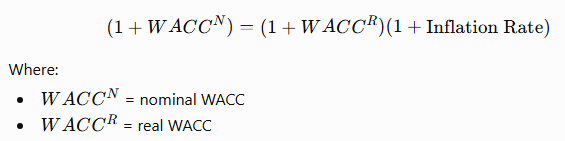
Furthermore, the real-terms continuing value formula must be adjusted downward to account for the ongoing perpetual monetary loss on net working capital. When these steps are performed with logical consistency, the nominal- and real-terms DCF models will generate the exact same intrinsic valuation.
Cross-Border Valuations
In the book, cross-border valuation is treated as a direct extension of core corporate finance principles, now aligned by the rapid convergence of global accounting standards (IFRS and U.S. GAAP). However, executing a cross-border valuation requires navigating complex macroeconomic and operational factors—such as inflation differentials, exchange rate volatility, capital controls, and tax jurisdictions—which can severely distort a company’s apparent value if not structurally integrated.
To maintain economic consistency, the book frameworks cross-border valuations around several critical operational and economic adjustments:
1. Spot-Rate vs. Forward-Rate Forecasting Methods
When valuing a foreign subsidiary, an analyst can forecast and discount cash flows using two primary methods:
- The Spot-Rate Method: Foreign cash flows are projected in the local foreign currency and discounted at the foreign cost of capital (foreign WACC). The resulting foreign-currency present value is then translated into domestic currency using the current spot exchange rate.
- The Forward-Rate Method: Foreign cash flows are projected in the foreign currency and converted into domestic currency year-by-year using projected forward exchange rates. These converted cash flows are then discounted at the domestic cost of capital (domestic WACC).
The book stresses that if consistent macroeconomic assumptions are used, both methods will yield the exact same domestic-currency valuation to the penny.
2. Macroeconomic Consistency: The Fisher Effect and Interest Rate Parity
To ensure the spot-rate and forward-rate methods reconcile, analysts cannot make independent assumptions about inflation, interest rates, and exchange rates. They must be structurally bound by two economic laws:
- The Fisher Effect: The expected inflation rate in any given country must be mathematically aligned with its nominal forward and real interest rates. If inflation projections in the cash flows change, the nominal risk-free rate used in the WACC must adjust in tandem to avoid mismatching real and nominal cash flows.
- Interest Rate Parity: Forward exchange rates must reflect the difference in nominal interest rates (and implicitly, inflation differentials) between the two currencies over the forecast interval.
3. Pricing Cost of Capital (Global vs. Local CAPM)
In integrated global markets with free capital flows, the book recommends using a Global CAPM to estimate the cost of equity.
- Diversified Global Risk: Under a Global CAPM, the risk-free rate, market risk premium, and stock betas are all measured against a global market portfolio. The book notes that the physical domicile of a company does not dictate its cost of capital; peer companies with similar operational risk profiles will trade at similar multiples globally, regardless of where they are headquartered.
- Beta Consistency Across Currencies: When estimating beta, analysts must regress the stock’s excess returns over the risk-free rate (rather than total returns) against the excess returns of the global portfolio to prevent short-term currency fluctuations from warping the beta measurement.
- The Local CAPM Exception: A Local CAPM is only recommended for emerging markets or countries facing strict capital controls that prevent local investors from freely diversifying their portfolios abroad.
4. Eliminating Ad Hoc Risk Premiums
A major pitfall in cross-border and emerging-market valuations is adding arbitrary risk premiums to the cost of capital to account for currency or country risk. The book strongly advises against this:
- Currency Risk is Diversifiable: Real effective exchange rates tend to revert to Purchasing Power Parity (PPP) in the long run. Because international investors can easily diversify currency volatility by holding a global portfolio, currency risk is not priced in WACC.
- Scenario-Based Cash Flows for Country Risk: Political risks, asset expropriation, and macroeconomic crises are best modeled explicitly through probability-weighted cash flow scenarios rather than markups to WACC. Elevating the discount rate overpenalizes long-term cash flows and assumes a constant, compounding probability of default that does not match real-world risk recovery.
5. Capital Structure and the WACC Dilemma (Domestic vs. Foreign WACC)
When calculating WACC for a cross-border entity, analysts must distinguish where the financing and taxation of interest occur:
- Domestic-Capital WACC: Assumes the business is financed and taxed at the parent company’s domestic interest and tax rates.
- Foreign-Capital WACC: Assumes the subsidiary is funded locally and subject to local tax shields.
Because tax shields are highly sensitive to inflation—debt financed in a high-inflation foreign currency yields larger nominal interest deductions—the converted domestic WACC and foreign-capital WACC will differ. Analysts must carefully model the actual capital structure strategy to avoid over- or underestimating the value of interest tax shields.
6. Adjusting for Historical Translation Distortions
When analyzing a foreign subsidiary’s historical performance, analysts must look past translated financial statements. Under the standard current method of translation, fluctuating exchange rates create artificial gains or losses on the parent’s consolidated balance sheet. These balance-sheet adjustments can mimic cash expenditures where no actual cash was spent. Analysts must identify and strip out these currency translation adjustments to isolate true operating cash flows and compute clean, undistorted historical ROIC.
— Linden Lake
This series:
→ Book Review (1 of 5): Valuation – Foundations of Value
→ Book Review (2 of 5): Valuation – Core valuation Techniques
→ Book Review (3 of 5): Valuation – Advanced Valuation Techniques
→ Book Review (4 of 5): Valuation – Managing for Value
→ Book Review (5 of 5): Valuation – Special Situations
Leave a Reply