
In the larger context of business analysis, financial statement analysis is defined in the book as the application of analytical tools and techniques to general-purpose financial statements and related data to derive estimates and inferences useful for making informed business decisions. While financial statements serve as the primary source of information for this process, the book emphasizes that they are abstractions of underlying business realities that require careful interpretation to reduce reliance on hunches and intuition.
The Role of Financial Statements in Reflecting Business Activities
The book explains that a company’s financial statements are designed to inform users about four major business activities: planning, financing, investing, and operating. These statements report on these activities at different intervals:
- Point-in-Time Reporting: The balance sheet reports on a company’s financing (liabilities and equity) and investing (assets) status at a specific moment. It is built on the fundamental identity: Total Investing = Total Financing.
- Period-of-Time Reporting: The income statement, statement of cash flows, and statement of changes in shareholders’ equity summarize a company’s operating activities—and changes in its financing and investing activities—over a period of time, typically a year or a quarter.
Articulation of Financial Statements
A central concept in the book is the articulation of financial statements, which refers to the fact that the statements are linked by design. Specifically, the period-of-time statements explain the movement between the point-in-time balance sheets. For example, the statement of cash flows explains how all business activities collectively changed the cash balance from the beginning of the year to the end, while the income statement and dividend payments explain the change in retained earnings between consecutive balance sheets.
Beyond the Primary Statements
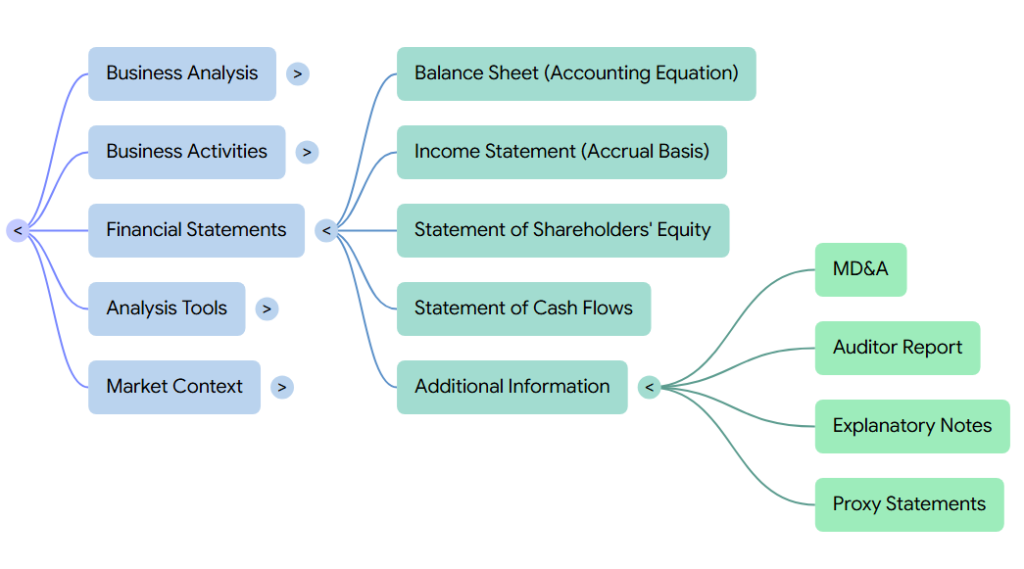
The book highlights that a thorough financial statement analysis must examine the entire financial reporting system, which includes several components beyond the four primary statements:
- Management’s Discussion and Analysis (MD&A): Management must highlight favorable or unfavorable trends and identify significant uncertainties affecting future operations.
- Explanatory Notes: These are an integral part of the reports, communicating technical information regarding accounting principles, commitments, contingencies, and business combinations.
- Auditor’s Report: This provides an independent opinion on whether the statements are prepared in conformity with generally accepted accounting principles (GAAP), which is essential for assessing the reliability of the data.
- Proxy Statements and Supplementary Schedules: These provide further detail on items like business segments, board compensation, and major shareholders.
Limitations and the Need for Accounting Analysis
The book cautions that while financial statements are indispensable, they have inherent limitations for analysis purposes. Accounting distortions can arise from the political process of standard-setting, errors in managerial estimates, and deliberate earnings management. Consequently, the book presents accounting analysis as a critical prerequisite to financial analysis. This process involves evaluating the extent to which a company’s reported numbers reflect economic reality and making necessary adjustments to improve their comparability and reliability before computing ratios or performing valuations.
Balance Sheet (Accounting Equation)
In the book, the balance sheet is defined as a listing of a company’s investing and financing activities at a specific point in time. It serves as the foundational report within the financial statement system, built upon the accounting equation, also known as the balance sheet identity: .
The Accounting Equation as Business Activities
The book explains that this identity is most revealing when viewed through the lens of business activities: Assets=Liabilities+Equity
- Total Investing (Assets): The left-hand side represents the resources controlled by the company, which are investments expected to generate future earnings through operating activities.
- Total Financing (Liabilities+Equity): The right-hand side identifies the funding sources for those investments.
- Creditor Financing (Liabilities): These are obligations of the company or claims of creditors on its assets.
- Owner Financing (Equity): This represents the claims of owners on the company’s assets and is comprised of contributed capital (funding invested by owners) and retained earnings (accumulated earnings in excess of distributions to owners since the company’s inception).
Classification and Working Capital
Within the balance sheet, assets and liabilities are separated into current and noncurrent amounts. Current assets are those expected to be converted to cash or used in operations within one year or the operating cycle, while current liabilities are obligations expected to be settled within that same timeframe. A key metric derived from this classification is working capital, which is the difference between current assets and current liabilities.
The Balance Sheet in the Context of Financial Statements
The balance sheet holds a unique position among the primary financial reports due to its “point-in-time” nature. While the income statement, statement of cash flows, and statement of changes in shareholders’ equity summarize activities over a period of time (typically a year or a quarter), the balance sheet reports the status of the company at the exact end of that period.
A central concept described in the book is the articulation of financial statements, which refers to the design-linked relationship where the period-of-time statements explain the changes between consecutive balance sheets. For example:
- Operating Impact: If a company is profitable, both its assets and equity levels increase on the balance sheet; if unprofitable, both decline.
- Retained Earnings Link: Net income and dividend payments (reported over a period) explain the movement in the retained earnings account between the beginning and ending balance sheets.
- Cash Flow Link: The statement of cash flows explains how all business activities collectively changed the cash balance reported on the balance sheet from the beginning of the year to the end.
Ultimately, the book positions the balance sheet and its underlying equation as the anchor of the financial reporting system, providing the structural framework that all other statements work to explain.
Income Statement (Accrual Basis)
In the book, the income statement is presented as the financial representation of a company’s operating activities over a specific period, typically a year or a quarter. While the balance sheet provides a point-in-time snapshot, the income statement explains how a company’s earning-related functions—such as production, marketing, and administration—resulted in a net profit or loss during that timeframe.
The Accrual Basis: The Cornerstone of Performance
The book identifies accrual accounting as the cornerstone of the modern income statement, distinguishing it from a simple record of cash inflows and outflows. Under this basis, income is determined through two fundamental processes:
- Revenue Recognition: Revenues are recorded when they are both earned (products delivered or services rendered) and realized or realizable (cash or a valid receivable is acquired), regardless of when actual cash is received.
- Expense Matching: Costs are matched against the specific revenues they helped generate. This includes product costs (like inventory) recognized at the time of sale and period costs (like administrative salaries) expensed in the timeframe they occur.
The book argues that this accrual approach is conceptually superior to cash-basis reporting because it overcomes timing and matching problems, providing a more relevant picture of a company’s present and continuing ability to generate cash.
Relationship with Other Financial Statements
A central concept in the book is the articulation of financial statements, where the income statement serves as a vital link between consecutive balance sheets. Every transaction captured on the income statement ultimately impacts the balance sheet:
- Retained Earnings Link: Net income, after deducting dividends, explains the change in the retained earnings account on the balance sheet from the beginning of the period to the end.
- Asset/Liability Impact: If a company is profitable on an accrual basis, its total assets and equity levels increase; if unprofitable, they decline.
- Comparison to Cash Flow: While the income statement measures profitability, the statement of cash flows provides a check on that profitability by summarizing the actual cash generated by those same operating activities.
Structure and Intermediate Measures
The income statement is designed to provide details on revenues, expenses, gains, and losses to explain the “bottom line”. The book highlights several intermediate measures of income that aid in analysis:
- Gross Profit (or Gross Margin): The difference between sales and cost of goods sold, measuring the ability to cover product costs.
- Operating Income: Specifically reflects income from normal operating activities, excluding financing costs like interest or investment income.
- Income from Continuing Operations: A measure that excludes nonrecurring items such as extraordinary gains/losses or discontinued operations to help analysts identify sustainable earning power.
- Comprehensive Income: The ultimate “bottom line,” which includes net income plus other unrealized gains and losses (such as foreign currency translations) that bypass the traditional income statement but affect shareholders’ equity.
Statement of Shareholders’ Equity
In the book, the statement of shareholders’ equity is identified as one of the four primary financial reports used in business analysis, alongside the balance sheet, income statement, and statement of cash flows,. It serves as a summary of the changes in a company’s financing and investing activities over a specific period of time,.
Purpose and Function
The primary objective of this statement is to identify the specific reasons for changes in equity holders’ claims on the assets of a company. While the balance sheet provides a point-in-time snapshot of financing, the statement of shareholders’ equity explains the movements that occurred throughout the period,. These changes typically result from activities such as:
- Earnings Reinvestment: The retention of profits within the business.
- Dividend Distributions: The payment of cash or stock to shareholders.
- Stock Transactions: The issuance of new shares (often related to employee stock options) or the repurchase of existing shares (treasury stock).
- Other Comprehensive Income: Adjustments that bypass the traditional income statement but affect equity, such as foreign currency translation.
Articulation and Statement Linkages
A central concept discussed in the book is the articulation of financial statements, which refers to the design-linked relationship where period-of-time statements explain changes between consecutive balance sheets,. The statement of shareholders’ equity is critical to this process because it bridges the income statement and the balance sheet,. Specifically, the change in the retained earnings account is explained by net income for the period minus any dividends declared. Consequently, every transaction captured in the statement of shareholders’ equity ultimately impacts the equity levels reported on the balance sheet.
Key Components for Analysis
The book identifies several specific accounts typically detailed within this statement that are vital for a thorough analysis:
- Retained Earnings: Reflects the accumulation of undistributed earnings since the company’s inception and often sets the upper limit on potential dividend distributions.
- Accumulated Other Comprehensive Income (AOCI): A separate column that aggregates non-owner changes in equity, such as unrealized gains or losses on certain securities.
- Treasury Stock: Reported as a reduction to equity, this represents the difference between the cash paid for share repurchases and any proceeds from reselling those shares.
- Contributed Capital: Often split between common stock and additional paid-in capital, this represents the total financing received from shareholders in exchange for shares,.
Variations in Reporting
The book notes that while the general purpose is consistent, there is latitude in how these items are reported, particularly under different accounting standards. For example, under IFRS, companies may show minority interest (noncontrolling interest) separately from the parent’s equity but include it as part of total equity, and there is wide variation in how “reserves” are grouped,. Regardless of the format, the statement remains the primary tool for analysts to reconstruct and explain changes in a company’s capital accounts.
Statement of Cash Flows
In the book, the statement of cash flows (SCF) is presented as one of the four primary financial reports—alongside the balance sheet, income statement, and statement of shareholders’ equity—required for a comprehensive evaluation of a company’s financial health. Its specific purpose is to report the cash inflows and outflows of an enterprise, categorized into operating, investing, and financing activities over a defined period.
The SCF as a Structural Bridge
A central concept discussed in the book is the articulation of financial statements, which refers to the design-linked relationship where period-of-time statements explain the changes between point-in-time balance sheets. The statement of cash flows serves as an essential bridge in this system:
- Bridge Between Balance Sheets: It explains how all business activities collectively changed the cash balance reported on the balance sheet from the beginning of a period to its end.
- Contrast to the Income Statement: While the income statement measures profitability using the accrual basis (recognizing revenue when earned and expenses when incurred), the SCF focuses on the cash basis (recognizing inflows and outflows when cash actually changes hands).
Three Primary Business Activities
The book explains that the statement organizes cash flows into three distinct categories to provide a clear picture of how a company obtains and deploys its funds:
- Operating Activities: These are the earning-related activities of a company, representing the cash-basis counterpart to accrual net income. They encompass cash effects from net income and changes in operating working capital accounts like receivables and inventories.
- Investing Activities: These involve the acquisition and disposal of noncash assets, such as the purchase or sale of property, plant, and equipment (PPE) or investment in securities.
- Financing Activities: These represent the methods used to contribute, withdraw, and service funds, such as borrowing and repaying debt, issuing stock, or paying dividends.
Methods of Reporting Operating Cash Flows
The book identifies two acceptable formats for reporting cash flows from operations, noting that while both yield the same final result, their presentations differ:
- Indirect Method: This format starts with net income and adjusts for noncash items (like depreciation) and changes in current assets and liabilities to arrive at operating cash flow. This is the most common method used in practice because it provides a clear reconciliation between net income and cash flow.
- Direct Method: This format reports the gross cash receipts and disbursements related to operations, such as cash collected from customers and cash paid to suppliers. This method is often preferred by analysts because it more clearly reveals the amounts for which management has discretion.
Analytical Importance
From an analytical perspective, the book emphasizes that the statement of cash flows is vital because no business survives in the long run without generating cash from its operations. It provides a reliable “check” on the quality of accrual earnings; if net income is high but operating cash flow is consistently low or negative, it can signal poor earnings quality or potential financial distress. Ultimately, the book positions the SCF as a tool to validate operating results and assess a company’s ability to meet obligations, pay dividends, and fund future growth without excessive reliance on external financing.
Additional Information
In the larger context of financial reporting, the book emphasizes that financial statements are not the sole output of the system. A thorough analysis requires examining additional information that accompanies these statements to better understand the underlying business realities they abstract.
Management’s Discussion and Analysis (MD&A)
The book identifies the MD&A as a critical requirement for companies with publicly traded securities. In this section, management must:
- Highlight favorable or unfavorable trends.
- Identify significant events and uncertainties affecting liquidity, capital resources, and results of operations.
- Disclose prospective information regarding material events that might make reported financial information less indicative of future condition or activities.
- The MD&A is described as an excellent starting point for performing business environment and strategy analysis.
Explanatory Notes
The book asserts that explanatory notes are an integral part of financial reports, communicating technical information regarding items both included and excluded from the primary statements. These notes include details on:
- Accounting principles and methods employed.
- Individual financial statement items, commitments, and contingencies.
- Business combinations and transactions with related parties.
- Stock option plans, legal proceedings, and significant customers.
Management and Auditor Reports
The book highlights two formal reports that provide context for the statements’ reliability:
- Management Report: This report reinforces senior management’s responsibility for the company’s internal control system and the shared roles of management, directors, and auditors in the preparation of financial records.
- Auditor Report: An independent certified public accountant provides an opinion on whether the statements conform to GAAP. The book notes that anything less than an “unqualified opinion” increases the risk for the analyst.
Proxy Statements and Supplementary Information
Beyond the annual report, the book points to other vital sources:
- Proxy Statements: These contain information necessary for shareholder voting, such as details on directors, compensation arrangements with officers, and the identity of shareholders owning more than 5% of outstanding shares.
- Supplementary Schedules: These provide detailed data on business segments, export sales, marketable securities, and quarterly financial results.
Other Statutory SEC Filings
The book identifies specific statutory reports that provide a more complete picture than the annual report alone:
- Form 10-K: The statutory equivalent of the annual report, often containing more detailed information.
- Form 10-Q: Quarterly reports that provide timely information, though they are subject to seasonality and year-end adjustments.
- Form 8-K: Filed to report unusual circumstances, such as a change in management control, an auditor change, or a director’s resignation.
- Prospectus: Accompanies an application for an equity offering and includes proposed project details.
MD&A
In the book, Management’s Discussion and Analysis (MD&A) is categorized as a critical form of additional information that accompanies the primary financial statements within a company’s reporting system. While the financial statements themselves are abstractions of business reality, the MD&A provides a narrative that helps analysts understand the underlying economic drivers and management’s perspective on the company’s future.
Requirements and Statutory Context
The book explains that the Securities and Exchange Commission (SEC) requires all companies with publicly traded debt or equity to file an MD&A. This information is typically found in both the annual report (Form 10-K) and quarterly reports (Form 10-Q). According to the book, management is specifically required to:
- Identify and highlight any favorable or unfavorable trends in the business.
- Discuss significant events and uncertainties that may affect the company’s liquidity, capital resources, and results of operations.
- Disclose prospective information when material events or uncertainties are known to make reported financial data less indicative of future condition or activities.
Role in Component Processes
Within the larger framework of business analysis, the book identifies the MD&A as a versatile tool for several component processes:
- Business Environment and Strategy Analysis: The MD&A is described as an “excellent starting point” for this analysis because it reveals management’s business plans, objectives, and tactical responses to competitive threats.
- Liquidity and Risk Analysis: It serves as a primary source for evaluating a company’s liquidity, as management must explicitly discuss its cash needs, unused sources of liquid assets, and any identified material deficiencies.
- Accounting Analysis: The book notes that the MD&A can help analysts identify “red flags” or hidden risks, such as undisclosed provisions for future losses or contingent liabilities that might not be fully reflected in the balance sheet.
- Prospective Analysis and Forecasting: It is a vital resource for forecasting because it provides management’s views on future performance and explains the specific factors—such as price versus volume changes—that are driving results like sales growth.
Limitations and Analytical Caution
While the MD&A provides a rich source of qualitative data, the book cautions that it represents management’s own interpretations. Analysts are encouraged to use the MD&A to “breathe life” into the assets on the balance sheet but must remain critical, as management may use the section to explain away poor performance or to frame results in the most favorable light. Despite these subjective elements, the book asserts that a thorough financial statement analysis is incomplete without a rigorous examination of the MD&A.
Auditor Report
In the book, the auditor report is categorized as a vital form of “additional information” that accompanies primary financial statements to provide a more complete picture of a company’s financial reporting system. It is defined as a formal document prepared by an independent certified public accountant (CPA) who provides an opinion on whether the financial statements are prepared in conformity with generally accepted accounting principles (GAAP).
Purpose and Role in the Reporting Environment
The book identifies external auditing as a critical monitoring and enforcement mechanism designed to ensure the quality, reliability, and integrity of financial records. While management has the primary responsibility for the accuracy of financial reporting, the auditor report provides added assurance to external users—such as investors and creditors—that the statements are a fair representation of the company’s financial position.
The Audit Opinion
The centerpiece of the auditor report is the audit opinion, which the book explains can take three primary forms:
- Unqualified Opinion: Often referred to as a “clean” opinion, this indicates the statements are prepared in accordance with GAAP.
- Qualified Opinion: This is issued when there are specific exceptions or deviations from GAAP.
- Disclaimer of Opinion: This occurs when an auditor is unable to express an opinion, typically due to significant uncertainties or limitations in the scope of the audit.
Importance for Financial Statement Analysis
From the perspective of an analyst, the book stresses that a rigorous review of the auditor report is an essential prerequisite for effective evaluation. Key analytical implications include:
- Risk Assessment: An unqualified opinion is the expected standard; anything less than this is considered a significant “red flag” that increases the risk and uncertainty of the analysis.
- Reliability Check: The report acts as a check on “accounting risk,” helping analysts decide how much confidence to place in the reported numbers before using them for profitability or solvency tests.
- Identifying Areas of Change: The book notes that the auditing process compels an understanding of the company’s operations in light of industry conditions, which can direct analysts toward areas of greatest change or unexplained performance.
Ultimately, while the auditor report is considered “additional information,” the book positions it as an integral part of the financial reports, providing the foundational credibility necessary for any meaningful business analysis.
Explanatory Notes
In the book, explanatory notes are identified as an integral part of the financial reporting system, categorized as a vital form of additional information that must accompany the primary financial statements. While the four primary statements provide an abstract summary of a company’s position and performance, the notes offer the technical detail necessary to understand the underlying business realities.
Purpose and Scope
The primary function of explanatory notes is to communicate information regarding items both included in and excluded from the main body of the financial statements. According to the book, these notes typically include:
- Accounting Principles: Details on the specific methods and assumptions employed by management.
- Itemized Disclosures: Elaborate breakdowns of individual line items, such as the composition of long-term debt, inventory levels, and receivable allowances.
- Commitments and Contingencies: Information on potential claims against resources, such as legal proceedings, product warranties, or guarantees of indebtedness.
- Specialized Transactions: Details regarding business combinations, related-party transactions, and stock option plans.
- Market Risk and Fair Value: Information about derivative instruments and the specific hierarchy of inputs used to determine fair value measurements.
The Analyst’s Perspective
The book emphasizes that because of their technical and complex nature, explanatory notes require a high level of accounting knowledge from the analyst. They are considered essential for several critical analytical tasks:
- Validating Reported Numbers: Analysts use notes to assess the reliability of financial statement data, particularly regarding management’s use of Level 3 (unobservable) inputs in fair value accounting.
- Performing Adjustments: Notes are the primary source of data for making analytical restatements, such as converting operating leases to capital leases or reconciling LIFO inventory values to FIFO.
- Evaluating “Core” Performance: The book cautions that analysts should not rely solely on summary pro forma earnings provided in press releases; instead, a thorough examination of the footnotes is required to identify transitory or non-operating items that may be hidden in GAAP numbers.
- Assessing Risk: Notes provide the only place to find details on off-balance-sheet financing, such as the securitization of receivables or the use of special purpose entities (SPEs).
Ultimately, the book positions explanatory notes as a bridge between the summarized accounting numbers and the economic reality of the company’s business activities, providing the evidentiary foundation for valuation and credit assessment.
Proxy Statements
In the book, proxy statements are categorized as a vital form of additional information and a key statutory report that analysts must examine beyond the primary financial statements. While the financial statements provide abstractions of a company’s financial activities, the proxy statement offers specific details regarding corporate governance and management incentives that are essential for a thorough business analysis.
Definition and Purpose
A proxy statement is a document sent to shareholders along with the notice of the annual meeting. Its primary purpose is to solicit shareholder votes for the election of directors and for significant corporate actions, such as mergers, acquisitions, or the authorization of new securities. The book notes that a “proxy” is the legal means by which a shareholder authorizes another person to act on their behalf at these meetings.
Key Content for Analysis
The book identifies proxy statements as containing a “wealth of information” that is typically not included in the standard annual report. Critical data points for analysts include:
- Ownership Details: The identity of any shareholders owning 5% or more of the company’s outstanding shares.
- Board of Directors: Biographical information on the board members, allowing analysts to evaluate their background and expertise.
- Management Compensation: Detailed arrangements regarding compensation for officers and directors, including salaries, bonuses, and employee stock options.
- Employee Benefit Plans: Information regarding specific plans and long-term incentives.
- Related-Party Transactions: Disclosure of certain transactions between the company and its officers or directors.
Statutory and Regulatory Context
In the larger framework of financial reporting, the proxy statement is a formal SEC filing regulated under Regulation 14-A. It is considered one of the “Other Statutory Reports” alongside filings like the Form 8-K and the Prospectus. The book emphasizes that because proxy statements provide the specific terms of CEO compensation and board composition, they are often the best place for an analyst to find information regarding the personal incentives and accountability of a company’s leadership.
— Linden Lake
This series:
→ Book Review (1 of 5): Financial Statement Analysis – Business Analysis
→ Book Review (2 of 5): Financial Statement Analysis – Business Activities
→ Book Review (3 of 5): Financial Statement Analysis – Financial Statements
→ Book Review (4 of 5): Financial Statement Analysis – Analysis Tools
→ Book Review (5 of 5): Financial Statement Analysis – Market Context
Leave a Reply