
Financial statement analysis is presented in the book as an integral and essential part of the broader field of business analysis. While business analysis is the comprehensive process of evaluating a company’s economic prospects and risks, financial statement analysis provides the systematic application of analytical tools to general-purpose financial statements to derive the estimates necessary for that evaluation.
Definition and Goal of Business Analysis
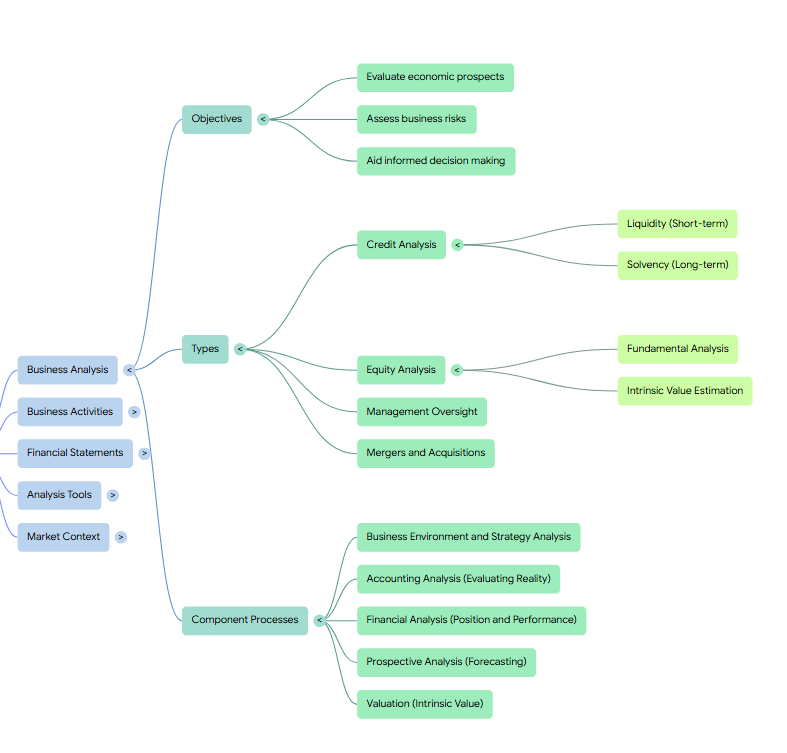
According to the book, business analysis is the process of evaluating a company’s business environment, its strategies, and its financial position and performance to make informed business decisions. Its primary goal is to improve decision-making by structuring tasks such as equity and debt valuation, credit risk assessment, and merger evaluations.
Types of Business Analysis
The book identifies several specialized forms of business analysis, each serving different users:
- Credit Analysis: This is the evaluation of a company’s creditworthiness—its ability to honor its obligations. It focuses on downside risk rather than upside potential, primarily assessing liquidity (short-term ability to raise cash) and solvency (long-term viability and ability to pay long-term obligations).
- Equity Analysis: Unlike credit analysis, equity analysis is symmetric, assessing both downside risks and unlimited upside potential. It often involves fundamental analysis, which seeks to determine a company’s intrinsic value without reference to its market price.
- Other Applications: Business analysis is also used by managers for benchmarking, by investment bankers for mergers and acquisitions, by directors for oversight, and by labor unions during negotiations.
Component Processes of Business Analysis
The book describes business analysis as encompassing several interrelated processes that work together to estimate company value:
- Business Environment and Strategy Analysis: This is the first step, aiming to identify a company’s economic circumstances and competitive strengths/weaknesses. It consists of industry analysis (assessing prospects and competition) and strategy analysis (evaluating business decisions for competitive advantage).
- Accounting Analysis: This process evaluates the extent to which a company’s accounting reflects economic reality. It is used to identify and reduce “accounting risk”—the uncertainty caused by distortions and lack of comparability in financial statements.
- Financial Analysis: This involves using financial statements to analyze a company’s current position and track record. It includes profitability analysis (return on investment), risk analysis (liquidity and solvency), and analysis of cash flows (source and use of funds).
- Prospective Analysis: This is the “art” of forecasting future payoffs, typically earnings or cash flows.
- Valuation: This is the final objective, converting forecasts of future payoffs into an estimate of the company’s total value.
The Role of Financial Statement Analysis
The book emphasizes that financial statement analysis is not a standalone activity but a collection of analytical processes (accounting, financial, and prospective analysis) that serve as the foundation for business analysis. It reduces the need to rely on “hunches, guesses, and intuition” by providing a systematic basis for making business decisions. While it is a part of business analysis, the book’s primary focus remains on the specific techniques used to analyze the financial statements themselves rather than the broader aspects of business environment or management theory.
Objectives
The primary goal of business analysis, according to the book, is to improve business decision-making by evaluating available information about a company’s financial situation, its management, its strategies, and its broader business environment. It structures the decision-making process by evaluating a company’s economic prospects and risks, thereby reducing reliance on intuition, hunches, and guesses.
Specific Objectives of Component Analyses
In the framework presented by the book, business analysis encompasses several interrelated processes, each with its own specific objectives that contribute to the overall goal of estimating company value:
- Business Environment and Strategy Analysis: The objective of this phase is to identify and assess a company’s economic and industry circumstances. It includes industry analysis, which evaluates the prospects and degree of competition in a sector, and strategy analysis, which evaluates a company’s business decisions and its success at establishing a competitive advantage.
- Accounting Analysis: The goal here is to evaluate the extent to which a company’s accounting reflects economic reality. It specifically seeks to identify and reduce accounting risk—the uncertainty caused by accounting distortions—to improve the comparability and economic content of financial statements.
- Financial Analysis: This process uses financial statements to evaluate a company’s financial position and performance. It includes profitability analysis (evaluating return on investment), risk analysis (assessing solvency, liquidity, and earnings variability), and analysis of cash flows (evaluating how a company obtains and deploys its funds).
- Prospective Analysis: The objective is the forecasting of future payoffs, which are typically earnings, cash flows, or both.
- Valuation: This is the final objective for many types of business analysis, involving the conversion of forecasts of future payoffs into an estimate of the company’s intrinsic value.
User-Specific Objectives
The book notes that the objectives of business analysis are often specialized based on the needs of the decision-maker:
- Credit Analysis: The main focus is the evaluation of a company’s creditworthiness, or its ability to honor its credit obligations. This analysis focuses primarily on downside risk (liquidity and solvency) rather than profitability.
- Equity Analysis: The objective is to assess both downside risks and unlimited upside potential. A major goal for active investors is determining intrinsic value—the value of a stock determined through fundamental analysis without reference to its market price.
- Other Applications: Managers use analysis for benchmarking and clues to strategic changes; investment bankers use it to determine company value in IPOs, mergers, or acquisitions; and directors use it to fulfill oversight responsibilities for shareholders.
Evaluate economic prospects
In the book, evaluating a company’s economic prospects and risks is defined as the core process of business analysis. The primary objective of this process is to improve business decision-making by providing a structured evaluation of a company’s business environment, its strategies, and its financial position and performance.
Strategic Role in Business Analysis
Evaluating economic prospects is presented as the central aim around which various component objectives are organized:
- Business Environment and Strategy Analysis: The objective of this phase is to identify and assess economic and industry circumstances, which the book describes as one of the most important and complex aims of business analysis.
- Prospective Analysis: This process specifically focuses on the objective of forecasting future payoffs—typically earnings, cash flows, or both—to provide the necessary inputs for estimating company value.
- Valuation: The final objective for many analysts is to convert these forecasts of future economic prospects into an estimate of the company’s total or intrinsic value.
User-Specific Objectives for Evaluating Prospects
The book notes that different users evaluate economic prospects to meet specialized objectives:
- Equity Analysis: For active investors, the goal is to determine a company’s intrinsic value—its value determined through fundamental analysis without reference to its market price. This requires a comprehensive, in-depth analysis of future profitability and risk.
- Credit Analysis: Creditors evaluate economic prospects with the objective of assessing a company’s sustainable earning power. This provides the primary source of assurance that the company can meet its long-term interest and principal payment obligations.
- Internal Management: Managers evaluate prospects to obtain clues for strategic changes in operating, investing, and financing activities, as well as to benchmark their performance against competitors.
Systematic Basis for Evaluation
The book emphasizes that the overarching objective of financial statement analysis is to provide a systematic and effective basis for this evaluation. By applying analytical tools to financial statements, analysts can reduce their reliance on “hunches, guesses, and intuition,” thereby decreasing the uncertainty inherent in evaluating a company’s future economic prospects.
Assess business risks
In the book, assessing business risks is presented as a fundamental objective of business analysis, integral to the overarching goal of making informed business decisions. It serves as a necessary counterbalance to the evaluation of economic prospects, together providing a structured framework for reducing reliance on intuition and hunches in the decision-making process.
Strategic Objective within Component Analyses
Risk assessment is a primary aim across several component processes of business analysis:
- Business Environment and Strategy Analysis: This phase aims to identify and assess a company’s economic and industry circumstances, scrutiny that includes identifying potential threats within the regulatory and competitive environment.
- Accounting Analysis: A major objective here is to evaluate and reduce accounting risk, defined as the uncertainty in financial analysis arising from accounting distortions. This includes assessing earnings quality to ensure that reported numbers accurately depict underlying business activities.
- Financial Analysis: This includes a specific risk analysis component aimed at evaluating a company’s ability to meet its commitments. It focuses on assessing solvency, liquidity, and earnings variability.
User-Specific Objectives for Risk Assessment
The book describes how the objective of assessing risk varies significantly depending on the needs of the analyst:
- Credit Analysis: Assessing risk is the main focus of credit analysis. The primary objective is to evaluate creditworthiness—the ability of a company to honor its obligations—by focusing on downside risk. This includes evaluating liquidity (the ability to raise cash in the short term) and solvency (long-term viability and the ability to pay long-term obligations).
- Equity Analysis: While credit analysis focuses on downside risk, the objective in equity analysis is symmetric, requiring the assessment of both downside risks and upside potential. For equity investors, risk assessment is crucial for determining the intrinsic value of a stock and estimating a company’s cost of capital.
- Internal Management: Managers assess risk to Obtain clues for strategic changes in operating, investing, and financing activities, as well as to benchmark performance against competitors.
Broad Categories of Risk Assessment
The book details several specialized areas where assessing risk is a key objective:
- Market Risk: Analysis aims to evaluate a company’s exposure to fluctuations in interest rates, foreign currency exchange rates, and commodity prices, often leading to the assessment of how effectively a company uses derivative securities to hedge these risks.
- Pension and OPEB Risk: Analysts evaluate pension risk exposure, which is the probability that a company will be unable to meet its future postretirement benefit obligations. This involves examining “pension intensity” and the potential mismatch between the risk profile of plan assets and obligations.
- Leverage Risk: Capital structure analysis aims to evaluate the risk of insolvency inherent in a company’s use of financial leverage (debt financing).
Aid informed decision making
In the book, aiding informed decision-making is presented as the primary goal of business analysis and the core purpose behind the systematic application of financial statement analysis. By providing a structured framework for evaluation, the book argues that these processes move decision-making away from intuition and toward a more reliable, evidence-based foundation.
Reducing Reliance on Intuition
A central objective of financial statement analysis is to reduce an analyst’s reliance on “hunches, guesses, and intuition” when making critical business choices. The book emphasizes that while analysis does not eliminate the need for expert judgment, it decreases uncertainty by providing a “systematic and effective basis” for drawing inferences about a company’s future. This structured approach is intended to increase the analyst’s confidence in their final decision.
Structuring the Decision Task
The book explains that business analysis aids informed decision-making by helping to structure complex tasks. This is achieved by:
- Integrating Diverse Information: Analysts must combine qualitative information, such as business plans and management’s future outlook, with quantitative data from financial statements to form a complete picture of risks and prospects.
- Applying Specific Building Blocks: The book identifies six “building blocks” of analysis—including liquidity, solvency, and profitability—that allow a user to focus on the specific elements most relevant to their particular decision.
- Defining Clear Objectives: The book notes that the first step in any effective analysis is to explicitly define the decision-making objective, which ensures that the subsequent evaluation remains focused and efficient.
Aiding Specialized User Decisions
The objective of aiding informed decisions is further specialized based on the needs of different financial statement users:
- Investors: For equity investors, the book provides tools to determine a company’s intrinsic value, aiding in buy, hold, or sell decisions.
- Creditors: Analysis aids lenders by evaluating a company’s creditworthiness, helping them decide whether to extend credit or set specific loan terms.
- Managers: For internal decision-makers, analysis provides clues for making strategic changes in operating, investing, and financing activities, as well as benchmarking against competitors.
- Other Stakeholders: The book notes that directors use analysis to fulfill oversight responsibilities, and labor unions use it during collective bargaining negotiations.
Ultimately, the book positions financial statement analysis as a tool to reconstruct the “economic reality” embedded in reported numbers, thereby yielding more informed and better decisions across a wide range of business contexts.
Types
In the larger context of business analysis—defined as the evaluation of a company’s prospects and risks for the purpose of making informed decisions—the book categorizes several specialized types of analysis based on the specific needs of different decision-makers.
Primary Types of Business Analysis
The book identifies two main types of business analysis that dominate the financial landscape:
- Credit Analysis: This is the evaluation of a company’s creditworthiness, or its ability to honor its obligations. Creditors, such as trade suppliers or bank lenders, use this analysis to assess the risk of default. Unlike other types, credit analysis focuses primarily on downside risk rather than profitability. It specifically analyzes liquidity (the ability to raise cash in the short term) and solvency (long-term viability and ability to pay long-term obligations).
- Equity Analysis: Equity investors provide funds in exchange for ownership and are entitled to residual interests. Consequently, equity analysis is symmetric, meaning it must assess both downside risks and unlimited upside potential. A major goal is determining intrinsic value, which is the value of a company or its stock determined through fundamental analysis without reference to its market price.
Other Specialized Types of Analysis
The book explains that business analysis is adapted for various other organizational roles:
- Management Analysis: Managers use financial statement analysis to obtain clues for strategic changes in operating, investing, and financing activities, as well as to benchmark their performance against competitors.
- Mergers, Acquisitions, and Divestitures: This type of analysis is performed when a company restructures its operations. Investment bankers use it to identify potential targets and determine their values, while security analysts use it to determine the value created for the acquiring and target companies.
- Financial Management: Managers apply analysis to evaluate the impact of financing decisions and dividend policies on the total value of the company.
- Director Oversight: As representatives of shareholders, directors use both business and financial statement analysis to fulfill their responsibilities in monitoring management and protecting shareholder interests.
- Regulatory and Legal Analysis: Regulators, such as the IRS, use analysis tools to audit tax returns, while labor unions apply these techniques during collective bargaining negotiations.
- Customer Analysis: Customers use analysis to determine the staying power (solvency) of their suppliers and to estimate the profits being generated from their mutual transactions.
Ultimately, while the book acknowledges these diverse types, it emphasizes that they all share a common bond by using financial statement information as their primary basis for deriving estimates and inferences.
Credit Analysis
In the larger context of the different types of business analysis, credit analysis is presented in the book as one of the two dominant forms of external evaluation, distinguished primarily by its singular focus on risk rather than profitability. While equity analysis assesses both upside potential and downside risk, credit analysis is characterized as an asymmetric process that concentrates almost exclusively on a company’s ability to honor its obligations.
Definition and Focus
Credit analysis is defined as the evaluation of a company’s creditworthiness, which the book describes as its ability to pay its bills and honor its credit obligations. Unlike other types of analysis that may prioritize earnings growth, the main focus here is on downside risk. Profit levels are considered important only to the extent that they provide a margin of safety for meeting these fixed commitments.
Categories of Creditors
The book identifies two main types of creditors who utilize this analysis:
- Trade (or Operating) Creditors: These provide goods or services and expect payment within a short period, usually 30 to 60 days. They generally do not receive explicit interest but earn a return from the profit margins on the business transacted.
- Nontrade Creditors (or Debtholders): These provide direct financing to a company in exchange for a promise of repayment with interest on specific future dates. This financing can be either short-term or long-term.
Key Analytical Components
Within this type of analysis, the book emphasizes two primary pillars:
- Liquidity: The assessment of a company’s ability to raise cash in the short term to meet its immediate obligations. This depends heavily on cash flows and the composition of current assets and liabilities.
- Solvency: The evaluation of a company’s long-term viability and its ability to pay long-term obligations. This is determined by long-term profitability and the company’s capital (financing) structure.
Variations by Maturity
The book explains that the tools and criteria for credit analysis vary depending on the term and purpose of the debt:
- Short-term Credit: Creditors focus on current financial conditions, immediate cash flows, and the liquidity of current assets.
- Long-term Credit: This requires more detailed, forward-looking analysis, including long-term projections of cash flows and an evaluation of sustainable earning power. Sustainable earnings are viewed as the primary source of assurance that a company can meet its interest and principal payments over many years.
Ultimately, the book positions credit analysis as a vital type of business analysis that structures the decision task for lenders by providing a systematic basis to derive estimates and inferences about default risk.
Liquidity (Short-term)
In the book, short-term liquidity is presented as one of the two primary pillars of credit analysis, focusing specifically on a company’s ability to meet its financial obligations as they come due. While credit analysis broadly evaluates creditworthiness, liquidity analysis is concerned with the “nearness to cash” of assets and liabilities and the ability of an enterprise to raise cash in the short term.
The Role of Working Capital and the Current Ratio
The book describes working capital—the excess of current assets over current liabilities—as a fundamental measure of the liquid reserve available to meet contingencies and uncertainties. To make this measure comparable across companies, creditors frequently use the current ratio.
- Significance: The current ratio measures the coverage of current liabilities by current assets, providing a “buffer” or margin of safety against potential shrinkage in the value of noncash assets.
- Limitations: The book cautions that the current ratio is a static measure that does not necessarily predict future cash patterns. It highlights that liquidity depends more on prospective cash flows than on the static reservoir of assets held at a single point in time.
- Management (Window-Dressing): Creditors must be alert to “window-dressing,” where management may temporarily improve the current ratio at year-end by pressing the collection of receivables or delaying normal purchases to pay off current liabilities.
Operating Activity Measures
Because the current ratio is limited, the book emphasizes the need to evaluate the “quality” and speed of the assets being converted into cash.
- Accounts Receivable Liquidity: This is assessed through the accounts receivable turnover ratio and the collection period (days’ sales in receivables). These tools help creditors determine if a company is collecting cash in a timely manner or if it faces poor collection efforts or distressed customers.
- Inventory Turnover: This measures the speed at which inventory moves through a company. Because inventory is typically the least liquid current asset, its turnover rate is a critical indicator of its quality and the company’s ability to use it to pay off liabilities.
- Conversion Period (Operating Cycle): By combining the collection period of receivables and the days to sell inventory, creditors can determine the total time required to convert goods into cash.
Dynamic and Qualitative Assessments
The book introduces more stringent or dynamic tools to supplement static ratio analysis:
- Acid-Test (Quick) Ratio: This provides a more severe test by excluding inventories, which are often the least liquid current assets, and focusing only on cash, marketable securities, and receivables.
- Cash Flow Measures: A ratio comparing operating cash flow to current liabilities is described as more dynamic because it recognizes that liabilities are paid with cash, not just reported earnings.
- Financial Flexibility: This is a qualitative factor representing a company’s ability to counter unexpected interruptions in fund flows by borrowing, raising equity, or selling assets.
Ultimately, the book suggests that while ratios provide a starting point, effective liquidity analysis within credit analysis requires evaluating the underlying economic conditions, management’s use of accounting discretion, and prospective cash flow patterns.
Solvency (Long-term)
In the book, long-term solvency is presented as one of the two primary pillars of credit analysis, focusing on a company’s long-run financial viability and its ability to cover its long-term obligations. While liquidity analysis deals with immediate cash needs, solvency analysis is more encompassing and requires a detailed, forward-looking evaluation of both the company’s capital structure and its sustainable earning power.
The Two Foundations of Solvency
According to the book, long-term solvency depends on two main factors:
- Capital Structure: This refers to a company’s sources of financing, ranging from relatively permanent equity capital to various forms of debt. Equity capital is viewed as a “risk capital” that provides a safety cushion for creditors because it has no mandatory repayment pattern. In contrast, debt capital must be repaid with interest regardless of the company’s financial condition, and an excessive proportion of debt increases the risk of insolvency during periods of earnings decline.
- Earning Power: The book identifies earnings as the “most desirable and reliable source of cash” for the long-term payment of interest and debt principal. A company’s earning power—its recurring ability to generate cash from operations—is often a more reliable indicator of long-term solvency than the mere composition of its assets.
Key Analytical Tools and Ratios
The book describes several quantitative tools used by credit analysts to assess solvency risk:
- Capital Structure Ratios: These ratios measure the relative magnitude of various financing sources. Common examples include the total debt ratio (total liabilities divided by total assets), the total debt to equity ratio, and the long-term debt to equity ratio. These serve as screening devices to identify companies where debt has become a significant part of capitalization.
- Earnings-Coverage Measures: These tools relate debt-related fixed charges to the earnings available to meet them. The book highlights the times interest earned ratio (earnings before interest and taxes divided by interest expense) and the more stringent earnings to fixed charges ratio, which includes additional obligations like the interest portion of operating leases.
- Financial Distress Models: Analysts may also use multiple-ratio models like the Altman Z-score to predict the likelihood of bankruptcy.
Protections and Qualitative Factors
Beyond ratios, the book emphasizes that solvency analysis must consider the contractual protections and qualitative attributes of a company’s debt:
- Lender Protections: Creditors protect their long-term interests through seniority (the order of payment during dissolution), security (collateral assets), and covenants. Loan covenants act as early warning mechanisms, often setting technical default conditions based on accounting measures to allow lenders to intervene before severe financial distress occurs.
- Financial Flexibility: This is a qualitative factor representing a company’s ability to borrow from various sources, raise equity, or sell assets to counter unexpected interruptions in fund flows.
- Accounting Adjustments: The book stresses that analysts should not blindly accept accounting classifications. For example, it suggests evaluating whether items like deferred income taxes or operating leases should be treated as debt or equity for a more accurate assessment of capital structure.
Equity Analysis
In the larger context of business analysis types, equity analysis is presented in the book as one of the two most dominant forms of external evaluation, alongside credit analysis. It is specifically designed for equity investors who provide funds to a company in exchange for the risks and rewards of ownership.
Residual Interest and Symmetry of Risk
The book defines equity financing—also known as risk capital—as a safeguard for all other forms of senior financing, such as debt. Equity investors hold a “residual interest,” meaning they are entitled to a company’s assets only after the claims of all senior creditors, such as bondholders and preferred stockholders, are satisfied. While this implies that equity holders are the first to absorb losses during liquidation, they also enjoy unlimited upside potential when a company prospers. Consequently, the book characterizes equity analysis as “symmetric,” requiring the assessment of both downside risks and upside potential, which distinguishes it from the primarily downside-focused nature of credit analysis.
Fundamental versus Technical Analysis
The book identifies two primary methods used by active investors to analyze equity:
- Technical Analysis: Also known as “charting,” this method searches for patterns in the price or volume history of a stock to predict future price movements.
- Fundamental Analysis: This is the more widely accepted approach, involving the determination of a company’s value by analyzing and interpreting key factors for the economy, the industry, and the company.
The Quest for Intrinsic Value
A major goal of fundamental equity analysis is to determine “intrinsic value,” also referred to as “fundamental value”. The book defines intrinsic value as the value of a company or its stock determined through fundamental analysis without reference to its current market price. An investor’s strategy is then based on comparing this value to the market price: buying when intrinsic value exceeds market value, selling when the opposite is true, and holding when they are approximately equal.
The Analysis Process
To determine intrinsic value, the book explains that an analyst must perform a comprehensive, in-depth analysis of the company’s business prospects and financial statements to forecast future earnings or cash flows and assess risk. Once these estimates are made, the analyst utilizes a valuation model to convert them into a measure of intrinsic value. Because equity investors are affected by every aspect of a company’s financial condition, the book notes that their analysis needs are among the most demanding and comprehensive of all financial statement users.
Fundamental Analysis
In the book, fundamental analysis is presented as the primary and most widely accepted method for performing equity analysis, which is the evaluation of a company from the perspective of an owner with a residual interest. While equity analysis more broadly assesses both the downside risks and the unlimited upside potential of an investment, fundamental analysis provides the structured process for determining a company’s true worth.
Methodology and Scope
Fundamental analysis is defined in the book as the process of determining a company’s value by analyzing and interpreting key factors from the economy, the industry, and the company itself. A central part of this process is the thorough evaluation of a company’s financial position and performance as reported in its financial statements. It is often contrasted with technical analysis (or “charting”), which relies on historical price and volume patterns; the book notes that fundamental analysis is considered a more robust and accepted approach.
The Objective of Intrinsic Value
The primary goal of fundamental analysis is to determine a company’s intrinsic value, also referred to as “fundamental value”.
- Definition: Intrinsic value is the value of a company or its stock determined through analytical processes without reference to its current market price.
- Investor Strategy: Fundamental analysts use this value as a benchmark for decision-making: they buy when the intrinsic value exceeds the market price, sell when it is lower, and hold when the values are approximately equal.
The Analytical Process
To arrive at an estimate of intrinsic value, the book describes a comprehensive, in-depth process involving several steps:
- Prospect Analysis: Evaluating the company’s future business prospects and its broader environment.
- Financial Analysis: Performing a detailed review of the company’s financial statements.
- Forecasting: Projecting future payoffs, typically in the form of earnings or cash flows.
- Risk Assessment: Determining the level of risk associated with these future payoffs.
- Valuation: Utilizing a valuation model (such as the residual income or dividend discount models) to convert these forecasts and risk estimates into a specific measure of intrinsic value.
Demand for Comprehensive Information
Because equity investors are at the bottom of the “pecking order” and only receive distributions after all senior claimants (such as bondholders) are paid, they are affected by every aspect of a company’s financial condition. Consequently, the book emphasizes that the information needs for fundamental analysis are among the most demanding and comprehensive of all financial statement users. Ultimately, this analysis seeks to look “beyond the numbers” to identify the economic reality and future earning power of the enterprise.
Intrinsic Value Estimation
In the book, estimating intrinsic value—also referred to as “fundamental value”—is identified as the primary objective of fundamental equity analysis. Intrinsic value is defined as the value of a company or its stock determined through analytical processes without reference to its current market price.
The Theoretical Basis of Estimation
The book explains that the basis for estimating intrinsic value is present value theory, which states that the value of any security is equal to the sum of all expected future payoffs, discounted to the present at an appropriate rate. To perform this estimation, an analyst requires two critical pieces of information:
- Expected Future Payoffs: These are typically forecasted in the form of dividends, cash flows, or earnings.
- Discount Rate: In equity analysis, this is the risk-adjusted cost of capital, representing the investor’s expected rate of return based on the perceived risk of the investment.
The Estimation Process
Estimating intrinsic value is presented as a comprehensive, in-depth process involving several interrelated components of business analysis:
- Accounting Analysis: The book stresses that an analyst must first evaluate the extent to which a company’s reported numbers reflect “economic reality”. This involves identifying and adjusting for accounting distortions to reduce accounting risk.
- Financial Analysis: Analysts use financial statements to analyze a company’s current position and identify “profitability drivers,” such as margins and asset turnover, which inform future expectations.
- Prospective Analysis: This is the “art” of forecasting future payoffs (earnings or cash flows). The book notes that these forecasts are the essential inputs for any valuation model.
Valuation Models
The book details three primary models used to convert forecasts into an estimate of intrinsic value:
- Dividend Discount Model: Values the security as the sum of the present values of all future expected dividends.
- Free Cash Flow to Equity Model: Replaces dividends with expected free cash flows to equity, defined as operating cash flows minus capital expenditures plus net debt increases.
- Residual Income Model: Defines value as the sum of current book value and the present value of all future expected residual income (net income minus a charge for the cost of capital on beginning book value). The book highlights that this model often outperforms others because it is less dependent on the estimation of “continuing value” at the end of the forecast horizon.
Strategic Application in Equity Analysis
The book identifies the estimation of intrinsic value as a tool for identifying market mispricing. Although the efficient market hypothesis suggests stock prices reflect all available information, the book argues that prices may not always reflect value due to incorrect interpretations or faulty evaluations of that information by the aggregate market. Consequently, an investor’s strategy is straightforward: buy a stock when its estimated intrinsic value exceeds its market value, sell when the market value exceeds intrinsic value, and hold when they are approximately equal. Because equity holders have a “residual interest” and are affected by every aspect of a company’s financial condition, their need for accurate intrinsic value estimation is among the most demanding of all financial statement users.
Management Oversight
In the larger context of business analysis types, management oversight is presented in the book as a specialized application of analysis used by those responsible for monitoring a company’s activities and protecting stakeholder interests. While credit and equity analysis are the most common external types, management oversight represents a critical internal and governance-related type of business analysis.
The Role of Directors in Oversight
The book identifies directors, as elected representatives of shareholders, as the primary practitioners of this type of analysis. Their objective is to fulfill oversight responsibilities by vigilantly monitoring management’s decisions and actions. To perform this effectively, directors use both business analysis and financial statement analysis to:
- Monitor Management: Directors use analysis to oversee company activities and ensure management is acting in the best interests of shareholders.
- Assess Financial Health: Analysis helps directors monitor company profitability, growth, and financial condition.
- Reduce Risk: By recognizing causal relationships among business activities, directors can take proactive measures to confront changing financial conditions and reduce their own litigation risk.
Governance Mechanisms and Oversight
The book describes several formal mechanisms that facilitate management oversight within a company’s reporting environment:
- Audit Committees: Many boards appoint an audit committee, typically composed of both managers and outsiders, to specifically oversee the financial reporting process. These committees are often entrusted with powers relating to the oversight of accounting methods, internal control procedures, and internal audits.
- Internal Audits: These serve as a defense against fraud and the misrepresentation of financial records, providing another layer of internal oversight.
- External Auditing: While performed by independent CPAs, the product of an external audit—the auditor’s report—is a key tool used by directors and others for oversight, as it provides an opinion on the fairness of the financial statements.
Management’s Internal Oversight
The book also notes that management themselves use financial statement analysis for internal oversight and control. This includes:
- Benchmarking: Managers analyze their own and competitors’ financial statements to evaluate relative strengths and weaknesses and to benchmark performance.
- Strategic Planning: Analysis provide clues for strategic changes in operating, investing, and financing activities.
- Internal Control: Managers use analysis for planning, budgeting, and controlling various business activities, ensuring that individual profit centers are meeting their return objectives.
Ultimately, the book positions management oversight as a vital type of business analysis that ensures accountability and structures the monitoring of a company’s economic prospects and risks.
Mergers and Acquisitions
In the larger context of the specialized types of business analysis, mergers and acquisitions (M&A) are presented in the book as critical processes performed when a company restructures its operations through mergers, acquisitions, divestitures, or spin-offs. While credit and equity analysis are the most common external forms of analysis, M&A analysis represents a specialized application used to evaluate the economic substance and value creation of corporate combinations.
Key Stakeholders and Their Roles
The book identifies specific users who apply business analysis within the M&A context to meet different objectives:
- Investment Bankers: They utilize analysis to identify potential acquisition targets and determine their appropriate values.
- Security Analysts: Their focus is on determining whether, and to what extent, additional value is created by a merger for both the acquiring and the target companies.
- Managers: Internal management must evaluate how the financing decisions and dividend policies related to a merger will impact the total value of the company.
- Directors: As representatives of shareholders, directors use analysis to fulfill their oversight responsibilities, vigilantly monitoring management’s decisions regarding restructurings to protect shareholder interests.
Core Analytical Objectives
The primary goal of M&A analysis is often valuation, which the book describes as the process of converting forecasts of future payoffs into an estimate of a company’s total value. This involves several interrelated component processes:
- Business Environment and Strategy Analysis: Used to identify the economic motivations for a combination, such as achieving economies of scale, acquiring new technology, or diversifying operations.
- Accounting Analysis: Crucial for evaluating the quality of the financial statements of the target company and identifying any “accounting risk” or distortions.
- Prospective Analysis: Necessary to forecast the future cash flows or earnings that the combined entity is expected to generate.
Accounting for Business Combinations
The book explains that business combinations fundamentally alter how a company reports its financial position. Both US GAAP and IFRS now require the acquisition method for recording these transactions. This method has significant implications for analysis:
- Fair Value Recognition: All identifiable tangible and intangible assets and liabilities of the acquired company must be recognized at their fair value on the date of acquisition.
- Goodwill: Any excess of the purchase price over the fair value of net identifiable assets is recorded as goodwill. The book cautions that while goodwill can represent superior earning power, it can also reflect overpayments due to “undisciplined zeal” or “silliness” in bidding contests.
- Consolidation: The financial statements of the parent and subsidiary are aggregated into one set of consolidated statements to reflect the economic substance of the single controlled entity.
Risks and Illusory Growth
The book warns that business combinations can sometimes be used to create “illusory” earnings growth. For example, a growth company with a high price-earnings ratio might acquire a company with lesser prospects using its own stock as payment. This can boost reported earnings per share and reinforce a high stock valuation, even if the underlying economic quality of the acquired earnings is lower. Consequently, the book emphasizes that thorough financial statement analysis is required to see “beyond the numbers” in M&A transactions.
Component Processes
Business analysis, as described in the book, is a comprehensive evaluation of a company’s prospects and risks, achieved through several interrelated component processes. These processes work together to structure the decision-making task by evaluating a company’s business environment, its strategies, and its financial position and performance.
Business Environment and Strategy Analysis
This component serves as the initial step in business analysis and aims to identify a company’s economic and industry circumstances. It consists of two primary parts:
- Industry Analysis: This process evaluates the structure and prospects of the industry in which a company operates, often using frameworks like Porter’s five forces or value chain analysis.
- Strategy Analysis: This involves evaluating a company’s specific business decisions and its success at establishing a competitive advantage through its product mix and cost structure.
Accounting Analysis
The book identifies accounting analysis as a process of evaluating the extent to which a company’s reported numbers reflect economic reality. This component is crucial because financial statement analysis depends on the reliability of the statements being analyzed. The process involves:
- Identifying and adjusting for accounting distortions—deviations caused by managerial estimation errors, earnings management, or limitations in accounting standards.
- Reducing accounting risk, defined as the uncertainty in financial statement analysis resulting from these distortions.
- Evaluating a company’s earnings quality and the persistence of its operating results.
Financial Analysis
Financial analysis involves using financial statements to evaluate a company’s financial position, track record, and future potential. The book divides this component into three broad areas:
- Profitability Analysis: This focuses on a company’s return on investment, identifying the impact of profitability drivers such as margins and asset turnover.
- Risk Analysis: This evaluates a company’s ability to meet its commitments by assessing its solvency, liquidity, and earnings variability.
- Analysis of Cash Flows: This process examines how a company obtains and deploys its funds, providing insights into future financing implications.
Prospective Analysis
Prospective analysis is described by the book as the “art” of forecasting future payoffs, which are typically earnings, cash flows, or both. This process draws on the outputs of the business environment, accounting, and financial analyses to provide the expected future payoffs necessary for estimating company value.
Valuation
The book presents valuation as the final objective of many types of business analysis. It refers to the process of converting forecasts of future payoffs into an estimate of a company’s intrinsic value. While most valuation models require prospective forecasts, some ad hoc approaches may use current financial information.
The book emphasizes that these separate processes share a common bond: they all utilize financial statement information to varying degrees for analysis purposes. Together, they provide a systematic and effective basis for business analysis, reducing reliance on intuition and hunches in the decision-making process.
Business Environment and Strategy Analysis
In the book, Business Environment and Strategy Analysis is presented as the essential first step among the interrelated component processes of business analysis. Its primary purpose is to identify a company’s economic and industry circumstances while assessing its competitive strengths, weaknesses, opportunities, and threats.
Core Sub-Components
The book identifies two distinct parts of this process:
- Industry Analysis: This is typically the starting point because the structure and prospects of an industry largely drive a company’s profitability. The book notes this is often performed using frameworks such as Porter’s five forces or value chain analysis to evaluate the degree of competition and the bargaining power of consumers and suppliers.
- Strategy Analysis: This involves evaluating a company’s specific business decisions and its success at establishing a competitive advantage. The book emphasizes the need to scrutinize a company’s competitive strategy, specifically its product mix and cost structure, to assess future growth potential.
Integration with Other Component Processes
Within the broader framework of component processes, environment and strategy analysis serves as the foundation for several subsequent tasks:
- Link to Prospective Analysis: By evaluating business prospects, this component provides the necessary qualitative context for prospective analysis, which is the “art” of forecasting future payoffs like earnings and cash flows.
- Informational Basis for Valuation: The insights gained from identifying economic circumstances are critical inputs for valuation models used to estimate a company’s intrinsic value.
- Implicit Role in Financial Analysis: Although it is sometimes viewed as outside conventional financial statement analysis, the book argues it is implicit in all component processes because the quality of financial analysis depends on understanding the underlying business reality.
Interdisciplinary Nature
The book highlights that this component process is inherently complex and subjective, requiring an interdisciplinary perspective. To be effective, an analyst must draw on knowledge from diverse fields, including strategic management, marketing, production, and managerial economics, to identify the economic forces that will impact future success.
Accounting Analysis (Evaluating Reality)
Accounting analysis is described in the book as the process of evaluating the extent to which a company’s accounting reflects its underlying economic reality. Within the broader framework of business analysis component processes, it serves as a critical prerequisite for financial analysis because the quality of any financial evaluation depends entirely on the reliability of the statements being used. The book explains that this process involves identifying and adjusting for accounting distortions, which are defined as deviations between reported information and business reality.
These distortions often arise from the inherent limitations of accounting standards, errors in management’s forecasts and estimates, and deliberate earnings management. A major objective of this component is to reduce “accounting risk,” which the book defines as the uncertainty in financial statement analysis caused by these distortions. To evaluate reality effectively, the book notes that an analyst must assess a company’s earnings quality by scrutinizing its key accounting policies and identifying potential “red flags” that might indicate serious problems.
The book emphasizes that accounting analysis is often the least understood and least appreciated process in business analysis, yet it is essential for an effective evaluation of a company’s prospects. The final phase of this component usually requires the restatement and reclassification of financial statements to improve their economic content and comparability for the analyst. By performing this analysis, the book asserts that users can move beyond reported numbers to reconstruct the true economic performance and financial position of an enterprise.
Financial Analysis (Position and Performance)
Financial analysis is defined in the book as the use of financial statements to analyze a company’s financial position and performance, as well as to assess its future financial potential. Within the larger framework of business analysis component processes, financial analysis follows accounting analysis, which is necessary to ensure the reliability and economic content of the statements being evaluated.
Core Perspectives of Financial Analysis
The book states that financial analysis typically addresses two sets of questions to evaluate a company’s position and performance:
- Future-Oriented Evaluation: This perspective focuses on whether a company has the resources to succeed and grow, its ability to invest in new projects, and its future earning power.
- Track Record Assessment: This perspective evaluates a company’s historical performance and its ability to deliver on expected results, including assessing the strength of its current financial position and whether earnings have met analyst forecasts.
Three Broad Areas of Analysis
According to the book, financial analysis is subdivided into three interrelated areas that provide a systematic basis for making business decisions:
- Profitability Analysis: This is the evaluation of a company’s return on investment. It identifies the sources and levels of profits while measuring the impact of specific drivers, such as profit margins and asset turnover.
- Risk Analysis: This involves evaluating a company’s ability to meet its commitments. It specifically assesses solvency, liquidity, and earnings variability. While risk is a primary concern for creditors, the book notes it is also vital for equity analysis to estimate a company’s cost of capital.
- Analysis of Cash Flows: This process examines how a company obtains and deploys its funds. It provides critical insights into future financing implications, such as whether a company can fund projects through internally generated cash rather than relying on heavy borrowing.
Integration with Component Processes
The book emphasizes that financial analysis does not operate in isolation. It relies on the “economic reality” established during accounting analysis to minimize accounting risk. Furthermore, financial analysis is integrated with the qualitative findings of business environment and strategy analysis to provide the necessary inputs for prospective analysis—the “art” of forecasting future payoffs. Ultimately, these combined efforts lead to valuation, which converts these performance estimates into an assessment of a company’s intrinsic value.
Prospective Analysis (Forecasting)
Prospective analysis is defined in the book as the “art” of forecasting future payoffs—typically earnings, cash flows, or both. Within the larger framework of business analysis component processes, it serves as the fourth step, drawing directly on the outputs of business environment and strategy analysis, accounting analysis, and financial analysis.
The Integration of Component Processes
The book emphasizes that prospective analysis does not operate in a vacuum but relies on the qualitative and quantitative insights established in previous steps:
- From Environment and Strategy Analysis: It gains the necessary qualitative context regarding a company’s business prospects and competitive landscape.
- From Accounting Analysis: It benefits from the “reconstructed reality” of financial statements, ensuring that the historical data used for forecasting is reliable and free from accounting distortions.
- From Financial Analysis: It utilizes identified profitability drivers and historical performance trends as a baseline for future projections.
The Forecasting Process and Outputs
The primary output of prospective analysis is a set of expected future payoffs, which are then used as essential inputs for valuation models to estimate a company’s intrinsic value. The book notes that while quantitative tools can improve accuracy, the process remains relatively subjective, distinguishing it as an art rather than a science.
Strategic and User-Specific Utility
Beyond simple valuation, the book describes several ways this component process aids decision-making:
- Evaluating Strategy: Analysts use it to determine if a company’s strategic plans are viable and whether they will yield the benefits forecasted by management.
- Assessing Financing Needs: It helps determine whether a company can generate sufficient cash flow internally to fund its growth or if it will need to seek external debt or equity financing.
- Credit Assessment: For creditors, short-term cash forecasting is used to evaluate a company’s ability to meet its immediate debt service requirements and obligations.
Ultimately, the book positions prospective analysis as the final step that converts the historical and qualitative data gathered through other component processes into the forward-looking estimates required for informed business decisions.
Valuation (Intrinsic Value)
In the book, valuation—specifically the estimation of intrinsic value—is presented as the final objective and crowning stage of the interrelated component processes of business analysis,,. While the other components (business environment, accounting, financial, and prospective analysis) provide the necessary evidentiary foundation, valuation converts those insights into a single estimate of a company’s true worth,.
Definition and Strategic Role
The book defines valuation as the process of converting forecasts of future payoffs into an estimate of a company’s total value. Within the framework of component processes, it serves as the ultimate goal for many analysts, particularly those performing fundamental equity analysis,.
Intrinsic value (also called fundamental value) is defined as the value of a company or its stock determined through analytical processes without reference to its current market price,,. An investor’s strategy relies on comparing this estimated intrinsic value to the prevailing market price: buying when intrinsic value exceeds market price, selling when it is lower, and holding when they are approximately equal.
Integration with Other Component Processes
Valuation does not occur in isolation; it is the synthesis of the preceding component processes:
- Link to Prospective Analysis: This is the most direct relationship. Prospective analysis provides the essential inputs for valuation models: the forecasted future payoffs, typically in the form of earnings or cash flows,,.
- Dependence on Accounting and Financial Analysis: The book emphasizes that the quality of a valuation depends on the reliability of the financial statements (Accounting Analysis) and the identification of profitability drivers (Financial Analysis),.
- Foundation in Environment and Strategy Analysis: By identifying a company’s economic circumstances and competitive strengths, this initial component provides the qualitative context that justifies the growth and risk assumptions used in the valuation,.
Methodology and Inputs
The book states that the theoretical basis for valuation is present value theory, which posits that the value of any asset is the sum of all expected future payoffs, discounted to the present at an appropriate rate,. Consequently, a valuation requires two critical inputs derived from the other component processes:
- Expected Future Payoffs: Forecasts of dividends, cash flows, or earnings,,.
- Discount Rate: Also known as the cost of capital, this represents the risk-adjusted expected rate of return required by investors,,.
Primary Valuation Models
The book details three primary models used to convert forecasted payoffs into intrinsic value:
- Dividend Discount Model: Values equity as the present value of all future expected dividends.
- Free Cash Flow to Equity Model: Replaces dividends with expected free cash flows to equity, which are cash flows from operations minus capital expenditures plus net increases in debt.
- Residual Income Model: Defines value as the sum of current book value and the present value of all future expected residual income (comprehensive net income minus a charge for the cost of capital on beginning book value),.
The book notes that while all three models are mathematically identical over an infinite horizon, the Residual Income Model is often preferred in practice because it is less dependent on the estimation of “continuing value” (terminal value) at the end of a finite forecast horizon.
— Linden Lake
This series:
→ Book Review (1 of 5): Financial Statement Analysis – Business Analysis
→ Book Review (2 of 5): Financial Statement Analysis – Business Activities
→ Book Review (3 of 5): Financial Statement Analysis – Financial Statements
→ Book Review (4 of 5): Financial Statement Analysis – Analysis Tools
→ Book Review (5 of 5): Financial Statement Analysis – Market Context
Leave a Reply