
In the broader context of investments, the book defines derivatives (or contingent claims) as financial instruments whose payoffs are determined by, or “derive from,” the prices of other underlying assets, such as stocks, bonds, foreign exchange, or commodities. While they do not contribute directly to the productive capacity of the economy like real assets, they are an integral part of the investment environment because they allow for the efficient allocation and transfer of risk.
Primary Functions: Hedging vs. Speculation
According to the book, derivatives serve two primary, albeit polar, purposes:
- Risk Management (Hedging): This is characterized as the primary use of derivatives, allowing firms and investors to insulate themselves against price movements. For example, a construction firm might use copper futures to lock in raw material prices, or an investor might use a “protective put” as a form of portfolio insurance to limit downside losses.
- Speculation: Derivatives are also powerful tools for taking positions on market movements. Because they require relatively small upfront payments (premiums or margins) compared to the value of the underlying assets, they provide significant leverage, magnifying both potential gains and losses. The book warns that while speculative blow-ups attract significant attention, they are generally the exception to the more common use of derivatives for risk management.
Major Categories of Derivatives
The book details three fundamental types of derivative contracts:
- Options: These give the holder the right, but not the obligation, to buy (a call) or sell (a put) an asset at a specified “strike price”. The purchase price of an option is called the premium, and the option’s value is the sum of its intrinsic value and time value.
- Futures and Forwards: Unlike options, these carry an obligation to purchase or sell an asset at a future date for an agreed-upon price. The book distinguishes between informal, over-the-counter forward contracts and highly standardized, exchange-traded futures that are subject to daily “marking to market” and clearinghouse oversight.
- Swaps: These are multi-period extensions of forward contracts calling for the exchange of a series of cash flows over time. Common types include interest rate swaps, where fixed-rate payments are traded for floating-rate ones, and foreign exchange swaps.
Advanced Applications and Financial Engineering
The book highlights that derivatives enable financial engineering, the creation of new securities or portfolios with custom-designed payoff patterns.
- Synthetic Positions: Investors can use derivatives to create “synthetic” holdings, such as a “bills-plus-futures” strategy that mimics a 100% stock position with lower transaction costs.
- Index Arbitrage: This strategy exploits temporary price discrepancies between the actual futures price of a stock index and its theoretically correct “parity” value.
- Dynamic Hedging: Practitioners use the hedge ratio (or delta) to manage stock price exposure. This requires “delta hedging,” the constant updating of positions as market conditions change.
Role in the 2008 Financial Crisis
In the context of the 2008–2009 financial crisis, the book notes that innovations in securitization and mortgage derivatives were double-edged swords. While designed to transfer risk, these tools facilitated high leverage and engendered a false sense of security.
- Credit Default Swaps (CDS): Originally conceived as insurance against default, CDS markets exploded as investors used them to speculate on the health of financial firms. The book highlights that firms like AIG sold $400 billion in CDS protection without sufficient capital to back those obligations, creating massive systemic risk.
- CDOs and Tranching: Collateralized debt obligations used “tranching” to slice up cash flows from subprime loan pools. These “structured products” masked the precarious condition of major institutions when the underlying housing assets began to fail.
Ultimately, the book compares derivatives to power tools: they are highly effective for managing risk in skilled hands but can be dangerous if handled without care or proper transparency.
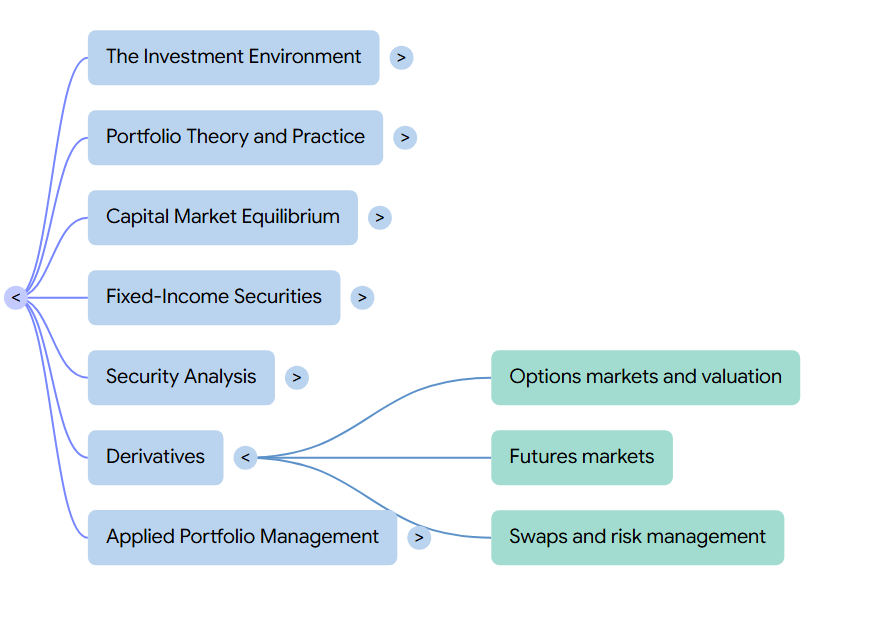
Options markets and valuation
In the larger context of derivatives, the book describes options as contingent claims whose value is determined by the price of an underlying asset. While they share characteristics with other derivatives like futures, options are unique because they provide the right, but not the obligation, to buy or sell an asset, offering a flexible way to manage risk or take speculative positions.
The Nature of Options and Trading
The book distinguishes between two fundamental types of contracts:
- Call Options: Give the holder the right to purchase an asset for a specified “strike price” on or before an expiration date. They are bullish vehicles, increasing in value as the underlying stock price rises.
- Put Options: Give the holder the right to sell an asset for a strike price. They are bearish vehicles, becoming more valuable as the stock price falls.
Trading is highly standardized to ensure liquidity. Most options in the U.S. are “American-style,” meaning they can be exercised at any time before expiration, whereas “European-style” options can only be exercised on the expiration date. The book notes that the Options Clearing Corporation (OCC) serves as the critical intermediary, guaranteeing contract performance and requiring writers to post margin.
Popular Option Strategies
The book highlights how combining options with other securities allows for custom-designed payoff patterns:
- Protective Put: Buying a put on a stock one already owns to provide “portfolio insurance,” limiting downside loss to the strike price while maintaining upside potential.
- Covered Call: Selling a call against a stock holding to generate premium income, effectively forfeiting potential gains above the strike price.
- Straddle: Buying both a call and a put with the same strike price, representing a “bet on volatility” where the investor profits from large price movements in either direction.
- Collars: Bracketing a portfolio’s value between two bounds using a protective put and a written call.
Framework for Option Valuation
According to the book, an option’s price consists of its intrinsic value (the payoff from immediate exercise) and its time value (the premium for the potential of future price movements). Six key variables determine these values: the current stock price, exercise price, volatility, time to expiration, interest rate, and dividend rate.
Valuation is primarily addressed through two major models:
- The Binomial Model: Values options by assuming a stock price can only take two possible values (up or down) in the next sub-period. It relies on the principle of replication, where a portfolio of the stock and borrowing mimics the option’s payoff.
- The Black-Scholes Model: Provides an exact formula for European call values by assuming stock prices follow a continuous random walk with constant volatility. Practitioners often use this model to “back out” the implied volatility of a stock based on observed market prices.
Risk Management and Portfolio Theory
The book emphasizes that options are essential tools for managing portfolio exposure through the hedge ratio (delta), which measures how an option’s price changes for every $1 change in the stock price. By maintaining a delta-neutral portfolio, investors can insulate themselves from stock price fluctuations.
Finally, the book notes that many financial instruments contain “embedded options”. For example, corporate debt can be viewed through the lens of option theory: because of limited liability, stockholders effectively hold a call option on the firm’s assets, while bondholders have implicitly written a put option to the firm’s owners. This framework was used to provide deeper insight into the fragility of financial institutions during the 2008–2009 crisis.
Futures markets
In the larger context of derivatives, the book defines futures contracts as a core category of contingent claims—financial instruments whose values are determined by the prices of underlying assets such as stocks, bonds, commodities, or currencies. While they share the goal of risk allocation with other derivatives like options and swaps, futures are distinguished by the obligation they impose on both parties to fulfill the trade at a specified future date.
According to the book, the futures market is structured around several critical functional and theoretical pillars:
The Mechanism of the Contract
A futures contract calls for the delivery of an asset at a specified maturity date for an agreed-upon futures price.
- Obligation versus Right: The book emphasizes that unlike an option holder, who has the right but not the requirement to trade, a futures participant must go through with the transaction.
- Long and Short Positions: The trader committing to purchase the asset holds the long position, while the trader committing to deliver the asset holds the short position.
- Zero-Sum Game: Futures trading is a zero-sum game; the aggregate profits across all investors net out to zero because every long position is offset by a short position.
Trading Infrastructure and Risk Management
The book describes a highly standardized environment designed to ensure liquidity and eliminate counterparty risk:
- The Clearinghouse: This intermediary acts as the buyer to every seller and the seller to every buyer, effectively guaranteeing contract performance. This allows traders to easily exit positions through a reversing trade rather than negotiating with the original counterparty.
- Marking to Market: This is the process of daily settling where gains and losses are credited to or debited from a trader’s margin account each day. This prevents losses from accumulating beyond a trader’s ability to pay.
- Convergence: As the contract approaches maturity, the futures price must equal the spot price of the underlying asset; this is known as the convergence property.
Strategic Use: Hedging vs. Speculation
The book identifies two primary uses for futures within an investment environment:
- Hedging: This is the primary use of derivatives, allowing participants to insulate themselves against price movements. A short hedge (selling futures) protects against a decline in the value of an asset already owned, while a long hedge (buying futures) locks in the purchase price of an asset to be acquired in the future.
- Speculation: Speculators use futures to profit from anticipated price changes, often attracted by the significant leverage provided by low margin requirements.
- Basis Risk: The book cautions that if a hedge is closed before maturity, the investor faces basis risk, as the “basis” (the difference between the spot and futures price) may not move perfectly in tandem with the asset being hedged.
Pricing Theory and Parity
A central theme in the book is the spot-futures parity theorem (or the cost-of-carry relationship), which dictates the theoretically correct relationship between the spot and futures prices.
- Financial Assets: For stocks or indices, the futures price is determined by the current spot price plus the risk-free interest rate, minus the dividend yield ().
- Commodities: For physical goods, the formula is modified to include storage costs, which act like a “negative dividend”.
- Arbitrage: If the actual futures price deviates from its parity value, the book explains that traders will engage in index arbitrage to capture risk-free profits, which eventually forces prices back into alignment.
Diverse Market Applications
While futures originated in agricultural commodities, the book notes that the market is now dominated by financial futures:
- Stock-Index Futures: These use cash settlement rather than actual delivery, allowing investors to create synthetic stock positions or hedge broad market risk cheaply.
- Foreign Exchange Futures: These are governed by interest rate parity, where the forward discount or premium on a currency offsets the interest rate differential between two countries.
- Interest Rate Futures: These allow managers to hedge interest rate risk by effectively modulating the duration of their portfolios.
Swaps and risk management
In the broader context of derivatives, the book presents swaps as multi-period extensions of forward contracts that allow for the exchange of a series of cash flows over time. While derivatives like options and futures provide single-period payoffs, the swap market is a massive segment of the financial universe, with over $400 trillion outstanding, designed primarily for long-term risk management and balance sheet restructuring.
Interest Rate Swaps and Risk Management
The most common type is the interest rate swap, where parties exchange a fixed-rate cash flow for a floating-rate one (typically tied to a benchmark like SOFR) based on a notional principal.
- Managing Debt Exposure: A firm with fixed-rate debt that expects interest rates to fall can enter a swap to receive fixed payments (offsetting its own coupons) and pay floating ones, effectively converting its liability into synthetic floating-rate debt.
- Balance Sheet Flexibility: Swaps allow managers to quickly and anonymously change a portfolio’s risk profile without the high transaction costs of selling and replacing underlying bonds.
- The Swap Dealer: These contracts are generally executed through a dealer (often a bank) that acts as an intermediary, matching parties with opposite needs and earning a profit through the bid-ask spread.
Foreign Exchange and Currency Swaps
Foreign exchange swaps call for the exchange of different currencies on several future dates. These are vital for firms with international operations to manage exchange rate risk. For example, a British firm with a project in the U.S. might use a swap to exchange its pound-denominated interest obligations for dollar-denominated ones to match its anticipated dollar revenues, thereby hedging its currency exposure.
Credit Default Swaps (CDS) and Systemic Risk
Although named similarly, a Credit Default Swap is functionally an insurance policy against the default of a third-party borrower.
- Credit Enhancement: Investors use CDS to transfer credit risk to a seller, effectively raising the credit quality of a bond holding (e.g., making a BB-rated bond behave like an AAA-rated bond).
- The 2008 Crisis: The book highlights the 2008 financial crisis as a failure of risk management involving CDS. Some issuers, like AIG, sold massive amounts of protection without sufficient capital, creating systemic risk when the underlying housing assets failed and counterparties lost confidence in each other’s solvency.
Pricing and Credit Risk Considerations
The book explains that a swap can be valued and priced as an implicit exchange of bonds. For instance, a 5-year interest rate swap can be synthetically engineered by issuing a floating-rate note and purchasing a fixed-rate note.
Regarding credit risk within the swap market itself, the book notes that the actual exposure is much smaller than the notional principal. Because the contract only requires the exchange of net cash flows, the loss incurred if a counterparty defaults is only the difference between the values of the fixed and floating obligations, not the total principal. To further limit this risk, post-crisis reforms like the Dodd-Frank Act mandated central clearinghouses and daily margin settlements to ensure transparency and stability.
— Linden Lake
This series:
→ Book Review (1 of 7): Investments – The Investment Environment
→ Book Review (2 of 7): Investments – Portfolio Theory and Practice
→ Book Review (3 of 7): Investments – Capital Market Equilibrium
→ Book Review (4 of 7): Investments – Fixed-Income Securities
→ Book Review (5 of 7): Investments – Security Analysis
→ Book Review (6 of 7): Investments – Derivatives
→ Book Review (7 of 7): Investments – Applied Portfolio Management
Leave a Reply