
In the larger context of investments, the book defines security analysis as the process of valuing particular securities to determine their attractiveness for inclusion in a portfolio. It represents the second stage of the “top-down” investment process: after the asset allocation decision establishes the broad features of a portfolio, security selection uses analysis to choose specific assets within each class.
The Framework of Fundamental Analysis
The book identifies fundamental analysis as the core of security analysis, focusing on the determinants of a security’s intrinsic value, such as earnings and dividend prospects. The objective is to identify mispriced securities by comparing their market price to their estimated “true” value. Analysts utilize several primary quantitative models for this purpose:
- Dividend Discount Models (DDM): These value a firm as a going concern by calculating the present value of all expected future dividends.
- Price-Earnings (P/E) Ratios: These reflect the market’s optimism regarding growth prospects; analysts use them to assess if a firm is valued more or less aggressively than its peers.
- Free Cash Flow Models: These value a firm based on the present value of cash flows available to the firm or its equityholders, which is especially useful for firms that do not pay dividends.
The Objective of Alpha
Within active portfolio management, the central goal of security analysis is to uncover alpha ()—the incremental risk premium attributable to private information or unique insight.
- Identifying Bargains: A security with a positive alpha is considered a “bargain” because its expected return exceeds the “fair” return dictated by its systematic risk; these securities should be overweighted in a portfolio.
- Macro vs. Micro Analysis: The book notes that while macroeconomic analysis estimates the performance of the overall market, security analysis “is king” in identifying specific mispriced assets.
Security Analysis and Market Efficiency
A unifying theme of the book is that well-developed markets are “nearly efficient,” meaning most securities are usually priced appropriately.
- The Paradox of Analysis: The book explains that markets only remain efficient because thousands of analysts constantly scour the markets for bargains.
- Difficulty of Execution: Fundamental analysis is described as difficult because identifying a well-run firm is not enough; the analyst’s insight must be superior to the consensus already reflected in the market price.
- Passive vs. Active Management: Because of the difficulty of consistently finding mispriced stocks, proponents of the Efficient Market Hypothesis (EMH) often advocate for passive management, such as index funds, which avoid the research and trading costs associated with active security analysis.
Practical Integration
The book uses the Treynor-Black model to show how security analysis is integrated into portfolio construction. This model requires analysts to provide an “input list” of alpha values, which are then used to build an active portfolio. However, the book emphasizes a fundamental trade-off: an active manager must balance the search for alpha against the risk of departing from efficient diversification, which introduces unnecessary firm-specific risk. Ultimately, the success of this practice depends entirely on the quality of the analysis; the book warns that if security analysis is poor, a passive market index will yield better risk-adjusted results.
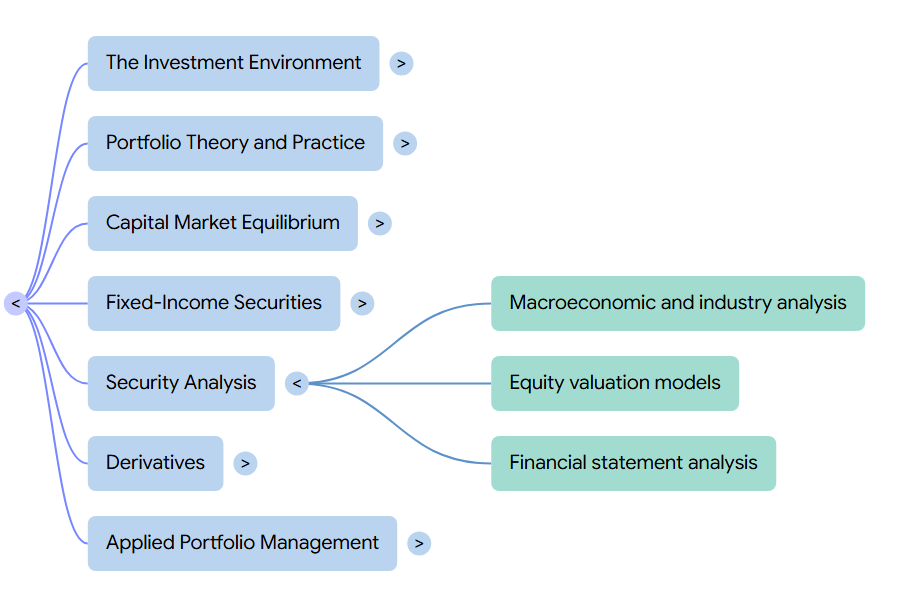
Macroeconomic and industry analysis
In the larger context of security analysis, the book describes macroeconomic and industry analysis as the initial stages of a “top-down” investment process. This approach holds that because firm prospects are tied to the broader economy, analysts must first understand the big economic picture and industry-specific circumstances before engaging in firm-specific research.
Macroeconomic Analysis
According to the book, a top-down analysis begins with the global economy, as international factors like regional GDP growth, political uncertainty, and exchange rates significantly impact firm performance and competition. Following this, analysts examine the domestic macroeconomy using several key indicators:
- Gross Domestic Product (GDP): The measure of total production; rapid growth indicates an expanding economy with ample opportunity for sales growth.
- Employment: The unemployment rate measures the extent to which the economy is operating at full capacity.
- Inflation: High inflation often signals an “overheated” economy where demand outstrips productive capacity.
- Interest Rates: These are key determinants of business investment; high rates reduce the present value of future cash flows, making investments less attractive.
- Government Policy: The book distinguishes between demand-side management, such as fiscal policy (taxes and spending) and monetary policy (money supply and interest rates), and supply-side policies that focus on enhancing productive capacity through infrastructure and education.
Industry Analysis
Industry analysis is vital because, as the book notes, it is unusual for a firm to perform well in a troubled industry. Analysts use this stage to determine the implications of macroeconomic forecasts for specific sectors.
- Sensitivity to the Business Cycle: The book categorizes industries into cyclical industries, which have above-average sensitivity to the economy (e.g., autos, capital goods), and defensive industries, which are less sensitive (e.g., food, pharmaceuticals, utilities). This sensitivity is driven by three factors: the sensitivity of sales, operating leverage (the ratio of fixed to variable costs), and financial leverage.
- Sector Rotation: This strategy involves shifting portfolio weights into sectors expected to outperform based on the current stage of the business cycle, such as moving into defensive firms during a contraction or capital goods during a trough.
- Industry Life Cycles: The book describes four stages of industry evolution: start-up (rapid growth), consolidation (emergence of leaders), maturity (standardized products and “cash cows”), and relative decline (obsolescence).
- Industry Structure: Utilizing Michael Porter’s framework, the book identifies five determinants of industry competition: threat of entry, rivalry among existing competitors, pressure from substitute products, and the bargaining power of buyers and suppliers.
Ultimately, the book emphasizes that while these analyses provide a ballpark estimate of intrinsic value, earning abnormal profits requires an analyst to forecast these macroeconomic and industry trends better than the market consensus.
Equity valuation models
In the larger context of security analysis, the book describes equity valuation models as the quantitative tools used by fundamental analysts to determine a security’s intrinsic value. This process represents the second stage of a “top-down” investment approach: once asset allocation is decided, security analysis is used to identify specific “bargains” or mispriced assets within those classes that offer a positive alpha.
According to the book, security analysis is built upon several primary categories of valuation models:
1. Valuation by Comparables
The book explains that analysts often begin by comparing a firm’s valuation to industry benchmarks using several key ratios:
- Price-Earnings (P/E) Ratio: The ratio of price per share to earnings per share, reflecting the market’s optimism regarding growth prospects.
- Price-to-Book (P/B) Ratio: The ratio of price to shareholders’ equity, though the book notes that book value is limited because it is based on historical rather than current market costs.
- Price-to-Sales and PEG Ratios: These are used to normalize valuation across firms of different sizes or growth rates.
2. Dividend Discount Models (DDM)
The book characterizes the DDM as the most popular model for valuing a firm as an ongoing concern. It posits that a stock’s intrinsic value equals the present value of all expected future dividends.
- Constant-Growth DDM (Gordon Model): This simplified version assumes dividends will grow at a steady rate forever. The book notes that a stock’s value is higher when expected dividends or growth rates are larger, or when the market capitalization rate (required return) is lower.
- Multistage Growth Models: Because firms typically pass through different life cycle phases, analysts use these models to account for an initial high-growth period before the firm settles into a sustainable terminal growth rate.
3. Price-Earnings Ratios and PVGO
A central theme in the book is that the P/E ratio is driven largely by the present value of growth opportunities (PVGO). A high P/E ratio indicates that the market expects a firm to invest in high-return projects. However, the book warns of “pitfalls” in P/E analysis, such as earnings management, where firms use accounting flexibility to manipulate reported profits.
4. Free Cash Flow (FCF) Models
The book identifies free cash flow models as a critical alternative, especially for firms that do not pay dividends.
- FCF to the Firm (FCFF): Discounts the after-tax cash flow from operations (net of investments) at the weighted-average cost of capital (WACC) to find the value of the entire firm.
- FCF to Equity (FCFE): Focuses specifically on cash flows available to shareholders, discounting them at the cost of equity.
Integration and the “Hard Part” of Analysis
Ultimately, the book frames these models as “unavoidably simplified versions of the real world”. While the mathematical application is straightforward, the book emphasizes that the “challenge” of security analysis lies in ensuring that the inputs—such as growth forecasts and risk premiums—are plausible. Because valuation estimates are highly sensitive to these assumptions, particularly the terminal value, the book recommends rigorous sensitivity analysis to identify the variables with the greatest impact on value.
Financial statement analysis
In the larger context of security analysis, the book describes financial statement analysis as the systematic process of evaluating a firm’s past and current performance to provide the critical inputs required for valuation models. While security analysis identifies specific “bargains” within asset classes, financial statement analysis serves as the foundation for this effort by translating accounting data into estimates of intrinsic value.
The Core Sources of Financial Data
The book identifies three primary financial statements that provide the raw material for analysis:
- The Income Statement: This summarizes a firm’s profitability over a period of time, distinguishing between operating income and net income after interest and taxes.
- The Balance Sheet: This provides a “snapshot” of the firm’s financial condition, listing its assets, liabilities, and the resulting stockholders’ equity (book value).
- The Statement of Cash Flows: This tracks the actual cash entering and leaving the firm, providing a more transparent view of whether a company can sustain its dividends and capital investments than accrual-based statements.
Measuring Firm Performance
The book organizes performance analysis into four categories: profitability, efficiency, leverage, and liquidity.
- Profitability Ratios: These measure earnings per dollar employed, with Return on Equity (ROE) being a primary focus for stockholders. The book also emphasizes Economic Value Added (EVA), which deducts the firm’s opportunity cost of capital from its profits to see if it is truly creating value.
- Asset Utilization (Efficiency): These ratios, such as Total Asset Turnover, assess how effectively a firm employs its assets to generate sales.
- Leverage and Liquidity: Leverage ratios assess the prudence of a firm’s debt policy, while liquidity ratios (like the current ratio) measure its ability to meet short-term obligations.
The DuPont System
A central methodology highlighted in the book is the DuPont system, which “decomposes” ROE into five component ratios: tax burden, interest burden, operating profit margin, asset turnover, and the leverage ratio. This allows an analyst to identify exactly which factor—such as improved operating efficiency versus increased financial risk—is driving changes in a firm’s profitability.
Comparability and Quality of Earnings
A significant challenge in security analysis is that accounting earnings often differ from economic earnings, which represent the sustainable cash flow that can be paid to shareholders without impairing productive capacity. The book warns analysts of several “comparability problems”:
- Accounting Conventions: Differences in LIFO versus FIFO inventory valuation or depreciation methods can make two identical firms appear very different on paper.
- Inflation Distortions: Inflation can lead to the systematic underestimation of real income by distorting depreciation and interest expense.
- Quality of Earnings: This concept refers to the realism and conservatism of reported numbers. Analysts must look for “red flags” such as earnings management, where firms use accounting flexibility to smooth out profits or hide liabilities off the balance sheet.
Ultimately, the book frames financial statement analysis as an essential, if difficult, discipline. While the Efficient Market Hypothesis suggests that obvious bargains are rare, the book notes that it is the diligent work of analysts scouring these statements for discrepancies that maintains a nearly efficient market environment.
— Linden Lake
This series:
→ Book Review (1 of 7): Investments – The Investment Environment
→ Book Review (2 of 7): Investments – Portfolio Theory and Practice
→ Book Review (3 of 7): Investments – Capital Market Equilibrium
→ Book Review (4 of 7): Investments – Fixed-Income Securities
→ Book Review (5 of 7): Investments – Security Analysis
→ Book Review (6 of 7): Investments – Derivatives
→ Book Review (7 of 7): Investments – Applied Portfolio Management
Leave a Reply