
In the broader context of investments, the book characterizes fixed-income securities as debt instruments representing a borrowing arrangement where the issuer promises a specified stream of periodic cash flows to the lender. These securities are fundamental to the investment environment because they allow for the allocation of risk, enabling more conservative investors to receive a fixed payment while stockholders bear the primary business risk.
Major Categories of Fixed-Income Securities
The book segments the fixed-income universe into two primary markets based on maturity and risk profile:
- The Money Market: This consists of very short-term, highly liquid, and low-risk debt securities, such as U.S. Treasury bills, certificates of deposit (CDs), and commercial paper. These instruments are often referred to as “cash equivalents” due to their high marketability and safety.
- The Bond Market: This market includes longer-term debt instruments such as Treasury notes and bonds, corporate bonds, municipal bonds, and mortgage-backed securities. These securities are more diverse than money market instruments and generally carry higher risk and potential return.
Pricing and Yield Principles
A central tenet in the book is the inverse relationship between bond prices and market interest rates: when interest rates rise, bond prices fall, and vice versa. The price of a bond is determined by the present value of its expected future cash flows—specifically its coupon payments and the final par value—discounted at a rate commensurate with its risk.
To evaluate these investments, analysts use several yield measures:
- Yield to Maturity (YTM): The single interest rate that equates the present value of a bond’s payments to its current market price.
- Current Yield: The bond’s annual coupon payment divided by its price.
- Realized Compound Return: A measure that accounts for the compound rate of growth of invested funds, including the reinvestment of coupon payments.
Managing Risk and Sensitivity
The book emphasizes that even “risk-free” Treasury bonds are subject to interest rate risk, as their prices fluctuate when market yields change. To quantify this sensitivity, practitioners use duration, which measures the weighted average time until the receipt of a bond’s cash flows. Generally, bonds with longer maturities or lower coupon rates exhibit greater duration and, therefore, higher price sensitivity to interest rate movements.
Beyond interest rate risk, corporate and municipal bonds are subject to credit (default) risk. Rating agencies like Moody’s and Standard & Poor’s provide grades to reflect an issuer’s safety, ranging from investment-grade to speculative-grade or “junk” bonds.
Portfolio Management Strategies
Within a diversified investment portfolio, fixed-income management typically follows one of two paths:
- Passive Management: This includes indexing, which seeks to replicate the performance of a broad bond index, and immunization, a strategy used by institutions like pension funds to match the duration of assets and liabilities, thereby shielding the portfolio from interest rate fluctuations.
- Active Management: This involves attempting to achieve superior returns through interest rate forecasting or by identifying relatively mispriced sectors or securities through techniques like substitution swaps or intermarket spread swaps.
Ultimately, the book frames fixed-income securities as a crucial component of asset allocation, determining the overall risk-return profile of a portfolio before specific security selection occurs.
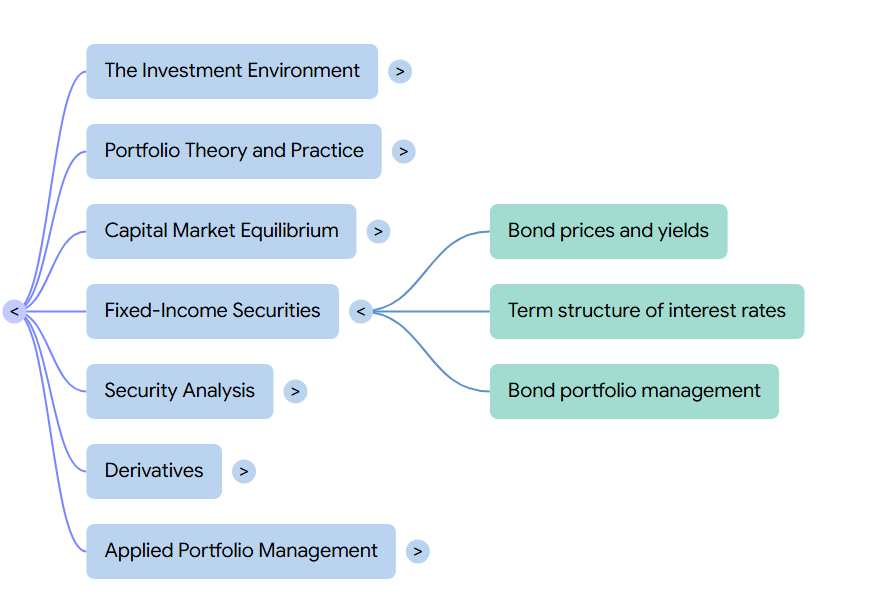
Bond prices and yields
In the larger context of fixed-income securities, the book describes bond prices and yields as being governed by a fundamental inverse relationship that is central to understanding risk and return in debt markets. A bond is essentially a borrowing arrangement where the issuer promises specific periodic cash flows—typically semiannual coupon payments and a final par value repayment at maturity—in exchange for an upfront investment.
Bond Pricing Principles
According to the book, the fair market price of a bond is determined by calculating the present value of all its future cash flows, discounted at a market interest rate () that reflects the security’s risk. Several key properties define how these prices react to the broader investment environment:
- Inverse Relationship: When market interest rates rise, the fixed coupon payments of existing bonds become less attractive, causing their prices to fall until their yields match the new market levels.
- Convexity: The relationship between prices and yields is not a straight line but is convex; this means that price increases resulting from a decrease in yields are larger than price decreases resulting from an equal-magnitude increase in yields.
- Maturity and Coupon Sensitivity: Prices of longer-term bonds and those with lower coupon rates are more sensitive to interest rate fluctuations than short-term or high-coupon bonds. This is because the impact of discounting is more powerful for cash flows occurring further in the future.
Measures of Bond Yield
The book identifies several yield measures used by analysts to evaluate fixed-income performance:
- Yield to Maturity (YTM): This is the single interest rate that equates the present value of a bond’s payments to its current price. It is the standard measure of a bond’s total rate of return if held until its maturity date.
- Current Yield: This is a simpler measure, calculated as the bond’s annual coupon payment divided by its current market price.
- Realized Compound Return: Unlike YTM, which assumes coupons are reinvested at the same rate, the realized compound return accounts for the actual rate of growth of invested funds, including varying reinvestment rates for coupon income.
- Yield to Call: For callable bonds, which the issuer can retire early, investors often focus on this yield, which uses the call price and call date instead of the par value and maturity date.
Relationships Between Price and Yield
A unifying theme in the book is how bond prices adjust over time to ensure competitive returns.
- Premium and Discount Bonds: If a bond sells above its par value (a premium bond), its coupon rate is greater than its current yield, which is greater than its YTM. Conversely, for discount bonds selling below par, the YTM is the highest value.
- Convergence to Par: As a bond approaches its maturity date, its price will steadily move toward its par value, regardless of whether it started at a premium or a discount.
The Role of Credit Risk
In the corporate bond market, pricing must also account for credit (default) risk. The book notes that the stated yield to maturity is the maximum possible return an investor can receive; however, the expected yield is often lower because it accounts for the probability that the issuer may default. To compensate for this risk, corporate bonds offer a default premium (or credit spread) over the yields of risk-free Treasury securities. This premium can spike dramatically during periods of economic stress, as seen during the 2008 financial crisis.
Term structure of interest rates
In the larger context of fixed-income securities, the book describes the term structure of interest rates as the relationship between interest rates (or yields to maturity) and the time to maturity for bonds of the same risk class. This structure is fundamental to bond valuation and serves as a critical tool for investors to gauge market expectations for future interest rates.
The Yield Curve: A Graphical Representation
The most common way to summarize the term structure is through the yield curve, which plots yield to maturity as a function of time to maturity.
- Varying Shapes: The yield curve can take several forms, including upward-sloping (rising), downward-sloping (inverted), flat, or hump-shaped.
- Types of Curves: The book distinguishes between the pure yield curve, which uses stripped zero-coupon Treasuries, and the on-the-run yield curve, which uses recently issued coupon bonds selling near par.
- The Law of One Price: In a well-functioning market, the value of a coupon bond should equal the sum of its parts (individual cash flows) if they were stripped and sold as zero-coupon bonds. This process of bond stripping and reconstitution ensures that arbitrage opportunities are eliminated and prices remain aligned.
Key Interest Rate Concepts
To interpret the term structure, the book introduces several distinct types of interest rates:
- Spot Rate: The yield to maturity on a zero-coupon bond for a specific maturity period prevailing today.
- Short Rate: The interest rate for a given short time interval (e.g., one year) available at different points in time.
- Forward Rate: A “break-even” interest rate inferred from today’s yield curve that equates the return of a long-term bond with a series of shorter-term investments. It can be viewed as the rate for a deferred loan arranged today but commencing in the future.
Theories of the Term Structure
The book details three primary theories that attempt to explain why the yield curve takes different shapes:
- Expectations Hypothesis: Asserts that forward rates are unbiased estimates of expected future short rates. An upward-sloping curve, under this theory, is clear evidence that the market expects interest rates to rise.
- Liquidity Preference Theory: Suggests that forward rates will generally exceed expected short rates to include a liquidity premium. This premium compensates short-term investors for the price risk of holding longer-term bonds. Consequently, an upward-sloping curve can exist even if interest rates are expected to remain constant.
- Market Segmentation Theory: Posits that long- and short-maturity bonds trade in largely distinct markets, with their yields determined independently by the specific supply and demand in each segment. While less common today, the book notes that institutional restrictions (like those on money market funds) can lead to some level of segmentation.
Practical Implications for Investors
The term structure is a powerful tool because it allows investors to compare their own interest rate forecasts against the market consensus reflected in prices.
- Predicting the Business Cycle: Steep yield curves are often seen as indicators of coming economic expansion, while downward-sloping curves are frequently interpreted as signals of an impending recession.
- Managing Risk: Understanding the term structure is essential for managing interest rate risk, particularly through strategies like duration matching and immunization, which aim to protect a portfolio’s value from fluctuations in the yield curve.
Bond portfolio management
In the broader context of fixed-income securities, the book describes bond portfolio management as a disciplined process of balancing risk and return, primarily categorized into passive and active strategies. While passive managers take market prices as fairly set and focus on risk control, active managers attempt to achieve superior returns through interest rate forecasting or by identifying mispriced securities.
Passive Management Strategies
Passive bond management seeks to maintain an appropriate risk-return balance without attempting to outguess the market. The book identifies three primary passive techniques:
- Bond-Index Funds: These funds aim to replicate the performance of a broad market index, such as the Bloomberg Barclays Capital U.S. Aggregate Bond Index. Because bond indexes often contain thousands of thinly traded securities, managers frequently use a stratified sampling (or cellular) approach to match the characteristics of the index (like maturity and credit risk) rather than buying every bond in the index.
- Immunization: This strategy is widely used by institutional investors to shield their overall financial status from interest rate risk. Immunization works by matching the duration of assets and liabilities, which allows the two offsetting types of interest rate risk—price risk and reinvestment rate risk—to cancel each other out. For example, if interest rates rise, the capital loss on a bond is offset by the faster growth of reinvested coupon income.
- Cash Flow Matching (Dedication): The most direct form of immunization, this involves purchasing zero-coupon bonds that precisely match the timing and magnitude of future obligations. While this eliminates the need for rebalancing, the book notes it is often infeasible due to the limited variety of available bond maturities.
Active Management Strategies
Active management relies on the manager’s ability to provide differential insight that is not yet reflected in market prices. Two broad sources of potential value are highlighted:
- Interest Rate Forecasting: Managers who anticipate interest rate declines will increase their portfolio duration to maximize capital gains, while those expecting rising rates will shorten duration to minimize losses. The book notes, however, that interest rate forecasters have a notoriously poor track record.
- Intramarket Analysis and Bond Swaps: This involves identifying temporary misalignments in the relative valuation of individual bonds or market sectors. Common swap types include:
- Substitution Swap: Exchanging one bond for a nearly identical one that is perceived to be temporarily underpriced.
- Intermarket Spread Swap: Shifting between different sectors (e.g., from Treasuries to corporate bonds) when the yield spread between them is out of line with historical norms.
- Pure Yield Pickup Swap: Moving into longer-term, higher-yield bonds to earn a term premium, though this increases interest rate risk.
Technical Tools: Duration and Convexity
Regardless of the chosen strategy, the book emphasizes that managers must understand the technical properties of bond pricing. Duration serves as the primary measure of a portfolio’s sensitivity to interest rate fluctuations. Because the relationship between bond prices and yields is convex, managers also use convexity to improve the accuracy of price-change approximations, especially when interest rate movements are large. The book highlights that investors generally prefer higher convexity because it results in greater price gains when yields fall and smaller losses when yields rise.
— Linden Lake
This series:
→ Book Review (1 of 7): Investments – The Investment Environment
→ Book Review (2 of 7): Investments – Portfolio Theory and Practice
→ Book Review (3 of 7): Investments – Capital Market Equilibrium
→ Book Review (4 of 7): Investments – Fixed-Income Securities
→ Book Review (5 of 7): Investments – Security Analysis
→ Book Review (6 of 7): Investments – Derivatives
→ Book Review (7 of 7): Investments – Applied Portfolio Management
Leave a Reply