
The book presents portfolio theory and practice as the core framework for modern investment analysis, designed to help investors navigate a competitive financial environment. This field is built upon the fundamental principle of the risk-return trade-off, which asserts that in well-developed security markets, higher expected returns are generally only available as compensation for bearing greater investment risk.
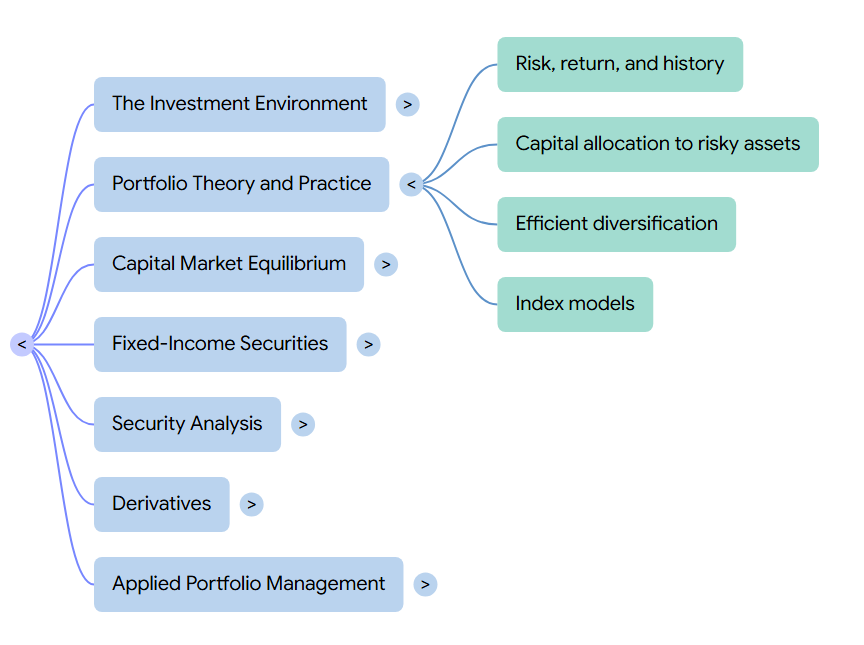
According to the book, the practice of portfolio management is organized around several key pillars:
- Statistical Building Blocks: The book identifies the measurement of risk and return as the starting point for portfolio theory. Practitioners use scenario analysis and historical time-series data to estimate the expected rate of return, variance, and standard deviation of assets. These statistics quantify the “worry” (risk) versus “waiting” (time value of money) components of an investment.
- The Capital Allocation Decision: A primary task in portfolio construction is determining the proportion of an overall portfolio to devote to a risky portfolio versus a risk-free asset, such as T-bills. This decision is personal and driven by an investor’s utility function, which scores potential portfolios based on their expected return and the investor’s level of risk aversion.
- Efficient Diversification: The book emphasizes that diversification is the most powerful tool for risk reduction. It distinguishes between firm-specific (unique) risk, which can be eliminated by holding many different securities, and systematic (market) risk, which remains even in a highly diversified portfolio because it is tied to broad macroeconomic factors.
- The Markowitz Model and the Efficient Frontier: Developed by Harry Markowitz, this model provides the formal methodology for identifying the efficient frontier—the set of risky portfolios offering the highest possible expected return for any given level of risk. A key finding of this theory is the separation property, which states that the technical task of identifying the optimal risky portfolio is independent of an individual investor’s personal risk preferences.
- Index Models: To address the practical difficulty of estimating the thousands of correlations required by the Markowitz model, the book introduces the single-index model. This model simplifies the process by assuming security returns are driven by one common market factor plus firm-specific shocks, vastly reducing the number of necessary parameter estimates.
- Equilibrium and the CAPM: The Capital Asset Pricing Model (CAPM) extends portfolio theory to predict how individual securities should be priced in equilibrium. It asserts that the risk premium on any asset should be determined solely by its beta, which measures its contribution to the systematic risk of the overall market portfolio.
- Performance Evaluation: The book details how to measure the success of a portfolio strategy after the fact. It provides several risk-adjusted metrics, such as the Sharpe ratio for overall portfolios, the Treynor measure for sub-portfolios, and Jensen’s alpha for identifying abnormal returns generated by active management.
- Active Management Theory: While the book acknowledges that security markets are “nearly efficient,” it provides models like Treynor-Black and Black-Litterman to help active managers. These tools allow professionals to integrate their subjective “views” and security analysis (the search for alpha) into a quantitative framework, while balancing the pursuit of mispriced securities against the need to maintain efficient diversification.
Ultimately, the book frames portfolio theory as a disciplined approach to asset allocation and security selection, ensuring that capital is directed toward its most productive uses while managing the inherent uncertainties of the market.
Risk, return, and history
In the larger context of Portfolio Theory and Practice, the book describes risk, return, and the historical record as the empirical foundation upon which modern investment analysis is built. Because investors cannot directly observe expected returns or risk, they must use history to estimate the parameters necessary for constructing optimal portfolios.
Measuring Returns and Performance
The book emphasizes that comparing investment performance requires re-expressing returns over a common period, typically as an effective annual rate (EAR). Central to portfolio practice is the distinction between two ways of averaging historical returns:
- Arithmetic Average: This is the unbiased estimate of the expected rate of return for a future period. It is calculated by treating each historical observation as an equally likely scenario.
- Geometric Average (Time-Weighted): This measure describes the actual historical compound rate of growth of a portfolio over a sample period. The book notes that the geometric average is always less than the arithmetic average, and the gap between them grows as volatility increases.
The Building Blocks of Risk and Reward
Portfolio theory relies on specific statistical measures to quantify the risk-return trade-off.
- Expected Return and Variance: The book defines the expected return as a probability-weighted average of possible outcomes. Risk is measured by variance (the expected squared “surprise”) and its square root, standard deviation.
- Risk Premium: This is the difference between the expected holding-period return on a risky asset and the risk-free rate. The book asserts that risk-averse investors will only hold risky assets if they offer a positive risk premium.
- The Sharpe Ratio: A key tool in performance evaluation, the Sharpe ratio (or reward-to-volatility ratio) measures the risk premium earned per unit of total risk. In portfolio theory, investors seek the risky portfolio that provides the highest possible Sharpe ratio.
The Role of the Normal Distribution
The book explains that portfolio selection is “hugely simplified” when returns follow a normal distribution because the distribution is fully characterized by only its mean and standard deviation. This symmetry ensures that standard deviation is a complete measure of risk and that the Sharpe ratio is a complete measure of performance.
However, the book warns practitioners that departures from normality—such as skew (asymmetry) and kurtosis (fat tails)—are dangerous to ignore. If a distribution is negatively skewed or fat-tailed, standard deviation will underestimate the true risk of extreme negative outcomes. To address these “tail risks,” practitioners use additional metrics like Value at Risk (VaR) and Expected Shortfall (ES).
Lessons from the Historical Record
The historical record provides critical context for what levels of risk and reward are “natural” in the marketplace.
- The U.S. Outlier: Analysis of global history suggests that U.S. stock returns over the last century may have been a positive outlier, offering a risk premium and Sharpe ratio significantly higher than the rest of the world. The book cautions that this record may overstate future expectations due to survivorship bias.
- Volatility over Time: While market risk “ebbs and flows” (most notably spiking during the Great Depression), the book observes that aside from extreme events, there is no obvious long-term trend in the level of market risk.
Risk in the Long Run
A major contribution of the book to portfolio practice is debunking the fallacy of “time diversification”—the idea that risky assets become safer as the investment horizon lengthens. While the probability of a shortfall may decrease over time, the book demonstrates that the magnitude of potential losses (the “near ruin” scenarios) grows significantly. Consequently, risky portfolios do not become safer in the long run; rather, the longer they are held, the greater the total risk.
Capital allocation to risky assets
In the larger context of Portfolio Theory and Practice, the book describes capital allocation to risky assets as the first and most fundamental step in the investment process. It is the high-level decision of how to divide an overall investment budget between a safe, risk-free asset and a diversified portfolio of risky assets.
The Core Task of Capital Allocation
The book identifies two broad tasks in portfolio construction:
- The Capital Allocation Decision: Determining the proportion of the complete portfolio to devote to safe assets versus risky ones.
- The Asset Allocation Decision: Determining the composition of the risky portion itself, such as the mix of stocks, bonds, and real estate.
While asset allocation determines the internal “engine” of the portfolio, the book emphasizes that the capital allocation choice is the primary determinant of the overall portfolio’s risk-return profile.
The Risk-Free vs. Risky Asset
To simplify the decision, the book treats all risky holdings as a single “risky portfolio” (P) and uses U.S. Treasury bills (or money market funds) as the representative risk-free asset (F).
- The Risk-Free Asset: While only inflation-indexed bonds are truly risk-free in real terms, T-bills are considered “the” risk-free asset in practice because their short-term nature makes them insensitive to interest rate fluctuations and default risk.
- The Risky Portfolio: This is often envisioned as a well-diversified index fund.
The Capital Allocation Line (CAL)
The set of all feasible risk-return combinations available to an investor by mixing these two assets is represented graphically as the Capital Allocation Line (CAL).
- Intercept and Slope: The CAL originates at the risk-free rate on the vertical axis (where risk is zero) and passes through the point representing the risky portfolio.
- The Sharpe Ratio: The slope of the CAL represents the Sharpe ratio (or reward-to-volatility ratio), which measures the increase in expected return for every unit of additional standard deviation. Investors naturally prefer a steeper CAL, as it offers a higher reward for bearing risk.
- Leverage: Investors can move to the right of the risky portfolio on the CAL by borrowing at the risk-free rate to “leverage up” their position, although in reality, borrowing rates are often higher than lending rates, which can create a “kink” in the line.
The Role of Risk Aversion and Utility
While finding the CAL is a “technical” task, choosing the specific point on that line is a “personal” task driven by an investor’s risk aversion.
- Utility Function: The book uses a utility scoring system where higher expected returns increase utility and higher volatility (variance) “penalizes” it.
- ):* The optimal fraction of wealth to invest in the risky portfolio is inversely proportional to the level of risk aversion and total risk, and directly proportional to the risk premium offered.
- Indifference Curves: Graphically, the optimal complete portfolio is found at the point where an investor’s indifference curve—a curve connecting all portfolios that provide the same level of utility—is tangent to the CAL.
The Separation Property
A critical concept in portfolio practice is the separation property, which asserts that the portfolio choice problem can be divided into two independent steps:
- Technical Step: The portfolio manager identifies the optimal risky portfolio (the tangency point on the efficient frontier) that provides the highest Sharpe ratio for all clients, regardless of their individual risk preferences.
- Personal Step: Each individual client then decides how much of their total wealth to allocate to that single optimal risky portfolio versus the risk-free asset based on their own unique risk aversion.
Ultimately, the book frames capital allocation as the mechanism by which investors tailor their exposure to uncertainty while ensuring their capital is working as efficiently as possible within the constraints of the market’s available risk-return trade-offs.
Efficient diversification
In the larger context of Portfolio Theory and Practice, the book presents efficient diversification as the formal methodology for constructing portfolios that provide the lowest possible risk for any given level of expected return. This principle is a cornerstone of modern finance, providing a disciplined approach to balancing the “no-free-lunch” relationship between risk and reward.
Systematic versus Firm-Specific Risk
The book emphasizes that the power of diversification stems from the distinction between two broad types of uncertainty:
- Firm-Specific (Unique) Risk: Also called diversifiable or nonsystematic risk, this arises from factors particular to a company, such as research success or management changes. Because these influences are independent across different firms, they tend to cancel out as more securities are added to a portfolio.
- Systematic (Market) Risk: Also called nondiversifiable risk, this is attributable to marketwide macroeconomic factors like the business cycle, inflation, or interest rates. Because these factors affect virtually all securities simultaneously, this risk remains even in highly diversified portfolios.
As a portfolio becomes more diversified, its total variance approaches the “systematic variance,” which is determined by the average covariance among the component securities.
The Role of Correlation
The effectiveness of diversification is heavily dependent on the correlation between the assets in a portfolio. The book notes that while expected return is a simple weighted average of component returns, portfolio standard deviation is generally less than the weighted average of the individual standard deviations, unless the assets are perfectly positively correlated ().
- Diversification Benefit: As long as the correlation coefficient is less than 1, mixing assets provides some degree of risk reduction.
- Hedge Assets: Assets with low or negative correlation are particularly effective at reducing total risk. In the extreme case of perfect negative correlation (), a perfectly hedged, zero-variance portfolio can be constructed.
The Markowitz Model and the Efficient Frontier
The book identifies the Markowitz model as the formal procedure for identifying the set of efficient portfolios. This process involves:
- The Input List: Security analysts generate estimates for expected returns, variances, and the covariance matrix for all available assets.
- Minimum-Variance Frontier: Using these inputs, the model calculates the lowest possible variance attainable for any targeted expected return.
- The Efficient Frontier: The portion of the minimum-variance frontier that lies above the global minimum-variance portfolio is the efficient frontier of risky assets, as it offers the best risk-return combinations.
A central finding of this theory is the separation property, which states that the technical task of identifying the single optimal risky portfolio (the tangency point on the efficient frontier) is independent of an individual investor’s personal risk preferences.
Risk Pooling vs. Risk Sharing
Finally, the book provides a rigorous clarification of how diversification works by distinguishing between two often-confused concepts:
- Risk Pooling: The act of adding more independent sources of risk to a pool. While this makes the average outcome more predictable, it actually increases the total potential dollar loss (the “insurance principle”).
- Risk Sharing: The act of spreading that pool of risk across many investors, so that each investor’s exposure to any single risk source is reduced.
This distinction is crucial for debunking the fallacy of time diversification. The book argues that longer investment horizons are analogous to risk pooling rather than risk sharing; while the probability of a loss may decrease over time, the magnitude of potential losses (the “near ruin” scenarios) grows, meaning that risky investments actually become riskier in the long run.
Index models
In the larger context of portfolio theory and practice, the book presents index models as a vital tool to simplify the formidable task of portfolio optimization and provide richer insights into the nature of risk and return. While the Markowitz model, established in 1952, provides the theoretical foundation for efficient diversification, it suffers from the “formidable task” of requiring a massive number of parameter estimates for large universes of securities.
Decomposing Risk and Return
The book explains that index models are built on the principle of decomposing a security’s risk into two distinct components:
- Systematic (Market) Risk: This is the component of return uncertainty attributable to macroeconomic factors that affect all firms simultaneously, such as business cycles, interest rates, and inflation. The book notes that this risk is “nondiversifiable” because it persists regardless of the number of securities held.
- Firm-Specific (Unique) Risk: Also known as residual or diversifiable risk, this arises from unexpected events particular to a specific firm. The book emphasizes that as a portfolio becomes more diversified, this nonmarket risk becomes negligible.
The single-index model uses a broad market index as a proxy for the common macroeconomic factor. The relationship is expressed through the security characteristic line (SCL), where the slope (beta) measures a security’s sensitivity to market movements and the intercept (alpha) represents its nonmarket premium.
Advantages over the Markowitz Model
According to the book, index models offer several decisive practical advantages in the investment environment:
- Reduced Parameter Estimates: The Markowitz model requires expected returns, variances, and covariances; for 3,000 stocks, this necessitates more than 4.5 million estimates. The book highlights that the single-index model reduces this requirement to only estimates, representing a 99% reduction for a 500-stock portfolio.
- Specialization of Labor: The model allows security analysts to specialize in specific industries. Instead of needing to estimate the covariance between every pair of stocks, analysts only need to estimate a stock’s sensitivity to the market factor, with covariances then derived simply as the product of their betas and market risk.
- Mitigating Estimation Risk: The book notes that the “cumulative effect of so many estimation errors” in a full Markowitz covariance matrix can result in an inferior portfolio. By using a smaller, consistent set of estimates, index models may be more robust in practical applications.
Active Management and Portfolio Construction
In the theory of active portfolio management, the book identifies the Treynor-Black model as the standard methodology for using index models to construct optimal risky portfolios.
- The Search for Alpha: Alpha is the key variable indicating whether a security is a “bargain”. The book describes the optimal risky portfolio as a combination of an active portfolio (composed of securities with nonzero alphas) and a passive portfolio (the market index).
- The Information Ratio: To maximize the overall Sharpe ratio, a manager must maximize the active portfolio’s information ratio, which measures the trade-off between alpha and the firm-specific risk incurred by departing from a diversified index.
- Equilibrium Considerations: The book notes that the Capital Asset Pricing Model (CAPM) is essentially an equilibrium version of the index model where all alphas are driven to zero by competition, making the passive market index the only efficient risky portfolio.
Limitations and Extensions
The book acknowledges that the single-index model is a “useful abstraction” that simplifies reality by assuming there is only one source of systematic risk. Its primary cost is that it ignores correlation between residuals, such as industry-specific events that might affect pairs of firms like BP and Shell Oil simultaneously. To address these complexities, the book introduces multifactor models, such as the Fama-French three-factor model, which expand the index structure to include additional systematic risks related to firm size and book-to-market ratios. Ultimately, the book cautions that while hundreds of factors have been proposed in the “factor zoo,” many may be redundant or the result of data mining.
— Linden Lake
This series:
→ Book Review (1 of 7): Investments – The Investment Environment
→ Book Review (2 of 7): Investments – Portfolio Theory and Practice
→ Book Review (3 of 7): Investments – Capital Market Equilibrium
→ Book Review (4 of 7): Investments – Fixed-Income Securities
→ Book Review (5 of 7): Investments – Security Analysis
→ Book Review (6 of 7): Investments – Derivatives
→ Book Review (7 of 7): Investments – Applied Portfolio Management
Leave a Reply