
An investment is fundamentally the current commitment of money or other resources with the expectation of reaping future benefits. The book explains that while a society’s material wealth is determined by its real assets—the land, buildings, machines, and knowledge used to produce goods and services—financial assets like stocks and bonds serve as the means by which individuals hold claims on those real assets. While real assets generate net income for the economy, financial assets define the allocation of that income or wealth among various investors.
In the larger context of investments, financial markets and assets play several crucial roles in developed economies. These include an informational role where stock prices direct capital to firms with the greatest perceived potential, a mechanism for consumption timing that allows individuals to shift purchasing power between different periods of life, and the allocation of risk by letting those with the greatest taste for risk bear it. Furthermore, the existence of financial assets facilitates the separation of ownership and management, which provides large corporations with a level of stability that owner-operated firms cannot achieve.
The investment process involves two primary types of decisions: asset allocation and security selection. Asset allocation is the choice among broad asset classes such as stocks, bonds, real estate, and commodities, while security selection involves choosing the specific securities to hold within each of those classes. The book emphasizes a “top-down” approach to portfolio construction, where the broad features of the portfolio are established first through asset allocation before turning to specific security analysis. This emphasis is justified because asset allocation is the primary determinant of a portfolio’s risk-return profile.
A central theme in the investment environment is that security markets are highly competitive and nearly informationally efficient, meaning most securities are usually priced appropriately given their risk and return attributes. This “no-free-lunch” proposition implies that higher expected returns generally come only at the price of bearing greater investment risk. Consequently, the book notes a distinction between passive management, which calls for holding highly diversified portfolios without attempting to find mispriced securities, and active management, which seeks to improve performance through security analysis or market timing.
The major players in this environment include firms, which are net demanders of capital; households, which are typically net suppliers of capital; and governments, which can be both borrowers and lenders. Financial intermediaries like banks, investment companies, and insurance companies have evolved to bring these suppliers and demanders of capital together, offering benefits such as pooling resources, diversification, and specialized expertise. Additionally, investment bankers act as underwriters, handling the marketing of new securities in the primary market before they are traded among investors in the secondary market.
Finally, the book highlights that the investment environment is constantly evolving, recently incorporating developments in Fintech, cryptocurrencies, and ESG (environmental, social, and governance) investing. It also stresses the importance of understanding systemic risk, as demonstrated by the financial crisis of 2008, where problems in one market segment spilled over to disrupt the entire financial system and the real economy.
Asset Types
Within the investment environment, the book distinguishes between two fundamental categories of assets: real assets and financial assets. Real assets, such as land, buildings, machines, and knowledge, determine the productive capacity and material wealth of a society by being used to produce goods and services. In contrast, financial assets like stocks and bonds are computer or paper entries that represent claims on the income generated by real assets. While real assets generate net income for the economy, financial assets define how that income and wealth are allocated among various investors.
The book identifies three broad types of financial assets: fixed-income, equity, and derivatives. Fixed-income or debt securities promise a stream of income that is either fixed or determined by a specific formula, and they range from very safe, short-term money market instruments to riskier, long-term corporate or “junk” bonds. Equity, or common stock, represents an ownership share in a corporation, where the performance of the investment is tied directly to the success or failure of the firm’s real assets. Derivative securities, such as options, futures, and swap contracts, provide payoffs that are contingent upon the values of other assets, like stock prices or interest rates.
Financial markets are traditionally segmented into the money market and the capital market. The money market consists of very short-term, highly liquid, and low-risk debt securities, such as Treasury bills and certificates of deposit, which are often referred to as “cash equivalents”. The capital market includes longer-term and riskier securities, further subdivided into bond markets, equity markets, and derivative markets. Additionally, the book highlights the significant growth of asset-backed and mortgage-backed securities, which bundle individual loans into tradable pools, a process known as securitization.
Beyond these traditional classes, the book discusses the expanding universe of alternative assets, which generally includes hedge funds, private equity, real assets, and structured products. Hedge funds are private investment pools that often employ complex strategies like market-neutral positioning or portable alpha to exploit perceived mispricing. Private equity encompasses investments in non-publicly traded firms, including angel investing and venture capital for start-ups, as well as leveraged buyouts for mature companies. Real assets in this context refer to investable vehicles like real estate and commodities, while structured products use derivatives to create customized risk-return profiles.
In the larger context of investments, the choice between these asset types is central to the investment process, which is divided into asset allocation and security selection. Asset allocation is the primary decision regarding the distribution of funds across broad classes like stocks and bonds, while security selection involves choosing specific assets within those classes. The book emphasizes that because well-developed markets are nearly informationally efficient, higher expected returns across these asset types generally only come as compensation for bearing greater investment risk.
Real Assets
In the larger context of asset types, the book defines real assets as the tangible and intangible resources used to produce goods and services, such as land, buildings, machines, and knowledge. These assets are fundamental because they determine the productive capacity and ultimate material wealth of a society.
The book draws several key distinctions between real assets and other asset types, specifically financial assets:
- Income Generation versus Allocation: While real assets generate the net income for an economy, financial assets (like stocks and bonds) simply define the allocation of that income or wealth among various investors.
- Net Wealth: On an individual balance sheet, such as that of a U.S. household, wealth includes both real assets (like real estate and consumer durables) and financial assets. However, because financial assets are claims on other entities, they appear as a liability for the issuer. When all balance sheets in an economy are aggregated, these claims cancel out, leaving only real assets as the net wealth of the economy.
- Interdependence: The successes or failures of financial assets ultimately depend on the performance of the underlying real assets they represent. For instance, if an individual cannot own an entire auto plant (a real asset), they can buy shares in a car company (financial assets) to share in the income derived from that production.
Beyond basic production, real assets also play a role in specialized investment categories:
- Commodities: Investors can invest directly in real assets through commodity markets, trading items like corn, wheat, gold, and silver. These markets allow firms to hedge business risks, such as a construction firm locking in copper prices.
- Alternative Assets: In the universe of “alternative assets,” real assets generally refer to investable vehicles like real estate, natural resources, and commodities. These are often included in diversified portfolios because they have low correlation with traditional public securities and can act as “return engines” to improve a portfolio’s expected return.
- Inflation Hedging: Real assets are often used as a hedge against inflation. While nominal assets like standard bonds may lose value as inflation rises, the value of real assets (and the income they produce) often moves in tandem with the general price level.
Land and buildings
Within the larger context of real assets, land and buildings (often categorized as real estate) represent fundamental tangible resources that determine the productive capacity and ultimate material wealth of a society. The book defines land and buildings as primary examples of real assets because they are used directly to produce goods and services, unlike financial assets which are merely claims on the income those real assets generate.
In the measurement of national wealth, land and structures—including residential and commercial real estate—are the components that remain after financial claims and liabilities cancel each other out. On the balance sheet of U.S. households, real estate is listed as a major category of real assets, though it represents a smaller percentage of total household wealth compared to financial assets. In contrast, for nonfinancial corporations, real estate typically accounts for about half of all assets on their balance sheets.
The book also discusses land and buildings through several specific lenses:
- Accounting Classification: In financial statements, buildings and property are treated as “tangible fixed assets”. While they are recorded at historical cost, their market value as a going concern often differs significantly due to factors like brand name recognition or specialized expertise not captured on the balance sheet.
- Investment Vehicles: Investors can hold land and buildings directly, such as through rental property, or indirectly through financial instruments like Real Estate Investment Trusts (REITs) or mortgage-backed securities. REITs allow for the pooling of funds to invest in real estate or loans secured by real estate, functioning similarly to closed-end funds.
- Alternative Assets: In the universe of alternative investments, real estate is a major subclass. These are often included in diversified institutional portfolios because they have low correlation with traditional public securities and can improve a portfolio’s Sharpe ratio.
- Liquidity: A defining characteristic of land and buildings as real assets is their illiquidity. They can be difficult to sell quickly, and forced sales may require substantial discounts—potentially up to 50%—from their fair market value.
Machines
In the larger context of asset types, the book defines machines (often categorized as equipment) as tangible real assets that are essential to the productive capacity and material wealth of a society. Unlike financial assets, which are merely claims on income, machines are the actual resources used by firms to produce goods and services.
The book discusses machines within several specific economic and financial contexts:
- Determination of National Wealth: When all balance sheets in an economy are aggregated, financial claims and liabilities cancel each other out, leaving only real assets as the net wealth of the economy. In this aggregate view, national wealth consists of land, structures, and equipment, which includes machines.
- Corporate Investment and Financing: Firms function as net demanders of capital, raising funds by issuing financial securities to pay for real assets such as plant and equipment. On the balance sheet of U.S. nonfinancial corporations, equipment and intellectual property represent a significant portion of total assets—approximately 16.6% as of 2021.
- Contrast with Financial Intermediaries: Financial intermediaries like commercial banks are distinguished from other businesses by the fact that their assets are overwhelmingly financial. For these institutions, real assets such as equipment and premises represent a tiny fraction (often less than 1%) of their total assets.
- Accounting and Depreciation: Because machines are used over time, they are subject to depreciation, which is the amount a firm must reinvest to sustain its real productive capacity. The book notes that accounting depreciation, which is based on the historical acquisition cost, can differ significantly from economic depreciation, especially during periods of inflation when the replacement cost of a machine may rise.
- Capital Budgeting Decisions: The decision to invest in machines is part of a firm’s capital budgeting process. These decisions are driven by the expected profitability of using that physical capital to generate future cash flows, and they are influenced by real interest rates.
Knowledge
Within the larger context of asset types, the book identifies knowledge as one of the fundamental real assets—alongside land, buildings, and machines—that determines the productive capacity and ultimate material wealth of a society. Knowledge, which the book often refers to as “know-how,” “expertise,” or “intellectual property,” is a primary resource used by members of an economy to create goods and services.
While knowledge generates net income for the economy, the book highlights several unique characteristics associated with it:
- Intangible Nature: Unlike tangible real assets such as machines or buildings, knowledge and expertise are categorized as “intangible assets”.
- Accounting and Valuation Challenges: The book notes that accountants are generally reluctant to include assets like expertise on formal balance sheets because they are notoriously difficult to value. However, when one firm acquires another for a premium over its net tangible asset value, that difference is recorded as “goodwill,” an intangible asset that captures the value of specialized expertise or brand recognition.
- Economic Measurement: In measurements of domestic net worth, knowledge is typically grouped with equipment under the heading of “intellectual property”. On the balance sheets of U.S. nonfinancial corporations, equipment and intellectual property accounted for approximately 16.6% of total assets as of 2021.
- Market Guidance: In a capitalist economy, the allocation of capital toward real assets like “know-how” is guided in large part by the signals provided by the prices of financial assets in the stock market.
- Venture Capital and Innovation: The book emphasizes that specific players in the investment environment, such as venture capitalists, focus heavily on funding start-ups where knowledge and innovation are the primary drivers of value. Research cited in the book indicates that venture funding is three times more likely to generate a patent—a formalization of knowledge—than traditional corporate research and development.
Financial Assets
In the larger context of asset types, the book defines financial assets as computer or paper entries—such as stocks and bonds—that represent claims on the income generated by real assets. While real assets determine the productive capacity and material wealth of an economy, financial assets define the allocation of that income or wealth among various investors.
The book identifies three broad categories of financial assets:
- Fixed-Income (Debt) Securities: These instruments promise a stream of income that is either fixed or determined by a specific formula. They range from short-term, low-risk money market instruments, like Treasury bills, to long-term capital market securities, such as corporate bonds, which may carry significant default risk.
- Equity (Common Stock): This represents an ownership share in a corporation. Equityholders have a residual claim on the income earned by the firm and prorated ownership of its underlying real assets. Because their returns are tied directly to the success or failure of the firm, equity investments are typically riskier than debt.
- Derivatives: These securities, including options, futures, and swaps, provide payoffs that are contingent upon the values of other assets, such as stock prices or interest rates. Their primary function in the investment environment is often to hedge or transfer risk.
A fundamental characteristic of financial assets is their interdependence with the rest of the economy. On an individual’s balance sheet, financial assets represent wealth; however, because they are claims on other entities, they appear as liabilities for the issuers. Consequently, when all balance sheets in an economy are aggregated, these financial claims cancel out, leaving only real assets as the net wealth of the nation.
Within the larger investment environment, financial assets and the markets in which they trade serve several crucial roles:
- Informational Role: Stock prices reflect the market’s collective assessment of a firm’s potential, directing capital toward the most promising applications.
- Consumption Timing: They allow individuals to “store” wealth during high-earning periods of life to be sold for consumption during low-earning periods, such as retirement.
- Allocation of Risk: Diverse financial instruments allow risk to be borne by those most willing to bear it, such as when risk-tolerant investors buy a firm’s stock while conservative investors buy its bonds.
- Separation of Ownership and Management: The existence of financial assets enables large corporations to pool capital from thousands of stockholders, which provides a level of stability that owner-operated firms cannot achieve.
The book also notes that the complexity of managing these assets has led to the rise of financial intermediaries—such as banks, mutual funds, and insurance companies—which pool resources, provide diversification, and offer specialized expertise to bring suppliers and demanders of capital together.
Fixed-income securities
In the larger context of financial assets, the book identifies fixed-income securities (also known as debt securities) as one of the three broad categories of financial assets, alongside equity and derivatives. These securities represent a borrowing arrangement where the issuer promises to provide the holder with a specified periodic stream of cash flows, typically in the form of interest payments and the return of principal at maturity. Because these payment formulas are usually established in advance, fixed-income instruments are often easier to value than equity, as their performance is generally less sensitive to the specific financial condition of the issuer.
The book segments the fixed-income environment into two primary markets based on the maturity and liquidity of the instruments:
- The Money Market: This segment consists of short-term, highly marketable, and low-risk debt securities, often referred to as “cash equivalents”. Examples include U.S. Treasury bills, certificates of deposit (CDs), and commercial paper. These instruments allow for high liquidity and minimal capital gains or losses.
- The Capital Market (The Bond Market): This segment includes longer-term borrowing instruments that are more diverse in terms of risk and provisions. This market is comprised of U.S. Treasury notes and bonds, corporate bonds, municipal bonds, federal agency debt, and mortgage-backed securities.
Within these markets, the book highlights several specialized types of fixed-income instruments that offer different risk-return profiles:
- Government and Agency Debt: U.S. Treasury securities are considered the safest end of the spectrum, with inflation-protected securities (TIPS) providing a constant stream of income in real dollars. Federal agencies also issue debt to channel credit to specific sectors, such as the housing market through Fannie Mae and Freddie Mac.
- Corporate and High-Yield Bonds: Private firms issue corporate bonds to raise capital, ranging from high-quality investment-grade bonds to riskier “junk” or speculative-grade bonds.
- Securitized Debt: This involves bundling individual loans, such as mortgages or auto loans, into tradable pools known as mortgage-backed or asset-backed securities.
- Floating-Rate and Inverse Floating-Rate Bonds: Some bonds have coupon rates that adjust based on market interest rates, while inverse floaters have coupon rates that move in the opposite direction of market rates.
In the broader investment process, fixed-income securities play a critical role in the asset allocation decision. Because they typically offer lower risk and more predictable income than equities, they are often used by conservative investors or those seeking to balance a risky portfolio. Furthermore, fixed-income markets provide essential functions for the economy, such as allowing for consumption timing over an individual’s life cycle and facilitating the allocation of risk to those most willing to bear it.
Equity (Common stock)
In the larger context of financial assets, the book defines equity (common stock) as a security representing an ownership share in a corporation. While financial assets as a whole serve as claims on the income generated by real assets, equityholders specifically hold a prorated ownership stake in those underlying real assets.
The book identifies several defining characteristics that distinguish equity from other financial assets, such as fixed-income securities:
- Residual Claim: Equityholders are “last in line” of all those who have a claim on the assets and income of a corporation. In the event of liquidation, they receive only what remains after all other claimants—including tax authorities, employees, suppliers, and bondholders—have been paid.
- Limited Liability: The most a shareholder can lose in the event of a corporate failure is their original investment. Shareholders are not personally liable for the firm’s obligations, which distinguishes them from owners of unincorporated businesses.
- Risk-Return Profile: Because their returns are tied directly to the success or failure of the firm’s real assets, equity investments are typically riskier than debt securities. However, this greater risk brings the potential for greater rewards, as bondholders are limited to fixed interest payments while shareholders capture the remaining profits.
Within the larger financial environment, equity plays a central role in corporate governance and the investment process:
- Corporate Governance: Each share of common stock generally entitles the owner to one vote on matters of corporate governance, such as electing the board of directors. This board then selects the managers who run the firm on a day-to-day basis, overseeing them to ensure they act in the best interests of the shareholders.
- Investment Decisions: In the investment process, the decision to invest in equities is part of asset allocation, which is the choice among broad asset classes. This is considered the primary determinant of a portfolio’s risk-return profile. Security selection then involves choosing which specific stocks to hold within that equity allocation.
- Market Indicators: The performance of the equity market is often tracked through stock market indexes, such as the Dow Jones Industrial Average (DJIA) or the Standard & Poor’s 500 (S&P 500). These indexes serve as benchmarks for investors to evaluate the performance of their own portfolios.
- Valuation Ratios: Investors use metrics like the dividend yield (annual dividend per dollar paid for the stock) and the price-earnings (P/E) ratio (the ratio of the current stock price to earnings per share) to assess whether an equity investment is attractively priced.
The book emphasizes that while financial assets like common stock represent wealth to individual households, they are not part of national wealth because they are offset by the liabilities of the issuers. Ultimately, the success of equity as a financial asset depends on the productive capacity of the firm’s underlying real assets.
Derivative securities
In the larger context of financial assets, the book defines derivative securities (or contingent claims) as instruments whose payoffs are determined by the prices of other assets, such as stocks, bonds, interest rates, or commodities. While they are one of the three broad categories of financial assets—alongside fixed-income and equity—their values derive entirely from the performance of these underlying assets.
Derivatives serve several crucial functions within the investment environment:
- Risk Management and Hedging: The primary use of derivatives is to hedge or transfer risk to other parties. For example, a firm might use currency futures to protect against exchange rate fluctuations, or a portfolio manager might use index futures to shield a portfolio from a temporary market downturn.
- Speculation and Leverage: Derivatives can be used to take highly leveraged speculative positions on the direction of market movements. Because they require relatively small margin deposits compared to the value of the underlying asset, they allow for disproportionate gains—or losses—relative to direct investment in the asset itself.
- Financial Engineering: Options and other derivatives allow for the creation of custom-designed securities with specific payoff patterns, such as index-linked certificates of deposit that guarantee a minimum return while allowing for participation in market gains.
- Reduced Transaction Costs: Trading derivatives often involves significantly lower transaction costs than buying or selling the underlying assets directly, making them efficient tools for large-scale asset allocation.
The book categorizes the most common derivatives into three main groups:
- Options: A call option gives the holder the right to purchase an asset for a specified exercise (strike) price on or before an expiration date, while a put option gives the right to sell the asset at that price.
- Futures and Forwards: These contracts represent an obligation to buy (long position) or sell (short position) an asset at an agreed-upon futures price at a specified future date. Unlike options, where exercise is discretionary, futures and forwards compel both parties to fulfill the contract.
- Swaps: These are multiperiod extensions of forward contracts, calling for the exchange of a series of cash flows, such as swapping fixed-rate interest payments for floating-rate payments (interest rate swaps) or exchanging different currencies at several future dates (foreign exchange swaps).
The pricing of derivative securities is fundamentally driven by “no-arbitrage” conditions, such as the put-call parity theorem or the spot-futures parity theorem, which ensure that the relative prices of derivatives and their underlying assets remain in alignment. Ultimately, because derivatives are contracts between two parties where one’s gain is the other’s loss, they represent a “zero-sum game” that allocates existing risk and wealth among investors rather than creating new wealth for the economy.
Economic Roles
In the larger context of the investment environment, the book identifies several critical economic roles played by financial assets and the markets in which they trade. While real assets determine the productive capacity of an economy, financial assets allow for the efficient use and allocation of those resources through the following mechanisms:
The Informational Role
Financial markets serve as a primary signaling mechanism for the allocation of capital. Stock prices reflect the collective assessment of thousands of analysts and investors regarding a firm’s current performance and future prospects. When a firm’s share price rises, it becomes easier and cheaper for that firm to raise capital, which encourages further investment in its real assets. In this way, the market directs resources toward firms and applications with the greatest perceived potential. The book notes that while markets are not perfect and can experience “bubbles,” they generally provide a more efficient means of resource allocation than alternative systems like central planning.
Consumption Timing
Financial markets allow individuals to decouple their consumption decisions from their current earnings. Some individuals earn more than they wish to spend, while others, such as retirees, spend more than they earn. By “storing” wealth in financial assets like stocks and bonds during high-earning periods, individuals can shift their purchasing power to low-earning periods of life. This flexibility allows for an allocation of lifetime consumption that provides the greatest overall satisfaction.
Allocation of Risk
Virtually all real assets and business ventures involve inherent risk, but individuals vary in their willingness and ability to bear that risk. Financial markets facilitate the transfer of risk from the firm to investors who are most willing to bear it. For example, a firm can issue both bonds and stocks; conservative investors can buy the bonds, which offer fixed payments and lower risk, while more risk-tolerant or optimistic investors can purchase common stock, bearing the bulk of the business risk in exchange for potentially higher rewards. This process benefits firms by allowing them to sell securities at the best possible prices to investors whose risk-return preferences match the security’s attributes.
Separation of Ownership and Management
Modern global markets and large-scale production require capital levels that far exceed the capacity of owner-operated firms. Financial assets allow large corporations to have tens of thousands of stockholders, none of whom need to be involved in day-to-day operations. This structure provides a level of stability that owner-managed firms cannot achieve, as ownership can change hands through the sale of shares without impacting the management of the firm.
However, the book highlights that this separation creates agency problems, where managers (the agents) might pursue their own interests rather than maximizing value for the shareholders (the principals). Mechanisms such as performance-based compensation, oversight by boards of directors, and the threat of corporate takeovers have evolved to mitigate these conflicts.
Corporate Governance and Ethics
The economic efficiency of the investment environment relies heavily on transparency and accurate information. If firms mislead the public about their prospects, capital is misallocated, as seen in scandals involving firms like Enron and WorldCom. The book also discusses the shifting focus from pure shareholder capitalism (maximizing value for owners) toward stakeholder capitalism, which balances the interests of employees, customers, and the community. This trend is reflected in the rapid growth of ESG (environmental, social, and governance) investing.
Capital allocation via prices
In the larger context of economic roles, the book identifies the informational role of financial markets as a primary mechanism for the efficient allocation of capital. Stock prices serve as signals, reflecting the collective assessment of thousands of analysts and investors regarding a firm’s current performance and future prospects.
This signaling process facilitates capital allocation through several key functions:
- Directing Capital to Potential: When the market is optimistic about a firm, its share price rises, making it easier and cheaper for that firm to raise new capital. This encourages further investment in the firm’s real assets, effectively directing resources toward applications with the greatest perceived potential for payoffs.
- Guidance for Real Asset Investment: In a capitalist economy, the prices of financial assets guide the allocation of resources into real assets like plant, equipment, and “know-how”. For example, if a firm’s stock price exceeds the cost of installing new production capacity, managers may interpret this as a signal to proceed with those investments.
- Market Efficiency vs. Alternatives: While the book acknowledges that markets are not perfect and can experience “bubbles” or make mistakes, it argues that market-based allocation is generally more efficient than alternatives such as central planning.
The effectiveness of capital allocation via prices is heavily dependent on several factors:
- Transparency and Accuracy: Market signals only help allocate capital efficiently if investors act on accurate information. When firms mislead the public about their financial status, as seen in scandals like Enron or WorldCom, capital is systematically misallocated.
- Near-Informational Efficiency: A central theme in the book is that well-developed security markets are “nearly efficient,” meaning prices usually reflect all available information regarding a security’s value.
- Consequences of Inefficiency: If markets were truly inefficient and securities were commonly mispriced, resources would be wasted. Corporations with overpriced securities would obtain capital too cheaply, while undervalued firms might be forced to forgo productive investment opportunities due to high capital costs.
Consumption timing
In the larger context of economic roles, the book identifies consumption timing as a fundamental mechanism that allows individuals to decouple their consumption decisions from their current earnings.
This role is essential for lifetime financial planning due to several key factors:
- Shifting Purchasing Power: Financial markets provide a way for individuals to “store” wealth during high-earning periods of their lives by investing in financial assets like stocks and bonds. These assets can then be sold during low-earning periods, such as retirement, to provide funds for consumption needs.
- Life-Cycle Management: This flexibility allows individuals to allocate their consumption over their entire lifetime in a way that provides the greatest overall satisfaction, rather than being strictly constrained by what they earn at any given moment.
- Role of Financial Assets: While real assets determine the productive capacity of the economy, financial assets (which represent claims on those real assets) serve as the primary vehicle for this consumption shifting. For example, by purchasing corporate stock or bonds, individuals are essentially holding claims on the future income generated by those firms’ real assets to fund their own future consumption.
- Investor Constraints: An individual’s stage in the life cycle and their specific investment horizon are critical constraints that dictate how they use markets for consumption timing. For instance, as individuals age and approach retirement, their tolerance for risk typically decreases because they have less time to “recalibrate” their financial plans if they suffer significant investment losses.
Ultimately, the book emphasizes that by allowing for consumption timing, financial markets and assets enable members of a developed economy to make the most efficient use of its real productive resources over time.
Risk allocation
In the larger context of economic roles, the book identifies the allocation of risk as a primary function of financial markets, allowing the inherent uncertainty of real-asset production to be borne by those most willing and able to shoulder it,.
This role is facilitated through several key mechanisms:
- Matching Risk Preferences: Virtually all real assets and business ventures involve risk, but investors vary significantly in their “taste” for it. Financial markets allow risk-tolerant or optimistic investors to bear the bulk of business risk, while more conservative individuals can “stay on the sidelines” to a greater extent.
- Diversity of Financial Instruments: The variety of securities available—such as the choice between a firm’s stocks and its bonds—is the tool for this allocation. For example, if a firm like Toyota needs to build an auto plant, it can issue both bonds and stocks; risk-averse investors can choose the bonds for their promised fixed payments, while risk-tolerant investors can purchase stock, taking on the business risk in exchange for potentially higher rewards.
- Facilitating Capital Formation: This process of matching security types to investor preferences benefits the firms that demand capital. By offering a menu of risk-return profiles, firms can sell their securities at the best possible prices, which facilitates the building of the economy’s stock of real productive assets.
- Interdependence with Other Roles: Risk allocation works alongside other economic roles, such as the informational role (directing capital via prices) and consumption timing (shifting purchasing power over a lifetime) to ensure that a developed economy makes the most efficient use of its real resources,.
Ultimately, the book emphasizes that while real assets create a society’s wealth, financial assets and the markets where they trade allow that wealth and its associated risks to be distributed among investors in a way that maximizes overall utility,,.
Risk allocation
In the larger context of economic roles, the book identifies the allocation of risk as a fundamental function of financial markets, allowing the inherent uncertainty of real-asset production to be borne by those most willing and able to shoulder it.
The book outlines several key aspects of this role:
- Matching Risk Preferences: Virtually all real-asset investments involve risk; for instance, when a company like Toyota builds a new plant, the future cash flows are uncertain. Financial markets allow risk-tolerant or optimistic investors to bear the bulk of this business risk, while more conservative individuals can choose to stay on the sidelines to a greater extent.
- Diversity of Financial Instruments: This allocation is facilitated by the variety of available securities, such as the choice between a firm’s stocks and its bonds. In the Toyota example, risk-averse investors might purchase bonds for their promised fixed payments, while risk-tolerant investors buy shares, bearing most of the business risk in exchange for potentially higher rewards.
- Benefits to Capital Demanders: This process benefits firms needing to raise capital. By offering a menu of security types with different risk-return characteristics, firms can sell their securities at the best possible prices to investors whose preferences match those attributes, which in turn facilitates building the economy’s stock of real assets.
- Integration with Other Roles: Risk allocation works alongside other economic roles, such as the informational role (directing capital via price signals) and consumption timing (shifting purchasing power over time), to ensure a developed economy makes the most efficient use of its real productive resources.
- Evolution and Systemic Risk: The book notes that the investment environment has evolved to include complex risk transfer strategies. However, the financial crisis of 2008 demonstrated that an “exaggerated notion of the efficacy of risk transfer” can lead to complacency and the rise of systemic risk, which occurs when problems in one market segment spill over to disrupt the entire financial system.
Ultimately, the book emphasizes that while real assets create a society’s material wealth, financial assets and the markets where they trade allow that wealth—and the risks associated with creating it—to be distributed among various investors.
Separation of ownership/management
In the larger context of economic roles, the book identifies the separation of ownership and management as a crucial function of financial markets that allows large-scale corporations to operate with stability and efficiency.
This separation is driven by several key factors and results in distinct economic implications:
- Necessity of Scale: Modern production and global markets require capital levels that far exceed the capacity of individual owner-operators. For example, large firms like Chevron have tens of thousands of stockholders, making it impossible for all owners to participate in day-to-day management.
- Organizational Stability: This structure provides a level of stability that owner-managed firms cannot achieve. Because management is a separate entity from ownership, shareholders can buy or sell their stakes in the firm without impacting the continuous operation and management of the business.
- Governance Structure: In this system, shareholders elect a board of directors, who in turn hire and supervise the professional managers responsible for running the firm. Managers are granted considerable discretion to make business decisions without requiring specific approval for every action from the owners.
- The Agency Problem: A significant challenge of this separation is the potential for agency problems, where managers (the agents) might pursue their own interests—such as “empire building” or protecting their jobs—rather than maximizing value for the shareholders (the principals).
- Mitigation Mechanisms: To align the interests of managers and owners, several mechanisms have evolved, including compensation plans tied to stock performance, oversight by boards of directors and institutional investors, and the constant threat of proxy contests or corporate takeovers for underperforming teams.
Ultimately, the book emphasizes that while real assets determine the productive capacity of the economy, the ability to separate ownership from management via financial assets ensures that these resources are managed by professionals while being financed by a broad base of investors. This role works in tandem with other economic functions, such as capital allocation via prices and risk distribution, to maximize the utility of a society’s wealth.
Investment Process
The investment process is a central component of the investment environment, encompassing the systematic steps and decisions involved in constructing and managing a portfolio of assets. In the larger context, this process is generally divided into two primary types of decisions: asset allocation and security selection.
Core Decisions in the Investment Process
- Asset Allocation: This is the primary decision regarding the distribution of funds across broad asset classes, such as stocks, bonds, real estate, and commodities. The book emphasizes that asset allocation is the most fundamental decision in investing, as it is the primary determinant of a portfolio’s overall risk-return profile.
- Security Selection: This involves choosing specific securities to hold within each of those broad asset classes. For example, after deciding to allocate a certain percentage of a portfolio to stocks, security selection involves asking whether specific companies like Merck or Pfizer are more attractively priced.
Approaches to Portfolio Construction
The book distinguishes between two main philosophies for assembling a portfolio:
- Top-Down Approach: This method starts with asset allocation, first establishing the broad features of the portfolio before turning to specific security analysis. This approach ensures that the portfolio’s risk and return ramification are determined at the highest level.
- Bottom-up Approach: In this strategy, the portfolio is constructed from securities that seem attractively priced without as much initial concern for the resulting asset allocation. While this focuses on individual opportunities, it can lead to unintended “bets” or over-representation in specific sectors or industries.
The CFA Institute Framework
In a more formalized context, the book highlights the framework suggested by the CFA Institute, which views the investment management process as a dynamic feedback loop consisting of three main elements:
- Planning: This stage focuses on identifying the investor’s objectives (risk and return) and constraints (liquidity, horizon, tax, etc.) to create an Investment Policy Statement (IPS). It also involves forming capital market expectations and creating a strategic asset allocation.
- Execution: This is where the actual portfolio construction and revision take place, including finessing asset allocation, security selection, and implementation.
- Feedback: This ongoing process involves monitoring investor-related and market input factors, rebalancing the portfolio, and evaluating performance to ensure the investor’s objectives are being met.
Ultimately, the investment process operates within a highly competitive environment where markets are nearly informationally efficient, meaning that most securities are usually priced appropriately given their risk. Consequently, the process must account for the risk-return trade-off, acknowledging that higher expected returns generally only come at the price of bearing greater investment risk.
Asset allocation decision
The asset allocation decision is defined by the book as the fundamental choice regarding how to distribute an investment budget across broad asset classes, such as stocks, bonds, real estate, and commodities. This is distinct from security selection, which involves choosing the specific individual securities to hold within each of those broad categories.
Within the larger investment process, the book highlights several key aspects of asset allocation:
- Primary Determinant of Performance: The book emphasizes that asset allocation is the most critical decision for an investor, as it is the primary determinant of a portfolio’s overall risk-return profile. It cites research indicating that this decision can account for approximately 94% of the differences in total returns achieved by large institutional pension funds.
- The Top-Down Approach: A central theme is the “top-down” approach to portfolio construction, where an investor first establishes the broad features of the portfolio through asset allocation before turning to specific security analysis. For instance, an investor would first decide what proportion of their funds to move from a bank account into the stock and bond markets before asking whether specific companies like Merck or Pfizer are more attractively priced.
- Capital Allocation: The very first step in the investment process is often the capital allocation decision, which is the choice of what proportion of the overall portfolio to devote to safe, risk-free assets (such as Treasury bills or money market funds) versus risky assets. This choice determines the investor’s overall exposure to risk.
- The Separation Property: The book explains that the portfolio choice problem can be separated into two independent tasks: the technical determination of the optimal risky portfolio (which is the same for all investors regardless of risk aversion) and the personal decision of capital allocation between that risky portfolio and safe assets, which depends on the individual’s risk tolerance.
- Strategic vs. Tactical Allocation: Under the framework suggested by the CFA Institute, the investment process includes creating a strategic asset allocation during the planning stage to establish target asset-class weights. This provides a strategic context for more tactical (short-term) investment decisions made during the execution stage.
- Role of Diversification: Efficient asset allocation involves diversifying across classes with low correlations to improve the portfolio’s expected return for a given level of risk. The book notes that incorporating international equities or alternative assets (like hedge funds, private equity, and real assets) can shift the efficient frontier and produce a steeper capital allocation line with a higher Sharpe ratio.
Security selection decision
The security selection decision is defined by the book as the choice of which particular individual securities to hold within each broad asset class. While asset allocation determines the distribution of funds across classes like stocks and bonds, security selection focuses on identifying the specific assets from a detailed menu within those classes,.
Within the larger context of the investment process, the book provides the following details regarding security selection:
- Role in Portfolio Construction: In a “top-down” approach, an investor first establishes the broad features of the portfolio through asset allocation before turning to security selection. This ensures that the overall risk-return profile is determined at the highest level before specific bets are made on individual firms.
- Security Analysis: The process of security selection involves security analysis, which is the valuation of particular securities to determine their attractiveness. The book notes that this valuation is generally far more difficult for stocks than for bonds because a stock’s performance is much more sensitive to the specific prospects of the issuing firm.
- Bottom-Up Strategy: In contrast to the top-down approach, a “bottom-up” strategy constructs a portfolio primarily from securities that appear attractively priced. While this focuses the portfolio on the most attractive individual opportunities, the book warns it can lead to unintended “bets” or over-representation in specific industries or sectors.
- Organizational Efficiency: In principle, asset allocation and security selection are technically identical tasks aimed at identifying the optimal risky portfolio,. However, the book explains that large investment firms often separate them for organizational efficiency. This allows specialized experts to optimize security selection independently for different asset classes (such as domestic vs. international), while top management continually updates the organization’s overall asset allocation.
- The CFA Institute Framework: Under the framework suggested by the CFA Institute, security selection is a key component of the execution stage of the investment management process. This stage involves the actual construction and revision of the portfolio based on the strategic guidelines established during the planning phase.
- Performance Attribution: Practitioners use performance attribution procedures to ascertain how much of a manager’s superior or inferior performance resulted from security selection decisions. This is measured by the weighted average of returns earned on the specific securities chosen in excess of the passive index for that sector.
Security analysis
Security analysis is defined by the book as the valuation of particular securities that might be included in a portfolio, such as determining whether Merck or Pfizer is more attractively priced. Within the larger investment process, it serves as the essential analytical component of the security selection decision, which is the choice of which specific individual securities to hold within each broad asset class.
The book highlights several key aspects of security analysis in this context:
- Active versus Passive Management: Security analysis is the heart of active management, which seeks to improve performance by identifying mispriced securities. In contrast, passive management avoids the costs and efforts of security analysis, instead holding highly diversified portfolios under the assumption that markets are efficient.
- Approaches to Portfolio Construction: In a “top-down” approach, security analysis is the final step, performed only after broad features of the portfolio are established through asset allocation. Conversely, a “bottom-up” strategy starts with security analysis, selecting assets based on their individual investment attractiveness without as much initial concern for the resulting asset allocation.
- Analytical Difficulty: The book notes that valuation is generally far more difficult for stocks than for bonds. This is because a stock’s performance is much more sensitive to the specific financial condition and future prospects of the issuing firm.
- The Role of Alpha: A primary goal of security analysis is to uncover alpha, which is the expected return of a security beyond what would be predicted by its exposure to market risk. A positive alpha indicates a “bargain” that should be overweighted, while a negative alpha suggests the security is overpriced.
- Fundamental Analysis: This is the core method of security analysis, where analysts use information regarding a firm’s current and prospective profitability (earnings and dividends) to determine its “true” or intrinsic value.
- Requirement for Superior Insight: Because markets are highly competitive, the book emphasizes that security analysis only generates abnormal returns if the analyst’s insight is better than that of their competitors.
- Forecast Precision: For security analysis to be effective in portfolio optimization models like the Treynor-Black model, the resulting alpha forecasts must be adjusted to account for their precision. This involves “shrinking” forecasts toward zero based on the analyst’s historical record of accuracy.
- Organizational Specialization: To manage the complexity of security analysis, large investment firms often decentralize the process into specialized micro-analysis units that focus on specific industries or sectors.
- The CFA Institute Framework: Under the framework suggested by the CFA Institute, security analysis is a critical part of the execution stage of the investment management process, where the details of portfolio construction and revision are fleshed out.
Market Competitive Factors
In the larger context of the investment environment, the book emphasizes that security markets are highly competitive, a fact that fundamentally shapes investment strategies and expectations. This competitiveness is driven by thousands of intelligent, well-backed analysts who constantly scour markets for the best opportunities, leading to several key principles:
The “No-Free-Lunch” Proposition
A central theme in the investment environment is that there are rarely “free lunches”—securities so underpriced that they represent obvious bargains. Because of intense competition, any such bargain would be quickly identified and bid up in price until its expected return is no more than commensurate with its risk.
The Risk-Return Trade-Off
A direct consequence of market competition is the risk-return trade-off. The book explains that in a competitive market, higher expected returns can generally only be achieved by accepting greater investment risk. If an asset offered a higher return without extra risk, investors would rush to buy it, driving the price up and the expected return down until it reached a “fair” level relative to its risk.
Efficient Markets
The book discusses the efficient market hypothesis (EMH), which posits that security prices quickly and fully reflect all available information. In such an environment:
- Price Adjustments: As new information becomes available, prices adjust almost instantaneously to a new consensus estimate of value.
- Informational Role: This efficiency ensures that capital is directed toward the firms with the greatest perceived potential, facilitating an effective allocation of resources in the economy.
Implications for Management Styles
Market competitiveness forces a choice between two primary management philosophies:
- Passive Management: This strategy assumes markets are efficient and calls for holding highly diversified portfolios (like index funds) without attempting to find mispriced securities.
- Active Management: This approach seeks to improve performance by identifying mispriced securities or timing broad market movements. The book notes that in nearly efficient markets, active management is difficult and may not justify its costs for many investors.
Economies of Scale in Competition
The book highlights that the high rewards for even small increases in investment performance justify massive spending by professional managers on research and analysis. This competition creates an environment where small, individual investors are often at a disadvantage compared to large institutions that can benefit from economies of scale in information gathering and trade execution.
Risk-return trade-off
In the larger context of market competitive factors, the book describes the risk-return trade-off as a fundamental “no-free-lunch” principle that governs the investment environment,. This trade-off is a direct consequence of the intense competition among thousands of intelligent, well-backed analysts who constantly scour security markets for the best opportunities.
The book highlights several key ways that market competition shapes this relationship:
- The “No-Free-Lunch” Proposition: Because markets are highly competitive, securities that appear to be obvious bargains—offering high returns without commensurate risk—are rare,. If such an asset existed, investors would rush to buy it, bidding up the price and simultaneously driving down the expected return until it reached a “fair” level relative to its risk.
- Equilibrium and Fair Returns: In a competitive market, prices adjust until the expected return on any particular asset is no more than commensurate with its risk. At this equilibrium point, investors can anticipate a “fair” return, but no more, as competition has already squeezed out any “easy pickings”,.
- Measurement of Risk and Return: While it is intuitive that higher risk should command higher rewards, the book emphasizes that modern portfolio theory is required to quantify this relationship. This approach focuses on the techniques and implications of efficient diversification, which demonstrates that the proper measure of risk for an individual asset is its contribution to the risk of a diversified portfolio rather than its own individual volatility,.
- Near-Informational Efficiency: Market competition among security analysts promotes an environment where markets are nearly informationally efficient, meaning that prices generally reflect all available information regarding a security’s value,,. In such markets, any new information is quickly digested and reflected in the price, maintaining the risk-return balance.
- Impact on Management Style: The reality of the risk-return trade-off in competitive markets forces a choice between active and passive management. Passive management assumes that because of this competition, markets are efficient and it is better to hold highly diversified portfolios rather than spending resources in a potentially “futile attempt to outguess” competitors through security analysis.
Ultimately, the book concludes that in well-developed and competitive security markets, higher expected returns generally only come as compensation for bearing greater investment risk,.
Efficient market hypothesis
In the larger context of market competitive factors, the book describes the efficient market hypothesis (EMH) as a fundamental principle that arises directly from the intense competition among thousands of intelligent, well-backed analysts searching for mispriced securities.
Competition as the Source of Efficiency
The book emphasizes that information is the most precious commodity in financial markets. Because even small increases in investment performance can lead to massive dollar rewards, professional managers spend large sums on research. This competitive environment ensures that any publicly available information is quickly identified and acted upon, driving stock prices to their fair levels where expected returns are commensurate with risk.
The “No-Free-Lunch” Proposition
A central theme of the book is that competitive markets rarely offer “free lunches”—securities so underpriced that they represent obvious bargains. If a bargain existed, investors would bid up its price almost instantaneously, eliminating the profit opportunity. Consequently, stock prices follow a random walk, moving unpredictably because they only change in response to new information, which is by definition unpredictable.
Three Forms of the EMH
The book distinguishes between three versions of the hypothesis based on what is meant by “all available information”:
- Weak-form: Prices reflect all information derived from market trading data (e.g., past prices and volume). This implies technical analysis is fruitless.
- Semistrong-form: Prices reflect all publicly available information regarding a firm’s prospects (e.g., earnings reports, product lines, management quality). This implies most fundamental analysis will not generate superior returns.
- Strong-form: Prices reflect all relevant information, including information available only to company insiders. The book notes this version is extreme and likely violated, as evidenced by profitable insider trading.
Implications for Management Styles
Market efficiency forces a critical choice between two primary philosophies:
- Passive Management: This strategy assumes markets are efficient and calls for holding highly diversified portfolios, such as index funds, without attempting to find mispriced securities.
- Active Management: This is the attempt to improve performance by identifying mispriced securities or timing the market. The book notes that in nearly efficient markets, active management is difficult and may not justify its research and trading costs for many investors.
Resource Allocation
Beyond investment strategies, the book highlights that the EMH is crucial for the efficient allocation of resources in a capitalist economy. When prices correctly reflect all information, they serve as reliable signals directing capital toward firms and projects with the greatest productive potential. If markets were commonly inefficient, resources would be systematically misallocated, leading to significant economic waste.
Active vs passive management
In the larger context of market competitive factors, the book defines the choice between active and passive management as a fundamental strategic decision driven by the intensity of competition among investors and the resulting informational efficiency of security markets.
Competition as the Source of the Dilemma
The book emphasizes that financial markets are populated by thousands of intelligent, well-backed analysts who constantly scour the market for “free lunches”—securities so underpriced that they represent obvious bargains. This intense competition leads to several key implications for management styles:
- The Efficient Market Hypothesis (EMH): Because information is a precious commodity, competitors quickly exploit any news, causing prices to adjust almost instantaneously to a new consensus of value.
- The “No-Free-Lunch” Proposition: In such a competitive environment, it is rare to find obvious bargains. If a security offers a high expected return without commensurate risk, investors will bid up its price until that expected return is no longer excessive.
- Risk-Return Trade-Off: A direct consequence of this competition is that higher expected returns can generally only be achieved by bearing greater investment risk.
Defining the Management Styles
The book distinguishes between the two philosophies based on their assumptions about market efficiency:
- Active Management: This is the attempt to improve portfolio performance either by identifying mispriced securities through security analysis or by timing the performance of broad asset classes (e.g., increasing stock exposure when bullish). The goal of active management is to uncover alpha, which is a nonmarket return premium.
- Passive Management: This strategy assumes that because markets are so competitive, securities are usually priced fairly. It calls for holding highly diversified portfolios, such as index funds, without spending resources attempting to outguess the market.
The Impact of Economies of Scale
The book highlights that market competition creates significant economies of scale that favor large institutional active managers over individual investors.
- Research Costs: Even a tiny increase in performance (e.g., 0.1%) on a multi-billion dollar portfolio can justify millions in research spending.
- Feasibility for Small Investors: For an individual with a $100,000 portfolio, a similar performance boost might only yield $1,000, which is insufficient to cover the costs of “herculean” research efforts. Consequently, the book suggests small investors are often better off in low-cost passive vehicles.
Performance and the “Near-Efficiency” Equilibrium
The book notes a persistent irony: despite the massive resources spent on active management, the average actively managed fund has historically underperformed passive indexes after accounting for fees and trading costs.
However, the book also explains that markets can only be “nearly efficient”. If every investor followed a passive strategy, prices would eventually depart from their correct values because no one would be performing the analysis necessary to keep them accurate. This would create new profit opportunities for active investors, who would then move in to exploit the mispricing, driving prices back toward fair levels. Thus, the investment environment exists in an equilibrium where the “easy pickings” have been picked, but rewards may still exist for the especially diligent or creative analyst.
Market Players
In the larger context of the investment environment, the book identifies several key participants that interact to facilitate the flow of capital and the production of goods and services. These players are broadly categorized into those who demand capital, those who supply it, and the various intermediaries that bring them together.
Primary Market Participants
The book identifies three major types of players from a “bird’s-eye view” of the financial markets:
- Firms: These entities are the net demanders of capital. They raise funds by issuing securities to pay for investments in real assets, such as plant and equipment. The income generated by these real assets ultimately provides the returns for the investors who purchased the firm’s securities.
- Households: Households typically serve as the net suppliers of capital. They purchase the securities issued by firms and governments to invest their savings for future use.
- Governments: Governments can be either borrowers or lenders depending on their budget status. Since World War II, the U.S. government has typically run deficits, requiring it to borrow funds from the public by issuing Treasury bills, notes, and bonds.
Financial Intermediaries
Because the “small” financial size of individual households makes direct investment in large-scale business ventures difficult, financial intermediaries have evolved to bridge the gap between suppliers and demanders of capital. These institutions—including banks, investment companies, insurance companies, and credit unions—issue their own securities to raise funds from households and then use those funds to purchase the securities of corporations.
The book notes that intermediaries provide several critical advantages:
- Pooling Resources: They aggregate small amounts of capital from many investors to lend large sums to borrowers.
- Diversification: By lending to many different borrowers, they achieve significant diversification, reducing the impact of any single loan failure.
- Expertise and Scale: They build specialized expertise to monitor and assess risk more efficiently than individual investors could.
Specialized Facilitators
Within the investment environment, other players provide specialized services to ensure markets function smoothly:
- Investment Bankers: These players act as agents for corporations, helping them market new securities to the public in the primary market. In this role, they are often called underwriters. They advise firms on pricing and interest rates and often purchase the entire security issue from the firm to resell it to the public.
- Venture Capital (VC) and Private Equity: These players focus on firms that do not trade on public exchanges. Venture capitalists provide equity funding for young, start-up companies in exchange for an ownership stake and an active role in management. Private equity investors often focus on distressed firms or those that can be “improved” and sold for a profit.
- Fintech and DeFi: The book highlights how technological advances are leading to “financial disintermediation,” often called decentralized finance (DeFi). New players, such as peer-to-peer lending platforms (e.g., LendingClub), use technology to link borrowers and lenders directly, bypassing traditional intermediaries like banks.
Firms (Net demanders)
In the larger context of market players, the book identifies firms as the primary net demanders of capital in the economy. Their fundamental role is to raise capital from households and financial markets to fund investments in real assets, such as plant, equipment, technology, and inventory. The productive capacity of these real assets determines the material wealth of society, and the income they generate provides the returns for the investors who purchased the firm’s securities.
To obtain this capital, firms issue various financial assets, such as stocks (equity) and bonds (debt), which serve as the means by which individuals hold claims on those underlying real assets. Because most corporations do not market their own securities directly to the public, they typically employ investment bankers as underwriters to advise on pricing and manage the sale of new issues in the primary market.
The book highlights several key characteristics and challenges associated with firms as market players:
- Separation of Ownership and Management: Large modern corporations are often too big to be owner-operated, leading to a structure where professional managers run the firm while tens of thousands of stockholders hold ownership stakes. This structure provides organizational stability because shares can be traded without impacting management.
- Agency Problems: A consequence of separating ownership and management is the potential for conflicts of interest, where managers (agents) might pursue personal goals, such as “empire building” or excessive perks, rather than maximizing value for the shareholders (principals).
- Access to Capital: While established public firms can raise funds directly from stock and bond markets, smaller start-ups often rely on venture capital—equity investments provided by specialized funds or “angel investors” in exchange for an ownership stake and an active role in management.
- Public versus Private Status: Firms may choose to remain private to avoid the regulatory burdens and transparency requirements of public listing, though this typically limits their ability to raise large amounts of capital from a wide investor base.
Ultimately, the book notes that while financial markets and intermediaries facilitate the flow of funds, the success of the investment environment depends on firms effectively using that capital to build and manage productive real assets.
Households (Net suppliers)
In the larger context of market players, the book identifies households as the primary net suppliers of capital to the economy. They fulfill this role by purchasing securities issued by firms and governments that need to raise funds for various projects and operations.
The book provides several insights into the position of households within the investment environment:
- Role of Financial Intermediaries: Because the “small” financial size of most individual households makes direct investment in large-scale business ventures difficult, they often rely on financial intermediaries like banks, mutual funds, and insurance companies. These institutions pool the resources of many small investors, providing households with benefits they could not achieve alone, such as efficient diversification, professional risk monitoring, and lower transaction costs.
- Consumption Timing: A fundamental economic reason households supply capital is for consumption timing. By “storing” wealth in financial assets during high-earning periods of their lives, individuals can shift their purchasing power to low-earning periods, such as retirement. This allows households to decouple their consumption decisions from their current earnings to maximize lifetime satisfaction.
- Household Balance Sheets: On an individual level, the book notes that financial assets like stocks and bonds represent wealth to households. However, these assets are simultaneously liabilities for the issuers, meaning that when all balance sheets in an economy are aggregated, these claims cancel out, leaving only real assets as the net wealth of the nation. Table 1.1 in the book illustrates that financial assets—including pension reserves, corporate equity, and deposits—make up the majority (approximately 71%) of total U.S. household assets.
- Life-Cycle and Risk Tolerance: A household’s investment objectives and risk tolerance are typically driven by its stage in the life cycle. Younger individuals often have significant “human capital” (future earning power) and can be more risk-tolerant with their financial wealth. As investors age and approach retirement, they have less time to recover from potential losses, which generally leads to a decrease in risk tolerance and a greater need for liquidity.
- Investment Constraints: Households face a variety of unique constraints, including tax status, specific investment horizons (such as funding a child’s education), and unique needs related to their employment. For instance, a household might need to avoid over-investing in the same industry where the breadwinners are employed to prevent being “doubly exposed” to a single economic sector’s downturn.
Ultimately, the book emphasizes that while firms and governments demand capital to build productive real assets, it is the savings and investment choices of households that provide the necessary flow of funds to sustain those activities.
Governments (Borrowers/Lenders)
In the larger context of market players, the book identifies governments as one of the three major participants in financial markets, along with firms and households. Their role is unique because they can act as either borrowers or lenders depending on the relationship between their tax revenue and expenditures.
The book provides the following details regarding the role of governments in the investment environment:
Governments as Borrowers
- Budget Deficits: Since World War II, the U.S. government has typically run budget deficits, meaning its tax receipts have been less than its expenditures. To cover these shortfalls, the government must borrow funds from the public.
- Issuance of Treasury Securities: The primary way the government borrows is by issuing U.S. Treasury bills, notes, and bonds. These securities are considered the safest end of the fixed-income spectrum because they are effectively free of default risk.
- Impact on Interest Rates: Large amounts of government borrowing can influence the macroeconomy by increasing the total demand for credit, which can force up interest rates and potentially “crowd out” private business investment.
Governments as Lenders
- Budget Surpluses: While less common in recent history, the book notes that when the government enjoys a budget surplus—as it did in the late 1990s—it can act as a lender by retiring outstanding debt.
- Channeling Credit via Agencies: Some government agencies are formed specifically to channel credit to sectors of the economy that might not receive adequate credit from private sources, such as the housing market. Major mortgage-related agencies include Fannie Mae, Freddie Mac, and Ginnie Mae, which borrow money by issuing their own securities and then use those funds to support mortgage lending.
Municipal and Local Governments
- Municipal Bonds: State and local governments also act as borrowers by issuing municipal bonds (or “munis”) to fund large capital investments or cover short-term expenses.
- Tax-Exempt Status: A defining feature of these securities is that their interest income is generally exempt from federal and often state and local income taxation, making them attractive to investors in high tax brackets.
Interaction with Other Players
- Role in Capital Allocation: Government fiscal policy (spending and taxing) and monetary policy (conducted by the Federal Reserve) are primary tools for managing the macroeconomy. The Fed’s actions, such as open market operations to buy or sell government bonds, directly affect the money supply and interest rates, influencing the investment decisions of both firms and households.
- Systemic Risk and Stability: In times of crisis, such as the 2008 financial meltdown, the government may step in to support other market players, as seen when it put Fannie Mae and Freddie Mac into conservatorship or provided loans to stabilize firms like AIG.
Financial intermediaries
In the larger context of market players, the book identifies financial intermediaries as institutions that stand between the security issuers (firms) and the ultimate owners of the securities (individual investors). While firms are typically net demanders of capital and households are net suppliers, intermediaries bridge the gap by issuing their own securities to raise funds from households and then using those funds to purchase the securities of corporations.
According to the book, financial intermediaries serve several critical functions that facilitate the efficient flow of capital:
- Social Function: Their primary social role is to channel household savings into the business sector.
- Pooling Resources: By aggregating small amounts of capital from many individual investors, they are able to lend considerable sums to large-scale borrowers.
- Diversification: Intermediaries lend to many different borrowers, achieving a level of diversification that allows them to accept loans that would be too risky for an individual lender.
- Expertise and Scale: These institutions build specialized expertise through their volume of business, using economies of scale and scope to monitor and assess risk more efficiently than individual investors could.
- Financial Balance Sheets: Intermediaries are distinguished from nonfinancial businesses because both their assets and liabilities are overwhelmingly financial rather than real.
The book categorizes several major types of players as financial intermediaries:
- Banks: These institutions raise funds by taking deposits and profiting from the spread between the interest rates paid to depositors and the rates charged to borrowers.
- Investment Companies: These entities, including mutual funds, pool and manage the money of many investors to provide benefits like professional management and lower transaction costs through scale.
- Hedge Funds: Similar to mutual funds, these pool money from many clients, but they are typically open only to institutional or wealthy “accredited” investors and often pursue more complex, higher-risk strategies.
- Insurance Companies and Credit Unions: These also serve as conduits that move funds from one sector of the economy to another.
Finally, the book notes that the role of traditional intermediaries is evolving due to technological innovation. The rise of Fintech has led to “financial disintermediation” or decentralized finance (DeFi), where technology allows individuals to interact directly—such as through peer-to-peer lending platforms—bypassing traditional intermediaries like commercial banks.
Investment bankers (Underwriters)
In the larger context of market players, the book identifies investment bankers as specialized agents who bridge the gap between firms needing to raise capital and the investing public. While firms are the net demanders of capital, they typically do not market their own securities directly; instead, they hire investment bankers to act as underwriters in the primary market.
The book details several critical roles and functions performed by these players:
- Role in the Primary Market: Investment bankers are the “midwives of securities,” managing the initial sale of new stocks and bonds to the public. This first issue of shares is known as an initial public offering (IPO), while subsequent issues by already-public firms are called seasoned equity offerings.
- The Underwriting Process: In a typical “firm commitment” arrangement, the investment banker (or a lead firm heading an underwriting syndicate) purchases the entire security issue from the company at a set price and then resells it to the public. This process transfers the price risk from the issuing firm to the underwriter, who must bear the loss if the securities cannot be fully sold at the planned offering price.
- Advisory and Pricing Services: Investment bankers advise corporations on the terms of the issue, including appropriate interest rates for bonds or offering prices for stocks. They conduct “road shows” to generate interest and perform “bookbuilding” to poll potential institutional investors, which helps determine the market demand and fair price for the new securities.
- Regulatory Compliance: They assist firms in navigating legal requirements, such as filing preliminary registration statements and final prospectuses with the Securities and Exchange Commission (SEC).
- Economies of Scale and Specialization: The book notes that firms use investment bankers because these intermediaries can perform security issuance services more cheaply than a firm maintaining its own in-house division.
- Historical Evolution: For most of the 20th century, U.S. law separated investment and commercial banking. Following the repeal of the Glass-Steagall Act in 1999, many large banks transformed into “universal banks” offering both services. However, the stand-alone investment banking model effectively ended during the 2008 financial crisis when major independent firms either went bankrupt, were acquired, or converted into traditional bank holding companies to gain greater stability.
Ultimately, the book characterizes investment bankers as essential facilitators that bring efficiency to corporate fundraising, ensuring that capital flows from households and institutional investors to the firms that use it to invest in real productive assets.
Venture capital/Private equity
In the larger context of market players, the book identifies venture capital and private equity as specialized sources of capital that cater to firms unable to raise funds through public markets. While traditional firms (the net demanders) typically issue securities to the public with the help of investment bankers, younger or distressed firms rely on these alternative players for financing and management expertise.
Providing Capital to Specific Demanders
Venture capital and private equity firms focus on specific niches of the “net demander” category:
- Start-ups and Young Firms: Venture capital (VC) provides equity investment to smaller, younger companies that have not yet reached a stage where they can issue securities to the public.
- Distressed or Underperforming Firms: Private equity investors often target mature, publicly traded companies that are underperforming. These “buyout” funds use significant leverage to take such firms private, aiming to improve their operations and financial structure.
- The Funding Gap: These players fulfill a critical social and economic role by linking lenders to borrowers in segments of the market where information is less transparent and risk is higher.
The Suppliers of Capital
The capital managed by these firms typically originates from a specific set of “net suppliers”:
- Accredited Investors: Unlike mutual funds, which are open to the general public, VC and private equity funds are generally restricted to “accredited” investors, such as wealthy individuals (often called angel investors) and institutional investors.
- Institutional Shift: Since the late 1970s, changes in regulations like ERISA have allowed large institutional players, such as pension funds and university endowments, to allocate a portion of their portfolios to these riskier alternative assets to seek higher returns and diversification.
- Structure: These organizations are usually structured as limited liability partnerships where the professional managers (General Partners) use capital committed by the investors (Limited Partners) to fund their deals.
Active Management and Governance
A defining feature of venture capital and private equity players is their active role in the management of their investments, which distinguishes them from passive households or intermediaries:
- Hands-on Involvement: Venture capitalists often sit on the boards of directors of start-ups, help recruit senior managers, and provide strategic business advice.
- Operational Restructuring: Private equity buyout firms work to implement structural changes, such as leaner operations and improved corporate governance, to increase the value of the firm before eventually selling it.
- Incentive Alignment: The fee structure for these players usually includes an “incentive fee” or “carried interest” (often 20% of profits), which is designed to align the interests of the fund managers with those of the capital suppliers.
The Exit Mechanism
Finally, the book notes that these players are temporary stewards of capital. Their ultimate goal is to “harvest” their investments through a successful exit, typically occurring within five to ten years. These exits often involve bringing the firm back to the public market through an initial public offering (IPO) or selling it to another firm (an acquisition), at which point the capital is returned to the suppliers.
Fintech and DeFi
In the larger context of the investment environment, the book describes Fintech as the application of technology to financial markets, a force that has significantly altered the financial landscape by making previously infeasible products possible. A major trend within this evolution is decentralized finance (DeFi), also known as financial disintermediation, which uses technology to allow individuals to interact directly, potentially eliminating the need for traditional intermediaries like banks.
The book highlights several key developments within Fintech and DeFi:
- Peer-to-Peer (P2P) Lending: This technology links lenders and borrowers directly. Platforms like LendingClub allow borrowers to apply for loans while providing investors (the lenders) with credit scores and information to decide on participation, effectively bypassing traditional commercial banks.
- Robo-Advice: To provide affordable guidance to investors who do not have enough assets for traditional financial advisors, robo-advisors use computer algorithms to recommend investment portfolios based on an individual’s risk tolerance and financial situation. These services often use low-cost mutual funds or ETFs and automatically handle account rebalancing.
- Blockchain Technology: The book defines blockchains as distributed ledgers of transactions recorded over a network of computers rather than a centralized database. This decentralized nature offers anonymity, makes it difficult for hackers to manipulate records, and removes the need for a trusted central administrator. Beyond record-keeping, blockchains enable “smart contracts,” where software automatically authorizes transactions when specific triggering events occur.
- Digital Assets and Tokens:
- Cryptocurrencies: Utilizing blockchain technology, currencies like Bitcoin and Ethereum create payment systems that bypass traditional channels like credit cards or checks. While they offer security and anonymity, the book notes challenges such as high price volatility and the significant energy required for transaction validation.
- Stablecoins and Digital Currencies: Stablecoins are cryptocurrencies pledged to be redeemable for conventional currency to limit volatility. Additionally, sovereign governments are exploring digital currencies issued by central banks, which would allow for direct transfers (such as tax refunds) into citizens’ digital wallets, bypassing the traditional financial system entirely.
- NFTs and ICOs: Blockchains have introduced non-fungible tokens (NFTs) as proof of ownership for digital assets. Start-up firms also use initial coin offerings (ICOs) as a source of crowdfunding, selling digital tokens that can later be used to purchase the firm’s products or services.
Ultimately, the book notes that while these technologies are still new and face regulatory and technical challenges, they represent a significant shift in the investment environment, where markets continually evolve to provide services that meet the changing needs of participants.
Robo advice
Within the larger context of Fintech (the application of technology to financial markets) and DeFi (decentralized finance or financial disintermediation), the book identifies robo-advice as a key innovation designed to provide affordable financial guidance to a broader range of investors.
According to the book, robo-advice functions through several specific mechanisms:
- Algorithmic Guidance: Unlike traditional human financial advisors, whose services may be too expensive for investors with fewer assets, robo-advisors utilize computer algorithms to provide automated investment guidance.
- Assessment of Risk Tolerance: The process typically begins with an online questionnaire where the investor provides details regarding their personal financial situation and their tolerance for risk.
- Portfolio Construction: Based on the results of the assessment, the algorithm recommends an investment portfolio. These portfolios generally consist of low-cost exchange-traded funds (ETFs) or mutual funds.
- Automated Management: Beyond initial recommendations, these services often include automated account rebalancing, adjusting the portfolio as the market value of the underlying funds fluctuates.
In the broader investment environment, robo-advice represents a shift toward making professional-grade financial planning accessible to a “wide swath of investors” who were previously underserved by the traditional advisory model. While it falls under the umbrella of Fintech, it also contributes to the trend of financial disintermediation by automating tasks that once required a human intermediary.
Blockchains and NFTs
In the larger context of Fintech (the application of technology to financial markets) and DeFi (decentralized finance or financial disintermediation), the book identifies blockchains and NFTs as key technological innovations that facilitate direct interaction between individuals, potentially eliminating the need for traditional central administrators.
Blockchains: Distributed Ledgers
The book defines a blockchain as a record of transactions that is distributed over a network of connected computers rather than being stored in a single, centralized database. Key features include:
- Security and Integrity: Because the ledger is distributed across a dispersed network, there is no single target for hackers to attack, making it difficult to manipulate the historical record.
- Anonymity: The network uses protocols that allow the identities of the parties involved in a transaction to be masked.
- Disintermediation: Crucially, a public distributed ledger removes the requirement for a “trusted administrator,” such as a bank or credit card company, to oversee and validate transactions.
- Smart Contracts: Beyond simple record-keeping, blockchain technology enables “smart contracts,” which are software programs that automatically authorize transactions once specific triggering events occur without human intervention.
- Broad Applications: While most famously associated with cryptocurrencies, the book notes that blockchains are ideally suited for various secure digital transactions, such as monitoring supply chains or sharing medical data.
NFTs: Proof of Digital Ownership
The book identifies the NFT (non-fungible token) as a recent blockchain-based innovation that serves as proof of ownership for a digital asset.
- Asset Variety: These digital assets can range from original videos of sports events to digital works of art.
- Verification: Like other blockchain applications, NFTs utilize a decentralized network of participants to verify the information regarding ownership.
Ultimately, the book characterizes these technologies as part of a significant shift in the investment environment where enthusiasts predict they will “upend today’s financial landscape,” allowing participants to bypass the costs and fees associated with traditional centralized exchanges.
Cryptocurrencies and Stablecoins
In the larger context of Fintech and DeFi, the book describes cryptocurrencies and stablecoins as significant technological innovations that aim to create alternative payment systems and reduce reliance on traditional financial intermediaries. Fintech is defined as the application of technology to financial markets, while DeFi (decentralized finance) represents the trend of financial disintermediation, where technology allows individuals to interact directly, potentially bypassing traditional institutions like commercial banks.
Cryptocurrencies
The book identifies cryptocurrencies, such as Bitcoin and Ethereum, as assets that utilize blockchain technology to create payment systems that function outside of traditional channels like credit cards, debit cards, or checks.
- Benefits: These systems are designed to offer greater security and anonymity for financial transactions.
- Growth: While Bitcoin was the first to be introduced in 2009, the market grew to include approximately 4,000 different cryptocurrencies by 2021, though most have negligible trading volume compared to the major players.
- Challenges: The book notes that the efficacy of cryptocurrencies as a means of exchange is currently limited by extreme price volatility, making them problematic as a store of value. Additionally, they face significant technical hurdles, including the enormous amount of energy required for computers to validate transactions and validation rates that are miniscule compared to traditional credit card networks.
Stablecoins
Stablecoins are characterized by the book as a more recent innovation intended to address the volatility issues inherent in traditional cryptocurrencies.
- Mechanism: A stablecoin is a cryptocurrency that the issuer pledges to redeem for a conventional currency, such as the U.S. dollar, on demand. The largest stablecoin at the time of the book’s writing was Tether.
- Backing: These coins are typically backed by holdings of actual dollars kept by a third-party custodian or, in some cases, by other assets or cryptocurrencies that require overcollateralization to account for price fluctuations.
- Risks: The book highlights that without adequate collateral, stablecoins are vulnerable to “runs,” where a sudden wave of investors attempts to withdraw their money simultaneously. This potential for instability has led the Federal Reserve and other regulators to consider new approaches to limit financial risk.
Broader Implications and Regulation
Enthusiasts within the investment environment predict that these technologies will eventually upend the traditional financial landscape by allowing participants to avoid the fees and costs associated with centralized exchanges. However, the book also notes that governments remain concerned about the use of these anonymous systems for tax avoidance, illegal trade, and ransomware. Consequently, the legal status of digital assets—including whether some should be regulated as securities—continues to evolve.
Digital currency
In the larger context of Fintech and DeFi, the book describes digital currency as a potential shift in the financial landscape where sovereign governments develop electronic currencies issued by their own central banks. Fintech is defined as the application of technology to financial markets, while DeFi (decentralized finance) represents the trend of financial disintermediation, where technology allows individuals to interact directly and potentially bypass traditional institutions like commercial banks.
Within this framework, the book highlights several key aspects of digital currencies:
- Bypassing Traditional Systems: Similar to cryptocurrencies, these digital currencies would allow for a system that bypasses the traditional financial system, its associated fees, and its relatively slow clearing mechanisms.
- Direct Transactions: A government could pay tax refunds directly into a citizen’s digital wallet rather than using checks or direct deposits into conventional bank accounts. Likewise, citizens could pay bills by transferring funds directly from their digital wallets into the wallets of their creditors.
- Stability of Value: A major distinction between these central bank digital currencies and private cryptocurrencies like Bitcoin is that the sovereign versions would not be subject to the problem of fluctuating value.
- Global Adoption and Testing: China is already running trials of a digital yuan, and in 2021, the U.S. Federal Reserve announced it would study the feasibility of a digital currency for the United States.
- Security and Privacy Concerns: Despite the potential benefits of speed and efficiency, the book notes there are significant unanswered questions surrounding security, privacy, and the level of government access to an individual’s financial activity.
Ultimately, while these technologies are still in the early stages of exploration, the book suggests they may soon become a permanent part of the investment and financial environment.
Financial Crisis 2008-2009
In the larger context of the investment environment, the book describes the financial crisis of 2008–2009 as a historic event that dramatically illustrated the intimate connections between the financial system and the “real” side of the economy. The crisis demonstrated that the material wealth of a society, determined by its productive capacity, is deeply reliant on a well-functioning financial environment to allocate capital efficiently.
Antecedents and the Housing Boom
The origins of the crisis are rooted in a period of low interest rates and high macroeconomic optimism known as the “Great Moderation,” where many believed the business cycle had been tamed. Following the tech bubble collapse in 2000–2002, the Federal Reserve aggressively reduced interest rates, which fed a historic boom in the housing market. This environment encouraged a search for higher-yielding investments and a greater tolerance for risk among investors.
Structural Changes and Securitization
A central feature of the pre-crisis environment was a shift in the “Players” and their business models, particularly in housing finance.
- Mortgage-Backed Securities (MBS): Agencies like Fannie Mae and Freddie Mac, and later private firms, bundled mortgage loans into large pools that could be traded as financial assets.
- “Originate to Distribute”: This model replaced the traditional “originate to hold” strategy, reducing the incentive for mortgage brokers to perform due diligence since the loans were quickly sold to outside investors.
- Subprime Mortgages: Securitization created a niche for nonconforming “subprime” loans with higher default risk, often involving low- or no-documentation for borrowers.
Financial Engineering and Systemic Risk
The crisis was exacerbated by new risk-shifting tools that ultimately concentrated risk rather than diversifying it.
- Collateralized Debt Obligations (CDOs): Investment banks used CDOs to carve out AAA-rated securities from lower-rated mortgage pools by dividing them into “tranches”.
- Credit Default Swaps (CDS): These served as insurance contracts against default, but in practice, some issuers—such as AIG—ramped up their exposure to unsupportable levels.
- Systemic Risk: The book defines this as a potential breakdown of the financial system where problems in one market spill over into others. Many large banks adopted a precarious model of borrowing short-term at low rates to fund long-term, illiquid assets, leaving them vulnerable to a sudden loss of confidence.
The Collapse and Global Contraction
The crisis peaked in September 2008 when Fannie Mae and Freddie Mac were put into conservatorship and Lehman Brothers filed for the largest bankruptcy in U.S. history. This triggered a freeze in the “money market” for short-term lending, most notably when the Reserve Primary Fund “broke the buck,” leading to a nationwide rush to withdraw funds. The turmoil spilled over into the real economy as capital-starved firms were forced to scale back operations, causing unemployment to rise rapidly. Globally, the banking crisis eventually spiraled into a sovereign debt crisis in Europe, most severely affecting Greece.
Evolution of the Investment Environment
In response to these events, the investment environment underwent significant regulatory and structural changes:
- End of Independent Investment Banks: Major stand-alone firms like Goldman Sachs and Morgan Stanley converted to traditional bank holding companies to gain greater stability through access to Fed borrowing and deposits.
- Dodd-Frank Reform Act: Passed in 2010, this act introduced stricter rules for bank capital and liquidity, annual stress tests, and the Volcker Rule to limit proprietary trading by banks.
- Emphasis on Transparency: The book concludes that systemic risk can be limited by transparency that allows participants to accurately assess counterparty risk.
Ultimately, the crisis serves as a reminder that while security markets are “nearly efficient,” they can be undermined by skewed incentives, a lack of transparency, and a failure to recognize the true nature of risk-return trade-offs.
Housing boom/Low interest rates
In the larger context of the 2008–2009 financial crisis, the book identifies the combination of low interest rates and a historic housing boom as critical antecedents that sowed the seeds for the eventual collapse.
The Role of Low Interest Rates
Following the collapse of the high-tech bubble in 2000–2002 and an emerging recession, the Federal Reserve aggressively reduced interest rates. Treasury bill rates and the LIBOR (the rate at which major banks lent to each other) dropped drastically between 2001 and 2004. This era, characterized by mild business cycles and low volatility, became known as the “Great Moderation,” leading many to believe that macroeconomic risk had been permanently reduced.
According to the book, these low interest rates had two primary effects on the investment environment:
- Search for Yield: Because the Fed’s policy resulted in low yields on safe investments, investors became “hungry” for higher-yielding alternatives.
- Increased Risk Tolerance: The stable economy and low volatility encouraged a greater tolerance for risk among investors, who began looking toward the exploding market for securitized mortgages.
The Historic Housing Boom
The plummeting interest rates fed a massive expansion in the housing market. In the 10-year period beginning in 1997, average U.S. housing prices approximately tripled, with the acceleration becoming particularly dramatic after 2001.
This boom led to significant structural changes in housing finance:
- Securitization and MBS: Federal agencies like Fannie Mae and Freddie Mac, followed by private-label issuers, bundled mortgage loans into large pools known as mortgage-backed securities (MBS). This “originate to distribute” model allowed mortgage brokers to sell loans to investors quickly, which reduced their incentive to perform proper due diligence on borrowers.
- Subprime Mortgages: The boom created a niche for “subprime” loans—risky loans made to financially weaker borrowers. Underwriting standards deteriorated, leading to the rise of “no-documentation” loans and adjustable-rate mortgages (ARMs) with low initial “teaser” rates.
- Investor Complacency: The book notes that the ongoing increase in housing prices lulled many into a belief that rising equity would always bail out poorly performing loans.
The Turn of the Cycle
The housing market peaked in 2006 and began to decline shortly thereafter. As interest rates rose and home prices stalled, homeowners with ARMs faced soaring monthly payments and were unable to refinance because they no longer had built-up equity. Mortgage default rates began to surge in 2007, triggering a “free fall” in the stock market and exposing the systemic risk that had been built into the financial system during the low-interest-rate era.
Mortgage securitization
In the larger context of the 2008–2009 financial crisis, the book describes mortgage securitization as a fundamental structural shift in housing finance that transformed simple home loans into complex, tradable financial assets, ultimately leading to widespread systemic risk.
The Shift to “Originate to Distribute”
Securitization is the process of bundling mortgage loans into large pools that can be traded like other financial assets. These pools are often called mortgage-backed securities (MBS) or pass-throughs because the cash flows from homeowners (principal and interest) are passed through to the ultimate investors.
The book notes that this process facilitated a move from the traditional “originate to hold” model—where a local bank kept a mortgage on its books for 30 years—to an “originate to distribute” model. Under this new system:
- Reduced Incentive for Due Diligence: Because mortgage brokers sold their loans to securitizers almost immediately, they had little incentive to perform thorough due diligence on a borrower’s ability to repay.
- Deterioration of Standards: This lack of incentive led to the rise of “nonconforming” or subprime mortgages, which often involved high leverage and little to no documentation of the borrower’s income (sometimes called “liar loans”).
Financial Engineering and Complexity
The book explains that as securitization matured, investment banks used “financial engineering” to create even more complex instruments, such as collateralized debt obligations (CDOs).
- Tranching Risk: CDOs divided mortgage pools into “tranches” (slices) with different levels of seniority. Senior tranches had the first claim on repayments and were often granted AAA ratings by credit agencies, even when they were backed by risky subprime loans.
- Ratings Failures: Rating agencies underestimated the risk of these securities by using historical data from unrepresentative periods of prosperity and overestimating the power of geographic diversification to mitigate defaults.
- Credit Enhancement: Investors also relied on credit default swaps (CDS), which acted as insurance against default. However, some swap issuers, such as AIG, ramped up their exposure to these risks without sufficient capital to back their obligations.
Contribution to the Crisis
Mortgage securitization became a primary driver of the crisis when the housing boom peaked in 2006. As housing prices fell and interest rates on adjustable-rate mortgages (ARMs) reset to higher levels, mortgage default rates surged.
- Systemic Risk: Many large financial institutions had adopted a business model of borrowing short-term at low rates to fund long-term, illiquid holdings like mortgage-backed securities. When defaults rose, these assets became difficult to value or sell, leading to a “freeze” in the credit markets.
- The Global Contraction: The collapse of major players like Lehman Brothers, which held significant mortgage-related debt, triggered a panic that spilled over into the “real” economy, leading to mass unemployment and the worst recession in decades.
Post-Crisis Reforms
In response to the disastrous outcomes of mortgage securitization, the 2010 Dodd–Frank Reform Act introduced several measures to increase transparency and mitigate risk. One key provision requires CDO issuers to retain a material portion of the credit risk of their underlying portfolios—ensuring they have “skin in the game” rather than simply off-loading all risk to outside investors.
Subprime loans
In the larger context of the 2008–2009 financial crisis, the book describes subprime loans as a high-risk market niche that emerged from structural changes in housing finance and ultimately triggered a global systemic collapse.
The Shift in Business Models
Historically, mortgages were “originate to hold” assets, where local banks kept 30-year loans on their own books. The book notes that the rise of securitization led to an “originate to distribute” model, where mortgage brokers sold loans to be pooled into financial assets. While government agencies like Fannie Mae and Freddie Mac primarily dealt with “conforming” mortgages that met strict underwriting criteria, private firms moved into the subprime space, targeting financially weaker borrowers with higher default risk.
Because brokers sold these loans to investors almost immediately, they had “little incentive to perform due diligence” regarding a borrower’s ability to repay. This lack of accountability led to a dramatic deterioration of standards, including:
- Low- or No-Documentation Loans: Often called “liar loans,” these involved little to no verification of a borrower’s income.
- High Leverage: Investors allowed for significantly higher loan-to-value ratios, leaving homeowners with little equity.
- Adjustable-Rate Mortgages (ARMs): These offered low initial “teaser” rates that eventually reset to much higher market levels, causing monthly payments to soar.
Financial Engineering and Ratings Failures
The book explains that the market for these risky loans was sustained by “financial engineering” tools like collateralized debt obligations (CDOs). By dividing subprime loan pools into different “tranches,” investment banks were able to carve out AAA-rated securities from original-issue “junk” loans.
The book highlights that credit rating agencies severely underestimated the risks of these securities because:
- They used historical data from an unrepresentative period of high growth and low defaults.
- They overestimated the power of geographic diversification to minimize risk.
- Agency problems existed because agencies were paid by the issuers of the securities they were rating rather than the purchasers.
Contribution to Systemic Collapse
The subprime market became the catalyst for the crisis when housing prices peaked in 2006. As prices fell and interest rates rose, homeowners with ARMs were unable to refinance their “underwater” homes, leading to a surge in default rates in 2007.
Many large financial institutions had adopted a precarious model of borrowing short-term at low rates to fund long-term, illiquid holdings like these subprime-backed securities. When the value of these assets fell, it created systemic risk, leading to a panic that froze short-term credit markets and resulted in the collapse or bailout of major players like Lehman Brothers and AIG. This turmoil eventually spilled over into the “real” economy, leading to the worst recession in decades.
Systemic risk
In the larger context of the 2008–2009 financial crisis, the book defines systemic risk as the potential breakdown of the financial system that occurs when problems in one market spill over and disrupt others. This period illustrated how a highly interconnected financial environment could transform localized issues in the housing market into a global economic collapse.
The Source of Fragility
According to the book, systemic risk was built into the financial system through several precarious business models and financial innovations:
- Asset-Liability Mismatch: Many large banks and financial institutions borrowed funds in short-term markets at low interest rates to finance holdings in higher-yielding, long-term illiquid assets, such as mortgage-backed securities. This model relied on the constant ability to refinance; when confidence evaporated, these firms could not renew their loans and were forced into “fire sales” of their illiquid portfolios.
- Concentrated Risk through CDOs: Investors relied on “credit enhancement” tools like Collateralized Debt Obligations (CDOs) to prioritize claims on loan repayments. While intended to manage risk, these instruments were often backed by subprime loans and became nearly impossible to value or sell when the housing market turned, leaving institutions with deeply impaired capital buffers.
- Credit Default Swaps (CDS): These contracts were intended as insurance against default, but issuers like AIG ramped up their exposure to unsupportable levels without sufficient capital. AIG’s potential insolvency threatened a chain reaction because other major banks held massive amounts of its credit guarantees.
The Trigger and Spillover
The book notes that systemic risk reached a breaking point in September 2008:
- Lehman Brothers Bankruptcy: The largest bankruptcy in U.S. history triggered a panic in the “money market”. When the Reserve Primary Fund “broke the buck” due to its holdings of Lehman’s commercial paper, it set off a nationwide rush by investors to withdraw funds from similar money market mutual funds.
- Freeze of Credit Markets: Fearing redemptions, money market funds stopped lending to corporations, causing the demand for commercial paper to dry up. Banks also became unwilling to lend to each other or to customers, causing the TED spread—a measure of bank insolvency fears—to skyrocket.
- Real Economy Impact: This financial turmoil spilled over into “Main Street” as capital-starved firms were forced to scale back operations, leading to rapid rises in unemployment and the worst recession in decades.
Mitigation and Reform
To limit future systemic risk, the book highlights that the 2010 Dodd–Frank Reform Act introduced stricter rules for bank capital and liquidity, annual stress tests, and the Volcker Rule to limit risky proprietary trading. The book concludes that transparency is a primary defense against systemic risk, as it allows participants to accurately assess counterparty risk before a crisis can spread.
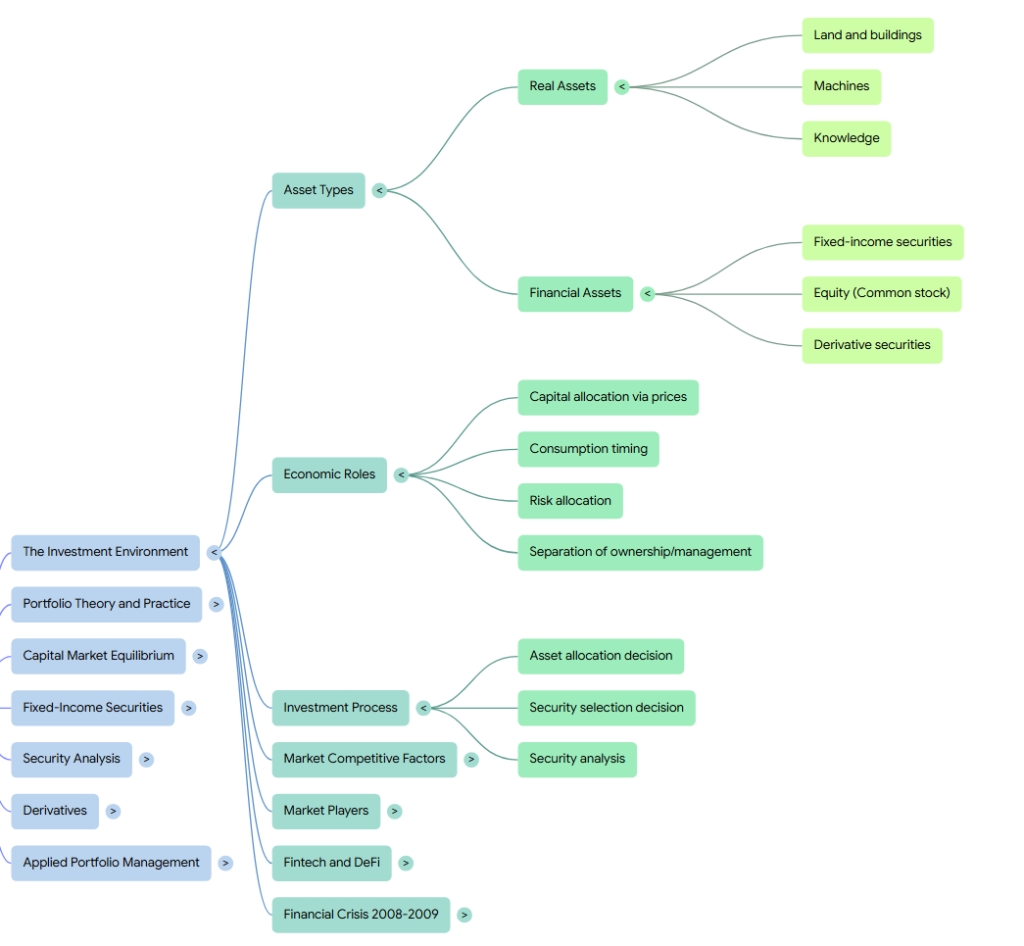
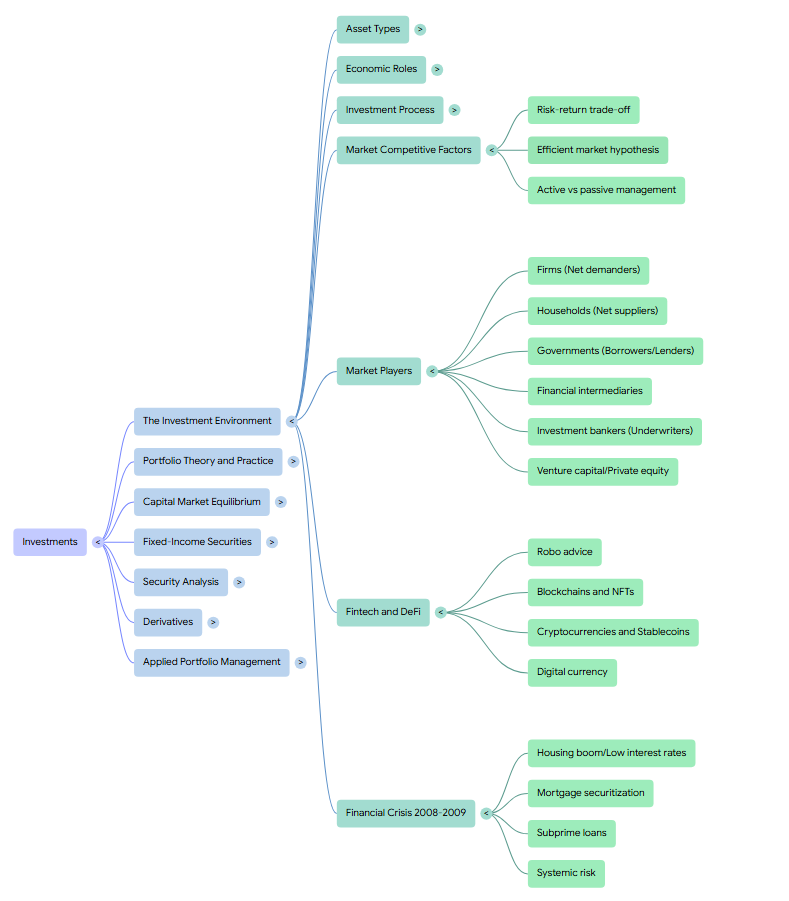
— Linden Lake
This series:
→ Book Review (1 of 7): Investments – The Investment Environment
→ Book Review (2 of 7): Investments – Portfolio Theory and Practice
→ Book Review (3 of 7): Investments – Capital Market Equilibrium
→ Book Review (4 of 7): Investments – Fixed-Income Securities
→ Book Review (5 of 7): Investments – Security Analysis
→ Book Review (6 of 7): Investments – Derivatives
→ Book Review (7 of 7): Investments – Applied Portfolio Management
Leave a Reply