
Over the past few weeks, YouTube’s recommendation algorithm has repeatedly suggested courses on building AI agents. Many of these courses, particularly those created by Chinese content creators, focus on using large language models to automate research, organize information, and create personal knowledge systems.
While exploring the topic, I came across a video titled “How to Build a Personal LLM Knowledge Base (Karpathy’s Method).” The concept immediately caught my attention because it closely resembles Google’s NotebookLM, a tool I have experimented with extensively for learning and research.
At first glance, both systems appear to accomplish the same goal. You upload documents, ask questions, generate summaries, and use AI to extract insights from source materials. However, the philosophy behind the two approaches is fundamentally different.
Beyond Document Storage
NotebookLM is exceptionally good at helping users interact with collections of documents. Upload reports, articles, research papers, textbooks, or notes, and the AI can answer questions based on those sources.
The workflow is straightforward:
Source Documents → Ask Questions → Receive Answers
This approach is highly effective for research projects, coursework, and quick knowledge retrieval.
However, the underlying structure remains document-centric. The documents themselves are the primary asset, and the AI serves as an intelligent interface for accessing them.
The Karpathy-inspired approach takes a different path.
Instead of simply querying documents, the AI continuously transforms information into a structured and evolving knowledge base:
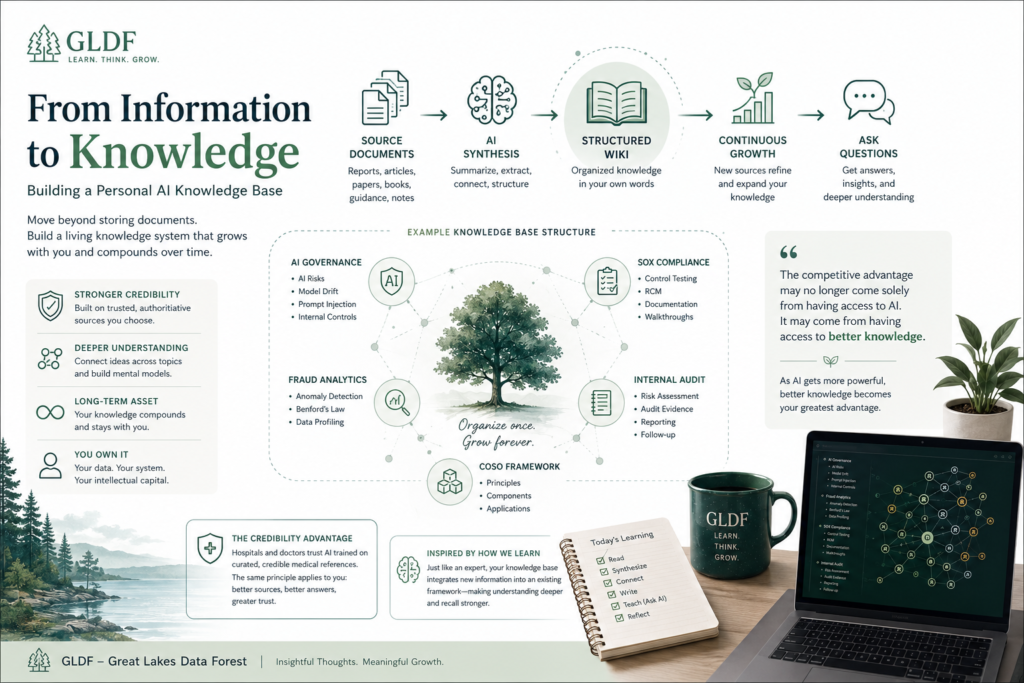
Source Documents → AI Synthesis → Structured Wiki → Continuous Growth → Ask Questions
In this model, the knowledge base itself becomes the asset.
The goal is no longer to store information. The goal is to cultivate knowledge.
| Feature | NotebookLM | Obsidian + Claude Wiki |
|---|---|---|
| Upload sources | Yes | Yes |
| Ask questions about sources | Yes | Yes |
| Generate summaries | Yes | Yes |
| Generate study guides | Yes | Yes |
| Voice conversation | Yes (Audio Overview) | Possible via Claude Voice |
| Data stored as documents | Mostly source-centric | Knowledge-centric |
| Editable knowledge base | Limited | Fully editable |
| Long-term accumulation | Per notebook | Infinite vault |
| Cross-topic linking | Limited | Excellent |
| Local ownership | No | Yes |
| AI vendor lock-in | Flexible |
The Difference Between Information and Knowledge
Consider a learning path focused on:
- Internal Audit
- COSO Framework
- SOX 404 Compliance
- Fraud Analytics
- AI Governance
Using NotebookLM, one might upload COSO publications, Journal of Accountancy articles, PCAOB guidance, and academic papers, then ask questions such as:
“What are the major risks associated with generative AI?”
The AI will provide a useful answer based on the uploaded materials.
A month later, however, another twenty reports may be added. The information grows, but the structure often remains tied to the source documents.
The knowledge-base approach works differently.
Instead of storing documents alone, the AI creates and updates topic-specific knowledge pages:
AI Governance
- AI Risks
- Model Drift
- Prompt Injection
- Internal Controls
Fraud Analytics
- Anomaly Detection
- Benford’s Law
SOX Compliance
- Control Testing
- Risk Control Matrices (RCM)
As new reports and articles are added, the existing pages evolve. Concepts become increasingly refined, interconnected, and easier to retrieve.
Rather than accumulating information, the system accumulates understanding.
In many ways, this mirrors how human experts develop expertise. New information does not replace old information; it integrates into an existing mental framework.
Knowledge Bases and the Credibility Advantage
Another aspect of this approach that deserves attention is credibility.
I once heard about a company that built an AI platform by ingesting large collections of authoritative medical references and clinical literature, then marketed the resulting product to hospitals and physicians. The value was not simply that the AI could answer questions. Rather, the answers were grounded in a curated body of trusted medical knowledge.
This highlights an important principle that extends well beyond medicine.
The quality of an AI system is heavily influenced by the quality of the knowledge it can access. When the underlying sources consist of peer-reviewed research, professional standards, regulatory guidance, and other authoritative references, the resulting answers tend to be more reliable and easier to verify.
A personal knowledge base applies the same concept at the individual level.
An auditor might build a knowledge base from COSO publications, PCAOB guidance, SOX documentation, Journal of Accountancy articles, and internal control frameworks. A data scientist might curate research papers, technical documentation, and statistical references. A language learner might compile grammar resources, dictionaries, and linguistic studies.
In each case, the objective is not simply to accumulate information. The objective is to create a trusted knowledge environment where AI can operate with greater context, consistency, and credibility.
As large language models become increasingly powerful, the competitive advantage may no longer come solely from having access to AI. It may come from having access to better knowledge.
A Connection to AI-Assisted Learning
This idea reminded me of another story I recently wrote about: an MIT student who reportedly used AI tools to learn an entire semester’s worth of material in just 48 hours.
The headline understandably attracts attention, but the more important lesson is not speed. The lesson is leverage.
AI dramatically reduces the time spent searching, organizing, summarizing, and synthesizing information. As a result, learners can devote more attention to understanding relationships between concepts and applying what they learn.
A personal AI knowledge base extends this advantage even further.
Instead of starting from scratch each time a new topic is studied, the learner gradually builds a permanent intellectual asset that compounds over time.
Each book, article, video, podcast, research paper, and professional publication contributes to a growing body of organized knowledge.
The more one learns, the more valuable the system becomes.
This creates a compounding effect that traditional note-taking systems rarely achieve.
The Economics of Learning
The implementation shown in the video relies heavily on Obsidian and Claude, which means maintaining the system may require a Claude subscription of approximately $20 per month.
Viewed strictly as a software expense, that cost may seem unnecessary.
Viewed as an investment in learning, however, the calculation changes.
Many people spend a similar amount each month on entertainment subscriptions. There is certainly nothing wrong with that. However, a tool that helps someone learn faster, retain more knowledge, and continuously expand a personal knowledge system may generate returns for years.
For students, researchers, accountants, auditors, analysts, programmers, and lifelong learners, the return on investment could be substantial.
In that sense, the monthly subscription cost may be one of the least expensive investments a knowledge worker can make.
Final Thoughts
Much of the public conversation around AI focuses on automation, job displacement, and technological disruption. Those discussions are important.
Equally important, however, is AI’s potential to transform how individuals learn.
Tools such as NotebookLM, Claude, Obsidian, and other emerging AI platforms are beginning to function as cognitive amplifiers. They help us organize information, identify patterns, connect ideas, and build structured knowledge at a scale that would have been difficult for a single individual only a few years ago.
The most valuable outcome may not be the answers these systems generate today.
It may be the personal knowledge systems we build that continue growing with us for years to come.
Just as organizations build data warehouses to preserve and leverage institutional knowledge, individuals may soon build personal AI knowledge bases that preserve and expand intellectual capital over a lifetime.
The future of learning may not belong to those who simply consume the most information.
It may belong to those who can transform information into knowledge most effectively.
— Linden Lake
Leave a Reply