
In a previous post, I wrote about how AI helped me launch Great Lakes Data Forest in just a few days. Looking back, getting the website online was only the beginning. What happened afterward turned out to be equally educational.
Once the basic structure was in place, I began refining the site’s appearance and user experience. At first, I assumed this would involve minor adjustments—changing fonts, moving images, tweaking layouts, and organizing content. Instead, what followed became an unexpected journey into web development, debugging, and systems thinking.
Many of the challenges seemed deceptively simple.
A logo appeared perfectly aligned on a desktop monitor but shifted on a tablet. A navigation menu looked fine on one screen size but behaved differently on another. A page title aligned correctly on most pages but developed strange spacing on specific post templates. A small CSS adjustment would fix one issue only to create a new one elsewhere.
Rather than treating these as isolated problems, ChatGPT and I approached them as investigations.
Each issue became a hypothesis-testing exercise.
Was the logo container shrinking unexpectedly?
Was a CSS rule being overridden by another selector?
Was a responsive breakpoint affecting only certain screen sizes?
Did the theme generate different HTML structures for pages and posts?
Instead of randomly changing settings and hoping for the best, we examined the evidence. We inspected HTML elements, reviewed generated CSS, compared layouts across devices, and gradually narrowed down the causes.
The process felt surprisingly familiar.
During my Master of Science in Computer Science program, I learned many concepts related to web technologies, software architecture, and system design. During cybersecurity training and OSCP preparation, I spent countless hours investigating how systems behave, how services communicate, and how to analyze problems methodically.
Building this website unexpectedly brought many of those experiences together.
The tools were different, but the thought process was remarkably similar.
Observe behavior.
Develop a theory.
Gather evidence.
Test the theory.
Adjust based on results.
Repeat.
As we continued troubleshooting, I found myself seeing the web stack more clearly than ever before.
A webpage was no longer just a webpage.
Behind every page was a chain of systems working together:
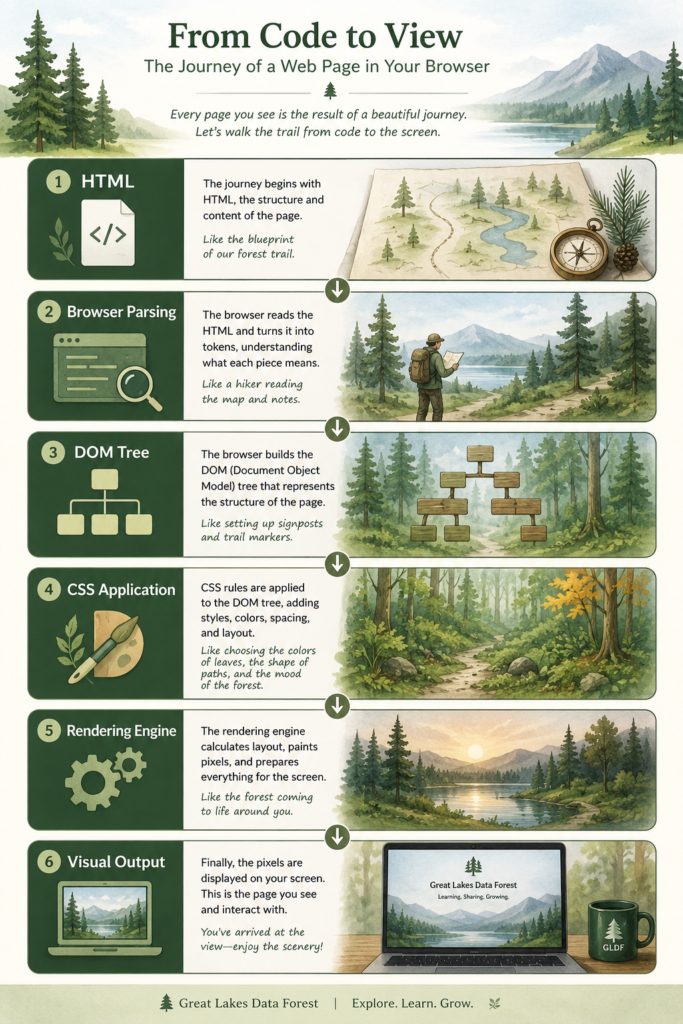
I had encountered these concepts before, but watching them influence real-world behavior made them far more tangible.
The relationship between front-end and back-end systems also became easier to visualize.
A visitor loads a page.
The browser sends a request.
The web server responds.
WordPress generates content.
PHP executes code.
The database provides information.
The browser receives the result and renders it on the screen.
What once felt like separate topics began fitting together into a single coherent system.
Seeing that chain unfold helped me appreciate how much complexity exists beneath even the simplest online experiences.
At the same time, many of the CSS challenges taught me practical lessons about responsive design.
Before building this website, I understood responsive design conceptually. Now I was experiencing it firsthand.
A layout that works beautifully on a desktop monitor may fail on a tablet.
A logo that scales correctly on one device may leave gaps on another.
A navigation menu that looks perfect on mobile may become awkward on landscape tablets.
Every adjustment required considering how the design would behave across multiple environments.
Those lessons were far more memorable than anything I could have learned by simply reading documentation.
Perhaps the most rewarding aspect of the process was realizing how interconnected knowledge can be.
A simple website project led me to revisit concepts from computer science.
Computer science concepts reinforced lessons from cybersecurity.
Cybersecurity thinking improved my debugging approach.
Debugging improved my understanding of web design.
Each area strengthened the others.
None of this was part of the original plan.
I did not set out to study responsive design.
I did not intend to revisit DOM structures.
I was not trying to review web architecture.
I certainly did not expect to spend an evening adjusting CSS values while discussing browser rendering behavior.
I simply wanted to build a blog.
Yet somewhere along the way, the project became much more than that.
What began as an effort to create a place for documenting ideas gradually turned into a small laboratory for experimentation and learning. Each design issue led to a deeper question. Each bug revealed another layer of the system. Every solution uncovered a new concept worth exploring.
Looking back, the website itself may be only part of the accomplishment. The greater reward has been the unexpected opportunities to revisit old knowledge, connect ideas from different disciplines, and gain a more practical understanding of technologies I had previously encountered only in classrooms, textbooks, or training environments.
The experience has reinforced something I have observed repeatedly throughout my life: meaningful learning often emerges from directions we never intended to pursue. We start with one goal in mind and, through the process of following it, discover lessons that turn out to be even more valuable than the original objective.
The website gave me a place to record my learning journey. In the process of building it, however, the journey itself became one of the most rewarding lessons.
— Linden Lake
Earlier Along This Trail
Before diving into CSS debugging, responsive design, and browser rendering, I wrote about how AI helped me launch Great Lakes Data Forest from a blank domain to a functioning website in just five days.
Leave a Reply