
Several weeks ago, while interviewing for an analyst position at a financial institution, a discussion about the transition from LIBOR to SOFR highlighted just how quickly the financial landscape continues to evolve.
Having spent several years away from studying finance in depth, I saw the experience as a valuable reminder that staying current is essential in an industry shaped by constant change.
Instead of simply reading a few articles, I challenged myself to design what I jokingly call another “master’s degree”—this time in finance.
Of course, this isn’t an actual academic degree. Rather, it’s a structured, AI-assisted self-study curriculum built around many of the textbooks commonly used in university finance programs, the CFA curriculum, banking education, and professional practice.
After several rounds of discussion with ChatGPT, I organized the reading list into four learning phases.
Phase I — Foundations
- Financial System Foundations
- Financial Institutions & Commercial Banking
- Corporate Finance
Goal: Understand how the financial system operates and how banks and corporations make financial decisions.
Phase II — Capital Markets
- Investments
- Valuation
- Fixed Income
- Derivatives
Goal: Learn how financial securities are priced, valued, and traded in modern capital markets.
Phase III — Specialized Finance
- Real Estate Finance
- Portfolio Management
- Alternative Investments
- International Finance
Goal: Build a deeper understanding of institutional investing, mortgage finance, and global financial markets.
Phase IV — Professional Practice
- Treasury Management
- Bank Risk Management
Goal: Integrate the previous topics into enterprise-level financial decision-making and risk management.
The curriculum currently consists of more than thirty textbooks and professional references, covering everything from monetary policy and commercial banking to mortgage-backed securities, derivatives, treasury management, and Basel III capital regulations.
However, collecting books is only the beginning.
To build a mental framework before diving into thousands of pages of reading, I turned to several AI tools.
First, I used NotebookLM to analyze the collection and perform topic modeling. It generated a comprehensive mind map that grouped the material into five major knowledge domains.
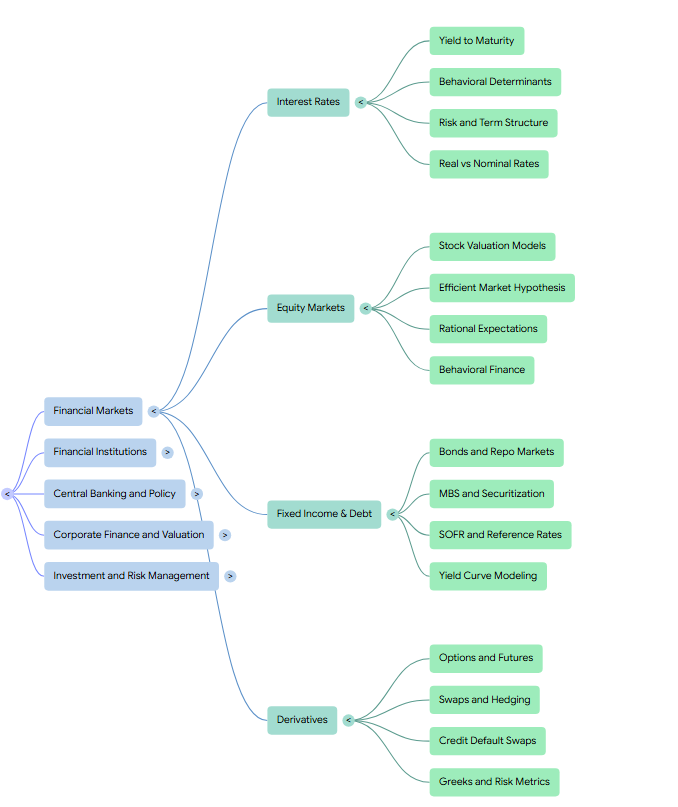
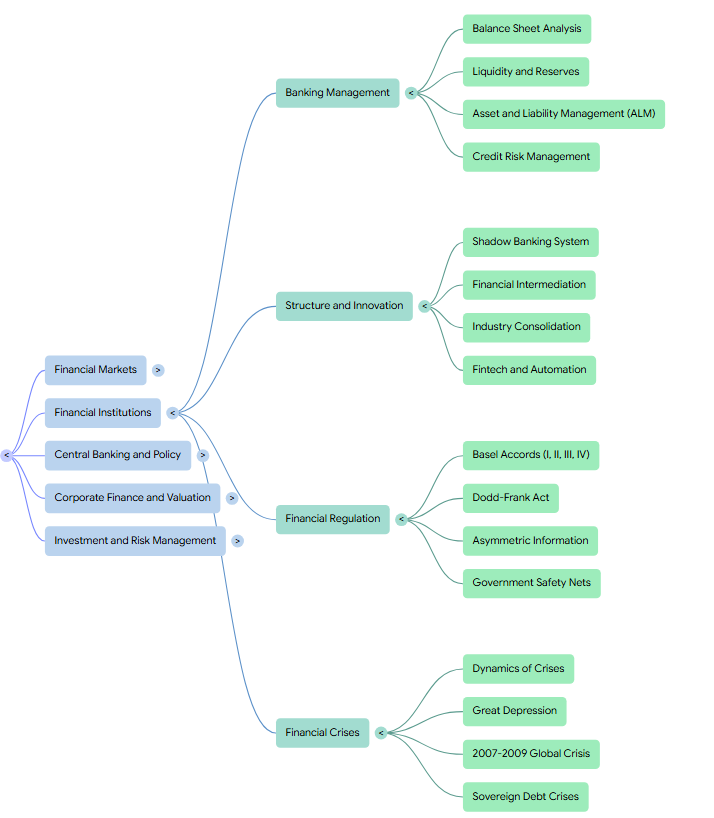

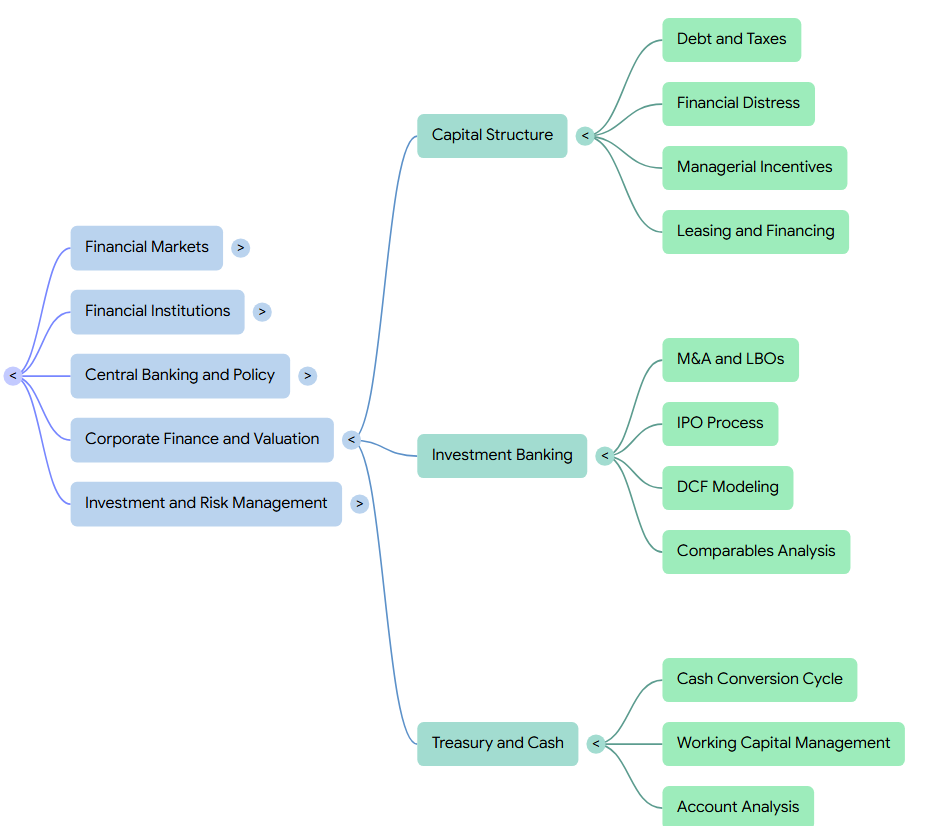
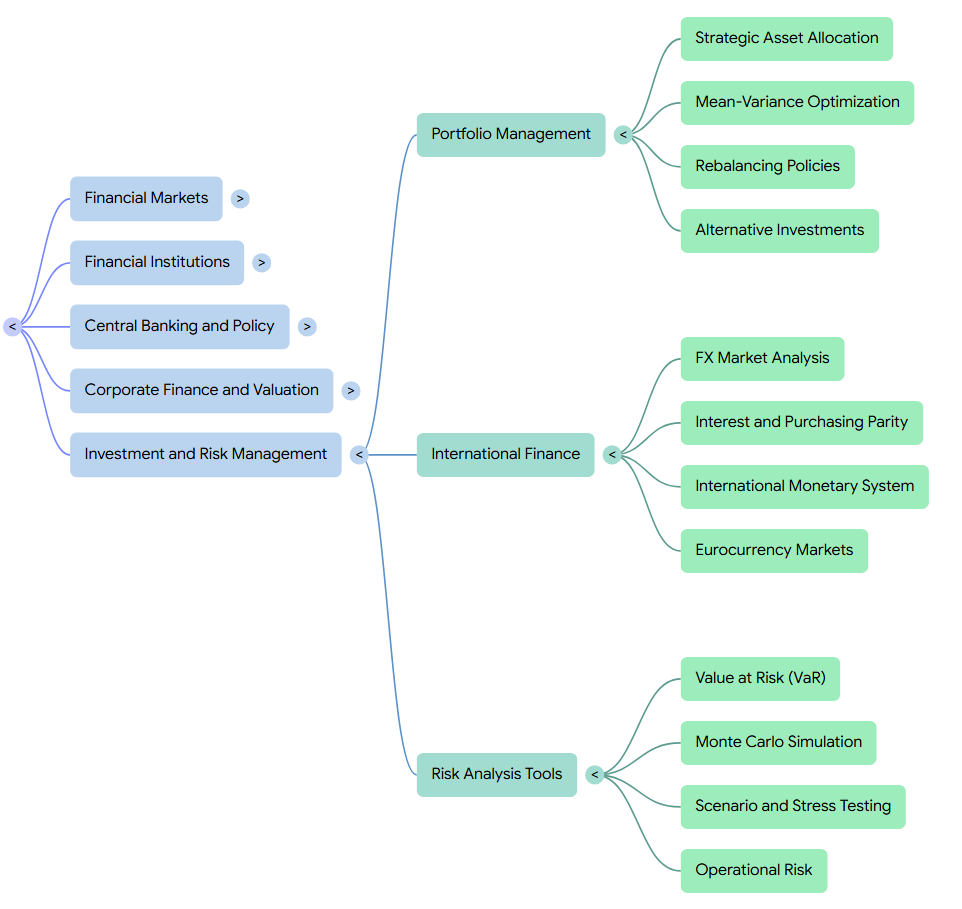


For each domain, I then generated a high-level concept summary before importing the text into InfraNodus, a tool for semantic network analysis. Rather than producing a traditional outline, InfraNodus visualizes how concepts connect to one another, making it much easier to see the underlying structure of an entire field.
I found this especially valuable because understanding a subject’s architecture is often more important than memorizing isolated facts. Once you know how ideas relate to one another, new information has a much more natural place to fit.


This approach also aligns with a learning strategy I wrote about earlier in my post, “How an MIT Student Used AI to Learn a Semester’s Worth of Material in 48 Hours.” One takeaway from that experiment was that building a conceptual framework before studying the details can make learning significantly more efficient.
Over the coming months, I’ll be reading through each tier of the curriculum and publishing a series of book reviews and learning notes here on Great Lakes Data Forest. Rather than summarizing every chapter, my goal is to capture the key concepts, connect them across disciplines, and gradually build a coherent mental model of modern finance.
For me, this project serves two purposes.
First, it helps me strengthen my understanding of the financial industry after several years away from intensive finance study.
Second, it gives me another opportunity to experiment with AI-assisted learning methods—exploring not only what we learn, but how we learn.
If the process proves effective, perhaps this won’t just become another reading project. It may become a repeatable framework for learning almost any complex subject.
You can also follow the progress of this project here—a back door to a hidden grove.
— Linden Lake
Leave a Reply