
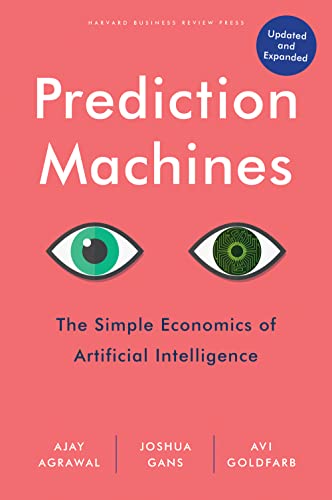
A few days ago, YouTube recommended a book-review video by a Chinese content creator discussing The Prediction Machine (published in Chinese as AI Minimalist Economics), a book originally written in English by three economists from the University of Toronto. The video offered one of the clearest economic explanations of AI that I have encountered, particularly regarding the relationship between prediction, judgment, work, and decision-making.
This topic connects directly to an earlier article I wrote, Is AI Really Taking Away People’s Jobs? Intrigued by the ideas presented in the video, I translated the review into English and organized it into a readable transcript. While the translation reflects the Chinese creator’s interpretation of the book rather than the original text itself, the discussion raises important questions about the future of work, the role of human judgment, and why the real impact of AI may have less to do with intelligence and more to do with the rapidly declining cost of prediction.
Full Video Transcript
Introduction
Welcome to Uncle Da’s Financial Wisdom Journal, a book-review channel dedicated to helping everyone become wealthier through knowledge and financial literacy. Today, we will be taking a deep dive into the book AI Minimalist Economics. Its English title is more directly translated as The Prediction Machine. The book was co-authored by three leading economists from the University of Toronto. Ajay Agrawal is the founder of the Creative Destruction Lab and has spent years researching technological innovation and the AI industry. Joshua Gans serves as the lab’s Chief Economist and has long contributed business insights to major media outlets. Avi Goldfarb specializes in the study of the digital economy.
Using this book as our guide, we are going to explore a core idea that may completely overturn the way you think about AI. All of your fears, hopes, and anxieties about AI may be based on a fundamentally incorrect assumption. We fear that a surveillance system might one day awaken and dominate humanity. We worry that AI will take away 90% of jobs. We imagine a future in which super intelligent machines cure cancer and solve the global energy crisis. Yet all of these ideas are built upon a premise that does not actually exist: The premise that AI possesses intelligence. This may be the greatest collective misunderstanding of our era. Because we call it artificial intelligence, we naturally judge it by human standards. We ask questions such as: Can it think? Does it have emotions? Can it develop consciousness? However, this book presents a harsh truth: Every AI system that exists today—from the facial recognition feature on your smartphone, to Tesla’s autonomous driving system, to today’s most popular GPT models—possesses not even the slightest trace of intelligence. They do not think. They do not understand. They certainly do not possess self-awareness. So what exactly are they? The answer is surprisingly simple. All artificial intelligence systems are fundamentally prediction machines. The only thing they do —and the only thing they can do— is use vast amounts of existing data to fill in unknown information. Nothing more. There are no exceptions.
Facial recognition does not actually recognize you. It has no idea who you are. It does not know your name, your character, or whether you are a good person or a bad person. It is merely predicting that the pixel pattern of the face in front of it matches a face in its database with a confidence level greater than 99.9%.
Autonomous driving does not truly know how to drive. It has no concept of roads, pedestrians, or traffic. Instead, it predicts that the object ahead has a 95% probability of moving to the left in the next second, so the car should steer to the right. It predicts that there is an 80% probability of a collision at the current distance, so it should apply the brakes.
ChatGPT does not actually understand the meaning of the words it generates. It is simply predicting the statistically most likely next word after the sequence of words that came before it. The reason it appears capable of writing articles, composing poetry, or carrying on conversations is that it seamlessly strings together billions of these next-word predictions.
At this point, you may ask: “Does that distinction really matter? After all, it can do many of the same things humans can do.” Yes—it matters enormously.
Once you accept the definition that AI is fundamentally a prediction machine, the entire discussion surrounding AI instantly moves from the murky realm of philosophy to the solid ground of economics. We no longer need to debate whether AI will develop consciousness. We no longer need to argue about whether machines have souls. We no longer need to become trapped in endless discussions about whether human beings are truly unique.
Instead, we only need to focus on one simple and measurable economic question: What happens when the cost of prediction falls close to zero?
This situation is similar to the electricity revolution a century ago. There was nothing inherently magical about electricity itself—it was simply another form of energy. But when the cost of electricity fell dramatically, the entire world was transformed. Factories no longer had to be built beside rivers. Cities could expand indefinitely. Electric lights replaced oil lamps. Telegraphs and telephones connected the globe. Electricity itself did not become magical. Rather, every industry that depended on electricity was fundamentally transformed.
Today’s AI revolution is, at its core, a revolution in the cost of prediction. In the past, prediction was extremely expensive. Organizations had to hire experts, collect data, build models, and spend months—or even years—developing forecasts that were not necessarily accurate. Today, AI can generate predictions in milliseconds with accuracy that often exceeds that of human experts. The marginal cost is approaching zero. This is the central logic of the book: Prediction is an input into every decision.
When prediction becomes extremely cheap, the cost of decision-making also falls dramatically. And when decision-making becomes cheaper, our way of working, the structure of businesses, and even the functioning of society itself will undergo profound transformation. This raises an important question: Why was prediction so expensive for decades, only to suddenly become almost free? What technological breakthrough caused the cost of prediction to fall by more than a million-fold within just ten years? That is the first question we will explore—and the starting point for understanding the entire AI revolution.
Part I: The Prediction Revolution
In the previous section, we left off with a key question: Why was prediction, for decades, an expensive luxury available only to a handful of experts, and yet suddenly become something so cheap that anyone can use it? The answer is not that computers became faster, nor is it simply that we have more data. The real reason is that the way we make predictions underwent a fundamental paradigm shift. This shift transformed prediction from an art practiced by a few geniuses into an industrial process that can be scaled and mass-produced.
- From Statistics to Machine Learning: A Paradigm Shift in Prediction
Before the emergence of machine learning, virtually all human prediction relied on traditional statistics. Traditional statistics, however, has a fundamental limitation: it can only calculate conditional averages, and all of those conditions must be specified in advance by human beings. What does that mean? Suppose we want to predict which customers are likely to leave a company. Using traditional regression analysis, industry experts would first brainstorm the factors that might influence customer churn: Monthly bill amount, Length of service, Number of complaints, Subscription plan type.
They would then run regressions on historical data and arrive at conclusions such as: “For every additional 100 yuan in monthly billing, churn increases by 5%.” “Customers who have filed complaints are twice as likely to leave as those who have not.” The problem with this approach is that it can only identify the effects of individual factors or simple combinations of factors. More importantly, every factor must first be imagined by a human being. If humans fail to think of a hidden pattern, traditional statistics will never discover it. The book provides a classic example.
A telecommunications company used machine learning to analyze customer-churn data and uncovered a pattern that astonished all the experts. Customers who suddenly increased their spending at the beginning of the month, frequently made long-distance calls on weekends, and sent large numbers of text messages were found to be three times more likely to cancel their service. No expert would have predicted this combination. The hidden logic was that these customers had accepted new jobs and moved to different cities. They were using their old phone numbers to notify friends and colleagues before canceling their service the following month.
This type of complex, nonlinear pattern —one with no obvious causal relationship— is exactly the kind of insight that machine learning can automatically uncover from tens of millions of customer records. This illustrates the most important difference between traditional statistics and machine learning. Traditional statistics seeks average correctness. It cares about how well the model fits the data overall and is less concerned with whether any individual prediction is correct. Machine learning seeks practical predictive performance. It does not care whether humans can easily explain the model. It only cares whether each prediction is accurate.
In statistics, humans write the rules first and then use data to test them. In machine learning, the machine is given vast amounts of data and discovers the rules on its own. The milestone of this paradigm shift came with the 2012 ImageNet image-recognition competition. Before then, the world’s best image-recognition algorithms still had error rates of around 30%, far behind the approximately 5% error rate achieved by humans. In 2012, Geoffrey Hinton’s team used an eight-layer deep learning neural network and reduced the error rate to 16%.It outperformed the second-place competitor by a full 10 percentage points. The result shocked the entire technology industry. For the first time, deep learning demonstrated that it could outperform every prediction method humans had previously invented. From that day forward, nearly every prediction task began migrating toward deep learning. Prediction accuracy started rising exponentially. Prediction costs started falling exponentially. - Data Is Not the New Oil — It Is the Fuel of Prediction
Today, everyone says that “data is the new oil.” The common belief is that whoever owns the most data owns the future. This book challenges that popular narrative. Not all data is valuable. In fact, most data is worth very little. Only one type of data possesses true strategic value. The authors divide data into three categories, each with dramatically different levels of value.
First Type: Training Data. Training data is the educational material used to teach machines. Examples include: Your shopping history over the last ten years, Public images available on the internet, Collections of Chinese books and documents. The value of training data is largely one-time in nature. Once it has been used to train a model, its usefulness is mostly exhausted. Training the same model on the exact same data one hundred times will not make it significantly better. Today, training data has largely become a commodity. If you have enough money, you can buy it. There are countless high-quality public datasets available, which means training data alone rarely creates a sustainable competitive advantage.
Second Type: Input Data. Input data is the information fed into a model at the moment a prediction is made. Examples include: The keywords you search for on Taobao (a Chinese online shopping platform), The destination you enter into a navigation app, The video you just swiped past on TikTok. Input data has immediate value, but little long-term value. Once it has been used, it disappears.
Third Type: Feedback Data. This is the truly valuable category. Feedback data is the equivalent of grading a student’s homework. It tells the machine whether its prediction was right or wrong. Examples include: Clicking the third Google search result instead of the first, Looking at a product on Taobao for five minutes but deciding not to purchase it, Immediately swiping away a video on TikTok. These seemingly insignificant actions—clicks, pauses, purchases, and skips—are the true food that feeds AI systems.
Every piece of feedback teaches the model something. It learns: “The user wanted this, not that.” The model then automatically adjusts its parameters so that future predictions become more accurate. This is Google’s real competitive advantage. Its advantage is not the amount of historical search data it possesses. Its advantage is that it processes billions of searches every day, and every search functions as a free lesson. The more people use Google, the better its model becomes. The better its model becomes, the more people use Google. This creates a self-reinforcing cycle that is extraordinarily difficult to break. That is the true strategic asset. That is the moat that money alone cannot buy. - The Nonlinear Revolution of Prediction Accuracy
This is one of the most counterintuitive—and most frequently overlooked—aspects of the AI revolution. The value generated by improvements in prediction accuracy is not linear. Many people assume that increasing accuracy from 85% to 90% creates roughly the same amount of value as increasing it from 98% to 99.9%. After all, both improvements appear to be only a few percentage points. In reality, the difference in value is enormous. Consider a simple calculation. When accuracy improves from 85% to 90%, the error rate falls from 15% to 10%. That is only a one-third reduction in errors. However, when accuracy improves from 98% to 99.9%, the error rate falls from 2% to 0.1%. That is a twenty-fold reduction in errors. More importantly, most commercial applications contain an invisible threshold — a make-or-break line. Only when the error rate falls below that threshold does AI become useful. Above that threshold, AI may have virtually no value at all. Even if it misses the threshold by only 0.1%.
Consider credit-card fraud detection. Suppose a bank processes 100 million transactions per day and the true fraud rate is one in ten thousand, meaning 10,000 fraudulent transactions occur daily. If the AI system has a 1% false-positive rate, it will incorrectly flag one million legitimate transactions as fraud every day.
Imagine one million customers having their credit cards frozen for no reason. The bank would likely be overwhelmed within days. Only when the error rate falls below 0.01%, reducing false alarms to roughly 10,000 transactions per day, does the system become commercially viable.
Now consider autonomous driving. If an autonomous-driving system has an error rate of 0.1%, it would cause an accident approximately every 1,000 kilometers. That performance would still be worse than a human driver and would never be approved for widespread use. Only when the error rate falls below 0.0001%—roughly one accident per one million kilometers—does autonomous driving become significantly safer than humans. At that point, large-scale adoption becomes possible.
This is what the authors call the nonlinear value curve of prediction. Before accuracy crosses a critical threshold, AI’s value is close to zero. Once it crosses that threshold, value explodes. Entire industries can be transformed almost overnight. The reason AI has been successfully deployed across one industry after another over the past five years is not because AI suddenly became intelligent. It is because its prediction accuracy finally crossed the make-or-break threshold in those industries.
We have now identified the three core drivers behind the prediction revolution: The paradigm shift from statistics to machine learning, which made prediction scalable. Feedback data, which allows prediction systems to continuously improve themselves. Nonlinear breakthroughs in accuracy, which make prediction commercially valuable.
When all three conditions are present, prediction truly becomes inexpensive. And what happens when something that was once extremely expensive suddenly becomes almost free? Economics tells us that people begin using it everywhere. Once prediction is embedded into every aspect of society, the way we make decisions will fundamentally change. In the next section, we will explore how prediction reshapes decision-making—and why the dramatic decline in the cost of decisions may be the most powerful consequence of the AI revolution.
Part II: Reconstructing Decision Making
In the previous section, we discussed how the dramatic decline in the cost of prediction is reshaping the fundamental logic of the world. The first—and perhaps most important—area to be transformed is decision-making.
Many people believe that AI will eventually make decisions for us. Some even fear that one day AI will control humanity’s destiny. However, this book makes a clear and compelling argument: AI will never make decisions. The most it can do is perform one step within the decision-making process. To understand why, we must first break down what appears to be a complex activity into its most basic components. The book introduces a classic framework known as the Seven Elements of Decision-Making. Every decision, regardless of size or importance, consists of seven steps: Input, Training, Prediction, Judgment, Action, Outcome, Feedback. Let’s examine each step. Input refers to all the raw information we collect. Training involves using historical experience and data to build a predictive model. Prediction uses that model to estimate what is likely to happen in the future. Judgment evaluates the value and cost of those predicted outcomes. Action is the choice we make based on that judgment. Finally, Outcome and Feedback help improve future decisions. Among these seven steps, AI can only perform one effectively: Prediction.
All of the other steps—especially the critical fourth step, judgment—must be performed by humans. This is the ultimate logic behind human-machine collaboration. AI answers the question, “What is likely to happen?” Humans answer the question, “What is it worth?”
To illustrate this idea, consider a simple decision everyone has faced: Should you bring an umbrella when leaving home? In this situation, AI can collect decades of weather data, analyze atmospheric pressure, temperature, humidity, and cloud cover, and tell you: “There is a 30% chance of rain between 2:00 PM and 4:00 PM today.” That’s all. But does knowing there’s a 30% chance of rain automatically tell you whether to bring an umbrella? Not necessarily. Suppose you’re heading to a job interview that could change the course of your career, and you’re wearing an expensive suit. In that case, even a 10% chance of rain might be enough to justify carrying an umbrella because the cost of getting soaked is far greater than the inconvenience of carrying one. Now imagine you’re simply taking a walk in a nearby park wearing an old T-shirt and sandals. Even with a 50% chance of rain, you might decide not to bring an umbrella because getting wet would be a minor inconvenience. The prediction is identical. The decision is completely different. That difference is the value of judgment.
AI can never make this judgment for you because it does not know how important the interview is to your future. It does not know how much inconvenience getting wet would cause you. It has no understanding of your preferences, values, priorities, or life experiences. Therefore, it cannot evaluate gains and losses the way a human can. This is why AI will never replace humans in decision-making. Prediction is objective, measurable, and scalable. Judgment is subjective, personal, and unique. Prediction can be delegated to machines. Judgment must remain in human hands.
Where Machines Dominate—and Where Humans Remain Irreplaceable
If the essence of human-machine collaboration is that AI performs prediction while humans provide judgment, then the next question becomes: In which situations do machines outperform humans? And: In which situations can humans never be replaced? Machines have an overwhelming advantage in two types of scenarios.
- Massive Data and Complex Correlations
When a problem involves hundreds or thousands of variables and requires identifying hidden patterns within millions—or even billions—of data points, the human brain simply cannot compete. The book provides a controversial but persuasive example. Every day, judges in the United States must decide whether criminal suspects should be released on bail. They need to estimate the probability that a suspect will flee or commit another crime if released. Traditionally, these decisions were based on the judge’s experience and intuition. Researchers later trained a machine-learning model using variables such as: Age, Gender, Criminal history, Place of residence. With only a handful of variables, the model could predict the likelihood of flight or reoffending. The results were striking. The model achieved accuracy levels approximately 30% higher than judges with decades of experience. Why? Because a judge may handle dozens of cases each day and cannot possibly remember every relevant detail or analyze every relationship among the variables. A machine, however, can analyze the historical records of 750,000 bail cases within milliseconds and identify patterns that humans could never discover. - High-Frequency, Repetitive Predictions
Machines also dominate when tasks must be repeated hundreds or thousands of times per minute while maintaining absolute consistency. Human performance declines with fatigue, boredom, and emotional fluctuation. Machines do not suffer from these limitations. A classic example is medical imaging. An experienced radiologist may review dozens of X-rays in a day. As fatigue sets in, accuracy naturally declines. An AI system can analyze thousands of images per minute, twenty-four hours a day, without becoming tired or distracted. Its accuracy remains consistent.
Three Areas Where Humans Will Always Outperform Machines
Despite their strengths, machines have significant limitations. There are three categories of problems in which humans maintain a decisive advantage.
- Rare Events with Limited Data
Machine learning requires large amounts of historical data. If an event has never occurred before—or has occurred only a few times—there is insufficient information for the machine to learn from. Consider the COVID-19 pandemic in 2020. When the outbreak first occurred, there was no historical data describing how such a virus would spread, how severe its impact would be, or which policies would be most effective. AI had no basis for making reliable predictions. All decisions had to be made by humans using limited information, reasoning, and common sense. - Causal Reasoning
Machines can identify correlations. They cannot truly understand causation. A machine can tell you that A and B frequently occur together. It cannot tell you whether: A causes B, B causes A, or C causes both A and B. For example, analysis of sales data might reveal that higher-priced products tend to have higher sales. If a machine were allowed to make decisions, it might recommend doubling the prices of all products. Humans, however, recognize that strong demand may be causing prices to rise—not the other way around. Because machines cannot truly understand causal relationships, they can arrive at completely incorrect conclusions. - Value Judgments
All decisions involving ethics, morality, emotions, or the value of human life must remain human decisions. A machine may tell you that a particular chemotherapy treatment offers: A 30% chance of curing cancer and an 80% chance of causing severe side effects. But it can never tell you whether enduring those side effects is worth the chance of recovery. Only the patient and their family can make that judgment.
The Power of Human-AI Collaboration
The book presents a famous example demonstrating the complementary strengths of humans and AI. Researchers at Harvard Medical School asked AI systems and eleven human pathologists to evaluate breast-cancer tissue samples. The results were remarkable: Human experts alone: 96.6% accuracy. AI alone: 92.5% accuracy. Humans and AI together: 99.5% accuracy. Why did the combination perform so well? Humans rarely miss cancer cases because they understand the consequences of overlooking a tumor. They carefully examine every suspicious cell. AI, on the other hand, rarely misclassifies healthy tissue as cancerous. It does not become tired, anxious, or overly cautious. Together, each compensates for the other’s weaknesses.
Will AI Take Your Job?
Once we understand the respective strengths of humans and machines, we can answer the question everyone asks: Will AI take my job? The book’s answer is remarkably clear: AI will not replace entire professions. It will replace prediction tasks within professions. No occupation will disappear completely. However, the duties of nearly every job will be fundamentally reorganized. The book provides three examples.
Radiologists
Many people assume AI will eliminate radiologists. In reality, radiologists will remain essential. They simply will not spend all day staring at images. Future radiologists will become “doctors for doctors.” They will interpret AI-generated findings, determine whether an abnormality is truly cancerous, decide whether a biopsy is necessary, develop treatment plans, and help train future AI systems by identifying correct and incorrect diagnoses.
School Bus Drivers
When autonomous driving becomes widespread, school bus drivers may no longer need to drive. But they will not disappear. Instead, they will become supervisors responsible for: Maintaining discipline, Resolving conflicts among students, Caring for sick children, Managing emergencies. If a child suddenly faints, or if a traffic accident occurs on the road, situations that an autonomous driving system cannot adequately handle, a human driver would need to take over. Human intervention remains necessary.
Bookkeepers
When spreadsheets were first introduced decades ago, many people predicted that bookkeepers would disappear. The opposite happened. Spreadsheets eliminated the most tedious calculations and freed bookkeepers to perform more valuable work. Today’s bookkeepers have evolved into financial analysts who focus on: Budgeting, Financial analysis, Investment evaluation, Risk assessment.
This illustrates a fundamental principle of work in the AI era: The better AI becomes at prediction, the more valuable human judgment becomes. As prediction becomes as abundant and inexpensive as air, jobs requiring judgment, creativity, empathy, and wisdom will become increasingly scarce—and increasingly valuable.
The Danger of Over reliance on AI
However, there is an important warning. Just because machines can predict accurately does not mean humans should abandon their own abilities. The book uses a tragic example: Air France Flight 447. In 2009, Air France Flight 447 crashed into the Atlantic Ocean, killing all 228 people on board. Investigators later discovered that the immediate cause was relatively simple: The aircraft’s pitot tubes froze, causing the autopilot system to disengage. The deeper cause, however, was the pilots’ response. The autopilot had been flying the aircraft for hours. The pilots had become passive observers and gradually lost situational awareness. When the autopilot suddenly disconnected, they did not understand what was happening. Nor did they know how to respond effectively. They made a series of incorrect control inputs that caused the aircraft to stall and crash. The lesson is clear: Humans cannot surrender all prediction and action to machines. We must retain the ability to take control during emergencies. We must understand how machine predictions are generated. We must know when to trust machines—and when to question them. For ordinary people, the book offers a simple but powerful piece of advice: Do not compete with machines at prediction. Develop judgment instead. People whose work consists entirely of repetitive prediction tasks will eventually be replaced. Those who possess strong judgment and can make sound value-based decisions will become increasingly indispensable.
Now that we understand the fundamental logic of human-machine collaboration and how individuals can thrive in the AI era, the next question becomes: How should businesses adapt? When prediction becomes nearly free, how must organizations redesign themselves to survive and compete? How will the source of competitive advantage change? That is the focus of the next section: The Reshaping of Strategy – Business Survival in the Age of AI.
Part III: Enterprise AI Strategy
In the previous section, we discussed the survival strategy for individuals in the age of AI: Do not compete with machines at prediction. Develop judgment instead. For businesses, however, the challenge posed by AI goes far beyond that. Many business leaders say: “I know AI is important, but I don’t know where to start. I’ve asked my IT department to purchase some AI tools and provide employee training, but nothing seems to have changed.” This is one of the most common problems companies encounter during AI transformation. The book makes a powerful point: AI is not an IT issue. It is a CEO issue. AI is not merely a tool for optimizing existing processes. It is a lever for redesigning entire business models. Most companies make a mistake in the very first step of their AI transformation. They simply sprinkle a little AI on top of existing workflows. For example: Customer service used to answer calls manually; now they add an AI chatbot. Sales teams used to prospect manually; now they add an AI lead-generation tool. Accounting used to be done manually; now they add AI bookkeeping software. Then they hope for: 20% lower costs and 30% higher efficiency. But this approach can only produce incremental improvements. It can never generate exponential growth.
Redesign the Process, Don’t Just Automate It
The true AI revolution is not about automating existing work. It is about redesigning the entire workflow and eliminating steps that only existed because prediction used to be expensive. The book provides a classic example from Ford Motor Company.
In the 1980s, Ford’s North American accounts payable department employed 500 people whose primary responsibility was processing supplier invoices. Ford later introduced computer systems and hoped to reduce headcount by 20%, lowering the workforce from 500 employees to 400. However, after carefully analyzing the process, they discovered that 90% of the department’s work consisted of comparing three documents: Purchase orders, Receiving documents, Invoices. If the information matched, payment was approved. If the information did not match, employees spent enormous amounts of time investigating discrepancies. Ford realized that the real problem was not invoice processing. The problem was the existence of invoices themselves. Instead of automating invoice verification, Ford eliminated invoices entirely. They redesigned the entire workflow. When the purchasing department issued an order, the information was entered directly into the system. When the warehouse received the goods, the system automatically compared the shipment against the purchase order. If everything matched, payment was automatically sent to the supplier. No invoice was required. No human verification was required. As a result, Ford’s accounts payable department shrank from 500 employees to 100 employees. Efficiency increased by approximately 500%.
This illustrates a core principle of AI-era strategy: Don’t ask: “How can AI help me do my current work better?” Ask: “If prediction were free, how would I redesign this business from scratch?”
When Does AI Become a Strategic Force?
The authors propose three conditions that determine whether AI will fundamentally disrupt an industry. If all three conditions are present, AI has the potential to transform the entire business. Condition 1: Your business model contains a critical trade-off that cannot currently be solved. Condition 2: That trade-off is fundamentally driven by uncertainty. Condition 3: AI can dramatically reduce that uncertainty. When all three conditions are met, AI can completely change the economics of the business. A classic example is Amazon’s concept of anticipatory shipping.
Amazon has long wanted to send products to customers before they actually place an order. Customers would simply keep the items they wanted and return the rest. Such a system could dramatically increase sales. The problem, however, was the cost of returns. Historically, Amazon could not accurately predict what each customer would want. The uncertainty made the model economically impossible. Today, AI can predict customer preferences with far greater accuracy. Once prediction becomes sufficiently accurate, the cost of returns becomes lower than the additional profit generated by increased sales. A business model that was once impossible suddenly becomes viable.
The AI Canvas
Many executives understand that AI is important, but struggle to identify where and how it should be applied within their organizations. To address this challenge, the authors developed a practical tool called the AI Canvas. The framework is based on the decision-making model discussed earlier. Any task can be broken into seven components. Once these components are identified, it becomes much easier to determine whether AI is appropriate and how it should be implemented. The book uses MBA admissions as an example.
Prediction: Who will become the most influential and generous alumni ten years after graduation?
Judgment: Which is more costly – Admitting an unqualified student? or Rejecting an exceptional student?
Action: Send admission offers to qualified candidates. Offer scholarships to outstanding candidates.
Inputs: Application forms, GMAT scores, Undergraduate transcripts, Interview videos, Recommendation letters.
Training Data: Thirty years of historical application materials, combined with alumni career achievements and donation records.
Outcomes: Student performance during their studies and their accomplishments after graduation.
Feedback: Annual updates regarding alumni career progression and donations, used to improve future prediction models.
By breaking the admissions process into these seven components, a vague idea such as “Let’s use AI to improve admissions.” becomes a concrete, measurable, and actionable project. The greatest value of the AI Canvas is that it forces organizations to stop speaking vaguely about AI transformation and start asking fundamental questions: What exactly are we trying to predict? What are we willing to pay for better predictions? How will we measure success? According to the authors, most AI projects fail not because the technology is inadequate, but because organizations never answer these questions in the first place.
The Strategic Trade-Off: Deploy Early or Wait?
Once you’ve identified an appropriate AI application, you face a difficult strategic decision: Should you launch early? Or should you wait until the technology matures? There is no universally correct answer. Launching early offers one major advantage: You immediately begin collecting real-world feedback data. The model improves rapidly through use. The downside is that early versions are often inaccurate and may create poor user experiences. Waiting offers the opposite trade-off. Users receive a more polished experience. However, competitors who launched earlier may gain an enormous advantage through the data they collect. The book provides two classic examples.
Google’s Smart Reply
When Google first launched Smart Reply in Gmail in 2015, its accuracy was only about 30%. In other words, 70% of the suggested responses were essentially useless. Most companies would have hidden such a feature until it reached 90% accuracy. Google released it immediately. Why? Because every time a user accepted or rejected a suggested response, they were providing free training data. Within only six months, Smart Reply’s accuracy rose to approximately 90%. Companies that waited for perfection never had a chance to catch up.
Tesla’s Autopilot
Tesla is arguably the only company willing to use millions of ordinary customers as real-world testers. Many people criticize Tesla for this approach. However, from an AI strategy perspective, it may have been the only viable option. Autonomous-driving systems must encounter countless unusual situations in real-world conditions before they can become truly safe. No simulated environment can replicate reality perfectly. Tesla’s lead today is not primarily the result of superior algorithms. It is the result of billions of kilometers of real-world driving data. That advantage cannot be replicated quickly.
The Limits of Early Deployment
Early deployment is not appropriate in every situation. The authors propose a simple rule: High-Tolerance Environments, Deploy early. Examples: Recommendation systems, Customer service, Advertising. Even if the AI makes mistakes, the consequences are relatively minor. The value of collecting feedback outweighs the cost of errors.
Low-Tolerance Environments
Simulate first, deploy later. Examples: Healthcare, Autonomous driving, Financial risk management. Mistakes in these areas can have severe consequences. Extensive testing must occur before widespread deployment.
AI and the Boundaries of the Firm
AI will also reshape the boundaries of organizations. Historically, companies outsourced non-core functions to reduce costs. AI makes outsourcing even easier.
Any standardized, repetitive prediction task can potentially be outsourced to specialized AI providers. However, one category of work should never be outsourced: Judgment. Questions such as: What makes a good product? Who are the right customers? What are the company’s core values? cannot be delegated to machines. Nor should they be delegated to external providers. These judgments constitute the soul of the organization. They must remain under the control of the company itself.
We now understand how companies can develop AI strategies, implement AI projects, and build competitive advantages in the age of AI. However, the impact of the AI revolution extends far beyond individuals and businesses. As the cost of prediction approaches zero, and as organizations redesign their business models around AI, the fundamental rules governing society itself will begin to change. New questions will emerge: Who owns the wealth created by AI? How should that wealth be distributed? What laws and institutions are needed to govern AI? These questions lead us to the final section of the book: The Future of Society in the Age of AI.
Conclusion: Survival Rules for the Age of AI
The Future of Society in a World Where the Cost of Prediction Approaches Zero. Over the previous four sections, we have explored the central argument of this book in depth. AI is not intelligence. AI is prediction. The dramatic decline in the cost of prediction is reshaping our decisions, our jobs, and our businesses. Yet at this point, many people still have one ultimate question: Where will this revolution ultimately lead us? And more importantly: What should ordinary people do to avoid being left behind?
When it comes to the future of AI, two extreme narratives dominate public discussion. The first is the doomsday scenario, which claims that AI will eliminate 90% of jobs, leading to mass unemployment and social instability. The second is the utopian scenario, which argues that AI will solve all major problems and usher humanity into a post-scarcity paradise. This book offers neither optimism nor pessimism. Instead, it provides a realistic answer grounded in economics. Employment: Not Mass Unemployment, but Mass Job Transformation. The issue people care about most is employment. The authors are explicit: AI will not cause mass unemployment. However, it will cause massive occupational transformation. No profession will disappear entirely, but the nature of nearly every job will change fundamentally. This transformation will occur in two directions.
Lower-Skilled Jobs: From Physical Labor to Simple Judgment
Consider delivery workers. In the future, they may no longer spend their days driving packages from place to place. Autonomous trucks may transport goods directly to neighborhoods. The delivery worker’s role will shift toward handling unusual deliveries, communicating with customers, and resolving disputes. The same pattern applies to supermarket cashiers. Self-checkout systems may handle routine transactions. Cashiers will focus on helping elderly customers use the machines, processing returns, and preventing theft.
Higher-Skilled Jobs: From Prediction Work to Advanced Judgment
The same transformation will occur in knowledge-intensive professions. Future financial analysts may no longer spend their days building spreadsheets, crunching numbers, and forecasting stock prices. AI will present a wide range of forecasts automatically. The analyst’s role will be to evaluate the credibility of those forecasts, assess potential risks, and formulate investment strategies. Similarly, lawyers may no longer spend countless hours searching through statutes and case law. AI will organize and retrieve relevant legal information instantly. The lawyer’s role will become determining which precedents are most applicable and how best to persuade a judge to protect a client’s interests.
Inequality: The Premium on Judgment
The book openly acknowledges that AI is likely to increase social inequality. However, the cause is not AI itself. The cause is what economists call a skill premium.
Put simply: People who know how to use AI and exercise good judgment will see their incomes rise dramatically. People whose value comes solely from prediction-related tasks will see their incomes decline. Consider copywriters. In the past, an excellent copywriter might earn 1,000 dollars for an article, while an average copywriter earned 500 dollars. The difference was roughly twofold. Today, an outstanding copywriter who effectively uses AI might produce ten high-quality articles in a single day and earn 10,000 dollars. Meanwhile, a copywriter who does not use AI may struggle to find work at all. The gap is no longer two times. It may become ten, fifty, or even one hundred times. According to the book, this is the true source of future inequality. It is not that AI takes jobs away from people. It is that people who know how to use AI take opportunities away from those who do not.
Monopoly: Will AI Create Permanent Winners?
Many people worry that AI will allow a handful of technology giants to dominate the entire world because they possess the most data and the most computing power. The book argues that the situation is more nuanced. The scale effects of AI are not nearly as overwhelming as many people imagine. Why? Because, as discussed earlier, historical data is not the most valuable asset. Real-time feedback data is. Google possesses more search data than anyone else in the world. Yet Google has never been able to dominate e-commerce. Why? Because Amazon possesses the real-time feedback data generated by e-commerce transactions. Likewise, Amazon possesses more e-commerce data than anyone else. Yet it cannot dominate short-form video platforms. Why? Because ByteDance possesses the real-time feedback data generated by user interactions with short videos. As long as new companies can discover new environments and acquire unique streams of feedback data, they can challenge established incumbents. This is why entrepreneurial opportunities will continue to exist in the AI era. The authors do not believe the future will be dominated by a single, all-powerful company.
Three Survival Strategies for Ordinary People
Having discussed these large-scale social issues, the book returns to a practical question: What should ordinary people do to survive—and thrive—in the age of AI? The authors offer three simple but powerful recommendations.
- Stop Investing in Pure Prediction Skills
Any skill that a machine can learn once it has enough data is a poor long-term investment. Examples include: Memorizing vocabulary, Performing routine calculations, Reading standard X-rays, Writing highly standardized content, Conducting basic statistical analysis, Translating simple documents. These are all prediction tasks. Machines are becoming better, faster, and cheaper at them every year. A skill that takes a human ten years to master may be automated almost overnight. - Develop Judgment Relentlessly
Judgment is the most important human competitive advantage of the future. The good news is that judgment is not an innate talent. It can be developed through deliberate practice. The authors identify three components. Knowing What Matters. When your manager asks for a presentation, success does not come from including every piece of available data. It comes from understanding what actually matters. Is the focus on return on investment? Risk? Progress? Problems? Judgment means knowing what deserves attention. Knowing Why Predictions Are Being Made. AI never sets goals for itself. It simply optimizes for the objective it is given. If the goal is wrong, then a smarter AI may actually produce worse outcomes. Humans must define the objectives. Understanding the Cost of Risk. AI can tell you the probability of success. It cannot tell you whether you can afford the consequences of failure. That judgment must come from you. - Learn to Work with AI
Treat AI as your prediction assistant. You remain the manager responsible for judgment. Many people fear that AI will take their jobs. The book argues otherwise. AI will not take your job. Someone who knows how to use AI better than you will. In the future, every professional will effectively become: One human + one AI team. You will no longer need to perform every prediction task yourself. Instead, your job will be to: Tell AI what you need. Evaluate whether its output is reasonable. Make the final decision. Returning to the Core Definition.
Let us return to the book’s central idea:
AI is not intelligence. AI is prediction. This may be one of the most gentle—and most powerful—definitions of AI I have ever encountered. Because it suggests that AI is not here to replace humanity. It is here to liberate humanity. For thousands of years, humans have devoted most of their time and energy to two forms of work: Physical labor and Predictive labor. We worked from sunrise to sunset simply to survive. We accumulated skills and experience largely to improve our ability to predict the future. Now, for the first time, AI is beginning to free us from much of that burden. In the future, human beings may finally be able to devote more of their energy to the things that only humans can do: Determining what is valuable. Defining the kind of future we want. Creating meaning. That is why the greatest risk in the age of AI is not that AI becomes too intelligent. The greatest risk is that humans become too passive. Passive enough that we stop defining goals. Passive enough that we stop exercising judgment. Passive enough that we hand over responsibility for our lives to machines. Remember: Never allow AI to make judgments on your behalf. Because only you can be the master of your own life.
That concludes our discussion of this book. I hope it has given you something to think about. Thank you for spending this journey through a book with me. I am Uncle Da, and this has been another slow and thoughtful reading in a fast-moving world. Until next time.
Leave a Reply