
Can AI help compress a semester of learning into a weekend? Perhaps not literally—but it can dramatically accelerate the path from information overload to meaningful understanding.
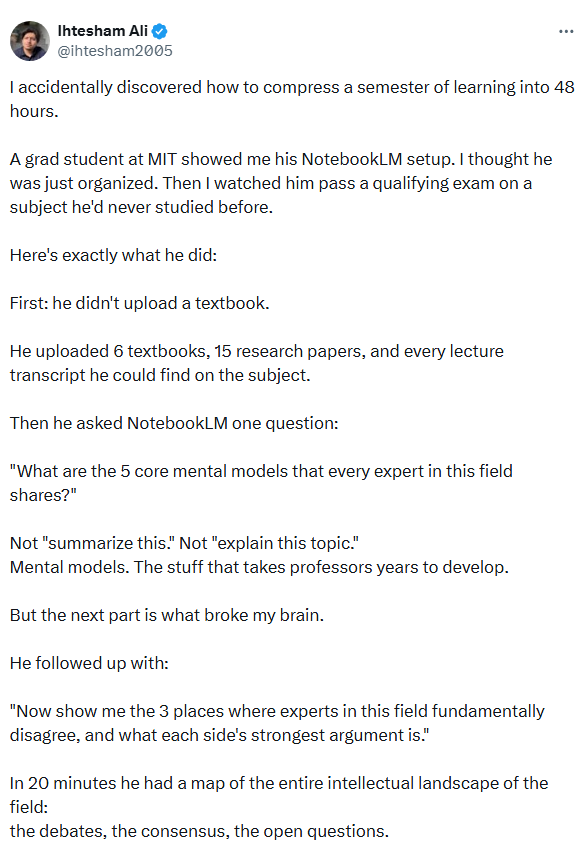
Recently, I came across an intriguing post describing how a graduate student used Google’s NotebookLM to absorb a new subject in roughly 48 hours. Rather than asking the AI to summarize a textbook, he uploaded an entire collection of learning materials—textbooks, research papers, and lecture transcripts—and used the system as an intellectual sparring partner. The key insight was surprisingly simple: the quality of the questions mattered far more than the quantity of information.
Moving Beyond Summaries
Many people approach AI tools as enhanced search engines or automatic note-takers. While useful, that approach often remains passive. The method described in the post takes a different path.
Instead of asking:
“Summarize this topic.”
The student asked:
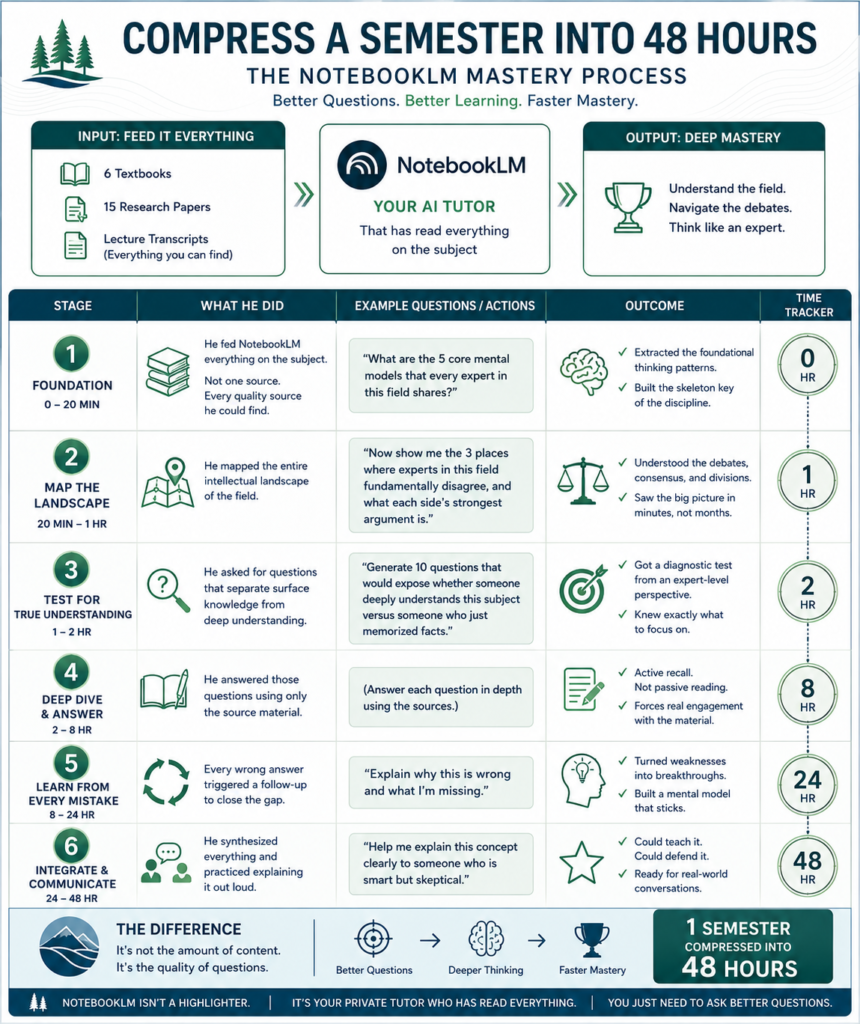
“What are the core mental models shared by experts in this field?”
This shifts the focus from collecting facts to understanding the underlying frameworks that organize those facts. In other words, the goal is not merely to know what experts know, but to understand how they think.
Mapping the Intellectual Landscape
The next step was equally powerful.
Rather than seeking consensus, the student asked where experts disagree and what arguments support each side. This quickly revealed the major debates, assumptions, and unresolved questions within the discipline.
For learners, this is often a missing piece. Traditional study methods present information as settled knowledge, while real-world expertise often exists in areas of uncertainty, competing models, and ongoing discussion. AI can help expose that landscape in minutes rather than months.
Testing for Real Understanding
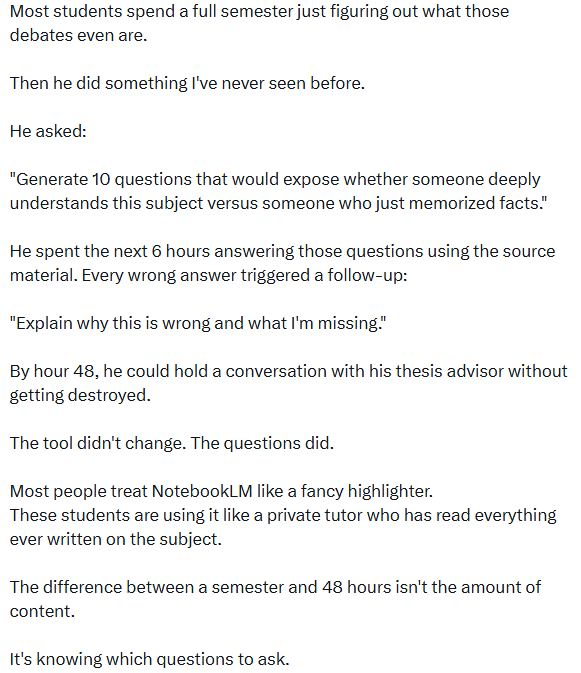
Perhaps the most valuable stage involved generating questions designed to separate genuine understanding from simple memorization.
Questions such as:
- What assumptions does this theory rely upon?
- Under what conditions would this model fail?
- How would you explain this concept to a beginner?
- What evidence would challenge this conclusion?
By attempting to answer these questions using the original source material, the learner engages in active recall rather than passive review. Each mistake becomes a diagnostic tool pointing directly toward a knowledge gap.
The Real Lesson
The most interesting takeaway is not NotebookLM itself.
The same principle could be applied using ChatGPT, Claude, Gemini, or even a study group.
The true lesson is that AI is most powerful when used as a thinking partner, not a content generator.
Used poorly, AI becomes a shortcut that bypasses learning.
Used thoughtfully, it becomes a tutor that continuously challenges assumptions, exposes blind spots, and accelerates the construction of mental models.
A Practical Experiment
The next time you study a new topic, try this workflow:
- Gather multiple high-quality sources.
- Ask AI to identify the key mental models.
- Ask where experts disagree.
- Generate questions that reveal deep understanding.
- Attempt to answer using the source material.
- Ask AI to critique your reasoning and identify gaps.
- Explain the concept in your own words.
If you can teach it clearly, you probably understand it.
If you cannot, you’ve just discovered where to continue learning.
In that sense, AI does not replace education—it amplifies curiosity. And for lifelong learners, that may be its most valuable contribution.
— Linden Lake
Leave a Reply